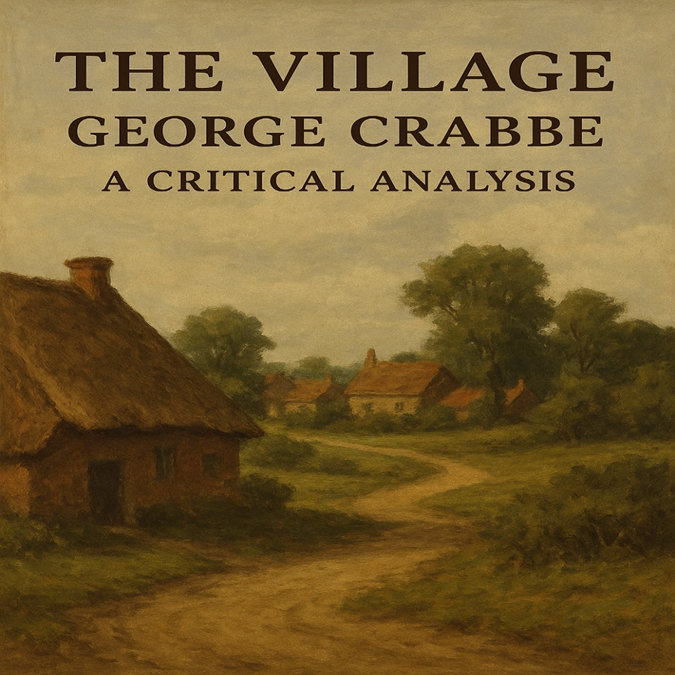
Introduction: “The Village” by George Crabbe
“The Village” by George Crabbe first appeared in May 1783, published in London as The Village; a poem, in two books (J. Dodsley), and it quickly distinguished itself by rejecting the “flattering dream” of pastoral convention in favor of a rigorously anti-idyll, social-realist portrait of rural hardship. From its opening claim that the “real picture of the poor / Demands a song—the Muse can give no more,” Crabbe frames village life not as decorative scenery but as a moral and economic problem—labor that consumes youth and then leaves “Age, in its hour of languor” with little security—while he explicitly critiques the literary fashion for “tender strain” in which “fond Corydons complain” about pains they “never feel,” and insists, instead, “I paint the cot, / As truth will paint it, and as bards will not.” The poem’s main ideas, as evidenced in the excerpt, include (i) a sustained exposure of structural rural deprivation (heat, exhaustion, and intergenerational vulnerability: “Can poets soothe you, when you pine for bread”), (ii) the erosion of communal recreation into desperation and petty criminality (“Where now are these?”), and (iii) institutional failure surrounding the parish poor—embodied in the bleak workhouse infirmary, the contemptuous “potent quack,” and the spiritually negligent cleric—culminating in the indignity of a poor man’s burial “unblessed.” Its popularity with readers and critics in 1783 is typically attributed to precisely this originality and moral force: Crabbe’s refusal to sentimentalize the countryside gave the period an urgently “needed” corrective to idealized rural verse, and contemporary testimony records Samuel Johnson’s admiration for the poem as “original, vigorous, and elegant.”
Text: “The Village” by George Crabbe
The village life, and every care that reigns
O’er youthful peasants and declining swains;
What labour yields, and what, that labour past,
Age, in its hour of languor, finds at last;
What forms the real picture of the poor,
Demands a song—the Muse can give no more.
Fled are those times, if e’er such times were seen,
When rustic poets praised their native green;
No shepherds now, in smooth alternate verse,
Their country’s beauty or their nymphs’ rehearse;
Yet still for these we frame the tender strain,
Still in our lays fond Corydons complain,
And shepherds’ boys their amorous pains reveal,
The only pains, alas! they never feel.
On Mincio’s banks, in Caesar’s bounteous reign,
If Tityrus found the Golden Age again,
Must sleepy bards the flattering dream prolong,
Mechanic echoes of the Mantuan song?
From truth and nature shall we widely stray,
Where Virgil, not where Fancy, leads the way?
Yes, thus the Muses sing of happy swains,
Because the Muses never knew their pains.
They boast their peasants’ pipes, but peasants now
Resign their pipes and plod behind the plough;
And few amid the rural tribe have time
To number syllables and play with rhyme;
Save honest Duck, what son of verse could share
The poet’s rapture and the peasant’s care?
Or the great labours of the field degrade
With the new peril of a poorer trade?
From one chief cause these idle praises spring,
That themes so easy few forbear to sing;
They ask no thought, require no deep design,
But swell the song and liquefy the line;
The gentle lover takes the rural strain,
A nymph his mistress and himself a swain;
With no sad scenes he clouds his tuneful prayer,
But all, to look like her, is painted fair.
I grant indeed that fields and flocks have charms
For him that gazes or for him that farms;
But when amid such pleasing scenes I trace
The poor laborious natives of the place,
And see the mid-day sun, with fervid ray,
On their bare heads and dewy temples play;
While some, with feebler heads and fainter hearts,
Deplore their fortune, yet sustain their parts:
Then shall I dare these real ills to hide
In tinsel trappings of poetic pride?
No, cast by Fortune on a frowning coast,
Which can no groves nor happy valleys boast;
Where other cares than those the Muse relates,
And other shepherds dwell with other mates;
By such examples taught, I paint the cot,
As truth will paint it, and as bards will not:
Nor you, ye poor, of lettered scorn complain,
To you the smoothest song is smooth in vain;
O’ercome by labour and bowed down by time,
Feel you the barren flattery of a rhyme?
Can poets soothe you, when you pine for bread,
By winding myrtles round your ruined shed?
Can their light tales your weighty griefs o’erpower,
Or glad with airy mirth the toilsome hour?
Lo! where the heath, with withering brake grown o’er,
Lends the light turf that warms the neighboring poor;
From thence a length of burning sand appears,
Where the thin harvest waves its withered ears;
Rank weeds, that every art and care defy,
Reign o’er the land and rob the blighted rye:
There thistles stretch their prickly arms afar,
And to the ragged infant threaten war;
There poppies, nodding, mock the hope of toil,
There the blue bugloss paints the sterile soil;
Hardy and high, above the slender sheaf,
The slimy mallow waves her silky leaf;
O’er the young shoot the charlock throws a shade,
And the wild tare clings round the sickly blade;
With mingled tints the rocky coasts abound,
And a sad splendor vainly shines around.
So looks the nymph whom wretched arts adorn,
Betrayed by man, then left for man to scorn;
Whose cheek in vain assumes the mimic rose
While her sad eyes the troubled breast disclose;
Whose outward splendour is but folly’s dress,
Exposing most, when most it gilds distress.
Here joyless roam a wild amphibious race,
With sullen woe displayed in every face;
Who far from civil arts and social fly,
And scowl at strangers with suspicious eye.
Here too the lawless merchant of the main
Draws from his plough th’ intoxicated swain;
Want only claimed the labor of the day,
But vice now steals his nightly rest away.
Where are the swains, who, daily labor done,
With rural games played down the setting sun;
Who struck with matchless force the bounding ball,
Or made the pond’rous quoit obliquely fall;
While some huge Ajax, terrible and strong,
Engaged some artful stripling of the throng,
And, foiled, beneath the young Ulysses fell,
When peals of praise the merry mischief tell?
Where now are these?—Beneath yon cliff they stand,
To show the freighted pinnace where to land;
To load the ready steed with guilty haste;
To fly in terror o’er the pathless waste,
Or, when detected in their straggling course,
To foil their foes by cunning or by force;
Or, yielding part (when equal knaves contest),
To gain a lawless passport for the rest.
Here, wand’ring long amid these frowning fields,
I sought the simple life that Nature yields;
Rapine and Wrong and Fear usurped her place,
And a bold, artful, surly, savage race;
Who, only skilled to take the finny tribe,
The yearly dinner, or septennial bribe
Wait on the shore and, as the waves run high,
On the tossed vessel bend their eager eye,
Which to their coast directs its vent’rous way,
Theirs, or the ocean’s, miserable prey.
As on their neighbouring beach yon swallows stand,
And wait for favoring winds to leave the land;
While still for flight the ready wing is spread:
So waited I the favouring hour, and fled;
Fled from these shores where guilt and famine reign,
And cried, Ah! hapless they who still remain;
Who still remain to hear the ocean roar,
Whose greedy waves devour the lessening shore;
Till some fierce tide, with more imperious sway,
Sweeps the low hut and all it holds away;
When the sad tenant weeps from door to door,
And begs a poor protection from the poor!
But these are scenes where Nature’s niggard hand
Gave a spare portion to the famished land;
Hers is the fault, if here mankind complain
Of fruitless toil and labor spent in vain;
But yet in other scenes, more fair in view,
Where Plenty smiles—alas! she smiles for few
And those who taste not, yet behold her store,
Are as the slaves that dig the golden ore,
The wealth around them makes them doubly poor.
Or will you deem them amply paid in health,
Labor’s fair child, that languishes with wealth?
Go then! and see them rising with the sun,
Through a long course of daily toil to run;
Like him to make the plenteous harvest grow,
And yet not shard the plenty they bestow;
See them beneath the dog-star’s raging heat,
When the knees tremble and the temples beat;
Behold them, leaning on their scythes, look o’er
The labour past, and toils to come explore;
See them alternate suns and showers engage,
And hoard up aches and anguish for their age;
Through fens and marshy moors their steps pursue,
When their warm pores imbibe the evening dew;
Then own that labour may as fatal be
To these thy slaves, as luxury to thee.
Amid this tribe too oft a manly pride
Strives in strong toil the fainting heart to hide;
There may you see the youth of slender frame
Contend with weakness, weariness, and shame:
Yet urged along, and proudly loth to yield,
He strives to join his fellows of the field;
Till long-contending nature droops at last,
Declining health rejects his poor repast,
His cheerless spouse the coming danger sees,
And mutual murmurs urge the slow disease.
Yet grant them health, ’tis not for us to tell,
Though the head droops not, that the heart is well;
Or will you urge their homely, plenteous fare,
Healthy and plain and still the poor man’s share!
Oh! trifle not with wants you cannot feel,
Nor mock the misery of a stinted meal;
Homely not wholesome, plain not plenteous, such
As you who envy would disdain to touch.
Ye gentle souls, who dream of rural ease,
Whom the smooth stream and smoother sonnet please;
Go! if the peaceful cot your praises share,
Go, look within, and ask if peace be there:
If peace be his—that drooping weary sire,
Or theirs, that offspring round their feeble fire,
Or hers, that matron pale, whose trembling hand
Turns on the wretched hearth th’ expiring brand.
Nor yet can time itself obtain for these
Life’s latest comforts, due respect and ease;
For yonder see that hoary swain, whose age
Can with no cares except his own engage;
Who, propped on that rude staff, looks up to see
The bare arms broken from the withering tree,
On which, a boy, he climbed the loftiest bough,
Then his first joy, but his sad emblem now.
He once was chief in all the rustic trade,
His steady hand the straightest furrow made;
Full many a prize he won, and still is proud
To find the triumphs of his youth allowed.
A transient pleasure sparkles in his eyes,
He hears and smiles, then thinks again and sighs:
For now he journeys to his grave in pain;
The rich disdain him, nay, the poor disdain;
Alternate masters now their slave command,
And urge the efforts of his feeble hand;
Who, when his age attempts its task in vain,
With ruthless taunts of lazy poor complain.
Oft may you see him, when he tends the sheep,
His winter-charge, beneath the hillock weep;
Oft hear him murmur to the winds that blow
O’er his white locks and bury them in snow;
When, roused by rage and muttering in the morn,
He mends the broken hedge with icy thorn:
“Why do I live, when I desire to be
At once from life and life’s long labour free?
Like leaves in spring, the young are blown away,
Without the sorrows of a slow decay;
I, like yon withered leaf, remain behind,
Nipped by the frost, and shivering in the wind;
There it abides till younger buds come on,
As I, now all my fellow-swains are gone;
Then, from the rising generation thrust,
It falls, like me, unnoticed to the dust.
“These fruitful fields, these numerous flocks I see,
Are others’ gain, but killing cares to me;
To me the children of my youth are lords,
Slow in their gifts but hasty in their words:
Wants of their own demand their care, and who
Feels his own want and succors others too?
A lonely, wretched man, in pain I go,
None need my help and none relieve my woe;
Then let my bones beneath the turf be laid,
And men forget the wretch they would not aid.”
Thus groan the old, till, by disease oppressed,
They taste a final woe, and then they rest.
Theirs is yon house that holds the parish poor,
Whose walls of mud scarce bear the broken door;
There, where the putrid vapours, flagging, play,
And the dull wheel hums doleful through the day;
There children dwell, who know no parents’ care,
Parents, who know no children’s love, dwell there;
Heart-broken matrons on their joyless bed,
Forsaken wives, and mothers never wed;
Dejected widows with unheeded tears,
And crippled age with more than childhood-fears;
The lame, the blind, and, far the happiest they!
The moping idiot and the madman gay.
Here too the sick their final doom receive,
Here brought, amid the scenes of grief, to grieve,
Where the loud groans from some sad chamber flow,
Mixed with the clamors of the crowd below;
Here, sorrowing, they each kindred sorrow scan,
And the cold charities of man to man:
Whose laws indeed for ruined age provide,
And strong compulsion plucks the scrap from pride;
But still that scrap is bought with many a sigh,
And pride embitters what it can’t deny.
Say ye, oppressed by some fantastic woes,
Some jarring nerve that baffles your repose;
Who press the downy couch, while slaves advance
With timid eye to read the distant glance;
Who with sad prayers the weary doctor tease
To name the nameless ever-new disease;
Who with mock patience dire complaints endure,
Which real pain, and that alone, can cure;
How would ye bear in real pain to lie,
Despised, neglected, left alone to die?
How would ye bear to draw your latest breath,
Where all that’s wretched paves the way for death?
Such is that room which one rude beam divides,
And naked rafters form the sloping sides;
Where the vile bands that bind the thatch are seen,
And lath and mud is all that lie between;
Save one dull pane, that, coarsely patched, gives way
To the rude tempest, yet excludes the day.
Here, on a matted flock, with dust o’erspread,
The drooping wretch reclines his languid head;
For him no hand the cordial cup applies,
Nor wipes the tear that stagnates in his eyes;
No friends with soft discourse his pain beguile,
Nor promise hope till sickness wears a smile.
But soon a loud and hasty summons calls,
Shakes the thin roof, and echoes round the walls.
Anon, a figure enters, quaintly neat,
All pride and business, bustle and conceit;
With looks unaltered by these scenes of woe,
With speed that, entering, speaks his haste to go,
He bids the gazing throng around him fly,
And carries fate and physic in his eye;
A potent quack, long versed in human ills,
Who first insults the victim whom he kills;
Whose murd’rous hand a drowsy bench protect,
And whose most tender mercy is neglect.
Paid by the parish for attendance here,
He wears contempt upon his sapient sneer;
In haste he seeks the bed where misery lies,
Impatience marked in his averted eyes;
And, some habitual queries hurried o’er,
Without reply, he rushes on the door:
His drooping patient, long inured to pain,
And long unheeded, knows remonstrance vain;
He ceases now the feeble help to crave
Of man, and mutely hastens to the grave.
But ere his death some pious doubts arise,
Some simple fears, which “bold bad” men despise;
Fain would he ask the parish priest to prove
His title certain to the joys above;
For this he sends the murmuring nurse, who calls
The holy stranger to these dismal walls;
And doth not he, the pious man, appear,
He, “passing rich with forty pounds a year”?
Ah! no; a shepherd of a different stock,
And far unlike him, feeds this little flock:
A jovial youth, who thinks his Sunday’s task
As much as God or man can fairly ask;
The rest he gives to loves and labors light,
To fields the morning and to feasts the night;
None better skilled the noisy pack to guide,
To urge their chase, to cheer them or to chide;
Sure in his shot, his game he seldom missed,
And seldom failed to win his game at whist;
Then, while such honors bloom around his head,
Shall he sit sadly by the sick man’s bed
To raise the hope he feels not, or with zeal
To combat fears that ev’n the pious feel
Now once again the gloomy scene explore,
Less gloomy now; the bitter hour is o’er,
The man of many sorrows sighs no more.
Up yonder hill, behold how sadly slow
The bier moves winding from the vale below;
There lie the happy dead, from trouble free,
And the glad parish pays the frugal fee.
No more, oh Death! thy victim starts to hear
Churchwarden stern, or kingly overseer;
No more the farmer gets his humble bow,
Thou art his lord, the best of tyrants thou!
Now to the church behold the mourners come,
Sedately torpid and devoutly dumb;
The village children now their games suspend,
To see the bier that bears their ancient friend:
For he was one in all their idle sport,
And like a monarch ruled their little court;
The pliant bow he formed, the flying ball,
The bat, the wicket, were his labours all;
Him now they follow to his grave, and stand
Silent and sad, and gazing, hand in hand;
While bending low, their eager eyes explore
The mingled relics of the parish poor.
The bell tolls late, the moping owl flies round,
Fear marks the flight and magnifies the sound;
The busy priest, detained by weightier care,
Defers his duty till the day of prayer;
And, waiting long, the crowd retire distressed,
To think a poor man’s bones should lie unblessed.
Source: The Longman Anthology of Poetry (2006)
Annotations: “The Village” by George Crabbe
| Line(s) from “Crabbe” | Annotation | Literary Devices |
| 1–2 “The village life…reigns / O’er youthful peasants and declining swains;” | Announces the subject: rural existence across the life-cycle (youth to old age). “Swains” evokes pastoral tradition, but the intent is social realism rather than idyll. | ⚫ Diction/Tone • 🟥 Contrast (youth/decline) • 🟠 Pastoral convention (allusive register) |
| 3–4 “What labour yields…labour past… / Age…finds at last;” | Frames a moral-economy: work produces little security; old age receives “languor,” not comfort. The couplet syntax mimics ledger-like accounting. | ⚫ Diction/Tone • 🟥 Contrast (work vs. reward) • 🟫 Sound (balanced parallel phrasing) |
| 5–6 “What forms the real picture of the poor… / Demands a song—the Muse can give no more.” | Program statement: poetry must depict poverty truthfully, yet art has limits (“can give no more”). The dash marks sober restraint rather than ornament. | 🟥 Contrast (real vs. poetic) • 🔵 Metaphor (poetry as “song”) • 🟣 Personification (Muse) • ⚫ Diction/Tone |
| 7–8 “Fled are those times… / When rustic poets praised their native green;” | Rejects nostalgic pastoral as an illusion of “olden times,” possibly never real (“if e’er”). The poem positions itself against sentimental rural celebration. | 🔴 Irony/Satire • 🟥 Contrast (past idyll vs. present) • ⚫ Diction/Tone |
| 9–10 “No shepherds now, in smooth alternate verse, / Their country’s beauty…rehearse;” | Attacks the artificial “smooth” pastoral mode (stylized alternation), implying it is literary fabrication rather than lived rural speech. | 🔴 Satire • ⚫ Diction/Tone • 🟥 Contrast (artifice vs. reality) |
| 11–12 “Yet still…tender strain… / Still…fond Corydons complain,” | Concedes that poets still manufacture pastoral laments (stock “Corydon” figure), despite knowing they are conventional. | 🟠 Allusion (Corydon/pastoral tradition) • 🔴 Irony • ⚫ Diction/Tone |
| 13–14 “And shepherds’ boys…amor-ous pains reveal, / The only pains…they never feel.” | Core satiric thrust: pastoral love-pains are fake; real pain is economic and bodily. The “alas!” sharpens moral indignation. | 🔴 Irony/Satire • 🟥 Antithesis (real vs. invented pain) • ⚫ Diction/Tone |
| 15–16 “On Mincio’s banks…Caesar’s…reign… / If Tityrus found the Golden Age again,” | Invokes Virgil’s Eclogues: Mincio (Mantua region), Tityrus, “Golden Age.” Used to critique imitation of classical pastoral as political flattery/dream. | 🟠 Allusion (Virgil/Tityrus/Golden Age) • ⚫ Diction/Tone |
| 17–18 “Must sleepy bards…dream prolong, / Mechanic echoes of the Mantuan song?” | Condemns derivative poets as “mechanic echoes”—unthinking imitators of Virgil. “Sleepy” implies moral and intellectual laziness. | 🟩 Rhetorical Question • 🔴 Satire • 🔵 Metaphor (echo/automation) • ⚫ Diction/Tone |
| 19–20 “From truth and nature…widely stray… / Where Virgil, not where Fancy, leads the way?” | Challenges poets who claim “nature” but actually follow fantasy. Even Virgil is invoked as a better guide than mere invention—but Crabbe will go further into social truth. | 🟩 Rhetorical Question • 🟥 Contrast (Truth/Nature vs Fancy) • 🟠 Allusion (Virgil) |
| 21–22 “Yes, thus the Muses sing… / Because the Muses never knew their pains.” | Bitter explanation: privileged art sings “happy swains” because the poets are insulated from peasant suffering. | 🔴 Irony • 🟣 Personification (Muses) • 🟥 Contrast (song vs suffering) |
| 23–24 “They boast their peasants’ pipes… / Resign their pipes and plod behind the plough;” | Replaces pastoral music with agricultural drudgery. “Plod” enacts heaviness; “pipes” becomes a symbol of lost leisure/voice. | 🟤 Symbol (pipes) • 🟥 Contrast (pipes/plough) • 🟡 Imagery • ⚫ Diction/Tone |
| 25–26 “And few…have time / To number syllables and play with rhyme;” | Suggests poetic craft is a luxury unavailable to laborers; indicts the class distance between literary production and rural toil. | ⚫ Diction/Tone • 🔴 Social satire • 🟥 Contrast (craft vs survival) |
| 27–28 “Save honest Duck…could share / The poet’s rapture and the peasant’s care?” | References Stephen Duck (laboring-class poet). The question underscores rarity: one cannot easily be both poet and peasant under harsh conditions. | 🟠 Allusion (Stephen Duck) • 🟩 Rhetorical Question • 🟥 Contrast |
| 29–30 “Or the great labours…degrade / With the new peril of a poorer trade?” | Notes that labor already burdens life; adding literary ambition is risky and economically “poorer.” Also hints at the market’s contempt for rustic art. | 🟩 Rhetorical Question • ⚫ Diction/Tone • 🟥 Contrast |
| 31–32 “From one chief cause these idle praises spring… / That themes so easy few forbear to sing;” | Diagnoses pastoral as “easy theme”: it flatters, sells, and costs little thought—hence its popularity. | 🔴 Satire • ⚫ Diction/Tone |
| 33–34 “They ask no thought… / But swell the song and liquefy the line;” | Attacks ornamental style as empty musicality. “Liquefy” suggests over-softening, loss of moral firmness. | 🔵 Metaphor (liquefy the line) • 🔴 Satire • ⚫ Diction/Tone |
| 35–36 “The gentle lover… / A nymph…himself a swain;” | Shows how pastoral lets a lover role-play simplicity, converting rural life into costume romance (“nymph,” “swain”). | 🟠 Pastoral allusion • 🔴 Irony • ⚫ Diction/Tone |
| 37–38 “With no sad scenes… / But all…painted fair.” | Condemns selective representation—beautifying everything by aesthetic “painting,” which becomes ethical concealment. | 🟡 Imagery (painting) • 🔵 Metaphor (art as paint) • 🟥 Contrast (fair vs real) |
| 39–40 “I grant…fields and flocks have charms… / For him that gazes or for him that farms;” | Balanced concession: countryside can be lovely to spectators and even farmers—but this sets up the pivot to laborers’ suffering. | 🟥 Antithesis (gazes/farms) • ⚫ Diction/Tone |
| 41–42 “But when… I trace / The poor laborious natives…” | The speaker’s method: close observation (“trace”) of the poor as the true subject; announces realist/ethical gaze. | ⚫ Diction/Tone • 🟡 Imagery (trace) |
| 43–44 “And see the mid-day sun… / On their bare heads and dewy temples play;” | Vivid bodily realism: exposure, sweat, heat. “Play” is ironic—sunlight “plays” while people suffer. | 🟡 Imagery • 🟣 Personification (sun “play”) • 🔴 Irony |
| 45–46 “While some…feebler heads… / Deplore their fortune, yet sustain their parts:” | Poverty produces quiet endurance; “sustain their parts” suggests life as forced performance under necessity. | 🔵 Metaphor (life as role/parts) • ⚫ Diction/Tone |
| 47–48 “Then shall I dare these real ills to hide / In tinsel trappings…?” | Ethical refusal: decorative poetry (“tinsel trappings”) would be moral fraud. | 🟩 Rhetorical Question • 🔵 Metaphor (tinsel/trappings) • 🔴 Satire |
| 49–50 “No, cast by Fortune on a frowning coast… / Which can no groves…boast;” | Scene shift to harsh coastal poverty. “Fortune” personified as disposer of lives; “frowning coast” sets bleak mood. | 🟣 Personification (Fortune/coast) • 🟡 Imagery • ⚫ Tone |
| 51–52 “Where other cares…Muse relates… / And other shepherds dwell with other mates;” | Rural life here is not pastoral; “shepherds” are different—suggesting smugglers, fishers, or desperate laborers rather than idyllic herdsmen. | 🟥 Contrast (pastoral vs actual) • ⚫ Diction/Tone |
| 53–54 “By such examples taught, I paint the cot… / As truth will paint it, and as bards will not:” | Reasserts realist aesthetics: truth as painter; poets as evasive. The “cot” becomes emblem of material deprivation. | 🟡 Imagery • 🔵 Metaphor (truth painting) • 🔴 Satire |
| 55–56 “Nor you, ye poor, of lettered scorn complain… / To you the smoothest song is smooth in vain;” | Direct address to the poor; argues that refined poetry cannot materially help them—art’s consolation is limited without justice/bread. | 🟦 Apostrophe • 🟥 Contrast (smooth song vs need) • ⚫ Tone |
| 57–58 “O’ercome by labour… / Feel you the barren flattery of a rhyme?” | Poetry without reform is “barren.” The line frames aesthetic pleasure as useless when bodies are exhausted. | 🟩 Rhetorical Question • 🔵 Metaphor (barren flattery) • ⚫ Tone |
Literary And Poetic Devices: “The Village” by George Crabbe
| Device (A–Z) | Example from “The Village” | Explanation (includes definition) |
| 🔴 Alliteration | “bowed down by time” | Definition: repetition of initial consonant sounds. Here: the repeated b compresses the rhythm, echoing physical strain and fatigue. |
| 🟠 Allusion | “On Mincio’s banks… Tityrus… the Mantuan song” | Definition: a reference to a known text/person/place. Here: Crabbe invokes Virgil’s pastoral tradition to expose how later poets romanticize rural life. |
| 🟡 Anaphora | “Can poets soothe you… Can their light tales…” | Definition: repetition at the start of successive clauses. Here: the repeated “Can” becomes a moral interrogation, stressing poetry’s limits against hunger. |
| 🟢 Antithesis | “Where Plenty smiles—alas! she smiles for few” | Definition: sharply contrasting ideas set side-by-side. Here: abundance exists, but its benefits are restricted—inequality becomes the point. |
| 🔵 Apostrophe | “Ye gentle souls, who dream of rural ease” | Definition: direct address to a person/group/abstraction. Here: Crabbe confronts comfortable readers and dismantles their “rural ease” fantasy. |
| 🟣 Assonance | “paint the cot / As truth will paint it” | Definition: repetition of vowel sounds in nearby words. Here: the echoing vowels smooth the cadence while emphasizing truthfulness as method. |
| 🟤 Caesura | “Fled are those times, — if e’er such times were seen,” | Definition: a strong mid-line pause. Here: the break interrupts nostalgia and signals doubt about the “golden” rural past. |
| ⚫ Enjambment | “What labour yields, and what, that labour past, / Age… finds at last;” | Definition: a sentence continues across line breaks. Here: the forward-driving syntax mimics unending toil and delayed reward. |
| 🟥 Hyperbole | “Thou art his lord, the best of tyrants thou!” | Definition: deliberate exaggeration for emphasis. Here: calling Death a “tyrant” heightens the bleak idea that only death ends oppression. |
| 🟧 Imagery | “mid-day sun… on their bare heads and dewy temples” | Definition: vivid sensory description. Here: heat, sweat, and exposure make labor bodily real—anti-pastoral and unsentimental. |
| 🟨 Irony | Pastoral “painted fair” vs. “pine for bread” | Definition: contrast between appearance/expectation and reality. Here: the poem exposes the cruelty of pretty rural verse beside actual deprivation. |
| 🟩 Metaphor | “tinsel trappings of poetic pride” | Definition: direct comparison without “like/as.” Here: idealized pastoral becomes cheap “tinsel,” masking real suffering with ornament. |
| 🟦 Metonymy | “Paid by the parish… the parish priest” | Definition: substituting an associated term for a larger system. Here: “parish” stands for local institutions—authority that should help but appears neglectful. |
| 🟪 Onomatopoeia | “the dull wheel hums doleful through the day” | Definition: a word imitates a sound. Here: “hums” sustains monotony, turning the workhouse into an audible symbol of grinding hardship. |
| 🟫 Oxymoron | “the moping idiot and the madman gay” | Definition: pairing of apparent opposites. Here: the clash unsettles and shows how “cheer” in misery can be distorted or tragic. |
| ⬛ Paradox | “the wealth around them makes them doubly poor” | Definition: an apparent contradiction that reveals a truth. Here: seeing abundance without access intensifies deprivation and humiliation. |
| 🟥⬛ Personification | “Rapine and Wrong and Fear usurped her place” | Definition: giving human actions/traits to abstractions. Here: crime and fear become political forces “ruling” the landscape, dramatizing social collapse. |
| 🟧⬛ Rhetorical Question | “How would ye bear… left alone to die?” | Definition: a question posed to provoke thought, not an answer. Here: it compels the privileged reader to imagine the poor man’s abandonment. |
| 🟨⬛ Simile | “Like leaves in spring, the young are blown away” | Definition: comparison using “like/as.” Here: seasonal imagery naturalizes early death and emphasizes how quickly youth disappears. |
| 🟩⬛ Symbolism | “one dull pane… excludes the day”; “The bell tolls late” | Definition: objects/actions representing larger ideas. Here: the patched pane signals exclusion/neglect; the late bell and unblessed burial embody institutional indifference. |
Themes: “The Village” by George Crabbe
🔴 Pastoral Illusion vs. Social Realism
“The Village” by George Crabbe dismantles the inherited pastoral convention that treats rural life as a decorative refuge of “happy swains,” and it replaces that flattering literary dream with a disciplined realism anchored in bodily fatigue, economic precarity, and moral indignation. Crabbe repeatedly exposes how smooth verse and stock figures (Corydons, nymphs, pipes, and “Golden Age” reminiscences) function less as truthful representation than as aesthetic anesthesia, because they permit “sleepy bards” to prolong an agreeable fiction while remaining insulated from the pains they describe. By insisting that he will “paint the cot” as “truth will paint it,” the speaker converts poetry into an ethical instrument rather than an ornamental pastime, and he implicitly indicts a culture in which the poor are made picturesque precisely when they are most deprived. In this way, the poem becomes a critique of genre itself, showing how pastoral’s sweetness is purchased through exclusion, misrecognition, and the systematic concealment of rural suffering.
🟡 Labour, Bodily Exposure, and the Economy of Survival
“The Village” by George Crabbe foregrounds labour not as a noble abstraction but as a daily regime that consumes the body and narrows the horizons of thought, so that even the possibility of “number[ing] syllables and play[ing] with rhyme” appears as a luxury incompatible with subsistence. The poem’s imagery presses close to the material surface of rural existence—bare heads under the “fervid ray,” “dewy temples,” trembling knees, aching age—so that the reader experiences work as an accumulation of wear rather than a sentimental virtue. Yet Crabbe’s emphasis is not merely physiological; he presents labour as an economic structure in which the worker generates plenty without sharing it, and where the promised compensation of “health” proves unstable, because toil itself can be “fatal.” Consequently, the poem links bodily exhaustion to systemic inequity, suggesting that the rural poor are trapped in a cycle where effort produces wealth for others, while their own lives are organized around shortage, delayed reward, and the long bookkeeping of pain.
🟣 Nature as Harsh Setting, Moral Mirror, and Symbolic Landscape
“The Village” by George Crabbe treats nature not as a benevolent pastoral backdrop but as a severe environment that can intensify deprivation, and it repeatedly personifies landscape to register how place shapes social life. The “frowning coast,” the heath overrun with “withering brake,” and the “burning sand” where thin harvests wave their “withered ears” create an ecology of scarcity, in which weeds “reign” and the soil seems to resist improvement, thereby making hunger feel both immediate and structural. At the same time, Crabbe uses the landscape as a moral mirror: the sad splendor that “vainly shines around” parallels forms of outward ornament that conceal inward distress, so that natural description becomes a vehicle for social commentary rather than scenic pleasure. By refusing to romanticize the rural environment, the poem suggests that beauty and barrenness coexist, yet their meaning is politically distributed; what looks picturesque to the spectator may be punishing to those whose lives are bound to that ground.
⚫ Institutional Poverty, Social Neglect, and the Critique of “Charity”
“The Village” by George Crabbe extends its realism into the social institutions that manage poverty, showing how the parish poorhouse and its routines can become mechanisms of humiliation rather than humane care, especially when the suffering body is handled with haste, contempt, or bureaucratic indifference. The poem’s portraits of the aged labourer, the sick confined to a miserable room, and the “cold charities of man to man” build a critique in which neglect is not accidental but normalized, because the poor are compelled to accept scraps at the cost of pride, while authority postpones attention and converts need into a moral failing. Even figures who should provide relief—the medical attendant who rushes, the cleric who is absent or worldly—appear as symptoms of a wider ethical failure, where responsibility is diluted and empathy is outsourced. Through this sustained exposure, Crabbe implies that a society may congratulate itself on provision while still producing unnecessary suffering, because it treats poverty as a nuisance to be administered rather than an injustice to be remedied.
Literary Theories and “The Village” by George Crabbe
| Literary theory | How it applies to “The Village” by George Crabbe | References from the poem (quoted/paraphrased from your excerpt) |
| 🟥 Marxist Criticism 🟥 | Reads the poem as an anatomy of class power, labour exploitation, and ideological “cover stories” that beautify inequality; the rural worker produces “plenty” yet remains excluded from it, while institutions (parish relief, overseers) regulate poverty in ways that preserve hierarchy and discipline the poor. | “peasants…plod behind the plough”; “few…have time / To number syllables”; “Can poets soothe you, when you pine for bread”; “Paid by the parish…” (the quack’s contempt); “the wealth around them makes them doubly poor”; “Like him to make the plenteous harvest grow, / And yet not share the plenty they bestow”; “strong compulsion plucks the scrap from pride.” |
| 🔵 New Historicism 🔵 | Situates the poem in late-18th-century debates about rural poverty, parish systems, medical practice, and literary taste, showing how Crabbe contests the dominant “pastoral” discourse and offers a counter-representation shaped by social institutions, economic change, and moral rhetoric rather than timeless “nature.” | “Fled are those times… / When rustic poets praised”; “Mechanic echoes of the Mantuan song?”; “As truth will paint it, and as bards will not”; parish bureaucracy: “Churchwarden stern, or kingly overseer”; poorhouse/policy: “Whose laws indeed for ruined age provide… / strong compulsion…”; critique of clerical worldliness: “passing rich with forty pounds a year.” |
| 🟣 Ecocriticism 🟣 | Treats landscape as materially consequential rather than decorative: ecology (heath, burning sand, weeds, blight, “dog-star’s raging heat”) is linked to hunger, bodily depletion, and social vulnerability, while “natural” scarcity and human systems together produce environmental injustice for those tied to the land. | “frowning coast”; “heath…withering brake”; “burning sand…thin harvest…withered ears”; “Rank weeds…rob the blighted rye”; “blue bugloss paints the sterile soil”; “dog-star’s raging heat”; “warm pores imbibe the evening dew”; “ocean roar…greedy waves devour the lessening shore…sweeps the low hut…” |
| 🔴 Formalism / New Criticism 🔴 | Focuses on how meaning is built through structure and rhetoric: the heroic couplets’ balance, antithesis, and controlled cadence create an argumentative “moral ledger,” while irony and repeated rhetorical questions sharpen the poem’s critique of pastoral sweetness and expose the limits of poetic consolation. | Couplet-driven contrasts: “youthful…declining”; “labour yields…labour past”; “truth and nature… / …Fancy”; irony: “The only pains…they never feel”; “smoothest song is smooth in vain”; rhetorical questions: “Must sleepy bards…?” “From truth and nature shall we…?” “Can poets soothe you…?”; emblematic metaphors: “tinsel trappings,” “paint the cot,” “cold charities.” |
Critical Questions about “The Village” by George Crabbe
🔴 Critical Question 1: How does Crabbe dismantle the pastoral “golden age” myth, and what ethical claim does he make for poetry?
“The Village” by George Crabbe rejects the inherited pastoral script by staging it as a seductive falsehood and then systematically replacing it with an ethics of witness, so that “smooth alternate verse” and “tender strain” become not merely stylistic choices but moral evasions that conceal hunger, exhaustion, and structural precarity. By insisting that poets “never knew their pains,” Crabbe exposes the genre’s authority problem: the rural poor are spoken about, yet not truly spoken for, because the speaking voice is insulated from deprivation. Consequently, he converts poetic representation into a question of truthfulness under conditions of inequality, asking whether it is permissible to “hide” “real ills” in “tinsel trappings,” and concluding that such beautification is a form of complicity. The poem therefore reframes popularity and convention as suspect comforts, and it advances a counter-aesthetic in which plainness is not a failure of imagination but a disciplined refusal to flatter.
🟠 Critical Question 2: In what ways does the poem construct rural poverty as both bodily experience and social structure rather than personal misfortune?
“The Village” by George Crabbe presents poverty as a total condition in which the body is continuously inscribed by labor, climate, and time, even as institutions and property relations determine who benefits from “Plenty” and who merely “behold[s] her store,” so that deprivation appears less as a private tragedy than as a patterned outcome. Crabbe’s sensory detail—bare heads under a “fervid ray,” trembling knees beneath “dog-star’s raging heat,” warm pores drinking the evening dew—insists that want is physiological before it is philosophical, yet he binds those bodily costs to a social economy in which workers “make the plenteous harvest grow” and still “not share the plenty they bestow.” When he depicts pride forcing youth to “contend with weakness,” and age being pressed by “alternate masters,” he reveals how class power reproduces itself through supervision, discipline, and shame. Thus, the poem’s realism is structural: pain is distributed, normalized, and managed.
🟡 Critical Question 3: What role do institutions (parish relief, medicine, clergy) play in the poem, and how does Crabbe critique “charity”?
“The Village” by George Crabbe portrays institutional care as a set of cold procedures that convert necessity into humiliation, so that relief exists, yet it arrives as surveillance, contempt, and delay rather than consolation, thereby making “charity” feel like another instrument of domination. The parish house is rendered as a space where bodies are stored and sorted—widows, forsaken wives, crippled age, the sick—while the language of “laws” and “strong compulsion” suggests that assistance is extracted from society grudgingly, and then delivered in forms that intensify stigma. The “potent quack,” paid for attendance, embodies a bureaucratized medicine whose haste and sneer reduce the patient to an inconvenience, and the negligent “jovial youth” of a priest underscores how spiritual authority can become leisure, with pastoral duty displaced by sport and social pleasure. Crabbe’s critique is therefore not anti-help but anti-degradation: he condemns systems that keep the poor alive while refusing them dignity.
🟢 Critical Question 4: How does Crabbe use voice and address to implicate the reader, and what emotional response is the poem designed to produce?
“The Village” by George Crabbe repeatedly shifts from description to direct confrontation, so that the reader cannot remain a neutral spectator of “scenes” that might otherwise be consumed as picturesque suffering, and this rhetorical strategy turns empathy into accountability. When Crabbe addresses “Ye gentle souls” who “dream of rural ease,” and then follows with a battery of rhetorical questions—“Can poets soothe you…?” “How would ye bear…?”—he forces privileged comfort to measure itself against real deprivation, while the second-person pronoun collapses distance and denies the reader the refuge of abstraction. Yet the poem’s aim is not merely to shock; rather, it seeks a sustained moral unease, in which pity is complicated by recognition of complicity, and indignation is sharpened by specificity. Even the funeral scene, with its delayed bell and the fear of lying “unblessed,” is engineered to produce a lingering sense of social failure, because death becomes the final proof that neglect persists beyond life.
Literary Works Similar to “The Village” by George Crabbe
- 🔴 “The Deserted Village” by Oliver Goldsmith — Like Crabbe’s The Village, it uses rural setting to critique socio-economic change and hardship, though Goldsmith is more elegiac and nostalgic where Crabbe is more unflinchingly realist.
- 🟠 “Michael” by William Wordsworth — Similar in its serious, anti-sentimental attention to rural labor, family strain, and loss, presenting village life as moral experience shaped by economic pressure rather than pastoral ease.
- 🟡 “The Ruined Cottage” by William Wordsworth — Comparable for its sustained depiction of poverty’s slow devastation and the ethical demand it makes on the observer, emphasizing suffering as structural and enduring, not merely accidental.
- 🟢 “The Borough” by George Crabbe — Closest in method and tone: the same documentary realism and social critique, extending Crabbe’s focus from the countryside to a coastal town’s labor, vice, and institutional neglect.
Representative Quotations of “The Village” by George Crabbe
| Quotation | Context (what is happening in the poem at this point?) | Theoretical perspective + explanation (why it matters?) |
| 🔴🟥 “And shepherds’ boys their amorous pains reveal, / The only pains, alas! they never feel.” | Crabbe ridicules conventional pastoral poetry that substitutes romantic “pains” for the genuine suffering of rural labour. | Marxist / Ideology critique: pastoral love-laments function as false consciousness, aestheticizing rural life to conceal exploitation and material deprivation, thereby protecting elite comfort through pleasing representation. |
| 🔵🔴 “Must sleepy bards the flattering dream prolong, / Mechanic echoes of the Mantuan song?” | He attacks derivative poets who imitate Virgil’s pastoral and perpetuate a “flattering dream” about the countryside. | New Historicist / Discourse contestation: the poem positions itself against a dominant literary regime (classical-pastoral imitation) and exposes how genre conventions reproduce social myths rather than social truth. |
| 🟥🟡 “They boast their peasants’ pipes, but peasants now / Resign their pipes and plod behind the plough;” | Crabbe contrasts the idyllic emblem of leisure (pipes) with the reality of relentless farm work. | Marxist / Labour realism: the “pipe” becomes an ideological prop; the line insists on the primacy of labour relations and the disappearance of leisure for the rural poor under economic necessity. |
| 🟡🟣 “And see the mid-day sun, with fervid ray, / On their bare heads and dewy temples play;” | He turns from abstract claims to close observation of workers’ bodies under punishing heat. | Ecocritical / Embodied environment: nature is not a scenic backdrop but an active force shaping vulnerability; environmental exposure becomes a material index of inequality and suffering. |
| 🔴🟥 “Then shall I dare these real ills to hide / In tinsel trappings of poetic pride?” | The speaker refuses to beautify poverty through decorative, self-congratulatory verse. | Formalism (rhetorical ethics) + Marxist: the rhetorical question dramatizes moral accountability in representation; “tinsel” signals ideological ornament that disguises structural harm. |
| 🟦🟥 “Can poets soothe you, when you pine for bread, / By winding myrtles round your ruined shed?” | Direct address to the poor; he challenges the adequacy of poetic consolation against hunger and ruin. | Marxist / Materialist corrective: art without material change is powerless; the image of myrtles (beauty) around ruin exposes the gap between symbolic charity and real needs. |
| 🟣🟡 “Whose greedy waves devour the lessening shore;” | In the coastal scenes, the sea erodes land and threatens already-fragile dwellings and lives. | Ecocritical / Nature–poverty entanglement: environmental instability compounds social precarity; “greedy” personifies nature in terms that echo human appetite and economic predation. |
| 🟥 “And those who taste not, yet behold her store, / Are as the slaves that dig the golden ore,” | He depicts workers who see abundance but cannot access it, despite creating or sustaining it. | Marxist / Surplus & exclusion: an explicit analogy to slavery highlights alienation and dispossession; proximity to wealth intensifies poverty by sharpening awareness of denied goods. |
| 🔴⚫ “He carries fate and physic in his eye; / A potent quack, long versed in human ills,” | The poem portrays a rushed, contemptuous parish doctor whose “treatment” is indifference and harm. | New Historicist / Institutions & power: medical authority appears as social control rather than care, revealing how parish systems can administer poverty with coercion, stigma, and negligence. |
| ⚫🔴 “To think a poor man’s bones should lie unblessed.” | After death, the crowd waits; the priest delays, and the community feels the indignity of neglected rites. | New Historicist + Formalism: the line crystallizes how institutional delay extends class humiliation beyond life; formally, the stark diction (“bones,” “unblessed”) compresses moral outrage into a blunt terminal image. |
Suggested Readings: “The Village” by George Crabbe
Books
- Ainger, Alfred. English Men of Letters: Crabbe. Macmillan, 1903. Project Gutenberg, https://www.gutenberg.org/ebooks/11088. Accessed 14 Dec. 2025.
- Kebbel, T. E. Life of George Crabbe. W. Scott, 1888.
Academic articles / scholarly
- Paulson, Ronald. “Social Drama in the Poetry of George Crabbe.” The Wordsworth Circle, vol. 24, no. 4, 1993, pp. 193–201. University of Chicago Press Journals (PDF), https://www.journals.uchicago.edu/doi/pdfplus/10.1086/TWC24040967. Accessed 14 Dec. 2025.
- “Unit 2: George Crabbe’s The Village (Book I).” eGyanKosh (IGNOU), PDF, https://egyankosh.ac.in/bitstream/123456789/75722/3/Unit-2.pdf. Accessed 14 Dec. 2025.
Poem websites
- Crabbe, George. “The Village: Book I.” Poetry Foundation, https://www.poetryfoundation.org/poems/44041/the-village-book-i. Accessed 14 Dec. 2025.
- Crabbe, George. “The Village: Book I.” Representative Poetry Online (University of Toronto Libraries), https://rpo.library.utoronto.ca/content/village-book-i. Accessed 14 Dec. 2025.