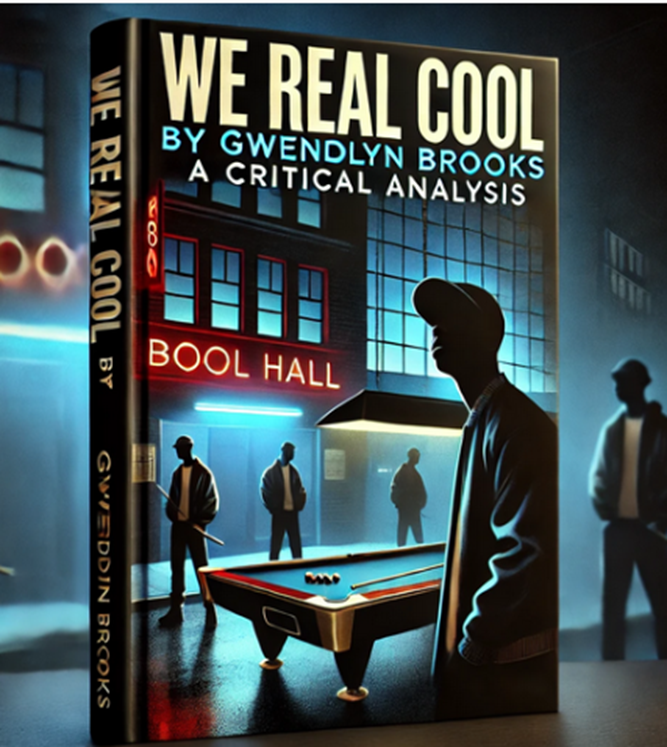
“We Real Cool” by Gwendolyn Brooks: A Critical Analysis

“We Real Cool” by Gwendolyn Brooks first appeared in the September 1959 issue of Poetry magazine and was later included in her collection The Bean Eaters (1960).

“We Real Cool” by Gwendolyn Brooks: A Critical Analysis
Introduction: “We Real Cool” by Gwendolyn Brooks

“We Real Cool” by Gwendolyn Brooks first appeared in the September 1959 issue of Poetry magazine and was later included in her collection The Bean Eaters (1960). Written with stark brevity and rhythmic cadence, the poem captures the defiant voices of seven young pool players at the Golden Shovel. Its main ideas revolve around youthful rebellion, the rejection of formal education—“We / Left school”—and indulgence in nightlife and risky pleasures—“We / Lurk late. We / Strike straight. We / Sing sin.” Brooks’s use of clipped, jazz-like rhythm and the repeated pronoun “We” gives the poem both collective identity and lyrical sharpness. The poem’s popularity stems from its ability to condense themes of alienation, bravado, and mortality into just a few lines, with the haunting conclusion—“We / Die soon”—underscoring the fleeting nature of reckless youth. Its enduring resonance lies in how it intertwines social critique with musicality, making it one of Brooks’s most anthologized and taught works (Brooks, 1963/1959).

Text: “We Real Cool” by Gwendolyn Brooks

The Pool Players.
        Seven at the Golden Shovel.

            We real cool. We   

            Left school. We

            Lurk late. We

            Strike straight. We

            Sing sin. We   

            Thin gin. We

            Jazz June. We   

            Die soon.

Annotations: “We Real Cool” by Gwendolyn Brooks
LineAnnotation (Meaning/Commentary)Literary DevicesSymbols/Images
The Pool Players. Seven at the Golden Shovel.Sets the scene: seven young men playing pool at a place ironically called the “Golden Shovel,” suggesting both glamour and burial (grave) undertones.Irony, Symbolism, SettingGolden Shovel = youth, rebellion, but also death (shovel = grave). Seven = completeness, but also collective identity.
We real cool. WeSelf-declaration of identity, rebellious tone, ungrammatical phrasing emphasizes colloquial voice.Colloquialism, Enjambment, RepetitionCool = defiance, style, rejection of norms.
Left school. WeDropped out of formal education, rejecting mainstream society.Symbolism, Alliteration (“school”/”cool”), CaesuraSchool = authority, future opportunities abandoned.
Lurk late. WeStaying out at night, aimlessness, secrecy, and risk.Alliteration (“lurk late”), ImageryLate night = danger, hidden lives.
Strike straight. WeSuggests skill at pool, but also connotations of violence or directness.Double entendre, AlliterationStrike = pool shot, aggression, violence.
Sing sin. WeCelebrating wrongdoing, treating sin as art or music.Alliteration (“sing sin”), IronySin = rebellion, moral decline.
Thin gin. WeDrinking cheap alcohol, highlighting poverty and indulgence.Internal rhyme (“sin/gin”), SymbolismGin = intoxication, escape, fragile existence.
Jazz June. WeRhythm, music, sensuality, carefree living, but limited to a single fleeting month.Alliteration (“Jazz June”), Symbolism, SynecdocheJazz = improvisation, freedom; June = youth, summer, transience.
Die soon.Sudden, stark conclusion: youthful recklessness leads to early death.Irony, Foreshadowing, JuxtapositionDeath = inevitability, finality, the cost of rebellion.
Literary And Poetic Devices: “We Real Cool” by Gwendolyn Brooks
DeviceExample(s) from the poemExplanation
Alliteration“Lurk late”; “Strike straight”; “Sing sin”; “Jazz June”Repetition of initial consonant sounds tightens the music of the lines and mirrors the clipped confidence of the speakers. The stacked /l/, /str/, /s/, and /j/ clusters produce punchy hits that feel like pool shots, reinforcing bravado and rhythm.
Anaphora“We real cool. We / Left school. We / Lurk late. We …”The grammatical clauses repeatedly begin with “We.” Even though “We” appears at line ends, it starts the next clause, forging a collective identity. The hammering repetition asserts group solidarity while hinting at insecurity that needs constant reaffirmation.
Antithesis“Jazz June” ↔ “Die soon”; “Golden Shovel” ↔ burial “Shovel”Stark placement of pleasure/life (“Jazz June”) against mortality (“Die soon”) compresses a life-cycle into two beats. The venue’s name contains a built-in contrast—“Golden” glamor vs. “Shovel” grave—capturing charm beside doom.
AssonanceLong oo in “cool/school”; short i in “thin gin”Repeated vowel sounds create a lean musicality without heavy rhyme. The oo sound feels smooth and languid (cool/school), while the clipped i sounds feel sharp and quick (thin/gin), echoing the poem’s alternating poses of ease and edge.
AsyndetonEntire catalogue: “We / Left school. We / Lurk late. We / Strike straight. …” (no “and”)The omission of conjunctions accelerates pacing and implies a breathless sequence of choices. Each act stands alone yet piles up—suggesting impulsivity and a life lived in staccato bursts rather than connected, reflective continuity.
CaesuraPeriods after each short claim: “We real cool. We / Left school. We …”Frequent full stops manufacture hard pauses that sound like breaks in a cue game: strike, stop; strike, stop. These stops emphasize each boast as a discrete beat while also fragmenting thought—mirroring fractured time and prospects.
Compression (Concision)Nearly all words are monosyllabic; statements are ultra-briefBrooks compresses a complete arc—identity, rebellion, indulgence, consequence—into a handful of blunt words. The minimalism heightens force: there’s no cushioning context, so the final blow (“Die soon”) lands with stark inevitability.
Consonance“strike straight”; “sing sin”; hard /g/ in “thin gin”Repeated consonant sounds (not just at the start) roughen the sonic surface. The dense clusters (/str/, /ng/, hard /g/) mimic the clack of pool balls and the toughness the speakers perform.
Diction (Colloquial / Vernacular)“We real cool” (copula omitted)Nonstandard grammar signals voice, locality, and stance. The omission of “are” conveys street brevity and defiance—rejecting school-taught correctness right after declaring they “Left school,” which makes the diction a thematic proof.
Double Entendre“Strike straight” (pool skill / violence); “Jazz June” (music / sensual freedom)Phrases carry layered meanings: technical prowess at the table doubles as a posture of aggression; seasonal music and celebration hint at sexual and sensory abandon. The layers dramatize how “cool” mixes skill, risk, and danger.
Ellipsis (Omission)“We [are] real cool”; bare, fragmentary clausesSkipping expected words and connectors makes the voice terse and coolly economical. The omissions create a sense of speed and bravado—but also gaps, suggesting what’s unplanned or unsustained beneath the swagger.
EnjambmentLine breaks after “We”: “We real cool. We / Left school. We / Lurk late. …”The pronoun hangs at each line’s end, then rolls forward to launch the next act. This “hanging We” produces suspense (who are we? what do we do?) and enacts group momentum—until the motion stops at “Die soon.”
End-stopping“We real cool. We” / “Left school. We” (periods close micro-claims)Alternating with enjambment, end-stops create a syncopated on/off rhythm—assertion, stop; assertion, stop—intensifying the poem’s jazz-like structure and making each boast feel isolatable and, finally, indictable.
ImageryNightlife: “Lurk late”; intoxication: “Thin gin”; music/season: “Jazz June”Concrete snapshots of nocturnal wandering, cheap drink, and summer jazz paint the texture of “cool.” Each image is skeletal yet vivid, letting readers project streets, neon, and heat onto the spare frame.
Internal Rhyme / Echo“Sing sin”; “Thin gin”; sound echo in “cool/school”Tight intra- and inter-line chiming makes the boasts catchy—like hooks. The easy sonic pleasure contrasts with the hard moral cost, sharpening the irony when the final rhyme in life is “Die soon.”
IronyOpening bravado “We real cool” vs. finality “Die soon”The poem’s swagger undercuts itself. The very list that performs “cool” becomes evidence of a trajectory toward early death. The title-sounding first claim turns out to be tragic foreshadowing rather than a sustainable identity.
JuxtapositionSequence of thrills (“Lurk late … Jazz June”) beside terminal line “Die soon”Placing pleasures shoulder to shoulder with the blunt ending creates a moral X-ray: what looks free and glamorous is framed by brevity and risk. The poem’s order teaches more than any explicit moralizing would.
Meter (Syncopated Rhythm)Monosyllabic stresses; alternating stops and run-onsWhile not in a fixed traditional meter, the piece rides a jazz-like backbeat created by short stressed units and strategic pauses. The rhythmic design performs the poem’s theme: improvisation under pressure, ending on a dead stop.
ParallelismRepeated two-word actions: “Lurk late,” “Strike straight,” “Sing sin,” “Thin gin”Matching syntactic frames build a ritual chant of identity. The structural sameness suggests habitual behavior—routine transgression—making the last break from pattern (“Die soon,” no “We”) feel like a terminal coda.
Refrain (Pronoun Motif)Recurring “We” at line endsThe pronoun works as a refrain binding the group. Its constant return asserts unity, but its isolation at line ends visually/aurally isolates the speakers too, hinting that the “we” is precarious and performative.
Symbolism“Golden Shovel” (glamour + grave); “June” (youth/summer); “Gin” (escape/poverty); “Jazz” (freedom/improvisation); “School” (authority/future)Concrete nouns carry thematic weight: the place already contains its end (“shovel”); June condenses youth’s warmth and brevity; gin signals cheap intoxication; jazz encodes improvised, rule-bending life; school embodies rejected structure and opportunity.
Synecdoche / Metonymy“June” for summer/youth; “Jazz” for a whole lifestyleParts or associated elements stand for larger states of being: one month for a season of life; one music for a culture of improvisation and risk. This scaling-up lets tiny images carry social worlds.
Tone (Bravado to Fatalism)From “We real cool” to “Die soon”The tonal slide is architectural: confident, playful, transgressive—then abruptly stark. Brooks crafts the fall without preaching; the mood pivot is the argument.
Turn (Volta)Final line: “Die soon.”A decisive pivot closes the poem. The earlier rhythmic pattern (We + verb phrase) breaks; there is no final “We.” The dropped pronoun feels like dropped members—suggesting mortality collapses the collective performance.
Themes: “We Real Cool” by Gwendolyn Brooks

1. Youthful Rebellion and Defiance: “We Real Cool” by Gwendolyn Brooks captures the bravado of young people who openly reject societal norms. From the opening declaration, “We real cool. We / Left school,” the speaker establishes an identity built on resistance to authority and education. The ungrammatical phrasing (“We real cool”) reinforces their rejection of conventional standards, while the act of leaving school represents a deliberate departure from structured opportunity. Their rebellion is not subtle but proudly voiced, underscoring the defiant stance of youth determined to define themselves against mainstream expectations.


2. The Illusion of Coolness and Self-Destruction: “We Real Cool” by Gwendolyn Brooks critiques the fragile allure of “coolness” by linking it to actions that ultimately lead to ruin. The boys claim their coolness through risky choices: “Lurk late. We / Strike straight. We / Sing sin. We / Thin gin.” Each line conveys indulgence, violence, or transgression, celebrated as a mark of style. Yet this coolness is illusory, as the brevity of the lines and abrupt enjambments suggest lives cut short. The closing “Die soon” delivers a stark reminder that the pursuit of coolness is intertwined with self-destruction, collapsing the façade of glamour into tragic brevity.


3. Transience of Youth and Fleeting Pleasure: “We Real Cool” by Gwendolyn Brooks highlights impermanence by using rhythm and imagery to convey the fleeting nature of youthful indulgence. The line “Jazz June” encapsulates this temporality, as “June” symbolizes summer, youth, and vitality—yet only for a brief season. Jazz, with its improvisational and transient quality, mirrors the unpredictability of their lifestyle. While the boys revel in music, nightlife, and alcohol, the inevitability of time closing in on them is foreshadowed in the finality of “Die soon.” Brooks emphasizes how the pleasures of youth are short-lived, offering momentary escape before the abrupt end.


4. Death and the Consequences of Recklessness: “We Real Cool” by Gwendolyn Brooks culminates in a sober confrontation with mortality. After a series of rhythmic, rebellious assertions, the abrupt line “Die soon” strips away bravado, leaving only the consequence of recklessness. Brooks juxtaposes the boys’ playful tone with the harsh reality that their choices—dropping out, drinking, and embracing sin—accelerate their path to an early death. The irony lies in how their search for freedom and identity leads not to empowerment but to oblivion. Death, in this context, becomes both literal and symbolic, representing the inevitable outcome of a life spent in defiance without foresight.

Literary Theories and “We Real Cool” by Gwendolyn Brooks
Literary TheoryApplication to “We Real Cool”References from the PoemInterpretive Insight
New CriticismFocuses on the poem’s form, language, and internal structure rather than outside context. The clipped syntax, monosyllabic diction, and enjambed “We” at line breaks form a self-contained aesthetic whole.“We real cool. We / Left school. We” → brevity, repetition, and rhyme in “Sing sin. We / Thin gin.”The artistry lies in how sound, rhythm, and form reinforce the tension between bravado and mortality, culminating in the ironic volta: “Die soon.”
Marxist CriticismHighlights class, economic struggle, and social alienation. The youths reject school (a pathway to social mobility) and embrace marginal pleasures—cheap alcohol, pool halls, and jazz—as forms of resistance.“Left school. We / Lurk late. We / Thin gin.”Dropping out represents alienation from institutional power. The pool hall (“Golden Shovel”) becomes a symbol of working-class escape yet foreshadows premature death—echoing systemic disenfranchisement.
African American/Harlem Renaissance CriticismExamines African American cultural expression and identity. The poem’s jazz-like rhythm, colloquial diction, and themes of rebellion reflect Black urban youth culture of the mid-20th century.“Jazz June. We / Die soon.”Jazz is both cultural affirmation and metaphor for improvisational life. Brooks compresses African American cultural vibrancy with the looming reality of early mortality in marginalized communities.
Feminist CriticismThough the poem voices male bravado, Brooks as a Black woman poet critiques patriarchal definitions of “cool” and exposes the fragility beneath masculine posturing.“We real cool. We / Strike straight. We / Sing sin.”The masculine performance of toughness and rebellion masks vulnerability. Brooks’s female gaze strips the “cool” of its glamour, revealing mortality and self-destruction as the real outcome.
Critical Questions about “We Real Cool” by Gwendolyn Brooks

·  1. How does the title “We Real Cool” reflect the poem’s exploration of identity?

  • The title of “We Real Cool” by Gwendolyn Brooks sets the tone of youthful defiance and collective bravado.
  • The phrase “We real cool” signals confidence but also uses ungrammatical diction, rejecting the norms of “school” they later abandon (“We / Left school”).
  • The repeated “We” reinforces group identity and solidarity, but by the final line, “We / Die soon,” this identity collapses.
  • The title thus foreshadows the fragility of their self-constructed identity, revealing that rebellion is temporary and ultimately self-destructive.

·  2. What role does rhythm and structure play in shaping the meaning of the poem?

  • The rhythm in “We Real Cool” is sharp and jazz-like, echoing both rebellion and improvisation.
  • Brooks uses enjambment by placing “We” at line ends: “We real cool. We / Left school. We / Lurk late.”
  • This dangling “We” creates suspense, highlighting uncertainty beneath the surface bravado.
  • The clipped lines mimic the sound of pool balls striking, while the abrupt end—“Die soon”—collapses the rhythm, symbolizing the inevitable halt of reckless living.

·  3. How does Brooks use symbolism to critique youth rebellion and mortality?

  • In “We Real Cool”, symbols compress themes of defiance and consequence.
  • The “Golden Shovel” represents both glamour and death (shovel = grave).
  • “Thin gin” symbolizes cheap indulgence and economic hardship, while “Jazz June” symbolizes fleeting joy and cultural vibrancy.
  • Each symbol moves from vitality to decay, climaxing with “Die soon,” where rebellion ends in mortality, not liberation.
  • Brooks critiques how youthful rebellion, though intoxicating, cannot escape its destructive trajectory.

·  4. In what ways does the poem critique masculinity and bravado?

  • “We Real Cool” by Gwendolyn Brooks portrays masculinity as fragile performance.
  • Phrases like “We / Strike straight” and “We / Sing sin” convey toughness, violence, and defiance, but they are short-lived declarations.
  • Brooks uses brevity and repetition to expose bravado as shallow posturing.
  • The final omission of “We” in “Die soon” symbolizes the collapse of their collective male voice and identity.
  • Through this, Brooks critiques toxic masculinity, showing how bravado masks vulnerability and leads to destruction.
Literary Works Similar to “We Real Cool” by Gwendolyn Brooks
  • Harlem” by Langston Hughes (1951)
    • Similarity: Explores the consequences of deferred dreams and unfulfilled youth, much like Brooks’s focus on wasted potential and mortality.
  • The Bean Eaters” by Gwendolyn Brooks (1960)
    • Similarity: Shares Brooks’s minimalist style and social critique, portraying marginalized lives with brevity and poignancy.
  • Theme for English B” by Langston Hughes (1951)
    • Similarity: Examines identity, education, and marginalization, paralleling Brooks’s portrayal of young men rejecting school.
  • “We Wear the Mask” by Paul Laurence Dunbar (1896)
    • Similarity: Highlights the performance of identity and hidden pain, resonating with the bravado masking vulnerability in “We Real Cool.”
  • The Negro Speaks of Rivers” by Langston Hughes (1921)
    • Similarity: Uses rhythm, heritage, and collective voice to embody African American experience, akin to Brooks’s use of “We” as a communal identity.
Representative Quotations of “We Real Cool” by Gwendolyn Brooks
QuotationContext in the PoemTheoretical Perspective
“We real cool.”The opening declaration of identity and bravado, using ungrammatical diction to signal rebellion.New Criticism – the form and language highlight irony between confidence and fragility.
“We / Left school.”Signals rejection of education and institutional authority, marking social alienation.Marxist Criticism – highlights class struggle and exclusion from upward mobility.
“We / Lurk late.”Suggests nocturnal life of risk-taking, secrecy, and marginal existence.Psychoanalytic Criticism – lurking reflects unconscious desires and rebellion against norms.
“We / Strike straight.”Double meaning: skill in pool and possible violence, tied to masculinity.Feminist Criticism – critiques patriarchal performance of toughness and aggression.
“We / Sing sin.”Celebrates wrongdoing, portraying it as playful and artistic.Moral Criticism – exposes tension between pleasure in sin and societal values.
“We / Thin gin.”Drinking cheap alcohol shows indulgence, poverty, and escapism.Marxist Criticism – symbolizes economic hardship and working-class struggle.
“We / Jazz June.”Evokes music, rhythm, and fleeting joy, but limited to a short season.African American Criticism – jazz as cultural identity and improvisation in Black life.
“We / Die soon.”The abrupt conclusion undermines all bravado, showing inevitable mortality.New Historicism – reflects mid-20th century social reality of marginalized Black youth.
“The Pool Players.”Establishes the collective identity of seven young men in a leisure setting.Structuralism – “players” symbolize a role within cultural codes of rebellion.
“Seven at the Golden Shovel.”The number seven suggests completeness, while “Golden Shovel” carries irony of glamour and death.Symbolic/Archetypal Criticism – shovel as death symbol, golden as fleeting youth.
Suggested Readings: “We Real Cool” by Gwendolyn Brooks

Books

hooks, bell. We Real Cool: Black Men and Masculinity. Routledge, 2004. https://en.wikipedia.org/wiki/We_Real_Cool:_Black_Men_and_Masculinity

Jones, Meta DuEwa. African-American Jazz Poetry: Orality, Prosody and Performance. Stanford University Press, 2000. https://www.sup.org/books/title/?id=1114


Journal Articles

Stavros, George, and Gwendolyn Brooks. “An Interview with Gwendolyn Brooks.” Contemporary Literature, vol. 11, no. 4, Winter 1970, pp. 355–364. https://www.jstor.org/stable/1207376

Miller, R. Baxter. “Gwendolyn Brooks and the Metaphysics of Cool.” Black American Literature Forum, vol. 16, no. 1, 1982, pp. 14–18. https://www.jstor.org/stable/2904199


Poem Website

Brooks, Gwendolyn. “We Real Cool.” Poetry Foundation. 1959. https://www.poetryfoundation.org/poems/55678/we-real-cool
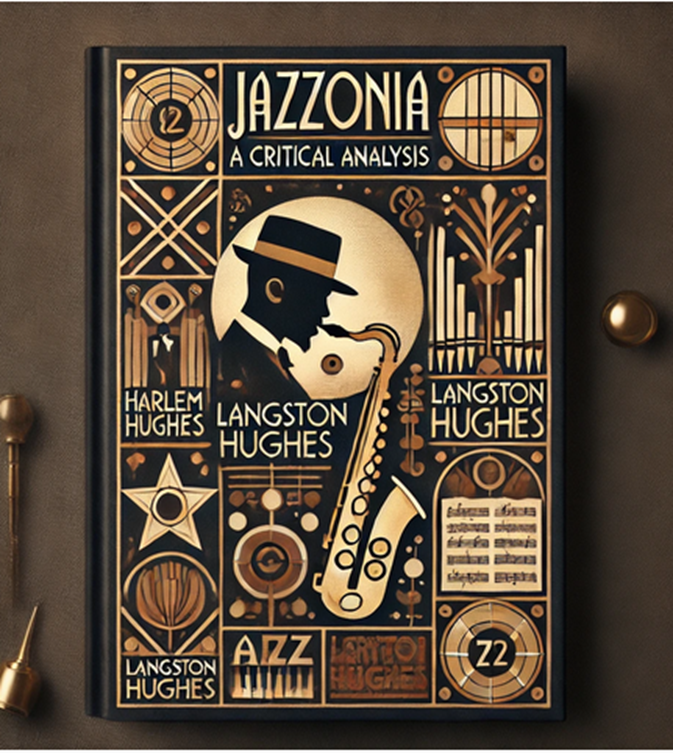
“Jazzonia” by Langston Hughes: A Critical Analysis

“Jazzonia” by Langston Hughes first appeared in The Weary Blues (1926), Hughes’s debut poetry collection published by Alfred A. Knopf, a landmark in the Harlem Renaissance.

“Jazzonia” by Langston Hughes: A Critical Analysis
Introduction: “Jazzonia” by Langston Hughes

“Jazzonia” by Langston Hughes first appeared in The Weary Blues (1926), Hughes’s debut poetry collection published by Alfred A. Knopf, a landmark in the Harlem Renaissance. The poem captures the vibrancy of Harlem cabaret life, where “six long-headed jazzers play” while a bold-eyed dancing girl lifts her “dress of silken gold.” Its popularity stems from Hughes’s ability to merge African American cultural expression with universal mythic imagery, drawing provocative parallels between the cabaret dancer and iconic figures like Eve and Cleopatra—women associated with beauty, temptation, and power. Lines such as “Were Eve’s eyes / In the first garden / Just a bit too bold?” suggest a continuity between sacred archetypes and the modern jazz age, elevating the cabaret scene to a symbolic realm of cultural and spiritual renewal. The repetition of “Oh, silver tree! / Oh, shining rivers of the soul!” further infuses the poem with a lyrical, almost hymn-like quality, blending jazz rhythms with biblical and historical allusions, which made it resonate both as social commentary and as a celebration of Black modernist aesthetics.

Text: “Jazzonia” by Langston Hughes

Oh, silver tree!
Oh, shining rivers of the soul!

In a Harlem cabaret
Six long-headed jazzers play.
A dancing girl whose eyes are bold
Lifts high a dress of silken gold.

Oh, singing tree!
Oh, shining rivers of the soul!

Were Eve’s eyes
In the first garden
Just a bit too bold?
Was Cleopatra gorgeous
In a gown of gold?

Oh, shining tree!
Oh, silver rivers of the soul!

In a whirling cabaret
Six long-headed jazzers play.

From The Weary Blues (Alfred A. Knopf, 1926) by Langston Hughes. This poem is in the public domain. 

Annotations: “Jazzonia” by Langston Hughes
LineAnnotation Literary Devices 🎨
Oh, silver tree!The poet compares the jazz experience to a shining, mystical tree full of life.Metaphor 🌳, Imagery ✨, Symbolism 🎭
Oh, shining rivers of the soul!The music feels like glowing rivers flowing through the soul, bringing joy and depth.Imagery ✨, Metaphor 🌊, Symbolism 🎵
In a Harlem cabaretThe setting is a lively Harlem club, central to jazz culture.Setting 📍, Realism 🏙️
Six long-headed jazzers play.Six musicians perform jazz passionately on stage.Imagery 🎵, Synecdoche 🎷, Alliteration 🔁 (six…/long-headed)
A dancing girl whose eyes are boldA fearless, confident woman dances with intensity.Characterization 👩, Imagery ✨, Symbolism 🎭
Lifts high a dress of silken gold.She raises her golden silk dress, suggesting allure and extravagance.Imagery 👗, Symbolism ✨ (gold = beauty, temptation), Visual Contrast 🎨
Oh, singing tree!Repetition of the tree image, equating jazz/music with a tree of life.Metaphor 🌳, Repetition 🔁, Symbolism 🎶
Oh, shining rivers of the soul!The soul again compared to glowing rivers, emphasizing inner rhythm.Imagery 🌊, Symbolism 🎵, Refrain 🔁
Were Eve’s eyesRefers to Eve from the Bible—connecting the bold dancer to Eve’s curiosity.Allusion 📖, Intertextuality 🔗
In the first gardenRefers to the Garden of Eden, linking jazz to primal temptation.Biblical Allusion ✝️, Imagery 🌱, Symbolism 🌳
Just a bit too bold?Suggests Eve’s boldness was both dangerous and transformative.Rhetorical Question ❓, Irony 🎭
Was Cleopatra gorgeousCompares the dancer to Cleopatra, symbol of beauty and power.Historical Allusion 👑, Comparison ⚖️, Symbolism ✨
In a gown of gold?Cleopatra’s beauty is visualized through golden attire, echoing the dancer.Imagery 👗, Symbolism ✨, Parallelism 🪞
Oh, shining tree!Returns to mystical metaphor of the tree of life/music.Refrain 🔁, Symbolism 🌳, Metaphor 🎶
Oh, silver rivers of the soul!Shifts from gold to silver—suggests purity and inner music.Imagery ✨, Symbolism 💎, Contrast ⚖️
In a whirling cabaretDescribes the lively, spinning energy of Harlem jazz clubs.Imagery 🌀, Setting 📍, Movement 💃
Six long-headed jazzers play.Ends by circling back to the musicians, grounding the poem in jazz.Refrain 🔁, Imagery 🎷, Rhythm 🎵
Literary And Poetic Devices: “Jazzonia” by Langston Hughes
DeviceExample from PoemExpanded Explanation
1. Alliteration 🔠“singing…soul” / “six…soul”Hughes repeats initial “s” sounds (“singing,” “soul,” “six”) to echo the hissing, flowing rhythm of jazz. This sound pattern mimics saxophones and cymbals, making the poem musically alive.
2. Allusion 📜“Were Eve’s eyes / In the first garden”The biblical allusion to Eve places the cabaret dancer in a lineage of temptation and beauty. It suggests that modern jazz culture mirrors ancient archetypes of desire.
3. Anaphora 🔁“Oh, silver tree! / Oh, shining rivers of the soul!”Repetition of “Oh” at the start of successive lines emphasizes invocation, giving the poem a chant-like, hymn-like quality as if celebrating jazz as a sacred force.
4. Apostrophe 🙏“Oh, silver tree!”Hughes addresses an imagined object—the “tree”—as if it were alive. This lyrical device raises jazz imagery to a spiritual or mythical level, as though the tree embodies vitality.
5. Assonance 🎶“rivers of the soul”Repetition of the long “o” sound (“soul,” “gold”) creates internal melody. It slows the line and mirrors the drawn-out tones of jazz instruments.
6. Biblical Imagery ✝️“Eve’s eyes in the first garden”Using Edenic imagery ties the cabaret to sacred beginnings. Hughes implies jazz is as primal and universal as the story of humanity’s origin.
7. Enjambment ↩️“Were Eve’s eyes / In the first garden / Just a bit too bold?”The thought spills across lines, just as jazz melodies spill across measures. This flowing structure mirrors improvisation in music.
8. Hyperbole 🌟“shining rivers of the soul”The phrase exaggerates the emotional depth of music, presenting jazz as a cosmic, almost limitless force that can move the soul like a river.
9. Imagery 🌅“A dancing girl whose eyes are bold / Lifts high a dress of silken gold”Vivid sensory details let readers visualize the shimmering dress and daring performance. The image is glamorous, sensual, and central to Harlem cabaret life.
10. Irony 😏Comparing Eve & Cleopatra to a cabaret dancerHughes ironically elevates a nightclub dancer to the level of legendary women. This playful contrast critiques moral judgments about beauty, temptation, and art.
11. Juxtaposition ⚖️“Eve” vs. “cabaret girl”Placing biblical and historical figures alongside a modern dancer blurs lines between sacred/profane, past/present, showing jazz as part of a timeless continuum.
12. Metaphor 🌳“Oh, silver tree!”The “tree” symbolizes creativity, life, and cultural flowering. Just as a tree grows from roots, jazz springs from African American heritage and flourishes in Harlem.
13. Musicality 🎷“Six long-headed jazzers play”Hughes builds rhythm into the line itself—short, percussive words mirror jazz improvisation. The poem doesn’t just describe jazz; it sounds like jazz.
14. Personification 🗣️“rivers of the soul”The “soul” has rivers that “shine,” suggesting movement and vitality. Abstract feelings are given lifelike qualities, intensifying the emotional impact.
15. Refrain 🔄“Oh, silver tree! / Oh, shining rivers of the soul!”This repeated chorus-like line imitates musical refrains in jazz, reinforcing the poem’s lyrical and rhythmic pulse.
16. Rhetorical Question“Was Cleopatra gorgeous / In a gown of gold?”These questions are not meant to be answered but to provoke comparison between past icons of beauty and the cabaret dancer, elevating her status.
17. Rhythm 🥁The whole cabaret descriptionThe poem’s short lines, repetition, and syncopation create a jazz-like rhythm. Its cadence mimics drumbeats and improvisational solos.
18. SimileImplicit: dancer as Eve/CleopatraThough no “like/as” is used, the poem suggests similarity between the dancer and Eve/Cleopatra, functioning as a subtle simile that equates modern sensuality with ancient allure.
19. Symbolism 🔮“Gold dress”The dancer’s golden dress symbolizes wealth, temptation, and allure. Gold also links her to Cleopatra, who historically embodied opulence.
20. Tone 🎭Overall tone: reverent yet playfulHughes balances admiration for jazz culture with a playful questioning of beauty’s timelessness. The tone celebrates while also provoking reflection.
Themes: “Jazzonia” by Langston Hughes

🎵 Theme 1: Jazz and the Soul’s Liberation: In “Jazzonia” by Langston Hughes, the central theme revolves around the liberating power of jazz, which transcends ordinary experience and enters the realm of the spiritual. The repeated refrain, “Oh, shining rivers of the soul!”, portrays music as a current flowing through the human spirit, washing away boundaries and offering release. Jazz here is not just entertainment but a metaphysical force—“In a Harlem cabaret / Six long-headed jazzers play”—suggesting that the club is transformed into a sacred space of rhythm, energy, and collective joy. Hughes elevates jazz into a symbol of cultural vitality, aligning Harlem’s music with the soul’s uncontainable need for expression.


👩‍🦱 Theme 2: Feminine Boldness and Sensuality: Langston Hughes’s “Jazzonia” highlights the confident sensuality of women, portraying them as central figures in the jazz age’s cultural scene. The dancer is described as “A dancing girl whose eyes are bold / Lifts high a dress of silken gold”, emphasizing not only her physical allure but also her fearless self-expression. This boldness challenges traditional expectations of femininity, linking her audacity with mythical and historical women such as Eve and Cleopatra. Through this imagery, Hughes suggests that female sensuality is both timeless and powerful, capable of commanding attention and reshaping cultural imagination.


🌳 Theme 3: Biblical and Historical Allusions: A striking theme in “Jazzonia” by Langston Hughes is the fusion of Harlem’s jazz culture with biblical and historical narratives. Hughes poses rhetorical questions such as, “Were Eve’s eyes / In the first garden / Just a bit too bold?” and “Was Cleopatra gorgeous / In a gown of gold?”, linking the Harlem dancer with iconic women who shaped history through beauty and boldness. These comparisons elevate the cabaret scene beyond its immediate setting, framing it within universal archetypes of temptation, power, and desire. Jazz thus becomes a modern continuation of ancient dramas, showing that human impulses—curiosity, beauty, rebellion—are eternal.


🌀 Theme 4: The Cabaret as a Cultural Microcosm: In “Jazzonia” by Langston Hughes, the Harlem cabaret emerges as a microcosm of cultural life, where music, sensuality, and history converge. The poem situates the reader “In a Harlem cabaret” where the performance unfolds as more than a local event—it reflects larger cultural and existential truths. The “whirling cabaret” becomes a metaphor for the dizzying, dynamic nature of Harlem Renaissance culture, full of rhythm and transformation. The cabaret setting embodies both the celebratory spirit of African American artistry and the layered symbolic world Hughes creates, blending everyday performance with mythic resonance.

Literary Theories and “Jazzonia” by Langston Hughes
Literary TheoryReferences from JazzoniaInterpretation
1. New Criticism (Formalist) 📖Repetition: “Oh, silver tree! / Oh, shining rivers of the soul!”; Imagery: “A dancing girl whose eyes are bold / Lifts high a dress of silken gold.”A New Critical reading would focus on the poem’s form, imagery, and symbols. The refrain and musical rhythm create unity, while contrasts (Eve, Cleopatra, cabaret girl) highlight tensions between sacred and sensual beauty. The meaning lies in the text itself, independent of historical context.
2. Harlem Renaissance / Cultural Theory 🎷“In a Harlem cabaret / Six long-headed jazzers play.”From a Harlem Renaissance lens, the poem celebrates Black art, music, and urban life. Jazz symbolizes African American creativity and cultural pride, while the cabaret scene represents the vibrancy of Harlem as a center of modern Black identity.
3. Feminist Theory 👩‍🦱“A dancing girl whose eyes are bold / Lifts high a dress of silken gold”; “Were Eve’s eyes…just a bit too bold?”A feminist reading highlights representations of women’s bodies and sexuality. The cabaret dancer is bold and glamorous, but the comparisons to Eve and Cleopatra reveal how women’s allure is often tied to cultural narratives of temptation, beauty, and power.
4. Postcolonial Theory 🌍“Was Cleopatra gorgeous / In a gown of gold?”A postcolonial lens examines how Hughes links African heritage (Cleopatra as an African queen) with African American modern culture. By placing Harlem’s dancer in dialogue with Cleopatra, the poem reclaims cultural lineage, asserting that Black beauty and artistry are globally and historically significant.
Critical Questions about “Jazzonia” by Langston Hughes

🎵 Question 1: How does “Jazzonia” by Langston Hughes portray jazz as more than just music?

Hughes presents jazz as a spiritual and transformative experience, transcending its role as entertainment. The refrain, “Oh, shining rivers of the soul!”, metaphorically portrays jazz as a flowing current that nourishes human spirit and identity. Similarly, the image of the “silver tree” suggests growth, rootedness, and transcendence, elevating jazz into a universal symbol of vitality. By situating the scene “In a Harlem cabaret / Six long-headed jazzers play”, Hughes underscores that Harlem’s jazz culture is not trivial nightlife but a cultural and soulful renaissance. Thus, jazz in this poem becomes a metaphor for freedom, creativity, and collective life energy.


👩‍🦱 Question 2: What role does feminine presence play in “Jazzonia” by Langston Hughes?

The poem foregrounds the boldness and sensuality of women as central to the Harlem Renaissance atmosphere. The line “A dancing girl whose eyes are bold / Lifts high a dress of silken gold” highlights female self-expression through movement, gaze, and attire. Her bold eyes and golden dress symbolize both confidence and allure, challenging traditional boundaries of modesty and propriety. Hughes then connects her with archetypal figures like Eve and Cleopatra, asking “Were Eve’s eyes… just a bit too bold?” and “Was Cleopatra gorgeous in a gown of gold?” This framing situates the dancer in a timeless continuum of powerful women whose beauty and daring reshaped history.


🌳 Question 3: Why does Hughes integrate biblical and historical allusions in “Jazzonia”?

The allusions to Eve and Cleopatra elevate the cabaret performance into a dialogue with universal themes of temptation, beauty, and power. By asking rhetorical questions—“Were Eve’s eyes / In the first garden / Just a bit too bold?”—Hughes links the Harlem dancer with humanity’s earliest narrative of curiosity and desire. Cleopatra’s mention—“Was Cleopatra gorgeous / In a gown of gold?”—associates her with legendary beauty and political power. Through these juxtapositions, Hughes situates Harlem within a grand historical and mythic framework, asserting that jazz culture is not marginal but deeply woven into the eternal human story.


🌀 Question 4: How does the cabaret setting in “Jazzonia” by Langston Hughes function as a cultural symbol?

The cabaret embodies both the energy of Harlem nightlife and the symbolic weight of a cultural stage. The setting “In a Harlem cabaret” and the imagery of a “whirling cabaret” suggest motion, rhythm, and transformation, reflecting the dynamism of African American cultural expression. This space becomes a microcosm of the Harlem Renaissance, where music, performance, sensuality, and history converge. By ending the poem with “Six long-headed jazzers play”, Hughes grounds the mystical and historical reflections in the tangible reality of jazz performance, symbolizing the inseparability of art, culture, and lived experience.

Literary Works Similar to “Jazzonia” by Langston Hughes
  • 🎷 The Weary Blues” by Langston Hughes (1926)
    Similarity: Like “Jazzonia,” it celebrates Harlem jazz culture, capturing rhythm, music, and African American identity through lyrical form.
  • 🌆 “Harlem Night Song” by Langston Hughes (1926)
    Similarity: Both poems romanticize Harlem nightlife, blending musical cadence with imagery of community, joy, and cultural vibrancy.
  • 💃 “Danse Russe” by William Carlos Williams (1917)
    Similarity: Shares Jazzonia’s focus on music, dance, and bodily expression, though Williams reflects on personal identity in modern life.
  • 🎶 “Poem” (also known as “I am so tired of waiting”) by Langston Hughes (1926)
    Similarity: Like “Jazzonia,” it fuses jazz rhythms with longing and emotional intensity, showcasing Hughes’s musical-poetic style.
  • 🌌 “If We Must Die” by Claude McKay (1919)
    Similarity: While more political, it resonates with “Jazzonia” in its Harlem Renaissance context, using bold imagery and rhythmic intensity to empower African American voices.
Representative Quotations of “Jazzonia” by Langston Hughes
QuotationContextTheoretical Perspective
“Oh, silver tree!” 🌳Opens the poem with a mystical metaphor of jazz as a tree, symbolizing life and growth.Symbolism & Archetypal Criticism – interprets the tree as a universal life-force.
“Oh, shining rivers of the soul!” 🌊Repeated refrain equating jazz with flowing spiritual energy.Psychoanalytic Theory – jazz seen as release of unconscious desires.
“In a Harlem cabaret” 🏙️Establishes setting in Harlem, the cultural hub of the Jazz Age.Cultural Studies – Harlem cabaret as a site of Black modernity.
“Six long-headed jazzers play.” 🎷Introduces the musicians who animate the cabaret.Marxist Criticism – labor of artists creates value in capitalist nightlife.
“A dancing girl whose eyes are bold” 👩‍🦱Describes a fearless, sensual performer.Feminist Criticism – challenges patriarchal constraints on female expression.
“Lifts high a dress of silken gold.” 👗Her golden dress symbolizes wealth, allure, and temptation.Semiotics – gold as a sign of desire, spectacle, and excess.
“Were Eve’s eyes / In the first garden / Just a bit too bold?” 🍎Allusion to Eve, linking dancer to biblical temptation.Theological & Feminist Criticism – reclaims Eve’s boldness as agency, not sin.
“Was Cleopatra gorgeous / In a gown of gold?” 👑Compares dancer to Cleopatra, symbol of power and beauty.Postcolonial Criticism – Cleopatra as exoticized figure in Western imagination.
“Oh, shining tree!”Refrain reinforcing mystical imagery of jazz as a sacred tree.Mythological Criticism – cabaret as modern sacred ritual.
“In a whirling cabaret / Six long-headed jazzers play.” 🌀Closing lines return to setting and music, grounding poem in Harlem life.Modernist Aesthetic Criticism – cyclical form mirrors rhythm of jazz itself.
Suggested Readings: “Jazzonia” by Langston Hughes

📚 Books

  • Hughes, Langston. The Weary Blues. Alfred A. Knopf, 1926.
  • Rampersad, Arnold. The Life of Langston Hughes: Volume I, 1902–1941, I, Too, Sing America. Oxford UP, 2002.

📄 Academic Articles

  • Davis, Arthur P. “The Harlem of Langston Hughes’ Poetry.” Phylon (1940-1956), vol. 13, no. 4, 1952, pp. 276–83. JSTOR, https://doi.org/10.2307/272559. Accessed 10 Sept. 2025.
  • Chinitz, David. “Rejuvenation through Joy: Langston Hughes, Primitivism, and Jazz.” American Literary History, vol. 9, no. 1, 1997, pp. 60–78. JSTOR, http://www.jstor.org/stable/490095. Accessed 10 Sept. 2025.

🌐 Website

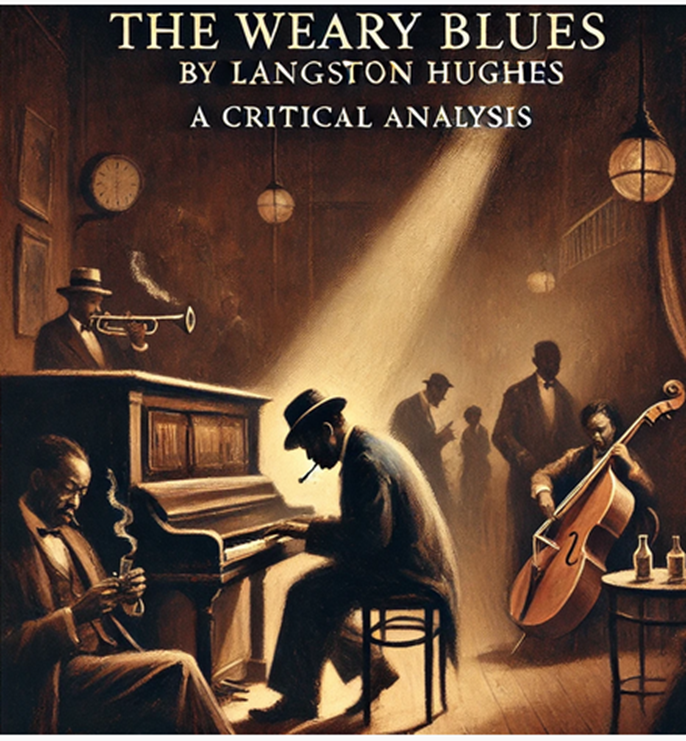
“The Weary Blues” by Langston Hughes: A Critical Analysis

“The Weary Blues” by Langston Hughes first appeared in 1925 in the magazine Opportunity and later became the title poem of his first poetry collection, The Weary Blues (1926).

"The Weary Blues" by Langston Hughes: A Critical Analysis
Introduction: “The Weary Blues” by Langston Hughes

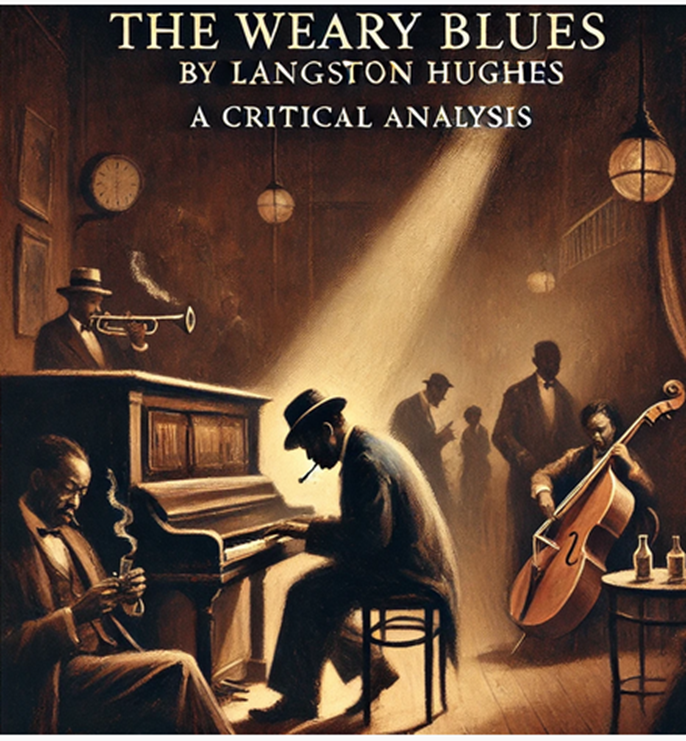
“The Weary Blues” by Langston Hughes first appeared in 1925 in the magazine Opportunity and later became the title poem of his first poetry collection, The Weary Blues (1926). The poem captures the essence of the Harlem Renaissance by blending jazz rhythms with African American vernacular, giving voice to Black identity and cultural expression. Hughes describes a blues musician on Lenox Avenue “rocking back and forth to a mellow croon” under “the pale dull pallor of an old gas light,” creating a vivid scene that reflects both artistry and hardship. The repeated refrain of loneliness—“Ain’t got nobody in all this world, / Ain’t got nobody but ma self”—and the melancholic wish for escape, “I ain’t happy no mo’ / And I wish that I had died,” resonate deeply with themes of suffering and endurance. The poem’s popularity lies in its ability to merge oral tradition, music, and poetry into a distinctly modern form, embodying Hughes’s mission to celebrate Black cultural roots while confronting racial realities. By making the piano “moan with melody” and echoing “the tune o’ those Weary Blues,” Hughes immortalized the blues as both a musical and existential expression of African American life.

Text: “The Weary Blues” by Langston Hughes

Droning a drowsy syncopated tune,

Rocking back and forth to a mellow croon,

I heard a Negro play.

Down on Lenox Avenue the other night

By the pale dull pallor of an old gas light

He did a lazy sway. . . .

He did a lazy sway. . . .

To the tune o’ those Weary Blues.

With his ebony hands on each ivory key

He made that poor piano moan with melody.

O Blues!

Swaying to and fro on his rickety stool

He played that sad raggy tune like a musical fool.

Sweet Blues!

Coming from a black man’s soul.

O Blues!

In a deep song voice with a melancholy tone

I heard that Negro sing, that old piano moan—

“Ain’t got nobody in all this world,

Ain’t got nobody but ma self.

I’s gwine to quit ma frownin’

And put ma troubles on the shelf.”

Thump, thump, thump, went his foot on the floor.

He played a few chords then he sang some more—

“I got the Weary Blues

And I can’t be satisfied.

Got the Weary Blues

And can’t be satisfied—

I ain’t happy no mo’

And I wish that I had died.”

And far into the night he crooned that tune.

The stars went out and so did the moon.

The singer stopped playing and went to bed

While the Weary Blues echoed through his head.

He slept like a rock or a man that’s dead.

Annotations: “The Weary Blues” by Langston Hughes
Lines (3–4)Simple AnnotationLiterary Devices
“Droning a drowsy syncopated tune, / Rocking back and forth to a mellow croon, / I heard a Negro play. / Down on Lenox Avenue the other night”The speaker describes hearing blues on Lenox Avenue. The rhythm is sleepy but musical, evoking Harlem’s jazz culture.🔠 Alliteration (“droning a drowsy”), 🎵 Musical imagery, 🌌 Setting imagery
“By the pale dull pallor of an old gas light / He did a lazy sway… / He did a lazy sway… / To the tune o’ those Weary Blues.”The dim gaslight and repeated “lazy sway” mimic the slow rhythm of the blues and the performer’s body swaying.🔁 Repetition, 🌌 Visual imagery, 🎭 Mood (dreamy, melancholy)
“With his ebony hands on each ivory key / He made that poor piano moan with melody. / O Blues! / Swaying to and fro on his rickety stool”The contrast of “ebony” and “ivory” highlights race and harmony. The piano “moaning” shows sorrow, while the stool suggests poverty.⚖️ Symbolism (“ebony/ivory”), 🤲 Personification (“piano moan”), 🔁 Repetition (“O Blues!”)
“He played that sad raggy tune like a musical fool. / Sweet Blues! / Coming from a black man’s soul. / O Blues!”The blues are both sorrowful and beautiful. They express authentic African American cultural suffering and resilience.🔗 Simile (“like a musical fool”), 🔁 Repetition, 🎭 Tone (sorrowful + sweet)
“In a deep song voice with a melancholy tone / I heard that Negro sing, that old piano moan— / ‘Ain’t got nobody in all this world, / Ain’t got nobody but ma self.’”The singer reveals loneliness and isolation. Repetition of “ain’t got nobody” stresses abandonment and despair.🔁 Repetition, 🤲 Personification (“piano moan”), 🗣️ Vernacular speech
“I’s gwine to quit ma frownin’ / And put ma troubles on the shelf.’ / Thump, thump, thump, went his foot on the floor. / He played a few chords then he sang some more—”Despite sorrow, the singer shows resilience by trying to “quit frownin’.” The “thump” mimics his foot tapping, creating rhythm.🎵 Onomatopoeia (“Thump, thump”), 🗣️ Vernacular, 🎭 Mood shift (hopeful moment)
“I got the Weary Blues / And I can’t be satisfied. / Got the Weary Blues / And can’t be satisfied—”The refrain stresses unhappiness and hopelessness, repeating the central theme of the blues.🔁 Repetition, 🎭 Tone (resigned despair), 🎵 Musical refrain
“I ain’t happy no mo’ / And I wish that I had died.’ / And far into the night he crooned that tune. / The stars went out and so did the moon.”The singer wishes for death, showing deep despair. The fading stars and moon reflect his emotional darkness.💥 Hyperbole (“wish that I had died”), 🌌 Nature imagery, 🎭 Tone (tragic)
“The singer stopped playing and went to bed / While the Weary Blues echoed through his head. / He slept like a rock or a man that’s dead.”The poem ends with exhaustion. The blues linger in his mind, but rest feels like death.🔗 Simile (“like a rock / a man that’s dead”), 🔁 Repetition (echo of blues), 🎭 Mood (finality, despair)
Literary And Poetic Devices: “The Weary Blues” by Langston Hughes
DeviceExample & Explanation
Alliteration 🔠“Droning a drowsy…” – repetition of the d sound creates a musical rhythm that mirrors the blues’ syncopated beat.
Allusion 📖The poem references the Blues tradition (e.g., “Weary Blues”), alluding to African American musical heritage and cultural resilience.
Anaphora 🔁“Ain’t got nobody… / Ain’t got nobody but ma self” – repetition at the beginning of lines emphasizes loneliness.
Assonance 🎵“Moan with melody” – long “o” sounds echo the mournful tone of the music.
Caesura ⏸️“I ain’t happy no mo’ / And I wish that I had died.” – natural pause after “mo’” dramatizes despair.
Colloquialism 🗣️“I’s gwine to quit ma frownin’” – use of African American Vernacular English (AAVE) adds authenticity and cultural identity.
Consonance 🔔“Thump, thump, thump” – repeated p and m sounds imitate the stomping rhythm of the pianist’s foot.
Dialect 🗯️“I’s gwine” – representation of regional and cultural speech patterns strengthens realism.
Enjambment ↩️“He made that poor piano moan with melody. / O Blues!” – flow across lines mirrors the continuous flow of music.
Hyperbole 🌌“The stars went out and so did the moon.” – exaggeration suggests how deeply the music consumed the night.
Imagery 🎨“By the pale dull pallor of an old gas light” – visual detail sets a dim, melancholic scene.
Irony 🎭The singer resolves to “quit ma frownin’” but later admits he “wish[es] that I had died” – a bitter contradiction between hope and despair.
Metaphor 🔄“He made that poor piano moan” – compares the piano’s sound to human suffering.
Onomatopoeia 🔊“Thump, thump, thump” – imitates the sound of the pianist’s foot hitting the floor.
Parallelism 📏“Got the Weary Blues / And can’t be satisfied. / Got the Weary Blues / And can’t be satisfied—” – repetition of structure intensifies emotion.
Personification 👤“Piano moan with melody” – gives human-like suffering to the piano, linking it with the singer’s voice.
Refrain 🔂“O Blues!” and “Weary Blues” repeated throughout, echoing the traditional structure of blues songs.
Simile 🔗“He slept like a rock or a man that’s dead.” – compares sleep to lifelessness, underscoring exhaustion and despair.
Symbolism 🕯️The Blues itself symbolizes African American struggles, endurance, and the expression of pain through art.
Tone 🎶The poem shifts from melancholic (loneliness and despair) to finality (sleep “like a man that’s dead”), capturing the soul of the blues.
Themes: “The Weary Blues” by Langston Hughes

🌌 Theme 1: Racial Identity and Cultural Expression: “The Weary Blues” by Langston Hughes reflects the African American struggle for cultural self-definition during the Harlem Renaissance, a movement Hughes was central to. The poem presents blues not merely as music but as a living embodiment of Black identity, resilience, and creativity. The image of “ebony hands on each ivory key” stands as a symbolic union of Black artistry with an instrument historically associated with European tradition. By emphasizing the authenticity of sound “coming from a black man’s soul,” Hughes elevates African American cultural expression as both unique and universal—rooted in centuries of struggle, yet transcending boundaries of race and class through its emotional power. The act of singing in dialect, with lines like “I’s gwine to quit ma frownin’,” anchors the poem in Black vernacular traditions, reminding readers that this culture thrives through oral, musical, and communal legacies. Thus, the blues emerge not only as entertainment but as testimony to African American endurance and identity in the face of marginalization.


🎭 Theme 2: Suffering and Emotional Pain: “The Weary Blues” by Langston Hughes captures human suffering at both the personal and collective levels. The singer laments isolation with the repeated cry, “Ain’t got nobody in all this world, / Ain’t got nobody but ma self.” This refrain emphasizes abandonment, echoing a broader sense of alienation faced by African Americans in a racially segregated society. The raw honesty of the blues allows pain to be verbalized, offering a glimpse into emotions often suppressed in public life. When the musician declares, “I ain’t happy no mo’ / And I wish that I had died,” the words transcend individual despair and suggest a cultural weariness brought on by systemic oppression and poverty. Yet Hughes portrays this suffering not as defeat but as resilience—the very act of singing and creating music from sorrow reveals the paradox of blues: pain is both endured and transformed. Through this theme, Hughes highlights the depth of human endurance, the inevitability of grief, and the artistry born from hardship.


🎵 Theme 3: Power of Music as Expression: “The Weary Blues” by Langston Hughes underscores music as a medium of emotional truth, bridging the gap between inner suffering and outward expression. The blues singer’s “deep song voice with a melancholy tone” turns grief into rhythm, while the piano’s personified “moan” transforms human anguish into sound. The repetition of lines, the steady thump of his foot, and the hypnotic sway of his body capture how music embodies both body and soul. For Hughes, music becomes a kind of spiritual outlet—it cannot erase sorrow, but it channels pain into art that resonates with others. The communal nature of blues is also evident: the speaker listens and bears witness, becoming part of the shared experience. In this sense, blues is not just an individual’s lament but a collective language of survival, resistance, and beauty. Hughes shows how music creates connection, turning loneliness into something shared, and despair into something lasting through rhythm, melody, and memory.


🌙 Theme 4: Despair and Deathlike Finality: “The Weary Blues” by Langston Hughes concludes with a haunting scene that merges exhaustion with imagery of death. The musician, after pouring out his sorrow in song, “slept like a rock or a man that’s dead.” This simile carries layered meaning: physical tiredness after emotional release, but also symbolic death, representing despair so deep that rest feels indistinguishable from finality. The imagery of the fading night—“The stars went out and so did the moon”—intensifies the darkness, as if the world itself echoes the singer’s hopelessness. The theme of deathlike stillness reflects not only the individual but also a cultural struggle in which relief seems attainable only in silence or oblivion. Yet Hughes captures the paradox: even in despair, the “Weary Blues echoed through his head,” meaning that music persists as memory, even when hope does not. In this way, the ending conveys both tragic inevitability and the enduring power of artistic expression to capture the deepest human emotions.

Literary Theories and “The Weary Blues” by Langston Hughes
Literary TheoryApplication to the PoemReferences from the Poem
African American Criticism / Harlem Renaissance Lens 🖤Highlights the cultural and historical significance of African American identity, music, and expression during the Harlem Renaissance. Hughes uses the Blues as a form of cultural pride and survival.“With his ebony hands on each ivory key / He made that poor piano moan with melody.” – evokes Black artistry shaping American music. “Sweet Blues! / Coming from a black man’s soul.” – asserts racial identity and cultural ownership.
Marxist Criticism 💰Focuses on class struggle, exploitation, and the economic hardships faced by African Americans. The Blues embody working-class suffering and alienation.“Ain’t got nobody in all this world, / Ain’t got nobody but ma self.” – reflects isolation tied to poverty. “I got the Weary Blues / And I can’t be satisfied.” – symbolizes dissatisfaction under oppressive social-economic structures.
Psychoanalytic Criticism 🧠Examines the unconscious, repression, and emotional release. The Blues function as catharsis for the singer’s deep loneliness, despair, and death wish.“I ain’t happy no mo’ / And I wish that I had died.” – reveals repressed desires and a death drive (Freudian Thanatos). The repeated “O Blues!” acts as both lament and therapeutic release.
Formalism / New Criticism 📜Analyzes the poem’s structure, rhythm, and literary devices without external context. The musicality of the verse mirrors the Blues’ syncopated rhythm.“Droning a drowsy syncopated tune, / Rocking back and forth to a mellow croon.” – alliteration and rhythm reproduce the musical form. “Thump, thump, thump, went his foot on the floor.” – onomatopoeia structurally embodies music.
Critical Questions about “The Weary Blues” by Langston Hughes

1. How does “The Weary Blues” by Langston Hughes reflect the Harlem Renaissance and African American identity?

Answer: Hughes’s poem captures the essence of the Harlem Renaissance by portraying music as a vessel of African American cultural expression. The imagery of a lone Black pianist on Lenox Avenue—“With his ebony hands on each ivory key / He made that poor piano moan with melody”—embodies the blending of suffering and artistry central to the movement. The title itself, “The Weary Blues,” conveys both exhaustion and resilience, suggesting that the act of singing the Blues transforms hardship into cultural strength. By asserting that the music came “from a black man’s soul,” Hughes underscores authenticity and cultural ownership, making the poem both a celebration of and testament to Black identity during the Harlem Renaissance.


2. What role does music play in “The Weary Blues” by Langston Hughes as both form and theme?

Answer: Music is not only the subject of Hughes’s poem but also shapes its rhythm and structure. The repetition and syncopation in lines like “Droning a drowsy syncopated tune, / Rocking back and forth to a mellow croon” mirror the cadences of Blues music itself. The refrain “O Blues!” works like a chorus, reinforcing the song-like quality. The onomatopoeia—“Thump, thump, thump, went his foot on the floor”—mimics the physical beat of performance, blurring the line between reading and hearing. Thematically, the music becomes a cathartic outlet for despair, as the singer laments, “I got the Weary Blues / And I can’t be satisfied.” Thus, Hughes uses music both as a structural framework and as a symbol of emotional survival.


3. How does despair manifest in “The Weary Blues” by Langston Hughes, and what does it reveal about the human condition?

Answer: Despair permeates the poem through both tone and imagery, reflecting universal struggles of loneliness and mortality. The singer confesses, “Ain’t got nobody in all this world, / Ain’t got nobody but ma self,” highlighting deep isolation. His later admission, “I ain’t happy no mo’ / And I wish that I had died,” introduces a death wish that underscores the extremity of suffering. Yet the act of singing the Blues transforms despair into shared art. The closing line, “He slept like a rock or a man that’s dead,” blurs the line between rest and death, emphasizing weariness as both physical and existential. Hughes thus portrays despair not just as an emotion but as a defining aspect of the human condition, alleviated only through creative expression.


4. How does the structure of “The Weary Blues” by Langston Hughes contribute to its meaning?

Answer: Hughes structures the poem to mimic the flow of a Blues performance, with alternating narrative description and sung lines. The shift from observation—“Down on Lenox Avenue the other night / By the pale dull pallor of an old gas light”—to first-person song lyrics immerses the reader in the performance. Refrains and parallelism, such as “Got the Weary Blues / And can’t be satisfied,” reproduce the cyclical patterns of Blues music. Even the enjambment and pauses, like “He made that poor piano moan with melody. / O Blues!” replicate musical breaks and improvisation. The poem’s structure is inseparable from its message: suffering and resilience are woven together, just as music and poetry are fused in the artistry of the Blues.

Literary Works Similar to “The Weary Blues” by Langston Hughes
  1. 🎶 Harlem” by Langston Hughes – Similar in its focus on deferred dreams and racial struggle, this poem, like “The Weary Blues,” captures African American experiences through vivid imagery and rhythm.
  2. 🥁 “Song for a Dark Girl” by Langston Hughes – Resonates with “The Weary Blues” in its fusion of music, sorrow, and racial injustice, using lyrical lament to process grief.
  3. 🎤 The Negro Speaks of Rivers” by Langston Hughes – Shares with “The Weary Blues”a celebration of African American cultural heritage, using rhythm and deep imagery to connect past and present.
  4. 🎷 “Jazzonia” by Langston Hughes – Like “The Weary Blues,” this poem draws on African American music (jazz instead of blues) to illustrate beauty, rhythm, and identity during the Harlem Renaissance.
  5. 🎼 “We Real Cool” by Gwendolyn Brooks – Though stylistically sparse, it echoes “The Weary Blues” in musical cadence and in its portrayal of Black life, struggle, and cultural rhythm.
Representative Quotations of “The Weary Blues” by Langston Hughes
QuotationContextTheoretical PerspectiveInterpretation
“Droning a drowsy syncopated tune”Opens the poem with a musical image capturing the rhythm of Blues.Formalism 📜The alliteration and rhythm replicate the musicality of Blues, showing how form mirrors content.
“With his ebony hands on each ivory key”Describes the pianist’s race through symbolic contrast.African American Criticism 🖤Ebony vs. ivory symbolizes Black artistry shaping a predominantly white cultural instrument (piano), asserting racial identity.
“Sweet Blues! Coming from a black man’s soul.”Narrator celebrates the authenticity of the performance.Cultural Criticism 🌍Positions Blues as an expression of Black heritage, validating African American creativity as central to American culture.
“Ain’t got nobody in all this world, / Ain’t got nobody but ma self.”The singer laments loneliness and alienation.Marxist Criticism 💰Expresses working-class isolation and alienation under systemic oppression.
“I’s gwine to quit ma frownin’ / And put ma troubles on the shelf.”Momentary resolve to overcome sorrow through song.Reader-Response 👥Readers may view this as hopeful catharsis, showing art’s power to transform suffering into resilience.
“Thump, thump, thump, went his foot on the floor.”Onomatopoeic description of rhythm in performance.Formalism 📜The sound imagery enacts music itself, emphasizing how structure embodies theme.
“I got the Weary Blues / And I can’t be satisfied.”Central refrain expressing deep dissatisfaction.Psychoanalytic Criticism 🧠Reveals unconscious despair and unfulfilled desire, echoing Freud’s concept of inner conflict and lack.
“I ain’t happy no mo’ / And I wish that I had died.”Singer voices a death wish, intensifying despair.Existentialism ⚖️Highlights the human confrontation with meaninglessness, suffering, and mortality.
“The stars went out and so did the moon.”Cosmic imagery closes the night of music.Symbolism 🕯️Suggests despair so deep it eclipses nature itself, dramatizing the power of human suffering.
“He slept like a rock or a man that’s dead.”Poem closes with ambiguous rest or death.Modernist Criticism 🕰️Reflects Modernist preoccupation with fragmentation, alienation, and the blurred line between life and death.
Suggested Readings: “The Weary Blues” by Langston Hughes

“The Weary Blues” by Langston Hughes: A Critical Analysis

“The Weary Blues” by Langston Hughes first appeared in 1925 in the magazine Opportunity and later became the title poem of his first poetry collection, The Weary Blues (1926).

"The Weary Blues" by Langston Hughes: A Critical Analysis
Introduction: “The Weary Blues” by Langston Hughes

“The Weary Blues” by Langston Hughes first appeared in 1925 in the magazine Opportunity and later became the title poem of his first poetry collection, The Weary Blues (1926). The poem captures the essence of the Harlem Renaissance by blending jazz rhythms with African American vernacular, giving voice to Black identity and cultural expression. Hughes describes a blues musician on Lenox Avenue “rocking back and forth to a mellow croon” under “the pale dull pallor of an old gas light,” creating a vivid scene that reflects both artistry and hardship. The repeated refrain of loneliness—“Ain’t got nobody in all this world, / Ain’t got nobody but ma self”—and the melancholic wish for escape, “I ain’t happy no mo’ / And I wish that I had died,” resonate deeply with themes of suffering and endurance. The poem’s popularity lies in its ability to merge oral tradition, music, and poetry into a distinctly modern form, embodying Hughes’s mission to celebrate Black cultural roots while confronting racial realities. By making the piano “moan with melody” and echoing “the tune o’ those Weary Blues,” Hughes immortalized the blues as both a musical and existential expression of African American life.

Text: “The Weary Blues” by Langston Hughes

Droning a drowsy syncopated tune,

Rocking back and forth to a mellow croon,

I heard a Negro play.

Down on Lenox Avenue the other night

By the pale dull pallor of an old gas light

He did a lazy sway. . . .

He did a lazy sway. . . .

To the tune o’ those Weary Blues.

With his ebony hands on each ivory key

He made that poor piano moan with melody.

O Blues!

Swaying to and fro on his rickety stool

He played that sad raggy tune like a musical fool.

Sweet Blues!

Coming from a black man’s soul.

O Blues!

In a deep song voice with a melancholy tone

I heard that Negro sing, that old piano moan—

“Ain’t got nobody in all this world,

Ain’t got nobody but ma self.

I’s gwine to quit ma frownin’

And put ma troubles on the shelf.”

Thump, thump, thump, went his foot on the floor.

He played a few chords then he sang some more—

“I got the Weary Blues

And I can’t be satisfied.

Got the Weary Blues

And can’t be satisfied—

I ain’t happy no mo’

And I wish that I had died.”

And far into the night he crooned that tune.

The stars went out and so did the moon.

The singer stopped playing and went to bed

While the Weary Blues echoed through his head.

He slept like a rock or a man that’s dead.

Annotations: “The Weary Blues” by Langston Hughes
Lines (3–4)Simple AnnotationLiterary Devices
“Droning a drowsy syncopated tune, / Rocking back and forth to a mellow croon, / I heard a Negro play. / Down on Lenox Avenue the other night”The speaker describes hearing blues on Lenox Avenue. The rhythm is sleepy but musical, evoking Harlem’s jazz culture.🔠 Alliteration (“droning a drowsy”), 🎵 Musical imagery, 🌌 Setting imagery
“By the pale dull pallor of an old gas light / He did a lazy sway… / He did a lazy sway… / To the tune o’ those Weary Blues.”The dim gaslight and repeated “lazy sway” mimic the slow rhythm of the blues and the performer’s body swaying.🔁 Repetition, 🌌 Visual imagery, 🎭 Mood (dreamy, melancholy)
“With his ebony hands on each ivory key / He made that poor piano moan with melody. / O Blues! / Swaying to and fro on his rickety stool”The contrast of “ebony” and “ivory” highlights race and harmony. The piano “moaning” shows sorrow, while the stool suggests poverty.⚖️ Symbolism (“ebony/ivory”), 🤲 Personification (“piano moan”), 🔁 Repetition (“O Blues!”)
“He played that sad raggy tune like a musical fool. / Sweet Blues! / Coming from a black man’s soul. / O Blues!”The blues are both sorrowful and beautiful. They express authentic African American cultural suffering and resilience.🔗 Simile (“like a musical fool”), 🔁 Repetition, 🎭 Tone (sorrowful + sweet)
“In a deep song voice with a melancholy tone / I heard that Negro sing, that old piano moan— / ‘Ain’t got nobody in all this world, / Ain’t got nobody but ma self.’”The singer reveals loneliness and isolation. Repetition of “ain’t got nobody” stresses abandonment and despair.🔁 Repetition, 🤲 Personification (“piano moan”), 🗣️ Vernacular speech
“I’s gwine to quit ma frownin’ / And put ma troubles on the shelf.’ / Thump, thump, thump, went his foot on the floor. / He played a few chords then he sang some more—”Despite sorrow, the singer shows resilience by trying to “quit frownin’.” The “thump” mimics his foot tapping, creating rhythm.🎵 Onomatopoeia (“Thump, thump”), 🗣️ Vernacular, 🎭 Mood shift (hopeful moment)
“I got the Weary Blues / And I can’t be satisfied. / Got the Weary Blues / And can’t be satisfied—”The refrain stresses unhappiness and hopelessness, repeating the central theme of the blues.🔁 Repetition, 🎭 Tone (resigned despair), 🎵 Musical refrain
“I ain’t happy no mo’ / And I wish that I had died.’ / And far into the night he crooned that tune. / The stars went out and so did the moon.”The singer wishes for death, showing deep despair. The fading stars and moon reflect his emotional darkness.💥 Hyperbole (“wish that I had died”), 🌌 Nature imagery, 🎭 Tone (tragic)
“The singer stopped playing and went to bed / While the Weary Blues echoed through his head. / He slept like a rock or a man that’s dead.”The poem ends with exhaustion. The blues linger in his mind, but rest feels like death.🔗 Simile (“like a rock / a man that’s dead”), 🔁 Repetition (echo of blues), 🎭 Mood (finality, despair)
Literary And Poetic Devices: “The Weary Blues” by Langston Hughes
DeviceExample & Explanation
Alliteration 🔠“Droning a drowsy…” – repetition of the d sound creates a musical rhythm that mirrors the blues’ syncopated beat.
Allusion 📖The poem references the Blues tradition (e.g., “Weary Blues”), alluding to African American musical heritage and cultural resilience.
Anaphora 🔁“Ain’t got nobody… / Ain’t got nobody but ma self” – repetition at the beginning of lines emphasizes loneliness.
Assonance 🎵“Moan with melody” – long “o” sounds echo the mournful tone of the music.
Caesura ⏸️“I ain’t happy no mo’ / And I wish that I had died.” – natural pause after “mo’” dramatizes despair.
Colloquialism 🗣️“I’s gwine to quit ma frownin’” – use of African American Vernacular English (AAVE) adds authenticity and cultural identity.
Consonance 🔔“Thump, thump, thump” – repeated p and m sounds imitate the stomping rhythm of the pianist’s foot.
Dialect 🗯️“I’s gwine” – representation of regional and cultural speech patterns strengthens realism.
Enjambment ↩️“He made that poor piano moan with melody. / O Blues!” – flow across lines mirrors the continuous flow of music.
Hyperbole 🌌“The stars went out and so did the moon.” – exaggeration suggests how deeply the music consumed the night.
Imagery 🎨“By the pale dull pallor of an old gas light” – visual detail sets a dim, melancholic scene.
Irony 🎭The singer resolves to “quit ma frownin’” but later admits he “wish[es] that I had died” – a bitter contradiction between hope and despair.
Metaphor 🔄“He made that poor piano moan” – compares the piano’s sound to human suffering.
Onomatopoeia 🔊“Thump, thump, thump” – imitates the sound of the pianist’s foot hitting the floor.
Parallelism 📏“Got the Weary Blues / And can’t be satisfied. / Got the Weary Blues / And can’t be satisfied—” – repetition of structure intensifies emotion.
Personification 👤“Piano moan with melody” – gives human-like suffering to the piano, linking it with the singer’s voice.
Refrain 🔂“O Blues!” and “Weary Blues” repeated throughout, echoing the traditional structure of blues songs.
Simile 🔗“He slept like a rock or a man that’s dead.” – compares sleep to lifelessness, underscoring exhaustion and despair.
Symbolism 🕯️The Blues itself symbolizes African American struggles, endurance, and the expression of pain through art.
Tone 🎶The poem shifts from melancholic (loneliness and despair) to finality (sleep “like a man that’s dead”), capturing the soul of the blues.
Themes: “The Weary Blues” by Langston Hughes

🌌 Theme 1: Racial Identity and Cultural Expression: “The Weary Blues” by Langston Hughes reflects the African American struggle for cultural self-definition during the Harlem Renaissance, a movement Hughes was central to. The poem presents blues not merely as music but as a living embodiment of Black identity, resilience, and creativity. The image of “ebony hands on each ivory key” stands as a symbolic union of Black artistry with an instrument historically associated with European tradition. By emphasizing the authenticity of sound “coming from a black man’s soul,” Hughes elevates African American cultural expression as both unique and universal—rooted in centuries of struggle, yet transcending boundaries of race and class through its emotional power. The act of singing in dialect, with lines like “I’s gwine to quit ma frownin’,” anchors the poem in Black vernacular traditions, reminding readers that this culture thrives through oral, musical, and communal legacies. Thus, the blues emerge not only as entertainment but as testimony to African American endurance and identity in the face of marginalization.


🎭 Theme 2: Suffering and Emotional Pain: “The Weary Blues” by Langston Hughes captures human suffering at both the personal and collective levels. The singer laments isolation with the repeated cry, “Ain’t got nobody in all this world, / Ain’t got nobody but ma self.” This refrain emphasizes abandonment, echoing a broader sense of alienation faced by African Americans in a racially segregated society. The raw honesty of the blues allows pain to be verbalized, offering a glimpse into emotions often suppressed in public life. When the musician declares, “I ain’t happy no mo’ / And I wish that I had died,” the words transcend individual despair and suggest a cultural weariness brought on by systemic oppression and poverty. Yet Hughes portrays this suffering not as defeat but as resilience—the very act of singing and creating music from sorrow reveals the paradox of blues: pain is both endured and transformed. Through this theme, Hughes highlights the depth of human endurance, the inevitability of grief, and the artistry born from hardship.


🎵 Theme 3: Power of Music as Expression: “The Weary Blues” by Langston Hughes underscores music as a medium of emotional truth, bridging the gap between inner suffering and outward expression. The blues singer’s “deep song voice with a melancholy tone” turns grief into rhythm, while the piano’s personified “moan” transforms human anguish into sound. The repetition of lines, the steady thump of his foot, and the hypnotic sway of his body capture how music embodies both body and soul. For Hughes, music becomes a kind of spiritual outlet—it cannot erase sorrow, but it channels pain into art that resonates with others. The communal nature of blues is also evident: the speaker listens and bears witness, becoming part of the shared experience. In this sense, blues is not just an individual’s lament but a collective language of survival, resistance, and beauty. Hughes shows how music creates connection, turning loneliness into something shared, and despair into something lasting through rhythm, melody, and memory.


🌙 Theme 4: Despair and Deathlike Finality: “The Weary Blues” by Langston Hughes concludes with a haunting scene that merges exhaustion with imagery of death. The musician, after pouring out his sorrow in song, “slept like a rock or a man that’s dead.” This simile carries layered meaning: physical tiredness after emotional release, but also symbolic death, representing despair so deep that rest feels indistinguishable from finality. The imagery of the fading night—“The stars went out and so did the moon”—intensifies the darkness, as if the world itself echoes the singer’s hopelessness. The theme of deathlike stillness reflects not only the individual but also a cultural struggle in which relief seems attainable only in silence or oblivion. Yet Hughes captures the paradox: even in despair, the “Weary Blues echoed through his head,” meaning that music persists as memory, even when hope does not. In this way, the ending conveys both tragic inevitability and the enduring power of artistic expression to capture the deepest human emotions.

Literary Theories and “The Weary Blues” by Langston Hughes
Literary TheoryApplication to the PoemReferences from the Poem
African American Criticism / Harlem Renaissance Lens 🖤Highlights the cultural and historical significance of African American identity, music, and expression during the Harlem Renaissance. Hughes uses the Blues as a form of cultural pride and survival.“With his ebony hands on each ivory key / He made that poor piano moan with melody.” – evokes Black artistry shaping American music. “Sweet Blues! / Coming from a black man’s soul.” – asserts racial identity and cultural ownership.
Marxist Criticism 💰Focuses on class struggle, exploitation, and the economic hardships faced by African Americans. The Blues embody working-class suffering and alienation.“Ain’t got nobody in all this world, / Ain’t got nobody but ma self.” – reflects isolation tied to poverty. “I got the Weary Blues / And I can’t be satisfied.” – symbolizes dissatisfaction under oppressive social-economic structures.
Psychoanalytic Criticism 🧠Examines the unconscious, repression, and emotional release. The Blues function as catharsis for the singer’s deep loneliness, despair, and death wish.“I ain’t happy no mo’ / And I wish that I had died.” – reveals repressed desires and a death drive (Freudian Thanatos). The repeated “O Blues!” acts as both lament and therapeutic release.
Formalism / New Criticism 📜Analyzes the poem’s structure, rhythm, and literary devices without external context. The musicality of the verse mirrors the Blues’ syncopated rhythm.“Droning a drowsy syncopated tune, / Rocking back and forth to a mellow croon.” – alliteration and rhythm reproduce the musical form. “Thump, thump, thump, went his foot on the floor.” – onomatopoeia structurally embodies music.
Critical Questions about “The Weary Blues” by Langston Hughes

1. How does “The Weary Blues” by Langston Hughes reflect the Harlem Renaissance and African American identity?

Answer: Hughes’s poem captures the essence of the Harlem Renaissance by portraying music as a vessel of African American cultural expression. The imagery of a lone Black pianist on Lenox Avenue—“With his ebony hands on each ivory key / He made that poor piano moan with melody”—embodies the blending of suffering and artistry central to the movement. The title itself, “The Weary Blues,” conveys both exhaustion and resilience, suggesting that the act of singing the Blues transforms hardship into cultural strength. By asserting that the music came “from a black man’s soul,” Hughes underscores authenticity and cultural ownership, making the poem both a celebration of and testament to Black identity during the Harlem Renaissance.


2. What role does music play in “The Weary Blues” by Langston Hughes as both form and theme?

Answer: Music is not only the subject of Hughes’s poem but also shapes its rhythm and structure. The repetition and syncopation in lines like “Droning a drowsy syncopated tune, / Rocking back and forth to a mellow croon” mirror the cadences of Blues music itself. The refrain “O Blues!” works like a chorus, reinforcing the song-like quality. The onomatopoeia—“Thump, thump, thump, went his foot on the floor”—mimics the physical beat of performance, blurring the line between reading and hearing. Thematically, the music becomes a cathartic outlet for despair, as the singer laments, “I got the Weary Blues / And I can’t be satisfied.” Thus, Hughes uses music both as a structural framework and as a symbol of emotional survival.


3. How does despair manifest in “The Weary Blues” by Langston Hughes, and what does it reveal about the human condition?

Answer: Despair permeates the poem through both tone and imagery, reflecting universal struggles of loneliness and mortality. The singer confesses, “Ain’t got nobody in all this world, / Ain’t got nobody but ma self,” highlighting deep isolation. His later admission, “I ain’t happy no mo’ / And I wish that I had died,” introduces a death wish that underscores the extremity of suffering. Yet the act of singing the Blues transforms despair into shared art. The closing line, “He slept like a rock or a man that’s dead,” blurs the line between rest and death, emphasizing weariness as both physical and existential. Hughes thus portrays despair not just as an emotion but as a defining aspect of the human condition, alleviated only through creative expression.


4. How does the structure of “The Weary Blues” by Langston Hughes contribute to its meaning?

Answer: Hughes structures the poem to mimic the flow of a Blues performance, with alternating narrative description and sung lines. The shift from observation—“Down on Lenox Avenue the other night / By the pale dull pallor of an old gas light”—to first-person song lyrics immerses the reader in the performance. Refrains and parallelism, such as “Got the Weary Blues / And can’t be satisfied,” reproduce the cyclical patterns of Blues music. Even the enjambment and pauses, like “He made that poor piano moan with melody. / O Blues!” replicate musical breaks and improvisation. The poem’s structure is inseparable from its message: suffering and resilience are woven together, just as music and poetry are fused in the artistry of the Blues.

Literary Works Similar to “The Weary Blues” by Langston Hughes
  1. 🎶 Harlem” by Langston Hughes – Similar in its focus on deferred dreams and racial struggle, this poem, like “The Weary Blues,” captures African American experiences through vivid imagery and rhythm.
  2. 🥁 “Song for a Dark Girl” by Langston Hughes – Resonates with “The Weary Blues” in its fusion of music, sorrow, and racial injustice, using lyrical lament to process grief.
  3. 🎤 The Negro Speaks of Rivers” by Langston Hughes – Shares with “The Weary Blues”a celebration of African American cultural heritage, using rhythm and deep imagery to connect past and present.
  4. 🎷 “Jazzonia” by Langston Hughes – Like “The Weary Blues,” this poem draws on African American music (jazz instead of blues) to illustrate beauty, rhythm, and identity during the Harlem Renaissance.
  5. 🎼 “We Real Cool” by Gwendolyn Brooks – Though stylistically sparse, it echoes “The Weary Blues” in musical cadence and in its portrayal of Black life, struggle, and cultural rhythm.
Representative Quotations of “The Weary Blues” by Langston Hughes
QuotationContextTheoretical PerspectiveInterpretation
“Droning a drowsy syncopated tune”Opens the poem with a musical image capturing the rhythm of Blues.Formalism 📜The alliteration and rhythm replicate the musicality of Blues, showing how form mirrors content.
“With his ebony hands on each ivory key”Describes the pianist’s race through symbolic contrast.African American Criticism 🖤Ebony vs. ivory symbolizes Black artistry shaping a predominantly white cultural instrument (piano), asserting racial identity.
“Sweet Blues! Coming from a black man’s soul.”Narrator celebrates the authenticity of the performance.Cultural Criticism 🌍Positions Blues as an expression of Black heritage, validating African American creativity as central to American culture.
“Ain’t got nobody in all this world, / Ain’t got nobody but ma self.”The singer laments loneliness and alienation.Marxist Criticism 💰Expresses working-class isolation and alienation under systemic oppression.
“I’s gwine to quit ma frownin’ / And put ma troubles on the shelf.”Momentary resolve to overcome sorrow through song.Reader-Response 👥Readers may view this as hopeful catharsis, showing art’s power to transform suffering into resilience.
“Thump, thump, thump, went his foot on the floor.”Onomatopoeic description of rhythm in performance.Formalism 📜The sound imagery enacts music itself, emphasizing how structure embodies theme.
“I got the Weary Blues / And I can’t be satisfied.”Central refrain expressing deep dissatisfaction.Psychoanalytic Criticism 🧠Reveals unconscious despair and unfulfilled desire, echoing Freud’s concept of inner conflict and lack.
“I ain’t happy no mo’ / And I wish that I had died.”Singer voices a death wish, intensifying despair.Existentialism ⚖️Highlights the human confrontation with meaninglessness, suffering, and mortality.
“The stars went out and so did the moon.”Cosmic imagery closes the night of music.Symbolism 🕯️Suggests despair so deep it eclipses nature itself, dramatizing the power of human suffering.
“He slept like a rock or a man that’s dead.”Poem closes with ambiguous rest or death.Modernist Criticism 🕰️Reflects Modernist preoccupation with fragmentation, alienation, and the blurred line between life and death.

Suggested Readings: “The Weary Blues” by Langston Hughes

“Saying Yes” by Diana Chang: A Critical Analysis

“Saying Yes” by Diana Chang was first published in the chapbook Saying Yes (Review Women Writers Chapbook No. 10: Translation) in 1997, though it had earlier appeared in her 1982 collection The Horizon is Definitely Speaking.

"Saying Yes" by Diana Chang: A Critical Analysis
Introduction: “Saying Yes” by Diana Chang

“Saying Yes” by Diana Chang was first published in the chapbook Saying Yes (Review Women Writers Chapbook No. 10: Translation) in 1997, though it had earlier appeared in her 1982 collection The Horizon is Definitely Speaking. The poem explores questions of cultural identity and belonging, highlighting the tension and harmony between being both Chinese and American. Structured as a dialogue, it resists the restrictive binaries of “either-or” by affirming the empowering inclusivity of “both-and.” Its popularity lies in the way it captures the lived realities of immigrants and bicultural individuals, offering a confident assertion of identity through the repeated affirmation of “yes.” This insistence on acceptance rather than fragmentation gives the poem enduring relevance in Asian American literature and beyond.

Text: “Saying Yes” by Diana Chang

“Are you Chinese?” “Yes.”

American?”

“Yes.”

Really Chinese?” “No . . . not quite.”

Really American?” “Well, actually, you see. . .”

But I would rather say yes

Not neither-nor not maybe,

but both, and not only

The homes I’ve had, the ways I am

I’d rather say it twice,

yes

Annotations: “Saying Yes” by Diana Chang
LineSimple English ExplanationLiterary DeviceExplanation of Literary Device
“Are you Chinese?”Someone asks the speaker if they are Chinese, questioning their cultural identity.Dialogue/Question ❓ (Red)The question format creates a conversational tone, reflecting external scrutiny of the speaker’s cultural heritage and introducing the theme of identity.
“Yes.”The speaker confidently confirms their Chinese identity.Monosyllabic Response ✅ (Green)The single-word answer emphasizes certainty but its brevity hints at an incomplete exploration of identity.
“American?”Another question probes whether the speaker is American, focusing on their national identity.Dialogue/Question 🇺🇸 (Blue/Red)The repeated question format continues the external probing, highlighting the speaker’s dual identity.
“Yes.”The speaker confidently affirms their American identity.Monosyllabic Response ✅ (Green)The brief response mirrors the earlier “Yes,” showing confidence but suggesting complexity beneath the surface.
“Really Chinese?”The questioner doubts the speaker’s Chinese identity, seeking further confirmation.Repetition 🤔 (Yellow)Repeating the question with “Really” intensifies scrutiny, implying skepticism about the authenticity of the speaker’s identity.
“No . . . not quite.”The speaker hesitates, admitting they don’t fully identify as Chinese.Ellipsis/Hesitation 😕 (Gray)The ellipsis indicates a pause, reflecting the speaker’s uncertainty and struggle to define their identity.
“Really American?”The questioner now doubts the speaker’s American identity.Repetition 🤔 (Yellow)The repeated “Really” mirrors the earlier question, emphasizing ongoing external judgment about the speaker’s identity.
“Well, actually, you see. . .”The speaker hesitates again, struggling to fully explain their American identity.Ellipsis/Hesitation 😕 (Gray)The ellipsis and qualifiers like “Well, actually” convey discomfort and the complexity of claiming a single identity.
But I would rather sayThe speaker shifts to internal reflection, wanting to define their identity on their own terms.Transition/Contrast 🔄 (Blue)The word “But” marks a shift from external questions to the speaker’s inner thoughts, asserting their agency.
yesThe speaker expresses a desire to confidently affirm their identity.Repetition/Emphasis ✅ (Green)The lowercase “yes” repeats earlier affirmations, but its softer tone suggests a personal, resolute claim.
Not neither-norThe speaker rejects being undefined or caught between identities.Negation/Contrast 🚫 (Red)“Neither-nor” negates binary categorizations, emphasizing the speaker’s refusal to be limited to one identity.
not maybe,The speaker rejects uncertainty or indecision about their identity.Negation/Contrast 🚫 (Red)“Not maybe” dismisses ambiguity, reinforcing the speaker’s desire for clarity and self-definition.
but both,The speaker embraces both Chinese and American identities.Affirmation/Parallelism 🤝 (Purple)“Both” asserts a dual identity, using parallelism with “not neither-nor” to emphasize inclusivity.
and not onlyThe speaker suggests their identity extends beyond just these two labels.Amplification ➕ (Blue)“Not only” expands the scope, hinting at additional layers of identity beyond Chinese and American.
The homes I’ve had,The speaker reflects on the places they’ve lived, which shape their identity.Metaphor 🏡 (Brown)“Homes” metaphorically represents physical places and cultural/emotional belonging, tying identity to experience.
the ways I amThe speaker acknowledges their multifaceted identity, shaped by experiences.Metaphor 🌈 (Rainbow)“Ways” metaphorically captures the speaker’s diverse characteristics and lived experiences.
I’d rather say itThe speaker reiterates their desire to confidently define their identity.Repetition/Emphasis 🗣️ (Orange)Repeating “I’d rather” reinforces the speaker’s agency in claiming their identity.
twice,The speaker emphasizes their dual identity by wanting to affirm it multiple times.Hyperbole ✌️ (Yellow)“Twice” exaggerates the act of affirmation, underscoring the strength of their conviction in their dual identity.
yesThe poem ends with a final, confident affirmation of the speaker’s identity.Repetition/Emphasis ✅ (Green)The final “yes” echoes earlier affirmations, concluding with a strong, positive acceptance of their complex identity.
Literary And Poetic Devices: “Saying Yes” by Diana Chang
DeviceExample from PoemExplanation
Alliteration“not neither-nor not maybe”Repetition of the ‘n’ sound creates rhythm and emphasizes the rejection of uncertainty.
Anaphora 🔁“Yes.” / “Yes.”The repeated beginning creates emphasis on affirmation and identity acceptance.
Antithesis ⚖️“Chinese” vs. “American”Contrasting terms highlight the struggle of bicultural identity.
Assonance 🎶“homes I’ve had, the ways I am”Repetition of vowel sounds (a/ai) produces a musical quality and unity.
Caesura ⏸️“Really Chinese?” “No… not quite.”A pause within the line mimics natural speech and hesitation in identity questions.
Climax 📈“Not neither-nor not maybe, / but both, and not only”Builds from negation to affirmation, strengthening the final resolution.
Dialogue 🗨️“Are you Chinese?” “Yes.” / “American?” “Yes.”Conversational format makes the poem direct, personal, and realistic.
Ellipsis … 🌌“No . . . not quite.”Suggests hesitation, trailing thought, and the complexity of defining identity.
Epiphora 🔄“Yes.” repeated at line endsRepetition at the close of lines emphasizes affirmation and resolution.
Imagery 🌄“The homes I’ve had, the ways I am”Evokes visual and emotional pictures of belonging and identity.
Irony 🎭“Really American?” / “Well, actually, you see…”Shows the absurdity of questioning someone’s identity with rigid labels.
Juxtaposition 🌓“Chinese” beside “American”Side-by-side placement underscores cultural duality.
Minimalism ✂️Short responses: “Yes.”The simplicity reflects directness and quiet strength of identity.
Paradox ♾️“Not neither-nor not maybe, but both”A statement that seems contradictory but reveals a truth: identity can be dual.
Parallelism 🪞“Are you Chinese?” / “American?”Similar sentence structures create balance and rhythm.
Personification 🌱“the ways I am”Attributes human-like existence to abstract “ways,” making them part of identity.
Repetition 🔔“Yes… Yes”Reinforces affirmation and creates a musical, emphatic rhythm.
Symbolism 🕊️“Yes”The word symbolizes acceptance, empowerment, and inclusivity of multiple identities.
Tone 🎨Gentle, conversational, affirmingThe relaxed yet firm tone makes the poem accessible and relatable.
Themes: “Saying Yes” by Diana Chang

🌏 Theme 1: Bicultural Identity and Belonging: In “Saying Yes” by Diana Chang, the central theme revolves around the challenges and affirmations of bicultural identity. The poem opens with direct questions: “Are you Chinese?” “Yes.” / “American?” / “Yes.”—a dialogue that instantly situates the speaker in two cultural worlds. Rather than choosing between them, Chang’s speaker asserts both identities, showing the refusal to be confined to a singular national or cultural definition. By embracing this duality, the poem challenges the conventional idea that belonging must be singular, affirming instead that identity can be expansive and inclusive.


⚖️ Theme 2: Rejection of Binary Thinking: In “Saying Yes” by Diana Chang, another strong theme is the rejection of binary categories that force people into narrow definitions. The speaker resists the pressure behind probing questions like “Really Chinese?” and “Really American?” Instead of accepting limiting binaries, the speaker asserts: “But I would rather say yes / Not neither-nor not maybe, / but both, and not only.” This declaration illustrates how identity cannot be captured by rigid categories. The poem therefore rejects reductionist thinking, advocating for fluid, layered selfhood instead of restrictive labels.


🪞 Theme 3: Affirmation and Self-Acceptance: In “Saying Yes” by Diana Chang, affirmation emerges as a central theme, particularly through the repetition of the word “yes.” The speaker’s insistence—“I’d rather say it twice, / yes”—demonstrates not just acceptance but also celebration of who they are. Saying “yes” becomes a metaphor for embracing multiple identities with confidence, rather than apologizing for or explaining them away. This affirmation is not passive; it is a bold redefinition of selfhood that transforms a potentially marginalizing interrogation into a moment of empowerment and pride.


🕊️ Theme 4: The Universality of Hybrid Experience: In “Saying Yes” by Diana Chang, the theme of hybrid experience extends beyond the personal to a universal level. The lines “The homes I’ve had, the ways I am” point to the multiplicity of influences that shape a person’s life. Here, identity is shown not as fixed but as a dynamic product of experience, culture, and belonging. By presenting this truth, Chang highlights that hybrid or multicultural identity is not an exception but a broader human reality in an interconnected world. The poem’s simple yet profound dialogue resonates with all who navigate more than one cultural space, making it universally relatable.

Literary Theories and “Saying Yes” by Diana Chang
Literary TheoryApplication to “Saying Yes”References from the Poem
Postcolonial TheoryThis theory examines the effects of colonialism, including hybrid identities and cultural displacement. In “Saying Yes,” the speaker navigates a hybrid Chinese-American identity, confronting external expectations and stereotypes about their cultural authenticity. The poem reflects the postcolonial struggle of defining oneself in a world that imposes binary cultural categories, ultimately embracing a hybrid identity.– “Are you Chinese?” / “Really Chinese?” / “No . . . not quite.”: These questions reflect colonial legacies of categorizing identity, doubting the speaker’s authenticity. – “but both, and not only / The homes I’ve had, the ways I am”: The speaker asserts a hybrid identity, rejecting imposed binaries and embracing their multifaceted cultural experience.
Feminist TheoryFeminist theory explores gender dynamics and the marginalization of women’s voices. In the poem, the speaker (implied to be female, based on Diana Chang’s identity and context) resists external attempts to define her identity, asserting agency in a patriarchal society that often silences women of color. The poem challenges gendered expectations by prioritizing the speaker’s self-definition over societal questioning.– “But I would rather say / yes”: The shift to “I” emphasizes the speaker’s agency, a feminist act of self-assertion against external judgment. – “Not neither-nor / not maybe, / but both”: The speaker rejects ambiguity and claims a dual identity, defying reductive labels often imposed on women of color.
Reader-Response TheoryThis theory focuses on the reader’s role in interpreting the text. “Saying Yes” invites readers to reflect on their own identities and experiences with cultural duality, especially those from multicultural backgrounds. The poem’s conversational style and universal themes of belonging prompt readers to project their personal struggles onto the speaker’s journey, making meaning through emotional resonance.– “Are you Chinese?” / “American?”: These questions engage readers by mirroring common experiences of being questioned about identity, prompting personal reflection. – “I’d rather say it / twice, / yes”: The affirmative ending encourages readers to interpret the speaker’s confidence as a call to embrace their own complex identities.
New CriticismNew Criticism emphasizes close reading of the text’s formal elements, such as structure, imagery, and tone, without external context. In “Saying Yes,” the poem’s concise structure, dialogue-to-monologue shift, and repeated affirmations (“yes”) create a cohesive exploration of identity. The tension between external questions and internal resolution is conveyed through deliberate word choice and pacing.– “Yes.” / “No . . . not quite.” / “Well, actually, you see. . .”: The short lines and ellipsis create a hesitant tone, reflecting identity struggles, while the shift to “yes” at the end conveys resolution. – “Not neither-nor / not maybe, / but both”: The parallel structure and negation emphasize the speaker’s rejection of ambiguity and embrace of duality, showcasing the poem’s formal unity.
Critical Questions about “Saying Yes” by Diana Chang

1. How does “Saying Yes” by Diana Chang challenge rigid notions of cultural identity?

In “Saying Yes” by Diana Chang, the poem directly challenges rigid notions of cultural identity by refusing to choose between being “Chinese” or “American.” The repeated responses—“Yes.” / “Yes.”—defy the expectation that identity must be singular and exclusive. When pressed further with “Really Chinese?” “No . . . not quite.” and “Really American?” “Well, actually, you see…”, the speaker highlights the inadequacy of such binary questions to capture lived experience. By declaring “Not neither-nor not maybe, / but both, and not only,” Chang rejects the pressure to conform to rigid categories. Instead, the poem insists that bicultural identity is not contradictory but expansive, offering a critique of narrow cultural definitions.


🔄2. What role does repetition play in reinforcing the poem’s central message?

In “Saying Yes” by Diana Chang, repetition functions as both a poetic device and a thematic strategy. The repeated answers—“Yes.”—in the opening dialogue convey quiet but firm affirmation. This repetition builds toward the emphatic closure: “I’d rather say it twice, / yes.” The insistence on repeating “yes” symbolizes the speaker’s refusal to be diminished or divided by external labels. The echoing of the same word creates a rhythm of assurance, allowing the poem to move from hesitation (“No… not quite”) to self-affirmation. Thus, repetition reinforces the central message: identity is not fragmented but doubled, and to embrace both sides is an act of empowerment.


🧭3. How does the conversational structure of the poem contribute to its meaning?

In “Saying Yes” by Diana Chang, the conversational structure gives the poem immediacy and authenticity. The dialogue format—“Are you Chinese?” “Yes.” / “American?” “Yes.”—mimics real-life interrogations faced by those with bicultural backgrounds. The speaker’s calm yet firm answers reflect lived negotiations of identity. The pauses, ellipses (“No . . . not quite”), and hesitations mirror the awkwardness of such exchanges while simultaneously exposing the absurdity of constantly being asked to prove authenticity. This conversational mode makes the reader a participant in the dialogue, helping them grasp the frustration but also the empowerment in the speaker’s choice to “say yes.”


🌍4. In what way does the poem universalize the immigrant or bicultural experience?

In “Saying Yes” by Diana Chang, the immigrant experience is presented not as an isolated struggle but as a universal human reality. The lines “The homes I’ve had, the ways I am” move beyond fixed national or ethnic categories, emphasizing the fluidity of identity shaped by multiple places and influences. By presenting bicultural existence as “both, and not only,” the poem universalizes hybridity as a common thread in human experience, especially in an interconnected world. The speaker’s affirmation “I’d rather say it twice, / yes” thus resonates with anyone negotiating multiple cultural, social, or personal identities. Chang’s poem transforms a personal experience into a broader statement about belonging, adaptability, and the richness of plurality.


Literary Works Similar to “Saying Yes” by Diana Chang
  • 🌏 “Legal Alien” by Pat Mora – Similar to “Saying Yes” by Diana Chang, it explores the bicultural experience of being both Mexican and American, showing the tension of belonging to two worlds at once.
  • 🪞 “Half-and-Half” by Naomi Shihab Nye – Like Chang’s poem, it highlights the struggles and affirmations of hybrid identity, portraying the speaker’s acceptance of multiplicity rather than division.
  • 🕊️ Theme for English B” by Langston Hughes – Resonates with Chang’s affirmation of identity, as Hughes reflects on race, individuality, and the interconnectedness of being both Black and American.
  • ⚖️ “Two Countries” by Naomi Shihab Nye – Similar to “Saying Yes”, it deals with straddling cultural lines and finding meaning in duality and belonging across borders.
  • 🔄 “Child of the Americas” by Aurora Levins Morales – Like Chang’s affirmation of “both, and not only”, this poem celebrates cultural hybridity, asserting identity as a fusion of multiple histories and traditions.
Representative Quotations of “Saying Yes” by Diana Chang
QuotationContextTheoretical Perspective
🌏 “Are you Chinese?” “Yes.”Opening dialogue that begins the interrogation of identity.Postcolonial Identity Theory – highlights how identity is framed through external questioning.
🗨️ “American?” / “Yes.”The immediate doubling of cultural affiliation.Hybridity (Homi Bhabha) – reflects dual belonging without contradiction.
⚖️ “Really Chinese?” “No . . . not quite.”Shows the pressure of authenticity tests within cultural labels.Essentialism vs. Constructivism – challenges fixed definitions of ethnicity.
🕊️ “Really American?” “Well, actually, you see. . .”Reveals hesitation and the struggle with imposed national categories.Critical Race Theory – exposes systemic expectations of proving “Americanness.”
🔄 “But I would rather say yes”Marks the speaker’s shift from defense to affirmation.Identity Politics – emphasizes agency in self-definition rather than imposed labels.
📖 “Not neither-nor not maybe,”Rejects uncertainty and exclusion.Binary Opposition (Structuralism) – dismantles “either/or” categories in cultural identity.
🪞 “but both, and not only”Asserts inclusivity of identity rather than limitation.Intersectionality (Crenshaw) – affirms multiplicity and overlapping cultural positions.
🌱 “The homes I’ve had, the ways I am”Invokes personal experience and belonging across spaces.Narrative Identity (Ricoeur) – identity constructed through lived histories and places.
🔔 “I’d rather say it twice,”Intensifies the insistence on affirmation.Performative Identity (Judith Butler) – repetition as performative empowerment of self.
“yes” (final line)Concludes with affirmation and empowerment.Affirmation Theory / Cultural Resistance – claiming power through acceptance of hybridity.
Suggested Readings: “Saying Yes” by Diana Chang
  1. Hamalian, Leo, and Diana Chang. “A MELUS Interview: Diana Chang.” MELUS, vol. 20, no. 4, 1995, pp. 29–43. JSTOR, https://doi.org/10.2307/467888. Accessed 7 Sept. 2025.
  2. Ling, Amy. “Writer in the Hyphenated Condition: Diana Chang.” MELUS, vol. 7, no. 4, 1980, pp. 69–83. JSTOR, https://doi.org/10.2307/467169. Accessed 7 Sept. 2025.
  3. Lynch, Joy M. “‘A Distinct Place in America Where All Mestizos Reside’: Landscape and Identity in Ana Castillo’s ‘Sapogonia’ and Diana Chang’s ‘The Frontiers of Love.’” MELUS, vol. 26, no. 3, 2001, pp. 119–44. JSTOR, https://doi.org/10.2307/3185560. Accessed 7 Sept. 2025.
  4. Ling, Amy. “A Perspective on Chinamerican Literature.” MELUS, vol. 8, no. 2, 1981, pp. 76–81. JSTOR, https://doi.org/10.2307/467153. Accessed 7 Sept. 2025.

“Mexicans Begin Jogging” by Gary Soto: A Critical Analysis

“Mexicans Begin Jogging” by Gary Soto first appeared in 1978 in the collection The Tale of Sunlight, which was nominated for the Pulitzer Prize.

"Mexicans Begin Jogging" by Gary Soto: A Critical Analysis
Introduction: “Mexicans Begin Jogging” by Gary Soto

“Mexicans Begin Jogging” by Gary Soto first appeared in 1978 in the collection The Tale of Sunlight, which was nominated for the Pulitzer Prize. The poem explores themes of racial identity, societal prejudice, and the struggle for acceptance, drawing from Soto’s own experiences as a Mexican-American. It portrays a factory worker, presumably Soto, who is forced to flee from border patrol despite being an American citizen, highlighting the irony and absurdity of racial stereotyping. The speaker’s declaration, “I shouted that I was American,” and the boss’s dismissive response, “No time for lies,” underscore the conflict of being caught between two cultural identities—Mexican by heritage, American by birth. The poem’s popularity stems from its vivid imagery, such as “the fleck of rubber, under the press / Of an oven yellow with flame,” and its ironic tone, exemplified by the speaker’s joyful “vivas / To baseball, milkshakes, and those sociologists,” which transforms a moment of fear into a defiant embrace of American culture. Its accessibility, emotional resonance, and critique of social injustices make it a powerful reflection of the Chicano experience, resonating with readers who relate to the challenges of navigating dual identities in a prejudiced society.

Text: “Mexicans Begin Jogging” by Gary Soto

At the factory I worked

In the fleck of rubber, under the press

Of an oven yellow with flame,

Until the border patrol opened

Their vans and my boss waved for us to run.

“Over the fence, Soto,” he shouted,

and I shouted that I was American.

“No time for lies,” he said, and pressed

A dollar in my palm, hurrying me

Through the back door.

Since I was on his time,

I ran And became the wag to a short tail of

Mexicans –

Ran past the amazed crowds that lined

The street and blurred like photographs, in rain

I ram from that industrial road to the soft

Houses where people paled at the turn of an autumn sky.

What could I do but yell vivas

To baseball, milkshakes, and those sociologists

Who would clock me

As I jog into the next century

On the power of a great, silly grin.

Annotations: “Mexicans Begin Jogging” by Gary Soto
LineTextSimple ExplanationDetailed ExplanationLiterary Devices
1At the factory I workedThe speaker says they were working at a factory.The poem opens by establishing the setting in an industrial workplace, grounding the narrative in the speaker’s labor-intensive environment, likely reflecting Soto’s own Mexican-American experience.Setting 🏭
2In the fleck of rubber, under the pressDescribes working with rubber under a machine.“Fleck of rubber” highlights the gritty details of manual labor, while “under the press” suggests both physical machinery and societal oppression.Imagery, Metaphor ⚙️
3Of an oven yellow with flame,The factory has a hot, glowing yellow oven.Vivid imagery of a “yellow” oven evokes heat and danger, possibly symbolizing harsh working conditions and societal scrutiny faced by the speaker.Imagery, Symbolism 🔥
4Until the border patrol openedBorder patrol arrives, creating tension.The sudden arrival of border patrol shifts the tone to urgency, introducing themes of racial profiling and fear of authority.Foreshadowing 🚨
5Their vans and my boss waved for us to run.The boss signals everyone to flee.The boss’s gesture to “run” shows complicity in assuming the workers are undocumented, revealing systemic fear and workplace dynamics.Narrative progression 🏃
6“Over the fence, Soto,” he shouted,The boss yells at Soto to jump a fence.Naming the speaker “Soto” personalizes the narrative, likely referencing the poet, while the command underscores urgency and dehumanization.Dialogue, Allusion 🗣️
7and I shouted that I was American.The speaker protests they are a U.S. citizen.The speaker’s assertion of American identity, ignored by the boss, highlights the injustice of racial assumptions and erasure of citizenship.Irony, Conflict 🇺🇸
8“No time for lies,” he said, and pressedThe boss dismisses the claim and urges haste.The boss’s rejection of the speaker’s truth as a “lie” reflects prejudice, assuming Mexican heritage negates American identity.Irony, Dialogue 🚫
9A dollar in my palm, hurrying meThe boss gives a dollar and pushes escape.The “dollar” symbolizes a token gesture or bribe, emphasizing exploitation and the absurdity of the situation.Symbolism 💵
10Through the back door.The speaker is rushed out a back exit.The “back door” represents a secretive, degrading escape, contrasting with the speaker’s rightful claim to belong.Symbolism 🚪
11Since I was on his time,The speaker runs under the boss’s orders.“His time” suggests the speaker’s lack of agency, bound by the boss’s authority, reflecting broader labor and societal control.Metaphor ⏰
12I ran And became the wag to a short tail of Mexicans –The speaker leads a group of Mexican workers.The metaphor “wag to a short tail” likens the speaker to a dog leading others, suggesting both leadership and dehumanization.Metaphor, Imagery 🐕
13Ran past the amazed crowds that linedThe speaker passes surprised onlookers.The “amazed crowds” frame the flight as a spectacle, highlighting public scrutiny and the speaker’s alienation.Imagery 👀
14The street and blurred like photographs, in rainThe scene blurs as the speaker runs.The simile “blurred like photographs, in rain” creates a chaotic, dreamlike image, suggesting disorientation and fleeting moments.Simile, Imagery 🌧️
15I ran from that industrial road to the softThe speaker moves to a residential area.The contrast between “industrial road” and “soft houses” highlights social divides, moving from gritty to affluent settings.Juxtaposition 🏠
16Houses where people paled at the turn of an autumn sky.Residents look shocked under the autumn sky.“Paled” suggests fear or surprise, while “autumn sky” adds a melancholic tone, symbolizing change or transience.Imagery, Symbolism 🍂
17What could I do but yell vivasThe speaker shouts cheers defiantly.The rhetorical question and “vivas” show defiance, reclaiming joy and cultural pride in a moment of fear.Rhetorical question, Tone 🎉
18To baseball, milkshakes, and those sociologistsThe speaker celebrates American culture.References to “baseball” and “milkshakes” embrace American symbols, while “sociologists” mocks academic categorization.Irony, Allusion ⚾🥤
19Who would clock meSociologists are imagined timing the speaker.“Clock me” implies scrutiny or measurement, suggesting society’s attempt to define or limit the speaker’s identity.Metaphor ⏱️
20As I jog into the next centuryThe speaker imagines running into the future.“Jog into the next century” symbolizes hope and resilience, with “jog” contrasting the earlier frantic “ran.”Metaphor, Symbolism 🕰️
21On the power of a great, silly grin.The speaker runs with a bold smile.The “great, silly grin” conveys defiance and joy, transforming oppression into personal triumph and optimism.Imagery, Tone 😄
Literary And Poetic Devices: “Mexicans Begin Jogging” by Gary Soto
DeviceExampleExplanation
Allusion“Those sociologists / Who would clock me”Refers to academics who study identity, migration, or labor—hinting at how Mexicans are often reduced to research subjects.
Anaphora“I ran… / Ran past the amazed crowds”The repetition of “ran” emphasizes urgency, fear, and the forced movement of the speaker.
Assonance“Over the fence, Soto”The long “o” vowel sound in “over,” “Soto,” and “no” creates musicality and highlights the moment of escape.
Caesura“Since I was on his time, / I ran”The pause after the comma breaks the rhythm, mirroring the sudden shift from work to flight.
Colloquialism“No time for lies”Informal speech reflects working-class dialogue and makes the boss’s command sound immediate and harsh.
Contrast“I shouted that I was American. / ‘No time for lies,’ he said”Juxtaposes the speaker’s truth with the boss’s disbelief, exposing racial prejudice and stereotypes.
Enjambment“I ran / And became the wag to a short tail of / Mexicans –”The line break without punctuation mimics continuous running, showing breathless momentum.
Hyperbole“Jog into the next century”Exaggerates his running as endless, symbolizing how the immigrant struggle stretches across generations.
Imagery (Visual)“The border patrol opened / Their vans”Creates a vivid image of looming authority and fear.
Imagery (Sensory)“Blurred like photographs, in rain”Appeals to sight and memory, showing the confusion and speed of the moment.
Irony“I shouted that I was American”It is ironic that a true American citizen must run from border patrol due to appearance and stereotypes.
Metaphor“Became the wag to a short tail of / Mexicans”Compares himself to a dog’s wagging tail, showing forced belonging to a group despite his citizenship.
Motif“Run / Jog” repeated throughoutThe recurring idea of running symbolizes survival, displacement, and identity crisis.
Paradox“On the power of a great, silly grin”The grin is “silly,” yet it empowers him to resist despair—holding both weakness and strength.
Personification“Soft houses where people paled at the turn of an autumn sky”Houses are described as “soft,” while people “pale,” giving human qualities to environment and showing contrast of safety vs. fear.
Satire“Vivas / To baseball, milkshakes, and those sociologists”Mocking celebration of stereotypical American symbols highlights the absurdity of forced patriotism.
Simile“Blurred like photographs, in rain”Compares the rushing crowds to blurred photos, emphasizing disorientation and motion.
Symbolism“A dollar in my palm”The dollar symbolizes exploitation—Mexican workers are reduced to cheap, disposable labor.
Tone (Humorous-Ironic)“On the power of a great, silly grin”The playful tone contrasts the serious theme of racial injustice, softening tragedy with ironic humor.
Themes: “Mexicans Begin Jogging” by Gary Soto
  • Racial Identity and Stereotyping 🧑‍🤝‍🧑
  • “Mexicans Begin Jogging” by Gary Soto powerfully explores the theme of racial identity and the pervasive stereotyping faced by Mexican-Americans, reflecting the speaker’s struggle to assert their American identity in a society quick to judge based on ethnicity. The poem begins with the speaker working in a factory, but the arrival of the border patrol disrupts this setting, as the boss assumes all workers are undocumented and urges them to flee: “Over the fence, Soto,” he shouted, / and I shouted that I was American.” This declaration of citizenship is dismissed with “No time for lies,” revealing the harsh reality of racial profiling, where the speaker’s Mexican heritage overshadows their legal status. The boss’s assumption that the speaker must be an immigrant underscores how societal biases reduce individuals to stereotypes, ignoring their true identity. The speaker’s eventual defiance, yelling “vivas / To baseball, milkshakes,” reclaims their American identity through cultural symbols, but the need to assert this identity highlights the ongoing tension of living between two worlds—Mexican by heritage, American by birth. This theme resonates because it captures the universal struggle of marginalized groups to be recognized for their full, complex identities rather than reductive assumptions.
  • Resilience and Defiance 😄
  • “Mexicans Begin Jogging” by Gary Soto celebrates the theme of resilience and defiance, showcasing the speaker’s ability to transform a moment of fear and oppression into one of triumph and joy. Forced to flee from border patrol despite being American, the speaker runs “from that industrial road to the soft / Houses,” a journey marked by physical and emotional endurance. The act of running, initially spurred by fear, becomes a powerful metaphor for pushing forward against adversity. The poem’s closing lines, where the speaker yells “vivas / To baseball, milkshakes, and those sociologists / Who would clock me / As I jog into the next century / On the power of a great, silly grin,” reflect an irrepressible spirit. The “great, silly grin” symbolizes defiance, turning a degrading situation into an assertion of individuality and optimism. By embracing American cultural icons like baseball and milkshakes, the speaker defies the stereotypes that seek to define them, running not just from danger but toward a hopeful future. This theme of resilience resonates widely, as it reflects the human capacity to find strength and humor in the face of injustice.
  • Social Injustice and Prejudice 🚨
  • “Mexicans Begin Jogging” by Gary Soto confronts the theme of social injustice and prejudice, exposing the systemic biases that marginalize Mexican-Americans and other minority groups. The poem’s pivotal moment occurs when the border patrol arrives, and the boss, without hesitation, assumes the speaker and others are undocumented: “‘No time for lies,’ he said, and pressed / A dollar in my palm, hurrying me / Through the back door.” This dismissive response to the speaker’s claim of being American reveals how prejudice overrides truth, forcing the speaker into a dehumanizing escape. The “amazed crowds that lined / The street” further highlight societal complicity, as their stares turn the speaker’s flight into a spectacle, reinforcing their alienation. The “dollar” pressed into the speaker’s hand symbolizes tokenism, a superficial gesture that underscores exploitation rather than addressing injustice. Soto’s critique of these systemic issues—racial profiling, workplace exploitation, and societal judgment—makes the poem a poignant commentary on the broader social structures that perpetuate inequality, resonating with readers who recognize these enduring challenges.
  • Cultural Duality and Belonging 🏠
  • “Mexicans Begin Jogging” by Gary Soto delves into the theme of cultural duality and the search for belonging, capturing the speaker’s navigation of their Mexican heritage and American identity. The poem juxtaposes the industrial factory, where the speaker is misidentified as an immigrant, with the “soft / Houses” of a suburban neighborhood, symbolizing a divide between the working-class, ethnic identity and the mainstream American world. The speaker’s assertion, “I shouted that I was American,” reflects their claim to belong in the U.S., yet the boss’s rejection and the need to flee “through the back door” highlight their exclusion from this identity. The poem’s closing celebration of “baseball, milkshakes” alongside the Spanish “vivas” blends American and Mexican cultural elements, illustrating the speaker’s embrace of both worlds. This duality is further emphasized by the ironic nod to “sociologists / Who would clock me,” suggesting external attempts to categorize the speaker’s identity. The poem’s exploration of belonging resonates with readers who experience the tension of living between cultures, seeking acceptance in a society that often demands conformity.
Literary Theories and “Mexicans Begin Jogging” by Gary Soto
TheoryExplanationReference from PoemApplication to the Poem
🔍 New HistoricismLiterature must be read in the context of its historical, cultural, and political moment.“Until the border patrol opened / Their vans”Reflects the U.S.–Mexico immigration context of the late 20th century. The speaker’s forced flight mirrors how Hispanic laborers were stereotyped as “illegal” regardless of citizenship.
📖 Postcolonial TheoryExamines identity, race, and the lingering effects of colonial and imperial power on marginalized groups.“I shouted that I was American. / ‘No time for lies,’ he said”Despite citizenship, the speaker is treated as an “other.” The boss and border patrol reproduce colonial hierarchies where Mexicans are seen as outsiders, showing systemic racism.
🌎 Marxist TheoryFocuses on class struggle, labor, exploitation, and the economic forces shaping human life.“Pressed / A dollar in my palm, hurrying me / Through the back door”The boss values the worker only for labor. The dollar symbolizes exploitation: Mexican workers are seen as replaceable and disposable under capitalist structures.
👥 Reader-Response TheoryMeaning is created by the reader’s interaction with the text, influenced by personal and cultural background.“What could I do but yell vivas / To baseball, milkshakes”Different readers interpret this differently: ironic celebration of American culture, or assimilation. Mexican-American readers may feel frustration, while others may read it as humor.
Critical Questions about “Mexicans Begin Jogging” by Gary Soto

Question 1: How does Soto portray the conflict between personal identity and imposed stereotypes in “Mexicans Begin Jogging” by Gary Soto?

In “Mexicans Begin Jogging” by Gary Soto, the speaker’s identity as an American citizen clashes with how others perceive him. When the boss shouts, “Over the fence, Soto,” and the speaker insists, “I shouted that I was American”, the denial of his truth reflects the imposition of stereotypes on Mexican-Americans. The boss’s response—“No time for lies”—underscores how racial profiling reduces him to a body in flight, regardless of his legal status. Soto shows that identity is not just what one claims but how it is recognized—or denied—by society. The irony is sharp: citizenship papers mean little when skin color and name trigger suspicion.


🔍 Question 2: In what ways does the poem critique labor exploitation and capitalist systems in “Mexicans Begin Jogging” by Gary Soto?

Soto exposes the exploitative nature of labor in “Mexicans Begin Jogging” by Gary Soto through the moment when the boss “pressed / A dollar in my palm, hurrying me / Through the back door.” This action reveals that the worker is seen only in terms of economic value, discarded the moment he becomes inconvenient. The dollar symbolizes both a payoff and an insult, showing how capitalist structures reduce workers to expendable commodities. The command to flee—while still on the boss’s “time”—ironically binds the worker to the system even in flight. Soto critiques not only individual prejudice but also the economic structures that profit from immigrant labor while simultaneously criminalizing it.


🌎 Question 3: How does the poem use imagery of running to symbolize displacement and resilience in “Mexicans Begin Jogging” by Gary Soto?

Running is the central motif and metaphor in “Mexicans Begin Jogging” by Gary Soto. The speaker confesses, “Since I was on his time, / I ran / And became the wag to a short tail of / Mexicans –” where the act of running becomes both literal escape and symbolic displacement. The enjambed lines mimic breathless movement, emphasizing the forced mobility of migrant laborers. Yet the running also suggests resilience and survival: he keeps moving past “amazed crowds” that blur “like photographs, in rain.” The final image—“jog into the next century / On the power of a great, silly grin”—turns running into a paradoxical triumph. Despite being chased, mocked, and reduced, the speaker reclaims dignity in persistence.


👥 Question 4: How does Soto use humor and irony to expose serious issues of race and belonging in “Mexicans Begin Jogging” by Gary Soto?

The closing lines of “Mexicans Begin Jogging” by Gary Soto reveal Soto’s use of humor and irony to critique cultural stereotypes. The speaker shouts “vivas / To baseball, milkshakes, and those sociologists”—a satirical celebration of mainstream American culture and academic observers. Baseball and milkshakes symbolize assimilation into U.S. identity, while the ironic mention of sociologists highlights how Mexican-Americans are studied but not truly understood. The humor of a “great, silly grin” contrasts with the injustice of being forced to flee despite citizenship. Soto demonstrates that laughter becomes a coping mechanism, allowing the speaker to undermine prejudice by embracing absurdity. The irony underscores that sometimes survival requires both endurance and mockery of the system that marginalizes you.

Literary Works Similar to “Mexicans Begin Jogging” by Gary Soto
  • 🌎 Let America Be America Again” by Langston Hughes
    Similarity: Like Soto, Hughes critiques the gap between American ideals and reality, showing how marginalized groups are excluded from the promised freedom.
  • 🚶 “Walking Around” by Pablo Neruda
    Similarity: Neruda’s poem, like Soto’s, portrays the alienation of the working class, where daily survival feels dehumanizing and disorienting.
  • 🧱 “The Latin Deli: An Ars Poetica” by Judith Ortiz Cofer
    Similarity: Cofer’s work, like Soto’s, explores Latino immigrant identity and the tension between assimilation and cultural preservation.
  • 🛂 “Refugee in America” by Langston Hughes
    Similarity: Hughes, like Soto, captures the pain of belonging and unbelonging—citizenship does not erase the experience of racial discrimination.
  • 🚧 Immigrants” by Pat Mora
    Similarity: Mora’s poem, like Soto’s, shows how immigrant families struggle with identity, raising children to “be American” while never fully accepted as such.
Representative Quotations of “Mexicans Begin Jogging” by Gary Soto
QuotationContext (Theoretical Perspective)Interpretation
“At the factory I worked / In the fleck of rubber, under the press” 🏭Chicano Studies: The poem opens with the speaker in a labor-intensive factory setting, grounding the narrative in the working-class experience of Mexican-Americans.The gritty imagery of “fleck of rubber” and “press” highlights the oppressive, industrial environment, symbolizing the socioeconomic struggles and exploitation faced by Chicano workers.
“Of an oven yellow with flame” 🔥Postcolonial Theory: The vivid description of the factory’s oven introduces a sense of danger and heat, reflecting the harsh conditions imposed on marginalized workers.The “yellow” oven symbolizes both physical toil and the systemic pressures of a society that marginalizes ethnic minorities, evoking a colonial legacy of labor exploitation.
“Until the border patrol opened / Their vans” 🚨Critical Race Theory: The arrival of border patrol introduces racial profiling, disrupting the workplace and forcing the speaker into a dehumanizing flight.This moment underscores systemic racism, as the assumption of illegality targets the speaker based solely on ethnicity, highlighting the pervasive fear of immigration enforcement.
““Over the fence, Soto,” he shouted” 🗣️Chicano Studies: The boss’s command personalizes the speaker as “Soto,” reflecting the poet’s own identity, and signals the urgency of escape due to presumed illegality.The direct address and command to flee over a fence reveal workplace complicity in racial assumptions, stripping the speaker of agency and reinforcing Chicano marginalization.
“and I shouted that I was American” 🇺🇸Critical Race Theory: The speaker asserts their American citizenship, which is dismissed, highlighting the conflict between their legal identity and societal perception.This declaration exposes the irony of racial profiling, where the speaker’s Mexican heritage overshadows their American identity, illustrating the erasure of minority citizenship.
““No time for lies,” he said” 🚫Postcolonial Theory: The boss’s dismissal of the speaker’s claim reflects a colonial mindset that assumes inferiority and illegitimacy of non-white identities.The rejection of the speaker’s truth as a “lie” perpetuates a power dynamic where marginalized voices are silenced, reinforcing systemic prejudice.
“A dollar in my palm, hurrying me / Through the back door” 💵🚪Marxist Theory: The boss’s act of giving a dollar and pushing the speaker out symbolizes economic exploitation and tokenism in a capitalist system.The “dollar” and “back door” represent superficial compensation and exclusion, highlighting how labor systems exploit and marginalize workers of color.
“I ran And became the wag to a short tail of Mexicans” 🐕Chicano Studies: The speaker leads a group of Mexican workers in flight, using a metaphor that suggests both leadership and dehumanization.The “wag to a short tail” metaphor reflects the collective Chicano experience of being chased and stereotyped, yet also shows resilience in community solidarity.
“Ran past the amazed crowds that lined / The street and blurred like photographs, in rain” 👀🌧️Postcolonial Theory: The speaker’s flight through a public space, observed by onlookers, underscores their alienation and objectification as a spectacle.The “amazed crowds” and simile of “blurred” photographs evoke colonial gazes, where the marginalized are reduced to objects of curiosity, their humanity obscured.
“What could I do but yell vivas / To baseball, milkshakes, and those sociologists / Who would clock me / As I jog into the next century / On the power of a great, silly grin” ⚾🥤😄Cultural Studies: The poem ends with the speaker defiantly embracing American culture while mocking societal scrutiny, symbolizing resilience and cultural duality.The celebratory “vivas” to American icons and the “silly grin” transform oppression into triumph, blending Chicano pride with American identity, defying attempts to categorize them.
Suggested Readings: “Mexicans Begin Jogging” by Gary Soto

Books

  • Pérez-Torres, Rafael. Movements in Chicano Poetry: Against Myths, Against Margins. Cambridge University Press, 1995.
  • Soto, Gary. New and Selected Poems. Raincoast Books, 1995.

Academic Articles


Poem Website


“The Flaming Heart” Richard Crashaw: A Critical Analysis

“The Flaming Heart” by Richard Crashaw first appeared in 1652 in the posthumous collection Carmen Deo Nostro: Te Decet Hymnus Sacred Poems, Collected, Corrected, Avgvmented, Most Humbly Presented to My Lady the Countesse of Denbigh.

“The Flaming Heart” Richard Crashaw: A Critical Analysis
Introduction: “The Flaming Heart” Richard Crashaw

“The Flaming Heart” by Richard Crashaw first appeared in 1652 in the posthumous collection Carmen Deo Nostro: Te Decet Hymnus Sacred Poems, Collected, Corrected, Avgvmented, Most Humbly Presented to My Lady the Countesse of Denbigh. Dedicated to St. Teresa of Ávila, the poem reflects Crashaw’s intense admiration for her mystical union with God and his desire to capture her spiritual fervor in verse. Its popularity stems from Crashaw’s strikingly passionate imagery, where he instructs readers and even the painter of Teresa’s portrait to “transpose the picture quite, / And spell it wrong to read it right” (ll. 9–10), urging them to imagine Teresa as a Seraphim whose fiery devotion transcends earthly form. The poem’s central metaphor of the flaming heart symbolizes divine love that consumes the soul, as seen in lines such as “The wounded is the wounding heart” (l. 97), highlighting the paradox of love as both pain and ecstasy. Crashaw’s fusion of Catholic mysticism, baroque intensity, and lyrical fervor contributed to the poem’s lasting reputation, with its closing invocation—“Leave nothing of my Self in me. / Let me so read thy life, that I / Unto all life of mine may dy” (ll. 145–147)—capturing the self-annihilation and transcendence at the heart of Teresa’s mysticism.

Text: “The Flaming Heart” Richard Crashaw

Well meaning readers! you that come as freinds
And catch the pretious name this piece pretends;
Make not too much hast to’ admire
That fair-cheek’t fallacy of fire.
That is a Seraphim, they say      
And this the great Teresia.
Readers, be rul’d by me; and make
Here a well-plac’t and wise mistake.
You must transpose the picture quite,
And spell it wrong to read it right;      
Read Him for her, and her for him;
And call the Saint the Seraphim.
  Painter, what didst thou understand
To put her dart into his hand!
See, even the yeares and size of him      
Showes this the mother Seraphim.
This is the mistresse flame; and duteous he
Her happy fire-works, here, comes down to see.
O most poor-spirited of men!
Had thy cold Pencil kist her Pen      
Thou couldst not so unkindly err
To show us This faint shade for Her.
Why man, this speakes pure mortall frame;
And mockes with female Frost love’s manly flame.
One would suspect thou meant’st to print      
Some weak, inferiour, woman saint.
But had thy pale-fac’t purple took
Fire from the burning cheeks of that bright Booke
Thou wouldst on her have heap’t up all
That could be found Seraphicall;      
What e’re this youth of fire weares fair,
Rosy fingers, radiant hair,
Glowing cheek, and glistering wings,
All those fair and flagrant things,
But before all, that fiery Dart      
Had fill’d the Hand of this great Heart.
  Doe then as equall right requires,
Since His the blushes be, and her’s the fires,
Resume and rectify thy rude design;
Undresse thy Seraphim into Mine.      
Redeem this injury of thy art;
Give Him the vail, give her the dart.
  Give Him the vail; that he may cover
The Red cheeks of a rivall’d lover.
Asham’d that our world, now, can show      
Nests of new Seraphims here below.
  Give her the Dart for it is she
(Fair youth) shootes both thy shaft and Thee
Say, all ye wise and well-peirc’t hearts
That live and dy amidst her darts,      
What is’t your tastfull spirits doe prove
In that rare life of Her, and love?
Say and bear wittnes. Sends she not
A Seraphim at every shott?
What magazins of immortall Armes there shine!      
Heavn’s great artillery in each love-spun line.
Give then the dart to her who gives the flame;
Give him the veil, who gives the shame.
  But if it be the frequent fate
Of worst faults to be fortunate;      
If all’s præscription; and proud wrong
Hearkens not to an humble song;
For all the gallantry of him,
Give me the suffring Seraphim.
His be the bravery of all those Bright things.      
The glowing cheekes, the glistering wings;
The Rosy hand, the radiant Dart;
Leave Her alone The Flaming Heart.
  Leave her that; and thou shalt leave her
Not one loose shaft but love’s whole quiver.      
For in love’s feild was never found
A nobler weapon then a Wound.
Love’s passives are his activ’st part.
The wounded is the wounding heart.
O Heart! the æquall poise of love’s both parts      
Bigge alike with wound and darts.
Live in these conquering leaves; live all the same;
And walk through all tongues one triumphant Flame.
Live here, great Heart; and love and dy and kill;
And bleed and wound; and yeild and conquer still.      
Let this immortall life wherere it comes
Walk in a crowd of loves and Martyrdomes
Let mystick Deaths wait on’t; and wise soules be
The love-slain wittnesses of this life of thee.
O sweet incendiary! shew here thy art,      
Upon this carcasse of a hard, cold, hart,
Let all thy scatter’d shafts of light, that play
Among the leaves of thy larg Books of day,
Combin’d against this Brest at once break in
And take away from me my self and sin,      
This gratious Robbery shall thy bounty be;
And my best fortunes such fair spoiles of me.
O thou undanted daughter of desires!
By all thy dowr of Lights and Fires;
By all the eagle in thee, all the dove;      
By all thy lives and deaths of love;
By thy larg draughts of intellectuall day,
And by thy thirsts of love more large then they;
By all thy brim-fill’d Bowles of feirce desire
By thy last Morning’s draught of liquid fire;      
By the full kingdome of that finall kisse
That seiz’d thy parting Soul, and seal’d thee his;
By all the heav’ns thou hast in him
(Fair sister of the Seraphim!)
By all of Him we have in Thee;      
Leave nothing of my Self in me.
Let me so read thy life, that I
Unto all life of mine may dy.

Annotations: “The Flaming Heart” Richard Crashaw
LinesSimple English AnnotationLiterary Devices
1–4Readers, you come as friends to admire this poem’s special name. Don’t rush to praise the fiery image—it’s deceptive.Metaphor 🔥, Imagery 🌟, Apostrophe 🗣️
5–8They call it a Seraphim and Saint Teresa, but I suggest you wisely mix them up.Allusion 🙏, Apostrophe 🗣️
9–12To get it right, swap their roles: name the saint the Seraphim and the Seraphim the saint.Paradox ⚖️, Symbolism 🏹
13–16Painter, why give her dart to him? His age and size show he’s the mother Seraphim.Apostrophe 🗣️, Symbolism 🏹, Imagery 🌟
17–20She’s the true flame; he’s her follower, admiring her fiery display. Painter, you’ve failed!Metaphor 🔥, Imagery 🌟, Apostrophe 🗣️
21–24Your weak sketch shows a mortal woman, not her blazing love.Metaphor 🔥, Imagery 🌟
25–28You depicted a lesser saint. Her radiant book would’ve shown her angelic fire.Allusion 🙏, Imagery 🌟, Metaphor 🔥
29–32Her fiery traits—rosy fingers, radiant hair, glowing cheeks—define her.Imagery 🌟, Alliteration 🎶
33–36The fiery dart belongs in her hand, the hand of this great heart.Symbolism 🏹, Metaphor 🔥
37–40Painter, correct your error: give her the dart, him the veil.Apostrophe 🗣️, Symbolism 🏹
41–44Give him the veil to hide his blushing cheeks, ashamed of new Seraphims on earth.Symbolism 🏹, Imagery 🌟
45–48Give her the dart; she shoots both the arrow and the youth.Symbolism 🏹, Personification ❤️
49–52Wise hearts, don’t you feel her unique life and love? Each shot sends a Seraphim.Apostrophe 🗣️, Allusion 🙏, Symbolism 🏹
53–56Her love-filled lines shine like heaven’s artillery, full of immortal weapons.Hyperbole 💥, Metaphor 🔥
57–60Give her the dart for her flame; give him the veil for his shame.Symbolism 🏹, Metaphor 🔥
61–64If errors persist, I choose the suffering Seraphim over his boldness.Paradox ⚖️, Allusion 🙏
65–68Let him have the bright traits—glowing cheeks, radiant dart—but leave her the flaming heart.Symbolism 🏹, Metaphor 🔥, Imagery 🌟
69–72Leave her the flaming heart, and you give her love’s entire quiver.Metaphor
Literary And Poetic Devices: “The Flaming Heart” Richard Crashaw
DeviceExampleExplanation
⚜️ Alliteration“Fire from the burning cheeks of that bright Booke”The repetition of initial consonant sounds (“burning,” “bright,” “Booke”) enhances rhythm and intensity, reflecting the consuming passion of divine love.
⚜️ Allusion“This the great Teresia”Refers to St. Teresa of Ávila, an allusion to the mystic saint whose ecstatic visions inspired Crashaw’s meditation on spiritual passion.
⚜️ Apostrophe“O sweet incendiary! shew here thy art”Direct address to St. Teresa as if she were present, elevating her as an active spiritual force who can ignite the poet’s heart.
⚜️ Assonance“Rosy fingers, radiant hair, / Glowing cheek, and glistering wings”The repetition of vowel sounds (“o,” “a,” “i”) creates musicality and highlights the beauty of Teresa’s spiritual fire.
⚜️ Conceit“The wounded is the wounding heart”An elaborate metaphor equating love’s paradoxical nature—pain as the highest form of devotion—typical of metaphysical poetry.
⚜️ Enjambment“Let all thy scatter’d shafts of light, that play / Among the leaves of thy larg Books of day”The continuation of a sentence without pause carries forward Teresa’s overwhelming spiritual influence across lines, mirroring boundless divine energy.
⚜️ Epigrammatic Paradox“Love’s passives are his activ’st part”A paradox stating that passivity (suffering) in divine love is actually its strongest form of action, encapsulating mystical theology.
⚜️ Exclamation“O most poor-spirited of men!”Sudden outburst conveys frustration with the painter who misrepresented Teresa, emphasizing the fervency of Crashaw’s devotion.
⚜️ Extended Metaphor“Give her the Dart for it is she / (Fair youth) shootes both thy shaft and Thee”The metaphor of arrows/darts extends throughout the poem, equating Teresa’s spiritual writings with divine weaponry that pierces the soul.
⚜️ Hyperbole“What magazins of immortall Armes there shine!”Exaggeration magnifies Teresa’s mystical power, portraying her writings as heaven’s vast arsenal of spiritual weapons.
⚜️ Imagery“Glowing cheek, and glistering wings”Vivid visual imagery evokes both earthly beauty and angelic radiance, blending human passion with divine fire.
⚜️ Irony“One would suspect thou meant’st to print / Some weak, inferiour, woman saint”The irony criticizes the painter for diminishing Teresa’s stature when she was in fact spiritually superior and fiery.
⚜️ Metaphor“Leave Her alone The Flaming Heart”The “flaming heart” is a metaphor for Teresa’s ecstatic mystical love, her soul ablaze with divine passion.
⚜️ Metonymy“Had thy cold Pencil kist her Pen”The “Pen” stands for Teresa’s spiritual writings, contrasting cold art with the warmth of inspired text.
⚜️ Oxymoron“Love’s passives are his activ’st part”Juxtaposition of contradictory ideas (“passive” vs. “active”) deepens the paradoxical truth of mystical love.
⚜️ Paradox“The wounded is the wounding heart”Expresses mystical contradiction: suffering in love also empowers; the lover is both victim and conqueror.
⚜️ Personification“Love’s whole quiver”Love is personified as an archer whose arrows (Teresa’s fiery writings) pierce human hearts with divine grace.
⚜️ Simile“See, even the yeares and size of him / Showes this the mother Seraphim”The comparison between the painted figure and an angel (“Seraphim”) underscores Teresa’s divine stature.
⚜️ Symbolism“Dart” and “Veil”The “dart” symbolizes divine passion and spiritual piercing, while the “veil” represents modesty or concealment.
⚜️ Synecdoche“Rosy hand, the radiant Dart”Parts (hand, dart) stand for the whole figure of Teresa and her mystical love, intensifying her embodiment of divine flame.
Themes: “The Flaming Heart” Richard Crashaw
  • 🔥 Mystical Love and Divine Passion
    “The Flaming Heart” by Richard Crashaw celebrates the consuming nature of mystical love, expressed as divine passion that burns beyond mortal limits. Crashaw portrays St. Teresa’s love for God as an ecstatic flame: “Leave Her alone The Flaming Heart. / Leave her that; and thou shalt leave her / Not one loose shaft but love’s whole quiver” (ll. 85–87). The “flaming heart” becomes a symbol of spiritual fervor, emphasizing that true devotion is not passive but transformative, consuming the soul with divine fire. The paradox “The wounded is the wounding heart” (l. 97) highlights that suffering in love is itself the most active form of divine union. Through this imagery, Crashaw communicates a theology of love where passion and wound, desire and pain, become inseparable in the soul’s journey toward God.

  • 🎨 Art versus Spiritual Reality
    “The Flaming Heart” by Richard Crashaw critiques human artistic attempts to capture divine ecstasy, contrasting the limitations of painting with the power of Teresa’s written testimony. Crashaw directly addresses the painter: “Had thy cold Pencil kist her Pen / Thou couldst not so unkindly err” (ll. 35–36), lamenting that art renders only a “faint shade” (l. 37) of her burning spirituality. He argues that Teresa’s writings, “that bright Booke” (l. 41), carry more fire than any painted image. This theme underscores the superiority of inspired words over visual representation, suggesting that divine love cannot be fully contained in human art but only hinted at through spiritual texts and mystical language.

  • ⚖️ Gender, Power, and Spiritual Authority
    “The Flaming Heart” by Richard Crashaw challenges contemporary gender expectations by elevating St. Teresa above stereotypical notions of weak female sanctity. Crashaw ironically criticizes the painter for making her appear “Some weak, inferiour, woman saint” (l. 39), when in fact she embodies the fiery authority of a Seraphim. He insists, “Give her the Dart for it is she / (Fair youth) shootes both thy shaft and Thee” (ll. 61–62), attributing divine power and agency to Teresa, who becomes not merely a recipient but the active transmitter of God’s flame. The “dart” becomes a gendered symbol of spiritual strength, subverting patriarchal images of women as passive in divine love. Instead, Teresa is represented as a commanding mystic whose authority rests in her spiritual passion.

  • Martyrdom, Transformation, and Self-Annihilation
    “The Flaming Heart” by Richard Crashaw explores the theme of mystical martyrdom where love transforms the self through death to the world. Crashaw prays, “Leave nothing of my Self in me. / Let me so read thy life, that I / Unto all life of mine may dy” (ll. 145–147). Here, the poet yearns for self-annihilation, surrendering his identity to be consumed by Teresa’s flame and God’s love. Martyrdom is not physical alone but mystical, a “crowd of loves and Martyrdomes” (l. 109), where the heart continually dies and rises in divine ecstasy. By framing love’s wound as “a nobler weapon then a Wound” (l. 89), Crashaw transforms suffering into triumph, suggesting that true life is found only through mystical death and union with God.
Literary Theories and “The Flaming Heart” Richard Crashaw
Literary TheoryApplication to “The Flaming Heart”References from the Poem
FormalismThe poem’s intricate structure and vivid imagery unify the exploration of Saint Teresa’s divine love, emphasizing spiritual intensity through fire and heart motifs.“That fair-cheek’t fallacy of fire” (line 4), “The wounded is the wounding heart” (line 74), “O sweet incendiary! shew here thy art” (line 85).
Feminist CriticismSaint Teresa is portrayed as a powerful, fiery figure, subverting gender norms by wielding the active dart while the male figure takes the passive veil, though her idealization risks reducing her humanity.“Give her the Dart for it is she / (Fair youth) shootes both thy shaft and Thee” (lines 47–48), “Leave Her alone The Flaming Heart” (line 68).
Psychoanalytic CriticismThe poem expresses a desire for spiritual union with the divine, sublimating human passions into religious ecstasy, with the speaker’s wish to lose the self suggesting transcendence or a death wish.“Leave nothing of my Self in me” (line 104), “By all thy dowr of Lights and Fires” (line 94), “O thou undanted daughter of desires!” (line 93).
New HistoricismReflecting 17th-century Baroque Catholic mysticism and Counter-Reformation zeal, the poem uses Saint Teresa to symbolize divine authority while engaging with debates on gender and religious ecstasy.“And call the Saint the Seraphim” (line 12), “Heavn’s great artillery in each love-spun line” (line 56), “By all the heav’ns thou hast in him” (line 103).
Critical Questions about “The Flaming Heart” Richard Crashaw
  • How does Crashaw depict the limitations of art compared to spiritual experience in “The Flaming Heart”?
    “The Flaming Heart” by Richard Crashaw presents art as inadequate to represent the depth of mystical passion, contrasting the painter’s cold depiction with the living fire of Teresa’s writings. Crashaw scolds the artist: “Had thy cold Pencil kist her Pen / Thou couldst not so unkindly err” (ll. 35–36), suggesting that written testimony inspired by divine ecstasy holds more authenticity than a lifeless painting. The poet calls the image a “faint shade” (l. 37), unable to capture the blazing force of Teresa’s spiritual love. This critique highlights the Baroque fascination with the tension between material art and immaterial truth, underscoring that divine passion transcends visual representation and can only be conveyed through inspired words.

  • What role does gender play in Crashaw’s representation of St. Teresa in “The Flaming Heart”?
    “The Flaming Heart” by Richard Crashaw challenges patriarchal assumptions by granting St. Teresa spiritual authority typically associated with male saints or angels. He rejects the painter’s reduction of her to “Some weak, inferiour, woman saint” (l. 39), instead presenting her as a Seraphim whose fiery passion is far greater than any earthly depiction. The line “Give her the Dart for it is she / (Fair youth) shootes both thy shaft and Thee” (ll. 61–62) places Teresa in an active, even martial role, wielding divine weapons of love. By giving Teresa the power of the dart, Crashaw subverts gendered expectations, elevating her as a mystical warrior of love. This reveals not only his admiration for Teresa but also his broader theological conviction that divine fire transcends gender boundaries.

  • How does Crashaw use paradox to communicate mystical truth in “The Flaming Heart”?
    “The Flaming Heart” by Richard Crashaw relies heavily on paradox to express truths about divine love that defy rational categories. One striking example is: “The wounded is the wounding heart” (l. 97), where Teresa embodies both the receiver and giver of divine passion. Similarly, the paradox “Love’s passives are his activ’st part” (l. 93) suggests that suffering and surrender are the highest forms of action in God’s love. These contradictions reflect the essence of mystical experience, where divine ecstasy is both pain and joy, wound and healing, death and life. Crashaw’s paradoxes not only echo metaphysical poetic traditions but also serve as theological statements that capture the ineffable nature of spiritual union.

  • In what ways does Crashaw present martyrdom as a spiritual ideal in “The Flaming Heart”?
    “The Flaming Heart” by Richard Crashaw frames martyrdom not merely as physical death but as a continual spiritual transformation through divine love. He envisions Teresa’s life as a “crowd of loves and Martyrdomes” (l. 109), suggesting repeated mystical deaths and rebirths in God. The poet himself longs for this transformation: “Leave nothing of my Self in me. / Let me so read thy life, that I / Unto all life of mine may dy” (ll. 145–147). Here martyrdom is portrayed as a surrender of the self, a death to earthly existence in order to live wholly in divine flame. By connecting love with wounds, darts, and fire, Crashaw elevates martyrdom as the supreme mode of mystical union, making Teresa both a saintly exemplar and a symbol of transcendent devotion.

Literary Works Similar to “The Flaming Heart” Richard Crashaw
  1. “The Invention of the Darling” by Li-Young Lee
    This collection explores spirituality, divinity, and intimacy through the beloved, echoing the mystical fervor and devotional imagery found in Crashaw’s “The Flaming Heart.”
  2. 🌌 “Something About Living” by Lena Khalaf Tuffaha
    Rooted in diaspora and history, this work transforms personal and collective love into sacred portals, aligning with Crashaw’s conflation of earthly affection and divine martyrdom.
  3. 🕯 Poems from “Nour” anthology
    Contemporary contributions, including those by Channing Tatum and Pedro Pascal, explore faith, surrender, and emotional worship, resonant with the devotional self-annihilation and spiritual ardor in Crashaw’s poem.
  4. 🔥 New Republic” by Michal Rubin
    A mystical, visionary dialogue between poets in the afterlife, this piece weaves creative transformation, empathy, and transcendence comparable to Crashaw’s spiritual imagination.
Representative Quotations of “The Flaming Heart” Richard Crashaw
QuotationContextTheoretical Perspective and Explanation
“Well meaning readers! you that come as freinds / And catch the pretious name this piece pretends” (lines 1–2)The poem opens by addressing readers, urging caution in interpreting its fiery imagery, setting up the interplay between Saint Teresa and the Seraphim.Formalism: The direct address and alliterative “pretious name” establish the poem’s intricate structure, drawing attention to its linguistic artistry and the thematic tension between appearance and truth.
“You must transpose the picture quite, / And spell it wrong to read it right” (lines 9–10)The speaker instructs readers to swap the identities of the saint and Seraphim, challenging artistic misrepresentation.Formalism: This paradox highlights the poem’s playful yet profound use of language, using contradiction to guide interpretation and emphasize the need for careful reading.
“Give her the Dart for it is she / (Fair youth) shootes both thy shaft and Thee” (lines 47–48)The speaker insists the dart, a symbol of active love, belongs to Saint Teresa, who dominates the youth.Feminist Criticism: This empowers Teresa as the active agent, subverting traditional gender roles by assigning her the phallic dart, positioning her as the dominant force in the spiritual narrative.
“Leave Her alone The Flaming Heart” (line 68)The speaker demands that Teresa retain the central symbol of the flaming heart, emphasizing her spiritual potency.Feminist Criticism: By claiming the flaming heart for Teresa, the poem elevates her as a powerful female figure, resisting attempts to diminish her through weaker depictions.
“O thou undanted daughter of desires!” (line 93)The speaker praises Teresa’s fearless passion, addressing her as a figure of intense desire and spiritual strength.Psychoanalytic Criticism: This reflects an unconscious drive for transcendence, with “desires” symbolizing a sublimated yearning for divine union, blending earthly and spiritual passion.
“Leave nothing of my Self in me” (line 104)The speaker pleads for complete self-annihilation through Teresa’s influence, seeking to merge with her divine essence.Psychoanalytic Criticism: This expresses a desire for ego dissolution, a psychological wish to transcend the self through spiritual ecstasy, aligning with mystical surrender.
“And call the Saint the Seraphim” (line 12)The speaker corrects the misidentification of Saint Teresa and the Seraphim, urging a redefinition of their roles.New Historicism: This reflects 17th-century Catholic debates on mystical figures, with Teresa’s elevation as a Seraphim aligning with Counter-Reformation efforts to exalt female saints.
“Heavn’s great artillery in each love-spun line” (line 56)The speaker describes Teresa’s writings as powerful, divine weapons, emphasizing their spiritual impact.New Historicism: This hyperbolic imagery ties to Baroque-era Catholic zeal, portraying Teresa’s texts as tools of religious warfare in the Counter-Reformation context.
“The wounded is the wounding heart” (line 74)The speaker articulates the paradox of love, where the heart that suffers also inflicts love’s wounds.Formalism: This paradox encapsulates the poem’s thematic core, using concise, balanced phrasing to convey the complex interplay of suffering and power in divine love.
“O sweet incendiary! shew here thy art” (line 85)The speaker invokes Teresa as a fiery force, urging her to transform the cold heart with her radiant influence.Psychoanalytic Criticism: The “incendiary” metaphor suggests an unconscious desire for purification through destruction, with Teresa’s fiery art symbolizing a transformative, consuming passion.
Suggested Readings: “The Flaming Heart” Richard Crashaw
  1. Crashaw, Richard. “The flaming heart.” Norton Anthology of English Literature (2012): 1753-1755.
  2. Wong, Alexander T. “Mystic Excess: Extravagance and Indecorum in Richard Crashaw.” The Cambridge Quarterly, vol. 39, no. 4, 2010, pp. 350–69. JSTOR, http://www.jstor.org/stable/43492435. Accessed 28 Aug. 2025.
  3. Yeo, Jayme M. “POLITICAL THEOLOGY IN THE POETRY OF RICHARD CRASHAW.” Literature and Theology, vol. 25, no. 4, 2011, pp. 393–406. JSTOR, http://www.jstor.org/stable/23927103. Accessed 28 Aug. 2025.

“At the Border, 1979” by Choman Hardi: A Critical Analysis

“At the Border, 1979” by Choman Hardi first appeared in her debut poetry collection Life for Us (2004), published by Bloodaxe Books.

"At the Border, 1979" by Choman Hardi: A Critical Analysis
Introduction: “At the Border, 1979” by Choman Hardi

“At the Border, 1979” by Choman Hardi first appeared in her debut poetry collection Life for Us (2004), published by Bloodaxe Books. The poem explores the themes of exile, displacement, and the fragility of national boundaries, reflecting the poet’s own experience as a Kurdish child returning to Iraq after years in exile. Its popularity lies in its deceptively simple, childlike narrative voice that captures profound contradictions—the promise of a “home” versus the reality of borders, the innocence of childhood perception versus the weight of political divisions. Lines such as “my right leg is in this country / and my left leg in the other” illustrate both the arbitrariness of borders and the curiosity of a child’s imagination. Similarly, “the autumn soil continued on the other side / with the same colour, the same texture. / It rained on both sides of the chain” highlights the shared natural landscape that transcends political separations. The poem resonates because it humanizes the experience of exile and belonging, portraying how children witness and interpret geopolitical realities with a clarity that often exposes their absurdity.

Text: “At the Border, 1979” by Choman Hardi

‘It is your last check-in point in this country!’
We grabbed a drink –
soon everything would taste different.

The land under our feet continued
divided by a thick iron chain.

My sister put her leg across it.
‘Look over here,’ she said to us,
‘my right leg is in this country
and my left leg in the other.’
The border guards told her off.

My mother informed me: We are going home.
She said that the roads are much cleaner
the landscape is more beautiful
and people are much kinder.

Dozens of families waited in the rain.
‘I can inhale home,’ somebody said.
Now our mothers were crying. I was five years old
standing by the check-in point
comparing both sides of the border.

The autumn soil continued on the other side
with the same colour, the same texture.
It rained on both sides of the chain.

We waited while our papers were checked,
our faces thoroughly inspected.
Then the chain was removed to let us through.
A man bent down and kissed his muddy homeland.
The same chain of mountains encompassed all of us.

Annotations: “At the Border, 1979” by Choman Hardi
LinesAnnotation (Simple Explanation + Literary Devices)
“‘It is your last check-in point in this country!’ / We grabbed a drink –”The speaker recalls the border guard announcing that this is the final point before leaving their country. The family pauses for a drink, signaling both tension and transition. Devices: ⚡Imagery (visualizing border), 🗣️Direct Speech, 🚧Symbolism (border = division).
“soon everything would taste different. / The land under our feet continued”Suggests that even ordinary things like taste will change across the border, highlighting psychological and cultural differences. The ground, however, stays the same, showing continuity of nature. Devices: 🌍Juxtaposition (taste vs. land), 🌱Motif of sameness in nature.
“divided by a thick iron chain. / My sister put her leg across it.”The chain is a literal border marker, but the sister treats it playfully, testing its authority. Devices: 🚧Symbolism (chain = political division), 👧Childlike innocence, ✂️Contrast (harsh chain vs. playful act).
“‘Look over here,’ she said to us, / ‘my right leg is in this country and my left leg in the other.’”The sister reduces the seriousness of the border to a game, showing how arbitrary human boundaries appear to children. Devices: 🗣️Direct Speech, 🎭Irony (serious border vs. childish play), 🌐Symbolism (division crossed by body).
“The border guards told her off. / My mother informed me: We are going home.”Guards enforce rules, showing the border’s strictness. The mother reassures the child that they are returning to their homeland. Devices: ⚖️Authority vs. ❤️Family bond, 👮Power imagery, 🏠Theme of belonging.
“She said that the roads are much cleaner / the landscape is more beautiful”The mother paints an idealized image of home, perhaps to comfort the child. Devices: 🌄Idealization, 🌸Imagery, 🎨Contrast (cleaner/more beautiful vs. implied dirtiness of the present).
“and people are much kinder. / Dozens of families waited in the rain.”Kindness of people is emphasized, but immediately contrasted with the hardship of waiting families. Devices: 🎭Irony, 👥Collective imagery, 🌧️Pathetic fallacy (rain reflects mood).
“‘I can inhale home,’ somebody said. / Now our mothers were crying.”Someone describes home as a scent, showing longing and emotional intensity; mothers cry out of relief, nostalgia, or sorrow. Devices: 👃Olfactory Imagery, 💧Pathos, 🌬️Metaphor (inhaling = absorbing belonging).
“I was five years old / standing by the check-in point”The narrator recalls childhood innocence and confusion, giving authenticity to memory. Devices: 👶Child’s perspective, 🕰️Flashback, 📝Autobiographical element.
“comparing both sides of the border. / The autumn soil continued on the other side”The child notices no difference between the soils, suggesting artificiality of political lines. Devices: 🌍Motif of sameness, 🍂Seasonal imagery, 🚧Irony (politics divide what nature unites).
“with the same colour, the same texture. / It rained on both sides of the chain.”Reinforces natural continuity—rain and soil don’t change with human boundaries. Devices: ☔Repetition (same, same), 🌧️Natural imagery, 🌀Universality theme.
“We waited while our papers were checked, / our faces thoroughly inspected.”Bureaucracy and suspicion dominate human movement, showing power structures. Devices: 📑Symbolism (papers = control), 👀Imagery (inspection of faces), ⚖️Authority.
“Then the chain was removed to let us through. / A man bent down and kissed his muddy homeland.”The lifting of the chain symbolizes temporary release; kissing the mud shows devotion and emotional attachment to homeland. Devices: 🚧Symbolism (chain removed = passage), 💋Gesture imagery, ❤️Patriotism.
“The same chain of mountains encompassed all of us.”The poem ends with the unifying image of mountains that surround both sides, contrasting with the artificiality of man-made borders. Devices: 🏔️Symbolism (mountains = permanence/unity), 🌐Theme of universality, 🎨Contrast (nature vs. man-made borders).
Literary And Poetic Devices: “At the Border, 1979” by Choman Hardi
DeviceExampleDetailed Explanation
📝 Autobiographical ElementEntire poem as memoir of crossing borderThe poem is drawn from Hardi’s lived childhood experience of migration. By presenting memory as poetry, she transforms personal recollection into a universal exploration of displacement, identity, and belonging. It merges private narrative with political history, showing how borders impact real lives.
📑 Bureaucratic Imagery“our papers were checked, / our faces thoroughly inspected”Evokes the cold, mechanical nature of border bureaucracy. People are reduced to documents and scrutinized appearances, stressing state control. This imagery highlights how political systems strip individuals of dignity and humanity.
👧 Child’s Perspective“I was five years old”A child’s innocent eyes capture the absurdity of man-made divisions. The perspective makes the border appear almost trivial, reflecting how natural sameness contrasts with adult seriousness. This voice amplifies honesty, vulnerability, and emotional authenticity.
🎨 Contrast“people are much kinder. / Dozens of families waited in the rain”Sharp opposition between idealized homeland (mother’s description) and harsh visible reality. This literary device exposes contradictions between nostalgic memory and lived suffering, showing the complexity of “home.”
🗣️ Direct Speech“It is your last check-in point in this country!”The guard’s voice creates immediacy and authority. Direct words make the scene vivid and confrontational. In contrast, family dialogue adds intimacy, showing competing voices of power and belonging.
🎭 Idealization“the roads are much cleaner / the landscape is more beautiful”The mother constructs an image of home as perfect and superior. This idealization comforts the child, but also reveals how memory and longing shape perception. It blurs the line between reality and imagined homeland.
🎭 Irony“my right leg is in this country / and my left leg in the other”The child treats the border as a game, trivializing a grave political division. The irony lies in how a playful act exposes the arbitrariness of national boundaries that adults take so seriously.
🌸 Imagery (Visual)“the roads are much cleaner / the landscape is more beautiful”Visual detail paints a mental picture of the mother’s idealized homeland. This device helps readers “see” the promised home while contrasting with the gloomy reality at the border.
👃 Imagery (Olfactory)“I can inhale home”Smell conveys closeness and intimacy with homeland. Using sensory imagery deepens emotional attachment, showing how belonging can be experienced physically as well as mentally.
💋 Gesture Imagery“A man bent down and kissed his muddy homeland”The act of kissing mud embodies devotion and reverence. Gesture imagery shows patriotism through action rather than words. The “muddy” detail adds realism, highlighting sacrifice and unromantic love for homeland.
🌱 Motif of Sameness in Nature“The autumn soil continued on the other side / with the same colour, the same texture”Repeated references to natural sameness emphasize how borders cannot change the earth. This motif critiques human divisions by showing how soil, rain, and mountains remain constant and united.
❤️ Patriotism“kissed his muddy homeland”A powerful moment of love and loyalty. Patriotism is portrayed through emotional and physical dedication to homeland. It reflects deep attachment felt by exiles returning home, showing how identity is tied to land.
Pathetic Fallacy“Dozens of families waited in the rain”Weather mirrors the mood of hardship and sorrow. Rain emphasizes the suffering of displaced families, reinforcing themes of endurance, uncertainty, and shared pain at the border.
💧 Pathos (Emotional Appeal)“Now our mothers were crying”Emotion directly appeals to the reader’s sympathy. Mothers’ tears express collective grief, nostalgia, and trauma of displacement, making the poem emotionally moving.
🔄 Repetition“the same colour, the same texture”Repeated phrasing reinforces sameness of soil, stressing that human divisions are artificial. Repetition strengthens rhythm, emphasizes key themes, and gives weight to the natural continuity across borders.
🚧 Symbolism“thick iron chain”The chain is both literal and metaphorical: a real border marker and a symbol of division, restriction, and separation imposed by politics. Its heaviness contrasts with the lightness of childhood play.
🏔️ Nature Symbolism“The same chain of mountains encompassed all of us”Mountains symbolize permanence, strength, and unity. Unlike fragile man-made chains, mountains remind us that nature transcends human boundaries, connecting people despite divisions.
🕰️ Flashback / Memory“I was five years old”The poem recalls a vivid childhood moment. Memory transforms into poetry, adding authenticity and emotional resonance. The flashback structure helps reflect on identity, belonging, and innocence lost.
🌀 Universality Theme“It rained on both sides of the chain”Suggests that nature, weather, and human experience are shared across borders. The universality emphasizes futility of political boundaries and highlights common humanity.
🌍 Juxtaposition“soon everything would taste different. / The land under our feet continued”Contrast between perception (food/culture “tastes” different) and reality (soil remains the same). This device underlines the tension between cultural constructs and natural continuity.
Themes: “At the Border, 1979” by Choman Hardi

·  🌍 Theme of Borders and Division
In “At the Border, 1979” by Choman Hardi, one of the central themes is the artificiality of borders that divide people and landscapes. The poem vividly shows how political boundaries contrast with the continuity of nature: “the autumn soil continued on the other side / with the same colour, the same texture. / It rained on both sides of the chain.” Here, the thick iron chain is a human-made barrier that interrupts the natural unity of the earth, highlighting the absurdity of separating identical lands and communities. This theme emphasizes that while borders are socially and politically enforced, they cannot alter the shared essence of humanity and nature.

·  🏠 Theme of Home and Belonging
In “At the Border, 1979” by Choman Hardi, the idea of home emerges as both an emotional and physical space. The mother’s words—“We are going home”—reveal the deep longing for return, belonging, and reconnection with one’s roots. Yet, the children’s perspective complicates this sense of belonging, as their perception of home is shaped through comparisons of “roads,” “landscape,” and “kindness of people.” The repeated emphasis on returning “home” reflects both nostalgia and idealization, suggesting that exile intensifies the desire for a purified vision of homeland.

·  👧 Theme of Childhood Innocence and Perception
In “At the Border, 1979” by Choman Hardi, the child narrator filters political realities through playful imagination. The sister’s remark—“my right leg is in this country / and my left leg in the other”—illustrates how children interpret borders as sites of curiosity and play, rather than conflict. The narrator’s age, revealed in “I was five years old / standing by the check-in point,” underscores the innocent lens through which the divisions of nations are perceived. This theme demonstrates how childhood innocence contrasts with adult anxieties, providing a unique perspective on migration and displacement.

·  😢 Theme of Exile, Displacement, and Longing
In “At the Border, 1979” by Choman Hardi, the emotional weight of exile and displacement permeates the poem. The lines “Dozens of families waited in the rain. / ‘I can inhale home,’ somebody said. / Now our mothers were crying” highlight the collective trauma and emotional yearning tied to return. The act of “a man bent down and kissed his muddy homeland” symbolizes reverence and attachment to a land left behind, even when scarred by political upheavals. This theme captures both the pain of forced migration and the deep, almost sacred connection individuals feel toward their homeland.

Literary Theories and “At the Border, 1979” by Choman Hardi
TheoryApplication (with poem references)Explanation
🕰️ New Historicism“It is your last check-in point in this country!” / “our papers were checked, / our faces thoroughly inspected”New Historicism situates the poem in the political and historical realities of Kurdish displacement and border-crossing in the late 20th century. The strict border checks reflect how state power and geopolitical conflict shape individual lives. The poem’s personal memory becomes a historical testimony, linking private trauma to collective political contexts.
🌍 Postcolonial Theory“the same colour, the same texture. / It rained on both sides of the chain.”Postcolonial reading highlights artificial boundaries imposed by political forces, often echoing colonial border-making practices. The sameness of soil and shared rain expose how nature resists these divisions. The poem critiques the legacy of nation-state borders that marginalize displaced groups like the Kurds, emphasizing resistance to imposed identities.
👧 Feminist / Gender Theory“Now our mothers were crying” / “My mother informed me: We are going home.”Through a feminist lens, the poem underscores women’s voices in shaping memory and homeland narratives. Mothers appear as emotional anchors, carrying both nostalgia and grief. Their tears embody the gendered dimension of displacement—women as preservers of cultural identity and transmitters of hope, but also as sufferers of migration’s emotional toll.
💧 Psychoanalytic Theory“I was five years old / standing by the check-in point”A psychoanalytic approach interprets the poem as a recollection of childhood trauma. The border crossing becomes a formative memory shaping identity and belonging. The child narrator’s act of “comparing both sides of the border” reflects unconscious attempts to reconcile divided realities. The adult voice revisiting the memory suggests repression, longing, and unresolved feelings tied to early displacement.
Critical Questions about “At the Border, 1979” by Choman Hardi

·  ❓ How does “At the Border, 1979” by Choman Hardi highlight the artificiality of national borders?
In “At the Border, 1979” by Choman Hardi, the artificiality of national borders is made visible through the imagery of continuity in nature. The speaker observes that “the autumn soil continued on the other side / with the same colour, the same texture. / It rained on both sides of the chain.” This imagery dismantles the notion that political divisions alter the essence of the land. The “thick iron chain” symbolizes man-made separation imposed upon a naturally unified world. The child’s perspective of comparing both sides emphasizes the futility of believing that borders can fundamentally change shared human and environmental realities.

·  🌿 In what ways does the poem address the theme of home and belonging?
In “At the Border, 1979” by Choman Hardi, the concept of home is presented as both nostalgic ideal and emotional anchor. The mother insists, “We are going home. / She said that the roads are much cleaner / the landscape is more beautiful / and people are much kinder.” These words embody the longing of exiles who view their homeland through the lens of memory and hope. Yet, the poem complicates this idea, as the child narrator notices the sameness of the soil and the rain on both sides, questioning whether home is as different or superior as adults claim. The theme of belonging is therefore interwoven with both longing and disillusionment.

·  👧 How does the child’s perspective shape the representation of migration in the poem?
In “At the Border, 1979” by Choman Hardi, the child narrator frames migration through innocence and curiosity. The sister’s playful gesture—“my right leg is in this country / and my left leg in the other”—captures how children perceive political divisions not as threats but as opportunities for imagination. The line “I was five years old / standing by the check-in point” emphasizes that the memory is filtered through youthful observation. This childlike lens provides both emotional distance and ironic clarity, exposing the absurdity of human-made boundaries while also underscoring the vulnerability of families caught in geopolitical struggles.

·  😢 What role do emotions of exile and displacement play in the poem?
In “At the Border, 1979” by Choman Hardi, exile is portrayed as a shared experience of grief and longing. The image of “Dozens of families waited in the rain” underscores the collective suffering of displaced people. Emotional intensity heightens with “Now our mothers were crying” and the symbolic act when “a man bent down and kissed his muddy homeland.” These gestures reveal the pain of separation, the reverence for homeland, and the emotional burden migration carries. The poem thus captures displacement as more than physical movement—it becomes a profound psychological rupture, one that deeply marks individuals and communities.

Literary Works Similar to “At the Border, 1979” by Choman Hardi
  1. 🌍 “Home” by Warsan Shire
    This poem, like At the Border, 1979, deals with exile, displacement, and the painful reality of migration, emphasizing that leaving one’s homeland is never a choice but a necessity.
  2. 🕊️ “Refugee Blues” by W.H. Auden
    Auden’s poem resonates with Hardi’s in its portrayal of refugees, longing, and the arbitrary cruelty of borders that deny people belonging, echoing the same themes of exclusion and loss.
  3. 🚶 “Immigrants at Central Station, 1951” by Peter Skrzynecki
    Similar to Hardi’s work, Skrzynecki’s poem reflects the emotions of migrants waiting in transit, capturing displacement, uncertainty, and the shared experience of leaving one life for another.
  4. 🌧️ “The Weary Blues” by Langston Hughes (though not about migration directly, but longing and displacement in identity)
    This poem parallels Hardi’s work through its sense of longing, struggle, and the search for belonging, albeit in the cultural rather than geographic sense.
  5. 🌄 “Exile” by Julia Alvarez
    Much like At the Border, 1979, Alvarez’s poem reflects on childhood memory, migration, and the disorienting feeling of crossing into an unfamiliar place while yearning for home.
Representative Quotations of “At the Border, 1979” by Choman Hardi
QuotationContextTheoretical Perspective
🗣️ “It is your last check-in point in this country!”Spoken by the border guard; it signals authority and the rigidity of state control.New Historicism – reflects political authority and the control of state power over movement.
🚧 “The land under our feet continued / divided by a thick iron chain.”The chain marks an artificial border despite the continuity of soil.Postcolonial Theory – critiques artificial, colonial-style boundaries imposed on natural land.
👧 “My sister put her leg across it.”A child’s playful act undermines the seriousness of the border.Psychoanalytic Theory – reveals unconscious attempts to trivialize trauma through play.
🎭 “my right leg is in this country / and my left leg in the other.”Child’s literal interpretation exposes arbitrariness of political divisions.Deconstruction – destabilizes binary oppositions of ‘this side’ vs. ‘that side.’
👩‍👧 “My mother informed me: We are going home.”Mother reassures the child with a sense of belonging.Feminist Theory – highlights women’s role in nurturing cultural memory and identity.
🌸 “She said that the roads are much cleaner / the landscape is more beautiful.”Mother idealizes homeland to comfort family.Postcolonial Theory – nostalgia and idealization reveal diasporic longing and imagined homeland.
“Dozens of families waited in the rain.”Depicts collective suffering and endurance at the border.New Historicism – situates individual memory within collective refugee displacement.
💧 “Now our mothers were crying.”Mothers express grief and emotional weight of migration.Feminist/Gender Theory – emphasizes gendered suffering and the emotional labor of women in displacement.
🍂 “The autumn soil continued on the other side / with the same colour, the same texture.”Child observes nature’s continuity despite political barriers.Ecocriticism – stresses unity of nature against human-imposed divisions.
🏔️ “The same chain of mountains encompassed all of us.”The mountains symbolize permanence, surrounding people on both sides.Postcolonial Ecocriticism – nature as a unifying force beyond borders, critiquing divisions.
Suggested Readings: “At the Border, 1979” by Choman Hardi
  1. Williams, Nerys. “Politics and Poetics.” Contemporary Poetry, Edinburgh University Press, 2011, pp. 58–97. JSTOR, http://www.jstor.org/stable/10.3366/j.ctt1g0b3h8.8. Accessed 6 Sept. 2025.
  2. Hardi, Choman. “Twenty Years of Feminist Engagement: Reflections on Practice.” South Atlantic Quarterly 123.4 (2024): 711-730.

“Theme for English B” by Langston Hughes: A Critical Analysis

“Theme for English B” by Langston Hughes, first published in 1951 as part of his collection Montage of a Dream Deferred, is among his most celebrated poems for its exploration of race, identity, and truth in America.

“Theme for English B” by Langston Hughes: A Critical Analysis
Introduction: “Theme for English B” by Langston Hughes

Theme for English B” by Langston Hughes, first published in 1951 as part of his collection Montage of a Dream Deferred, is among his most celebrated poems for its exploration of race, identity, and truth in America. The poem begins with the instructor’s assignment—“Go home and write a page tonight. / And let that page come out of you— / Then, it will be true”—which sets up the speaker’s reflection on what “truth” means for a young, twenty-two-year-old Black student in a predominantly white academic space. Hughes weaves personal details—“I am the only colored student in my class,” “I like to eat, sleep, drink, and be in love,” and “I like a pipe for a Christmas present, / or records—Bessie, bop, or Bach”—to show that identity is both individual and universal, challenging racial boundaries by emphasizing shared human experiences. The poem’s popularity stems from its honest, conversational tone and its bold assertion of interconnectedness: “You are white— / yet a part of me, as I am a part of you. / That’s American.” By situating the self within Harlem, music, and the broader American context, Hughes captures both the divisions and the possibilities of mutual learning across racial lines, making the poem a timeless reflection on identity and belonging.

Text: “Theme for English B” by Langston Hughes

The instructor said,

      Go home and write

      a page tonight.

      And let that page come out of you—

      Then, it will be true.

I wonder if it’s that simple?

I am twenty-two, colored, born in Winston-Salem.   

I went to school there, then Durham, then here   

to this college on the hill above Harlem.   

I am the only colored student in my class.   

The steps from the hill lead down into Harlem,   

through a park, then I cross St. Nicholas,   

Eighth Avenue, Seventh, and I come to the Y,   

the Harlem Branch Y, where I take the elevator   

up to my room, sit down, and write this page:

It’s not easy to know what is true for you or me   

at twenty-two, my age. But I guess I’m what

I feel and see and hear, Harlem, I hear you:

hear you, hear me—we two—you, me, talk on this page.   

(I hear New York, too.) Me—who?

Well, I like to eat, sleep, drink, and be in love.   

I like to work, read, learn, and understand life.   

I like a pipe for a Christmas present,

or records—Bessie, bop, or Bach.

I guess being colored doesn’t make me not like

the same things other folks like who are other races.   

So will my page be colored that I write?   

Being me, it will not be white.

But it will be

a part of you, instructor.

You are white—

yet a part of me, as I am a part of you.

That’s American.

Sometimes perhaps you don’t want to be a part of me.   

Nor do I often want to be a part of you.

But we are, that’s true!

As I learn from you,

I guess you learn from me—

although you’re older—and white—

and somewhat more free.

This is my page for English B.

Annotations: “Theme for English B” by Langston Hughes
Text (Lines)Annotation (Simple English)Literary Devices
The instructor said, / Go home and write / a page tonight.The poem starts with the teacher’s assignment: write a page that shows your truth.Dialogue 🗨️, Instruction 📘
And let that page come out of you— / Then, it will be true.The teacher suggests writing honestly will automatically create truth.Irony ⚡ (since truth is not always simple), Theme of Identity 🎭
I wonder if it’s that simple?The student questions if truth can really be captured so easily.Rhetorical Question ❓, Tone of Doubt 🌫️
I am twenty-two, colored, born in Winston-Salem. / I went to school there, then Durham, then here…The speaker shares his background: his age, race, and education history.Autobiography 📖, Direct Statement 📝
I am the only colored student in my class.Shows isolation and racial difference in his learning environment.Social Commentary 🏛️, Contrast ⚖️
The steps from the hill lead down into Harlem…Moves from college to Harlem, describing his physical and cultural environment.Imagery 🎨, Setting 🌆
It’s not easy to know what is true for you or me at twenty-two, my age.He reflects on the difficulty of defining truth at a young age.Philosophical Tone 🧠, Universality 🌍
But I guess I’m what I feel and see and hear, Harlem, I hear you: hear you, hear me—we two—you, me, talk on this page.Suggests a dialogue between himself and Harlem—his environment shapes his identity.Personification 🗣️ (Harlem speaks), Repetition 🔁
Well, I like to eat, sleep, drink, and be in love… or records—Bessie, bop, or Bach.Lists his simple, human pleasures, showing shared humanity across races.Cataloguing 📋, Alliteration 🎶 (“Bessie, bop, Bach”)
I guess being colored doesn’t make me not like the same things other folks like who are other races.Affirms common humanity despite racial divisions.Theme of Equality ⚖️, Conversational Tone 💬
So will my page be colored that I write?He questions if his race influences his writing.Metaphor 🎭 (“colored page” = identity), Question ❓
Being me, it will not be white. / But it will be a part of you, instructor.His writing reflects himself (Black identity) but also connects to his teacher (white).Contrast ⚖️, Symbolism 🌈
That’s American.Recognizes America as a mix of identities, even when in tension.Theme of National Identity 🇺🇸, Conciseness ✂️
Sometimes perhaps you don’t want to be a part of me. Nor do I often want to be a part of you. But we are, that’s true!Acknowledges racial tension yet unavoidable interconnectedness.Paradox ♾️, Realism 🌑
As I learn from you, I guess you learn from me—although you’re older—and white—and somewhat more free.He admits inequality (teacher has more freedom), but also suggests mutual exchange.Irony ⚡, Parallelism 🔄, Theme of Education 🎓
This is my page for English B.Ends the poem by fulfilling the assignment, blending personal truth and reflection.Closure 🔚, Self-Assertion ✊
Literary And Poetic Devices: “Theme for English B” by Langston Hughes
DeviceExample (from poem)Explanation (Simple English)
1. Alliteration 🎶“Bessie, bop, or Bach”Repetition of the “b” sound highlights rhythm and musicality, echoing the theme of jazz and cultural variety.
2. Allusion 🔗“Bessie, bop, or Bach”Refers to famous musicians: Bessie Smith (blues), bop (jazz), Bach (classical). This shows cultural breadth and identity.
3. Anaphora 🔁“I hear you: hear you, hear me—we two—you, me”Repetition at the beginning of phrases creates rhythm and emphasizes mutual exchange between poet and Harlem.
4. Assonance 🎵“Go home and write / a page tonight”Repetition of the long “o” sound creates musical flow, softening the instruction tone.
5. Autobiographical Tone 📖“I am twenty-two, colored, born in Winston-Salem.”Hughes shares personal facts, grounding the poem in his lived reality.
6. Cataloguing 📋“I like to eat, sleep, drink, and be in love.”A list of simple pleasures highlights universal human experiences across races.
7. Contrast ⚖️“Being me, it will not be white. / But it will be / a part of you, instructor.”Contrasts Black and white identities while stressing shared humanity.
8. Dialogue 🗨️“The instructor said, / Go home and write a page tonight.”The poem begins with a classroom conversation, framing the assignment.
9. Enjambment ➡️“I guess I’m what I feel and see and hear, Harlem, I hear you:”Lines run into each other without pause, mimicking natural thought and speech.
10. Imagery 🎨“The steps from the hill lead down into Harlem, / through a park, then I cross St. Nicholas…”Vivid description paints the student’s journey and environment.
11. Irony “Then, it will be true.”The teacher claims writing truth is simple, but the student ironically questions whether truth can really be captured that way.
12. Metaphor 🎭“So will my page be colored that I write?”“Colored page” is a metaphor for racial identity influencing his writing.
13. Paradox ♾️“Sometimes perhaps you don’t want to be a part of me. Nor do I often want to be a part of you. But we are, that’s true!”Despite resistance, both are inseparable in the American experience.
14. Personification 🗣️“Harlem, I hear you: hear you, hear me”Harlem is given a voice, symbolizing the neighborhood as a living influence on identity.
15. Repetition 🔂“I hear you: hear you, hear me”Repeated words emphasize connection and rhythm, reinforcing mutual understanding.
16. Rhetorical Question“I wonder if it’s that simple?”Challenges the idea that writing automatically equals truth.
17. Setting 🌆“This college on the hill above Harlem.”Establishes the geographical and cultural divide between the student’s school and Harlem.
18. Symbolism 🌈“Being me, it will not be white.”Whiteness symbolizes mainstream power; the student’s writing symbolizes his Black identity.
19. Theme of Identity 🎭“I guess being colored doesn’t make me not like the same things other folks like.”Explores racial identity while showing universal human similarities.
20. Tone 🎤Shifts from questioning (“I wonder if it’s that simple?”) to reflective (“As I learn from you, I guess you learn from me”).Tone moves from doubt to recognition of interconnectedness and learning.
Themes: “Theme for English B” by Langston Hughes
  • 🔹 Search for Personal Identity
    The poem revolves around the speaker’s effort to discover what it means to be himself as both an individual and a young Black student in America. The instructor’s simple prompt—“Go home and write a page tonight. / And let that page come out of you— / Then, it will be true”—leads the speaker to question whether truth and identity can be so easily expressed. He reflects on his age and experiences: “I am twenty-two, colored, born in Winston-Salem. / I went to school there, then Durham, then here”, situating himself within personal and geographical contexts. The speaker’s search highlights that identity is not fixed or singular; rather, it is shaped by history, race, and environment, making the poem a profound exploration of selfhood.

  • 🔹 Racial Experience and Difference
    Hughes directly addresses the racial divide through the speaker’s acknowledgment of being “the only colored student in my class.” This phrase encapsulates the isolation of being a minority within a predominantly white institution. Yet, the speaker insists on the complexity of his humanity, emphasizing ordinary joys like “I like to eat, sleep, drink, and be in love”—shared desires that transcend race. The question, “So will my page be colored that I write? / Being me, it will not be white”, underscores how identity inevitably carries racial experiences, but also suggests that race does not limit one’s universality. Through these lines, Hughes portrays the racialized reality of American life while insisting on shared human commonalities.

  • 🔹 Interconnectedness of People
    A defining strength of the poem is its recognition that individuals, regardless of race, are bound together in mutual influence. The speaker declares, “You are white— / yet a part of me, as I am a part of you. / That’s American.” This acknowledgment complicates the racial divide, highlighting the ways in which Black and white lives intersect culturally, socially, and educationally. The speaker admits, “As I learn from you, / I guess you learn from me— / although you’re older—and white— / and somewhat more free,” suggesting that education and growth are reciprocal, not one-sided. The poem thus conveys a vision of America as an interdependent community, even amid racial inequality.

  • 🔹 Defining the American Experience
    Hughes uses the student’s reflections to capture the essence of what it means to be American. The geographical and cultural setting—“the hill above Harlem” and “the Harlem Branch Y”—ties the speaker’s identity to Harlem, a central site of Black culture and creativity. His musical preferences—“records—Bessie, bop, or Bach”—showcase the blending of African American traditions with global art, underscoring cultural hybridity as an American reality. By claiming, “That’s American”, the poem affirms that the U.S. is defined by diversity, contradiction, and shared struggles. Hughes suggests that the American experience cannot be separated from the Black experience, making the poem both personal testimony and national commentary.
Literary Theories and “Theme for English B” by Langston Hughes
🔹 TheoryExplanationReferences from the Poem
🟦 New CriticismFocuses on the text itself, analyzing structure, imagery, and language rather than author or context. The poem’s free-verse structure mirrors the search for identity, while the repetition of phrases like “That’s American” emphasizes unity through rhythm. The contrast between “Being me, it will not be white. / But it will be / a part of you” shows internal paradox resolved in textual unity.“Go home and write a page tonight. / And let that page come out of you— / Then, it will be true”; “That’s American.”
🟥 Critical Race Theory (CRT)Examines race, power, and identity. Hughes critiques the racial divide by highlighting the student’s marginalization: “I am the only colored student in my class.” The assertion that race shapes but does not limit humanity challenges white-dominant perspectives. CRT reveals how the poem situates identity within systemic inequality while asserting dignity.“So will my page be colored that I write? / Being me, it will not be white.”; “although you’re older—and white— / and somewhat more free.”
🟩 Marxist TheoryExplores class, power, and social relations. The poem’s Harlem imagery—“the hill above Harlem”, “cross St. Nicholas, Eighth Avenue, Seventh”—reflects spatial and economic segregation between white academia and Black community life. The speaker’s declaration of shared humanity critiques class and racial hierarchies embedded in American society.“The steps from the hill lead down into Harlem”; “You are white— / yet a part of me, as I am a part of you.”
🟨 Reader-Response TheoryHighlights how meaning is shaped by readers’ perspectives. Each reader interprets the “page” differently, mirroring the poem’s theme of subjective truth: “It’s not easy to know what is true for you or me / at twenty-two, my age.” Readers relate personally to the universality of likes (“I like to eat, sleep, drink, and be in love”), creating a dynamic interaction between text and audience.“I guess being colored doesn’t make me not like / the same things other folks like who are other races.”; “It’s not easy to know what is true for you or me.”
Critical Questions about “Theme for English B” by Langston Hughes

Question 1: How does “Theme for English B” by Langston Hughes explore the relationship between identity and truth?

In Langston Hughes’s “Theme for English B”, the poem questions whether personal truth can be expressed simply by writing a page. The student narrator reflects on his racial identity, noting, “I am twenty-two, colored, born in Winston-Salem.” This personal fact is part of his truth, yet he also acknowledges shared humanity when he lists universal pleasures such as eating, sleeping, and loving. The poem suggests that truth is complex—shaped by race, age, environment, and experience—but also universal, because despite differences, humans share common feelings and desires. By weaving his individuality with collective human experience, Hughes shows that truth is both personal and interconnected.


⚖️ Question 2: How does “Theme for English B” by Langston Hughes address racial inequality and interconnectedness?

In Langston Hughes’s “Theme for English B”, the student recognizes the racial divide between himself and his white instructor: “Being me, it will not be white. But it will be a part of you, instructor.” Here, Hughes confronts racial inequality while also affirming interdependence. The speaker admits that he and his instructor may not always want to be “a part” of each other, yet they inevitably are, because they share the American experience. This tension illustrates Hughes’s central idea—that America’s racial history cannot erase the deep connections between Black and white citizens. The poem critiques inequality while also proposing mutual learning and growth, showing both division and unity in American identity.


🌆 Question 3: What role does Harlem play in “Theme for English B” by Langston Hughes?

In Langston Hughes’s “Theme for English B”, Harlem functions as both a setting and a symbol. The student describes his journey: “The steps from the hill lead down into Harlem, / through a park, then I cross St. Nicholas, / Eighth Avenue, Seventh…” This physical movement from the white academic space to the Black cultural center mirrors his dual identity. Harlem is personified—“Harlem, I hear you: hear you, hear me”—showing it as a living influence that shapes his truth. It represents not only the richness of Black culture (jazz, blues, community) but also the challenges of racial marginalization. Harlem, therefore, anchors the poem in a cultural space that affirms the speaker’s voice and authenticity.


🎭 Question 4: How does “Theme for English B” by Langston Hughes highlight the theme of education and mutual learning?

In Langston Hughes’s “Theme for English B”, the relationship between the student and instructor reflects more than classroom dynamics—it symbolizes broader social learning. The speaker admits: “As I learn from you, / I guess you learn from me— / although you’re older—and white— / and somewhat more free.” This moment highlights the imbalance of privilege but also suggests reciprocal exchange. Education is not one-directional; the instructor learns from the student’s experiences just as the student learns from academic instruction. Hughes uses this dialogue to emphasize that true education requires listening across racial and social divides, showing that America’s progress depends on recognizing the contributions of marginalized voices.


Literary Works Similar to “Theme for English B” by Langston Hughes
  1. 📘 “I, Too” by Langston Hughes (1926)
    Like “Theme for English B”, this poem affirms Black identity and inclusion in the American narrative, declaring “I, too, sing America” against racial exclusion.
  2. 📙 “Incident” by Countee Cullen (1925)
    Both poems explore the impact of race on personal experience; while Hughes reflects on identity in education, Cullen highlights how a single racist incident in childhood shaped his life.
  3. 📕 “America” by Claude McKay (1921)
    McKay, like Hughes, grapples with contradictions of belonging: America feeds him strength yet brings pain, similar to Hughes’s acknowledgment of both unity and racial difference.
  4. 📗 “The Negro Speaks of Rivers” by Langston Hughes (1921)
    Both poems connect personal identity with collective Black experience; while “Theme for English B” situates the self in Harlem, this poem ties identity to the vast history of African heritage.
  5. 📔 “Yet Do I Marvel” by Countee Cullen (1925)
    Cullen’s poem, like Hughes’s, blends personal reflection with broader questions of race and existence, pondering why a Black poet must wrestle with divine and social paradoxes.
Representative Quotations of “Theme for English B” by Langston Hughes
🔹 QuotationContextTheoretical Perspective
📝 “Go home and write a page tonight. / And let that page come out of you— / Then, it will be true.”The instructor’s assignment sets the premise of self-expression and authenticity.Reader-Response Theory – highlights subjectivity of truth, showing how meaning emerges through individual experience.
“I am twenty-two, colored, born in Winston-Salem. / I went to school there, then Durham, then here.”The speaker situates his identity in age, race, and geography.Critical Race Theory (CRT) – emphasizes how racial identity and location shape lived experience.
🏫 “I am the only colored student in my class.”The speaker underscores his isolation in a predominantly white institution.Postcolonial Theory – reflects marginalization and the struggle for recognition in dominant spaces.
🌆 “The steps from the hill lead down into Harlem, / through a park, then I cross St. Nicholas, / Eighth Avenue, Seventh, and I come to the Y.”The physical journey symbolizes the social distance between white academia and Black Harlem.Marxist Theory – reveals spatial segregation and class/race divides in urban America.
🎶 “I like a pipe for a Christmas present, / or records—Bessie, bop, or Bach.”The speaker embraces diverse cultural tastes, blending Black and Western traditions.Cultural Studies – shows hybridity and the intersection of cultures in shaping identity.
🤝 “I guess being colored doesn’t make me not like / the same things other folks like who are other races.”The speaker stresses common humanity despite racial difference.Humanist Perspective – affirms universality of human desires and experiences.
🗽 “So will my page be colored that I write? / Being me, it will not be white.”The speaker acknowledges that his racial identity shapes his voice, but not exclusively.CRT / Identity Politics – highlights how identity influences expression while resisting reductionism.
🇺🇸 “You are white— / yet a part of me, as I am a part of you. / That’s American.”The poem recognizes interconnectedness between races in the American identity.New Historicism – situates the poem in the cultural history of American racial dynamics.
📚 “As I learn from you, / I guess you learn from me— / although you’re older—and white— / and somewhat more free.”The poem critiques racial hierarchy within education while affirming reciprocity.Critical Pedagogy – challenges one-sided learning models, advocating mutual knowledge exchange.
🖋️ “This is my page for English B.”The closing line frames the poem as both assignment and personal manifesto.New Criticism – emphasizes structural closure, where the form (a page) mirrors the theme of self-expression.
Suggested Readings: “Theme for English B” by Langston Hughes
  1. Westover, Jeff. “Langston Hughes’s Counterpublic Discourse.” The Langston Hughes Review, vol. 24, 2010, pp. 2–19. JSTOR, http://www.jstor.org/stable/26434683. Accessed 6 Sept. 2025.
  2. O’Daniel, Therman B. “Langston Hughes: An Updated Selected Bibliography.” Black American Literature Forum, vol. 15, no. 3, 1981, pp. 104–07. JSTOR, https://doi.org/10.2307/2904259. Accessed 6 Sept. 2025.
  3. Stairs, Andrea J. “Culturally Responsive Teaching: The Harlem Renaissance in an Urban English Class.” The English Journal, vol. 96, no. 6, 2007, pp. 37–42. JSTOR, http://www.jstor.org/stable/30046750. Accessed 6 Sept. 2025.
  4. Jarraway, David R. “Montage of an Otherness Deferred: Dreaming Subjectivity in Langston Hughes.” American Literature, vol. 68, no. 4, 1996, pp. 819–47. JSTOR, https://doi.org/10.2307/2928139. Accessed 6 Sept. 2025.

“The Emigrée” by Carol Rumens: A Critical Analysis

“The Emigrée” by Carol Rumens first appeared in 1993 in her collection Thinking of Skins, published by Bloodaxe Books.

“The Emigrée” by Carol Rumens: A Critical Analysis
Introduction: “The Emigrée” by Carol Rumens

“The Emigrée” by Carol Rumens first appeared in 1993 in her collection Thinking of Skins, published by Bloodaxe Books. The poem has remained popular for its exploration of memory, exile, and identity, capturing the emotional conflict of a speaker who has been forced to leave her homeland but continues to view it through an idealized lens. The poem’s recurring motif of “sunlight” — “my memory of it is sunlight-clear” and “I am branded by an impression of sunlight” — symbolizes innocence, nostalgia, and the unshakable beauty of the lost homeland, even when political realities suggest oppression, war, and tyranny (“It may be at war, it may be sick with tyrants”). The tension between memory and reality is further dramatized in the imagery of “time rolls its tanks and the frontiers rise between us,” where political violence contrasts with the speaker’s cherished vision of “the white streets of that city, the graceful slopes.” Its popularity lies in this universal resonance: the poem speaks not only to political refugees but to anyone who has experienced displacement, exile, or the bittersweet pull of a remembered home that no longer exists in reality. The closing lines, “my shadow falls as evidence of sunlight,” encapsulate the paradox at the heart of the poem: the speaker’s identity remains indelibly marked by her imagined homeland, a memory that endures despite loss, exile, and hostility.

Text: “The Emigrée” by Carol Rumens

There once was a country… I left it as a child
but my memory of it is sunlight-clear
for it seems I never saw it in that November
which, I am told, comes to the mildest city.
The worst news I receive of it cannot break
my original view, the bright, filled paperweight.
It may be at war, it may be sick with tyrants,
but I am branded by an impression of sunlight.

The white streets of that city, the graceful slopes
glow even clearer as time rolls its tanks
and the frontiers rise between us, close like waves.
That child’s vocabulary I carried here
like a hollow doll, opens and spills a grammar.
Soon I shall have every coloured molecule of it.
It may by now be a lie, banned by the state
but I can’t get it off my tongue. It tastes of sunlight.

I have no passport, there’s no way back at all
but my city comes to me in its own white plane.
It lies down in front of me, docile as paper;
I comb its hair and love its shining eyes.
My city takes me dancing through the city
of walls. They accuse me of absence, they circle me.
They accuse me of being dark in their free city.
My city hides behind me. They mutter death,
and my shadow falls as evidence of sunlight.

Annotations: “The Emigrée” by Carol Rumens
StanzaAnnotationLiterary Devices
Stanza 1 (“There once was a country… branded by an impression of sunlight.”)The speaker remembers her homeland from childhood. Even though she left young and hears bad news about it, her memory remains pure, beautiful, and full of light. She refuses to let war or tyrants change the positive image in her mind. The metaphor of sunlight symbolizes warmth, purity, and hope. Her past is idealized, like a precious object she cannot break.• Metaphor (M): “sunlight-clear,” “impression of sunlight.” • Imagery (I): visual description of “bright, filled paperweight.” • Symbolism (S): sunlight = hope, innocence, beauty. • Contrast (C): joy of memory vs. reality of “tyrants” and “war.” • Personification (P): country “sick with tyrants.”
Stanza 2 (“The white streets… It tastes of sunlight.”)The memory of the city becomes even stronger as time passes. Tanks and borders symbolize conflict, but her memory resists them. She recalls carrying a child’s simple language, which now grows richer with time. Even if the state bans the truth, she cannot stop remembering—it remains on her tongue, tasting of sunlight. Memory is powerful and resistant against political oppression.• Metaphor (M): “time rolls its tanks.” • Simile (Sim): “like a hollow doll” (child’s vocabulary). • Imagery (I): “white streets,” “coloured molecule.” • Symbolism (S): grammar = identity, language, belonging. • Alliteration (A): “tastes of sunlight.” • Juxtaposition (J): truth vs. lie, memory vs. state control.
Stanza 3 (“I have no passport… evidence of sunlight.”)The speaker knows she cannot return; her homeland is lost to her physically. Yet in imagination, her city is alive, loving, and protective. She treats it like a companion, even a person (“combs its hair,” “shining eyes”). However, others accuse her of absence, foreignness, and darkness. The city remains behind her as support, but hostility surrounds her. Her identity as emigrée is both a blessing (sunlight) and a burden (exile, suspicion).• Personification (P): city “takes me dancing,” “hides behind me.” • Metaphor (M): “my shadow falls as evidence of sunlight.” • Juxtaposition (J): love for city vs. hostility of others. • Imagery (I): “docile as paper,” “shining eyes.” • Repetition (R): idea of sunlight tying all stanzas. • Symbolism (S): passport = exile, loss of belonging.
Literary And Poetic Devices: “The Emigrée” by Carol Rumens
Device 🎨Example from the PoemDetailed Explanation
Alliteration 🔤✨“my memory of it is sunlight-clear”The repetition of the “m” sound in “my memory” and the “s” in “sunlight-clear” creates a musical quality that highlights the clarity and brightness of her remembered homeland. This device strengthens the nostalgic tone by making the imagery more memorable.
Ambiguity ❓🌗“It may by now be a lie”The uncertain phrasing reflects how memories can be distorted by time or political censorship. Ambiguity here mirrors the emigrée’s own conflict between what she remembers and what may no longer exist.
Anaphora 🔁📜“It may be at war, it may be sick with tyrants”The repeated phrase “it may” conveys uncertainty and emphasizes the instability of her homeland. The device mimics the speaker’s struggle to reconcile memory with current political reality.
Contrast ⚖️🌌“The worst news I receive of it cannot break my original view”This sharp contrast shows how the harsh reality (news of war and tyranny) cannot shatter her idyllic, unshakable childhood memory of home.
Enjambment ➡️✒️“The white streets of that city, the graceful slopes / glow even clearer as time rolls its tanks”By carrying the sentence over the line break, Rumens mirrors the unstoppable flow of time and memory. It also intensifies the imagery of glowing slopes against the intrusion of war.
Imagery 🖼️👁️“The white streets of that city, the graceful slopes”Vivid visual images reinforce the purity and idealized perfection of her homeland. The whiteness suggests innocence and clarity, contrasting with darker realities.
Juxtaposition 🔲⚡“They accuse me of being dark in their free city”Sets the supposed freedom of the host city against its prejudice. This juxtaposition underscores the irony of exile—though she has fled oppression, she faces discrimination in her new land.
Metaphor 🌞🔮“I am branded by an impression of sunlight”Sunlight represents warmth, purity, and eternal hope. Being “branded” suggests permanence, as if her identity is seared by the positive image of her homeland.
Mood 🎭🌤️Overall nostalgic and tenseThe nostalgic mood (loving memories of sunlight and white streets) is complicated by tension (tanks, tyrants, accusations). This shifting mood reflects the emigrée’s inner conflict.
Motif ♻️🌞Repeated references to “sunlight”Sunlight recurs in each stanza, unifying the poem. It symbolizes enduring memory and resilience, a motif that connects the personal (her memory) with the universal (hope).
Narrative Voice 🗣️📖First-person pronouns: “I,” “my”The consistent use of first-person makes the poem intimate and personal. The emigrée’s individual perspective highlights themes of exile, belonging, and memory.
Oxymoron ⚔️🌹“Docile as paper”The simile presents the city as both passive and alive. Paper is fragile, yet it becomes a stand-in for something living (the city). This oxymoronic imagery reflects how memory is both vulnerable and enduring.
Personification 👤🏙️“My city takes me dancing”The city is given human qualities—dancing, shining eyes, hiding. This personification makes the city feel like a beloved companion or even a protective guardian, showing the depth of emotional attachment.
Repetition 🔂🔊“Sunlight… sunlight… sunlight”The repeated word creates emphasis and rhythm, reinforcing the permanence of her memory. Each mention strengthens the symbolic power of hope and brightness.
Sensory Imagery 👅👁️👂“It tastes of sunlight”Moves beyond sight into taste, making the memory physically vivid. This synesthetic blend of senses suggests how deeply embedded and real the memory feels, despite its distance.
Simile 🔗🌟“Like a hollow doll”Compares her child’s vocabulary to a doll without substance, symbolizing both fragility and emptiness. This simile reflects how language from childhood carries nostalgia but lacks the depth of lived experience.
Symbolism 🕊️🌞“Sunlight” and “passport”Sunlight = hope, purity, and memory. Passport = belonging and legal identity. The absence of a passport emphasizes her exile, while sunlight shows memory’s power to transcend borders.
Tone 🎶📜Hopeful yet melancholicThe hopeful tone (sunlight, dancing, shining eyes) is countered by melancholy (accusations, muttered death). This duality highlights the tension between memory and exile.
Childlike Diction 🧸📚“That child’s vocabulary I carried here”References the language of her childhood, which is simple but meaningful. This diction reflects innocence and ties her identity to her homeland, even though it feels limited.
Volta (Shift) 🔄🌊“They accuse me of absence, they circle me”The poem shifts dramatically here: from tender memory to confrontation with hostility. The volta marks a change in tone and theme, highlighting the emigrée’s outsider status.
Themes: “The Emigrée” by Carol Rumens

🌞 Theme 1: Memory and Nostalgia: “The Emigrée” by Carol Rumens presents memory as a powerful force that shapes the speaker’s perception of her homeland. Despite leaving her country as a child, she recalls it as a place of beauty and light: “my memory of it is sunlight-clear.” The contrast between what she remembers and what she is told — “for it seems I never saw it in that November / which, I am told, comes to the mildest city” — highlights the tension between subjective memory and objective reality. The imagery of “the bright, filled paperweight” suggests how her memories are preserved and crystallized, untouched by the destructive power of time or political turmoil. This nostalgic vision anchors the poem and reflects the universal human tendency to idealize childhood places, even when they have changed beyond recognition.


⚔️ Theme 2: Conflict and Political Oppression: “The Emigrée” by Carol Rumens also addresses the harsh political realities of the speaker’s homeland, contrasting them with her luminous memories. She acknowledges the state of her country with stark lines such as: “It may be at war, it may be sick with tyrants.” The oppressive imagery of “time rolls its tanks and the frontiers rise between us” evokes authoritarian control, militarization, and exile. Despite these realities, the speaker resists allowing them to tarnish her inner image of her homeland. This theme highlights how personal memory and emotional attachment can resist political narratives, making the poem a reflection on the resilience of identity against external oppression.


🌍 Theme 3: Exile, Identity, and Belonging: “The Emigrée” by Carol Rumens deeply explores exile and its impact on identity. The speaker acknowledges displacement: “I have no passport, there’s no way back at all” — a statement of exile’s permanence. Yet, her homeland remains embedded in her speech and self: “That child’s vocabulary I carried here / like a hollow doll, opens and spills a grammar.” Language becomes both a burden and a gift, symbolizing how identity persists through memory and words. Despite being accused of absence and treated as an outsider — “They accuse me of being dark in their free city” — the speaker affirms her bond with the lost homeland. This struggle between belonging and exclusion captures the migrant’s dilemma, making the poem resonate with contemporary discussions on displacement and cultural identity.


☀️ Theme 4: Sunlight as Symbol of Hope and Idealization: “The Emigrée” by Carol Rumens uses the recurring symbol of sunlight to represent hope, purity, and the untarnished beauty of the speaker’s homeland. From the opening — “my memory of it is sunlight-clear” — to the closing affirmation — “my shadow falls as evidence of sunlight” — the motif binds the poem together. Sunlight symbolizes not only memory but also resilience, the speaker’s determination to hold onto love and beauty in the face of war, exile, and hostility. Even when she admits her vision may be false — “It may by now be a lie, banned by the state” — she cannot relinquish it because it “tastes of sunlight.” Thus, sunlight transcends reality, functioning as a metaphor for hope, imagination, and the enduring human need to idealize and preserve the past.


Literary Theories and “The Emigrée” by Carol Rumens
Literary TheoryReference from the PoemExplanation
Postcolonial Theory 🌍⛓️“It may be at war, it may be sick with tyrants”Postcolonial theory examines themes of displacement, exile, and cultural power struggles. The emigrée reflects how political oppression and authoritarian regimes force individuals into exile. The imagery of “tyrants” and “war” mirrors colonial/postcolonial struggles over power, borders, and identity.
Psychoanalytic Theory 🧠💭“I am branded by an impression of sunlight”From a Freudian/Lacanian lens, the poem explores memory, repression, and the unconscious. The “sunlight” acts as a psychological imprint — a symbol of an idealized homeland. Despite external realities, the emigrée’s unconscious clings to childhood memories as a defense against trauma.
Feminist Theory 👩‍🦰✊“My city takes me dancing through the city of walls”Feminist theory highlights voice, identity, and agency. The city is personified almost as a partner or protector, suggesting a nurturing, feminine-coded relationship. At the same time, the emigrée faces exclusion (“They accuse me of being dark”), which reflects how women and exiles face layered marginalization.
New Historicism 📜🏛️“Time rolls its tanks and the frontiers rise between us”New Historicism situates literature in historical/political context. Tanks and frontiers evoke real-world conflicts, nationalism, and border controls. The emigrée’s memory resists these historical forces, but the poem cannot be separated from the political realities of migration, exile, and modern geopolitics.
Critical Questions about “The Emigrée” by Carol Rumens

❓1. How does memory shape the speaker’s perception of the homeland?

“The Emigrée” by Carol Rumens foregrounds the role of memory in shaping how the speaker envisions her country. Even though she left it as a child, her recollections remain “sunlight-clear,” suggesting purity and innocence untouched by political realities. The metaphor of “the bright, filled paperweight” conveys how memory preserves a frozen, idealized vision. Despite hearing “the worst news” about her homeland, her imagination resists corruption, creating a powerful contrast between her subjective recollection and the objective suffering of the present. This raises the critical question of whether memory reflects reality or constructs a comforting illusion — one that shields her from the pain of exile while simultaneously distancing her from the truth.


2. What is the significance of exile and displacement in the poem?

“The Emigrée” by Carol Rumens uses exile as both a physical and psychological condition. The speaker asserts, “I have no passport, there’s no way back at all,” acknowledging the permanent rupture between herself and her homeland. Yet, she continues to embody it through memory, language, and affection. The metaphor of “That child’s vocabulary I carried here / like a hollow doll” symbolizes how exile fragments identity, leaving her with remnants of her cultural past that spill into her present. At the same time, the speaker is othered in her new country: “They accuse me of being dark in their free city.” Thus, displacement not only severs her from her homeland but also alienates her from her place of residence, leaving her caught between two worlds — never fully belonging to either.


3. How does the recurring motif of sunlight function in the poem?

“The Emigrée” by Carol Rumens employs sunlight as a recurring motif that embodies hope, beauty, and resilience. From the beginning, the homeland is remembered as “sunlight-clear” and its taste lingers on her tongue: “It tastes of sunlight.” Sunlight becomes an emblem of the homeland’s idealized image, persisting despite political oppression and the passage of time. Even her shadow — a symbol of exile and dislocation — testifies to its presence: “my shadow falls as evidence of sunlight.” Critically, the sunlight may represent an imagined or even false vision, but its power lies in how it sustains the speaker’s identity. This raises questions about whether the idealization of the past is an act of resistance or self-deception, reflecting the tension between nostalgia and reality.


4. How does the poem explore the relationship between personal identity and political oppression?

“The Emigrée” by Carol Rumens juxtaposes the intimate voice of memory with the harsh realities of tyranny and war. The speaker admits her country “may be at war, it may be sick with tyrants,” acknowledging political violence, yet refuses to let this define her sense of belonging. Instead, she claims her homeland through language and imagination, combing its hair and loving “its shining eyes.” However, the political oppression extends into her present, as she is accused of absence and treated as an outsider: “They accuse me of being dark in their free city.” This intertwining of personal identity with larger political forces reveals how exile creates a fractured self, where private memory resists but cannot entirely escape the pressures of external authority. The poem thus critiques how politics invades even the most intimate experiences of identity.

Literary Works Similar to “The Emigrée” by Carol Rumens
  • Refugee Blues” by W. H. Auden 🌍🎶
    Like The Emigrée, it captures the pain of exile and displacement, voicing the struggles of refugees facing rejection and hostility.
  • The Negro Speaks of Rivers” by Langston Hughes 🌊🖤
    Both poems use strong imagery of memory and heritage, with Hughes linking rivers to identity as Rumens links sunlight to homeland.
  • Dulce et Decorum Est” by Wilfred Owen ⚔️💀
    While Owen depicts the horrors of war directly, both poems contrast violent political realities with the personal human cost of conflict.
  • Do Not Go Gentle into That Good Night” by Dylan Thomas 🌌🔥
    Both use recurring imagery (sunlight in Rumens, light/dark in Thomas) to symbolize resilience and the human spirit against loss.
  • Ozymandias” by Percy Bysshe Shelley 🏛️⏳
    Similar in its meditation on power, memory, and loss — Rumens on exile, Shelley on ruined empires — both emphasize how memory resists time and tyranny.
  • The Road Not Taken” by Robert Frost 🌲🛤️
    Both explore choices and their consequences: Frost through literal roads, Rumens through the figurative “road” of exile and memory.
  • “Island Man” by Grace Nichols 🌴🌅
    Directly parallels The Emigrée in its depiction of an immigrant clinging to memories of homeland, contrasting remembered beauty with present reality.
Representative Quotations of “The Emigrée” by Carol Rumens
Quotation 🎨ContextTheoretical Explanation
“There once was a country… I left it as a child” 🌍👧Opening line; the speaker recalls her homeland, immediately situating the poem in memory and exile.Postcolonial theory: The displacement of identity begins here, foregrounding migration and the loss of rootedness.
“My memory of it is sunlight-clear” ☀️🧠Memory described as pure, bright, untarnished by reality.Psychoanalytic lens: Memory as an unconscious idealization, protecting her from trauma of loss.
“The worst news I receive of it cannot break my original view” 📜⚖️She insists her memory resists the negative reports of war and tyranny.Reader-response / resistance reading: Shows how personal memory overpowers political narratives.
“It may be at war, it may be sick with tyrants” ⚔️⛓️Acknowledges the homeland’s suffering under oppression.New Historicism: Links the poem to real political contexts of exile and authoritarian regimes.
“I am branded by an impression of sunlight” 🔥☀️Suggests an inescapable, permanent mark of memory.Psychoanalytic: The metaphor of branding suggests trauma but also attachment — memory is burned into identity.
“That child’s vocabulary I carried here like a hollow doll” 🧸📚She recalls the innocence of her childhood language and how it feels fragile in exile.Feminist/Postcolonial: Language as identity; exile fragments linguistic heritage and reduces it to nostalgia.
“It tastes of sunlight” 👅☀️Sensory image of memory becoming physical and real.Phenomenology: Embodied memory; sunlight is not just remembered but experienced through the senses.
“I have no passport, there’s no way back at all” 🛂🚫She recognizes the impossibility of physically returning to her homeland.Postcolonial theory: Exile strips away national identity, making belonging a contested concept.
“My city takes me dancing through the city of walls” 💃🏙️The city is personified as a companion, both tender and entrapped.Feminist theory: The homeland is feminized, nurturing yet constrained by patriarchal/political walls.
“They accuse me of being dark in their free city” 🌑⚖️Outsiders in the host land view her with suspicion and prejudice.Postcolonial / Critical Race Theory: Exposes xenophobia; even “free” societies impose otherness on migrants.
Suggested Readings: “The Emigrée” by Carol Rumens
  1. Rumens, Carol, and Isabelle Cartwright. “Carol Rumens: Interviewed by Isabelle Cartwright.” The Poetry Ireland Review, no. 36, 1992, pp. 8–14. JSTOR, http://www.jstor.org/stable/25577392. Accessed 6 Sept. 2025.
  2. Ford, Mark, editor. “Carol Rumens (1944–).” London: A History in Verse, Harvard University Press, 2012, pp. 664–65. JSTOR, https://doi.org/10.2307/j.ctv22jnsm7.176. Accessed 6 Sept. 2025.