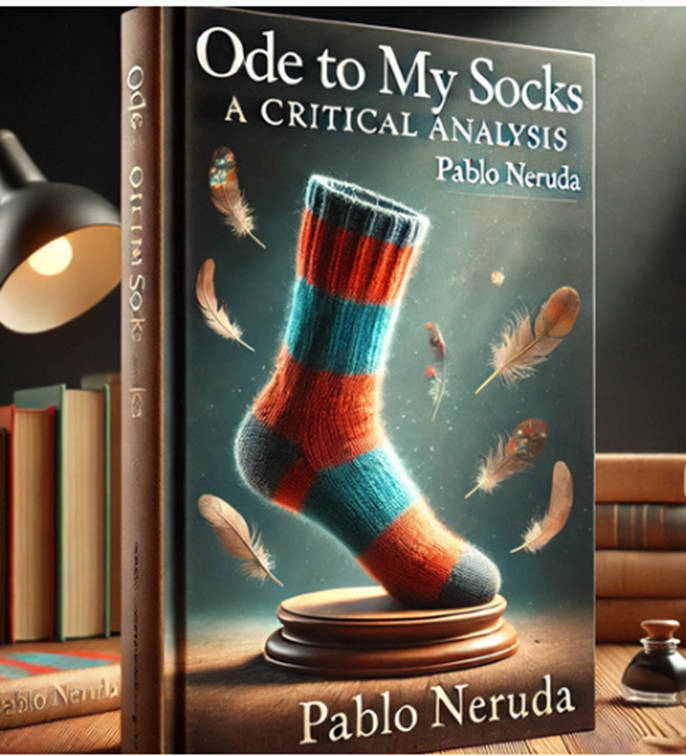
Introduction: “Ode to My Socks” by Pablo Neruda
“Ode to My Socks” by Pablo Neruda first appeared in 1956 in the collection Nuevas odas elementales (New Elementary Odes), published by Editorial Losada in Buenos Aires, as part of his mid-1950s “ode” sequence that dignifies ordinary, domestic objects. In the poem, a handmade gift becomes an event of wonder: Maru Mori’s “sheepherder’s hands” produce socks “soft / as rabbits,” and the speaker slips into them “as though into / two / cases … with threads of / twilight / and goatskin,” transforming the mundane into the mythic through lavish metaphors (“two fish made / of wool,” “two long sharks,” “two immense blackbirds,” “two cannons”) and a comic self-mockery in which his feet seem “unacceptable / like two decrepit / firemen” beside that “woven / fire.” The central idea is not merely aesthetic praise but an ethics of use: he resists turning beauty into museum-sacred property—refusing the “mad impulse” to lock them in a “golden / cage”—and instead wears them, accepting that lived warmth matters more than display. Its popularity endures because it is instantly accessible yet philosophically resonant: it honors manual labor and gift-giving, surprises with playful, cinematic imagery, and ends with a memorable, democratic “moral”—“beauty is twice / beauty … when it is a matter of two socks / made of wool / in winter”—making everyday life feel both intimate and exalted.
Text: “Ode to My Socks” by Pablo Neruda
Maru Mori brought me
a pair
of socks
which she knitted herself
with her sheepherder’s hands,
two socks as soft
as rabbits.
I slipped my feet
into them
as though into
two
cases
knitted
with threads of
twilight
and goatskin.
Violent socks,
my feet were
two fish made
of wool,
two long sharks
sea-blue, shot
through
by one golden thread,
two immense blackbirds,
two cannons:
my feet
were honored
in this way
by
these
heavenly
socks.
They were
so handsome
for the first time
my feet seemed to me
unacceptable
like two decrepit
firemen, firemen
unworthy
of that woven
fire,
of those glowing
socks.
Nevertheless
I resisted
the sharp temptation
to save them somewhere
as schoolboys
keep
fireflies,
as learned men
collect
sacred texts,
I resisted
the mad impulse
to put them
into a golden
cage
and each day give them
birdseed
and pieces of pink melon.
Like explorers
in the jungle who hand
over the very rare
green deer
to the spit
and eat it
with remorse,
I stretched out
my feet
and pulled on
the magnificent
socks
and then my shoes.
The moral
of my ode is this:
beauty is twice
beauty
and what is good is doubly
good
when it is a matter of two socks
made of wool
in winter.
“Ode to My Socks” from Neruda & Vallejo: Selected Poems, by Pablo Neruda and translated by Robert Bly (Boston: Beacon Press, 1993). Used with permission of Robert Bly.
Annotations: “Ode to My Socks” by Pablo Neruda
| Stanza | Line | Text (from your excerpt) | Annotation (what the line is doing) | Literary devices |
| 1 | 1 | Maru Mori brought me | Opens with a personal, intimate gift-giving scene. | 💠 Diction/Tone • ⚫️ Enjambment |
| 1 | 2 | a pair | Delays the object for emphasis; creates anticipation. | ⚫️ Enjambment |
| 1 | 3 | of socks | Reveals the humble object—sets up “ordinary → extraordinary.” | 💠 Diction/Tone • 🟩 Contrast/Juxtaposition |
| 1 | 4 | which she knitted herself | Highlights care, labor, and intimacy of handmade craft. | 💠 Diction/Tone • ⚫️ Enjambment |
| 1 | 5 | with her sheepherder’s hands, | Links the gift to rural work, texture, and authenticity. | 🟣 Symbolism • 🟢 Imagery • 💠 Diction/Tone |
| 1 | 6 | two socks as soft | Begins explicit praise; “two” starts a pattern of doubling. | 🟧 Repetition/Anaphora • ⚫️ Enjambment |
| 1 | 7 | as rabbits. | Softness becomes vivid through an animal comparison. | 🔵 Simile • 🟢 Imagery |
| 2 | 1 | I slipped my feet | Sensory entry into the experience; intimacy and comfort. | 🟢 Imagery • 💠 Diction/Tone • ⚫️ Enjambment |
| 2 | 2 | into them | Continuation—enacts the motion physically through line breaks. | ⚫️ Enjambment |
| 2 | 3 | as though into | Sets up an imaginative transformation of socks into “containers.” | 🔵 Simile • ⚫️ Enjambment |
| 2 | 4 | two | Pauses on number—foregrounds pairing/doubling. | 🟧 Repetition/Anaphora • ⚫️ Enjambment |
| 2 | 5 | cases | Socks become protective “cases,” upgrading them beyond clothing. | 🔴 Metaphor • 🟣 Symbolism |
| 2 | 6 | knitted | Returns to craft—textile-making becomes part of meaning. | 💠 Diction/Tone • ⚫️ Enjambment |
| 2 | 7 | with threads of | Builds a near-mystical texture; “threads” literal + figurative. | 🟣 Symbolism • ⚫️ Enjambment |
| 2 | 8 | twilight | Suggests dusk, softness, magic—time becomes material. | 🟢 Imagery • 🟣 Symbolism |
| 2 | 9 | and goatskin. | Earthy, tactile finish; combines the magical with the rustic. | 🟢 Imagery • 🟩 Contrast/Juxtaposition |
| 3 | 1 | Violent socks, | Shock adjective: elevates socks into powerful, forceful objects. | 🟩 Contrast/Juxtaposition • 💠 Diction/Tone |
| 3 | 2 | my feet were | Announces sustained metaphor: feet will be reimagined repeatedly. | 🔴 Metaphor • ⚫️ Enjambment |
| 3 | 3 | two fish made | Starts a surreal chain of metaphors—feet become creatures. | 🔴 Metaphor • 🟧 Repetition/Anaphora • ⚫️ Enjambment |
| 3 | 4 | of wool, | Mixes animal-life with textile—humor and wonder. | 🟩 Contrast/Juxtaposition • 🟢 Imagery |
| 3 | 5 | two long sharks | Escalates from “fish” to “sharks”: comic intensification. | 🔴 Metaphor • 🟧 Repetition/Anaphora • 🟠 Hyperbole/Exaggeration |
| 3 | 6 | sea-blue, shot | Color + motion suggests energy; “shot through” feels electric. | 🟢 Imagery • 💠 Diction/Tone • ⚫️ Enjambment |
| 3 | 7 | through | Suspended syntax heightens the “thread” reveal. | ⚫️ Enjambment |
| 3 | 8 | by one golden thread, | Makes a single strand feel precious; “golden” sanctifies craft. | 🟣 Symbolism • 🟢 Imagery |
| 3 | 9 | two immense blackbirds, | Metaphor shifts again; adds grandeur and size. | 🔴 Metaphor • 🟧 Repetition/Anaphora • 🟠 Hyperbole/Exaggeration |
| 3 | 10 | two cannons: | Most extreme reimagining—feet become weapons; playful excess. | 🔴 Metaphor • 🟧 Repetition/Anaphora • 🟠 Hyperbole/Exaggeration |
| 3 | 11 | my feet | Returns to reality after the metaphoric fireworks. | ⚫️ Enjambment |
| 3 | 12 | were honored | Treats feet as deserving ceremony—elevates the ordinary. | 🟡 Personification • 💠 Diction/Tone |
| 3 | 13 | in this way | Underlines the “ritual” quality of wearing them. | 🟣 Symbolism • ⚫️ Enjambment |
| 3 | 14 | by | Mini-pause heightens reverence. | ⚫️ Enjambment |
| 3 | 15 | these | Points deictically—like presenting an offering. | 💠 Diction/Tone • ⚫️ Enjambment |
| 3 | 16 | heavenly | Sacred register: socks become almost divine. | 🟣 Symbolism • 💠 Diction/Tone |
| 3 | 17 | socks. | Ends the praise-cycle; restores the humble noun after “heavenly.” | 🟩 Contrast/Juxtaposition |
| 4 | 1 | They were | Begins reflective evaluation—shift from wonder to self-judgment. | 💠 Diction/Tone • ⚫️ Enjambment |
| 4 | 2 | so handsome | Aesthetic admiration; socks treated like art/fashion. | 🟠 Hyperbole/Exaggeration • 💠 Diction/Tone |
| 4 | 3 | for the first time | Turning point: the socks change the speaker’s self-perception. | 🟣 Symbolism • ⚫️ Enjambment |
| 4 | 4 | my feet seemed to me | Self-consciousness enters; narrator becomes the object of critique. | 💠 Diction/Tone • ⚫️ Enjambment |
| 4 | 5 | unacceptable | Comic shame: feet judged against the socks’ beauty. | 🟩 Contrast/Juxtaposition • 💠 Diction/Tone |
| 4 | 6 | like two decrepit | Sets up a degrading comparison—humor through mismatch. | 🔵 Simile • 🟧 Repetition/Anaphora • ⚫️ Enjambment |
| 4 | 7 | firemen, firemen | Repetition amplifies the ridiculous image and emphasis. | 🟧 Repetition/Anaphora • 🟤 Alliteration/Sound (f) |
| 4 | 8 | unworthy | Moral language—beauty produces a sense of “deserving.” | 💠 Diction/Tone • ⚫️ Enjambment |
| 4 | 9 | of that woven | The socks become “woven fire”: craft becomes sacred energy. | 🔴 Metaphor • 🟣 Symbolism • ⚫️ Enjambment |
| 4 | 10 | fire, | Metaphor peaks: socks imagined as flame/heat, not cloth. | 🔴 Metaphor • 🟢 Imagery |
| 4 | 11 | of those glowing | Light imagery intensifies their radiance and value. | 🟢 Imagery • 🟠 Hyperbole/Exaggeration • ⚫️ Enjambment |
| 4 | 12 | socks. | Closes the stanza by returning to the object—still “glowing.” | 🟩 Contrast/Juxtaposition |
| 5 | 1 | Nevertheless | Pivot word: speaker resists turning beauty into hoarding. | 💠 Diction/Tone |
| 5 | 2 | I resisted | Introduces ethical struggle; self-discipline begins. | 🟧 Repetition/Anaphora • ⚫️ Enjambment |
| 5 | 3 | the sharp temptation | Temptation is tactile (“sharp”)—desire becomes physical. | 🟡 Personification • 🟢 Imagery |
| 5 | 4 | to save them somewhere | Critiques possessiveness: to “save” beauty by hiding it. | 🟣 Symbolism • ⚫️ Enjambment |
| 5 | 5 | as schoolboys | First analogy: childish collecting impulse. | 🔵 Simile • ⚫️ Enjambment |
| 5 | 6 | keep | Sparse verb—mimics the act of storing/holding. | ⚫️ Enjambment |
| 5 | 7 | fireflies, | Beauty as fleeting light—saving it risks killing its life. | 🟣 Symbolism • 🟢 Imagery |
| 5 | 8 | as learned men | Second analogy: scholarly collecting impulse. | 🔵 Simile • ⚫️ Enjambment |
| 5 | 9 | collect | Continues the critique of possession through accumulation. | ⚫️ Enjambment |
| 5 | 10 | sacred texts, | Elevates the socks to “sacred,” but also warns against fetishizing. | 🟣 Symbolism • 🟩 Contrast/Juxtaposition |
| 5 | 11 | I resisted | Repetition reinforces moral effort. | 🟧 Repetition/Anaphora • ⚫️ Enjambment |
| 5 | 12 | the mad impulse | Desire described as irrational—comic self-awareness. | 🟠 Hyperbole/Exaggeration • 💠 Diction/Tone |
| 5 | 13 | to put them | Sets up absurd preservation fantasy. | ⚫️ Enjambment |
| 5 | 14 | into a golden | “Golden” signals luxury; turns socks into museum treasure. | 🟣 Symbolism • 🟢 Imagery • ⚫️ Enjambment |
| 5 | 15 | cage | Beauty imprisoned—suggests wrong way to “honor” art. | 🟣 Symbolism • 🟩 Contrast/Juxtaposition |
| 5 | 16 | and each day give them | Treats socks like living pets—comic personification. | 🟡 Personification • ⚫️ Enjambment |
| 5 | 17 | birdseed | Surreal caretaking detail that makes the fantasy vivid. | 🟢 Imagery |
| 5 | 18 | and pieces of pink melon. | Luxurious, playful color imagery—heightens absurdity. | 🟢 Imagery • 🟠 Hyperbole/Exaggeration |
| 6 | 1 | Like explorers | New comparison: shifts from playful hoarding to ethical consumption. | 🔵 Simile • 💠 Diction/Tone |
| 6 | 2 | in the jungle who hand | Sets a dramatic scene; suggests “rare” beauty in the wild. | 🟢 Imagery • ⚫️ Enjambment |
| 6 | 3 | over the very rare | Intensifies value—beauty framed as scarce. | 🟠 Hyperbole/Exaggeration • ⚫️ Enjambment |
| 6 | 4 | green deer | Strange, mythical rarity; shocks the imagination. | 🟢 Imagery • 🟣 Symbolism |
| 6 | 5 | to the spit | Abrupt turn toward consumption; beauty is used, not displayed. | 🟩 Contrast/Juxtaposition • 💠 Diction/Tone |
| 6 | 6 | and eat it | The “use” becomes literal—consumption as a metaphor for living fully. | 🔴 Metaphor • ⚫️ Enjambment |
| 6 | 7 | with remorse, | Ethical tension: pleasure + guilt; complicates the moral. | 💠 Diction/Tone • 🟩 Contrast/Juxtaposition |
| 6 | 8 | I stretched out | Returns to the speaker’s body; action replaces fantasy. | ⚫️ Enjambment |
| 6 | 9 | my feet | Re-centers the ordinary self. | ⚫️ Enjambment |
| 6 | 10 | and pulled on | The simplest, correct response to beauty: wear it. | 🟣 Symbolism • ⚫️ Enjambment |
| 6 | 11 | the magnificent | Grand adjective—still reverent, but now practical. | 🟠 Hyperbole/Exaggeration • 💠 Diction/Tone |
| 6 | 12 | socks | Object returns, grounded. | ⚫️ Enjambment |
| 6 | 13 | and then my shoes. | Final grounding: everyday life continues; beauty joins routine. | 🟩 Contrast/Juxtaposition |
| 7 | 1 | The moral | Explicit didactic “ode” turn: speaker states lesson. | ✳️ Moral/Didactic turn • 💠 Diction/Tone |
| 7 | 2 | of my ode is this: | Frames poem as instructive, not just decorative praise. | ✳️ Moral/Didactic turn |
| 7 | 3 | beauty is twice | Introduces doubling as a philosophy, not merely a number. | 🟣 Symbolism • ⚫️ Enjambment |
| 7 | 4 | beauty | The repetition embodies the claim. | 🟧 Repetition/Anaphora |
| 7 | 5 | and what is good is doubly | Parallel phrasing extends the “doubling” logic to ethics. | 🟧 Repetition/Anaphora • ✳️ Moral/Didactic turn |
| 7 | 6 | good | Reinforces the didactic cadence through repetition. | 🟧 Repetition/Anaphora |
| 7 | 7 | when it is a matter of two socks | Grounds abstract moral in a concrete, comic example. | 🟩 Contrast/Juxtaposition • 💠 Diction/Tone |
| 7 | 8 | made of wool | Returns to tactile substance—warmth, craft, care. | 🟢 Imagery • 🟣 Symbolism |
| 7 | 9 | in winter. | Closes with context of need: beauty that also serves life. | 🟣 Symbolism • ✳️ Moral/Didactic turn |
| Source | 1 | “Ode to My Socks” from Neruda & Vallejo: Selected Poems… (Beacon Press, 1993)… | Publication/source note: identifies collection and translator for citation. | 💠 Diction/Tone |
Literary And Poetic Devices: “Ode to My Socks” by Pablo Neruda
| Device | Definition | Example from the poem | Explanation (how it works) |
| 🟣 Ode | A lyric poem that praises a person, thing, or idea. | Title: “Ode to My Socks” | Neruda treats socks as a subject worthy of celebration, turning the ordinary into the exalted. |
| 🟦 Free Verse | Poetry without a fixed rhyme scheme or regular meter. | Short, irregular line lengths throughout | The loose form mimics natural speech and delight, making the praise feel intimate and spontaneous. |
| 🟩 Enjambment | A sentence/phrase continues across line breaks. | “I slipped my feet / into them / as though into / two / cases” | The broken lines slow the action and heighten suspense, as if the moment deserves ceremony. |
| 🟨 Imagery (Tactile) | Sensory language, especially touch/texture. | “two socks as soft / as rabbits” | The vivid softness makes the gift physically real and emotionally warm. |
| 🔵 Simile | Comparison using like or as. | “soft / as rabbits”; “like two decrepit / firemen” | Familiar comparisons make the wonder accessible—and the “firemen” simile adds comic self-mockery. |
| 🔴 Metaphor | A direct comparison (no like/as). | “threads of twilight”; “woven / fire” | The socks become twilight and fire—beauty rendered as something you can literally wear. |
| 🟠 Extended Metaphor | A metaphor sustained and developed across several lines. | “my feet were / two fish… / two long sharks… / two immense blackbirds… / two cannons” | The speaker’s imagination cascades, magnifying the socks’ “power” by transforming the feet repeatedly. |
| 🟧 Hyperbole | Deliberate exaggeration for emphasis. | “heavenly / socks”; “beauty is twice / beauty” | Overstatement creates playful awe and insists that small comforts can feel extraordinary. |
| 🟫 Personification | Giving human qualities to nonhuman things. | “my feet / were honored… by these… socks” | The socks act like dignitaries conferring honor, making the gift feel morally significant. |
| 🟪 Repetition | Reusing words/phrases for emphasis. | “two … two … two”; “firemen, firemen” | Repetition builds rhythm and obsession: he is fixated on doubling, pairing, and emphasis. |
| ⚪ Anaphora | Repetition at the start of successive phrases/lines. | “two fish… / two long sharks… / two immense blackbirds…” | The repeated “two” turns the list into a chant, intensifying energy and wonder. |
| 🟤 Parallelism | Similar grammatical structure in a series. | “as schoolboys keep… / as learned men collect…” | Balanced phrasing strengthens the argument: the urge to “save” beautiful things is universal. |
| 🟡 Listing / Cataloguing | Accumulating a series of images or items. | fish → sharks → blackbirds → cannons | The piling-up mimics a mind in delight—each new image tops the last. |
| 🟢 Contrast (Juxtaposition) | Placing opposing ideas together for impact. | “glowing / socks” vs. “feet… unacceptable… decrepit” | The socks seem even more splendid when set beside the speaker’s unglamorous feet. |
| ⚫ Irony (playful) | Meaning shaped by a humorous gap between tone and subject. | Grand praise for something as small as socks | The poem knowingly “overpraises,” creating charm and inviting readers to value the everyday. |
| 🧿 Self-deprecating humor | Humor that lowers the speaker to avoid grandiosity. | “two decrepit / firemen… unworthy” | By mocking himself, the speaker keeps the poem tender, not boastful—gratitude feels genuine. |
| 💠 Symbolism | An object suggests broader meanings beyond itself. | “two socks / made of wool / in winter” | Socks symbolize warmth, care, craft, and human kindness—beauty that serves life. |
| 🔺 Synecdoche | A part represents the whole. | The focus on “my feet” | “Feet” stand for the whole human self—ordinary, flawed, and suddenly dignified by a gift. |
| 🧭 Allusion | Reference to recognizable practices/texts without explicit citation. | “learned men collect / sacred texts”; “explorers / in the jungle…” | These references enlarge the socks into “treasure,” while also critiquing possessive collecting. |
| 🏁 Moral / Aphorism | A concise concluding lesson or principle. | “The moral / of my ode is this: …” | The ending crystallizes the theme: usefulness doubles beauty—practical goodness is aesthetic goodness. |
Themes: “Ode to My Socks” by Pablo Neruda
- 🔵 Everyday Objects Transfigured into Wonder
“Ode to My Socks” by Pablo Neruda transforms a humble garment into a site of astonishment, because the poem argues—through image, tempo, and delighted attention—that value does not depend on grandeur but on perception and craft. What begins as a simple gift, “a pair / of socks,” is elevated by the intimacy of handmade labor and the speaker’s sensuous noticing, so that softness (“as rabbits”) and tactile warmth (“threads of twilight / and goatskin”) create a world where the mundane can glow with poetic excess. Yet the poem keeps returning to the plain noun “socks” after each imaginative ascent, and this return is crucial, for it shows that wonder is not an escape from reality but a deeper entry into it. In this way, praise becomes a method of seeing, and the ode suggests that reverence for small things is neither naïve nor trivial but an ethical and aesthetic recalibration of attention toward daily life. - 🔴 Metaphor, Imagination, and Comic Magnification of the Body
“Ode to My Socks” by Pablo Neruda unleashes imagination as a playful engine that refuses to keep scale, converting feet into “two fish made / of wool,” then into “two long sharks,” “two immense blackbirds,” and even “two cannons,” as though warmth itself triggers a carnival of identities. This chain of metaphors is not mere ornament; rather, it dramatizes how language can remake the body, and how the body—once re-described as swift, dangerous, or grand—becomes newly dignified through perception. Even the startling phrase “Violent socks” works as comic shock, because it assigns intensity to cloth and sustains that intensity through accumulating images, so that exaggeration becomes a form of joy rather than a claim of literal truth. By enlarging the humble into the magnificent, the poem implies that self-perception is pliable, and that imaginative reframing can momentarily bridge the distance between human fragility and the radiance of what is lovingly made and gratefully received. - 🟩 Desire, Restraint, and the Ethics of Possessing Beauty
“Ode to My Socks” by Pablo Neruda turns admiration into an ethical trial, because beauty invites not only enjoyment but also the anxious impulse to preserve, hoard, and protect it from use, as if use would profane what we adore. The poem stages this temptation through crisp analogies—schoolboys who keep “fireflies,” learned men who collect “sacred texts”—and these comparisons imply that reverence can quietly become possession when it tries to freeze what should live, shimmer, or circulate. When the narrator imagines placing the socks in a “golden / cage” and feeding them “birdseed” and “pieces of pink melon,” the fantasy becomes deliberately absurd, yet that absurdity exposes a recognizable reflex: to imprison the beloved object so it cannot be damaged, thereby converting affection into museum-logic. Against this, the speaker finally chooses the harder generosity of living, pulling on the “magnificent / socks,” and accepting that beauty fulfills itself when it serves rather than when it is entombed. - ✳️ Doubling, Gratitude, and the Moral Beauty of Usefulness
“Ode to My Socks” by Pablo Neruda ends with an explicit moral that turns playful imagery into a philosophy of abundance, where “beauty is twice / beauty” and what is “good” becomes “doubly / good” precisely because the gift is paired, practical, and timed to need. The poem’s emphasis on “two” is more than counting; it becomes a symbolic structure suggesting reciprocity, balance, and a small wholeness produced by care, because a pair completes what a single item cannot. Context deepens the lesson, for “in winter” introduces necessity, and necessity tests whether beauty can endure contact with life rather than remaining ornamental. By choosing to wear rather than enshrine, the speaker converts gratitude into action, implying that the highest praise for a beautiful thing is not anxious protection from the world, but participation in the world—warming the body, tempering vanity, and deepening daily existence through use, companionship, and shared human comfort.
Literary Theories and “Ode to My Socks” by Pablo Neruda
| 🟣 Marxist Criticism | Focus: labor, class, material production, value. | “Maru Mori… knitted herself / with her sheepherder’s hands” | The poem foregrounds hand-labor and craft as the true source of value; “hands” become the real “means of production,” and the speaker’s awe reframes a humble product as culturally priceless. |
| 🟦 New Historicism | Focus: text within its social/cultural moment; everyday life as history. | Title + domestic setting; “made of wool / in winter” | The ode documents a lived material culture—warmth, wool, winter need—showing how “small” domestic objects carry a history of living conditions and social relations. |
| 🟩 Feminist Criticism | Focus: gendered labor, care-work, agency, representation. | “Maru Mori brought me… a pair of socks… knitted herself” | The gift highlights women’s/household-associated labor as skilled and empowering; care-work becomes visible, honored, and central to meaning (not “background” work). |
| 🟧 Reader-Response Criticism | Focus: meaning formed through reader experience and emotional response. | “two socks as soft / as rabbits”; “The moral… beauty is twice / beauty” | The poem invites readers to feel softness and delight, then guides interpretation with an explicit “moral,” encouraging readers to connect personal experience (comfort, gifts) to the poem’s meaning. |
Critical Questions about “Ode to My Socks” by Pablo Neruda
- 🟣 How does the poem transform ordinary socks into something sublime?
“Ode to My Socks” by Pablo Neruda begins by treating a small domestic gift as an occasion for lyric revelation, so that “a pair / of socks” is lifted into wonder through sensuous detail and imaginative comparison. The softness “as rabbits” is not mere ornamentation but a claim that touch can be a form of knowledge, and the speaker’s pleasure becomes a serious way of seeing. As he slips his feet into “two / cases” knitted with “threads of / twilight / and goatskin,” the ordinary object absorbs the language of dusk, animals, and elemental texture, until it feels like nature translated into clothing. The metaphoric surge—feet as “two fish,” “two long sharks,” “two immense blackbirds”—works as escalating praise, showing gratitude as a force that re-scripts the body from routine to radiant. When the socks become “heavenly,” the poem completes its transformation: the sublime is not distant; it is produced by attention, metaphor, and love for the everyday. - 🟦 What moral stance does the poem take on beauty—should it be preserved or used?
“Ode to My Socks” by Pablo Neruda stages a temptation many readers recognize: once beauty appears, the mind wants to freeze it into an object of display rather than a lived experience. The speaker admits “the sharp temptation” to “save them somewhere,” and his comparisons—schoolboys keeping “fireflies,” learned men collecting “sacred texts”—quietly reveal how preservation can become captivity even when it calls itself reverence. The fantasy of a “golden / cage,” complete with “birdseed” and “pieces of pink melon,” makes the impulse comically literal, as if beauty were a pet to be exhibited instead of a gift meant to function. Yet the poem chooses use, not as contempt for beauty, but as its highest honor: he pulls on the “magnificent / socks” and then his shoes, accepting the small “remorse” of consumption so that warmth can enter daily life. The closing “moral” insists that beauty doubles when it becomes practical goodness, especially in winter. - 🟩 Why does the poem describe comfort with “violent” animal-and-weapon imagery?
“Ode to My Socks” by Pablo Neruda deliberately shocks by describing tenderness in the language of force, because it wants to show that comfort can feel overwhelming, even transformative, when it arrives as intimate care. The phrase “Violent socks” creates a fruitful contradiction: softness is framed as power, and the body is reimagined in startling metamorphoses—“two long sharks,” “two immense blackbirds,” “two cannons”—as if warmth were a kind of armor rather than mere coziness. These images are comic, yet they also suggest defense, since winter makes the world adversarial and wool becomes protection against cold; in that sense, the socks are “violent” only toward deprivation. The “sea-blue” wool “shot / through / by one golden thread” intensifies the effect, implying craft, precision, and a flash of value embedded inside the everyday. By pairing ferocity with domesticity, the poem dignifies care-work as strong rather than sentimental, and it lets the reader feel how a handmade object can “honor” a body. - 🟧 What does the poem suggest about gift-giving, labor, and intimacy?
“Ode to My Socks” by Pablo Neruda treats the gift less as an object than as a relationship made visible, which is why it names the giver—“Maru Mori”—and emphasizes that she knitted the socks “with her sheepherder’s hands,” tying beauty to skilled labor and lived history. Because the socks are handmade, they carry time, attention, and knowledge of another person’s needs, and the speaker’s astonishment becomes ethical recognition: he receives not only wool but also care. Yet intimacy is complicated by embarrassment, as his feet seem “unacceptable” and “decrepit,” suggesting that a genuine gift exposes vulnerability by revealing how ordinary—and needy—the human body is. His impulse to preserve the socks like “fireflies” or “sacred texts” shows how love can slip toward possessiveness when it tries to immortalize beauty, but the poem resolves this by choosing use: wearing them completes the gift’s purpose and honors the labor behind it. The final claim—beauty and goodness doubled—frames intimacy as practical, warm, and shared.
Literary Works Similar to “Ode to My Socks” by Pablo Neruda
- 🍅 “Ode to the Tomato” — Pablo Neruda: Like “Ode to My Socks,” this poem elevates an everyday object through sensuous imagery and exuberant praise, making the ordinary feel radiant and celebratory. (Poets of Modernity)
- 🥬 “Ode to the Artichoke” — Pablo Neruda: Like “Ode to My Socks,” it uses playful, surprising metaphors to transform a common thing into something heroic and wondrous, blending humor with admiration. (versedaily.org)
- 🟤 “Ode to Dirt” — Sharon Olds: Like “Ode to My Socks,” it honors what is usually overlooked, addressing the humble subject directly and turning appreciation into an ethical, almost reverent recognition. (The Library of Congress)
- 🍑 “This Is Just To Say” — William Carlos Williams: Like “Ode to My Socks,” it finds poetry in the domestic and immediate, using plain diction and sharp sensory detail to make a small everyday moment feel memorable. (poetryfoundation.org)
Representative Quotations of “Ode to My Socks” by Pablo Neruda
| Quotation | Context in the poem | Theoretical perspective + explanation |
| 🧦🔵🟢 “two socks as soft / as rabbits.” | The gift is introduced, and the speaker begins praising its tactile comfort. | Phenomenology (embodied experience): The simile makes touch thinkable; meaning starts in sensation, as the body becomes the first “reader” of the object. |
| 🌒🟢🟣 “with threads of / twilight / and goatskin.” | The socks are imagined as woven from dusk and animal hide, blending craft with the elemental. | Ecocriticism (nature-texture nexus): Natural materials and twilight imagery collapse the human/nature divide, presenting warmth as an ecological intimacy rather than mere commodity. |
| ⚡💠 “Violent socks,” | An abrupt, shocking description jolts the reader into surprise. | Defamiliarization (Russian Formalism): By attaching “violent” to “socks,” the poem breaks habitual perception so the ordinary returns as strange, vivid, and newly perceptible. |
| 🐟🔴🟧 “my feet were / two fish made / of wool,” | Wearing the socks triggers a cascade of wild transformations of the speaker’s feet. | Conceptual Metaphor (cognitive poetics): The self is re-mapped through metaphor, turning bodily awkwardness into energetic, animated identity. |
| 🦈🔴🟠🟢 “two long sharks / sea-blue, shot / through / by one golden thread,” | The metaphors escalate in scale and intensity, while a single thread becomes a luminous detail. | Aesthetic theory (the ‘aura’ of craft): The “golden thread” functions like a concentrated emblem of workmanship, making material detail feel precious and almost sacred. |
| ☁️🟣🟡 “my feet / were honored … by … these / heavenly / socks.” | The speaker describes the socks as conferring dignity on even the most overlooked body-part. | Ethics of care / Gift theory: The handmade gift carries relational value, and “honored” frames wearing as recognition of the giver’s labor and love. |
| 🚒🔵🟩 “my feet seemed to me / unacceptable / like two decrepit / firemen” | The socks’ beauty makes the speaker suddenly judge his own feet as unworthy. | Psychoanalytic (idealization & shame): The adored object becomes an ideal standard that produces self-disgust, exposing how beauty can generate anxious self-comparison. |
| 🧠🟩💠 “I resisted / the sharp temptation / to save them somewhere” | The speaker debates preserving the socks as a treasured object rather than using them. | Marxist / Material culture critique: The poem critiques fetishizing objects as possessions; value is tested not by display but by lived use. |
| 🏆🟡🟢🟣 “into a golden / cage … give them / birdseed / and pieces of pink melon.” | A humorous fantasy imagines treating socks like living, pampered creatures. | Postmodern irony (commodity satire): The absurd “care routine” mocks luxury logic—turning preservation into a parody of consumer worship. |
| ✳️🟧 “beauty is twice / beauty / and what is good is doubly / good” | The poem concludes with an explicit moral about doubling, goodness, and winter usefulness. | Moral philosophy (virtue ethics): The “good” is practical and relational—beauty becomes ethically complete when it participates in life (warming, pairing, being worn). |
Suggested Readings: “Ode to My Socks” by Pablo Neruda
Books
- Neruda, Pablo, and César Vallejo. Neruda and Vallejo: Selected Poems. Translated by Robert Bly et al., Beacon Press, 1993.
- Neruda, Pablo. Selected Odes of Pablo Neruda. Translated and introduced by Margaret Sayers Peden, University of California Press, 2011.
Academic articles
- Holzinger, Walter. “Poetic Subject and Form in the ‘Odas Elementales’.” Revista Hispánica Moderna, vol. 36, nos. 1–2, 1970, pp. 41–49. JSTOR, https://www.jstor.org/stable/30203091
- Mascia, Mark J. “Honoring Everyday Alimentation: The Case of Pablo Neruda’s Odas elementales and Food.” Convivium Artium, 2000. DigitalCommons@SHU, https://digitalcommons.sacredheart.edu/lang_fac/11/
Poem websites
- Neruda, Pablo. “Ode to My Socks.” Academy of American Poets, https://poets.org/poem/ode-my-socks. Accessed 1 Dec. 2025.
- Neruda, Pablo. “Oda a los calcetines.” Currículum Nacional (Ministerio de Educación de Chile), https://www.curriculumnacional.cl/614/w3-article-26006.html. Accessed 1 Dec. 2025.