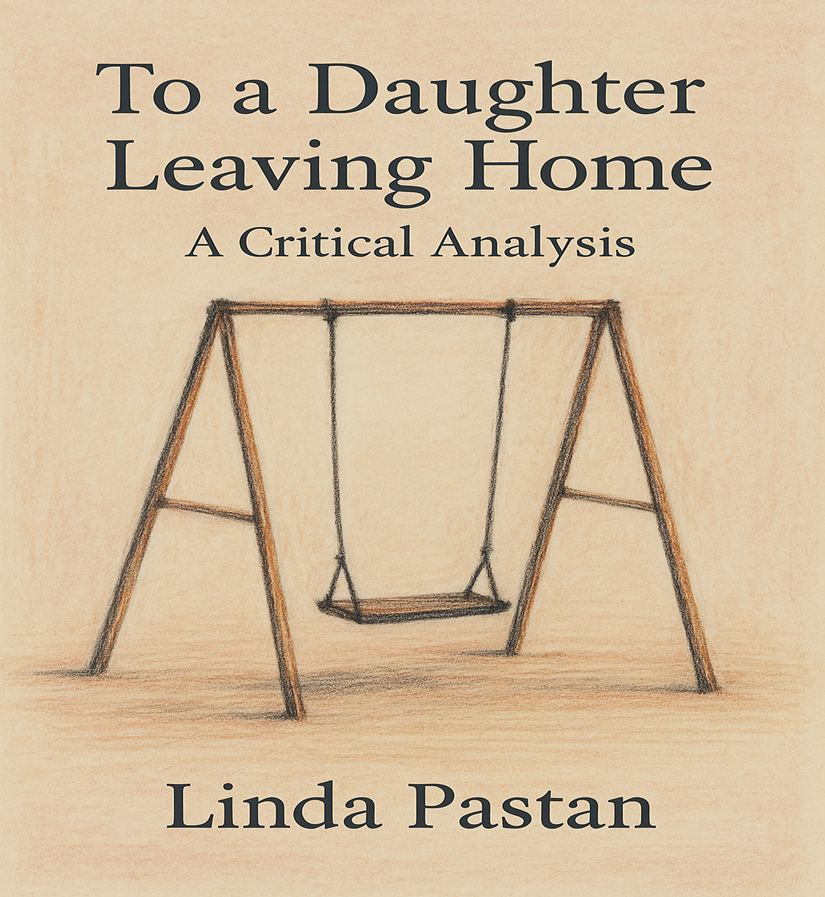
Introduction: “To a Daughter Leaving Home” by Linda Pastan
“To a Daughter Leaving Home” by Linda Pastan first appeared in 1988, in her poetry collection The Imperfect Paradise (W. W. Norton). Using the childhood moment of teaching an eight-year-old to ride a bicycle as an extended metaphor for the larger arc of parenting, the poem crystallizes the paradox of love: you must help a child move forward even as you fear the consequences of distance. The speaker’s anxious vigilance—“I kept waiting / for the thud / of your crash”—captures parental dread, while the child’s growing autonomy is rendered as she pulls “ahead down the curved / path,” becoming “smaller, more breakable / with distance.” The girl’s fierce aliveness (“pumping, pumping / for your life, screaming / with laughter”) contrasts with the parent’s instinct to protect, and the closing simile—hair “like a / handkerchief waving / goodbye”—turns an ordinary image into a quiet rite of passage, where “leaving home” begins long before the suitcase. Its popularity endures because Pastan compresses a universal experience into plain, lyrical diction and a single, cinematic scene that readers instantly recognize, and its wide circulation in teaching contexts (including the Library of Congress Poetry 180 selection) keeps it culturally present across generations.
Text: “To a Daughter Leaving Home” by Linda Pastan
When I taught you
at eight to ride
a bicycle, loping along
beside you
as you wobbled away
on two round wheels,
my own mouth rounding
in surprise when you pulled
ahead down the curved
path of the park,
I kept waiting
for the thud
of your crash as I
sprinted to catch up,
while you grew
smaller, more breakable
with distance,
pumping, pumping
for your life, screaming
with laughter,
the hair flapping
behind you like a
handkerchief waving
goodbye.
© by owner. provided at no charge for educational purposes.
Annotations: “To a Daughter Leaving Home” by Linda Pastan
| # | Line / stanza unit | Annotation | Literary devices |
| 0 | Legend (symbols used below) | Use this key to read the “devices” column. | 🔴 Metaphor / extended metaphor; 🔵 Simile; 🟢 Imagery (visual/kinesthetic); 🟠 Symbolism; 🟣 Repetition; 🟡 Sound (alliteration/assonance/consonance); 🟤 Enjambment / line-break effect; ⚫ Contrast / tone shift / irony; 🩶 Hyperbole / intensifier |
| 1 | When I taught you | Opens in a reflective, parental “I–you” frame; intimacy and memory. | 🟠 Symbolism (teaching = parenting); 🟤 Enjambment |
| 2 | at eight to ride | Pins the memory to a tender age: innocence + vulnerability. | 🟠 Symbolism (early independence); 🟤 Enjambment |
| 3 | a bicycle, loping along | Sets the central scene; “loping” gives a jogging, protective rhythm. | 🔴 Extended metaphor (cycling = life/independence); 🟢 Kinetic imagery; 🟤 Enjambment |
| 4 | beside you | Emphasizes proximity—support without controlling. | 🟠 Symbolism (guidance); 🟤 Enjambment |
| 5 | as you wobbled away | The child’s instability + movement away; early separation begins. | 🟢 Imagery; ⚫ Contrast (caregiver steadiness vs child wobble); 🟤 Enjambment |
| 6 | on two round wheels, | Concrete detail grounds the metaphor; “round” hints at cycles/continuity. | 🟢 Imagery; 🟠 Symbolism (life’s cycles); 🟡 Assonance/soft sounds; 🟤 Enjambment |
| 7 | my own mouth rounding | Parent mirrors the “rounding” (wheels → mouth): embodied shock. | 🟢 Imagery; 🟡 Assonance (“rounding”); ⚫ Subtle irony (parent amazed by child’s forwardness); 🟤 Enjambment |
| 8 | in surprise when you pulled | The moment independence asserts itself: child “pulls” ahead. | 🔴 Extended metaphor; ⚫ Contrast (expected dependence vs sudden autonomy); 🟤 Enjambment |
| 9 | ahead down the curved | Distance increases; “curved” suggests an uncertain future path. | 🟠 Symbolism (life-path); 🟢 Imagery; 🟤 Enjambment |
| 10 | path of the park, | Safe training ground—yet still a rehearsal for bigger departures. | 🟠 Symbolism (protected world / childhood “park”); 🟤 Enjambment |
| 11 | I kept waiting | Signals anxiety; parent’s vigilance becomes the emotional center. | ⚫ Tone (worry/anticipation); 🟤 Enjambment |
| 12 | for the thud | A stark, blunt sound: fear of harm compressed into one word. | 🟡 Sound (onomatopoeic feel); ⚫ Tone intensification; 🟤 Enjambment |
| 13 | of your crash as I | Extends the feared scenario; the parent’s body reacts instantly. | ⚫ Contrast (fear vs child’s freedom); 🟤 Enjambment |
| 14 | sprinted to catch up, | Love as reflex: protection is urgent, almost involuntary. | 🟢 Kinetic imagery; ⚫ Tension; 🟤 Enjambment |
| 15 | while you grew | Two motions at once: parent chasing, child expanding into selfhood. | 🔴 Extended metaphor; ⚫ Contrast (growth vs pursuit); 🟤 Enjambment |
| 16 | smaller, more breakable | Paradox of distance: as the child becomes “bigger” in life, she looks fragile to the parent. | ⚫ Paradox/irony; 🟢 Visual imagery; 🟠 Symbolism (perceived vulnerability); 🟤 Enjambment |
| 17 | with distance, | Names the cause: separation itself produces the parent’s fear. | 🟠 Symbolism (emotional distance); 🟤 Enjambment |
| 18 | pumping, pumping | Breathless momentum; the child’s will-to-go-forward. | 🟣 Repetition (insistence, rhythm); 🟢 Kinetic imagery; 🟤 Enjambment |
| 19 | for your life, screaming | Heightens stakes—parent reads the ride as survival-training. | 🩶 Hyperbole/intensifier (“for your life”); ⚫ Tone (anxiety peaks); 🟢 Imagery; 🟤 Enjambment |
| 20 | with laughter, | Swerves into joy: the child experiences freedom, not danger. | ⚫ Contrast (parental dread vs child’s delight); 🟤 Enjambment |
| 21 | the hair flapping | A crisp, cinematic detail; motion becomes visual farewell. | 🟢 Imagery; 🟤 Enjambment |
| 22 | behind you like a | Prepares the poem’s most memorable comparison; suspense at the line break. | 🟤 Enjambment (delay sharpens impact); 🔵 Simile (setup) |
| 23 | handkerchief waving | The ride becomes a symbolic departure gesture; the ordinary turns ceremonial. | 🔵 Simile; 🟠 Symbolism (farewell / letting go); 🟢 Imagery; ⚫ Tone (tender ache) |
| 24 | goodbye. | Finality in a single word: love releases, but grieves. | 🟠 Symbolism (separation/coming-of-age); ⚫ Tone (quiet closure) |
Literary And Poetic Devices: “To a Daughter Leaving Home” by Linda Pastan
| Device | Short definition | Example from the poem | Explanation / effect |
| Alliteration | Repetition of initial consonant sounds | “path of the park” | The repeated p sound gives the memory a gentle rhythm and makes the scene feel vivid and immediate. |
| Assonance | Repetition of vowel sounds | “two round wheels / my own mouth rounding” | Echoed oo/ou sounds mimic the “roundness” of wheels and mouth, subtly binding action to emotion. |
| Consonance | Repetition of consonant sounds within/at ends of words | “wobbled away… curved / thud” | The recurring d taps like small impacts, reinforcing the mother’s fear of a fall. |
| Caesura | A pause created by punctuation mid-line | “on two round wheels, / my own mouth rounding” | The comma forces a breath—like a quick, startled pause—matching the speaker’s sudden astonishment. |
| Enjambment | A thought runs on past the line break | “loping along / beside you / as you wobbled away” | The run-on lines simulate continuous motion, like jogging alongside a moving bicycle. |
| Free verse / Lineation | Poetry without fixed rhyme/meter; meaning shaped by line breaks | Short, broken lines throughout | The fragmented layout mirrors breathless running and the stop-start pulse of anxiety and pride. |
| Visual imagery | Descriptive language that appeals to sight | “two round wheels,” “curved / path,” “hair flapping” | Creates a film-like snapshot of the daughter’s ride, making the memory tactile and cinematic. |
| Auditory imagery | Sound details | “the thud,” “screaming / with laughter” | Contrasts the sound the mother expects (crash) with the sound that arrives (joy). |
| Kinetic imagery | Language of movement/action | “loping,” “sprinted,” “pumping, pumping” | Keeps the poem in motion, embodying both the bike’s momentum and the parent’s urgent pursuit. |
| Onomatopoeia | A word that imitates a sound | “thud” | A single blunt sound-word condenses the mother’s dread into one imagined impact. |
| Repetition | Repeated word/phrase for emphasis | “pumping, pumping” | Mimics pedaling rhythm and amplifies intensity—effort, urgency, and life-force. |
| Hyperbole | Deliberate exaggeration | “pumping… for your life” | Heightens the moment into something existential: the ride becomes a rehearsal for survival and independence. |
| Simile | Comparison using like/as | “hair flapping / behind you like a / handkerchief” | Turns a child’s ponytail into a farewell gesture—sweet, shocking, and final. |
| Symbolism | Concrete object stands for an abstract idea | “a bicycle” / “wheels” / “path” | The bike ride symbolizes growing up: balance, risk, speed, and the inevitability of moving away. |
| Extended metaphor (letting go) | A sustained metaphor across a passage | The whole ride scene as a lesson in separation | Teaching balance becomes teaching life; the parent’s job shifts from holding to releasing. |
| Foreshadowing | Hinting at what may come later | “waiting / for the thud / of your crash” | Predicts future pains (mistakes, falls, departures) that come with independence—even if not today. |
| Juxtaposition / Contrast | Placing opposites side by side | “thud… crash” vs “laughter” | Tightens the emotional tension: fear and joy occupy the same moment, like two truths at once. |
| Connotation | Emotional/associative meanings of words | “smaller, more breakable” | “Breakable” frames the child as fragile; distance increases vulnerability in the parent’s imagination. |
| Tone | Speaker’s attitude | Anxious, tender, amazed throughout | The voice mixes protectiveness with pride—love expressed as both celebration and dread. |
| Point of view (first-person address) | Speaker uses “I” and speaks to “you” | “When I taught you” | The direct address makes the poem intimate—like a private confession from parent to child. |
Themes: “To a Daughter Leaving Home” by Linda Pastan
· 🔴 Parental Anxiety as Protective Love
To a Daughter Leaving Home by Linda Pastan: The poem frames parental anxiety not as weakness but as the vigilant underside of care, because the speaker runs “loping along / beside you” and yet still “kept waiting / for the thud / of your crash,” as though every step forward carries an invisible risk. Even when the child succeeds, the fear does not dissolve; instead, it sharpens into anticipation, since the mother “sprinted to catch up” while the daughter moved farther down the “curved / path,” and the curve suggests a future the parent cannot see or control. What makes the worry poignant is that it arises precisely at the moment of progress, so the triumph of balance becomes the trigger for imagining falls. When the daughter grows “smaller, more breakable / with distance,” the speaker reveals how love can magnify vulnerability, turning separation into an ache that keeps pace with pride.
· 🔵 Autonomy and the First Practice of Leaving
To a Daughter Leaving Home by Linda Pastan: Independence emerges as the poem’s quiet drama, because the daughter begins by “wobbl[ing] away” and then, almost abruptly, “pulled / ahead,” transforming a simple lesson into a first rehearsal of departure. The park setting feels safe, yet the “curved / path” implies that even in protected spaces the child’s forward motion will bend toward unknown destinations, and the parent’s role is reduced to accompaniment rather than command. Pastan intensifies autonomy through bodily rhythm—“pumping, pumping”—so effort becomes a kind of identity in motion, while the charged phrase “for your life” suggests that learning to ride is also learning to persist. At the same time, the daughter experiences freedom as delight, “screaming / with laughter,” which places joy beside danger and shows a child who cannot interpret distance as loss. Thus, leaving home begins here, not as a suitcase moment, but as momentum.
· 🟢 Memory, Retrospection, and Double Time
To a Daughter Leaving Home by Linda Pastan: The poem’s tenderness depends on double time, because the speaker remembers “When I taught you” at eight while addressing a present in which “leaving home” is imminent, so the childhood scene becomes both recollection and prophecy. Details like “my own mouth rounding / in surprise” preserve the body’s immediate astonishment, yet the adult voice overlays interpretation, reading that small advance—“you pulled / ahead”—as an early version of the later separation. Enjambment carries sentences forward with the same unstoppable glide as the bicycle, and that forward spill mirrors a mind that cannot stop projecting, since one memory opens into a chain of anticipated departures. Distance functions as the hinge between past and present: as the daughter moves away on the path, she also moves away in time, and the mother’s gaze makes her “smaller, more breakable,” as though memory itself miniaturizes what it loves. Retrospection, then, becomes an emotional second ride.
· 🟣 Farewell Symbolism and Bittersweet Acceptance
To a Daughter Leaving Home by Linda Pastan: The closing image turns ordinary motion into a symbolic goodbye, because the daughter’s “hair flapping / behind you like a / handkerchief waving / goodbye” converts speed into a farewell gesture and makes departure feel both natural and unavoidable. A handkerchief implies parting, tears, and tenderness, so the simile quietly formalizes what the poem has been staging all along: the parent must let the child go even while the heart strains to keep pace. Significantly, Pastan refuses to end with disaster; although the speaker anticipates “the thud,” the poem resolves in laughter and a wave, suggesting that growing up is not a crash but a continuous leaving that can be survivable, even beautiful. The child’s exuberance—“screaming / with laughter”—does not negate the mother’s ache; it deepens it, because joy accelerates distance. What remains is bittersweet acceptance, where love releases without pretending it doesn’t hurt.
Literary Theories and “To a Daughter Leaving Home” by Linda Pastan
| 🔴📚 Theory | Core lens | References from the poem | What the lens reveals in this poem |
| 🔴📚 Feminist Literary Criticism | Gendered roles, care-work, mother–daughter subjectivity, social scripts | “When I taught you”; “I kept waiting / for the thud”; “sprinted to catch up” | Highlights maternal labor and emotional management: the mother’s “teaching” and “sprinting” show caregiving as embodied work, while the daughter’s forward motion signals a girl’s emerging agency beyond protective limits. |
| 🔵🧠 Psychoanalytic Criticism | Anxiety, attachment/separation, projection, unconscious fears | “my own mouth rounding / in surprise”; “I kept waiting / for the thud / of your crash”; “smaller, more breakable / with distance” | Reads the ride as a separation drama: the mother projects catastrophe (“thud”) and experiences distance as threat; the daughter’s growing “smaller” activates fear of loss, revealing ambivalence—pride entwined with panic. |
| 🟢🌿 Ecocriticism | Human experience through place, environment, movement through landscape | “curved / path of the park”; “with distance”; “hair flapping / behind you” | Treats the park-path as more than setting: the curving path suggests life’s nonlinearity; distance is spatial and emotional. Nature/space becomes the medium through which independence happens—freedom is literally “worked out” in open air. |
| 🟣🏛️ New Historicism / Cultural Materialism | Everyday practices shaped by culture; family pedagogy, norms, power in ordinary scenes | “at eight”; “taught you… to ride / a bicycle”; “handkerchief waving / goodbye” | Interprets the scene as a culturally learned rite of passage: learning to ride marks entry into mobility/autonomy. The “handkerchief” evokes older farewell rituals, turning a modern childhood moment into a culturally saturated goodbye narrative. |
Critical Questions about “To a Daughter Leaving Home” by Linda Pastan
· 🔴 How does the bicycle lesson function as an extended metaphor for separation and adulthood?
“To a Daughter Leaving Home” by Linda Pastan turns the bicycle lesson into a living metaphor for growing up, because the child’s movement from “wobbled away” to “pulled / ahead” compresses the shift from dependence to autonomy into one visible progression. The mother’s “loping along / beside you” suggests guidance that is intimate yet necessarily temporary, while the “curved / path” implies that life’s direction will soon bend beyond parental sight, so that adulthood appears less as a sudden break than as a widening arc of distance. Meanwhile, the speaker “kept waiting / for the thud / of your crash,” and this imagined impact converts ordinary risk into existential threat, as though every step toward freedom contains the possibility of harm. Yet the daughter is “screaming / with laughter,” and the poem therefore holds two truths together: the parent reads departure as danger, while the child experiences it as joy.
· 🔵 What does the poem suggest about the ethics of parenting—support, control, and the limits of protection?
“To a Daughter Leaving Home” by Linda Pastan proposes that good parenting is a disciplined balance between help and release, because the mother runs close enough to steady the child but not so close that she prevents the child from learning independence. The speaker’s posture—“beside you”—signals companionship rather than possession, yet her reflex to “sprint…to catch up” reveals how quickly love becomes protective urgency when danger is imagined. What deepens the ethical tension is that the child’s forward motion is the very goal of the lesson, and therefore the mother’s fear cannot be solved by stopping the movement without betraying the purpose of teaching. As the daughter grows “smaller, more breakable / with distance,” the poem shows how separation distorts perception: the more capable the child becomes, the more fragile she looks in the parent’s mind. In this way, Pastan frames parenting as courageous restraint, where permission is offered even while the heart trembles.
· 🟢 How do form, pacing, and repetition shape the reader’s emotional experience of the scene?
“To a Daughter Leaving Home” by Linda Pastan uses short lines and heavy enjambment to mimic the forward glide of a bicycle, so that the reader feels motion as continuous, breathy, and difficult to halt. Because the sentence keeps spilling across line breaks, the poem reproduces the mother’s running rhythm, and the lack of full stops sustains the sensation of pursuit, as though worry itself must keep moving. The sudden bluntness of “thud” interrupts that glide with a hard sonic weight, creating an emotional jolt that resembles the mother’s feared crash even before any crash occurs. Repetition intensifies this physicality: “pumping, pumping” sounds like repeated pedal-strokes, but it also becomes a heartbeat of survival, especially when followed by “for your life,” which lifts the moment from ordinary learning into high-stakes meaning. By pacing fear beside laughter, the poem makes tenderness feel urgent rather than merely nostalgic.
· 🟣 Why is the ending image so memorable, and what kind of “goodbye” does it finally deliver?
“To a Daughter Leaving Home” by Linda Pastan ends with an image that is unforgettable because it converts a small, everyday detail into a ceremonial sign of parting: the daughter’s “hair flapping / behind you like a / handkerchief waving / goodbye.” The simile is gentle, yet its emotional reach is large, since a handkerchief suggests farewell and the possibility of tears, meaning that leaving is already inscribed in the scene of learning. Importantly, the poem refuses the disaster it repeatedly anticipates—“the thud / of your crash”—and instead offers a goodbye made of motion, wind, and continuation, as though growing up is less about breaking than about moving beyond the parent’s grasp. The daughter’s “screaming / with laughter” keeps the ending from collapsing into sorrow, but it also sharpens the mother’s ache, because joy accelerates distance. The goodbye delivered here is therefore bittersweet acceptance: release without denial, love without possession, and pride threaded with grief.
Literary Works Similar to “To a Daughter Leaving Home” by Linda Pastan
- 🟩 “Walking Away” — Cecil Day-Lewis: Like Pastan’s bike-lesson, it captures the parent’s ache of watching a child move away into independence—love “proved in the letting go.”
- 🟦 “The Writer” — Richard Wilbur: Similar in its tender parental gaze—an adult “paus[ing]” nearby while a daughter pushes forward with her own difficult, private momentum.
- 🟨 “A Prayer for My Daughter” — W. B. Yeats: Like Pastan’s poem, it’s a direct address to a daughter shaped by protective worry and hope as she grows beyond the parent’s control.
- 🟥 “Mother to Son” — Langston Hughes: It echoes the parent-to-child counsel at the heart of Pastan’s scene—love expressed as guidance for endurance, forward motion, and not turning back.
Representative Quotations of “To a Daughter Leaving Home” by Linda Pastan
| Quotation | Context in the poem | Theoretical perspective + explanation |
| 🔴 “When I taught you” | The speaker begins by recalling a specific lesson from childhood. | Feminist criticism: foregrounds maternal care-work as active “teaching,” showing motherhood as labor, responsibility, and emotional stewardship rather than a passive role. |
| 🟠 “at eight to ride” | The daughter is precisely aged; the memory is anchored in a rite-of-passage moment. | New Historicism / Cultural materialism: learning to ride becomes a culturally coded milestone—an everyday practice through which society scripts “growing up” and mobility. |
| 🟡 “as you wobbled away” | The child’s instability marks early, fragile independence. | Psychoanalytic / attachment lens: the “wobble” triggers separation-anxiety; the parent’s psyche anticipates danger as the child moves beyond immediate control. |
| 🟢 “two round wheels” | The bicycle is defined in simple, concrete imagery. | Symbolic / structural reading: the wheels imply balance and forward motion—an object that carries the abstract idea of autonomy (staying upright = coping in life). |
| 🔵 “my own mouth rounding / in surprise” | The mother’s body reacts instinctively to the daughter’s sudden competence. | Affect theory: the poem records emotion as bodily event—astonishment is not just thought, it’s physically formed (“mouth rounding”), emphasizing lived intensity. |
| 🟣 “you pulled ahead” | The daughter outpaces the mother; control shifts. | Narratology (power dynamics in voice): the narrative pivots from guidance to lag; the plot’s “advance” is the child’s, while the parent becomes a following consciousness. |
| 🟥 “waiting… for the thud” | The mother imagines the crash before it happens. | Psychoanalytic lens: anticipatory dread and projection—fear invents the “thud” as a mental event, revealing how love can generate catastrophe-scripts. |
| 🟧 “I sprinted to catch up” | The parent’s instinct is pursuit and rescue. | Feminist criticism: shows protective labor as urgent, physical, and self-effacing—care is an action the mother performs, even when the child is already moving forward. |
| 🟨 “smaller, more breakable” | Distance makes the daughter appear fragile in the mother’s perception. | Reader-response / phenomenology: “breakable” is perception shaped by emotion; the poem demonstrates how distance alters what the parent feels the child is. |
| 🟩 “handkerchief… goodbye” | The ending image turns the daughter’s hair into a farewell gesture. | Ecocriticism (space & distance): the park-path and moving air (“flapping”) make departure tangible; environment and motion collaborate to stage a quiet “leaving.” |
Suggested Readings: “To a Daughter Leaving Home” by Linda Pastan
Books
- Pastan, Linda. The Imperfect Paradise: Poems. W. W. Norton & Company, 1988. URL: https://books.google.com/books/about/The_Imperfect_Paradise.html?id=IilpQgAACAAJ
- Pastan, Linda. Carnival Evening: New and Selected Poems, 1968–1998. W. W. Norton & Company, 1998. URL: https://www.nationalbook.org/books/carnival-evening-new-and-selected-poems-1968-1998/
Academic articles
- Olivetti, Katherine. “The Ordinary, Metaphor, and Depth: A Conversation with Poet Linda Pastan.” Jung Journal: Culture & Psyche, vol. 9, no. 1, 2015, pp. 104–115. DOI: 10.1080/19342039.2015.988080. URL: https://www.tandfonline.com/toc/ujun20/9/1?nav=tocList
- Lerner, Anne Lapidus. “Back to the Beginning: An Exploration of the Roles Played by Eve and the Garden of Eden in Modern Poetry by Jewish Women.” Nashim: A Journal of Jewish Women’s Studies & Gender Issues, no. 19, 2010, pp. 9–31. DOI: 10.2979/NAS.2010.-.19.9. URL: https://www.jstor.org/stable/10.2979/nas.2010.-.19.9
Poem websites
- Pastan, Linda. “To a Daughter Leaving Home.” Poetry 180, Library of Congress. Accessed 4 Dec. 2025. URL: https://www.loc.gov/programs/poetry-and-literature/poet-laureate/poet-laureate-projects/poetry-180/all-poems/item/poetry-180-075/to-a-daughter-leaving-home/
- Pastan, Linda. “To a Daughter Leaving Home.” The Writer’s Almanac, American Public Media, 24 May 2013. Accessed 4 Dec. 2025. URL: https://writersalmanac.publicradio.org/index.php?date=2013%2F05%2F24.html