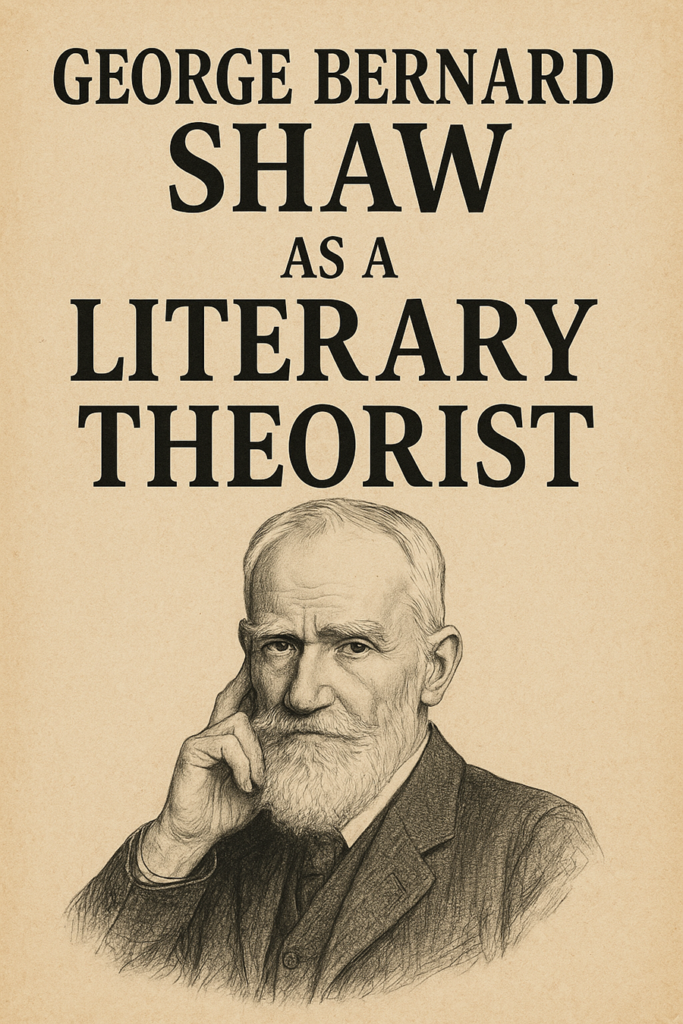
George Bernard Shaw as a Literary Theorist

George Bernard Shaw as a Literary Theorist is best understood as a social critic who treats criticism as an instrument of intellectual and public reform—a stance summed up in his refusal to write on merely aesthetic grounds: “For art’s sake alone I would not face the toil of writing a single sentence” (Shaw, qtd. in Weintraub ix).

George Bernard Shaw as a Literary Theorist
Introduction: George Bernard Shaw as a Literary Theorist

George Bernard Shaw as a Literary Theorist is best understood as a social critic who treats criticism as an instrument of intellectual and public reform—a stance summed up in his refusal to write on merely aesthetic grounds: “For art’s sake alone I would not face the toil of writing a single sentence” (Shaw, qtd. in Weintraub ix). Born 26 July 1856 in Dublin, Ireland, and deceased 2 November 1950 in Ayot St. Lawrence, Hertfordshire, England (Britannica), Shaw grew up in “genteel poverty,” and his early education was uneven: he was first tutored by a clerical uncle, then attended schools he largely rejected; by age 16 he was already employed in a land agent’s office (Britannica). His full education, however, was largely self-directed: after moving to London (1876), he formed himself through intensive reading and debate—spending “his afternoons in the British Museum reading room… and his evenings… in the lectures and debates” of London’s intellectual culture (Britannica). As a theorist of literature and culture, Shaw’s central method is to turn texts into platforms for argument, since (as Weintraub notes) he often used books as “platform for saying something cogent” about society and art (Weintraub ix). Even his geography becomes theoretical: he explains his choice of metropolitan English letters in explicitly instrumental terms—“the English language was my weapon… [so] there was nothing for it but London” (Shaw, qtd. in Kent 342).

This combination of polemic, realism, and ethical-social judgment informs both his critical prose (e.g., The Quintessence of Ibsenism, The Perfect Wagnerite, The Sanity of Art) and his major dramatic works—Man and Superman, Major Barbara, Pygmalion, Heartbreak House, Back to Methuselah, and Saint Joan—whose famously expansive prefaces and “discussion” structures extend criticism into drama as a vehicle for ideas rather than mere entertainment.

Major Works of George Bernard Shaw as a Literary Theorist

The Quintessence of Ibsenism (1891)

  • Shaw’s earliest major theoretical book, born from his Fabian Society lecture series on “Socialism in Contemporary Literature,” and designed to explain why Ibsen’s drama mattered aesthetically and socially.
  • Core claim: modern drama should move from plot-mechanics to argument—what later critics call Shaw’s “discussion play.”
  • Signature maxim: “the discussion is the test of the playwright” (Shaw qtd. in Kent 347).
  • A related principle is that discussion can become structurally dominant: it may “assimilate” the action, making “play and discussion practically identical” (Shaw qtd. in Kent 347).

The Perfect Wagnerite (1898)

  • Shaw’s landmark model of “reading” a major artwork as ideology, ethics, and social structure—treating opera/music drama as a serious site of modern cultural theory (not mere entertainment).
  • It belongs to his wider canon-making project: Shaw frames modern European art as a living authority for modern consciousness.
  • The cosmopolitan “world-literature” claim often used to situate this stance: modern European “literature and music now form a Bible …” (Shaw qtd. in Kent 345).

“Better Than Shakespear?” (critical essay; collected)

  • A key theoretical statement of Shaw’s historicism: art changes because ideas and moral horizons change, not because craft suddenly becomes “better.”
  • Compressed thesis: “It is the philosophy, the outlook on life, that changes, not the craft of the playwright” (Shaw 231).
  • He links theatrical renewal to intellectual renewal: “there can be no new drama without a new philosophy” (Shaw 231).

Preface to Man and Superman (1903) — Shaw’s aesthetic manifesto in preface-form

  • Shaw turns the preface into theory: an explicit declaration that writing is justified by intellectual and public purpose, not “art-for-art’s-sake” piety.
  • His blunt anti-aestheticism (in the narrow sense): “For art’s sake alone I would not face the toil of writing a single sentence” (Shaw 226).
  • Style becomes epistemic and argumentative (not decorative): style, he says, is “the power to put a fact with the most absolute conviction” (Shaw 226).

“Fiction and Truth” (lecture; prepared 1887)

  • One of Shaw’s clearest theoretical positions on narrative ethics: fiction is not morally neutral; it should be written with intention and consequence in view.
  • Programmatic claims: “a work of fiction should have a purpose” and “Art was not outside the sphere of morals” (Shaw qtd. in Weintraub xxv).
  • He also rejects formulaic plotting as a substitute for organic form: “The proper framework for a book is its own natural skeleton” (Shaw qtd. in Weintraub xxv).

The Sanity of Art (art theory; grounded in his 1890s criticism)

  • Shaw argues that the social function of art is educational of perception and character—not mere pleasure.
  • Representative principle: art must “cultivate and refine our senses and faculties” (Shaw qtd. in Weintraub xxvi).
  • And its ethical horizon is explicit: it should make us “intolerant of baseness, cruelty, injustice” (Shaw qtd. in Weintraub xxvi).

“Caliban upon Setebos” (1884; early major criticism)

  • A formative critical stance: Shaw ranks genres by what they demand from the artist—defending drama as a discipline of total design and intellectual pressure.
  • Memorable comparative claim: dramatic invention requires being “at once actor, poet, stage manager, and scene painter” (Shaw qtd. in Weintraub xxiii).

“What Is a World Classic?” (late critical reflection; “Postscript”)

  • Shaw’s mature synthesis: modern ideas can be socially dangerous unless they achieve aesthetic force; hence, style and art become vehicles for intellectual change.
  • One-line theory of cultural survival for dissent: “heretical teaching must be made irresistibly attractive by fine art” (Shaw 241).

Shaw’s “anti–well-made play” poetics (theory across criticism and practice)

  • Shaw rejects carpentered plot as lifeless mechanism: “constructed plays are all dead wood” (Shaw qtd. in Kent 347).
  • He explicitly ties formal innovation to philosophy/politics: he tells Ellen Terry he must be “more than a common dramatist” (Shaw qtd. in Kent 348).
Major Literary Ideas of George Bernard Shaw as a Literary Theorist
Major literary idea (Shaw the theorist)ExplanationKey formulation / evidenceWhere it appears
Art is not morally neutral; literature must have purposeShaw treats art as ethically consequential: reading/theatre shapes character, so serious writing should pursue an intelligible social-moral end rather than pure ornament.“Art was not ‘outside the sphere of morals’ … ‘a work of fiction should have a purpose’” (Shaw qtd. in Weintraub xiv).Weintraub’s introductory synthesis of Shaw’s critical stance (from Shaw’s early lecture “Fiction and Truth”).
Rejection of “art for art’s sake”Shaw explicitly opposes aestheticism detached from meaning; for him, art’s value depends on what it asserts and changes in life.“For art’s sake alone I would not face the toil of writing a single sentence” (Shaw 226).“Preface to Man and Superman” excerpted in Nondramatic Literary Criticism.
Style = force of conviction (“assertion”), not decorative flourishShaw defines style pragmatically: persuasive energy is the core of language; rhetoric is justified by intellectual commitment (“conviction”).“Effectiveness of assertion is the Alpha and Omega of style” (Shaw 226).“Preface to Man and Superman” (critical portion).
Anti-plot carpentry: organic form over mechanical plottingHe attacks formulaic plotting as a “machine-made” scaffold that cripples art; form must grow from the work’s own internal logic and necessity.“The proper framework for a book is its own natural skeleton” (Shaw qtd. in Weintraub xiv).Weintraub’s introduction summarizing Shaw’s 1880s–1890s review principles.
Anti–well-made play: “constructed” drama is deadShaw rejects the French “well-made play” formula; drama should feel alive and intellectually driven, not mechanically engineered for suspense.“constructed plays are all dead wood” (Shaw qtd. in Kent 347).Kent’s study of Shaw’s relation to European dramaturgy and the “well-made play.”
The “discussion play” as modern dramatic formShaw elevates argument as the structural core of drama: stage conflict becomes discursive, turning theatre into public reasoning (Shaw’s “play of ideas”).“the discussion is the test of the playwright” (Shaw qtd. in Kent 347).Kent’s analysis of Shaw’s Ibsenism and the modernization of dramatic structure.
New drama requires new philosophy (idea-change > craft-change)Shaw historicizes art: technical skill repeats across time, but major artistic revolutions require a transformed worldview; hence aesthetics follows ideas.“there can be no new drama without a new philosophy” (Shaw 232).“Better than Shakespear?” excerpted in Nondramatic Literary Criticism.
World classic = high purpose + high art (heresy must be aestheticized)Shaw theorizes canon/“world classic” status as the fusion of intellectual audacity with artistic attractiveness: radical thought survives when carried by compelling form.“Heretical teaching must be made irresistibly attractive by fine art” (Shaw qtd. in Weintraub xv).Weintraub’s introduction quoting Shaw’s 1944 “Postscript: What Is a World Classic?”
Criticism as ethical-cultural work (critic as “missionary” and “elucidator”)Shaw treats criticism as a civic practice: the critic clarifies purpose, values, and consequences rather than merely judging and “executing” artworks.“a critic … was a missionary and elucidator, not a judge and executioner” (Weintraub xiv).Weintraub’s framing of Shaw’s critical vocation in the volume’s introduction.

Theoretical Terms/Concepts of George Bernard Shaw as a Literary Theorist

Terms / ConceptsExplanation
Discussion PlayShaw’s modern drama is grounded in the “discussion play”: theatre organized around sustained argument (ethical, social, political), a form associated with Ibsen and taken up by Shaw as a blueprint for “a new dramatic structure.”
Critic as “missionary and elucidator”For Shaw, criticism should explain and guide rather than condemn: “a critic…was a missionary and elucidator, not a judge and executioner.”
Purpose in fiction / dramaShaw rejects aesthetic neutrality: he argues that art is not “outside the sphere of morals” and insists that “a work of fiction should have a purpose.”
Art’s civilizing (sensory + moral) functionHe defines high art as cultivating refined perception and moral sensibility, making audiences “intolerant of baseness, cruelty, [and] injustice,” not merely entertained.
Anti–“art for art’s sake”Shaw denies that art’s sole end is aesthetic display: “But ‘for art’s sake’ alone I would not face the toil of writing a single sentence.”
“Effectiveness of assertion” (style as conviction)Style, for Shaw, is inseparable from intellectual force: “Effectiveness of assertion is the Alpha and Omega of style…He who has nothing to assert has no style.”
“The writer has opinions” (ideational energy as artistic value)Artistic quality depends less on what a book “propagates” than on the author’s possession of real convictions: “the main thing…is not the opinions…it propagates, but the fact that the writer has opinions.”
Natural form vs. plot-mechanics (“natural skeleton”)Shaw attacks plot-as-machine: the proper framework is “its own natural skeleton”; if a work is born without one, “let it perish as a shapeless abortion.”
Anti–Well-Made Play (“Scribe formula” / “Sardoodledom”)He opposes rigid, formulaic plotting, claiming his own drama avoids “dead wood”: “My plays are miracles…because I have never constructed them…every bit of them is alive for somebody.”
World Classic (literature as metaphysical inquiry)In later self-definition, Shaw calls a “world classic” a work that “try[ies] to solve, or at least to formulate, the riddles of creation.”
Heresy + aesthetic strategy (art as vehicle for dangerous truth)Because new ideas provoke hostility, Shaw argues that “Heretical teaching must be made irresistibly attractive by fine art” to survive.
Creative Evolution (anti-pessimism metaphysic)When creeds collapse, Shaw frames a stark choice: one must “embrace Creative Evolution or fall into…utterly discouraging pessimism.”
“Improved types of humanity” (the “highly evolved” protagonist)Shaw theorizes the hero/heroine as the “most highly evolved person,” whose intelligent, foreseeing actions may look like “crimes” to “average” readers—yet superiority remains evident.
Paradox as critical/theoretical methodShaw values a Nietzschean mode of critique: “pungency…rousing, startling paradoxes,” and the tactic of getting “underneath moral precepts…[and] upsetting them.”
Anti-Determinism (“what must be must be”)He rejects reducing his work to determinism, contrasting passive fatalism (“what will be will be”) with necessity/agency (“what must be must be”).
Application of Theoretical Ideas of George Bernard Shaw as a Literary Theorist To Literary Works
  • Henrik Ibsen, A Doll’s House (1879)
    Shaw’s core theoretical claim is that modern drama proves itself through argument, not carpentered intrigue: “the discussion is the test of the playwright” (Shaw qtd. in Kent 347).
  • Read through this Shavian lens, A Doll’s House culminates not in sensational “stage tricks,” but in a sustained ethical debate (Nora/Torvald) where the “discussion” expands until it “assimilates” the action, making “play and discussion practically identical” (Shaw qtd. in Kent 347).
  • The famous final confrontation thus becomes (in Shaw’s terms) the play’s true dramatic engine: a forensic stripping-away of idealized marriage, culminating in Nora’s decision as a rational answer to the argument the play has been building all along.
  • George Bernard Shaw, Pygmalion (1913)
    Shaw applies his anti-formula aesthetics to his own practice by rejecting the “well-made” pattern as lifeless mechanism: “My plays are miracles of dramatic organization because I have never constructed them: there is not an ounce of dead wood in them: every bit of them is alive for somebody… ‘To me constructed plays are all dead wood’” (Shaw qtd. in Kent 347).
  • In Pygmalion, this principle shows up as a drama driven by ideas in collision—language as social power, class as performance, “education” as domination—so that the plot’s real movement occurs through talk (argument, cross-examination, verbal redefinition) rather than melodramatic suspense. The work becomes a demonstration of Shaw’s “discussion play” doctrine: the audience is compelled to judge institutions and ideologies (accent prejudice, gendered authority, social mobility) because the play’s most decisive “actions” are the contested meanings produced in dialogue.
  • William Shakespeare, Hamlet (c. 1600–1601)
    Shaw’s criticism often treats Shakespeare as a cautionary example of how “plot necessity” can deform dramatic life. He argues against “Procrustean scaffolds,” insisting: “The proper framework for a book is its own natural skeleton” (Shaw 23).
  • Shaw claims Shakespeare “suffered himself…to be persuaded…that plots were necessary,” so that “The stolen plots forced him to deform his plays” with “inconsistencies” and other encumbrances (Shaw 23). From this angle, Hamlet becomes a vivid instance of the tension Shaw diagnoses between the audience’s appetite for immediate dramatic intensity and the burdens of exposition—Shaw even points to Hamlet’s complaint that clowns made the pit laugh while the serious actors were wearying it with “some necessary question of the play” (Shaw 23).
  • Shaw’s theoretical takeaway is formal and ideological: modern drama should resist inherited plot-machinery and build structure from the “natural skeleton” of living conflict and intelligible argument.
  • George Eliot, Middlemarch (1871–72)
    Shaw’s late theoretical position turns on the question of human agency (volition) versus pessimistic determinism. In his “World Classic” reflections, he admits he “almost venerated” Middlemarch as a teen, yet condemns its fatalistic horizon: “there is not a ray of hope: the characters have no more volition than billiard balls: they are moved only by circumstances and heredity” (Shaw 241).
  • The Shavian application is clear: where Middlemarch embodies a world of constraint that drains willpower into causality, Shaw argues modern writers must craft forms of thought that keep agency alive—since “heretical teaching must be made irresistibly attractive by fine art” if new thinking is to survive public hostility (Shaw 241). Within this framework, Eliot’s greatness is acknowledged, but her determinist atmosphere becomes, for Shaw, precisely what the modern “world classic” must overcome by joining intellectual risk to aesthetic power and a philosophy that can sustain hope, struggle, and volition.
Representative Quotations of George Bernard Shaw as a Literary Theorist
Representative quotation What it illustrates in Shaw’s literary theory
“Effectiveness of assertion is the Alpha and Omega of style.” (Shaw, Man and Superman) Style, for Shaw, is not ornament but forceful intellectual pressure—the writer’s conviction made rhetorically effective.
“I would not face the toil of writing a single sentence.” (Shaw, Man and Superman)A rejection of “art-for-art’s-sake” aesthetics: writing must be justified by purpose, argument, and social meaning, not mere virtuosity.
“It is the philosophy, the outlook on life, that changes.” (Shaw, Three Plays for Puritans)Drama evolves because the ideas governing a society evolve; artistic renewal follows conceptual (philosophic) renewal.
“there can be no new drama without a new philosophy.” (Shaw, Three Plays for Puritans)Shaw’s historicist claim that modern drama requires a new worldview—new ethical and intellectual premises, not just new technique.
“The manufacture of well made plays is not an art: it is an industry.” (Shaw, “How to Write a Popular Play”)His critique of formula theatre: “well-made” plotting becomes mechanical production, not interpretive art.
“Now great art is never produced for its own sake.” (Shaw, “How to Write a Popular Play”)Shaw frames great art as mission-driven (ethically/collectively oriented), not self-enclosed aesthetic play.
“The Ring … is a drama of today.” (Shaw, The Perfect Wagnerite)A model of Shaw’s critical method: works should be read for their contemporary social and political meaning, even when mythic in form.
“not … a remote and fabulous antiquity.” (Shaw, The Perfect Wagnerite)Myth and tradition are valuable insofar as they function as allegories of living structures (power, economy, ideology).
“Every step in morals is made by challenging the validity of the existing conception.” (Shaw, “The Sanity of Art”)A core Shaw principle: moral/intellectual progress is critical and revisionary—art participates by disputing inherited “truths.”
“Heretical teaching must be … made irresistibly attractive by fine art.” (Shaw qtd. in Weintraub)Shaw’s theory of persuasive art: if art is to reform thought, it must combine intellectual dissent with aesthetic compulsion (pleasure as a vehicle for truth).
Criticism of the Ideas of George Bernard Shaw as a Literary Theorist

“Talk” over action: the ‘discussion play’ as an aesthetic liability

  • Shaw openly elevates debate as dramatic substance—“the discussion is the test of the playwright” (Kent 347).
  • But a durable line of reception argues that this principle swells plays beyond theatrical economy: in Saint Joan criticism, “two consistent features of Shaw criticism” are “that his plays are too long, and that they are dominated by discussion rather than action” (Ormond 70).

·  Resistance to “well-made” plotting: innovation or structural weakness

  • Shaw attacks constructed plotting as “dead wood” (Kent 347), aligning his theory with anti-formula dramaturgy.
  • Yet hostile reviewers converted that anti-formal stance into an accusation of craft-deficit: he faced “savaging by English theatre critics, who bemoaned his inability to write a well-made play” (Kent 355).

Didactic rhetoric and “forensic” theatre: art becoming sermon

  • Shaw’s own model is unapologetically rhetorical—he praises a “forensic technique” and “a free use of all the rhetorical and lyrical arts of the orator, the preacher, the pleader, and the rhapsodist” (Kent 347).
  • Critics often read that as polemic displacing dramatic ambiguity: e.g., an early review labels Saint Joan “tedious and loquacious” and “a mere historical scaffolding” for Shavian wit (Ormond 69).

·  The epilogue/preface habit: interpretive over-determination

  • Reception repeatedly objects when Shaw “underlines” what the play already implies; reviewers felt Saint Joan’s Epilogue “repetitive and redundant” (Ormond 70).
  • The larger theoretical criticism is that Shaw’s explanatory apparatus can narrow interpretive freedom by instructing audiences how to read.

·  Paradox as method: brilliance vs. “cheap effects”

  • Shaw’s critical persona thrives on overturning “moral precepts” with “startling paradoxes” (Kent 346).
  • But later evaluators sometimes treat this as performative contrarianism: one commentator contrasts another critic’s sobriety with “the pamphleteering Shaw without the irresponsibility (which produced the paradoxes and the cheap effects)” (George Orwell: The Critical Heritage 226).

·  Creative Evolution / “Life Force”: philosophical ambition, scientific vulnerability

  • Shaw’s teleological “creative evolution” has been challenged as incompatible with modern biological science; one scholarly assessment calls it “completely and essentially opposed to the findings of modern microbiology” (Mills).
  • The theoretical criticism here is epistemic: Shaw’s metaphysics can look like a literary-moral myth mistaken for scientific explanation.

·  Ethical-political controversy: eugenics and authoritarian sympathies

  • Biographical and institutional summaries note that Shaw advocated eugenics and held other contentious political positions; the Nobel Prize site explicitly flags his “contradictory and controversial views,” including advocacy of eugenics and sympathies with Hitler, Stalin, and Mussolini (“George Bernard Shaw – Facts”).
  • This fuels a core critique of his “improvement” discourse: that social “progress” talk can slide into coercive or anti-democratic imaginaries when mapped onto real governance.
Suggested Readings on George Bernard Shaw as a Literary Theorist

Books

  • Shaw, George Bernard. The Quintessence of Ibsenism: Now Completed to the Death of Ibsen. Constable, 1913.
  • Shaw, George Bernard. Our Theatres in the Nineties: Criticisms Contributed Week by Week to the Saturday Review from January 1895 to May 1898. 3 vols., Constable, 1932. (
  • Shaw, George Bernard. Bernard Shaw’s Nondramatic Literary Criticism. Edited by Stanley Weintraub, University of Nebraska Press, 1972.
  • Innes, Christopher, editor. The Cambridge Companion to George Bernard Shaw. Cambridge UP, 1998.

Academic Articles

  • Crawford, F. D. “Bernard Shaw’s Theory of Literary Art.” The Journal of General Education, vol. 34, no. 1, 1982, pp. 20–34. JSTOR, www.jstor.org/stable/27796888.
  • James, Eugene Nelson. “The Critic as Dramatist: Bernard Shaw, 1895–1898.” The Shaw Review, vol. 5, no. 3, Sept. 1962, pp. 97–108. JSTOR, www.jstor.org/stable/40682474.
  • Ortiz, Javier. “Bernard Shaw’s Ibsenisms.” Alicante Journal of English Studies / Revista Alicantina de Estudios Ingleses, no. 7, 1994, pp. 151–58. https://doi.org/10.14198/raei.1994.7.13.
  • Kalmar, Jack. “Shaw on Art.” Modern Drama, vol. 2, no. 2, 1959, pp. 147–159. https://doi.org/10.3138/md.2.2.147.

Websites

“Ode to the Artichoke” by Pablo Neruda: A Critical Analysis

“Ode to the Artichoke” by Pablo Neruda first appeared in 1954 in his Spanish collection Odas elementales (Elemental Odes), the mid-1950s sequence in which Neruda adopts a deliberately simple, direct, humorous style to praise everyday beings and objects.

“Ode to the Artichoke” by Pablo Neruda: A Critical Analysis
Introduction: “Ode to the Artichoke” by Pablo Neruda

“Ode to the Artichoke” by Pablo Neruda first appeared in 1954 in his Spanish collection Odas elementales (Elemental Odes), the mid-1950s sequence in which Neruda adopts a deliberately simple, direct, humorous style to praise everyday beings and objects. In this ode, the “artichoke / with a tender heart” is comically personified as a soldier—“dressed up like a warrior,” an “army / in formation,” with “Marshals” and “command voices”—only to have its “military” career quietly defused when “Maria… chooses / An artichoke… / up against the light like it was an egg,” takes it home, and “submerges it in a pot,” after which we “strip off / The delicacy / scale by scale” to reach “the… green heart.” This movement from public spectacle (garden/market “parade”) to domestic ritual (kitchen/pot/table) captures Neruda’s central idea: the dignity of the humble and the shared, communal meanings of food—one reason these odes became so widely loved and approachable.

Text: “Ode to the Artichoke” by Pablo Neruda

The artichoke
With a tender heart
Dressed up like a warrior,
Standing at attention, it built
A small helmet
Under its scales
It remained
Unshakeable,
By its side
The crazy vegetables
Uncurled
Their tendrills and leaf-crowns,
Throbbing bulbs,
In the sub-soil
The carrot
With its red mustaches
Was sleeping,
The grapevine
Hung out to dry its branches
Through which the wine will rise,
The cabbage
Dedicated itself
To trying on skirts,
The oregano
To perfuming the world,
And the sweet
Artichoke
There in the garden,
Dressed like a warrior,
Burnished
Like a proud
Pomegrante.
And one day
Side by side
In big wicker baskets
Walking through the market
To realize their dream
The artichoke army
In formation.
Never was it so military
Like on parade.
The men
In their white shirts
Among the vegetables
Were
The Marshals
Of the artichokes
Lines in close order
Command voices,
And the bang
Of a falling box.

But
Then
Maria
Comes
With her basket
She chooses
An artichoke,
She’s not afraid of it.
She examines it, she observes it
Up against the light like it was an egg,
She buys it,
She mixes it up
In her handbag
With a pair of shoes
With a cabbage head and a
Bottle
Of vinegar
Until
She enters the kitchen
And submerges it in a pot.

Thus ends
In peace
This career
Of the armed vegetable
Which is called an artichoke,
Then
Scale by scale,
We strip off
The delicacy
And eat
The peaceful mush
Of its green heart.

© by poet, provided at no charge for educational purposes

Annotations: “Ode to the Artichoke” by Pablo Neruda
LinesAnnotationLiterary devices
The artichoke / With a tender heart / Dressed up like a warrior, / Standing at attention, it built / A small helmetSets the central contrast: inner softness vs. outer armor, elevating a vegetable into a mock-heroic soldier.🟣 Personification • 🔵 Metaphor (warrior conceit) • 🟤 Symbolism (soft heart) • 🟢 Imagery
Under its scales / It remained / Unshakeable, / By its side / The crazy vegetablesReinforces the “armored” body and stoic posture, then introduces comic contrast with unruly neighbors.🔵 Metaphor • 🟣 Personification • 🔴 Comic irony • 🟢 Imagery • ⚪ Enjambment
Uncurled / Their tendrills and leaf-crowns, / Throbbing bulbs, / In the sub-soil / The carrotBuilds a lively garden scene; vegetables become animated characters with crowns and pulse.🟣 Personification • 🟢 Sensory imagery • 🟦 Catalogue/Listing • ⚪ Enjambment
With its red mustaches / Was sleeping, / The grapevine / Hung out to dry its branches / Through which the wine will rise,Continues the character parade; adds domestic and transformational hints (grape → wine).🟣 Personification • 🟢 Imagery • 🟤 Symbolism (wine rising) • 🟦 Catalogue
The cabbage / Dedicated itself / To trying on skirts, / The oregano / To perfuming the world,The garden becomes a playful theatre of roles—fashion, fragrance—turning nature into culture.🟣 Personification • 🔵 Metaphor • 🟢 Imagery • 🟧 Hyperbole (“perfuming the world”)
And the sweet / Artichoke / There in the garden, / Dressed like a warrior, / BurnishedReturns to the “hero”: repeats the armor idea, polishing the artichoke into a proud figure.🔵 Extended metaphor • 🟣 Personification • 🟢 Imagery • ⚪ Enjambment
Like a proud / Pomegrante. / And one day / Side by side / In big wicker basketsA simile crowns the portrait, then the poem shifts from still-life to narrative movement toward the market.🟡 Simile • ⚫ Tone shift • 🟢 Imagery • ⚪ Enjambment
Walking through the market / To realize their dream / The artichoke army / In formation. / Never was it so militaryPublic spectacle: vegetables march like troops; the “dream” makes the joke grander.🟣 Personification • 🔵 Metaphor (army) • 🟧 Hyperbole • 🟢 Imagery • 🟠 Rhythm
Like on parade. / The men / In their white shirts / Among the vegetables / WereThe human world enters: authority and order appear in the market scene.🟡 Simile • ⚫ Tone shift • 🟢 Visual imagery • ⚪ Enjambment
The Marshals / Of the artichokes / Lines in close order / Command voices, / And the bangMock-military hierarchy peaks; sound details (“command,” “bang”) sharpen realism.🔵 Metaphor • 🟤 Symbolism (authority) • 🟠 Sound/Rhythm • 🟢 Imagery
Of a falling box. / But / Then / Maria / ComesThe grand parade is punctured by an ordinary accident; then a sharp pivot introduces Maria.🔴 Anticlimax • ⚫ Tone shift • 🟠 Rhythm
With her basket / She chooses / An artichoke, / She’s not afraid of it. / She examines it, she observes itDomestic agency replaces military drama; one artichoke is singled out and “defeated” by calm attention.🟤 Symbolism (human choice) • 🔴 Irony • 🟢 Imagery • 🟠 Rhythm
Up against the light like it was an egg, / She buys it, / She mixes it up / In her handbag / With a pair of shoesThe simile reframes it as fragile/food; mixing with shoes deflates its “heroism.”🟡 Simile • 🔴 Irony/deflation • 🟢 Imagery • 🟦 Catalogue
With a cabbage head and a / Bottle / Of vinegar / Until / She enters the kitchenA casual list of groceries turns the market epic into everyday routine; setting shifts to the kitchen.🟦 Catalogue/Listing • ⚫ Tone shift • 🟢 Imagery • ⚪ Enjambment
And submerges it in a pot. / Thus ends / In peace / This career / Of the armed vegetableCooking becomes the “end” of the soldier’s career—war imagery dissolves into peace.🔴 Anticlimax • 🟤 Symbolism (peace) • 🔵 Metaphor (career) • 🟠 Rhythm
Which is called an artichoke, / Then / Scale by scale, / We strip off / The delicacyThe poem shifts into a shared ritual (“we”): peeling reveals value hidden beneath armor.🟤 Symbolism (hidden heart) • 🔵 Metaphor • 🟠 Rhythm (repetition) • ⚪ Enjambment
And eat / The peaceful mush / Of its green heart. / © by poet, / provided at no charge for educational purposesFinal reversal: the “warrior” becomes food; the heart is the true meaning (tenderness). Last two lines are paratext from your excerpt.🟤 Symbolism (green heart) • 🔴 Irony • 🟢 Imagery • ⚫ Tone shift
Literary And Poetic Devices: “Ode to the Artichoke” by Pablo Neruda
DeviceShort definitionExample from the poemHow it works here
🟢 Personification / AnthropomorphismGiving human traits to non-humans“With a tender heart / Dressed up like a warrior”The artichoke becomes a human-like figure with emotion and posture, making the vegetable feel alive and dramatic.
🔴 Extended Metaphor (Conceit)One metaphor sustained across many lines“The artichoke army / In formation”The poem builds a full military world (helmet, attention, marshals), turning description into a sustained imaginative scene.
🟣 SimileComparison using like/as“Up against the light like it was an egg”A gentle domestic comparison contrasts sharply with the earlier “parade” mood.
🟡 Visual ImageryStrong picture-making language“A small helmet / Under its scales”The layered leaves look like armor, sharpening the “warrior” effect.
🟠 SymbolismObject represents an idea“The peaceful mush / Of its green heart”The tough exterior vs. soft “heart” suggests appearance vs. inner tenderness.
🔵 Mock-Heroic (Comic Elevation)Treating ordinary things in grand, epic style“Never was it so military / Like on parade”Military diction applied to vegetables creates playful satire of pomp and glory.
🟤 JuxtapositionContrasting images placed side by side“Marshals…” vs. “she enters the kitchen / And submerges it in a pot”The “heroic” public scene is undercut by quiet domestic cooking reality.
⚫ Tone ShiftClear change in mood or attitudeFrom “on parade” to “Thus ends / In peace”The poem moves from spectacle to calm closure, highlighting how the “career” ends as food.
🟧 EnjambmentMeaning runs over the line break“Standing at attention, it built / A small helmet”The forward-pushing lines mimic marching and motion, matching the military theme.
🟦 Free VerseNo fixed meter or rhyme schemeIrregular line lengths throughoutThe flexible form lets the poem jump scenes (garden → market → kitchen) with cinematic ease.
🟥 Catalog / ListingA series of items to build atmosphere“The carrot… / The grapevine… / The cabbage… / The oregano…”The garden becomes a lively “cast” of characters, expanding the poem’s humorous world.
🟩 MetaphorDirect comparison without like/as“The carrot / With its red mustaches”A vegetable feature becomes a human feature, adding comedy and vividness.
🟪 EpithetsDescriptive labels attached to nouns“crazy vegetables,” “sweet / Artichoke,” “armed vegetable”Quick tags create personality and irony: affectionate, comic, and mock-serious.
🟫 OnomatopoeiaWord that imitates sound“the bang / Of a falling box”A sudden sound makes the market scene physical and noisy—like a drill ground moment.
🟨 IronyContrast between expectation and outcome“She’s not afraid of it”… then “submerges it in a pot”The “fearsome warrior” is handled casually; its grandeur collapses into cooking.
🟦 RepetitionRepeating words/structures for emphasis“And… And…”, “Then / Then”, “She… She…”The repeated patterns create rhythm: first parade-like movement, then brisk kitchen actions.
🟧 AlliterationRepeated initial consonant sounds“big wicker baskets”The repeated b sound adds punch and musicality to the marching-market mood.
🟩 Sensory Detail (Taste/Touch)Concrete sensory language“Bottle / Of vinegar”; “Scale by scale, / We strip off / The delicacy”Taste and touch bring the fantasy back to the body: cooking, peeling, eating.
🟣 SynecdocheA part stands for the whole/essence“its green heart”“Heart” compresses the artichoke into its essence—the prized, intimate center.
🟠 ParadoxApparent contradiction showing a truth“armed vegetable” … “ends / In peace”The poem holds “war” and “peace” together to expose how pageantry dissolves into nourishment.
Themes: “Ode to the Artichoke” by Pablo Neruda

🟢 Everyday Epic / Dignity of the Ordinary
“Ode to the Artichoke” by Pablo Neruda turns a common vegetable into a figure of ceremony, and the poem’s comic grandeur becomes a serious argument that ordinary life already contains its own epic meanings. By presenting the artichoke “dressed up like a warrior,” “standing at attention,” and later moving “in formation” through the market, Neruda borrows the language of discipline, pageantry, and command; yet he attaches that elevated register to garden produce, so that value shifts away from monuments and toward the overlooked textures of daily existence. The surrounding vegetables—carrot, grapevine, cabbage, oregano—appear not as background but as a bustling community, which suggests that the “world” is made not only by heroes but by humble, working things. In this way, the poem celebrates the democratisation of wonder, urging readers to find dignity in what is handled, bought, cooked, and eaten.

🔵 Appearance vs. Essence (Armor and Heart)
“Ode to the Artichoke” by Pablo Neruda builds a sustained contrast between a defended exterior and a tender interior, making the artichoke a vivid emblem of how surfaces can conceal what is most valuable. The “helmet” and “scales” imply toughness and invulnerability, and the artichoke initially seems “unshakeable,” proud, and burnished, as if strength were its deepest truth; however, the poem carefully prepares the reversal in which this martial identity is revealed as a costume rather than an essence. Maria’s calm inspection—holding it “up against the light like it was an egg”—replaces fear with attention, and attention becomes the method by which the false grandeur is dismantled. When the closing lines move “scale by scale” toward “its green heart,” the poem suggests that intimacy, patience, and care expose the real delicacy beneath hardened appearances, and that tenderness is not weakness but the hidden core of worth.

🟣 Public Pageantry vs. Domestic Reality (Market to Kitchen)
“Ode to the Artichoke” by Pablo Neruda stages a sharp movement from public spectacle to private practice, showing how the noisy theatre of collective life is ultimately answered by the quiet authority of the household. In the market scene the artichokes seem “so military,” the men in white shirts become “Marshals,” and the “command voices” plus the sudden “bang / Of a falling box” create a parody of drill and parade; yet this order is fragile, because it depends on performance rather than substance. Maria enters the scene without reverence, chooses an artichoke “not afraid of it,” and carries it among shoes, cabbage, and vinegar, which collapses the poem’s pomp into the plain logic of everyday necessity. The journey from market to kitchen therefore becomes a critique of inflated seriousness: what is exalted in public can be gently reduced at home, where reality has the last word.

🟠 Peaceful Transformation / Cooking as Ritual and Meaning**
“Ode to the Artichoke” by Pablo Neruda treats cooking as a ritual of peaceful transformation, in which what looks threatening is converted—through ordinary care—into nourishment and community. When Maria “submerges it in a pot,” the poem’s militarism is not defeated by violence but dissolved by heat, water, and time, so that the “armed vegetable” ends its “career” without tragedy, simply by becoming food. The repeated action of peeling “scale by scale” functions like a patient unmasking: each layer removed is another badge of false severity, and each step draws the eater closer to the real “delicacy.” Because the poem ends with “the peaceful mush / Of its green heart,” it suggests that the deepest meaning of strength is not domination or display, but usefulness, sharing, and sustenance. In this final calm, the kitchen replaces the parade ground, and peace becomes both method and outcome.

Literary Theories and “Ode to the Artichoke” by Pablo Neruda
Literary theoryHow it reads “Ode to the Artichoke”References from the poem (quoted)
🟦 Marxist / Materialist CriticismFocuses on labor, commodities, markets, and classed spaces: the “army” becomes produce-as-commodity moving through distribution (garden → market → purchase → kitchen). Power sits with buyers/sellers who “marshal” goods; Maria’s selection shows everyday consumption shaping the object’s “career.”“Walking through the market”; “In big wicker baskets”; “The men… were / The Marshals / Of the artichokes”; “Maria / Comes / With her basket / She chooses / An artichoke… She buys it.”
🟩 New Criticism / FormalismTreats the poem as a self-contained object: meaning arises from tension and paradox (hard outer “warrior” vs soft “tender heart”), patterned repetition (“dressed like a warrior”), and the structural turn from spectacle to domestic peace. The ending resolves the central opposition through imagery (“green heart”).“With a tender heart / Dressed up like a warrior”; “Unshakeable”; repeated “Dressed like a warrior”; the pivot “But / Then / Maria”; closure “Thus ends / In peace”; “the… green heart.”
🟨 Feminist Criticism (Domesticity & Agency)Highlights Maria’s agency and the kitchen as a site of power: the “military” masculine-coded performance is calmly undone by a woman’s routine knowledge—inspection, purchase, cooking—turning violence-coded imagery into nourishment and care.“Maria… She chooses… She’s not afraid of it”; “She examines it… Up against the light”; “She enters the kitchen / And submerges it in a pot”; “We strip off / The delicacy / And eat.”
🟪 Ecocriticism (Human–Nature Relationship)Reads the ode as celebrating the more-than-human world and everyday ecology: vegetables are animated companions in a garden community; the poem values ordinary natural life while also showing human interaction (harvest, market, cooking) as part of a cycle.“There in the garden”; “The crazy vegetables”; “The carrot… Was sleeping”; “The oregano / To perfuming the world”; “Scale by scale … ‘green heart.’”
Critical Questions about “Ode to the Artichoke” by Pablo Neruda

🟣 Critical Question 1: How does the poem’s warlike personification reshape our attention to the everyday?
“Ode to the Artichoke” by Pablo Neruda turns an ordinary vegetable into a mock-heroic figure so that we sense the dignity hidden in daily life. By calling it “dressed up like a warrior,” “standing at attention,” and sheltered by “a small helmet / under its scales,” the poem sustains an extended metaphor in which rough leaves become armor, yet the phrase “with a tender heart” keeps insisting on softness beneath the pose. This tension is not decorative, because it trains the reader to look twice at what the eye usually dismisses, and to admit that resilience can be made of tenderness rather than aggression. Even the artichoke’s stillness—“it remained / unshakeable”—suggests a quiet endurance that outlasts spectacle, so the ode praises not conquest but composure, and invites us to translate that composure into our own ethics of attention. Because the “warrior” is eaten, the joke keeps reverence from becoming preachy.

🟦 Critical Question 2: What social critique emerges from the market “parade” and the “Marshals” of the artichokes?
“Ode to the Artichoke” by Pablo Neruda stages the garden-to-market journey as a miniature social drama, and the question is why the poem insists on marching language—“army,” “formation,” “parade”—inside a scene of buying vegetables. By turning produce into troops “walking through the market,” Neruda lets us see how commerce organizes living matter into ranks, quantities, and display, while the men in “white shirts” appear as “Marshals,” suggesting that ordinary exchange can mimic authority and discipline. Yet the poem also punctures that seriousness with the “bang / of a falling box,” a deliberately banal sound that collapses the pageantry into clumsy reality. In this way, the market becomes both theater and machine: it invites admiration for order, but it also exposes how quickly grand narratives attach to objects that will soon be handled, priced, and replaced. The satire remains gentle, because the poem finally returns control to the kitchen each day.

🟨 Critical Question 3: Why is Maria’s role crucial to the poem’s meaning and tone?
“Ode to the Artichoke” by Pablo Neruda introduces Maria as a decisive counter-force, and a critical question is how her calm actions reframe the entire “military” conceit without needing argument or violence. Against the artichoke’s armored reputation, she “chooses / an artichoke,” and the line “she’s not afraid of it” is funny precisely because the poem has momentarily made fear seem plausible. Her gaze is practical and intimate—she holds it “up against the light like it was an egg”—so the warrior is reinterpreted as food, fragility, and potential nourishment rather than threat. Then, by mixing it in her handbag “with a pair of shoes,” a “cabbage head,” and “vinegar,” she demotes the grand figure into ordinary life, where usefulness matters more than display. Finally, when she “enters the kitchen” and “submerges it in a pot,” domestic knowledge becomes the real power that converts spectacle into sustenance for everyone at table.

🟩 Critical Question 4: What does the closing act of peeling and eating suggest about peace and inner truth beneath appearances?
“Ode to the Artichoke” by Pablo Neruda ends by dismantling its own hero, and the key question is what the ritual of eating reveals about peace, community, and truth beneath appearances. After the “career / of the armed vegetable” concludes “in peace,” the poem shifts to a collective voice—“we strip off / the delicacy”—so the reader is no longer a spectator of pageantry but a participant in an intimate, shared act. The phrase “scale by scale” is both instruction and philosophy: meaning is not seized in one conquest, but uncovered gradually, through patience and touch, as the tough exterior yields to the “peaceful mush / of its green heart.” Because the “warrior” becomes nourishment, the poem converts militarized language into a lesson about transformation, suggesting that what looks defensive may exist to protect tenderness. The anticlimax keeps the poem humble, reminding us that reverence can begin with hunger in life.

Literary Works Similar to “Ode to the Artichoke” by Pablo Neruda
  • 🍅 Ode to Tomatoes” by Pablo Neruda: Like “Ode to the Artichoke” it elevates an everyday food into a vivid, celebratory “hero,” using lush imagery and playful reverence for the ordinary.
  • 🧂 “Ode to Salt” by Pablo Neruda: Similar in its elemental-ode style, it praises a humble kitchen staple to show how daily life (taste, labor, meals) carries quiet grandeur.
  • 🧦 Ode to My Socks” by Pablo Neruda: It shares the same comic-adoring tone and personifying warmth, transforming a simple object into something almost mythic through metaphor and delight.
  • 🍑 This Is Just to Say” by William Carlos Williams: Like Neruda’s artichoke ode, it finds significance in the domestic and edible, turning a small household moment into concentrated poetic attention.
Representative Quotations of “Ode to the Artichoke” by Pablo Neruda
🖍️ QuotationContextTheoretical perspective
🟢 “With a tender heart / Dressed up like a warrior”The artichoke is introduced as both soft and militarized, setting the poem’s central contrast.Formalism (New Criticism): The poem’s core tension is built through paradox—“tender” vs. “warrior”—so meaning emerges from the poem’s internal oppositions rather than external biography.
🔴 “Standing at attention”The artichoke is staged like a soldier on duty, turning the garden into a drill-ground.Performance / Power (Foucauldian lens): “Attention” evokes disciplined bodies; the poem humorously maps military discipline onto nature to question how “order” is socially produced.
🟣 “A small helmet / Under its scales”The artichoke’s layered leaves are reimagined as armor and uniform.Metaphor Studies (Conceptual Metaphor): The text frames PLANT AS SOLDIER; this metaphor reorganizes perception so anatomy becomes ideology (defense, rank, readiness).
🟡 “The crazy vegetables”Other vegetables appear as unruly figures beside the artichoke’s rigid composure.Bakhtinian Carnivalesque: The garden becomes a playful, crowded “lower” world where seriousness is mocked, and the hierarchy of “important” subjects is inverted.
🔵 “The artichoke army / In formation”In the market scene, artichokes become a regiment “walking” toward a collective “dream.”Marxist / Materialist Critique: The “army” moving through the market hints at commodities in mass circulation—objects disciplined by exchange, packaging, and sale.
🟤 “Never was it so military / Like on parade”The poem heightens mock-heroic spectacle, exaggerating militarism to absurdity.Satire / Ideology Critique: By parodying parade-language, the poem exposes how pomp and militarized pride can be empty theatre—especially when applied to vegetables.
🟠 “Maria / Comes / With her basket”A named working woman enters and disrupts the masculine-coded “military” framing.Feminist (Domestic Labor & Agency): Maria’s calm choice shifts authority from public spectacle to practical skill; she becomes the agent who converts display into nourishment.
🟧 “Up against the light like it was an egg”Maria examines the artichoke with care, using light and scrutiny rather than fear.Phenomenology / Attention Ethics: The simile models a way of knowing through close looking; meaning arises from mindful encounter, not inherited narratives of intimidation.
🟥 “submerges it in a pot”The warrior-vegetable is domesticated through cooking—heat, water, routine.Ritual / Cultural Materialism: Cooking functions as a civilizing ritual that transforms nature into culture, replacing militarism with everyday practices of survival and community.
🟩 “Scale by scale, / We strip off / The delicacy”The ending dismantles the “armor,” revealing an edible, peaceful core.Deconstruction (Appearance vs. Essence): The poem unravels its own martial image; the “warrior” is shown as a removable surface, while value resides in the inner “delicacy.”
Suggested Readings: “Ode to the Artichoke” by Pablo Neruda

Books

  • Neruda, Pablo. Selected Odes of Pablo Neruda. Translated by Margaret Sayers Peden, University of California Press, 2011. https://www.ucpress.edu/books/selected-odes-of-pablo-neruda/paper. Accessed 6 Dec. 2025.
  • Wilson, Jason. A Companion to Pablo Neruda: Evaluating Neruda’s Poetry. Boydell & Brewer, 2008. Cambridge Core.

Academic Articles

Poem Websites