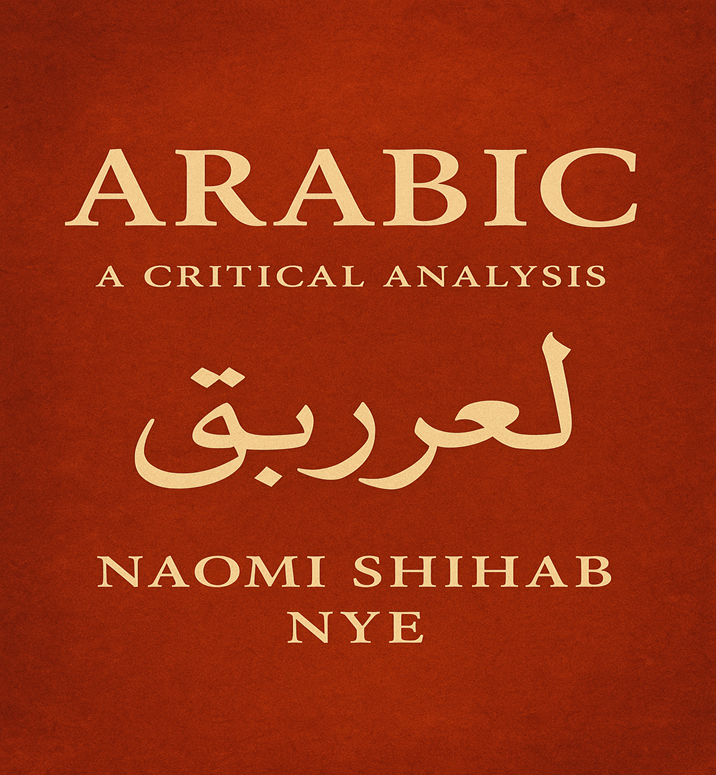
Introduction: “Arabic” by Naomi Shihab Nye
“Arabic” by Naomi Shihab Nye first appeared in her poetry collection Red Suitcase: Poems (BOA Editions, 1994), where it turns “Arabic” into more than a language—into a doorway to embodied history and feeling: “Until you speak Arabic, / you will not understand pain,” the speaker is told, as sorrow is pictured as something an “Arab carries…in the back of the head” that “only language cracks,” like the “thrum of stones” and an “old metal gate.” The poem’s central ideas braid heritage-language loss with the ethics of empathy: the speaker confesses, “I thought pain had no tongue,” yet admits the “shame” of living “on the brink of Arabic,” hearing “The sound, but not the sense,” and “tugging / its rich threads without understanding / how to weave the rug,” which frames Arabic as cultural craft, not just vocabulary. Its popularity comes from that emotionally direct, story-like voice and its unforgettable, teachable images—music “heard / from a distance” that later wells “inside your skin”—plus the final twist that lands as both comic and humane: she hails a taxi by shouting “Pain!” and it “stopped / in every language,” suggesting that while languages carry particular histories, suffering (and responsiveness) can still be recognized across borders.
Text: “Arabic” by Naomi Shihab Nye
The man with laughing eyes stopped smiling
to say, “Until you speak Arabic,
you will not understand pain.”
Something to do with the back of the head,
an Arab carries sorrow in the back of the head,
that only language cracks, the thrum of stones
weeping, grating hinge on an old metal gate.
“Once you know,” he whispered, “you can
enter the room
whenever you need to. Music you heard
from a distance,
the slapped drum of a stranger’s wedding,
well up inside your skin, inside rain, a thousand
pulsing tongues. You are changed.”
Outside, the snow has finally stopped.
In a land where snow rarely falls,
we had felt our days grow white and still.
I thought pain had no tongue. Or every tongue
at once, supreme translator, sieve. I admit my
shame. To live on the brink of Arabic, tugging
its rich threads without understanding
how to weave the rug…I have no gift.
The sound, but not the sense.
I kept looking over his shoulder for someone else
to talk to, recalling my dying friend
who only scrawled
I can’t write. What good would any grammar
have been
to her then? I touched his arm, held it hard,
which sometimes you don’t do in the Middle East,
and said, I’ll work on it, feeling sad
for his good strict heart, but later in the slick street
hailed a taxi by shouting Pain! and it stopped
in every language and opened its doors.
Naomi Shihab Nye, “Arabic” from Red Suitcase. Copyright © 1994 by Naomi Shihab Nye. Reprinted with the permission of The Permissions Company, Inc., on behalf of BOA Editions, Ltd.
Annotations: “Arabic” by Naomi Shihab Nye
| Stanza | Annotation (what it’s doing / what it means) | Devices |
| 1. “The man with laughing eyes stopped smiling … ‘Until you speak Arabic, / you will not understand pain.’” | Opens with a sharp tonal turn: warmth (“laughing eyes”) collapses into gravity. The claim frames Arabic as a key to a particular kind of lived, historical hurt—pain is presented as knowable through language, not just emotion. | 👁️ Imagery • 🎭 Tone shift • 🗣️ Dialogue • 👉 Second-person address • 🧠 Language-as-key metaphor (implicit) |
| 2. “Something to do with the back of the head … carries sorrow … only language cracks, the thrum of stones” | Suggests sorrow is carried physically and culturally—stored in the body (“back of the head”). Language is portrayed as the only tool that can “crack” that sealed, internal burden; pain has texture and weight like stones. | 🧠 Metaphor • 🔁 Repetition (“back of the head”) • 👤 Personification (“language cracks”) • ✋ Embodied imagery • 🎧 Sound image (“thrum”) |
| 3. “weeping, grating hinge … ‘Once you know,’ he whispered, ‘you can / enter the room … Music you heard / from a distance,’” | Sound becomes a door into intimacy: once you understand Arabic, you can “enter” whenever needed—into memory, culture, and emotional access. The whisper implies secrecy/reverence; “room” signals an inner, private space of belonging. | 🎧 Auditory imagery (“weeping, grating,” “whispered”) • 👤 Personification (hinge “weeping”) • 🚪 Motif (enter/room) • 🗣️ Dialogue • 🧩 Enjambment |
| 4. “the slapped drum … well up inside your skin … rain … a thousand / pulsing tongues. You are changed.” | Shows what understanding feels like: distant cultural music becomes bodily—inside skin and weather. “A thousand pulsing tongues” makes language plural and alive; comprehension transforms identity (“You are changed”). | 🎧 Auditory imagery • ✋ Tactile imagery (“inside your skin”) • 🧠 Metaphor (“pulsing tongues”) • 🧩 Enjambment • 👉 Second-person address |
| 5. “Outside, the snow has finally stopped … snow rarely falls … our days grow white and still.” | The external scene mirrors an internal hush: rare snow becomes a symbolic pause, whitening time—suggesting suspended life, dislocation, and a quietness in which the speaker reflects on language, place, and belonging. | ❄️ Symbolism (snow/whiteness/stillness) • 👁️ Visual imagery • 🧠 Metaphor (“days grow white”) • 🧩 Enjambment |
| 6. “I thought pain had no tongue. Or every tongue / at once, supreme translator, sieve. I admit my / shame …” | The speaker revises a belief: pain isn’t beyond language, nor perfectly universal—it is both shared and filtered. Calling pain a “translator” and “sieve” suggests language shapes what suffering becomes; the “shame” signals moral self-judgment for not understanding. | ⚖️ Paradox (“no tongue / Or every tongue”) • 🧠 Metaphor (“translator,” “sieve”) • 👤 Personification (pain as translator) • 🧩 Enjambment • 🎭 Confessional tone |
| 7. “To live on the brink of Arabic, tugging / its rich threads … weave the rug … The sound, but not the sense.” | A sustained craft image: Arabic is a woven rug—complex, patterned, cultural. The speaker can tug threads (hear sounds) but can’t weave meaning (understand). “Sound, but not sense” crystallizes partial belonging. | 🧵 Extended metaphor (threads/rug/weaving) • ⚖️ Antithesis (“sound, but not the sense”) • ✋ Tactile imagery (tugging/weaving) • 🧩 Enjambment |
| 8. “I kept looking over his shoulder … dying friend … ‘I can’t write.’ What good would any grammar …” | Reveals avoidance and guilt: the speaker looks for escape, then remembers a friend for whom language failed at the edge of death. The stanza questions academic “grammar” as inadequate when pain is immediate—re-centering language as lived necessity, not a classroom object. | 👁️ Gesture imagery (“looking over his shoulder”) • 🎭 Emotional contrast (avoidance vs grief) • 🗣️ Quoted speech (“I can’t write.”) • 💡 Rhetorical question • ⚖️ Implied critique (grammar vs suffering) |
| 9. “I touched his arm, held it hard … you don’t do in the Middle East … ‘I’ll work on it,’ feeling sad” | The body becomes the apology: touch stands in for linguistic failure, but it also risks cultural misreading (“sometimes you don’t do” there). The promise “I’ll work on it” marks a turn from passive listening to ethical effort and responsibility. | ✋ Tactile imagery (touch/held) • 🌍 Cultural reference (touch norms) • 🗣️ Direct speech • 🎭 Tone (remorse/resolve) • 🧩 Enjambment |
| 10. “hailed a taxi by shouting Pain! and it stopped / in every language and opened its doors.” | Ends with a darkly comic, humane twist: although Arabic is presented as uniquely unlocking pain, the world still responds to the word “Pain” across languages—suggesting both universality and the urgent practicality of suffering. The “doors” echo the earlier “room”: access, entry, and recognition. | 😶 Irony/Humor (unexpected taxi stop) • 🚪 Motif (doors/entry) • 🧠 Metaphor (pain as a shared signal) • 👤 Personification (doors “opened” as welcome) • ⚖️ Tension: particular vs universal |
Literary And Poetic Devices: “Arabic” by Naomi Shihab Nye
| Symbol | Literary/Poetic Device | Example from Text | Explanation |
| 🎭 | 1. Juxtaposition | “The man with laughing eyes stopped smiling” | The poem opens by placing “laughing eyes” next to the action of “stopped smiling,” creating immediate tension and signaling a shift from lightheartedness to seriousness. |
| 🗣️ | 2. Dialogue | “Until you speak Arabic, / you will not understand pain.” | The poet uses direct speech from the man to establish the central argument of the poem: the intrinsic link between the Arabic language and the experience of deep sorrow. |
| 🧠 | 3. Metaphor (Somatic) | “an Arab carries sorrow in the back of the head” | Nye physicalizes an abstract emotion (sorrow), suggesting it is not just a feeling but a physical burden stored in a specific part of the body. |
| 🧱 | 4. Personification | “language cracks,” “stones / weeping” | Inanimate objects (language, stones) are given human abilities (cracking, weeping) to illustrate how the language is alive with emotion. |
| 🔊 | 5. Onomatopoeia | “thrum of stones,” “grating hinge,” “slapped drum” | Words like thrum, grating, and slapped mimic the actual sounds they describe, creating a harsh, auditory texture that reflects the “pain” of the language. |
| 👂 | 6. Auditory Imagery | “weeping, grating hinge on an old metal gate” | This description evokes a specific, piercing sound that creates a sense of age, rust, and resistance, symbolizing the difficulty and history of the language. |
| 🥁 | 7. Consonance | “slapped drum of a stranger’s wedding” | The repetition of the hard ‘p’, ‘d’, and ‘s’ sounds creates a percussive rhythm that mimics the beating of the drum mentioned in the line. |
| 🌦️ | 8. Synesthesia | “Music… well up inside your skin, inside rain” | The blending of senses—hearing music but feeling it physically inside the skin—shows the visceral, pervasive nature of the experience. |
| 👅 | 9. Synecdoche | “a thousand pulsing tongues” | A part (“tongues”) is used to represent the whole (languages or speakers). It emphasizes the sheer volume and life force of the communication. |
| ❄️ | 10. Symbolism | “Outside, the snow has finally stopped… days grow white and still.” | The snow represents silence, isolation, and a pause in communication, contrasting with the “pulsing” heat and noise of the Arabic language described earlier. |
| ⚖️ | 11. Paradox | “I thought pain had no tongue. Or every tongue / at once” | The speaker presents a contradiction that is true: pain is universal (no specific language) yet also expressed in all languages simultaneously. |
| 🧶 | 12. Extended Metaphor | “tugging / its rich threads without understanding / how to weave the rug” | The Arabic language is compared to a rug. The speaker has the raw materials (“threads”/words) but lacks the cultural skill (“weave”/grammar) to make it whole. |
| 🔤 | 13. Alliteration | “Sound, but not the sense.” | The repetition of the ‘s’ sound emphasizes the disconnect the speaker feels—she hears the music of the language but misses the meaning. |
| 🆚 | 14. Antithesis | “Sound, but not the sense.” | Two opposing concepts (auditory noise vs. intellectual meaning) are balanced in one phrase to highlight the speaker’s incomplete understanding. |
| 📝 | 15. Irony (Situational) | “my dying friend / who only / scrawled I can’t write.” | It is ironic that the friend uses the act of writing to communicate the inability to write, highlighting the desperation and futility of language in the face of death. |
| ❓ | 16. Rhetorical Question | “What good would any / grammar / have been / to her then?” | The question is asked not for an answer, but to make a point: formal rules of language are useless when facing the raw reality of death. |
| 🤝 | 17. Cultural Allusion | “which sometimes you don’t do in the Middle East” | The poet breaks the fourth wall to explain a cultural norm regarding touch between genders, grounding the poem in a specific cultural reality. |
| 🚕 | 18. Double Entendre / Metaphor | “shouting Pain! and it stopped / in every language” | “Pain” is used literally as a shout of emotion, but functionally acts as the word “Taxi.” It suggests that pain is the one universal signal that everyone stops for. |
| 🚪 | 19. Personification (Vehicle) | “it [the taxi]… opened its doors” | The taxi is imbued with agency; it responds to the universal call of pain by opening up, suggesting the world becomes accessible through shared suffering. |
| ⤵️ | 20. Enjambment | “enter the room / whenever you need to.” | The line breaks occur in the middle of the sentence (throughout the poem), creating a fractured rhythm that mimics the “cracking” of the language and the hesitation of the speaker. |
Themes: “Arabic” by Naomi Shihab Nye
🟠 Language as the Key to Pain (🔑)
“Arabic” by Naomi Shihab Nye stages language not as a decorative cultural accessory but as an ethical instrument that can unlock registers of suffering otherwise muffled or misheard. The poem begins with a disarming authority—“Until you speak Arabic, / you will not understand pain”—and that claim is not merely linguistic, because it binds comprehension to intimacy, and intimacy to responsibility. Pain here is located not only in nerves but “in the back of the head,” where memory, inheritance, and historical pressure reside, suggesting that certain griefs are carried as communal knowledge rather than private complaint. Arabic becomes the “crack” that opens what is sealed, the sound that translates stones “weeping” and a gate’s “grating hinge,” so that ordinary noises turn into intelligible testimony. Yet the speaker’s unease shows that knowing a language is never purely technical; it is a transformation of perception, a re-training of listening, and a willingness to let the world’s harsh textures speak inside the self.
🟣 Inherited Sorrow, History, and the Body (🧠)
“Arabic” by Naomi Shihab Nye frames suffering as embodied history, carried in a posture of the mind and a pressure under the skin, so that pain becomes both physiological and civilizational at once. The “Arab carries sorrow in the back of the head” suggests a burdensome archive stored where we cannot easily see it, which is why the poem repeatedly turns to sound—stones “weeping,” a gate’s hinge—because the body absorbs what the intellect avoids naming. When the man whispers that “Once you know…you can enter the room / whenever you need to,” he implies that language grants entry into an interior chamber of experience where grief is organized, not erased, and where one may return for strength as well as lament. The poem’s music imagery intensifies this: the distant wedding drum, once external, begins to “well up inside your skin,” implying that culture is not spectacle but incorporation. In this way, Arabic signifies not ethnicity alone but a bodily receptivity to histories that pulse through “a thousand / pulsing tongues,” remaking the speaker’s sense of self.
🟢 Shame, In-betweenness, and the Limits of Translation (🧵)
“Arabic” by Naomi Shihab Nye dramatizes the speaker’s uneasy position on the threshold—close enough to “tug” at Arabic’s “rich threads,” yet unable to “weave the rug”—and this in-betweenness becomes a moral discomfort as much as an intellectual lack. The confession “I admit my / shame” matters because it refuses the romantic excuse that admiration equals understanding; instead, it recognizes that partial access can become a kind of appropriation, where one enjoys the “sound, but not the sense.” The poem therefore critiques shallow multicultural listening, the kind that consumes texture while dodging responsibility, and it stages the speaker’s instinct to look “over his shoulder for someone else / to talk to” as a moment of avoidance that exposes how discomfort can produce social retreat. Even the notion that pain has “no tongue” or “every tongue / at once” wrestles with translation’s paradox: language can be a “supreme translator,” yet it is also a “sieve” that lets meanings slip. The poem insists that translation is not only a linguistic act; it is an ethical apprenticeship, slow and humbling, in which the listener must accept not-knowing without turning away.
🔵 Universality of Pain vs. Cultural Specificity (🚕)
“Arabic” by Naomi Shihab Nye ends by balancing a radical claim of cultural specificity—Arabic as the pathway into certain pains—with an equally radical reminder that suffering can summon recognition across borders, accents, and grammars. The speaker recalls a dying friend who “only scrawled / I can’t write,” and the question “What good would any grammar / have been / to her then?” punctures any elitist faith in linguistic mastery, because it shows that extreme pain can strip language to its barest plea. Yet the poem does not dissolve into easy universals; it keeps the tension alive by showing the speaker’s embodied attempt at connection—touching his arm “held it hard,” even while noting this gesture violates local custom—which implies that care sometimes risks cultural missteps, though it must still try. The final scene is brilliantly ironic: the speaker hails a taxi by shouting “Pain!” and it stops “in every language,” suggesting that while Arabic may deepen, sharpen, and particularize the understanding of sorrow, pain also travels with a terrible fluency, recognizable to strangers, opening doors anywhere, even on “slick” streets after snow.
Literary Theories and “Arabic” by Naomi Shihab Nye
| Literary theory | How it reads “Arabic” by Naomi Shihab Nye | References from the poem (quoted phrases) |
| 🟦 Postcolonial Theory | The poem frames language as a gatekeeper to lived realities, implying that dominant cultures often stand “on the brink” of Arab experience while consuming its “sound” without the “sense.” The speaker’s shame signals the ethics of representation and the power imbalance between proximity to a culture and actual epistemic access to it. | “Until you speak Arabic, / you will not understand pain.”; “To live on the brink of Arabic”; “tugging / its rich threads without understanding / how to weave the rug”; “The sound, but not the sense.” |
| 🟩 Reader-Response Theory | Meaning is shown as something that happens in the listener/reader: once the language is “known,” experience enters the body and reconfigures perception. The poem narrates interpretation as affective—music, memory, and pain “well up” and “change” the self—so understanding becomes a participatory event, not passive reception. | “Once you know… you can / enter the room / whenever you need to.”; “Music you heard / from a distance”; “well up inside your skin”; “You are changed.” |
| 🟨 Psychoanalytic Theory | Pain is imagined as lodged in the psyche and body—“the back of the head”—suggesting repressed or inherited sorrow stored beyond ordinary speech. Language functions like a crack or release mechanism that lets the unconscious grief become audible, while avoidance (“looking over his shoulder”) resembles a defense response to discomfort and guilt. | “an Arab carries sorrow in the back of the head”; “that only language cracks”; “I admit my / shame.”; “I kept looking over his shoulder for someone else / to talk to” |
| 🟥 New Historicism / Cultural Materialism | The poem situates meaning in cultural practice—weddings, touch etiquette, climate as setting—showing how language and pain are embedded in social codes and material life. The speaker’s gesture (holding the arm) and the comment about what one “doesn’t do in the Middle East” highlight how bodies, customs, and everyday interactions carry cultural history. | “the slapped drum of a stranger’s wedding”; “which sometimes you don’t do in the Middle East”; “Outside, the snow has finally stopped. / In a land where snow rarely falls”; “hailed a taxi by shouting Pain! and it stopped / in every language” |
Critical Questions about “Arabic” by Naomi Shihab Nye
🧠 1. How does the poem construct the relationship between linguistic fluency and the somatic experience of historical trauma?
In “Arabic”, the poet Naomi Shihab Nye establishes a complex, almost physiological link between the Arabic language and the endurance of suffering, suggesting that the language acts as a physical vessel for collective memory rather than a mere tool for communication. The poem opens with a stark epistemological claim from a native speaker who asserts that “Until you speak Arabic, / you will not understand pain,” which immediately positions the language as the exclusive domain of deep, ancestral sorrow that is carried in the “back of the head.”1 Nye expands this connection by personifying the language itself through harsh, auditory imagery—describing it as a “grating hinge” and the “thrum of stones”—which implies that the phonetics of Arabic are infused with the weight of hard, physical labor and historical grief.2 Consequently, the speaker is forced to confront the limitation of her own experience, realizing that without the “gift” of this specific tongue, she is merely an observer hearing the “sound, but not the sense,” permanently separated from the “thousand pulsing tongues” that keep the history of her heritage alive and vibrant within the skin of those who speak it.
🧶 2. What is the function of the extended metaphor of weaving and textiles in defining the speaker’s fragmented cultural identity?
Through the intricate imagery of rug making, Naomi Shihab Nye in “Arabic” vividly illustrates the speaker’s diasporic anxiety and the sensation of possessing the raw materials of a culture without the ability to synthesize them into a coherent whole. when the speaker admits to living “on the brink of Arabic” and “tugging / its rich threads without understanding / how to weave the rug,” she is acknowledging that while she has inherited the colorful, isolated elements of her identity—her genetics, memories, and emotions—she lacks the structural “grammar” required to bind them into a complete pattern.3 This metaphor effectively highlights the distinction between heritage and capability; the speaker can feel the texture of the “threads” and appreciate their value, but she remains an apprentice who cannot participate in the creation of the cultural tapestry. By positioning herself as someone who holds the threads but cannot work the loom, Nye emphasizes the melancholy of the second-generation experience, where the “gift” of belonging feels tantalizingly close, yet ultimately inaccessible because the skill of the language—the warp and weft of the rug—has been lost in the silence of assimilation.
💀 3. How does the anecdote of the dying friend serve to deconstruct the poem’s initial premise regarding the necessity of grammar?
The inclusion of the dying friend’s paradox serves as the philosophical turning point in “Arabic” by Naomi Shihab Nye, effectively challenging the opening argument that formal language is the only legitimate vehicle for understanding pain. By recalling a friend who, in her final moments, “scrawled / I can’t write,” Nye utilizes situational irony to demonstrate that in the face of ultimate mortality, the rules of syntax and “grammar” crumble, rendering the distinction between fluency and silence irrelevant. This tragic recollection acts as a rebuttal to the man with “laughing eyes,” for it suggests that while specific languages like Arabic may claim ownership over historical sorrow, the raw, immediate reality of death is a “supreme translator” that requires no dictionary. The rhetorical question, “What good would any / grammar / have been / to her then?” underscores the futility of structure when the human body fails, thereby validating the speaker’s own position; she may lack the intricate “sense” of Arabic, but she possesses the intuitive, universal understanding of loss that transcends the intellectual barriers of language, proving that the heart’s “strict” reality exists independently of the words used to describe it.
🚕 4. What does the surreal conclusion of hailing a taxi with the word “Pain” suggest about the universality of human emotion versus the specificity of language?
In the powerful resolution of “Arabic”, Naomi Shihab Nye moves beyond the binary of speaking versus not speaking to propose that shared vulnerability is the true universal language that supersedes all linguistic divides. When the speaker, standing in a “slick street,” hails a taxi not by shouting a destination but by shouting “Pain!” and finds that the vehicle “stopped / in every language,” the poem achieves a moment of transcendent clarity that resolves the speaker’s earlier feelings of shame and inadequacy. This surreal image transforms pain from a private, culturally gate-kept burden—as initially suggested by the man who claimed only Arabic speakers understand it—into a public, universally recognized signal that “opens doors” indiscriminately. By shifting from the specific “thrum of stones” associated with Arabic to the broad, accessible symbol of the taxi, Nye concludes that while she may not master the “rich threads” of her father’s tongue, her capacity to feel and project human suffering allows her to navigate the world, proving that empathy is the ultimate currency of connection in a world often divided by “snow” and silence.
Literary Works Similar to “Arabic” by Naomi Shihab Nye
- 🟣 “Persimmons” — Li-Young Lee: Like Nye’s “Arabic,” this poem links language to bodily memory and emotional truth, showing how mispronunciation, cultural misunderstanding, and “knowing the word” can carry shame, tenderness, and a deeper, lived form of identity.
- 🔵 “Bilingual/Bilingüe” — Rhina P. Espaillat: Similar to “Arabic,” it dramatizes the push-and-pull between two languages as an inner conflict and inheritance, where translation is never neutral and the speaker’s self is shaped by what each tongue can (and cannot) fully hold.
- 🟢 “The Latin Deli: An Ars Poetica” — Judith Ortiz Cofer: Like Nye, Cofer presents language as a portable homeland—stored in everyday sounds, foods, and stories—so that cultural pain and belonging appear through material details and communal memory rather than abstract claims.
- 🟠 “My Father and the Fig Tree” — Naomi Shihab Nye: Closely aligned with “Arabic,” it explores heritage as a felt presence that persists across geography, using a single cultural emblem to show how longing, identity, and “home” survive in the senses even when words fall short.
Representative Quotations of “Arabic” by Naomi Shihab Nye
| Quotation | Reference to the Context | Theoretical Perspective & Explanation |
| 🗣️ “Until you speak Arabic, / you will not understand pain.” | The poem begins with a native Arabic speaker (the “man with laughing eyes”) asserting a direct correlation between the Arabic language and the authentic experience of suffering. | Linguistic Determinism (Sapir-Whorf Hypothesis) This perspective suggests that the structure of a language determines a native speaker’s perception and categorization of experience. The man argues that the qualia (subjective experience) of pain is inaccessible without the specific linguistic framework of Arabic to decode it. |
| 🧠 “an Arab carries sorrow in the back of the head” | Following the opening dialogue, the speaker describes the physiological location of grief for an Arab person, suggesting it is a physical weight rather than just a mental state. | Somatic Theory of Trauma This reflects the theory that historical and emotional trauma is “embodied”—stored physically within the body (soma). The specific anatomical location (“back of the head”) suggests a burden that is unseen but constantly present, influencing posture and perspective unconsciously. |
| 🧱 “language cracks, the thrum of stones / weeping” | The speaker describes the auditory quality of the Arabic language, comparing its phonetics to the sound of breaking stones and natural earth elements. | Geopoetics This perspective analyzes how a specific geography and landscape shape language and culture. Nye links the harsh, guttural sounds of Arabic to the physical landscape of the Middle East (“stones,” “earth”), suggesting the language is an acoustic map of the land itself. |
| 🚪 “grating hinge on an old metal gate” | Further describing the sound of the language, the speaker evokes an image of an ancient, rusty mechanism opening with difficulty. | Post-colonial Memory The “old metal gate” serves as a symbol of access to a pre-colonial or ancestral past. The “grating” sound implies that accessing this collective history is painful and resistant, requiring force to open the “gate” of memory that has been rusted shut by time or distance. |
| 🥁 “slapped drum of a stranger’s wedding” | The speaker describes the sensation of the language entering her skin, comparing it to the percussive vibration of a wedding drum heard from afar. | Phenomenology of Perception This highlights the immediate, sensory experience of the “Other.” Even though the wedding is a “stranger’s” (indicating alienation), the physical vibration (the “slap”) bridges the gap between self and other, bypassing intellectual understanding for visceral feeling. |
| ❄️ “In a land where snow rarely falls, / we had felt our days grow white and still.” | The poem shifts to the setting outside the room, contrasting the heat of the Arabic language with the cold, silent, snowy environment of the speaker’s current location (presumably the West). | Diasporic Alienation The “white and still” snow symbolizes the silence of assimilation and the cultural void felt by the diaspora. It contrasts the hot/noisy nature of the homeland with the cold/sterile nature of the adopted land, highlighting the emotional numbness of living between two worlds. |
| ⚖️ “I thought pain had no tongue. Or every tongue / at once” | The speaker internalizes the man’s claim and counters it with her own philosophical reflection, wondering if pain is actually a pre-linguistic or pan-linguistic universal. | Universalism vs. Cultural Relativism This juxtaposition questions whether human emotion is culturally specific (Relativism—only Arabs understand this pain) or a fundamental human constant (Universalism—pain has “no tongue”). The speaker acts as the synthesizer, caught between these two truths. |
| 🧶 “tugging / its rich threads without understanding / how to weave the rug” | The speaker admits her inability to speak Arabic fluently, using the metaphor of a rug maker who has the materials but lacks the technique. | Cultural Hybridity & Liminality The speaker occupies a “liminal” space (a threshold). She possesses the genetic “threads” of her heritage but lacks the “weaving” skills (grammar/syntax) to construct a complete identity. This illustrates the fragmentation of the bicultural experience. |
| 📝 “scrawled / I can’t write. What good would any / grammar / have been” | The speaker recalls a dying friend who used her last strength to write that she couldn’t write, realizing that rules of language are meaningless at the moment of death. | Existential Nihilism / The Failure of Language This perspective posits that structured systems (like grammar) collapse in the face of the “Real” (death). It critiques the man’s earlier obsession with linguistic precision, suggesting that in ultimate crises, language fails and only raw being remains. |
| 🚕 “hailed a taxi by shouting Pain! and it stopped / in every language” | The poem concludes with the speaker successfully hailing a taxi by shouting an emotion rather than a destination, and being understood instantly. | Transcendental Humanism This final image resolves the tension by suggesting that affect (emotion) transcends syntax. It proposes a Global Humanism where the shared vulnerability of “Pain” acts as a universal passport, dissolving the barriers of “strangers” and “languages” established earlier in the poem. |
Suggested Readings: “Arabic” by Naomi Shihab Nye
- Books
- Nye, Naomi Shihab. Red Suitcase: Poems. BOA Editions, 1994. Google Books,
- Charara, Hayan, editor. Inclined to Speak: An Anthology of Contemporary Arab American Poetry. University of Arkansas Press, 2008. University of Arkansas Press, https://www.uapress.com/product/inclined-to-speak/. Accessed 8 Dec. 2025.
- Academic articles
- Corrigan, Paul T. “Kindness, Politics, and Religion: An Interview with Naomi Shihab Nye.” MELUS, vol. 44, no. 2, Summer 2019, pp. 173–188. Oxford Academic, https://doi.org/10.1093/melus/mlz009. Accessed 8 Dec. 2025.
- Gómez-Vega, Ibis. “The Art of Telling Stories in the Poetry of Naomi Shihab Nye.” MELUS, vol. 26, no. 4, Dec. 2001, pp. 245–252. Oxford Academic, https://doi.org/10.2307/3185549. Accessed 8 Dec. 2025.
- Poem websites
5. Nye, Naomi Shihab. “Arabic.” Poets.org, Academy of American Poets, https://poets.org/poem/arabic. Accessed 8 Dec. 2025.
6. “Naomi Shihab Nye.” Poetry Foundation, Poetry Foundation, https://www.poetryfoundation.org/poets/naomi-shihab-nye. Accessed 8 Dec. 2025.