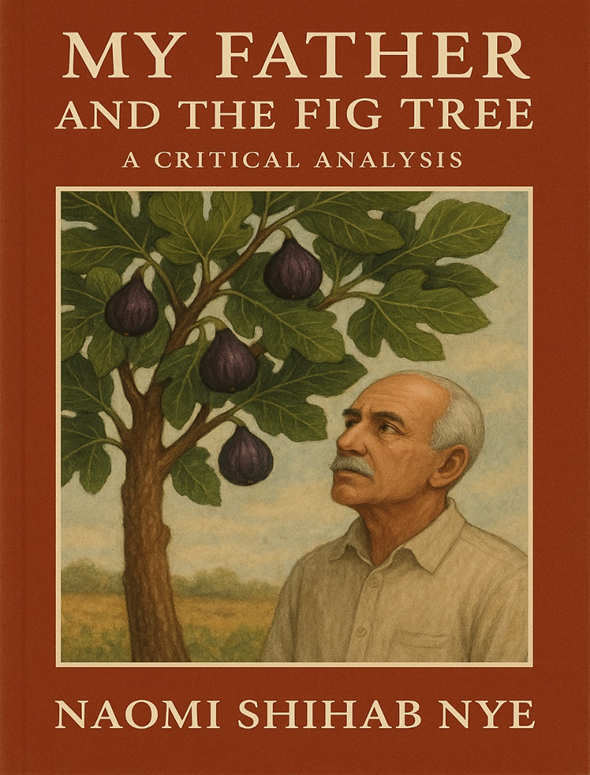
Introduction: “My Father and the Fig Tree” by Naomi Shihab Nye
“My Father and the Fig Tree” by Naomi Shihab Nye first appeared in 1982 (published in Wrapping the Grapeleaves) and was later collected in her Middle East–centered volume 19 Varieties of Gazelle: Poems of the Middle East (2002), where it is commonly reproduced and taught. The poem’s core concerns are diasporic longing and cultural inheritance: the father’s near-mythic fixation on figs (“I wish they were figs”) becomes a portable homeland, carried through bedtime storytelling (“weaving folktales like vivid little scarves”), faith-inflected wonder (“gift of Allah!”), and the repeated dream of “the largest, fattest, / sweetest fig,” until that dream is materially realized “in the middle of Dallas, Texas,” where the fig finally stands as “emblems, assurance / of a world that was always his own.” Its popularity endures because it is narratively lucid yet symbolically dense: it offers an accessible family story while opening rich interpretive pathways about identity, migration, memory, and the way ordinary objects become anchors of belonging—qualities that make it especially effective in classroom and anthology contexts.
Text: “My Father and the Fig Tree” by Naomi Shihab Nye
For other fruits, my father was indifferent.
He’d point at the cherry trees and say,
“See those? I wish they were figs.”
In the evening he sat by my beds
weaving folktales like vivid little scarves.
They always involved a figtree.
Even when it didn’t fit, he’d stick it in.
Once Joha
1 was walking down the road
and he saw a fig tree.
Or, he tied his camel to a fig tree and went to sleep.
Or, later when they caught and arrested him,
his pockets were full of figs.
At age six I ate a dried fig and shrugged.
“That’s not what I’m talking about! he said,
“I’m talking about a fig straight from the earth –
gift of Allah! — on a branch so heavy
it touches the ground.
I’m talking about picking the largest, fattest,
sweetest fig
in the world and putting it in my mouth.”
(Here he’d stop and close his eyes.)
Years passed, we lived in many houses,
none had figtrees.
We had lima beans, zucchini, parsley, beets.
“Plant one!” my mother said.
but my father never did.
He tended garden half-heartedly, forgot to water,
let the okra get too big.
“What a dreamer he is. Look how many
things he starts and doesn’t finish.”
The last time he moved, I got a phone call,
My father, in Arabic, chanting a song
I’d never heard. “What’s that?”
He took me out back to the new yard.
There, in the middle of Dallas, Texas,
a tree with the largest, fattest,
sweetest fig in the world.
“It’s a figtree song!” he said,
plucking his fruits like ripe tokens,
emblems, assurance
of a world that was always his own.
-Naomi Shihab Nye
1
The above is excerpted from 19 VARIETIES OF GAZELLE by Naomi Shihab Nye. Used with kind permission from HarperCollins Publishers, 10 East 53rd Street, New York, NY 10022
Annotations: “My Father and the Fig Tree” by Naomi Shihab Nye
| # | Snippet | Annotation (what it’s doing / what it means) | Literary devices |
| S1 | Stanza 1 (lines 1–13) | Establishes the father’s fig-longing as a recurring thread, using folktale cadence and gentle humor; the fig begins operating as portable memory/home. | 🟨 Motif/Symbol; 🟪 Allusion (folklore/culture); 🎙️ Dialogue; ⬛ Contrast/Irony; 🟩 Imagery |
| 1 | “other fruits…indifferent” | Opens with selective desire; prepares the fig as the singular object of attachment. | ⬛ Contrast; 🟨 Motif/Symbol |
| 2 | “point at the cherry trees” | Physical gesture externalizes longing; present reality is measured against an absent ideal. | 🟩 Imagery; ⬛ Contrast; 🟨 Motif/Symbol |
| 3 | “I wish they were figs.” | Direct yearning turns the visible landscape into imagined replacement. | 🎙️ Dialogue; ⬛ Contrast; 🟨 Motif/Symbol |
| 4 | “sat by my beds” | Domestic intimacy: longing becomes part of the child’s nightly inheritance. | 🟩 Imagery; 🟨 Motif/Symbol |
| 5 | “folktales like…scarves” | Storytelling becomes textile-work—warmth, craft, continuity; culture is “made” and passed on. | 🟦 Simile; 🟥 Metaphor; 🟩 Imagery; 🟪 Allusion (oral tradition) |
| 6 | “always involved a figtree” | Repetition fixes the figtree as narrative anchor and identity-marker. | 🟨 Motif/Symbol; 🟩 Imagery |
| 7 | “Even when it didn’t fit” | Affectionate comic pressure: he inserts the fig regardless, showing devotion/obsession. | ⬛ Irony/Contrast; 🟨 Motif/Symbol |
| 8 | “Once Joha” | Introduces a known folklore figure; expands personal memory into shared cultural story-space. | 🟪 Allusion (Joha/Juha folklore); 🟫 Diction (cultural naming) |
| 9 | “walking down the road” | Folktale setup diction gives an oral-story rhythm and simplicity. | 🟪 Allusion (folktale form); 🟫 Diction; 🟩 Imagery |
| 10 | “he saw a fig tree” | The fig appears as inevitable in this story-world—desire shapes narrative reality. | 🟨 Motif/Symbol; 🟪 Allusion; 🟩 Imagery |
| 11 | “tied his camel…went to sleep” | Folkloric absurdity normalizes the fig as a natural landmark of imagination. | 🟪 Allusion; 🟩 Imagery; ⬛ Light irony |
| 12 | “caught and arrested him” | Sudden trouble adds folktale drama; fig remains central even in crisis. | ⬛ Contrast; 🟪 Allusion; 🟨 Motif/Symbol |
| 13 | “pockets were full of figs” | Comic abundance; fig functions as treasure/sustenance beyond ordinary realism. | 🟧 Hyperbole; 🟨 Motif/Symbol; 🟩 Imagery |
| S2 | Stanza 2 (lines 14–22) | The child’s indifference is corrected by the father’s vivid, reverent definition of “real” figs—sensory, sacred, embodied longing. | 🎙️ Dialogue; 🟩 Imagery; 🟪 Allusion (religious); 🟧 Hyperbole; ⬛ Contrast; 🟨 Motif/Symbol |
| 14 | “dried fig and shrugged” | The shrug contrasts with the father’s passion; desire is learned, not automatic. | ⬛ Contrast; 🟩 Imagery; 🟨 Motif/Symbol |
| 15 | “That’s not what I’m talking about!” | Emotional insistence draws a boundary: imitation vs authenticity. | 🎙️ Dialogue; ⬛ Contrast |
| 16 | “fig straight from the earth” | Roots authenticity in origin/soil; fig as grounded identity. | 🟩 Imagery; 🟨 Motif/Symbol |
| 17 | “gift of Allah!” | Sacralizes the fruit; longing is framed as gratitude and blessing. | 🟪 Allusion (religious); 🟫 Diction/Code-switching |
| 18 | “branch so heavy…ground” | Concrete abundance image; heaviness makes yearning physical and believable. | 🟩 Imagery; 🟧 Hyperbole |
| 19 | “largest, fattest,” | Intensifying adjectives create escalating desire; builds toward mythic perfection. | 🟧 Hyperbole; 🟩 Imagery |
| 20 | “sweetest fig” | Sensory climax (taste); memory becomes edible. | 🟩 Imagery; 🟧 Hyperbole; 🟨 Motif/Symbol |
| 21 | “in the world…in my mouth” | Global superlative + bodily image: identity-longing expressed through embodiment. | 🟧 Hyperbole; 🟩 Imagery; 🟨 Motif/Symbol |
| 22 | “close his eyes” | Rapture/transport: he “tastes” the dream inwardly; memory becomes vision. | 🟩 Imagery; 🟥 Metaphor (inner travel) |
| S3 | Stanza 3 (lines 23–42) | Displacement (“many houses”) and absence (“none had figtrees”) culminate in the fig’s surprising return in Dallas—fig as emblem of belonging that survives migration. | 🟨 Motif/Symbol; ⬛ Contrast/Irony; 🟐 Enumeration; 🟫 Diction/Code-switching; 🎙️ Dialogue; 🟩 Imagery; 🟧 Hyperbole |
| 23 | “Years passed…many houses” | Time + movement signal unsettledness; desire persists across relocations. | ⬛ Contrast; 🟨 Motif/Symbol |
| 24 | “none had figtrees” | Central absence: missing fig stands for cultural dislocation and unfulfilled longing. | 🟨 Motif/Symbol; ⬛ Contrast |
| 25 | “lima beans…zucchini…” | Listing ordinary vegetables stresses substitution and mismatch: plenty exists, but not the one thing. | 🟐 Enumeration; 🟩 Imagery; ⬛ Contrast |
| 26 | “Plant one!” | Practical voice counters dreaming; action vs longing. | 🎙️ Dialogue; ⬛ Contrast |
| 27 | “my father never did” | Inertia underscores the gap between vision and habit. | ⬛ Contrast/Irony |
| 28 | “half-heartedly…forgot to water” | Characterization via mundane detail: he is a visionary more than a cultivator. | 🟩 Imagery; ⬛ Irony |
| 29 | “okra get too big” | Small failure symbolizes larger unfinished beginnings; dream-management mismatch. | 🟩 Imagery; 🟥 Metaphor; ⬛ Irony |
| 30 | “What a dreamer he is” | Explicit label frames him; mild critique inside affection. | 🎙️ Dialogue; ⬛ Irony |
| 31 | “starts and doesn’t finish” | Pattern statement: longing without completion becomes the family narrative. | ⬛ Irony; 🟥 Metaphor (life pattern) |
| 32 | “I got a phone call” | Narrative pivot; builds anticipation toward revelation. | ⬛ Contrast (shift); 🟩 Imagery (scene cut) |
| 33 | “in Arabic, chanting a song” | Language and sound signal cultural return; identity arrives through voice. | 🟫 Diction/Code-switching; 🟪 Allusion (cultural); 🟩 Imagery |
| 34 | “I’d never heard…What’s that?” | Generational distance: heritage is partly inherited, partly unfamiliar. | 🎙️ Dialogue; ⬛ Contrast; 🟫 Diction |
| 35 | “out back…new yard” | Staged movement suggests ritual unveiling of something treasured. | 🟩 Imagery |
| 36 | “middle of Dallas, Texas” | Geographic irony intensifies the “miracle”: the homeland emblem appears in the diaspora’s center. | ⬛ Irony/Contrast; 🟨 Motif/Symbol |
| 37 | “largest, fattest,” | Refrain returns; earlier hyperbole now reads as prophecy being realized. | 🟧 Hyperbole; 🟨 Motif/Symbol |
| 38 | “sweetest fig in the world” | The dream becomes concrete; the superlative becomes lived experience. | 🟧 Hyperbole; 🟨 Motif/Symbol; 🟩 Imagery |
| 39 | “It’s a figtree song!” | Naming confers meaning; the song consecrates the tree as identity reclaimed. | 🎙️ Dialogue; 🟪 Allusion (song/ritual); 🟨 Motif/Symbol |
| 40 | “plucking…like ripe tokens” | Fruit becomes symbolic “currency” of belonging; fig as proof and keepsake. | 🟦 Simile; 🟨 Motif/Symbol; 🟥 Metaphor; 🟩 Imagery |
| 41 | “emblems, assurance” | Abstract nouns declare symbolism directly: figs equal certainty, continuity, selfhood. | 🟥 Metaphor; 🟨 Motif/Symbol |
| 42 | “a world…always his own” | Closing claim: not property but inner homeland—identity preserved despite displacement. | 🟨 Motif/Symbol; ⬛ Contrast; 🟥 Metaphor |
Literary And Poetic Devices: “My Father and the Fig Tree” by Naomi Shihab Nye
| Symbol | Device | Example from Text | Explanation |
| 🔠 | Alliteration | “…world that was always his own.” | The repetition of the “w” sound creates a smooth, rhythmical closing to the poem, emphasizing the wholeness and comfort the father finally feels. |
| 🕌 | Allusion | “Once Joha was walking down the road…” | A reference to Joha, a popular character in Arab folklore (often a wise fool), connecting the father’s stories to his specific cultural heritage. |
| 🔄 | Anaphora | “Or, he tied his camel… / Or, later when they caught…” | The repetition of “Or” at the beginning of successive clauses emphasizes the abundance and variations of the father’s stories. |
| 🗣️ | Assonance | “…lima beans, zucchini…” | The repetition of the “i” (ee) vowel sound ties the list of vegetables together, creating a sonic flow even in a simple list. |
| 📝 | Asyndeton | “We had lima beans, zucchini, parsley, beets.” | The omission of conjunctions (like “and”) between the vegetables speeds up the rhythm, suggesting a long, perhaps mundane list of “ordinary” crops compared to the fig. |
| 🏔️ | Climax | “There, in the middle of Dallas, Texas, a tree…” | The narrative peak of the poem occurs when the narrator discovers the fig tree in the most unexpected place, resolving the father’s lifelong quest. |
| 💬 | Dialogue | “‘See those? I wish they were figs.'” | The use of direct speech gives the father an immediate, active voice, allowing the reader to hear his specific longing. |
| 📖 | Diction | “shrugged,” “stick it in,” “indifferent.” | Nye uses simple, conversational word choices to create an authentic, approachable, and storytelling tone rather than high, formal language. |
| ⤵️ | Enjambment | “He’d point at the cherry / trees and say,” | The sentence runs over the line break without punctuation, creating a natural, conversational pace that mimics storytelling. |
| 🕊️ | Free Verse | (The entire poem) | The poem lacks a strict rhyme scheme or meter, reflecting the natural rhythms of speech and the wandering nature of memory. |
| 🔭 | Hyperbole | “…largest, fattest, sweetest fig in the world” | An exaggeration used by the father to express his passionate emotional attachment to the figs of his memory; ordinary figs cannot compare. |
| 👅 | Imagery (Gustatory) | “…sweetest fig in the world and putting it in my mouth.” | Descriptive language appealing to the sense of taste, allowing the reader to imagine the intense sweetness the father craves. |
| 🎨 | Imagery (Visual) | “…vivid little scarves.” | Descriptive language appealing to the sense of sight, painting a colorful picture of the texture and brightness of the father’s stories. |
| 🔄 | Irony (Situational) | “He tended garden half-heartedly… There, in the middle of Dallas… a tree…” | It is ironic that a man who was a bad gardener and moved constantly finally finds his “roots” and perfect tree in Dallas, a place far removed from his homeland. |
| ⚖️ | Juxtaposition | “Dallas, Texas” vs. “Arabic” / “Fig tree” | Placing the very American setting of Dallas next to the Middle Eastern elements highlights the theme of cultural displacement and hybrid identity. |
| 🎭 | Metaphor | “plucking his fruits like ripe tokens, emblems, assurance…” | While the action is literal, the figs are equated to “tokens” and “emblems”—they are not just fruit, they are physical proofs of his identity and past. |
| 👤 | Narrative Voice | “At age six I ate a dried fig…” | The poem is told from the first-person perspective (“I”) of the daughter, providing a personal witness to the father’s evolution over time. |
| 🔁 | Repetition | “Fig,” “Fig tree” (repeated throughout) | The constant repetition of the word “fig” mirrors the father’s obsession; it is the central thread woven through every stanza of their lives. |
| 🧣 | Simile | “…weaving folktales like vivid little scarves.” | A direct comparison using “like,” comparing the father’s storytelling to the weaving of colorful fabric, suggesting warmth, craft, and vibrancy. |
| 🌳 | Symbolism | The Fig Tree | The tree represents more than fruit; it symbolizes Palestine, the father’s heritage, stability, and the concept of “home” that he carries with him. |
Themes: “My Father and the Fig Tree” by Naomi Shihab Nye
🌳 Cultural Heritage and Identity
In the poem “My Father and the Fig Tree” by Naomi Shihab Nye, the poet utilizes the central symbol of the fig tree to explore the enduring nature of cultural heritage and the deep-seated roots of identity that persist even when one is transplanted to a foreign environment. The father’s distinct indifference toward local American fruits like cherries, contrasted with his fervent adoration of figs, illustrates a profound connection to his Middle Eastern origins, suggesting that his sense of self is inextricably tied to the specific landscape, agricultural rhythms, and flavors of his homeland. Although the family attempts to plant various generic vegetables such as lima beans and zucchini to sustain themselves physically, these crops represent a mundane reality that fails to ignite the father’s spirit, whereas the fig tree serves as a potent emblem of the “gift of Allah” and a reminder of a world that was distinctly his own. By ultimately finding the tree in Dallas, the narrative confirms that heritage is not merely a geographical location left behind, but a portable, internal sanctuary that provides assurance, pride, and continuity amidst the chaos of relocation.
🧳 The Immigrant Experience and Displacement
Within “My Father and the Fig Tree” by Naomi Shihab Nye, the narrative poignantly depicts the immigrant experience as a complex journey characterized by a sense of spiritual displacement, frequent physical movement, and a perpetual longing for the familiar comforts of the past. As the family moves restlessly from house to house, the father’s half-hearted attempts at gardening and his tendency to leave projects unfinished reflect the psychological unease and underlying disconnection often felt by those who have been uprooted and forced to adapt to a culture that does not mirror their own values. The narrative reveals that for the immigrant, the new environment—represented by the cherry trees and the practical, uninspiring vegetable gardens—often feels alien and unsatisfying until a tangible connection to the homeland can be re-established in the new soil. The culmination of the poem in a backyard in Dallas, where the father finally discovers his beloved tree, suggests that the immigrant’s quest is not just for physical shelter, but for a reconciliation between their history and their present reality, allowing them to finally feel at home in a strange land.
💭 The Power of Memory and Idealization
Through the verses of “My Father and the Fig Tree” by Naomi Shihab Nye, the text examines the transformative and sometimes distorting power of memory, demonstrating how nostalgia can idealize the past and sustain an individual through the emotional trials of the present. The father’s descriptions of figs are consistently hyperbolic, painting them as the “largest, fattest, sweetest” in the world, which indicates that his memory serves as a protective mechanism, preserving the perfection of his childhood home against the erosion of time, distance, and the harshness of his current reality. Even when his daughter, the narrator, eats a dried fig and remains unimpressed by the taste, the father insists on a superior version of reality that exists primarily in his mind, highlighting the profound disconnect between the tangible object in front of them and the emotional weight it carries for the exile. Ultimately, the poem suggests that memory is an active, creative force, capable of manifesting the “emblems” of one’s history even in unlikely places like Texas, thereby ensuring that the beauty of the past is never truly lost.
🗣️ The Tradition of Storytelling and Oral History
In her evocative work “My Father and the Fig Tree” by Naomi Shihab Nye, the writer underscores the vital role of storytelling and oral tradition in preserving culture and bridging the gap between generations born in different worlds. The father is depicted “weaving folktales like vivid little scarves,” a simile that suggests his stories are not merely fleeting entertainment but essential, colorful coverings that provide warmth, texture, and protection to their family life. By constantly inserting the fig tree into tales of the folk character Joha, even when it logically does not fit the narrative, the father actively constructs a mythological landscape for his children, ensuring that the symbols of his heritage are embedded in their consciousness despite their American upbringing. This act of chanting songs and recounting legends transforms the simple act of eating fruit into a ritualistic celebration of history, proving that through the spoken word, a parent can transmit the “assurance of a world” that might otherwise vanish, keeping their ancestral identity alive in the hearts of their descendants.
Literary Theories and “My Father and the Fig Tree” by Naomi Shihab Nye
| Literary Theory | How it applies to “My Father and the Fig Tree” |
| 🧭🌍 Postcolonial / Diaspora Studies | The fig becomes a portable “homeland-object” that travels with the father across dislocation: he longs for what is absent (“none had figtrees”), insists on inserting it into stories (“Even when it didn’t fit, he’d stick it in”), and finally re-roots it in diaspora (“in the middle of Dallas, Texas”). The tree and fruit function as “emblems” and “assurance” of belonging across migration and cultural displacement. |
| 🧠🪞 Psychoanalytic / Desire & Symbolic Fulfillment | The fig works as an obsessional wish-image: the father rehearses an intensified fantasy (“largest, fattest, / sweetest fig”), closes his eyes at the peak of desire, and the delayed gratification shapes years of dissatisfaction (“He tended garden half-heartedly”). The Dallas figtree reads like wish-fulfillment—desire made real—followed by release and joy (“chanting a song… ‘It’s a figtree song!’”). |
| 🧩🗣️ Reader-Response / Affective Theory | Meaning emerges through the speaker’s changing reception: as a child she “ate a dried fig and shrugged,” not yet sharing the father’s affect; later, she understands the emotional and cultural stakes as she narrates his yearning, the repeated imagery, and the final “assurance.” The poem invites readers to supply their own memories of food, family, and longing, which is why the fig’s symbolism feels intimate and widely relatable. |
| 🧶📜 Narratology / Folklore & Intertextuality | The poem foregrounds storytelling as a cultural technology: the father “weaving folktales like vivid little scarves” repeatedly inserts the figtree into Joha tales (“Once Joha… he saw a fig tree”), showing how motifs travel, persist, and produce identity. The fig functions as a recurring narrative device (motif/leitmotif) that structures the poem’s movement from tale → desire → absence → fulfillment. |
Critical Questions about “My Father and the Fig Tree” by Naomi Shihab Nye
🟨 Q1 (Motif/Identity): How does the fig function as a “portable homeland,” and what does the father’s longing reveal about displacement and belonging?
“My Father and the Fig Tree” by Naomi Shihab Nye treats the fig as more than a fruit, since it functions as a portable homeland that the father carries through speech, appetite, and ritual even when geography denies him a real tree. Although the family lives in “many houses” without figtrees, his desire keeps translating the present into the elsewhere he remembers, so cherries and okra become contrasts that sharpen the ache of displacement. When he insists that the “real” fig is “straight from the earth—gift of Allah,” he anchors memory in soil and sanctifies it, implying that identity is not abstract but tasted and embodied. Yet the poem also suggests resilience: longing does not merely mourn loss; it preserves meaning until circumstances allow return in another form, which is why the later figtree in Dallas feels like recognition rather than coincidence. It is, finally, belonging made visible again.
🟦 Q2 (Storytelling/Transmission): In what ways do the folktales (and the Joha episodes) operate as cultural inheritance, and why does the father force the figtree into every story?
“My Father and the Fig Tree” by Naomi Shihab Nye presents storytelling as a domestic craft, since the father “weaves” folktales and the poem compares them to “vivid little scarves,” implying warmth and continuity that can travel. By invoking Joha/Juha, a familiar trickster in Arabic folk tradition, Nye turns the father’s bedtime talk into a cultural archive, so each tale quietly teaches how a community jokes, warns, and remembers. The refrain that the stories “always involved a figtree,” even when it “didn’t fit,” is humorous, yet it also exposes narrative agency: he edits plots until they house his longing, showing that memory is shaped rather than merely stored. Because the folktale images are deliberately exaggerated—camels, arrests, pockets of figs—the fig swells into a symbol of what cannot be replaced by abundance. Thus, the poem suggests that heritage is inherited through repeated stories more than through formal instruction.
⬛ Q3 (Dream vs. Practice): What does the poem imply about nostalgia when it clashes with responsibility, especially in the father–mother contrast around planting and tending?
“My Father and the Fig Tree” by Naomi Shihab Nye complicates longing by staging it against practicality, because the mother’s simple imperative—“Plant one!”—exposes how desire can become a performance that avoids the labor of fulfillment. The father’s half-hearted gardening, his forgetting to water, and the okra that “get[s] too big” build a quiet portrait of someone who lives more intensely in imagined plenitude than in daily maintenance. Yet this is not a flat condemnation, since the poem’s tone remains affectionate: the critique is folded into family observation, and the daughter records the mother’s frustration without surrendering the father’s dignity. In effect, Nye asks whether nostalgia can immobilize, making the beloved object safer as a dream than as a responsibility, and whether immigrants sometimes preserve identity by refusing to domesticate it fully. That tension keeps the fig both precious and perpetually just out of reach until chance intervenes.
🟫 Q4 (Language/Ritual/Resolution): Why does the ending pivot to Arabic song in Dallas, and how does that shift redefine “home” as both inner and outer reality?
“My Father and the Fig Tree” by Naomi Shihab Nye resolves its central longing through a reversal that is ironic and restorative: in “the middle of Dallas, Texas,” the father finds what years of moving and failed planting never produced. This appearance matters because it converts the earlier hyperbole—“largest, fattest, sweetest”—from fantasy into lived fact, so the poem suggests that desire can outlast displacement without becoming delusional. The father’s Arabic chanting and his declaration, “It’s a figtree song!,” turn the backyard into a ritual site, where language, music, and fruit align to reauthorize belonging. When he plucks figs “like ripe tokens” and calls them “emblems” and “assurance,” the poem names the fig as symbolic currency, proof that identity can be replanted rather than merely remembered. The closing claim—“a world that was always his own”—therefore reads as inner sovereignty finally mirrored by the outer landscape. At last.
Literary Works Similar to “My Father and the Fig Tree” by Naomi Shihab Nye
- 🍊🌙 “Oranges” by Gary Soto — Like Nye’s poem, it uses an everyday fruit as an emotional “carrier” for memory and belonging, turning a simple object into a lasting emblem of tenderness and lived experience.
- 🍂🧳 “Persimmons” by Li-Young Lee — Similar in its fusion of food imagery with cultural identity, it treats fruit as a sensory archive of family, language, and immigrant selfhood shaped by longing and remembrance.
- 🧺🎆 “Immigrant Picnic” by Gregory Djanikian — Like “My Father and the Fig Tree,” it stages assimilation and heritage through family ritual and food, with the father’s presence anchoring the speaker’s negotiation between old-world identity and American space.
- 🕯️🤲 “The Gift” by Li-Young Lee — Closest in its father-centered intimacy, it frames paternal care and storytelling/voice as a lifelong inheritance, paralleling Nye’s depiction of the father’s longing as a formative family legacy.
Representative Quotations of “My Father and the Fig Tree” by Naomi Shihab Nye
| Quotation | Reference to Context | Theoretical Perspective & Explanation |
| 🍒 “For other fruits, my father was indifferent. / He’d point at the cherry trees and say, ‘See those? I wish they were figs.'” | Opening stanza, establishing the father’s attitude toward his American surroundings compared to his memory of home. | Cultural Alienation & Displacement: The father’s indifference to the cherry tree—a staple of Western/American imagery (e.g., George Washington)—signifies his psychological rejection of the assimilationist narrative. He defines his identity through negation; he knows who he is by knowing what he is not (he is not a man of cherry trees). |
| 🧣 “In the evening he sat by my beds / weaving folktales like vivid little scarves.” | Early in the poem, describing the bedtime rituals and the father’s method of storytelling. | Narratology & Oral Tradition: This highlights the function of the oral tradition as a protective mechanism (“scarves”) against cultural erasure. The “weaving” suggests that culture is not static; it is actively constructed and repaired through the act of narration, turning memory into a tangible, comforting texture for the next generation. |
| 🧩 “Even when it didn’t fit, he’d stick it in. / Once Joha was walking down the road and he saw a fig tree.” | Describing how the father altered traditional Joha stories to include his favorite symbol. | Myth-Making & Cultural Preservation: This illustrates the malleability of folklore in the diaspora. The father disrupts the canonical structure of the Joha tales to insert the signifier of his identity (the fig tree). Theory suggests that for the exile, the symbol of home becomes more important than narrative logic; he forces his heritage into the story to ensure it survives. |
| 🍬 “I’m talking about a fig straight from the earth – gift of Allah! … / I’m talking about picking the largest, fattest, sweetest fig in the world” | The father’s passionate correction after the narrator is unimpressed by a dried fig. | Romanticization & Nostalgia: Through the lens of Psychoanalytic Criticism, the father’s hyperbole represents “restorative nostalgia.” He idealizes the lost object (the fig) to “divine” status (“gift of Allah”) to cope with the trauma of separation. The fig is no longer just fruit; it is a sublime object that reality (the dried fig) cannot match. |
| 🤷 “At age six I ate a dried fig and shrugged. / ‘That’s not what I’m talking about!’ he said” | The narrator’s first physical encounter with the fruit her father praises, leading to disappointment. | Second-Generation Hybridity: This moment captures the disconnect between the immigrant generation and their children. For the daughter, the fig is just a commodity (a dried snack); for the father, it is an affective anchor. This illustrates the “gap of translation” where cultural meaning fails to transfer through material objects alone. |
| 🏠 “Years passed, we lived in many houses, / none had figtrees.” | The middle section of the poem, detailing the family’s frequent moves and lack of stability. | Diaspora Studies & Unhomeliness: The plurality of “many houses” but no “home” reflects the concept of unhomeliness (Homi Bhabha). The absence of the fig tree serves as a marker of their transient existence; without the specific cultural anchor, every dwelling remains temporary and foreign. |
| 🥀 “He tended garden half-heartedly, forgot to water, / let the okra get too big.” | Describing the father’s failed attempts to grow a garden with American/generic vegetables. | Psychological Displacement: The father’s failure to nurture the “lima beans and zucchini” is a manifestation of his subconscious rejection of the new soil. From an Eco-critical perspective, his relationship with the land is broken because the land is “wrong.” He cannot be a creator/gardener in a space where he feels he does not belong. |
| 🎶 “My father, in Arabic, chanting a song I’d never heard. ‘What’s that?'” | Near the end, when the father calls the daughter to see the new tree in the backyard. | Linguistic Heritage & Code-Switching: The reversion to Arabic signifies a return to the “authentic self.” The daughter’s inability to recognize the song (“I’d never heard”) underscores the fragmentation of heritage, yet the father’s chanting indicates that the discovery of the tree has unlocked a suppressed or dormant cultural reservoir within him. |
| 🏙️ “There, in the middle of Dallas, Texas, / a tree with the largest, fattest, sweetest fig in the world.” | The climax of the poem where the father finds the perfect tree in an unlikely urban setting. | Transnationalism & Hybrid Space: Finding the tree in Dallas represents the successful creation of a “Third Space.” It disrupts the binary of “Home” (Palestine) vs. “Here” (Texas). By finding his roots in Dallas, he reconciles his two worlds, proving that the diaspora can eventually cultivate the “sweetest” parts of the past in the present. |
| 🌍 “assurance of a world that was always his own.” | The final line of the poem, describing the father’s feelings as he picks the fruit. | Post-Colonial Identity & Agency: The phrase “always his own” reclaims agency. Despite displacement, borders, and migration, the father asserts ownership over his identity. The fig tree validates his history, serving as physical proof that his world was real, tangible, and endures regardless of geography. |
Suggested Readings: “My Father and the Fig Tree” by Naomi Shihab Nye
Books (primary collections)
- Nye, Naomi Shihab. 19 Varieties of Gazelle: Poems of the Middle East. Greenwillow Books, 2002. Internet Archive, https://archive.org/details/19varietiesofgaz00nyen. Accessed 10 Dec. 2025.
- Nye, Naomi Shihab. Different Ways to Pray: Poems. Breitenbush Publications, 1980. Google Books, https://books.google.com/books/about/Different_Ways_to_Pray.html?id=8OxfNwAACAAJ. Accessed 10 Dec. 2025.
Academic articles
- Bujupaj, Ismet. “Nature in Arab American Literature Majaj, Nye, and Kahf.” European Journal of American Studies, vol. 10, no. 2, 2015, document 19. OpenEdition Journals, https://journals.openedition.org/ejas/11130 (doi: https://doi.org/10.4000/ejas.11130). Accessed 10 Dec. 2025.
- Shamim, Amna. “Ecocritical Concerns in the Selected Poems of Mahmoud Darwish and Naomi Shihab Nye.” Humanities, vol. 13, no. 5, 2024, article 135. MDPI, https://www.mdpi.com/2076-0787/13/5/135 (doi: https://doi.org/10.3390/h13050135). Accessed 10 Dec. 2025.
Poem websites (reprints/teaching text access)
- Nye, Naomi Shihab. “My Father and the Fig Tree.” PBS NOW Classroom (PDF handout), https://www-tc.pbs.org/now/classroom/nyepoems1.pdf. Accessed 10 Dec. 2025.
- Nye, Naomi Shihab. “My Father and the Figtree.” Persimmon Tree, Winter 2013, https://persimmontree.org/winter-2013/twelve-poems/. Accessed 10 Dec. 2025.
Note: The poem is widely reprinted; the PBS classroom handout credits 19 Varieties of Gazelle, while Persimmon Tree’s editor’s note associates it with Different Ways to Pray.