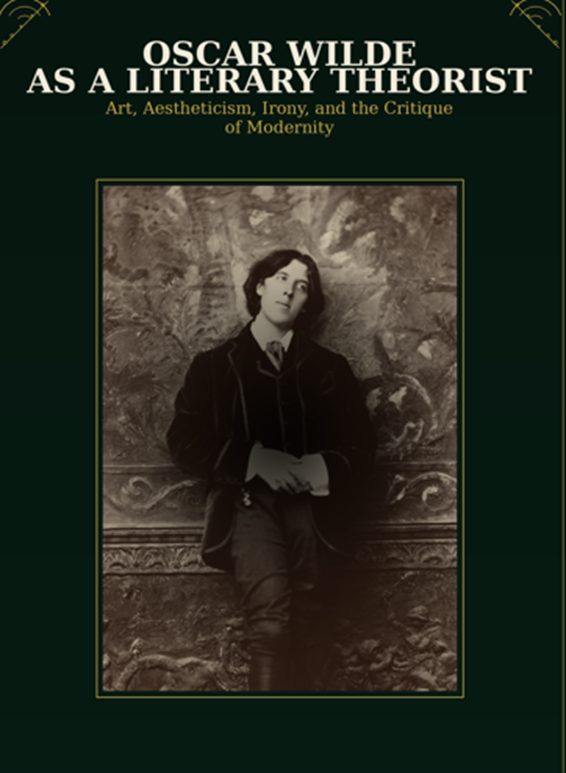
Oscar Wilde as a Literary Theorist

Oscar Wilde as a Literary Theorist emerges above all as a paradoxical aesthete who treats criticism not as secondary commentary but as an independent, creative act—so much so that he insists “the highest criticism…is…the record of one’s own soul” (Wilde, The Critic as Artist 395).

Oscar Wilde as a Literary Theorist
Introduction: Oscar Wilde as a Literary Theorist

Oscar Wilde as a Literary Theorist emerges above all as a paradoxical aesthete who treats criticism not as secondary commentary but as an independent, creative act—so much so that he insists “the highest criticism…is…the record of one’s own soul” (Wilde, The Critic as Artist 395). Born in Dublin (1854) into an intellectually charged Irish milieu shaped by his mother’s nationalist-literary presence (Lady Wilde, “Speranza”), Wilde’s early formation combined cultural politics with an intense commitment to style and imagination (Bristow 123). His educational background sharpened this orientation: he read classics at Trinity College Dublin (1871–1874) and then pursued literae humaniores (“Greats”) at Oxford (1874–1878), working through extensive notebooks that reveal serious scholarly method beneath the pose of effortless brilliance (Bristow 162). From this training, Wilde develops a set of core theoretical ideas: (1) criticism is a distinct art requiring superior refinement—“criticism demands infinitely more cultivation than creation does” (Wilde, qtd. in Weintraub x); (2) art is not a mirror of reality but a generative force that shapes perception and conduct, captured in Vivian’s dictum “Life imitates Art far more than Art imitates Life” (Wilde, The Decay of Lying 220); and (3) history and “fact” are themselves aesthetic constructions, hence “the one duty we owe to history is to re-write it” (Wilde, qtd. in Weintraub xxix). These principles crystalize in his major critical works—especially “The Critic as Artist” and “The Decay of Lying” (collected in Intentions)—while his literary practice in The Picture of Dorian Gray, The Importance of Being Earnest, and Salomé dramatizes the same claims: that style produces truth-effects, that social “reality” is theatrical, and that interpretation is itself a form of creation rather than mere judgment (Wilde, The Critic as Artist 395).

Major Works of Oscar Wilde as a Literary Theorist

Preface to The Picture of Dorian Gray (1890): Aesthetic Autonomy, Symbol, and Anti-Moralizing Criticism
Wilde’s preface functions as a compact manifesto for aesthetic criticism: it asserts the autonomy of art, defines criticism as creative translation, and rejects the reduction of literature to moral adjudication—an explicitly “theoretical” posture that later schools (formalism, aestheticism, aspects of reader-response) echo.

  • 🌸 “The artist is the creator of beautiful things.” (Wilde, Literary Criticism 229)

🌼 “The highest, as the lowest, form of criticism is a mode of autobiography.” (Wilde, Literary Criticism 229)

🌺 “There is no such thing as a moral or an immoral book. Books are well written, or badly written.” (Wilde, Literary Criticism 229)

🌷 “All art is quite useless.” (Wilde, Literary Criticism 230)

“The Critic as Artist” (1890; in Intentions): Criticism as Cultural Leadership and Creative Reproduction
Here Wilde elevates criticism from “secondary” commentary to an engine of cultural consciousness: criticism does not merely follow art; it “leads” by imposing form, articulating value, and making meaning transmissible through imaginative re-creation—turning interpretation into a quasi-creative act.

  • 🌸 “There was never a time when Criticism was more needed than it is now. It is only by its means that Humanity can become conscious of the point at which it has arrived.” (Wilde, Literary Criticism 228)

🌼 “Creation is always behind the age. It is Criticism that leads us.” (Wilde, Literary Criticism 228)

🌺 The critic, Wilde insists, reproduces art “in a mode that is never imitative,” making the critic’s work a transformation rather than a copy. (Wilde, Literary Criticism 228)

“The Decay of Lying” (1889; in Intentions): Anti-Mimesis and the Priority of Artistic Fabrication
In this dialogue, Wilde theorizes art as invention rather than mirror: the “lie” becomes a disciplined aesthetic principle—style, selection, and imaginative distortion that (paradoxically) best reveals what mere factuality cannot.

  • 🌸 “Lying, the telling of beautiful untrue things, is the proper aim of Art.” (Wilde, Literary Criticism 169)

🌼 “Life imitates Art far more than Art imitates Life.” (Wilde, Literary Criticism 182)

🌺 Wilde’s “lying” is not fraud but form: art achieves intensity by refusing the dull coercions of “the actual,” thereby shaping how reality is later perceived and even lived. (Wilde, Literary Criticism 182)

“The Truth of Masks” (1885/1891): Semiotics of Costume, Performance, and the Theatrical Production of Meaning
Wilde’s essay treats costume as an interpretive system: clothing operates as sign, dramaturgical device, and “technology” of illusion—anticipating later theoretical emphases on performance, signification, and the constructedness of identity on stage (and by implication, in social life).

  • 🌸 Costume can function as “a mode of intensifying dramatic situation.” (Wilde, Literary Criticism 135)

🌼 Shakespeare “saw that costume could be made… expressive of certain types of character.” (Wilde, Literary Criticism 139)

🌺 Wilde frames historical accuracy as valuable only when aesthetically transfigured—archaeology must be “transfused into some form of art,” rather than becoming pedantic “lecture.” (Wilde, Bristow et al. 262)

“The Soul of Man under Socialism” (1891): Individualism as the Condition of Art and the Politics of Aesthetic Freedom
Wilde’s social theory is inseparable from his aesthetics: he argues that art requires the freedom of the unique temperament, and that coercive publics and states deform art into mere craft. This makes his “literary theory” simultaneously ethical-political: an argument about the material conditions that allow creativity to exist.

  • 🌸 “A work of art is the unique result of a unique temperament.” (Wilde, Artist as Critic 300)

🌼 “Art is the most intense mode of individualism that the world has known.” (Wilde, Artist as Critic 300)

🌺 “The true perfection of man lies, not in what man has, but in what man is.” (Wilde, Artist as Critic 291)

Major Literary Ideas of Oscar Wilde as a Literary Theorist
Major Wildean Literary IdeaExplanation / CommentaryKey quotation
🌸 Criticism is a creative art (not “secondary” talk)Wilde elevates criticism into an imaginative reproduction of art: the critic transforms a work into “another manner,” making interpretation itself a mode of artistic making. This is foundational to Wilde’s theory of criticism as cultural authority and meaning-production.“I would call criticism a creation within a creation.” (Wilde 221)
🌼 Criticism leads culture; creation tends to repeatWilde argues that criticism supplies innovation by inventing “fresh forms,” whereas creation often reiterates inherited patterns. Criticism becomes the intellectual mechanism by which an age becomes self-conscious.“Creation is always behind the age. It is Criticism that leads us.” (Wilde 228)
🌺 The critic “translates” impressions into new form/materialWilde defines the critic not as a moral judge but as a translator of aesthetic experience—someone who re-expresses beauty through a new medium (language, style, genre). This implies interpretation is materially productive, not merely evaluative.“The critic is he who can translate into another manner or a new material his impression of beautiful things.” (Wilde 229)
🌷 Aesthetic autonomy: art is not to be judged morallyWilde separates ethics from aesthetics: the literary work is to be assessed as writing (style, form, execution), not as moral instruction. This is a direct rejection of Victorian moralized reviewing culture.“There is no such thing as a moral or an immoral book. Books are well written, or badly written.” (Wilde 229)
🌻 Art is “surface and symbol”; interpretation is risky and powerfulWilde theorizes aesthetic meaning as double-layered: art offers both surface pleasure and symbolic depth, but reading “beneath” or “as symbol” carries interpretive danger—suggesting that meaning is not stable, and that the reader’s approach partly creates what is found.“All art is at once surface and symbol.” (Wilde 230)
🌹 Art mirrors the spectator, not “life”Wilde relocates “truth” from external reality to reception: the artwork reflects the viewer/reader—taste, desire, corruption, cultivation—thereby aligning criticism with self-revelation and positioning interpretation as autobiographical.“It is the spectator, and not life, that art really mirrors.” (Wilde 230)
🌸 Anti-mimesis: “life imitates art” and the aesthetics of “lying”Wilde’s most disruptive claim is that art shapes how reality is perceived and even enacted; “lying” becomes a disciplined aesthetic principle (fabrication, selection, stylization) rather than a moral fault. Bristow’s analysis summarizes Wilde’s dialogue-argument and its cultural implications.“Life imitates art far more than Art imitates Life.” (Bristow 233)
Theoretical Terms/Concepts of Oscar Wilde as a Literary Theorist
  • 🌸 Criticism-as-Creation (Creative Criticism)
    Explanation: Wilde rejects the hierarchy that treats criticism as “secondary.” For him, the critic reshapes already “purified” artistic material into a new aesthetic object; interpretation is itself a productive art.
  • Example (quotation): “I would call criticism a creation within a creation.” (Wilde, Literary Criticism 221)
  • 🌼 Autobiographical Criticism (Impressionism in Reading)
    Explanation: Wilde defines high criticism as the critic’s refined self-record—less about “events” and more about moods, sensibility, and intellectual passion. This is a key Wildean premise for later reader-centered approaches.
  • Example (quotation): “That is what the highest criticism really is, the record of one’s own soul.” (Wilde, Literary Criticism 222)
  • 🌺 Cultural Leadership of Criticism (Criticism Leads the Age)
    Explanation: Wilde claims that criticism is how an era becomes self-conscious; it “imposes form upon chaos” and therefore leads cultural development more than “creation,” which tends to repeat.
  • Example (quotation): “Creation is always behind the age. It is Criticism that leads us.” (Wilde, Literary Criticism 228)
  • 🌷 The Critical Faculty Invents Forms (Form-Making Theory of History)
    Explanation: Wilde’s theory is not only about reviewing art but about how art evolves: new schools and genres arise from critical intelligence (classification, refinement, formal invention).
  • Example (quotation): “For it is the critical faculty that invents fresh forms.” (Wilde, Literary Criticism 214)
  • 🌻 Anti-Mimesis (Life Imitates Art)
    Explanation: Wilde reverses the commonsense model of representation: art does not simply copy reality; it helps produce what later looks like reality. Bristow’s discussion clarifies that the relationship is causal—art exerts an “imaginative hold” over its audience and conduct.
  • Example (quotation): “Life imitates art far more than Art imitates Life.” (Bristow 231)
  • 🌹 “Lying in Art” (Beautiful Untruths / Romance over Realism)
    Explanation: “Lying” becomes a technical aesthetic principle: disciplined invention that resists crude “Realism” and restores “Romance.” Bristow explains Wilde’s distinction between debased lying (journalism) and the pure form—“Lying in Art.”
  • Example (quotation): “The supreme type of lying…is ‘Lying in Art.’” (Bristow 233)
  • 🌸 Aesthetic Autonomy (Art vs. Ethics)
    Explanation: Wilde separates aesthetic judgment from moral policing: books are to be evaluated by writing and form, not by alleged virtue/vice. This is central to his theory of art’s independence from social moralism.
  • Example (quotation): “There is no such thing as a moral or an immoral book. Books are well written, or badly written.” (Wilde, Artist as Critic 264)
  • 🌼 Surface / Symbol and the Risk of Interpretation (Hermeneutic Peril)
    Explanation: Wilde insists that art is simultaneously surface pleasure and symbolic depth—but warns that aggressive “beneath-the-surface” reading can corrupt the reader’s relationship to beauty.
  • Example (quotation): “All art is at once surface and symbol…Those who read the symbol do so at their peril.” (Wilde, Literary Criticism 230)
  • 🌺 The Spectator-Mirror Principle (Reception as Meaning-Maker)
    Explanation: Wilde relocates the “mirror” function of art from the external world to the viewer/reader; interpretation reveals the spectator’s sensibility—one reason criticism becomes “autobiography.”
  • Example (quotation): “It is the spectator, and not life, that art really mirrors.” (Wilde, Literary Criticism 230)
  • 🌷 Individualism / Unique Temperament (Artist’s Autonomy from Demand)
    Explanation: Wilde theorizes art as the outcome of a singular temperament; once the artist caters to demand, art collapses into craft. This is his aesthetic theory of artistic freedom (with clear social implications).
  • Example (quotation): “A work of art is the unique result of a unique temperament…Art is the most intense mode of individualism that the world has known.” (Wilde, Artist as Critic 300)
Application of Theoretical Ideas of Oscar Wilde as a Literary Theorist to Literary Works
Literary WorkApplication of Oscar Wilde’s Theoretical Ideas
The Picture of Dorian Gray (1890)This novel is the most sustained fictional enactment of Wilde’s aesthetic theory. It applies aesthetic autonomy and the surface/symbol doctrine articulated in the Preface, where Wilde insists that “There is no such thing as a moral or an immoral book” (Wilde, Literary Criticism 229). The portrait dramatizes the danger of interpretive moralism: readers who search obsessively for ethical meanings repeat the very error Wilde warns against—reading “the symbol” at their peril (230). The novel also illustrates anti-mimesis: Dorian’s life imitates the aesthetic script offered by art (the “yellow book”), confirming Wilde’s claim that “Life imitates Art far more than Art imitates Life” (The Decay of Lying 182).
The Importance of Being Earnest (1895)The play exemplifies Wilde’s rejection of Realism in favor of artifice, performance, and mask-play. Social identity becomes theatrical rather than “natural,” aligning with Wilde’s theory that art does not mirror life but reshapes how life is perceived. The deliberate artificiality of dialogue and plot supports Wilde’s idea that comedy thrives on style rather than verisimilitude. Moreover, the play enacts the spectator-mirror principle: audiences recognize their own social hypocrisies not because the play imitates life, but because “it is the spectator, and not life, that art really mirrors” (Wilde, Literary Criticism 230).
Salomé (1891)Salomé applies Wilde’s theory of symbolist surface and aesthetic autonomy most radically. Its repetitive imagery and ritualized language force readers toward symbolic interpretation while simultaneously demonstrating the risk of over-interpretation that Wilde theorizes in the Preface. Moral outrage directed at the play exemplifies Wilde’s claim that ethical judgment is an illegitimate critical category for art. As Wilde argues elsewhere, art and ethics are “absolutely distinct and separate spheres” (Wilde, Artist as Critic 265), and Salomé becomes a practical test-case for this separation.
“The Happy Prince” (1888)This tale illustrates Wilde’s belief in cultivated reading and impressionistic criticism. While the story appears morally transparent, Wilde’s theory insists that its value lies not in didactic instruction but in the reader’s refined emotional response. The text rewards those who “find beautiful meanings in beautiful things” (Wilde, Literary Criticism 229), aligning with Wilde’s view that criticism is autobiographical—“the record of one’s own soul” (222). The story thus applies Wilde’s theory that art generates ethical feeling indirectly through beauty, not through moral preaching.
Representative Quotations of Oscar Wilde as a Literary Theorist
QuotationExplanation (how the quotation functions theoretically)
🌸 “To reveal art and conceal the artist is art’s aim.” (Wilde, Literary Criticism 229)Establishes Wilde’s doctrine of impersonality: criticism should not reduce artworks to biography; art is a formal construction whose “truth” is aesthetic, not confessional.
🌼 “The critic is he who can translate into another manner or a new material his impression of beautiful things.” (Wilde, Literary Criticism 229)Defines criticism as creative translation (not mere evaluation): the critic produces a new work (a new “manner”/“material”) out of aesthetic experience.
🌺 “The highest, as the lowest, form of criticism is a mode of autobiography.” (Wilde, Literary Criticism 229)Core Wildean premise for impressionistic/reader-centered criticism: interpretation reveals the critic’s sensibility; the critic’s “self” is the medium of value.
🌷 “There is no such thing as a moral or an immoral book. Books are well written, or badly written. That is all.” (Wilde, Literary Criticism 229)Articulates aesthetic autonomy: ethical judgment is an illegitimate critical category for literature; evaluation belongs to form, style, and artistic execution.
🌻 “All art is at once surface and symbol.” (Wilde, Literary Criticism 230)Wilde’s compact semiotic theory of art: art operates simultaneously as sensuous surface and symbolic depth, resisting single-level interpretation.
🌹 “It is the spectator, and not life, that art really mirrors.” (Wilde, Literary Criticism 230)A major reception principle: meaning is co-produced by the audience; art reflects the interpreter’s desires, fears, and cultivation more than external reality.
🌸 “All art is quite useless.” (Wilde, Literary Criticism 230)Wilde’s most famous statement of anti-utilitarian aesthetics: art’s “use” is not instrumental (moral, political, practical) but aesthetic—valued for its own form and intensity.
🌼 “Life imitates Art far more than Art imitates Life.” (Wilde, Literary Criticism 196)The center of Wilde’s anti-mimetic theory: art shapes perception and behavior; “reality” often follows aesthetic scripts generated by literature, painting, and style.
🌺 “Lying, the telling of beautiful untrue things, is the proper aim of Art.” (Wilde, Literary Criticism 196)Reframes “lying” as an aesthetic virtue: deliberate invention and stylization are the condition of artistic beauty, opposing crude “Realism” and factual worship.
🌷 “Man is least himself when he talks in his own person. Give him a mask, and he will tell you the truth.” (Wilde, Artist as Critic 420)A theory of mask, performance, and truth-effects: identity and sincerity are often produced through artifice; representation can disclose truths unavailable to direct self-report.
Criticism of the Ideas of Oscar Wilde as a Literary Theorist
  1. Aestheticism and the Charge of Moral Evasion
    Critics from the Victorian period onward have argued that Wilde’s insistence on aesthetic autonomy—especially his claim that “there is no such thing as a moral or an immoral book”—amounts to an evasion of ethical responsibility. From this perspective, Wilde’s theory is seen as insufficient for addressing literature’s social and moral consequences, particularly in texts like The Picture of Dorian Gray, where ethical effects appear inseparable from aesthetic form.
  2. Excessive Subjectivism in Impressionistic Criticism
    Wilde’s definition of criticism as “the record of one’s own soul” has been criticized for collapsing evaluation into personal taste. Later formalists and structuralists object that such subjectivism undermines the possibility of shared standards of interpretation and turns criticism into refined autobiography rather than disciplined analysis.
  3. Paradox over Systematic Theory
    Wilde’s theoretical writings privilege wit, paradox, and dialogue over conceptual rigor. While rhetorically powerful, this method has been criticized for lacking a coherent, systematic framework, making his ideas difficult to operationalize as a stable critical methodology.
  4. Anti-Mimesis as Overstatement
    The claim that “life imitates art more than art imitates life” has been challenged as an overcorrection rather than a balanced theory of representation. Marxist and historicist critics argue that material conditions, social structures, and historical forces shape art more decisively than Wilde allows.
  5. Elitism and the Cult of the ‘Cultivated’ Reader
    Wilde’s frequent distinction between the “cultivated” and the “uncultivated” reader has been read as elitist. Critics argue that this aesthetic hierarchy marginalizes popular or mass readerships and privileges a narrow, class-inflected notion of taste and refinement.
  6. Neglect of Socio-Political Context
    Despite The Soul of Man under Socialism, Wilde’s literary theory is often seen as insufficiently attentive to power, class, and ideology. Marxist, feminist, and postcolonial critics contend that Wilde underestimates how literature participates in social struggle rather than existing in a purely aesthetic realm.
  7. Contradiction between Theory and Practice
    Some critics note a tension between Wilde’s theory of impersonality (“to reveal art and conceal the artist”) and the biographical intensity of works like De Profundis. This contradiction raises questions about whether Wilde’s own life and suffering destabilize his aesthetic detachment.
  8. Romanticization of ‘Lying’ and Artifice
    Wilde’s valorization of “lying in art” has been criticized as potentially encouraging disengagement from truth, particularly in modern contexts where misinformation and spectacle blur ethical boundaries between art, journalism, and propaganda.
  9. Limited Engagement with Gender and Power
    Feminist critics have argued that Wilde’s theoretical writings largely ignore gendered power relations, even though his creative works often dramatize them. His theory, they argue, remains silent on how aesthetic “freedom” may operate differently across gendered bodies.
  10. Historical Containment of Wildean Aestheticism
    Later theorists have suggested that Wilde’s aestheticism is historically specific to late Victorian culture and fin-de-siècle decadence. While influential, it may not easily transfer to periods where literature is inseparable from urgent political, ethical, or national concerns.
Suggested Readings on Oscar Wilde as a Literary Theorist

Books

  1. Wilde, Oscar. Literary Criticism of Oscar Wilde. Edited by Stanley Weintraub, University of Nebraska Press, 1968.
  2. Wilde, Oscar. The Artist as Critic: Critical Writings of Oscar Wilde. Edited by Richard Ellmann, University of Chicago Press, 1982. University of Chicago Press.
  3. Bristow, Joseph, and Rebecca N. Mitchell. Oscar Wilde’s Chatterton: Literary History, Romanticism, and the Art of Forgery. Yale University Press, 2015. Yale University Press.
  4. Finzi, John Charles. Oscar Wilde and His Literary Circle: A Catalog of Manuscripts and Letters in the William Andrews Clark Memorial Library. HathiTrust Digital Library.

Academic articles

  1. Lamarque, Peter. “The Uselessness of Art.” The Journal of Aesthetics and Art Criticism, vol. 68, no. 3, 2010, pp. 205–214. Oxford Academic, https://academic.oup.com/jaac/article-abstract/68/3/205/5979855. Accessed 12 Dec. 2025.
  2. Bristow, Joseph, and Rebecca N. Mitchell. “Oscar Wilde’s ‘Cultivated Blindness’: Reassessing the Textual and Intellectual History of ‘The Decay of Lying’.” The Review of English Studies, vol. 69, no. 288, 2018, pp. 94–156. Oxford Academic, https://academic.oup.com/res/article-abstract/69/288/94/4093510. Accessed 12 Dec. 2025.
  3. Delhorme, Carole. “Embracing and Rejecting the Ruskinian Heritage in Wilde’s Aesthetic Theories.” Cahiers victoriens et édouardiens, no. 91, 2020. OpenEdition Journals, https://journals.openedition.org/cve/7197?lang=en. Accessed 12 Dec. 2025.

Websites

  1. Wilde, Oscar. Intentions. Project Gutenberg, https://www.gutenberg.org/files/887/887-h/887-h.htm. Accessed 12 Dec. 2025.
  2. Diniejko, Andrzej. “Oscar Wilde’s Vision of Aesthetic Socialism.” The Victorian Web, 16 Nov. 2017, https://victorianweb.org/authors/wilde/diniejko.html. Accessed 12 Dec. 2025.
“Immigrant Picnic” by Gregory Djanikian: A Critical Analysis

“Immigrant Picnic” by Gregory Djanikian first appeared in 1999 in Poetry magazine (July 1999) and was later collected in his book So I Will Till the Ground (2007).

"Immigrant Picnic" by Gregory Djanikian: A Critical Analysis
Introduction: “Immigrant Picnic” by Gregory Djanikian

“Immigrant Picnic” by Gregory Djanikian first appeared in 1999 in Poetry magazine (July 1999) and was later collected in his book So I Will Till the Ground (2007). Set on the Fourth of July—when “the flags / are painting the town” and the picnic’s “plastic forks and knives / are laid out like a parade”—the poem stages assimilation not as a solemn thesis but as lived, comic pressure: the speaker tries to host a textbook-American barbecue (apron, potato salad, Pennsylvania hat), yet language keeps slipping at the family table, from the father’s deadpan “Hot dog, medium rare” to the mother’s malapropism (“like a chicken with its head loose”) that triggers an anxious, identity-laced correction (“cut off… as far apart / as, say, son and daughter”). Its main ideas cluster around (1) immigrant hybridity—American rituals performed through an inherited, slightly skewed idiom; (2) generational translation—where meanings, not just accents, get negotiated (“what’s the big difference… as if he’s really asking”); and (3) the paradox of belonging—joyful inclusion (“let’s have some fun,” the father says, launching into a polka) alongside the speaker’s private sense of semantic and cultural overload, figured in the closing synesthetic rush of “pistachios in the Sinai… pecans in the South… the jumbled / flavor… wordless, confusing, / crowding out everything else.” The poem’s popularity, in practical terms, is well explained by how quickly it wins readers: its scene is instantly recognizable, its humor is warm rather than contemptuous, and its linguistic misunderstandings are both entertaining (“That’s roll!”) and intellectually resonant—turning everyday picnic chatter into an emotionally precise portrait of how immigrant families live inside multiple vocabularies at once.

Text: “Immigrant Picnic” by Gregory Djanikian

It’s the Fourth of July, the flags

are painting the town,

the plastic forks and knives

are laid out like a parade.

And I’m grilling, I’ve got my apron,

I’ve got potato salad, macaroni, relish,

I’ve got a hat shaped   

like the state of Pennsylvania.

I ask my father what’s his pleasure

and he says, “Hot dog, medium rare,”

and then, “Hamburger, sure,   

what’s the big difference,”   

as if he’s really asking.

I put on hamburgers and hot dogs,   

slice up the sour pickles and Bermudas,

uncap the condiments. The paper napkins   

are fluttering away like lost messages.

“You’re running around,” my mother says,   

“like a chicken with its head loose.”

“Ma,” I say, “you mean cut off,

loose and cut off being as far apart   

as, say, son and daughter.”

She gives me a quizzical look as though   

I’ve been caught in some impropriety.

“I love you and your sister just the same,” she says,

“Sure,” my grandmother pipes in,

“you’re both our children, so why worry?”

That’s not the point I begin telling them,

and I’m comparing words to fish now,   

like the ones in the sea at Port Said,   

or like birds among the date palms by the Nile,

unrepentantly elusive, wild.   

“Sonia,” my father says to my mother,

“what the hell is he talking about?”

“He’s on a ball,” my mother says.

“That’s roll!” I say, throwing up my hands,

“as in hot dog, hamburger, dinner roll….”

“And what about roll out the barrels?” my mother asks,

and my father claps his hands, “Why sure,” he says,

“let’s have some fun,” and launches   

into a polka, twirling my mother   

around and around like the happiest top,   

and my uncle is shaking his head, saying

“You could grow nuts listening to us,”   

and I’m thinking of pistachios in the Sinai

burgeoning without end,   

pecans in the South, the jumbled

flavor of them suddenly in my mouth,

wordless, confusing,

crowding out everything else.

Source: Poetry (July 1999)

Annotations: “Immigrant Picnic” by Gregory Djanikian
Stanza / line blockText (as given)Annotation (what it’s doing)Literary devices
1It’s the Fourth of July… plastic forks and knives / are laid out like a parade.Establishes an “official” American scene (national holiday, flags, civic ritual) while framing it through the speaker’s observant, slightly outsider gaze. The domestic picnic becomes a miniature public ceremony.🟠 Imagery; 🟤 Allusion (Fourth of July); 🔵 Simile (“like a parade”); 🟡 Symbolism (flags/parade = national belonging)
2And I’m grilling… potato salad… I’ve got a hat shaped / like the state of Pennsylvania.The speaker performs Americanness through food and props; the PA-shaped hat signals adopted identity as something worn—literal, playful, and a bit performative.🟠 Imagery (foods/objects); 🟤 Allusion (Pennsylvania); 🔵 Simile (“like the state…”); 🟡 Symbolism (hat = “wearing” assimilation)
3I ask my father… “Hot dog, medium rare”… “Hamburger… what’s the big difference,” / as if he’s really asking.Humor and cultural/linguistic mismatch: the father’s “medium rare” hot dog and his genuine uncertainty show incomplete mastery of local food codes—standing in for broader assimilation gaps.🔴 Irony/comic incongruity; ⚫ Dialogue/voice; 🟡 Symbolism (food choice = cultural navigation)
4I put on hamburgers and hot dogs… The paper napkins / are fluttering away like lost messages.Everyday action becomes emblematic: “lost messages” suggests communication slipping away—between generations, languages, and cultural systems—despite the festive setting.🟠 Imagery; 🟢 Personification (“napkins… fluttering away”); 🔵 Simile (“like lost messages”); 🟡 Symbolism (napkins/messages = failed translation/connection)
5“You’re running around,” my mother says, / “like a chicken with its head loose.”The mother’s idiom is slightly “off” (typically “cut off”), revealing second-language interference. The comic error exposes the family’s hybrid English—functional but unstable.⚫ Dialogue/voice; ⚪ Wordplay/malapropism (idiom distortion); 🟧 Idiom; 🔵 Simile (“like a chicken…”)
6“Ma,” I say… “cut off… as far apart / as, say, son and daughter.”The speaker turns a small correction into a meditation on categorical difference: loose vs. cut off becomes an analogy for gender/identity difference and the emotional stakes of “getting it right.”⚪ Wordplay (precision about words); 🟣 Metaphor (distance between words = distance between roles); 🔴 Comic incongruity (over-serious correction at a picnic); 🟡 Symbolism (word distance = identity distance)
7She gives me a quizzical look… “I love you and your sister…” “Sure,” my grandmother pipes in…Family affection is sincere, but it “misses” the speaker’s point: they interpret his language concern as emotional insecurity. This highlights generational misreading and the loneliness of the speaker’s linguistic self-consciousness.⚫ Dialogue/voice; 🔴 Irony (they answer a different question); 🟡 Symbolism (love-talk vs. language-talk = competing “languages” of care)
8That’s not the point… comparing words to fish… Port Said… birds among the date palms by the Nile… elusive, wild.The poem opens into memory geography: language becomes living, slippery, native-world imagery. The speaker argues that words are not interchangeable commodities; they are ecosystems shaped by place, history, and feeling.🟣 Metaphor (words = fish/birds); 🔵 Simile (“like the ones…” / “or like birds…”); 🟠 Imagery (sea/date palms/Nile); 🟤 Allusion (Port Said, Nile); 🟡 Symbolism (elusive wildlife = elusive meaning/translation)
9“What the hell is he talking about?”… “He’s on a ball,” my mother says.Another near-miss idiom (“on a roll”) shows how meaning can be almost right yet socially disruptive. The speaker’s interior intensity reads as nonsense to others because the phrasing fails.⚪ Wordplay/malapropism (“on a ball”); ⚫ Dialogue/voice; 🔴 Irony (deep point reduced to “what’s he talking about?”)
10“That’s roll!”… “as in… dinner roll….”The speaker tries to “repair” language through definition and examples—treating speech like a lesson. The insistence reveals frustration: he wants linguistic accuracy because identity is lodged in such distinctions.⚪ Wordplay (semantic clarification); ⚫ Dialogue/voice; 🟡 Symbolism (roll = competence/fluency)
11“roll out the barrels?”… launches / into a polka… around and around like the happiest top,Misunderstanding transforms into celebration: sound association (“roll”) triggers a folk-party allusion. The scene becomes joyous, but it also drowns the speaker’s intended meaning—festivity as a kind of erasure.🟤 Allusion (“Roll Out the Barrel” / polka); 🔵 Simile (“like the happiest top”); 🟠 Imagery (twirling); 🔴 Irony (fun replaces understanding); 🟡 Symbolism (spinning = circular talk, no resolution)
12“You could grow nuts listening to us,”A punchline that compresses the family dynamic: their talk is so maddening it produces “nuts.” It’s affectionate mockery and self-critique at once.🟧 Hyperbole; ⚪ Wordplay (nuts = madness/actual nuts); ⚫ Dialogue/voice
13pistachios in the Sinai… pecans in the South… jumbled / flavor… wordless, confusing, / crowding out everything else.The closing fuses cultures through taste: Middle Eastern pistachios and Southern pecans become a sensory metaphor for mixed identity. Language collapses into “wordless” sensation—translation fails, but embodied memory persists, even overwhelms.🟣 Metaphor (flavor = identity/language mixture); 🟠 Imagery (taste/mouth); 🟤 Allusion (Sinai, the South); 🟡 Symbolism (nuts/flavor = hybrid self); 🔴 Irony (word-obsession ends in wordlessness)
Literary And Poetic Devices: “Immigrant Picnic” by Gregory Djanikian
SymbolDeviceExampleExplanation
🏛️Allusion“…sea at Port Said…”

“…date palms by the Nile…”
The poet references specific real-world locations (Egypt, the Sinai) to anchor the family’s heritage and contrast their past geography with their current American setting.
🔄Anaphora“I’ve got my apron, / I’ve got potato salad… / I’ve got a hat…”The repetition of “I’ve got” at the beginning of successive clauses emphasizes the narrator’s frantic attempt to gather all the correct “ingredients” for a perfect American identity.
📝Asyndeton“…potato salad, macaroni, relish…”The omission of conjunctions (like “and”) between the list items creates a fast-paced, breathless rhythm, reflecting the narrator’s busyness and the overwhelming abundance of food.
🗣️Colloquialism“Ma,” “Sure,” “What the hell”The use of casual, everyday speech makes the dialogue feel authentic and grounds the poem in a realistic family dynamic.
⤵️Enjambment“The paper napkins / are fluttering away / like lost messages.”The lines break without punctuation, allowing the thought to spill over into the next line. This mimics the fluttering motion of the napkins and the uncontrolled flow of the conversation.
📄Free Verse(The entire poem)The poem lacks a strict rhyme scheme or meter. This open structure mirrors the chaotic, unstructured nature of the family gathering and the “wild,” elusive nature of language described in the text.
🎈Hyperbole“…flags are painting the town…”An exaggeration suggesting the flags are so numerous or vibrant that they color the entire town, emphasizing the intensity of the Fourth of July celebration.
🐓Idiom“Chicken with its head cut off” (implied/misused as “head loose”)The poem centers on the use (and misuse) of idioms—phrases where the meaning isn’t literal. The mother’s struggle to get them right highlights the difficulty of cultural assimilation.
👅Imagery (Gustatory)“…sour pickles…”

“…jumbled flavor…”
Descriptions related to taste evoke the sensory experience of the picnic, symbolizing the “jumbled” mix of cultures (American hot dogs vs. Middle Eastern pistachios).
🕺Imagery (Kinesthetic)“…twirling my mother / around and around…”Words describing movement create a vivid picture of the father’s joyous, physical reaction to the music, contrasting with the narrator’s intellectual frustration.
🎩Imagery (Visual)“…hat shaped like the state of Pennsylvania.”A strong visual description that serves as a slightly comical symbol of the narrator’s eagerness to fit into the specific geography of his new home.
🤡Irony (Situational)“Hamburger, sure, what’s the big difference”It is ironic that on the most American of holidays, the father cannot distinguish between the two staples of the American BBQ (hot dog vs. hamburger), signaling a disconnect from the culture they are celebrating.
⚖️Juxtaposition“Pistachios in the Sinai” vs. “Pecans in the South”The poet places memories of the Middle East side-by-side with the reality of the American South, illustrating the hybrid identity of the immigrant experience.
Malapropism“head loose” (instead of “head cut off”)

“on a ball” (instead of “on a roll”)
The accidental misuse of similar-sounding words. These errors are the source of humor and conflict, representing the “slippery” nature of a second language.
🎣Metaphor“…comparing words to fish now… unrepentantly elusive, wild.”The narrator compares language to slippery fish. Just as fish are hard to catch, the correct English idioms are hard for his family to grasp and hold onto.
🌬️Personification“…flags are painting the town…”

“napkins are fluttering… like lost messages”
Inanimate objects (flags, napkins) are given human-like agency, adding a sense of life and chaotic movement to the scene.
🥜Pun“You could grow nuts listening to us” vs. “pistachios… pecans”The poem ends on a play on words. “Nuts” means “crazy” in the idiom, but the narrator immediately connects it to literal nuts (food), merging the confusion of language with the flavor of memory.
👯Simile“…laid out like a parade.”

“…like the happiest top.”
Comparisons using “like” or “as.” Comparing the cutlery to a parade reinforces the festive, patriotic theme, while the “top” comparison emphasizes the father’s dizzying happiness.
🇺🇸SymbolismThe Hat / The GrillThese objects symbolize the performative aspect of assimilation. The narrator puts on the “costume” of an American (apron, hat) to try and validate his belonging.
Themes: “Immigrant Picnic” by Gregory Djanikian
  • 🎆 Theme 1: Assimilation and Cultural Hybridity
    “Immigrant Picnic” by Gregory Djanikian presents assimilation as an ongoing negotiation rather than a finished conversion, so that immigrant identity remains layered, hybrid, and situational instead of neatly resolved. Set on the Fourth of July, a day saturated with national symbolism, the poem shows an immigrant family performing Americanness through the familiar objects of a public ritual—flags, plastic cutlery, hot dogs, hamburgers—yet that performance is continually inflected by difference, as if the script has been learned by practice but not fully absorbed by instinct. The father’s request, “Hot dog, medium rare,” collapses categories in a way that is humorous on the surface while quietly revealing how cultural codes are adopted without becoming naturalized. The speaker’s careful arranging of food, condiments, and napkins resembles an effort to manage belonging through competence, yet the scene implies that the most authentic “American” moment may be the imperfect one, where adaptation and inheritance coexist without apology.
  • 🗣️ Theme 2: Language, Miscommunication, and Meaning
    “Immigrant Picnic” by Gregory Djanikian foregrounds language as the central pressure point of immigrant family life, because words function not only as tools for communication but also as markers of identity, authority, and intimacy. The poem’s comic energy comes from idiomatic slips—“like a chicken with its head loose,” “He’s on a ball”—yet the speaker’s reaction exposes a deeper anxiety, since he hears in these errors the risk of being misunderstood, mislabeled, or spiritually “out of place.” When he tries to clarify, he expands into metaphor, comparing words to fish and birds, “unrepentantly elusive, wild,” which suggests that language is inherently unstable, capable of escaping the meanings we assign to it. The elders treat speech pragmatically, preferring conviviality to precision, while the speaker experiences linguistic accuracy as existential work, so the conflict becomes less about grammar than about whether one’s inner life can be faithfully carried across cultures, generations, and everyday conversations.
  • 👨‍👩‍👦 Theme 3: Generational Conflict and Familial Affection
    “Immigrant Picnic” by Gregory Djanikian depicts generational tension as affectionate misrecognition, where love is genuine but interpretation repeatedly fails, and the family’s emotional economy compensates for what it cannot fully translate. The speaker’s parents and grandmother respond to his frustration with reassurance—“I love you and your sister just the same,” “you’re both our children, so why worry?”—which reveals their priority: preserving bonds and domestic harmony rather than engaging his abstract concern about language, identity, and the politics of being correctly understood. This gap produces conflict that is real yet not cruel, because the poem refuses melodrama and instead lets misunderstanding become a familiar household weather that everyone endures. The father’s sudden invitation to joy—“let’s have some fun,” followed by a polka—turns confusion into kinetic celebration, implying that immigrant families often survive dissonance through humor, music, and ritual, where shared pleasure provides a form of reconciliation stronger than argument.
  • 🌍 Theme 4: Memory, Displacement, and Sensory Overload
    “Immigrant Picnic” by Gregory Djanikian concludes by dramatizing how displacement is experienced as accumulation, since the present moment can be crowded by inherited geographies, tastes, and images that surge without warning and resist orderly explanation. As conversation becomes noise and the speaker feels linguistically cornered, his mind leaps across regions—Port Said, the Nile, the Sinai—while also holding the American South, so that multiple “homes” coexist in a single sensory field. The culminating imagery of nuts—pistachios and pecans—creates a synesthetic compression in which taste becomes memory and memory becomes confusion, described as “wordless” and “crowding out everything else,” thereby suggesting that the deepest immigrant realities are often pre-verbal, lodged in the body rather than the sentence. What the speaker cannot successfully articulate to his family is nonetheless rendered with precision to the reader: identity is not merely a narrative we tell, but an overload of overlapping histories that the mind and senses carry together, at once richly sustaining and quietly exhausting.
Literary Theories and “Immigrant Picnic” by Gregory Djanikian
TheoryCore lens (very brief)Poem references (quoted)Interpretation through this lens
Postcolonial TheoryNegotiates belonging, cultural translation, hybridity, “center vs. margin.”It’s the Fourth of July”; “hat shaped / like the state of Pennsylvania”; “comparing words to fish… Port Said… the Nile”; “pistachios in the Sinai… pecans in the SouthThe picnic stages citizenship as performance (holiday, state-shaped hat), while the speaker’s memory-geography (Port Said/Nile/Sinai) interrupts the “official” national scene. The ending’s mixed nuts/tastes dramatize hybridity: identities combine, but not smoothly—often “jumbled,” “confusing,” and socially misread.
Sociolinguistics / Linguistic RelativityMeaning is socially located; “errors” show identity, power, and code negotiation.Hot dog, medium rare”; “like a chicken with its head loose”; “He’s on a ball”; “That’s roll!The poem’s central conflict is not food but language competence and the social cost of near-correct phrasing. “Medium rare” for a hot dog and “on a ball” for “on a roll” show second-language interference and idiom fragility. The speaker’s insistence on correction reveals how linguistic precision becomes a site of dignity, embarrassment, and intergenerational tension.
Psychoanalytic CriticismUnconscious conflict, anxiety, displaced desire; family dynamics and symptom-like language slips.That’s not the point”; “I’m comparing words to fish now… unrepentantly elusive, wild”; “wordless, confusing, / crowding out everything else”; “quizzical look… “caught in some improprietyThe speaker’s “word” obsession operates like a symptom: a small idiom (“loose/cut off,” “roll/ball”) triggers disproportionate intensity, suggesting deeper anxieties about legitimacy and being understood. The poem ends not with verbal mastery but with “wordless” sensation that “crowd[s] out everything else,” implying repression/overflow: what cannot be articulated returns as taste, memory, and bodily confusion.
Reader-Response TheoryMeaning is co-created by readers; misreading is productive and central.as if he’s really asking”; “What the hell is he talking about?”; “I love you and your sister just the same”; “let’s have some funThe poem dramatizes interpretation in real time: the family “reads” the speaker’s concern as emotional insecurity, not linguistic nuance. Their responses show how audiences supply meanings based on their own frames. For the reader, humor can flip into pathos depending on how one “hears” the voices—turning the poem into a study of how misinterpretation structures immigrant-family intimacy.
Critical Questions about “Immigrant Picnic” by Gregory Djanikian
  • 🧭 Critical Question 1: How does the poem use the Fourth of July picnic to critique and reframe “Americanness”?
    “Immigrant Picnic” by Gregory Djanikian uses the Fourth of July as a deliberately overdetermined setting—flags, parade-like utensils, the canonical foods of a backyard barbecue—so that “Americanness” appears less as an essence than as a script that can be learned, performed, and revised. The speaker’s meticulous hosting (apron, salads, condiments, napkins) shows a sincere desire to participate in national ritual, yet the scene’s minor dislocations—most memorably the father’s “Hot dog, medium rare”—signal that belonging is not achieved by perfect imitation but by imperfect, lived adaptation. Because the poem frames these moments with humor rather than shame, it critiques exclusionary ideas of patriotism that demand linguistic or cultural purity, and it reframes national identity as something capacious enough to include mispronunciations, mixed habits, and family improvisation. In that sense, the picnic becomes a small civic stage where immigrant presence is ordinary, creative, and unquestionably American.
  • 🗣️ Critical Question 2: What does the poem suggest about language as both a bridge and a barrier within immigrant families?
    “Immigrant Picnic” by Gregory Djanikian suggests that language can be tenderly connective in intent while still functioning as a barrier in effect, because idioms and connotations do not travel cleanly across generations, accents, and cultural histories. The mother’s phrase “like a chicken with its head loose” is comic, yet the speaker’s urgent correction reveals how linguistic slips can feel like existential misplacements, as though the self is constantly at risk of being “off” by a word. When he begins “comparing words to fish,” and imagines them “unrepentantly elusive, wild,” he frames meaning as something that resists capture, implying that translation is not merely technical but philosophical and emotional. Meanwhile, the father’s baffled “what the hell is he talking about?” shows a pragmatic stance toward speech: communication should serve the moment, not dissect it. The poem therefore dramatizes a painful irony: language is what families use to love one another daily, yet it is also where the deepest gaps in understanding become audible.
  • 👨‍👩‍👦 Critical Question 3: How does humor operate in the poem—does it soften conflict, expose it, or both?
    “Immigrant Picnic” by Gregory Djanikian employs humor as a dual instrument that both softens conflict and exposes its underlying seriousness, so that laughter becomes a socially acceptable form of truth-telling. The misunderstandings—“on a ball” for “on a roll,” “head loose” for “cut off,” the father’s culinary confusion—are undeniably funny, yet the poem positions the speaker’s irritation as more than pedantry, because he experiences these errors as symptoms of cultural displacement and the strain of living between linguistic worlds. Humor, then, is not mere decoration; it is the poem’s method for making tension legible without turning the family into villains. The father’s sudden leap into a polka intensifies this function, because it converts argument into motion, implying that joy can interrupt the spiral of self-consciousness. At the same time, the uncle’s remark—“You could grow nuts listening to us”—acknowledges that the family’s talk can be exhausting, so comedy becomes the poem’s candid register for naming fatigue, affection, and contradiction at once.
  • 🌍 Critical Question 4: Why does the poem end in “wordless” sensory imagery, and what does that ending achieve?
    “Immigrant Picnic” by Gregory Djanikian ends in “wordless” sensory imagery because the poem’s central problem—how to make meaning stable across cultures and generations—reaches a point where language no longer suffices, and only taste, memory, and association can carry the complexity without collapsing it. The speaker’s mind travels from pistachios in the Sinai to pecans in the American South, and this geographic compression suggests an immigrant consciousness shaped by simultaneity, where multiple landscapes coexist in the same interior space rather than lining up in a neat sequence of past-to-present. By letting “the jumbled / flavor” crowd out speech, the poem demonstrates that identity is sometimes experienced as overwhelm: not a coherent narrative one can explain at the picnic table, but a dense, bodily knowledge that rises unexpectedly. The ending therefore achieves two effects at once: it refuses the tidy resolution of “understanding,” and it grants the speaker a different kind of clarity, one grounded in sensation, where the truth of belonging is felt even when it cannot be successfully translated into words.
Literary Works Similar to “Immigrant Picnic” by Gregory Djanikian
  1. 🟥 Immigrants” by Pat Mora — Like Djanikian’s picnic, it uses quintessential “American” symbols and foods (e.g., flag, hot dogs, apple pie) to expose the pressures and fears of assimilation inside immigrant family life.
  2. 🟦 “Prayer for My Immigrant Relatives” by Lory Bedikian — Similar to “Immigrant Picnic,” it foregrounds immigrant family experience through memory, homeland imagery, and the emotional labor of navigating bureaucracies and language in the U.S.
  3. 🟩 “THE UNGRATEFUL IMMIGRANT” by Ouyang Yu — Like Djanikian’s poem, it interrogates the demand to “fit” the mainstream (especially via English) while resisting the idea that citizenship or language must equal cultural surrender.
  4. 🟨 HOME” by Warsan Shire — While more urgent in tone, it parallels Djanikian’s thematic core of displacement and the immigrant condition: the push-pull between where one comes from and where one must try to belong.
Representative Quotations of “Immigrant Picnic” by Gregory Djanikian
🌈 Quotation📖 Context🧠 Theoretical Perspective & Explanation
1. 🇺🇸 “It’s the Fourth of July, the flags / are painting the town, / the plastic forks and knives / are laid out like a parade.”The poem opens by establishing the setting: a patriotic American holiday where even the cutlery seems to be participating in a military-style procession.Cultural Hegemony. The environment is dominated by the symbols of the host culture (America). The “painting of the town” suggests an overwhelming, almost aggressive covering of the landscape with nationalistic imagery, forcing the immigrant family to exist within this specific cultural frame.
2. 🧢 “I’ve got a hat shaped / like the state of Pennsylvania.”The narrator describes his attire for the barbecue, which includes a very specific, kitschy item of clothing representing his location.Performativity (Judith Butler). Identity is portrayed as a performance or a costume. The narrator feels the need to literally “wear” his assimilation. By donning the map of Pennsylvania, he is anxiously over-compensating to prove his belonging to the new land.
3. 🍔 “Hamburger, sure, / what’s the big difference,” / as if he’s really asking.”The narrator’s father is asked what he wants to eat. He dismisses the distinction between a hot dog and a hamburger, two distinct American cultural icons.Cultural Hybridity. To the immigrant father, the nuanced differences of American culture (hot dog vs. hamburger) are irrelevant. He inhabits a “third space” where these symbols are flattened. It highlights his refusal to obsess over the details of assimilation that stress his son.
4. 🌬️

“The paper napkins / are fluttering away / like lost messages.”
As the picnic begins, the wind blows the napkins away. The narrator creates a simile connecting the napkins to communication.Semiotic Instability. The napkins represent the “signifiers” (words) that the narrator tries to control but fails. Just as he cannot keep the physical picnic orderly, he cannot keep language (“messages”) fixed or stable in a multilingual environment.
5. 🐔

“You’re running around,” my mother says, / “like a chicken with its head loose.”
The mother observes the narrator’s frantic cooking and attempts to use a common American idiom but gets the wording slightly wrong (“loose” instead of “cut off”).Linguistic Interference / Interlanguage. The mother speaks in “Interlanguage”—a linguistic system used by learners that blends features of the native and target languages. Her error creates a new, humorous meaning, disrupting the narrator’s desire for linguistic purity.
6. ✂️

“loose and cut off being as far apart / as, say, son and daughter.”
The narrator corrects his mother’s idiom, insisting that the difference between her word choice and the correct phrase is massive.Structuralism (Binary Oppositions). The narrator relies on rigid binaries (son/daughter, loose/cut off) to make sense of his world. He believes that order and identity depend on strict definitions, revealing his anxiety about the fluidity of his own bicultural identity.
7. 🐟

“comparing words to fish now, / like the ones in the sea at Port Said”
Frustrated by the language barrier, the narrator retreats into his thoughts, comparing the elusive English idioms to fish in Egypt (Port Said).Diasporic Nostalgia. When the “new” language fails him, the narrator’s mind involuntarily retreats to the geography of the “old” home. It illustrates how the immigrant experience is a constant overlay of past memories onto present realities.
8. 💃

“launches / into a polka, / twirling my mother / around and around”
After the mother makes another linguistic error (“on a ball”), the father ignores the son’s correction and begins to dance joyously.The Carnivalesque (Mikhail Bakhtin). The parents overturn the “official” rules of language and order through laughter and dance. They reject the son’s serious, hierarchical attempt to police their speech, favoring the joy of the moment over correctness.
9. 🥜

“You could grow nuts listening to us”
The uncle shakes his head at the family’s chaotic conversation, using the idiom “grow nuts” (go crazy).Polysemy (Multiple Meanings). The word “nuts” serves as a linguistic bridge. It functions as an idiom for insanity, but simultaneously triggers the literal memory of food in the next stanza. It represents the chaotic intersection of language and sensory memory.
10. 🧠

“the jumbled flavor of them / suddenly in my mouth, / wordless, confusing”
The poem ends with the narrator tasting both pistachios (Middle East) and pecans (American South) simultaneously, silencing his internal monologue.Phenomenology / Embodied Experience. Ultimately, intellectual analysis (language) fails. The reality of the immigrant experience is physical and sensory—a “jumbled flavor” in the mouth. The confusion is not solved by logic, but felt in the body as a mix of two worlds.
Suggested Readings: “Immigrant Picnic” by Gregory Djanikian

Books

  1. Djanikian, Gregory. So I Will Till the Ground. Carnegie Mellon University Press, 2007.
  2. Djanikian, Gregory. Falling Deeply into America. Carnegie Mellon University Press, 1989.

Academic articles

  1. Muratori, Fred. “Traditional Form and the Living, Breathing American Poet.” New England Review and Bread Loaf Quarterly, vol. 9, no. 2, Winter 1986, pp. 217–241. JSTOR, https://www.jstor.org/stable/40375082. Accessed 14 Dec. 2025.
  2. Kitchen, Judith. “In Pursuit of Elegance.” The Georgia Review, vol. 54, no. 4, Winter 2000, pp. 763–780. JSTOR, https://www.jstor.org/stable/41401896. Accessed 14 Dec. 2025.

Poem websites

  1. Djanikian, Gregory. “Immigrant Picnic.” Poetry, July 1999. Poetry Foundation, https://www.poetryfoundation.org/poetrymagazine/poems/40607/immigrant-picnic. Accessed 14 Dec. 2025.
  2. Djanikian, Gregory. “Weekly Poem: ‘Immigrant Picnic’.” PBS NewsHour, 2 July 2012. https://www.pbs.org/newshour/arts/weekly-poem-immigrant-picnic. Accessed 14 Dec. 2025.