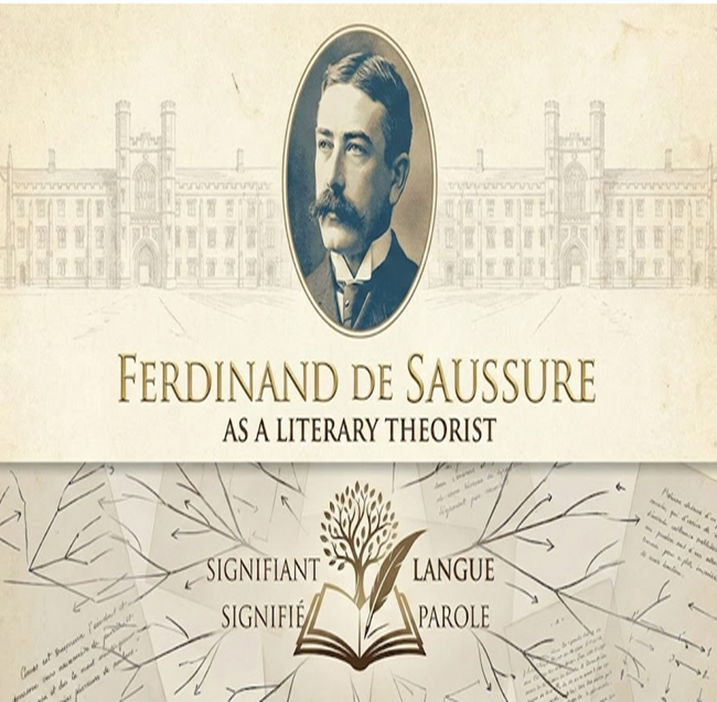
Introduction: Ferdinand de Saussure as a Literary Theorist
Ferdinand de Saussure as a Literary Theorist is best understood through his foundational quality as a structural thinker who reconceptualized language not as a mere nomenclature of things but as a self-regulating system of differences that generates meaning. Born in Geneva in 1857, Saussure received early training in classical languages and later studied historical and comparative linguistics at Leipzig and Berlin, where he earned his doctorate with distinction, before teaching in Paris and ultimately at the University of Geneva. Although he published little during his lifetime, his posthumously compiled Course in General Linguistics (1916) transformed literary and cultural theory by introducing key ideas such as the arbitrariness of the sign, the binary structure of signifier and signified, and the distinction between langue (the underlying system of language) and parole (individual utterance). Saussure famously asserts that “in language there are only differences without positive terms” (Course 120), a claim that redirected literary criticism from authorial intention and historical reference to relational structures within texts. His insistence that language is “a system in which all the terms are interdependent” (Course 113) laid the theoretical groundwork for structuralism and later developments in narratology, semiotics, and poststructuralism. As Jonathan Culler aptly observes, Saussure’s work “made possible the application of structural analysis to literature by redefining meaning as a product of relations rather than reference” (Culler 19), thereby securing Saussure’s enduring status as a central—if indirect—figure in modern literary theory.
Major Works of Ferdinand de Saussure as a Literary Theorist
· Course in General Linguistics(1916)
- Compiled posthumously by Charles Bally and Albert Sechehaye from Saussure’s lectures delivered at the University of Geneva (1907–1911).
- This work constitutes Saussure’s most influential contribution to literary theory, semiotics, and structuralism, despite not being authored directly by him.
- Introduces the foundational concept of the linguistic sign, composed of the signifier (sound-image) and the signified (concept).
- Establishes the principle of arbitrariness, asserting that meaning arises from convention rather than natural resemblance.
- Formulates the crucial distinction between langue (the abstract system of language) and parole (individual speech acts), which later shaped structuralist literary analysis.
- Emphasizes meaning as relational, not referential, famously stating:
“In language there are only differences without positive terms” (Saussure 120).
- This idea directly influenced literary critics to analyze texts as systems of relations rather than expressions of authorial intention or historical reality.
- Saussure further defines language as an internally structured system:
“Language is a system in which all the parts can and must be considered in their synchronic solidarity” (Saussure 113).
· Mémoire sur le système primitif des voyelles dans les langues indo-européennes(1879)
- Saussure’s early scholarly masterpiece written at the age of twenty-one, establishing his reputation as a rigorous structural thinker.
- Though a technical linguistic study, it anticipates structuralist methodology by privileging systematic relations over empirical data.
- Demonstrates that linguistic elements derive meaning from their position within a structure, not from intrinsic properties.
- Jonathan Culler notes that this work reveals Saussure’s lifelong commitment to structural explanation:
“The Mémoire already exhibits Saussure’s insistence on relational explanation rather than historical accumulation” (Culler 16).
- This relational logic later becomes central to literary structuralism, especially in narratology and poetics.
· Anagram Notebooks(written c. 1906–1909; published later)
- A collection of unpublished notebooks in which Saussure explored hidden phonetic patterns (anagrams or hypograms) in ancient poetry, particularly Latin verse.
- Reveals Saussure’s intense interest in poetic language, repetition, and unconscious textual structures.
- Although controversial, these notebooks significantly influenced later theorists concerned with textual unconscious, intertextuality, and poetic structure.
- Jean Starobinski argues that the anagram studies expose a literary dimension of Saussure often overlooked:
“Saussure listens to the text as a network of echoes rather than as a vehicle of meaning alone” (Starobinski 23).
- The notebooks prefigure poststructuralist concerns with latent textual mechanisms and the instability of meaning.
· Essai sur les langues(1872, unpublished early manuscript)
- Written during Saussure’s adolescence, this early essay reflects his precocious attempt to theorize language as a unified system.
- Demonstrates his early fascination with underlying linguistic structures rather than surface usage.
- Though immature, it foreshadows his later insistence on abstraction and systematization.
- Scholars regard it as the conceptual seed of his later theoretical framework (Bouissac 38).
· Influence through Secondary Theoretical Reception (via Structuralism)
- Saussure’s ideas entered literary theory largely through later thinkers rather than through literary texts authored by him.
- His concepts were foundational for:
- Claude Lévi-Strauss (structural anthropology)
- Roland Barthes (structuralist and semiotic literary criticism)
- Roman Jakobson (structural poetics)
- Culler underscores Saussure’s decisive literary impact:
“Saussure made possible a theory of literature in which meaning is produced by systems of conventions rather than mimetic representation” (Culler 19).
Major Literary Ideas of Ferdinand de Saussure as a Literary Theorist
| Literary Idea | Explanation (Literary Perspective) | Key Quotation |
| Language as a System (Structuralism) | Saussure reconceptualizes language as a self-contained system whose elements derive meaning from their relations within the whole. Literary texts, therefore, should be analyzed as structured systems rather than as reflections of reality or authorial intention. | “Language is a system in which all the terms are interdependent” (Saussure 113). |
| The Linguistic Sign | Every linguistic unit consists of two inseparable components: the signifier (sound/image) and the signified (concept). Literary meaning emerges from the interaction of these components, not from reference to external reality. | “The linguistic sign unites, not a thing and a name, but a concept and a sound-image” (Saussure 66). |
| Arbitrariness of the Sign | There is no natural or inherent connection between words and what they signify. This idea undermines mimetic theories of literature and emphasizes convention, making literary meaning culturally constructed rather than fixed. | “The bond between the signifier and the signified is arbitrary” (Saussure 67). |
| Meaning through Difference | Meaning does not arise from positive content but from contrast and opposition within the linguistic system. In literature, words, motifs, and symbols gain significance only through difference from others. | “In language there are only differences without positive terms” (Saussure 120). |
| Langue and Parole | Langue refers to the underlying abstract system of language; parole refers to individual utterances. Literary criticism focuses on langue—the codes, genres, and conventions governing texts—rather than isolated expressions. | “Langue is social; parole is individual” (Saussure 14). |
| Synchrony vs. Diachrony | Saussure privileges synchronic analysis (language at a given moment) over diachronic (historical development). Structuralist literary criticism similarly analyzes texts as complete systems rather than tracing historical evolution alone. | “The opposition between synchrony and diachrony is absolute and allows no compromise” (Saussure 88). |
| Relational Value of Signs | A sign’s value depends on its position within the system, not on intrinsic meaning. In literary texts, themes, characters, and symbols acquire value through narrative and structural relations. | “The value of a term is determined by what surrounds it” (Saussure 115). |
| Foundation of Semiology | Saussure proposes a general science of signs (semiology), of which literature is a central domain. Literary texts are treated as sign-systems governed by codes and conventions. | “A science that studies the life of signs within society… I shall call it semiology” (Saussure 16). |
| Text over Author | By prioritizing systems over individuals, Saussure indirectly shifts focus away from authorial intention. This paves the way for later theories emphasizing textual autonomy (e.g., Barthes’ “Death of the Author”). | “The individual does not create the system; he registers it” (Saussure 72). |
| Influence on Structuralist Literary Criticism | Saussure’s ideas form the theoretical foundation for structuralist and poststructuralist literary theory, influencing Barthes, Lévi-Strauss, Jakobson, and narratology. | “Saussure made possible a theory of literature based on relations rather than reference” (Culler 19). |
Theoretical Terms/Concepts of Ferdinand de Saussure as a Literary Theorist
| Term / Concept | Explanation (Literary-Theoretical Context) | Key Reference / Quotation |
| Sign | The basic unit of meaning in language and literature. A sign is not a word-object relation but a mental construct functioning within a system. Literary texts are networks of signs rather than reflections of reality. | “The linguistic sign unites… a concept and a sound-image” (Saussure 66). |
| Signifier | The material or perceptible form of the sign (sound, written word, image). In literature, signifiers (words, metaphors, symbols) generate multiple meanings depending on context. | “The signifier is the sound-image” (Saussure 66). |
| Signified | The conceptual meaning associated with the signifier. Literary meaning is conceptual, not referential, and remains culturally conditioned and unstable. | “The signified is the concept” (Saussure 66). |
| Arbitrariness of the Sign | There is no natural link between signifier and signified. Literary language is conventional, undermining mimetic or realist theories of representation. | “The bond between the signifier and the signified is arbitrary” (Saussure 67). |
| Langue | The abstract, collective system of language governing grammar, genres, and codes. Literary criticism focuses on langue—shared conventions shaping texts. | “Langue is social in its essence” (Saussure 14). |
| Parole | Individual acts of speech or writing. A literary text is an instance of parole, structured by the rules of langue. | “Parole is individual and willful” (Saussure 14). |
| Synchrony | The study of language at a given moment as a complete system. Structuralist literary criticism adopts synchronic analysis to examine texts as closed systems. | “The synchronic state excludes diachronic considerations” (Saussure 87). |
| Diachrony | The historical evolution of language over time. Saussure subordinates diachrony to synchrony, influencing anti-historicist literary analysis. | “Diachronic facts are unrelated to synchronic facts” (Saussure 88). |
| Difference | Meaning arises from difference and opposition, not positive essence. In literature, themes and symbols gain meaning relationally. | “In language there are only differences without positive terms” (Saussure 120). |
| Value (Valeur) | The meaning-value of a sign determined by its position in the system. Literary elements acquire significance through contrast with others. | “The value of a term is determined by what surrounds it” (Saussure 115). |
| Syntagmatic Relations | Linear relations between signs in sequence (sentence, narrative). Literary structure depends on syntagmatic ordering of words and events. | “Syntagmatic relations exist in praesentia” (Saussure 123). |
| Paradigmatic Relations | Associative relations among signs that can substitute for each other. Literary meaning emerges from choices among alternatives (e.g., metaphor). | “Associative relations exist in absentia” (Saussure 123). |
| Semiology | A proposed general science of signs. Literature is treated as a semiotic system governed by codes and conventions. | “A science that studies the life of signs within society… I call it semiology” (Saussure 16). |
| Relational Meaning | Meaning is produced internally within the system, not by reference to external reality. Literature is autonomous and self-regulating. | “Language is a form, not a substance” (Saussure 122). |
| Textual Autonomy (Implied) | Saussure’s system-centered theory indirectly marginalizes authorial intention, paving the way for structuralist and poststructuralist criticism. | “The individual does not create the system” (Saussure 72). |
| Structural Method | A method of analysis focusing on relations, oppositions, and systems rather than content or biography. | “What is essential is not the meaning itself but the relations” (Culler 19). |
Application of Theoretical Ideas of Ferdinand de Saussure as a Literary Theorist To Literary Works
- Application to Hamlet by William Shakespeare
- Saussure’s idea that meaning arises through difference helps explain Hamlet’s identity, which is defined in opposition to Claudius (action vs. hesitation), Laertes (impulsiveness vs. reflection), and Fortinbras (political action vs. moral inquiry).
- The play operates as a system of signs, where symbols like the ghost, madness, and poison gain meaning relationally rather than intrinsically.
- Hamlet’s famous soliloquy (“To be or not to be”) exemplifies paradigmatic relations, presenting binary oppositions (being/non-being, action/inaction) that structure meaning.
- A synchronic reading focuses on how these oppositions function within the play’s structure rather than tracing Elizabethan history.
- Hamlet’s speeches (parole) are governed by the dramatic and linguistic conventions (langue) of tragedy.
- Application to Heart of Darkness by Joseph Conrad
- Saussure’s principle of arbitrariness of the sign exposes how terms like “civilization,” “savagery,” and “darkness” have no fixed meaning but shift according to context.
- The word “darkness” gains value through contrast with “light,” revealing colonial ideology as a linguistic construct rather than a moral truth.
- The novella functions as a semiological system, where Africa becomes a signifier loaded with European conceptual meanings rather than an objective reality.
- Meaning is produced through difference, not reference—“civilized” Europe is defined only by opposition to the constructed “primitive” Other.
- A Saussurean reading emphasizes the instability of signifieds, paving the way for postcolonial interpretations.
- Application to Pride and Prejudice by Jane Austen
- Social identities (gentleman, lady, marriageable woman) operate as linguistic signs, defined by their position within a social system.
- Elizabeth Bennet and Darcy acquire meaning through relational value, particularly through contrasts in class, manners, and speech.
- Marriage functions as a cultural code (langue), while individual romantic choices represent parole.
- Misunderstandings in the novel arise from unstable signifiers, such as Darcy’s reserve being interpreted as arrogance.
- A synchronic analysis highlights how Austen’s narrative system regulates meaning without requiring historical background.
- Application to The Waste Land by T. S. Eliot
- The poem exemplifies Saussure’s claim that language is “a form, not a substance,” as meaning emerges from fragmentation and relational patterns.
- Repeated images (water, dryness, ruins) function as signifiers whose meanings shift depending on textual placement.
- The poem relies heavily on paradigmatic relations, drawing on myth, religion, and literature as absent but implied alternatives.
- Eliot’s intertextual method illustrates semiology, where literary tradition itself becomes a system of signs.
- Meaning is not author-centered but system-generated, reinforcing Saussure’s influence on modernist aesthetics.
Key Saussurean Concepts Applied Across the Texts
- Meaning is relational, not referential
- Literary texts function as self-contained sign systems
- Binary oppositions structure narrative and character
- Emphasis on structure (langue) over individual expression (parole)
- Preference for synchronic analysis over historical explanation
Representative Quotations of Ferdinand de Saussure as a Literary Theorist
| Quotation | Explanation (Literary-Theoretical Significance) |
| “Without language, thought is a vague, uncharted nebula.” | This statement underlines Saussure’s foundational claim that thought does not pre-exist language. In literary theory, it implies that meaning in texts is produced by linguistic structures, not by pre-linguistic ideas or authorial intention. |
| “Psychologically our thought—apart from its expression in words—is only a shapeless and indistinct mass.” | Reinforces the idea that language shapes cognition. Literary meaning, therefore, is inseparable from verbal form, supporting close textual and structural analysis. |
| “A linguistic system is a series of differences of sound combined with a series of differences of ideas.” | This quotation encapsulates Saussure’s theory of difference, central to structuralist literary criticism, where words, images, and motifs gain meaning only through contrast. |
| “In language there are only differences without positive terms.” | One of Saussure’s most influential ideas for literary theory. It rejects fixed meanings and supports reading literature as a relational system of signs, anticipating poststructuralism. |
| “Speech has both an individual and a social side, and we cannot conceive of one without the other.” | Forms the basis of the langue/parole distinction. In literary studies, individual texts (parole) are governed by shared linguistic and generic conventions (langue). |
| “Time changes all things; there is no reason why language should escape this universal law.” | Acknowledges linguistic change (diachrony) while still privileging synchronic analysis. Literary critics apply this to balance historical context with structural reading. |
| “For the study of language to remain solely the business of a handful of specialists would be a quite unacceptable state of affairs.” | Suggests that language—and by extension literature—is a social phenomenon, justifying its study across disciplines including literary criticism, anthropology, and philosophy. |
| “A science that studies the life of signs within society… I shall call it semiology.” | Establishes the theoretical foundation for semiotics, allowing literature to be studied as a system of signs governed by codes and conventions. |
| “Language is a form, not a substance.” | A crucial statement for modern literary theory: meaning arises from structure and relations, not from material or referential content. |
| “I’m almost never serious, and I’m always too serious… I’m like a collection of paradoxes.” | Though autobiographical, this remark reflects the tensions and dualities (system/use, stability/change) that characterize Saussure’s theory and later structuralist thought. |
Criticism of the Ideas of Ferdinand de Saussure as a Literary Theorist
· Over-emphasis on Structure at the Expense of Meaning
- Saussure’s focus on language as an autonomous system (langue) downplays semantic depth, emotional resonance, and lived experience in literature.
- Critics argue that literary meaning cannot be fully explained through structural relations alone.
· Neglect of Historical and Cultural Context (Anti-Historicism)
- By privileging synchronic analysis over diachronic study, Saussure marginalizes history, ideology, and social change.
- Marxist and New Historicist critics contend that texts are inseparable from historical forces and material conditions.
· Marginalization of the Author and Intentionality
- Saussure’s system-centered model minimizes the role of authorial intention.
- Humanist critics argue that literature is also a product of conscious creativity, personal vision, and ethical responsibility.
· Reduction of Literature to Linguistic Codes
- Treating literature primarily as a system of signs risks reducing aesthetic experience to technical analysis.
- Critics claim that poetry, irony, and ambiguity exceed purely linguistic explanation.
· Problem of Fixed Structures
- Structuralism inspired by Saussure assumes relatively stable systems.
- Poststructuralists (notably Derrida) argue that meaning is inherently unstable and endlessly deferred, even within structures.
· Binary Oppositions Are Over-Simplified
- Saussurean analysis relies heavily on binaries (signifier/signified, langue/parole).
- Feminist and postcolonial critics argue that such binaries often reproduce hierarchies and suppress marginalized meanings.
· Insufficient Attention to Power and Ideology
- Saussure treats language as neutral, ignoring how power relations shape meaning.
- Later theorists (Foucault, Althusser) emphasize discourse as a site of ideological control, absent in Saussure’s model.
· Limited Applicability Beyond Language
- While Saussure proposed semiology, critics argue that linguistic models cannot fully explain visual arts, literature, or cultural practices.
- Literature involves imagination, emotion, and ambiguity beyond structural regularities.
· Dependence on a Posthumous Text
- Course in General Linguistics was compiled by students, not written by Saussure himself.
- Scholars question whether the “Saussurean system” accurately reflects his nuanced and sometimes tentative thinking.
· Challenged by Poststructuralism
- Derrida’s critique of the sign undermines the stability of the signified assumed by Saussure.
- Poststructuralism exposes internal contradictions within Saussure’s framework, particularly regarding meaning and difference.
Suggested Readings on Ferdinand de Saussure as a Literary Theorist
- Culler, Jonathan. Ferdinand de Saussure. Penguin Books, 1977.
- Saussure, Ferdinand de. Course in General Linguistics. Edited by Charles Bally and Albert Sechehaye, translated by Wade Baskin, McGraw-Hill, 1966.
- Bouissac, Paul. Saussure: A Guide for the Perplexed. Continuum, 2010.
- Starobinski, Jean. Words upon Words: The Anagrams of Ferdinand de Saussure. Translated by Olivia Emmet, Yale University Press, 1979.
- Jakobson, Roman. “Linguistics and Poetics.” Style in Language, edited by Thomas A. Sebeok, MIT Press, 1960, pp. 350–377.
- Hawkes, Terence. “Saussure and the Structuralist Enterprise.” Structuralism and Semiotics, Routledge, 1977, pp. 17–45.
- “Ferdinand de Saussure.” Stanford Encyclopedia of Philosophy, Stanford University, https://plato.stanford.edu/entries/saussure/.
- “Saussure and Structuralism.” Internet Encyclopedia of Philosophy, https://iep.utm.edu/saussure/.