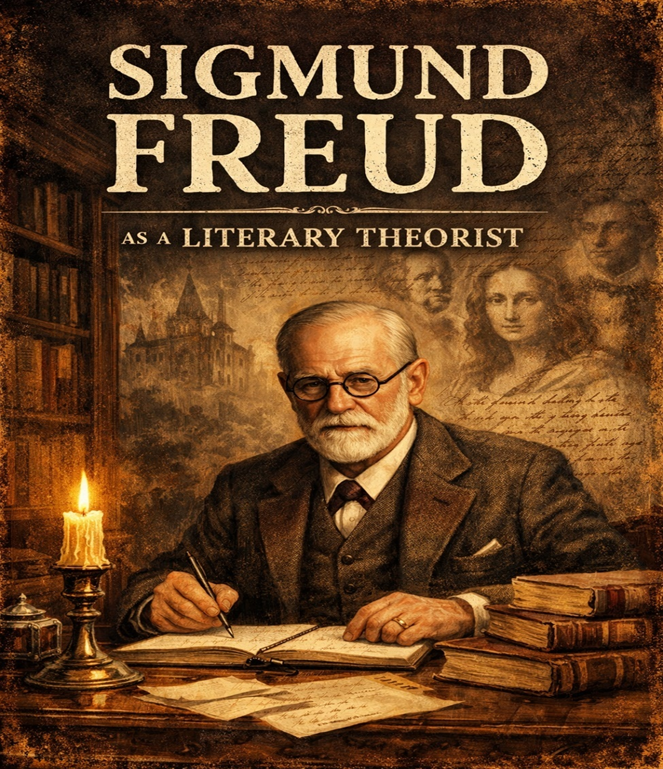
Introduction: Sigmund Freud as a Literary Theorist
Sigmund Freud as a Literary Theorist is distinguished by a clinician’s interpretive rigor applied to imaginative writing: even sympathetic critics note that his theories “bear the unmistakable stamp of the doctor’s consulting-room,” yet that same clinical method built a “bridge” from case-history to the analysis of cultural and artistic forms (Jung 59). Educated in medicine and research “at the University of Vienna in 1873,” Freud developed his approach through late-nineteenth-century neurology and the emerging study of hysteria; Jung recalls that Freud “owed his initial impetus to Charcot, his great teacher at the Salpêtrière,” and that work with Breuer on traumatic memories and affects laid foundations for psychoanalysis (Byrd 46; Jung 60). His major writings then formalized a new hermeneutics of depth—Die Traumdeutung (The Interpretation of Dreams) appears as a landmark of 1900 (Freud, On Creativity 301)—and, crucially for literary criticism, he argued that meaning is structured by unconscious conflict: neurosis (and, by extension, symbolic representation) turns on the “suppression of a part of instinctual life and the repression of the ideas” representing it, with “symptoms” emerging as compromises between opposing psychic currents (Freud, Writings 49). Freud’s larger intellectual posture was disillusioning and diagnostic—he confessed that “a great part of my life’s work … has been spent [trying to] destroy illusions” (Kaye 34)—which, in literary studies, translates into reading texts as aestheticized wish, displacement, and cultural symptom rather than as transparent moral statement.
Major Works of Sigmund Freud as a Literary Theorist
- 🔵 The Interpretation of Dreams (1900)
- Establishes the core interpretive premise for psychoanalytic criticism: dreams (and, by extension, literary images) are structured by repression and “disguised wish-fulfilments” (Jung 63).
- Canonizes the dream as a privileged route into latent meaning: “the dream is the via regia to the unconscious” (Jung 63).
- 🟣 Jokes and Their Relation to the Unconscious (1905)
- Frames wit as an “applied” laboratory for unconscious processes—explicitly extending repression-based interpretation to comic language (Jung 64).
- Connects joking to truth-telling under disguise: “In joke, as we know, even the truth may be told” (Freud, On Creativity 233).
- 🟢 “The Relation of the Poet to Day-Dreaming” (1908)
- Provides Freud’s most direct bridge between psychic life and literary production: “every child at play behaves like an imaginative writer” (Freud, On Creativity 45).
- Defines the writer’s method as controlled fantasy-work: “the writer does the same as the child at play; he creates a world of phantasy” (Freud, On Creativity 45).
- Supplies a practical biographical-historicist heuristic for criticism: a present “actual experience” stirs childhood memory and “arouses a wish that finds a fulfilment in the work” (Freud, On Creativity 52).
- 🔴 Delusions and Dreams in Jensen’s “Gradiva” (1907)
- Foundational for “psychoanalysis and literature” because it targets fictional dreams: “dreams that have never been dreamt at all—dreams created by imaginative writers” (Freud, Writings 171).
- Reasserts the thesis of latent desire: the dream “revealed itself … as a wish of the dreamer’s represented as fulfilled” (Freud, Writings 4).
- 🟠 “The ‘Uncanny’” (1919)
- Reorients aesthetics toward negative affect and interpretive disturbance: the uncanny “belongs to all that is terrible … dread and creeping horror” (Freud, On Creativity 123).
- Models how literary effects (doubling, animation of the inanimate, compulsive repetition) can be read as returns of repressed or “primitive” modes of thought—i.e., fear as a meaning-bearing symptom rather than a merely “atmospheric” mood (Kaye 31).
- 🟡 Totem and Taboo (1912–13)
- Offers a cultural-mythic framework frequently used in literary theory (ritual, taboo, collective fantasy), grounded in ambivalence: Freud argues taboo’s origin involves “an innate ambivalence inherent in taboo” (Freud, Sexuality and the Psychology of Love 68).
- Articulates a durable psychoanalytic reduction of religious authority (often applied to literary representations of “the sacred”): “God is nothing other than an exalted father” (Freud qtd. in Butts 170).
- 🟤 Civilization and Its Discontents (1930)
- Widely applied in literary/cultural studies for interpreting texts as negotiations between instinct and social regulation; Freud’s civilizational diagnosis is blunt: “what we call our [Christian] civilization is largely responsible for our misery” (Freud qtd. in Byrd 51).
- Provides a working definition of “civilization” usable as a critical lens on narratives of progress and modernity: it includes “all those respects in which human life has raised itself above its animal status” (Freud qtd. in Miri 136).
- 🟩 “The Moses of Michelangelo” (written 1913; published 1914) / Freud’s art-criticism corpus
- Demonstrates Freud’s “applied psychoanalysis” to visual art as a close-reading practice; he describes the essay as a “love-child,” recalling how he “stood every day in the church … studied it … sketched it” to “capture” its meaning (Freud, On Creativity 304).
Major Literary Ideas of Sigmund Freud as a Literary Theorist
| Major literary idea (Freud) | Explanation for literary analysis | Key quotation with MLA in-text citation |
| 🔵 Literature as structured fantasy | Freud treats imaginative writing as a socially acceptable continuation of childhood play: the text builds an alternative “world” that can stage intense affects without collapsing into reality. | “every child at play behaves like an imaginative writer” (Freud, On Creativity 45). |
| 🟣 Wish as the engine of imaginative production | Freud’s basic causal claim: fantasies (and many narratives) are driven by dissatisfaction and aim at symbolic gratification—useful for reading plot as “wish-work” rather than mere event-sequence. | “Unsatisfied wishes are the driving power behind phantasies” (Freud, On Creativity 48). |
| 🟢 Time-structure of fantasy | Freud models fantasy as temporally braided: a present stimulus activates an infantile memory and projects a future fulfilment—useful for reading flashback, obsession, and recurring motifs as desire’s timeline. | “past, present and future are threaded… on the string of the wish” (Freud, On Creativity 49). |
| 🟠 Biographical trigger + childhood memory | Freud proposes a working heuristic for psycho-biographical criticism: an “actual experience” reactivates childhood memory and crystallizes as a wish fulfilled in the work—useful for framing authorial “material” without reducing the text to gossip. | “Some actual experience… stirred up a memory… arouses a wish that finds a fulfilment in the work” (Freud, On Creativity 52). |
| 🔴 Myth as collective wish-fantasy | Freud extends the fantasy model from the individual to the collective: myths/legends can be read as culturally “distorted” deposits of shared desires—useful for archetypal and nationalist readings. | “myths… are distorted vestiges of the wish-phantasies of whole nations” (Freud, On Creativity 53). |
| 🟡 The artist’s “tolerance” for the unconscious | Freud differentiates the artist’s method from the clinician’s: the writer attends to unconscious developments and gives them form rather than censoring them—useful for theorizing creativity as managed access to unconscious material. | “He directs his attention to the unconscious… and lends them artistic expression instead of suppressing them” (Freud, Writings 106). |
| 🟤 Latent vs. manifest meaning (censorship) | Freud provides the classic hermeneutic model for depth-interpretation: surface content is “distorted” by censorship; interpretation translates it into latent thoughts—transferable to symbolic, oblique, or “coded” literary language. | “translating the manifest content… into the latent dream-thoughts” (Freud, Writings 76). |
| 🟩 Wish + repression as motive force | Freud insists that (unconscious) wish-energy supplies the drive behind symbolic constructions; repression shapes what can appear—useful for reading omissions, gaps, and substitutions as motivated, not random. | “the co-operation of a wish (usually an unconscious one) is required” (Freud, Writings 107). |
| ⚫ Repression and symptom-formation (compromise) | Freud’s symptom model becomes a general tool for reading “symptomatic” textual moments—contradictions, compulsions, repeated images—as compromises between desire and prohibition. | “symptoms [are]… compromises in the conflict” (Freud, Sexuality 7). |
| 🟧 Sublimation and “cultural achievement” | Freud links culture/art to redirected libido: frustrated instinct becomes productive energy—useful for interpreting art as transformed desire rather than “pure” transcendence. | “the grandest cultural achievements… [are] brought to birth by… sublimation” (Freud, On Creativity 196). |
| 🟦 Humour/jokes as licensed truth | Freud treats joking as a mode where censored truths can surface safely—useful for reading satire, irony, and comic relief as disclosure under cover of play. | “In joke… even the truth may be told” (Freud, On Creativity 234). |
| 🟥 The uncanny as aesthetic dread | Freud theorizes a distinct aesthetic affect (not simply “fear”): the uncanny organizes texts around dread/horror and interpretive disturbance—useful for Gothic, psychological realism, and modernist estrangement. | “related to what is frightening—to what arouses dread and horror” (Freud, Writings 194). |
| 🟪 Doubling + repetition as uncanny mechanisms | Freud shows how motifs like doubles and involuntary repetition generate uncanny helplessness—useful for reading mirrored characters, recurring scenes, and circular plots as affect-machines. | “repetition of the same thing… arouse[s] an uncanny feeling” (Freud, Writings 213). |
| 🟫 Drama as safe “release” of suppressed impulses | Freud frames theatrical pleasure as controlled discharge: the stage lets audiences “blow off steam,” finding enjoyment even in defeat/suffering—useful for tragedy, catharsis, and spectatorship studies. | “give way… to… suppressed impulses… and ‘blow off steam’” (Freud, Writings 112). |
Theoretical Terms/Concepts of Sigmund Freud as a Literary Theorist
| Term / Concept | Core meaning (Freud) | Typical use in literary analysis |
| Unconscious | A large domain of mental activity not directly accessible to awareness; consciousness gives only partial, unreliable “news.” | Read plots/symbols as expressions of what characters/narrators/authors cannot avow; track gaps, slips, contradictions, and symptomatic motifs. |
| Repression | Defensive exclusion of unacceptable wishes/impulses from consciousness, often returning as symptoms. | Interpret recurring images/events as “return of the repressed”; explain narrative detours, silences, and compulsive repetitions. |
| Return of the repressed | Repressed material reappears indirectly (symptoms, dreams, compulsions, uncanny effects). | Identify disguised re-emergence of forbidden desire (e.g., haunting, obsession, intrusive memories). |
| Libido | Psychic energy of the sexual instincts; a driving force shaping conflict and symptom-formation. | Trace desire as the engine of character motivation and narrative pressure; map erotic investments onto themes/objects. |
| Libido-theory (of neuroses) | Neuroses arise from conflict involving sexual instincts and ego defenses; fixation and gratification paths matter. | Explain “neurotic” characterization and symbolic symptom-structures in plots (e.g., compulsions, inhibitions, phobias). |
| Ego | Organizing “I” that mediates between instinct, norms, and reality; often not master “in its own house.” | Analyze narration/character as a management system (control, rationalization, selective memory), including breakdowns and lapses. |
| Id | Reservoir of instinctual drives operating by pleasure/wish logic. | Read raw desire/aggression as the pressure behind choices, fantasies, and symbolic substitutions. |
| Superego | Internalized authority (law, prohibition, guilt, ideal standards). | Interpret guilt, punitive plots, moral masochism, or harsh inner “judges” shaping confession, punishment, or sacrifice arcs. |
| Psychic conflict | Struggle among incompatible demands (instinct vs. defense; desire vs. norm). | Treat narrative tension as dramatized psychic struggle; read crises as eruptions of conflict-management failure. |
| Narcissism | Libido investment in the self; development from narcissism to object-love, with narcissism persisting. | Explain vanity, grandiosity, wounded pride, rivalry, and “narcissistic injury” driving revenge, withdrawal, or self-destruction. |
| Cathexis | Attachment/investment of libidinal energy in an idea/object/person. | Map “charged” objects (letters, portraits, relics) as libidinally loaded; track shifts of investment across the plot. |
| Object-choice / Object-love | Direction of libido toward external objects rather than the self. | Explain attachment patterns (obsessive love, idealization, triangulation) and why certain figures become narrative “centers of gravity.” |
| Fixation | Arrest of libido at an earlier developmental point. | Read regressions and character “stuckness” as developmental residues; connect adult conflict to early attachments or traumas. |
| Sublimation | Transformation of instinctual energy into socially valued activity (art, thought, work). | Interpret artistic creation within the text as redirected desire; read style as a “civilized” outlet of unruly drives. |
| Dream-work | Mechanisms that transform latent wishes into manifest dream content. | Treat texts (especially symbolic ones) like dreams: decode distortions, substitutions, and narrative disguises. |
| Condensation | Multiple ideas/wishes compressed into one image or event. | Identify “overdetermined” symbols (one figure/object doing many psychic jobs at once). |
| Displacement | Emotional intensity shifted from a threatening target to a safer one. | Explain misdirected anger/love; interpret “minor” objects/scenes as carrying major affect. |
| Symbolization | Indirect representation of wishes/conflicts via symbols. | Build symbol-systems (doors, water, shadows, doubles) as encoded desire, fear, or guilt. |
| Primary vs. secondary process | Primary: associative, wish-driven; secondary: logical, reality-oriented. | Contrast fantasy logic with rational narration; show where the text slides into primary-process imagery or breaks realism. |
| Oedipus complex | Child’s desire and rivalry structured around parental triangle and prohibition. | Analyze triangulated desire, rivalry with authority figures, “father-law,” forbidden love, and the formation of guilt/identity. |
| Castration anxiety | Fear of loss/punishment linked to prohibition and sexual difference. | Read threats, humiliation, “loss” motifs, and crises of masculinity/power as symbolic castration narratives. |
| Penis envy | Conceptualization of female development via perceived lack (historically contested). | Used (often critically) to discuss gendered desire, compensation, rivalry, and how texts encode patriarchal psychic economies. |
| Fetishism | Substitution that manages anxiety by fixing desire onto an object/part. | Read obsessive objects (shoes, hair, fabrics, relics) as anxiety-management devices sustaining desire while disavowing conflict. |
| The Uncanny (Das Unheimliche) | The frightening as the strangely familiar—often tied to repressed material returning. | Interpret doubles, automata, repetition, haunted houses, déjà vu, and eerie homeliness as repressed content resurfacing. |
| Repetition compulsion | Drive to repeat distressing patterns beyond pleasure. | Explain cyclical plots, recurring failures, return-to-origin structures, and characters “reliving” trauma. |
| Pleasure principle | Tendency to seek gratification and reduce tension. | Read plot momentum as gratification-seeking (romance, revenge, confession), with detours as defensive compromises. |
| Reality principle | Modification of pleasure-seeking under external constraints. | Analyze compromise formations: delayed gratification, renunciation, strategic rationality, and socially negotiated desire. |
| Defense mechanisms (e.g., projection, denial, rationalization) | Ego strategies to manage anxiety/conflict. | Diagnose unreliable narration, scapegoating, moralizing, misrecognition, and “explaining away” as textual defenses. |
| Transference | Redirection of feelings from earlier figures onto a present figure. | Read intense attachments/hostilities as displaced past relations (mentor, ruler, lover as parental substitute). |
| Overdetermination | A symptom/text element has multiple causes and meanings. | Justifies layered readings: one symbol/event can legitimately carry several psychic “sources” simultaneously. |
Application of Theoretical Ideas of Sigmund Freud as a Literary Theorist To Literary Works
- 🔵 William Shakespeare, Hamlet: repression, the uncanny, and desire as interpretation
- The Ghost as “uncanny” return: the play’s dread intensifies because what should remain buried reappears as a demand for meaning—“‘So the dead do live on and appear on the scene / of their former activities!’” (Freud, Writings on Art and Literature 248). Hamlet’s world is immediately reorganized by that return: “The time is out of joint” (Shakespeare 1.5.188).
- Uncanny affect as a critical signal: Freud defines the uncanny as “related to what is frightening—to what arouses dread and horror” (Freud, Writings 193–94). In Hamlet, that affect marks points where “knowledge” cannot stay merely rational (the Ghost’s command, Hamlet’s paralysis, the contagion of suspicion).
- Soliloquy as dramatized fantasy-work: Freud argues that imaginative making continues childhood play—“every child at play behaves like an imaginative writer” (Freud, On Creativity and the Unconscious 45). Hamlet’s interior speeches function like staged, public “day-dreaming” in which he tests wishes and prohibitions: “To be, or not to be” (Shakespeare 3.1.56).
- Symptoms as compromise formations: Freud’s clinical model maps cleanly onto Hamlet’s oscillations, where action is repeatedly deferred and rerouted into language, performance, and self-accusation.
- 🔴 William Shakespeare, Macbeth: guilt, symptom-formation, and compulsive repetition
- Lady Macbeth’s sleepwalking as symptom: Freud describes neurotic symptoms as “equivalent to compromises in the conflict” between libido and repression (Freud, Sexuality and the Psychology of Love 7). Her body “speaks” what consciousness cannot master: “Out, damned spot! out, I say!” (Shakespeare 5.1.30).
- Repetition as the structure of dread: Freud notes that the “factor of the repetition of the same thing… arouse[s] an uncanny feeling” (Freud, Writings 213). In Macbeth, recurrence (blood imagery, knocking, sleeplessness, “again and again” returns to fear) is not decorative—it is the compulsion of a guilty psyche.
- The uncanny as the repressed returning as anxiety: Freud maintains that the uncanny often involves “something repressed which recurs” (Freud, Writings 240). Macbeth’s “Stars, hide your fires” (Shakespeare 1.4.50) reads as an explicit wish for repression—followed by its inevitable return in hallucination and panic.
- Ambition as wish-fantasy under moral censorship: Freud’s model of fantasy as wish-fulfilment clarifies how Macbeth’s “vaulting ambition” repeatedly fabricates necessity, prophecy, and destiny to disguise desire as fate.
- 🟢 Mary Shelley, Frankenstein: the Double, projection, and the uncanny familiar
- The Creature as the “double” turned terrifying: Freud writes, “The ‘double’… has become a vision of terror” (Freud, On Creativity 144). Shelley externalizes Victor’s disavowed drives and ambitions into a living mirror that will not stay hidden.
- Uncanny logic: the familiar made alien by repression: Freud argues the uncanny is “nothing new or alien, but something… familiar… alienated… through… repression” (Freud, Writings 240). Victor’s horror is therefore not merely at “otherness,” but at the return of his own authorship and desire in embodied form.
- Desire for origin and rivalry with the creator: the Creature frames the relationship in biblical/tragic terms—“I ought to be thy Adam; but I am rather the fallen angel” (Shelley ch. 10). Read Freudianly, the text stages a violent family romance: creator/creation becomes father/son rivalry and demand for recognition.
- Involuntary recurrence as fate: Freud’s emphasis on involuntary repetition generating an “uncanny atmosphere” (Freud, On Creativity 144). aligns with the novel’s relentless returns—each attempt to escape the act of creation re-circles Victor back to it.
- 🟣 Emily Brontë, Wuthering Heights: wish-fantasy, fixation, and identity-fusion
- Fusion of self and object-choice: Catherine’s declaration—“I am Heathcliff” (Brontë ch. 9)—is usefully read as extreme libidinal investment where the “object” is not external but constitutive of the self (a psychoanalytic grammar of attachment rather than a merely romantic trope).
- Fantasy as driven by dissatisfaction: Freud states, “happy people never make phantasies, only unsatisfied ones… Unsatisfied wishes are the driving power behind phantasies” (Freud, On Creativity 48). Brontë’s plot repeatedly shows desire intensifying precisely where social reality blocks it (class, inheritance, respectability).
- Past–present–future threaded by desire: Freud’s temporal model—“past, present and future are threaded… on the string of the wish” (Freud, On Creativity 49). clarifies how the novel’s structure works: memory and revenge are not background; they are the wish’s timeline narratively enforced.
- Repetition as compulsion rather than choice: the text’s cyclical returns (names, pairings, wounds re-enacted across generations) can be read through Freud’s account of repetition producing helplessness and uncanny pressure, especially where characters seem “driven” more than deciding.
Representative Quotations of Sigmund Freud as a Literary Theorist
| # | Representative Freudian quotation (for literary theory) | Explanation (how literary critics use it) |
| 1 | “every child at play behaves like an imaginative writer” (Freud, On Creativity and the Unconscious 45). | Grounds Freud’s core analogy: literature is continuous with fantasy/play, so texts can be read as structured psychic productions (not mere “decorative” inventions). |
| 2 | “Now the writer does the same as the child at play; he creates a world of phantasy” (Freud, On Creativity and the Unconscious 45). | Justifies treating plots, symbols, and narration as organized wish-scenarios—aesthetic constructions that separate themselves from reality while carrying heavy affect. |
| 3 | “Unsatisfied wishes are the driving power behind phantasies” (Freud, On Creativity and the Unconscious 48). | Provides the engine for psychoanalytic reading: narrative pressure often comes from lack, frustration, and compensation, not simply from external events. |
| 4 | “So past, present and future are threaded… on the string of the wish” (Freud, On Creativity and the Unconscious 49). | Helps critics explain why texts braid time: memory, flashback, prophecy, obsession, and recurrence can be read as desire organizing temporality. |
| 5 | “nocturnal dreams are fulfil-ments of desires… in exactly the same way as day-dreams are” (Freud, On Creativity and the Unconscious 50). | Authorizes “dream-like” reading of literature: poems/fiction can be interpreted via wish-fulfilment plus disguise (distortion, symbol, indirection). |
| 6 | “Some actual experience… stirred up a memory… [which] arouses a wish that finds a fulfilment in the work” (Freud, On Creativity and the Unconscious 52). | A classic template for psycho-biographical criticism: texts may crystallize where present triggers re-activate childhood memory and convert it into art. |
| 7 | “myths… are distorted vestiges of the wish-phantasies of whole nations” (Freud, On Creativity and the Unconscious 53). | Extends individual psychoanalysis to culture: myths/legends (and “mythic” literature) can be read as collective fantasy, ideologically and emotionally charged. |
| 8 | “the frightening element can be shown to be something repressed which recurs” (Freud, Writings on Art and Literature 217). | Defines the psychoanalytic core of the uncanny: Gothic/modernist dread often signals repressed content returning in displaced, aesthetic form. |
| 9 | “nothing new or alien, but something… familiar… alienated… only through… repression” (Freud, Writings on Art and Literature 217). | A practical rule for textual interpretation: what feels “strange” in a work may be over-familiar psychic material made strange by defense and censorship. |
| 10 | “the repetition of the same thing… arouse[s] an uncanny feeling” (Freud, Writings on Art and Literature 212). | Helps critics read pattern as meaning: recurring scenes, names, motifs, and cyclic plots can function as compulsion, anxiety, or unresolved conflict, not mere style. |
Criticism of the Ideas of Sigmund Freud as a Literary Theorist
- 🔴 Questionable “scientificity” and verification problems
- Critics argue Freudian readings can become self-sealing: any textual evidence can be re-described as disguise, displacement, or resistance, making claims difficult to test against alternatives.
- Jung contends psychoanalytic theory “has no intention of passing as a strict scientific truth,” and its public authority often exceeds what “a simple statement” of scientific truth would require.
- 🟠 Overgeneralization from clinical cases to art and culture
- A recurrent objection is that Freud’s interpretive model was developed in therapy and then exported to literature, myth, and art—sometimes beyond what the evidence base can sustain.
- Jung notes that Freud’s dream theory “stirred up problems” that would require “a more compendious equipment than the limited experiences of the consulting-room.”
- 🟡 One-sidedness and theoretical rigidity
- Many scholars accept Freud’s insights while criticizing the tendency to treat one explanatory axis (especially sexuality/repression) as the master key for all symbolic meaning.
- Jung argues the Freudian theory is “at best a partial truth” and therefore can develop “the rigidity of a dogma.”
- 🟢 Victorian/Eurocentric cultural bias
- Freud is often criticized for universalizing what may be historically local—reading “civilized” (late-19th-century European) norms back into the psyche as if timeless.
- Jung explicitly warns that a theory “based on a Victorian prejudice” is of “secondary importance to science” once it claims cross-cultural scope; when the sexual theory “branches out” into other fields, its “one-sidedness and inadequacy leap to the eye.”
- 🔵 Biographical reductionism and “gossip” explanations
- In literary criticism, Freudian method is sometimes faulted for collapsing artworks into the author’s private life, turning interpretation into a hunt for scandal, trauma, or sexual motive.
- Jung illustrates this risk via Freud’s Leonardo analysis: a genuinely “scientific clue” (a “mythological motif”) is displaced by the more sensational claim about a “slip-up” by Leonardo’s father—effective rhetorically, weaker as interpretation.
- 🟣 Gender essentialism and androcentric assumptions
- Feminist and gender-oriented critiques target Freud’s frameworks of femininity (e.g., penis envy, “inferiority,” masculinity as norm), arguing they encode patriarchal assumptions as developmental “laws.”
- Freud’s own account describes women as sharing “the contempt felt by men for a sex which is the lesser in so important a respect,” a formulation frequently challenged in later theory.
- Freud also records direct disagreement from within psychoanalytic debate (e.g., Karen Horney’s critique that penis envy is overestimated), indicating the contested status of these claims even in early reception.
- 🟤 Determinism and reductive explanatory habits
- Critics argue Freudian interpretation can become determinist—treating diverse motives (ethical, political, aesthetic) as ultimately reducible to a narrow causal set.
- A representative critical-theory objection is captured in Adorno’s remark: “in psycho-analysis, nothing is true except exaggerations,” often used to flag psychoanalysis’ tendency toward overreach.
- ⚫ Neglect of form, language, and historical poetics
- Literary scholars often object that “symptom reading” can underplay form (genre, prosody, narrative technique, intertextuality) by treating the text chiefly as evidence of psychic content.
- The criticism here is methodological: psychoanalysis may explain why a motif is charged, but not how literary craft produces meaning (tone, syntax, plot architecture, rhetoric).
- 🟩 Competing psychoanalytic schools expose non-uniqueness
- The existence of powerful alternative psychoanalytic explanations (e.g., Adler, Jung, later object-relations and Lacanian frameworks) is used to argue that Freudian readings are not uniquely compelled by the text.
- Jung underscores this point by contrasting Freud’s pleasure/sexual emphasis with Adler’s “power drive,” noting that each “one-sidedness” can appear persuasive—thereby highlighting the limits of any single master theory.
- 🟧 Blind spots about power, race, and social structures
- Contemporary criticism often argues that classical Freudian interpretation over-centers the private family drama and under-theorizes structural forces (colonialism, racism, class, institutions) that also shape subjectivity and literature.
- Even within psychoanalytic discourse, there is acknowledged division over whether psychoanalysis should interrogate social ills (race, gender inequality, class antagonisms) or remain confined to individual therapy.
Suggested Readings on Sigmund Freud as a Literary Theorist
Books
- Freud, Sigmund. On Creativity and the Unconscious: Papers on the Psychology of Art, Literature, Love, Religion. Selected, with introduction and annotations by Benjamin Nelson, Harper Torchbooks, 1958.
- Freud, Sigmund. Writings on Art and Literature. Foreword by Neil Hertz, Stanford University Press, 1997.
- Weber, Samuel. The Legend of Freud. University of Minnesota Press, 1982.
- Brooks, Peter. Reading for the Plot: Design and Intention in Narrative. Harvard University Press, 1992.
Academic Articles
- Brooks, Peter. “Freud’s Masterplot.” Yale French Studies, no. 55/56, 1977, pp. 280–300. JSTOR, https://www.jstor.org/stable/2930440. Accessed 16 Dec. 2025.
- Felman, Shoshana. “Turning the Screw of Interpretation.” Yale French Studies, no. 55/56, 1977, pp. 94–207. JSTOR, https://www.jstor.org/stable/2930436. Accessed 16 Dec. 2025.
- Cixous, Hélène. “Fiction and Its Phantoms: A Reading of Freud’s Das Unheimliche (The ‘Uncanny’).” New Literary History, vol. 7, no. 3, 1976, pp. 525–548. JSTOR, https://www.jstor.org/stable/468561. Accessed 16 Dec. 2025.
- Brooks, Peter. “Fictions of the Wolfman: Freud and Narrative Understanding.” Diacritics, vol. 9, no. 1, 1979, pp. 72–81. JSTOR, https://www.jstor.org/stable/464701. Accessed 16 Dec. 2025.
Websites
- “Sigmund Freud (1856—1939).” Internet Encyclopedia of Philosophy, https://iep.utm.edu/freud/. Accessed 16 Dec. 2025.
- Brizee, Allen, and J. Case Tompkins. “Literary Theory and Schools of Criticism” (includes a section on psychoanalytic criticism). Purdue OWL Literary Theory (PDF), https://mseffie.com/assignments/heart_of_darkness/Purdue%20OWL%20Literary%20Theory.pdf. Accessed 16 Dec. 2025.