“To a Daughter Leaving Home” by Linda Pastan: A Critical Analysis

“To a Daughter Leaving Home” by Linda Pastan first appeared in 1988, in her poetry collection The Imperfect Paradise (W. W. Norton).

"To a Daughter Leaving Home" by Linda Pastan: A Critical Analysis
Introduction: To a Daughter Leaving Home” by Linda Pastan

“To a Daughter Leaving Home” by Linda Pastan first appeared in 1988, in her poetry collection The Imperfect Paradise (W. W. Norton). Using the childhood moment of teaching an eight-year-old to ride a bicycle as an extended metaphor for the larger arc of parenting, the poem crystallizes the paradox of love: you must help a child move forward even as you fear the consequences of distance. The speaker’s anxious vigilance—“I kept waiting / for the thud / of your crash”—captures parental dread, while the child’s growing autonomy is rendered as she pulls “ahead down the curved / path,” becoming “smaller, more breakable / with distance.” The girl’s fierce aliveness (“pumping, pumping / for your life, screaming / with laughter”) contrasts with the parent’s instinct to protect, and the closing simile—hair “like a / handkerchief waving / goodbye”—turns an ordinary image into a quiet rite of passage, where “leaving home” begins long before the suitcase. Its popularity endures because Pastan compresses a universal experience into plain, lyrical diction and a single, cinematic scene that readers instantly recognize, and its wide circulation in teaching contexts (including the Library of Congress Poetry 180 selection) keeps it culturally present across generations.

Text: To a Daughter Leaving Home” by Linda Pastan

When I taught you
at eight to ride
a bicycle, loping along
beside you
as you wobbled away
on two round wheels,
my own mouth rounding
in surprise when you pulled
ahead down the curved
path of the park,
I kept waiting
for the thud
of your crash as I
sprinted to catch up,
while you grew
smaller, more breakable
with distance,
pumping, pumping
for your life, screaming
with laughter,
the hair flapping
behind you like a
handkerchief waving
goodbye.

© by owner. provided at no charge for educational purposes.

Annotations: “To a Daughter Leaving Home” by Linda Pastan
#Line / stanza unitAnnotationLiterary devices
0Legend (symbols used below)Use this key to read the “devices” column.🔴 Metaphor / extended metaphor; 🔵 Simile; 🟢 Imagery (visual/kinesthetic); 🟠 Symbolism; 🟣 Repetition; 🟡 Sound (alliteration/assonance/consonance); 🟤 Enjambment / line-break effect; ⚫ Contrast / tone shift / irony; 🩶 Hyperbole / intensifier
1When I taught youOpens in a reflective, parental “I–you” frame; intimacy and memory.🟠 Symbolism (teaching = parenting); 🟤 Enjambment
2at eight to ridePins the memory to a tender age: innocence + vulnerability.🟠 Symbolism (early independence); 🟤 Enjambment
3a bicycle, loping alongSets the central scene; “loping” gives a jogging, protective rhythm.🔴 Extended metaphor (cycling = life/independence); 🟢 Kinetic imagery; 🟤 Enjambment
4beside youEmphasizes proximity—support without controlling.🟠 Symbolism (guidance); 🟤 Enjambment
5as you wobbled awayThe child’s instability + movement away; early separation begins.🟢 Imagery; ⚫ Contrast (caregiver steadiness vs child wobble); 🟤 Enjambment
6on two round wheels,Concrete detail grounds the metaphor; “round” hints at cycles/continuity.🟢 Imagery; 🟠 Symbolism (life’s cycles); 🟡 Assonance/soft sounds; 🟤 Enjambment
7my own mouth roundingParent mirrors the “rounding” (wheels → mouth): embodied shock.🟢 Imagery; 🟡 Assonance (“rounding”); ⚫ Subtle irony (parent amazed by child’s forwardness); 🟤 Enjambment
8in surprise when you pulledThe moment independence asserts itself: child “pulls” ahead.🔴 Extended metaphor; ⚫ Contrast (expected dependence vs sudden autonomy); 🟤 Enjambment
9ahead down the curvedDistance increases; “curved” suggests an uncertain future path.🟠 Symbolism (life-path); 🟢 Imagery; 🟤 Enjambment
10path of the park,Safe training ground—yet still a rehearsal for bigger departures.🟠 Symbolism (protected world / childhood “park”); 🟤 Enjambment
11I kept waitingSignals anxiety; parent’s vigilance becomes the emotional center.⚫ Tone (worry/anticipation); 🟤 Enjambment
12for the thudA stark, blunt sound: fear of harm compressed into one word.🟡 Sound (onomatopoeic feel); ⚫ Tone intensification; 🟤 Enjambment
13of your crash as IExtends the feared scenario; the parent’s body reacts instantly.⚫ Contrast (fear vs child’s freedom); 🟤 Enjambment
14sprinted to catch up,Love as reflex: protection is urgent, almost involuntary.🟢 Kinetic imagery; ⚫ Tension; 🟤 Enjambment
15while you grewTwo motions at once: parent chasing, child expanding into selfhood.🔴 Extended metaphor; ⚫ Contrast (growth vs pursuit); 🟤 Enjambment
16smaller, more breakableParadox of distance: as the child becomes “bigger” in life, she looks fragile to the parent.⚫ Paradox/irony; 🟢 Visual imagery; 🟠 Symbolism (perceived vulnerability); 🟤 Enjambment
17with distance,Names the cause: separation itself produces the parent’s fear.🟠 Symbolism (emotional distance); 🟤 Enjambment
18pumping, pumpingBreathless momentum; the child’s will-to-go-forward.🟣 Repetition (insistence, rhythm); 🟢 Kinetic imagery; 🟤 Enjambment
19for your life, screamingHeightens stakes—parent reads the ride as survival-training.🩶 Hyperbole/intensifier (“for your life”); ⚫ Tone (anxiety peaks); 🟢 Imagery; 🟤 Enjambment
20with laughter,Swerves into joy: the child experiences freedom, not danger.⚫ Contrast (parental dread vs child’s delight); 🟤 Enjambment
21the hair flappingA crisp, cinematic detail; motion becomes visual farewell.🟢 Imagery; 🟤 Enjambment
22behind you like aPrepares the poem’s most memorable comparison; suspense at the line break.🟤 Enjambment (delay sharpens impact); 🔵 Simile (setup)
23handkerchief wavingThe ride becomes a symbolic departure gesture; the ordinary turns ceremonial.🔵 Simile; 🟠 Symbolism (farewell / letting go); 🟢 Imagery; ⚫ Tone (tender ache)
24goodbye.Finality in a single word: love releases, but grieves.🟠 Symbolism (separation/coming-of-age); ⚫ Tone (quiet closure)
Literary And Poetic Devices: “To a Daughter Leaving Home” by Linda Pastan
DeviceShort definitionExample from the poemExplanation / effect
AlliterationRepetition of initial consonant sounds“path of the park”The repeated p sound gives the memory a gentle rhythm and makes the scene feel vivid and immediate.
AssonanceRepetition of vowel sounds“two round wheels / my own mouth rounding”Echoed oo/ou sounds mimic the “roundness” of wheels and mouth, subtly binding action to emotion.
ConsonanceRepetition of consonant sounds within/at ends of words“wobbled away… curved / thud”The recurring d taps like small impacts, reinforcing the mother’s fear of a fall.
CaesuraA pause created by punctuation mid-line“on two round wheels, / my own mouth rounding”The comma forces a breath—like a quick, startled pause—matching the speaker’s sudden astonishment.
EnjambmentA thought runs on past the line break“loping along / beside you / as you wobbled away”The run-on lines simulate continuous motion, like jogging alongside a moving bicycle.
Free verse / LineationPoetry without fixed rhyme/meter; meaning shaped by line breaksShort, broken lines throughoutThe fragmented layout mirrors breathless running and the stop-start pulse of anxiety and pride.
Visual imageryDescriptive language that appeals to sight“two round wheels,” “curved / path,” “hair flapping”Creates a film-like snapshot of the daughter’s ride, making the memory tactile and cinematic.
Auditory imagerySound details“the thud,” “screaming / with laughter”Contrasts the sound the mother expects (crash) with the sound that arrives (joy).
Kinetic imageryLanguage of movement/action“loping,” “sprinted,” “pumping, pumping”Keeps the poem in motion, embodying both the bike’s momentum and the parent’s urgent pursuit.
OnomatopoeiaA word that imitates a sound“thud”A single blunt sound-word condenses the mother’s dread into one imagined impact.
RepetitionRepeated word/phrase for emphasis“pumping, pumping”Mimics pedaling rhythm and amplifies intensity—effort, urgency, and life-force.
HyperboleDeliberate exaggeration“pumping… for your life”Heightens the moment into something existential: the ride becomes a rehearsal for survival and independence.
SimileComparison using like/as“hair flapping / behind you like a / handkerchief”Turns a child’s ponytail into a farewell gesture—sweet, shocking, and final.
SymbolismConcrete object stands for an abstract idea“a bicycle” / “wheels” / “path”The bike ride symbolizes growing up: balance, risk, speed, and the inevitability of moving away.
Extended metaphor (letting go)A sustained metaphor across a passageThe whole ride scene as a lesson in separationTeaching balance becomes teaching life; the parent’s job shifts from holding to releasing.
ForeshadowingHinting at what may come later“waiting / for the thud / of your crash”Predicts future pains (mistakes, falls, departures) that come with independence—even if not today.
Juxtaposition / ContrastPlacing opposites side by side“thud… crash” vs “laughter”Tightens the emotional tension: fear and joy occupy the same moment, like two truths at once.
ConnotationEmotional/associative meanings of words“smaller, more breakable”“Breakable” frames the child as fragile; distance increases vulnerability in the parent’s imagination.
ToneSpeaker’s attitudeAnxious, tender, amazed throughoutThe voice mixes protectiveness with pride—love expressed as both celebration and dread.
Point of view (first-person address)Speaker uses “I” and speaks to “you”“When I taught you”The direct address makes the poem intimate—like a private confession from parent to child.
Themes: “To a Daughter Leaving Home” by Linda Pastan

·  🔴 Parental Anxiety as Protective Love
To a Daughter Leaving Home by Linda Pastan: The poem frames parental anxiety not as weakness but as the vigilant underside of care, because the speaker runs “loping along / beside you” and yet still “kept waiting / for the thud / of your crash,” as though every step forward carries an invisible risk. Even when the child succeeds, the fear does not dissolve; instead, it sharpens into anticipation, since the mother “sprinted to catch up” while the daughter moved farther down the “curved / path,” and the curve suggests a future the parent cannot see or control. What makes the worry poignant is that it arises precisely at the moment of progress, so the triumph of balance becomes the trigger for imagining falls. When the daughter grows “smaller, more breakable / with distance,” the speaker reveals how love can magnify vulnerability, turning separation into an ache that keeps pace with pride.

·  🔵 Autonomy and the First Practice of Leaving
To a Daughter Leaving Home by Linda Pastan: Independence emerges as the poem’s quiet drama, because the daughter begins by “wobbl[ing] away” and then, almost abruptly, “pulled / ahead,” transforming a simple lesson into a first rehearsal of departure. The park setting feels safe, yet the “curved / path” implies that even in protected spaces the child’s forward motion will bend toward unknown destinations, and the parent’s role is reduced to accompaniment rather than command. Pastan intensifies autonomy through bodily rhythm—“pumping, pumping”—so effort becomes a kind of identity in motion, while the charged phrase “for your life” suggests that learning to ride is also learning to persist. At the same time, the daughter experiences freedom as delight, “screaming / with laughter,” which places joy beside danger and shows a child who cannot interpret distance as loss. Thus, leaving home begins here, not as a suitcase moment, but as momentum.

·  🟢 Memory, Retrospection, and Double Time
To a Daughter Leaving Home by Linda Pastan: The poem’s tenderness depends on double time, because the speaker remembers “When I taught you” at eight while addressing a present in which “leaving home” is imminent, so the childhood scene becomes both recollection and prophecy. Details like “my own mouth rounding / in surprise” preserve the body’s immediate astonishment, yet the adult voice overlays interpretation, reading that small advance—“you pulled / ahead”—as an early version of the later separation. Enjambment carries sentences forward with the same unstoppable glide as the bicycle, and that forward spill mirrors a mind that cannot stop projecting, since one memory opens into a chain of anticipated departures. Distance functions as the hinge between past and present: as the daughter moves away on the path, she also moves away in time, and the mother’s gaze makes her “smaller, more breakable,” as though memory itself miniaturizes what it loves. Retrospection, then, becomes an emotional second ride.

·  🟣 Farewell Symbolism and Bittersweet Acceptance
To a Daughter Leaving Home by Linda Pastan: The closing image turns ordinary motion into a symbolic goodbye, because the daughter’s “hair flapping / behind you like a / handkerchief waving / goodbye” converts speed into a farewell gesture and makes departure feel both natural and unavoidable. A handkerchief implies parting, tears, and tenderness, so the simile quietly formalizes what the poem has been staging all along: the parent must let the child go even while the heart strains to keep pace. Significantly, Pastan refuses to end with disaster; although the speaker anticipates “the thud,” the poem resolves in laughter and a wave, suggesting that growing up is not a crash but a continuous leaving that can be survivable, even beautiful. The child’s exuberance—“screaming / with laughter”—does not negate the mother’s ache; it deepens it, because joy accelerates distance. What remains is bittersweet acceptance, where love releases without pretending it doesn’t hurt.

Literary Theories and “To a Daughter Leaving Home” by Linda Pastan
🔴📚 TheoryCore lens References from the poem What the lens reveals in this poem
🔴📚 Feminist Literary CriticismGendered roles, care-work, mother–daughter subjectivity, social scripts“When I taught you”; “I kept waiting / for the thud”; “sprinted to catch up”Highlights maternal labor and emotional management: the mother’s “teaching” and “sprinting” show caregiving as embodied work, while the daughter’s forward motion signals a girl’s emerging agency beyond protective limits.
🔵🧠 Psychoanalytic CriticismAnxiety, attachment/separation, projection, unconscious fears“my own mouth rounding / in surprise”; “I kept waiting / for the thud / of your crash”; “smaller, more breakable / with distance”Reads the ride as a separation drama: the mother projects catastrophe (“thud”) and experiences distance as threat; the daughter’s growing “smaller” activates fear of loss, revealing ambivalence—pride entwined with panic.
🟢🌿 EcocriticismHuman experience through place, environment, movement through landscape“curved / path of the park”; “with distance”; “hair flapping / behind you”Treats the park-path as more than setting: the curving path suggests life’s nonlinearity; distance is spatial and emotional. Nature/space becomes the medium through which independence happens—freedom is literally “worked out” in open air.
🟣🏛️ New Historicism / Cultural MaterialismEveryday practices shaped by culture; family pedagogy, norms, power in ordinary scenes“at eight”; “taught you… to ride / a bicycle”; “handkerchief waving / goodbye”Interprets the scene as a culturally learned rite of passage: learning to ride marks entry into mobility/autonomy. The “handkerchief” evokes older farewell rituals, turning a modern childhood moment into a culturally saturated goodbye narrative.
Critical Questions about “To a Daughter Leaving Home” by Linda Pastan

·  🔴 How does the bicycle lesson function as an extended metaphor for separation and adulthood?
“To a Daughter Leaving Home” by Linda Pastan turns the bicycle lesson into a living metaphor for growing up, because the child’s movement from “wobbled away” to “pulled / ahead” compresses the shift from dependence to autonomy into one visible progression. The mother’s “loping along / beside you” suggests guidance that is intimate yet necessarily temporary, while the “curved / path” implies that life’s direction will soon bend beyond parental sight, so that adulthood appears less as a sudden break than as a widening arc of distance. Meanwhile, the speaker “kept waiting / for the thud / of your crash,” and this imagined impact converts ordinary risk into existential threat, as though every step toward freedom contains the possibility of harm. Yet the daughter is “screaming / with laughter,” and the poem therefore holds two truths together: the parent reads departure as danger, while the child experiences it as joy.

·  🔵 What does the poem suggest about the ethics of parenting—support, control, and the limits of protection?
“To a Daughter Leaving Home” by Linda Pastan proposes that good parenting is a disciplined balance between help and release, because the mother runs close enough to steady the child but not so close that she prevents the child from learning independence. The speaker’s posture—“beside you”—signals companionship rather than possession, yet her reflex to “sprint…to catch up” reveals how quickly love becomes protective urgency when danger is imagined. What deepens the ethical tension is that the child’s forward motion is the very goal of the lesson, and therefore the mother’s fear cannot be solved by stopping the movement without betraying the purpose of teaching. As the daughter grows “smaller, more breakable / with distance,” the poem shows how separation distorts perception: the more capable the child becomes, the more fragile she looks in the parent’s mind. In this way, Pastan frames parenting as courageous restraint, where permission is offered even while the heart trembles.

·  🟢 How do form, pacing, and repetition shape the reader’s emotional experience of the scene?
“To a Daughter Leaving Home” by Linda Pastan uses short lines and heavy enjambment to mimic the forward glide of a bicycle, so that the reader feels motion as continuous, breathy, and difficult to halt. Because the sentence keeps spilling across line breaks, the poem reproduces the mother’s running rhythm, and the lack of full stops sustains the sensation of pursuit, as though worry itself must keep moving. The sudden bluntness of “thud” interrupts that glide with a hard sonic weight, creating an emotional jolt that resembles the mother’s feared crash even before any crash occurs. Repetition intensifies this physicality: “pumping, pumping” sounds like repeated pedal-strokes, but it also becomes a heartbeat of survival, especially when followed by “for your life,” which lifts the moment from ordinary learning into high-stakes meaning. By pacing fear beside laughter, the poem makes tenderness feel urgent rather than merely nostalgic.

·  🟣 Why is the ending image so memorable, and what kind of “goodbye” does it finally deliver?
“To a Daughter Leaving Home” by Linda Pastan ends with an image that is unforgettable because it converts a small, everyday detail into a ceremonial sign of parting: the daughter’s “hair flapping / behind you like a / handkerchief waving / goodbye.” The simile is gentle, yet its emotional reach is large, since a handkerchief suggests farewell and the possibility of tears, meaning that leaving is already inscribed in the scene of learning. Importantly, the poem refuses the disaster it repeatedly anticipates—“the thud / of your crash”—and instead offers a goodbye made of motion, wind, and continuation, as though growing up is less about breaking than about moving beyond the parent’s grasp. The daughter’s “screaming / with laughter” keeps the ending from collapsing into sorrow, but it also sharpens the mother’s ache, because joy accelerates distance. The goodbye delivered here is therefore bittersweet acceptance: release without denial, love without possession, and pride threaded with grief.

Literary Works Similar to “To a Daughter Leaving Home” by Linda Pastan
  • 🟩 Walking Away” — Cecil Day-Lewis: Like Pastan’s bike-lesson, it captures the parent’s ache of watching a child move away into independence—love “proved in the letting go.”
  • 🟦 “The Writer” — Richard Wilbur: Similar in its tender parental gaze—an adult “paus[ing]” nearby while a daughter pushes forward with her own difficult, private momentum.
  • 🟨 A Prayer for My Daughter” — W. B. Yeats: Like Pastan’s poem, it’s a direct address to a daughter shaped by protective worry and hope as she grows beyond the parent’s control.
  • 🟥 Mother to Son” — Langston Hughes: It echoes the parent-to-child counsel at the heart of Pastan’s scene—love expressed as guidance for endurance, forward motion, and not turning back.
Representative Quotations of “To a Daughter Leaving Home” by Linda Pastan
QuotationContext in the poemTheoretical perspective + explanation
🔴 “When I taught you”The speaker begins by recalling a specific lesson from childhood.Feminist criticism: foregrounds maternal care-work as active “teaching,” showing motherhood as labor, responsibility, and emotional stewardship rather than a passive role.
🟠 “at eight to ride”The daughter is precisely aged; the memory is anchored in a rite-of-passage moment.New Historicism / Cultural materialism: learning to ride becomes a culturally coded milestone—an everyday practice through which society scripts “growing up” and mobility.
🟡 “as you wobbled away”The child’s instability marks early, fragile independence.Psychoanalytic / attachment lens: the “wobble” triggers separation-anxiety; the parent’s psyche anticipates danger as the child moves beyond immediate control.
🟢 “two round wheels”The bicycle is defined in simple, concrete imagery.Symbolic / structural reading: the wheels imply balance and forward motion—an object that carries the abstract idea of autonomy (staying upright = coping in life).
🔵 “my own mouth rounding / in surprise”The mother’s body reacts instinctively to the daughter’s sudden competence.Affect theory: the poem records emotion as bodily event—astonishment is not just thought, it’s physically formed (“mouth rounding”), emphasizing lived intensity.
🟣 “you pulled ahead”The daughter outpaces the mother; control shifts.Narratology (power dynamics in voice): the narrative pivots from guidance to lag; the plot’s “advance” is the child’s, while the parent becomes a following consciousness.
🟥 “waiting… for the thud”The mother imagines the crash before it happens.Psychoanalytic lens: anticipatory dread and projection—fear invents the “thud” as a mental event, revealing how love can generate catastrophe-scripts.
🟧 “I sprinted to catch up”The parent’s instinct is pursuit and rescue.Feminist criticism: shows protective labor as urgent, physical, and self-effacing—care is an action the mother performs, even when the child is already moving forward.
🟨 “smaller, more breakable”Distance makes the daughter appear fragile in the mother’s perception.Reader-response / phenomenology: “breakable” is perception shaped by emotion; the poem demonstrates how distance alters what the parent feels the child is.
🟩 “handkerchief… goodbye”The ending image turns the daughter’s hair into a farewell gesture.Ecocriticism (space & distance): the park-path and moving air (“flapping”) make departure tangible; environment and motion collaborate to stage a quiet “leaving.”
Suggested Readings: “To a Daughter Leaving Home” by Linda Pastan

Books

Academic articles

  • Olivetti, Katherine. “The Ordinary, Metaphor, and Depth: A Conversation with Poet Linda Pastan.” Jung Journal: Culture & Psyche, vol. 9, no. 1, 2015, pp. 104–115. DOI: 10.1080/19342039.2015.988080. URL: https://www.tandfonline.com/toc/ujun20/9/1?nav=tocList
  • Lerner, Anne Lapidus. “Back to the Beginning: An Exploration of the Roles Played by Eve and the Garden of Eden in Modern Poetry by Jewish Women.” Nashim: A Journal of Jewish Women’s Studies & Gender Issues, no. 19, 2010, pp. 9–31. DOI: 10.2979/NAS.2010.-.19.9. URL: https://www.jstor.org/stable/10.2979/nas.2010.-.19.9

Poem websites

“The Language of the Brag” by Sharon Olds: A Critical Analysis

“The Language of the Brag” by Sharon Olds first appeared in 1980, in her debut collection Satan Says (University of Pittsburgh Press).

"The Language of the Brag" by Sharon Olds: A Critical Analysis
Introduction: “The Language of the Brag” by Sharon Olds

“The Language of the Brag” by Sharon Olds first appeared in 1980, in her debut collection Satan Says (University of Pittsburgh Press). In the poem, Olds deliberately borrows the traditionally masculine idiom of athletic “achievement” and public heroism—wanting “excellence in the knife-throw” and “some American achievement”—only to overturn it by naming childbirth as the truly “epic use” of the “excellent body,” rendered in unflinching corporeal detail (“passed blood and shit and water”) and then refigured as a kind of lyric triumph: “that language of blood like praise all over the body.” Its core ideas are (1) a feminist redefinition of courage and greatness, where women’s labor becomes “this exceptional / act with the exceptional heroic body,” (2) a challenge to the American poetic tradition by direct address—“I have done what you wanted to do, Walt Whitman, / Allen Ginsberg”—and (3) a reclamation of “boast” as an earned, public speech-act: “I am putting my proud American boast / right here with the others.” The poem’s lasting popularity comes from this audacious reversal (applying the “brag” posture to women’s experience) and its bracing honesty, which critics often describe as a swaggering feminist manifesto that forces readers to rethink what “heroism” means.

Text: “The Language of the Brag” by Sharon Olds

I have wanted excellence in the knife-throw,
I have wanted to use my exceptionally strong and accurate arms
and my straight posture and quick electric muscles
to achieve something at the center of a crowd,
the blade piercing the bark deep,
the haft slowly and heavily vibrating like the cock.
I have wanted some epic use for my excellent body,
some heroism, some American achievement
beyond the ordinary for my extraordinary self,
magnetic and tensile, I have stood by the sandlot
and watched the boys play.
I have wanted courage, I have thought about fire
and the crossing of waterfalls, I have dragged around
my belly big with cowardice and safety,
stool charcoal from the iron pills,
huge breasts leaking colostrum,
legs swelling, hands swelling,
face swelling and reddening, hair
falling out, inner sex
stabbed and stabbed again with pain like a knife.
I have lain down.
I have lain down and sweated and shaken
and passed blood and shit and water and
slowly alone in the center of a circle I have
passed the new person out
and they have lifted the new person free of the act
and wiped the new person free of that
language of blood like praise all over the body.
I have done what you wanted to do, Walt Whitman,
Allen Ginsberg, I have done this thing,
I and the other women this exceptional
act with the exceptional heroic body,
this giving birth, this glistening verb,
and I am putting my proud American boast
right here with the others.

Annotations: “The Language of the Brag” by Sharon Olds
#Text (line)Annotation (what it’s doing)Literary devices
1I have wanted excellence in the knife-throw,Opens with a hunger for mastery; “knife-throw” sets a performative, risky ambition.🔁 Anaphora · 🔪 Motif · 📣 Tone
2I have wanted to use my exceptionally strong and accurate armsStakes a physical, “athletic” self-image—competence framed as almost competitive.🔁 Anaphora · 🖼️ Imagery · 🔪 Motif
3and my straight posture and quick electric musclesBody described as charged/engine-like; emphasizes power and readiness.🖼️ Imagery · 🧠 Metaphor (“electric”) · 🔊 Sound
4to achieve something at the center of a crowd,Desire for public recognition; accomplishment as spectacle.🧷 Enjambment · 🖼️ Imagery · 📣 Tone
5the blade piercing the bark deep,Penetration image dramatizes precision; success leaves a visible mark.🖼️ Imagery · 🔪 Motif · 😶‍🌫️ Symbolism (impact/validation)
6the haft slowly and heavily vibrating like the cock.Provocative comparison connects “skill” to masculine sexual bravado; hints critique of macho language.🧪 Simile · 🔀 Juxtaposition · 📣 Tone
7I have wanted some epic use for my excellent body,Moves from stunt to “epic” destiny—body as instrument for greatness.🔁 Anaphora · 🧠 Metaphor (body as tool) · 📣 Tone
8some heroism, some American achievementFrames ambition in national mythology (heroism/success narrative).🇺🇸 Motif · 🗂️ Listing · 📣 Tone
9beyond the ordinary for my extraordinary self,Self-consciously elevated diction; reveals tension between aspiration and reality.🔀 Juxtaposition (ordinary/extraordinary) · 📣 Tone
10magnetic and tensile, I have stood by the sandlot“Magnetic/tensile” makes the body feel like force/material; sandlot scene shifts to childhood masculinity space.🧠 Metaphor · 🖼️ Imagery · 🔀 Juxtaposition
11and watched the boys play.Speaker is sidelined observer; gendered exclusion becomes visible.🔀 Juxtaposition · 🖼️ Imagery
12I have wanted courage, I have thought about fireCourage imagined through elemental trials; “fire” suggests purification/testing.🔁 Anaphora · 🖼️ Imagery · 😶‍🌫️ Symbolism
13and the crossing of waterfalls, I have dragged aroundHeroic adventure imagery, then abrupt bodily burden (“dragged”).🔀 Juxtaposition · 🖼️ Imagery · 🧷 Enjambment
14my belly big with cowardice and safety,Pregnancy recoded as “cowardice/safety” (self-accusation shaped by cultural ideals of heroism).🧠 Metaphor · 🔀 Juxtaposition · 📣 Tone (self-critique)
15stool charcoal from the iron pills,Stark medical/physical detail; refuses romanticizing the body.🖼️ Imagery · 📣 Tone (anti-sentimental realism)
16huge breasts leaking colostrum,Maternal body shown as powerful and leaking—messy vitality.🖼️ Imagery · 😶‍🌫️ Symbolism (nourishment/new life)
17legs swelling, hands swelling,Repetition mimics accumulation; bodily change becomes relentless.🔁 Repetition · 🗂️ Listing · 🖼️ Imagery
18face swelling and reddening, hairContinues the inventory; identity/beauty standards quietly under pressure.🗂️ Listing · 🖼️ Imagery · 🧷 Enjambment
19falling out, inner sexIntensifies intimacy; “inner sex” centers internal pain, not display.🖼️ Imagery · 📣 Tone (unflinching)
20stabbed and stabbed again with pain like a knife.Pain described as repeated assault; knife returns as a bodily experience, not a performance trick.🔁 Repetition · 🧪 Simile · 🔪 Motif
21I have lain down.A surrender beat—short sentence signals collapse and transition.📣 Tone (turning point) · ⏸️ Pause/caesura (brevity)
22I have lain down and sweated and shakenLabor beginning in a chant-like rhythm; bodily verbs pile up.🔁 Anaphora · 🗂️ Listing · 🖼️ Imagery
23and passed blood and shit and water andIntensifies realism; dismantles “clean” narratives of birth.🗂️ Listing · 🖼️ Imagery · 📣 Tone
24slowly alone in the center of a circle I haveRitual framing: “center of a circle” suggests ceremonial space/community witnessing.😶‍🌫️ Symbolism · 🖼️ Imagery · 🧷 Enjambment
25passed the new person outBirth is rendered as a completed action with awe: “new person.”😶‍🌫️ Symbolism · 🖼️ Imagery
26and they have lifted the new person free of the actCommunity/assistants separate baby from ordeal; “act” echoes performance/achievement language.🧠 Metaphor (birth as “act”) · 🖼️ Imagery
27and wiped the new person free of thatThe wiping is both literal and symbolic cleansing—entry into social life.😶‍🌫️ Symbolism · 🖼️ Imagery
28language of blood like praise all over the body.Key thesis: blood becomes a “language” of triumph; redefines what deserves praise.🧠 Metaphor (“language of blood”) · 🧪 Simile (“like praise”) · 📣 Tone
29I have done what you wanted to do, Walt Whitman,Turns outward to literary fathers; claims a comparable “American” bodily epic.🎯 Allusion · 🧍 Apostrophe · 🇺🇸 Motif
30Allen Ginsberg, I have done this thing,Extends the allusion; insists on equal (or truer) embodiment and candor.🎯 Allusion · 🧍 Apostrophe · 📣 Tone
31I and the other women this exceptionalCollectivizes achievement; women become the unrecognized heroic chorus.🔀 Juxtaposition (individual→collective) · 📣 Tone
32act with the exceptional heroic body,Reclaims “heroic body” for maternity; heroism becomes biological/social work.🧠 Metaphor · 🔀 Juxtaposition · 🇺🇸 Motif
33this giving birth, this glistening verb,Birth elevated as pure action-word; “verb” makes labor linguistic/poetic power.🧠 Metaphor (verb/action) · 🖼️ Imagery (“glistening”)
34and I am putting my proud American boastExplicitly names “brag/boast” and national pride—both asserted and lightly ironized.🇺🇸 Motif · 📣 Tone (boast + critique)
35right here with the others.Claims a place in the tradition/canon; birth becomes a public “achievement” alongside male epics.🎯 Allusion (canon/tradition implied) · 🔀 Juxtaposition · 📣 Tone
Literary And Poetic Devices: “The Language of the Brag” by Sharon Olds
SymbolShort definitionExample from the poemExplanation
🔴 Apostrophe (Direct Address)Speaking to absent people directly“I have done what you wanted to do, Walt Whitman, / Allen Ginsberg”Olds confronts iconic male poets as witnesses/benchmarks, claiming women’s experience as equally “American” and epic.
🟠 AllusionReference to a known person/text“Walt Whitman, / Allen Ginsberg”The names invoke a public, masculine tradition of American poetic bigness; Olds enters that tradition by re-centering childbirth.
🟡 AnaphoraRepetition at the start of lines/clauses“I have wanted… I have wanted…”The chant-like repetition builds momentum from desire/ambition into endurance and accomplishment.
🟢 Antithesis (Contrast)Opposed ideas in close relation“courage” vs “cowardice and safety”The poem argues that what looks “safe” can still require profound courage; heroism is redefined.
🔵 AssonanceRepeated vowel sounds“blade piercing the bark deep”The vowel music tightens the line and intensifies impact, echoing the imagined precision of achievement.
🟣 AlliterationRepeated starting consonants“boys play” / “big … breasts”Sound patterning adds rhythm and emphasis, sharpening both the youthful scene and bodily immediacy.
🟤 EnjambmentSentence runs across line breaks“some American achievement / beyond the ordinary for my extraordinary self”The run-on flow mirrors yearning that keeps pushing forward, refusing neat closure.
⚫ Catalogue (Listing)Series of details piled up“legs swelling, hands swelling, / face swelling… hair / falling out”Accumulation recreates the overwhelming totality of pregnancy/labor—physical, relentless, undeniable.
⚪ Visceral ImageryGraphic sensory detail“passed blood and shit and water”The blunt physicality rejects idealization; the “brag” is earned through reality, not myth.
🟥 Simile (Sexual)Comparison using like/as“vibrating like the cock”Links knife-throw “bravado” to masculine sexuality, setting up the later reversal of what counts as power.
🟧 Simile (Pain)Comparison using like/as“pain like a knife”The earlier knife motif returns as lived pain, converting imagined heroics into embodied ordeal.
🟨 MetaphorDirect comparison without like/as“this giving birth, this glistening verb”Childbirth becomes action/language itself (“verb”), turning the body’s labor into poetic and cultural authority.
🟩 SymbolismConcrete thing stands for an idea“knife-throw” / “center of a crowd”Knife-throw symbolizes public, male-coded triumph; the poem later replaces that with childbirth as true achievement.
🟦 Motif (Center/Circle)Repeated image that deepens meaning“at the center of a crowd” / “in the center of a circle”“Center” repeats to insist women’s labor is central, witnessed, and world-making—not marginal.
🟪 JuxtapositionPlacing unlike things side-by-side“epic… heroism” beside “colostrum… shit…”Forces “glory” and “mess” together, collapsing the false divide between greatness and bodily reality.
🟫 Diction Shift (High ↔ Raw)Meaning through word-choice contrast“epic… heroic” vs “shit”Elevated rhetoric meets blunt language to argue: real heroism includes the unsanitized body.
⬛ Repetition (Structural)Repeating key lines/phrases“I have lain down. / I have lain down”The repetition slows time, conveying exhaustion and surrender before the decisive “act” completes.
⬜ PersonificationHuman traits given to nonhuman things“the haft… vibrating”The object seems alive, heightening physical charge and intensity in the imagined athletic feat.
💠 HyperbolePurposeful exaggeration“stabbed and stabbed again” / “exceptional heroic body”Amplifies the extremity of labor and matches the poem’s “boast” mode—grand language for a grand ordeal.
🧿 Irony (Reclaimed Brag)Reversal of expectation/meaning“my proud American boast… this giving birth”Bragging is usually masculine/public; Olds reclaims it for women’s experience, redefining “American achievement.”
Themes: “The Language of the Brag” by Sharon Olds
  • 🔴 Reclaiming Heroism through Childbirth
    “The Language of the Brag” by Sharon Olds stages heroism where American culture least expects it, beginning with a fantasy of public mastery—“excellence in the knife-throw”—and the desire to “achieve something at the center of a crowd,” yet pivoting toward a feat that is usually privatized, feminized, and undervalued. The speaker admits she has “dragged around / my belly big with cowardice and safety,” but the poem insists that courage can exist inside fear, because endurance is not a spectacle but a sustained wager with pain and vulnerability. Even after she has “lain down,” she still “sweated and shaken” and “passed blood and shit and water,” so that, slowly and alone, she “passed the new person out,” transforming the body into a site of hard-won achievement. When she declares, “I have done what you wanted to do, Walt Whitman, / Allen Ginsberg,” she revises the very definition of an “American” epic and places her “proud American boast” beside theirs, not as imitation but as correction.
  • 🟢 The Body as a Language of Truth
    “The Language of the Brag” by Sharon Olds makes the body not merely a topic but a whole vocabulary, a grammar of sensation that speaks most clearly when culture’s polite terms collapse. The poem shifts from athletic diction—“quick electric muscles,” “strong and accurate arms”—into the swollen, leaking realities of pregnancy and labor, naming “huge breasts leaking colostrum,” “hands swelling,” and “hair / falling out” with an insistence that refuses euphemism. Pain is figured as both emphasis and return—“stabbed and stabbed again with pain like a knife”—so that the earlier knife-throw fantasy reappears as lived, internal trial, converting bravado into endurance. When the speaker “passed blood and shit and water,” the blunt monosyllables strike like percussion, enforcing bodily truth against any sentimental veil that might soften the scene. At the close, the newborn is “wiped… free of that / language of blood like praise,” and childbirth becomes “this glistening verb,” suggesting that the body itself composes an earned statement whose authority comes precisely from its unembarrassed physicality.
  • 🔵 Critiquing Masculine “Achievement” and Claiming the Canon
    “The Language of the Brag” by Sharon Olds critiques masculine-coded greatness by revealing how “epic” aspiration is often scripted as spectacle, competition, and phallic mastery, even when it pretends to be universal. The blade “piercing the bark deep” and the haft “vibrating like the cock” expose the gendered circuitry of the brag, so that “achievement” reads as a public performance of masculinity rather than a neutral measure of worth. Meanwhile, the speaker has “stood by the sandlot / and watched the boys play,” a compressed scene that implies how the nation trains its idea of greatness early, granting boys the field and women the margin, while calling that arrangement “ordinary.” Yet the poem refuses marginality by addressing the American canon directly—“Walt Whitman, / Allen Ginsberg”—and by stating, without apology, “I have done what you wanted to do,” a sentence that both confronts and fulfils the tradition’s hunger for the grand act. In placing childbirth within the lineage of American poetic boasting, Olds does not merely add a new subject; she argues that the canon’s loud voice is incomplete unless it honors the labor that literally makes “Americans.”
  • 🟣 From Spectacle to Center: Witness, Community, and Creation
    “The Language of the Brag” by Sharon Olds traces a transformation from hunger for spectacle to the reality of creation, and the repeated “I have wanted” operates like a ladder of desire that finally breaks under experience, forcing a new definition of value. Early, the speaker imagines standing “at the center of a crowd,” but later she gives birth “alone in the center of a circle,” shifting “center” from applause to necessity and replacing display with ordeal. The circle’s logic is not entertainment but attendance, because after the solitary passage others “lifted the new person” and “wiped the new person,” so that care becomes the poem’s final choreography and the community is shown as co-witness to survival. Even the line “I have lain down,” repeated, becomes a pivot rather than a defeat, since the act of yielding makes space for the “new person” to arrive, and it redefines agency as cooperation with the body’s demands. By ending with “this giving birth, this glistening verb,” Olds frames creation as both communal and linguistic, a deed that remakes the world and insists on being praised in public speech rather than hidden in private silence.
Literary Theories and “The Language of the Brag” by Sharon Olds
Literary theory Core lens (what it looks for)Key poem references (quoted)What it reveals in this poem (tight application)
🟣♀️ Feminist Criticism (Gender & Power)How gender scripts shape value, heroism, voice, and whose “achievement” counts“watched the boys play”; “my belly big with cowardice and safety”; “I and the other women this exceptional / act with the exceptional heroic body”The poem exposes a culture that codes male public performance as “heroism,” while women’s embodied labor is dismissed or privatized. Olds reclaims childbirth as heroic work and insists women’s experience belongs in the same “public” register as masculine feats.
🔵🧠 Psychoanalytic Criticism (Desire, Body, Conflict)Desire vs. inhibition, shame, fear, bodily anxiety; how identity forms through conflict and taboo“I have wanted excellence…”; “cowardice and safety”; “inner sex / stabbed and stabbed again”; “I have lain down”The speaker’s repeated “I have wanted” reads like compulsion/desire, while pregnancy/labor becomes a site of ambivalence (safety vs courage). Pain and bodily detail dramatize the psyche’s confrontation with vulnerability—ending in a transformed self who can finally “brag” without borrowing male models.
🟠🗣️ New Historicism / Cultural Critique (American myth-making)How texts negotiate ideology, nation, cultural myths (success, heroism, masculinity)“some American achievement”; “some heroism”; “proud American boast”; “Walt Whitman, / Allen Ginsberg”Olds stages a confrontation with American exceptionalism and its literary lineage. By invoking Whitman/Ginsberg, she places childbirth into the tradition of American bodily epic, challenging which bodies get to represent “America” and what counts as a national “achievement.”
🟢🔍 Formalist / New Criticism (Close Reading: language & structure)How meaning is built through diction, imagery, repetition, rhythm, metaphor, turnsAnaphora: “I have wanted… / I have wanted…”; imagery: “blood and shit and water”; metaphor: “language of blood like praise”; turn: “I have lain down.”The poem’s power comes from craft: anaphora builds pressure; cataloging creates intensity; the short line “I have lain down” is a structural volta (turn). The climactic metaphor “language of blood like praise” fuses body and rhetoric, making childbirth the poem’s central “boast.”
Critical Questions about “The Language of the Brag” by Sharon Olds

🎯 How does the poem redefine “heroism” and “achievement”?
“The Language of the Brag” — Sharon Olds shifts heroism away from public spectacle toward embodied endurance, because it opens with a desire for mastery that is meant to be seen—“excellence in the knife-throw” performed “at the center of a crowd”—so achievement initially looks like risk, precision, and a performative bravado culturally coded as masculine. Yet the speaker’s stance “by the sandlot” watching “the boys play” quietly signals exclusion, since the arena in which heroism is recognized is already gendered before any contest begins. Pregnancy then appears as an internal clash of values, when she calls her belly “big with cowardice and safety,” revealing how cultural myths can train a person to misname care and survival as weakness. The poem overturns that misnaming by narrating labor as an ordeal of blood, shaking, and isolation within a witnessing “circle,” culminating in “language of blood like praise,” where birth becomes the true epic act. The final boast is therefore a corrective, insisting that what creates life deserves a public vocabulary of honor.

🔵🩸 How does Olds create a new “language” through imagery, repetition, and rhythm?
“The Language of the Brag” — Sharon Olds constructs a counter-poetics by making the body speak in a register that ordinary decorum tries to silence, and she does so through insistence, since the recurring “I have wanted” functions like an oath whose repetition builds pressure until desire becomes unmistakable. This rhythmic return is paired with cataloging—swelling limbs, leaking colostrum, reddening face, hair “falling out”—so experience arrives as accumulation rather than a single symbolic moment, and the reader is made to feel duration, heaviness, and loss of control. The blunt list “blood and shit and water” refuses euphemism, turning physiology into language and thereby forcing recognition rather than sentimentality. Even the knife motif evolves structurally: the early blade that “pierc[es] the bark deep” becomes pain “like a knife” inside the speaker’s “inner sex,” relocating bravado from performance into ordeal. When childbirth is named “this glistening verb,” language becomes action, and “the language of blood like praise” seals the poem’s claim that meaning is produced through bodily truth.

🇺🇸🏛️ What does the poem suggest about “American achievement” and the idea of a national boast?
“The Language of the Brag” — Sharon Olds argues with the nation’s preferred myth of greatness by adopting its vocabulary—“some American achievement,” “some heroism,” and finally “my proud American boast”—and then showing how that vocabulary fails to honor foundational labor. At first, the speaker wants the theatrics of measurable success: a crowd, a center, a target struck cleanly, as though achievement is a precise outcome that can be applauded without discomfort. However, the poem’s visceral turn to pregnancy and labor exposes what that myth excludes, because the most consequential “achievement” depicted is neither tidy nor publicly celebrated in heroic terms, despite demanding extraordinary endurance and generating a literal new citizen. The “center of a circle” during birth mirrors the earlier “center of a crowd,” yet the second center is not entertainment but creation, and the poem implies that national pride is distorted when it praises spectacular feats more readily than sustaining ones. By placing her boast “right here with the others,” Olds reframes American achievement as something women have enacted, repeatedly, without the cultural language to name it.

📚✨ Why does Olds address Walt Whitman and Allen Ginsberg, and how does that reshape literary authority?
“The Language of the Brag” — Sharon Olds uses apostrophe to enter the American poetic lineage while simultaneously revising its terms, because naming Whitman and Ginsberg invokes poets known for bodily candor and expansive selfhood, yet the speaker’s tone is not deferential so much as declarative. When she says, “I have done what you wanted to do,” she implies that the project of making the body central to American poetry finds an even more radical fulfillment in childbirth, an experience that male-centered canons often treat as private, sentimental, or merely biological. The claim gains ethical weight because she expands the “I” into “I and the other women,” turning individual brag into collective testimony and resisting the idea that pride is only solitary self-display. Moreover, by calling giving birth “this exceptional / act with the exceptional heroic body,” Olds transfers authority from literary fame to lived ordeal, suggesting that the canon’s definition of the “heroic body” has been incomplete. In placing her boast alongside “the others,” she is not asking admission; she is asserting that the tradition must acknowledge women’s verbs as equally constitutive of American poetry.

Literary Works Similar to “The Language of the Brag” by Sharon Olds
  • 🟣 “Parturition” — Mina Loy: Like Olds, Loy makes childbirth the center of an epic experience, using stark bodily intensity and a bold female “I” to redefine what counts as heroic.
  • 🔵 Morning Song” — Sylvia Plath: Like Olds, Plath writes motherhood without sentimentality, blending intimate physical reality with a fierce, self-aware voice that refuses polite silence.
  • 🟠 the mother” — Gwendolyn Brooks: Like Olds, Brooks uses confession and direct emotional address to foreground women’s reproductive experience as morally complex, public, and unforgettable.
  • 🟢 homage to my hips” — Lucille Clifton: Like Olds, Clifton turns the female body into a proud “brag,” using celebratory assertion to reclaim power against cultural constraint.
Representative Quotations of “The Language of the Brag” by Sharon Olds
Quotation Context (where/what’s happening)Theoretical perspective
🔪 “I have wanted excellence in the knife-throw,”Opening desire for public mastery and precision, framed as an “excellent” feat.Formalist / Close Reading: The anaphora (“I have wanted…”) functions like a drumbeat that builds urgency, while the concrete noun “knife-throw” anchors the poem in performance and risk, setting up the later reversal where the body’s “feat” becomes childbirth rather than spectacle.
🟣⚡ “quick electric muscles”Still in the opening self-portrait: a body imagined as powerful, energetic, engineered for greatness.Psychoanalytic (Desire & Ideal Ego): The charged diction projects an idealized self—competent, controlled, admired—suggesting a psyche hungry for recognition; later, pregnancy and labor disrupt this fantasy of control, forcing identity to be rebuilt around vulnerability and endurance.
🍒🧪 “the haft slowly and heavily vibrating like the cock.”Knife-throw succeeds; the poem briefly adopts a provocative, masculinized register of triumph.Feminist Criticism (Gendered Language): The simile borrows phallic bravado to expose how “achievement” is often narrated in male-coded terms, and the poem later counters this by asserting a distinctly female-bodied heroism that does not need masculine metaphors to be legitimate.
🇺🇸🏅 “some heroism, some American achievement”The speaker names the cultural script she wants to satisfy: epic, national, publicly validated greatness.New Historicism / Cultural Critique: The phrase invokes American myth-making—exceptionalism, hero narratives, public success—so the poem can interrogate what the nation chooses to praise, and why women’s labor is often excluded from the category of “achievement.”
⚽👀 “and watched the boys play.”The sandlot scene: the speaker stands near, but outside, a masculine arena of recognized “heroism.”Feminist Criticism (Access & Exclusion): This small line exposes a structural boundary—boys do, she watches—making gender not a private feeling but a social arrangement that limits who gets to occupy the center and receive applause.
🫃🛡️ “my belly big with cowardice and safety,”Pregnancy is first framed through shame-laced labels, as if caution and care negate courage.Ideology Critique (Internalized Norms): The line dramatizes how cultural values colonize self-perception, turning maternity into “cowardice,” until the poem’s later logic flips the judgment and redefines courage as endurance rather than display.
🩸🔪 “pain like a knife.”Labor pain is depicted as repeated stabbing, echoing the earlier knife motif but inwardly.Formalist (Motif Transformation): The knife shifts from outward performance (weapon mastered) to inward ordeal (body wounded), a structural inversion that recasts “excellence” as survival; the repeated violence in the imagery insists that this is an epic trial, not a sentimental scene.
🚫🧼 “passed blood and shit and water”The poem refuses sanitized birth narratives, foregrounding raw bodily reality.Materialist / Body Politics: By insisting on the abject and the physical, Olds challenges what “serious” language is allowed to include, making the female body’s realities a legitimate public discourse rather than an embarrassment to be erased.
🩸🏆 “language of blood like praise all over the body.”Climactic metaphor: birth becomes a “language,” and blood becomes a form of celebratory rhetoric.Semiotic / Discourse Lens: The poem turns physiology into sign-system—blood as “speech”—to argue that meaning and value are produced through embodied acts; this metaphor transforms what culture calls “mess” into what the poem calls “praise,” rewriting the terms of honor.
📚✨ “I have done what you wanted to do, Walt Whitman, / Allen Ginsberg,”Direct address to canonical American poets associated with bodily candor and national voice.Canon Critique / Feminist Intertextuality: Olds claims parity with, and revision of, a male literary lineage, asserting that the most consequential “American” body-poem is not only the male poet’s expansive song but also women’s collective act of giving birth—heroic, foundational, and long under-credited.
Suggested Readings: “The Language of the Brag” by Sharon Olds

Books

Academic articles

Poem websites

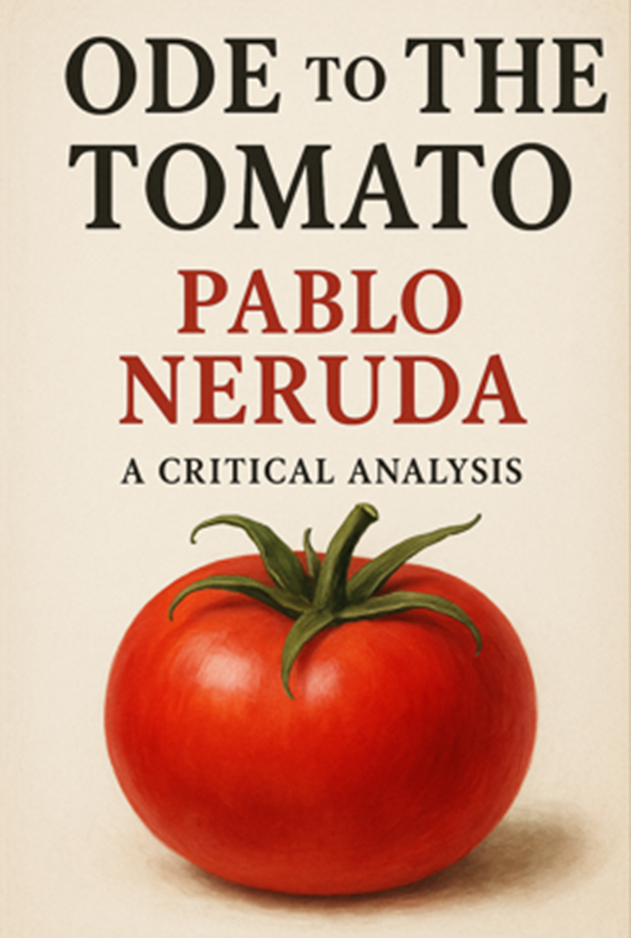
“Ode to the Tomato” by Pablo Neruda: A Critical Analysis

“Ode to the Tomato” by Pablo Neruda first appeared (in Spanish as “Oda al tomate”) in 1954, in the collection Odas elementales(Elemental Odes)—the first volume of Neruda’s mid-century “odes” sequence that elevates ordinary things into public, celebratory lyric.

“Ode to the Tomato” by Pablo Neruda: A Critical Analysis
Introduction: “Ode to the Tomato” by Pablo Neruda

“Ode to the Tomato” by Pablo Neruda first appeared (in Spanish as “Oda al tomate”) in 1954, in the collection Odas elementales (Elemental Odes)—the first volume of Neruda’s mid-century “odes” sequence that elevates ordinary things into public, celebratory lyric. In the poem, the tomato is staged as a seasonal, almost cosmic eruption—“the roadway / is full of tomatoes,” and even “the light / splits itself / in two / halves / of tomato”—so that everyday eating becomes an experience of abundance, radiance, and democratic “plenty.” It “goes wild” and “invades / kitchens,” yet it also possesses “its own / light” and “gentle authority,” until the speaker admits the paradox at the heart of food: “Sadly we have to / murder it,” sinking “the knife / in its living pulp,” turning the tomato into “a red / heart” and “a fresh / sun.” The poem’s popularity comes from this irresistible mix of sensual concreteness (juice, pulp, fragrance), communal festivity (a “stylish / wedding” of onion, oil, pepper, salt), and ethical shiver (beauty that must be cut to be shared)—a recipe that critics note has an unusually immediate, appetite-awakening effect on readers.

Text: “Ode to the Tomato” by Pablo Neruda

The roadway

is full of tomatoes,

midday,

summer,

the light

splits itself

in two

halves

of tomato,

runs

down the roads

as juice.

In December

it goes wild

the tomato,

invades

kitchens,

infiltrates lunches,

settles itself

quietly

on sideboards,

among glasses,

butter-dishes,

blue salt-shakers.

It has

its own

light,

gentle authority.

Sadly we have to

murder it:

sinking,

the knife

in its living pulp,

it is a red

heart,

a fresh

sun,

deep,

inexhaustible,

filling the salads

of Chile,

is happily wedded

to the clear onion,

and to celebrate

oil

lets itself

pour,

essential

child of the olive,

over its half-open hemispheres,

the peppers

add

their fragrance,

salt its magnetism:

its a stylish

wedding,

parsley

lifts

little flags,

the potatoes

boil with vigour,

the roast

knocks

on the door

with its aroma,

it’s time!

come on!

and on to

the table, in the middle

of summer,

the tomato,

earth-star,

star

repeated

and fecund,

shows us

its convolutions,

its channels,

the famous fullness

and plenty

delivers up

without stone

without rind

without scales or spines

the gift

of its fiery colour

and the whole of its freshness.

A. S. Kline translator 2001

Annotations: “Ode to the Tomato” by Pablo Neruda
Segment (5 lines)TextAnnotationLiterary devices
Lines 1–5The roadway / is full of tomatoes, / midday, / summer, / the lightSets a public, everyday scene of abundance, then locks it into the intensity of summer light, establishing the ode’s celebratory lens.🟡 Imagery (place/season/light) ⭐ Motif (abundance) 🟢 Enjambment
Lines 6–10splits itself / in two / halves / of tomato, / runsLight becomes “tomato-like,” as if color and form reshape perception; the verb “runs” makes brightness kinetic.🔴 Metaphor (light = tomato) 🟠 Personification (light “splits,” “runs”) 🟡 Imagery
Lines 11–15down the roads / as juice. / In December / it goes wild / the tomato,The juice simile turns the roadway into a channel for life; the jump to December signals the tomato’s recurring, uncontrollable vitality.🟡 Imagery (flow) 🟠 Personification (“goes wild”) ⚫ Juxtaposition (summer→December)
Lines 16–20invades / kitchens, / infiltrates lunches, / settles itself / quietlyMilitary verbs dramatize domestic life, then “quietly” softens the violence—power presented as calm, everyday presence.🟠 Personification 🧨 Militarized diction ⚫ Contrast (invades/quietly)
Lines 21–25on sideboards, / among glasses, / butter-dishes, / blue salt-shakers. / It hasA still-life catalogue: ordinary objects become artful staging; “blue” adds painterly color contrast to the tomato’s implied red.🟡 Imagery (still-life detail) 🧾 Catalogue/listing ⚫ Color contrast
Lines 26–30its own / light, / gentle authority. / Sadly we have to / murder it:The tomato is dignified with autonomy (“authority”), then the ethical tension appears: eating is framed as violence against life.🟠 Personification 🔴 Metaphor (“murder” = consumption) ⚫ Juxtaposition
Lines 31–35sinking, / the knife / in its living pulp, / it is a red / heart,The cut is rendered bodily and intimate—“living pulp” and “heart” intensify both beauty and guilt.🔴 Metaphor (tomato = heart) 🟡 Vivid imagery 🟠 Personification (“living”)
Lines 36–40a fresh / sun, / deep, / inexhaustible, / filling the saladsCosmic praise: the tomato becomes a life-giving sun—deep and “inexhaustible”—that nourishes daily life.🔴 Metaphor (tomato = sun) 🟤 Hyperbole (“inexhaustible”) 🟡 Imagery
Lines 41–45of Chile, / is happily wedded / to the clear onion, / and to celebrate / oilLocal identity (“Chile”) meets ritual: ingredients are “wedded,” turning salad-making into ceremony and community.🟣 Cultural reference (Chile) 🔴 Metaphor (wedding of flavors) 🟠 Personification
Lines 46–50lets itself / pour, / essential / child of the olive, / over its half-open hemispheres,Oil is animated and given lineage (“child of the olive”); the tomato becomes globe-like (“hemispheres”), enlarging the domestic into the planetary.🟠 Personification 🔴 Metaphor (genealogy; globe) 🟣 Symbolism (wholeness/world)
Lines 51–55the peppers / add / their fragrance, / salt its magnetism: / its a stylishSensory layering (smell/taste) makes the tomato “magnetic”; the tone shifts toward style—celebration as aesthetics.🟡 Sensory imagery 🔴 Metaphor (“magnetism”) 🟠 Personification
Lines 56–60wedding, / parsley / lifts / little flags, / the potatoesThe wedding motif continues; parsley becomes a festive sign-bearer, as if the meal stages a miniature parade.🔴 Metaphor (wedding/ritual) 🟠 Personification (parsley “lifts”) 🟣 Symbolism (flags = festivity)
Lines 61–65boil with vigour, / the roast / knocks / on the door / with its aroma,Heat and aroma animate the home; the roast is made social—arriving like a guest who announces itself.🟠 Personification (“knocks”) 🟡 Sensory imagery 🔵 Auditory cue
Lines 66–70it’s time! / come on! / and on to / the table, in the middle / of summer,Imperatives and exclamations create urgency and invitation, urging communal movement toward the shared table.⚪ Apostrophe/imperatives ⚪ Exclamation ⭐ Motif (ritual of serving)
Lines 71–75the tomato, / earth-star, / star / repeated / and fecund,The tomato is elevated to a cosmic emblem—earthly yet stellar—linked to fertility and recurring abundance.🔴 Metaphor (“earth-star”) ⭐ Repetition 🟣 Symbolism (star = value/wonder)
Lines 76–80shows us / its convolutions, / its channels, / the famous fullness / and plentyThe tomato becomes a revealed landscape/body; its interior complexity embodies “fullness” and “plenty.”🟡 Imagery (interior anatomy) 🔴 Metaphor (interior as geography) ⭐ Motif (plenitude)
Lines 81–85delivers up / without stone / without rind / without scales or spines / the giftA crescendo of “without” stresses defenseless generosity: it offers itself without armor, as a perfected gift.⭐ Anaphora (“without…”) 🟣 Symbolism (“gift”) ⚫ Contrast (defenseless vs knife)
Lines 83–87 (final 5 to close)without rind / without scales or spines / the gift / of its fiery colour / and the whole of its freshness.The close concentrates essence: “fiery colour” as vitality and “freshness” as total renewal—ending in gratitude for nature’s offering.⭐ Anaphora 🟡 Imagery (color/freshness) 🔴 Metaphor (“fiery”) 🟣 Symbolism (renewal)
Literary And Poetic Devices: “Ode to the Tomato” by Pablo Neruda
DeviceExample from the poemExplanation
🔴 Alliteration“famous fullness”Repeated initial consonants add musical punch and highlight the tomato’s overflowing abundance.
🟠 Anaphora“without stone / without rind / without scales or spines”Repeating the opener builds a chant-like rhythm, stressing the tomato as a pure, unarmored gift.
🗣️ Apostrophe / Direct Address“come on!”The speaker calls to readers like guests, turning the ode into a shared invitation to eat and celebrate.
🎶 Assonance“roadway… tomatoes”Echoed vowel sounds create a smooth internal music, matching the flow of juice and summer ease.
🧺 Cataloguing (Listing)“among glasses, / butter-dishes, / blue salt-shakers”A list of common objects anchors the poem in domestic life, showing the tomato’s everyday reach.
⏸️ Caesura (Strong Pause)“Sadly we have to / murder it:”The pause (plus the colon) forces a stop, making the ethical turn feel sudden and weighty.
🔔 Consonance“kitchens… infiltrates… settles”Repeated consonant textures sharpen sound and energy, fitting the tactile world of kitchen action.
Enjambment“The roadway / is full of tomatoes, / midday,”Lines spill forward without closure, creating motion—like summer plenty that keeps coming.
💥 Exclamation“it’s time!”Exclamations heighten excitement and urgency, capturing the feast moment.
🕊️ Free Verse(No fixed rhyme or meter)The flexible form mirrors natural speech and sensory flashes, keeping the ode fresh and immediate.
📣 Hyperbole“invades / kitchens, / infiltrates lunches”Exaggeration makes the tomato feel epic and irresistible, turning the ordinary into a seasonal marvel.
👁️ Imagery (Sensory)“runs / down the roads / as juice”Strong visual/tactile detail makes the scene almost cinematic—summer becomes something you can taste.
⚖️ Juxtaposition“Sadly we have to / murder it” vs “a fresh / sun”Places tenderness beside violence to reveal the poem’s core truth: nourishment involves cutting.
🔥 Metaphor“a red / heart, / a fresh / sun”The tomato becomes heart/sun—life and energy—so the ingredient feels vital, radiant, sacred.
🚪 Sound-Image (Onomatopoeic effect)“the roast / knocks / on the door”“Knocks” makes aroma feel audible, as if hunger itself is calling you to the table.
🧩 Paradox“knife / in its living pulp”“Living” clashes with “pulp,” intensifying the unsettling beauty of something imagined alive yet prepared to be eaten.
👑 Personification“It has / its own / light, / gentle authority.”Human traits give the tomato dignity and agency—like a guest of honor with quiet power.
🔁 Repetition“the tomato,” (repeated across the scene)Repeating the noun works like a refrain, keeping the subject central and reinforcing praise.
🌍⭐ Symbolism“earth-star”The tomato symbolizes earth’s generosity: humble yet radiant, a star of everyday plenty.
✂️ Fragmentation / Short-line Form“the light / splits itself / in two / halves”Chopped line units mimic slicing and quick perception, making the poem feel cut, served, and alive on the page.
Themes: “Ode to the Tomato” by Pablo Neruda
  • 🟢🍅 Theme 1: The Ordinary Made Glorious (Democratic Praise of Daily Life)
    Ode to the Tomato by Pablo Neruda elevates an everyday object into a subject of public wonder, implying that the common table can be as meaningful as any grand monument, and that beauty is not reserved for rare things but is scattered through ordinary hours. When “The roadway / is full of tomatoes,” the fruit is placed in open daylight rather than in private luxury, so that the poem’s praise becomes communal and accessible, while the quick, spare lines mimic the plain rhythm of a bustling day. Even indoors, the tomato “invades / kitchens” and “settles itself / quietly / on sideboards,” suggesting that daily domestic spaces are active sites of meaning, not dull backdrops. By granting the tomato “its own / light” and “gentle authority,” the speaker turns the humble into the dignified, as though nourishment itself were a form of quiet power.
  • 🟡🌞 Theme 2: Seasonal Abundance, Radiance, and Nature’s Generosity
    Ode to the Tomato by Pablo Neruda frames the tomato as a concentrated emblem of summer plenitude, so intensely present that “the light / splits itself / in two / halves / of tomato,” as if the season’s brightness could be portioned and eaten. The poem’s movement from open road to domestic interior keeps the tomato tethered to time and harvest—“midday, / summer”—and, even when “In December / it goes wild,” the language insists on cycles of ripening and return, where nature repeatedly overflows the boundaries humans set. Calling it “earth-star” and “star / repeated / and fecund,” the speaker gives the fruit a cosmic dignity without losing its concreteness, because it still “delivers up” fullness “without stone / without rind,” offering itself as pure colour and freshness. In this vision, abundance is not abstract; it is visible, edible, and shared.
  • 🔴🔪 Theme 3: The Paradox of Eating—Beauty, Life, and Necessary Violence
    Ode to the Tomato by Pablo Neruda refuses to romanticize consumption by inserting a sharp ethical shudder into celebration, because the poem admits that enjoyment is purchased through destruction. The line “Sadly we have to / murder it” interrupts the feast with a moral vocabulary that is deliberately excessive, and that excess makes us feel the act of cutting as something more than routine. When the knife sinks “in its living pulp,” the tomato is imagined as vividly alive, and the violence becomes intimate rather than distant, yet the poem’s imagery also insists that what is cut releases a deeper vitality, since the tomato becomes “a red / heart” and “a fresh / sun.” This contradiction—killing in order to nourish—creates a sacrificial tone, as though the salad were a ceremony in which life is transformed, not erased, and the reader is asked to feel gratitude alongside appetite.
  • 🔵🍽️ Theme 4: Communal Feast, Harmony, and the “Wedding” of Ingredients
    Ode to the Tomato by Pablo Neruda imagines food as social bond and cultural music, so that eating becomes a shared ritual in which separate elements join, complement, and complete one another. The tomato “is happily wedded / to the clear onion,” and, as “oil / lets itself / pour,” the poem shifts from solitary object to relational harmony, where flavour is cooperation rather than competition. The celebratory “wedding” expands through lively details—“the peppers / add / their fragrance,” “parsley / lifts / little flags,” “the potatoes / boil with vigour”—until the whole kitchen feels like a festival preparing its procession toward the table. By naming “the salads / of Chile,” the poem anchors this feast in place and identity, suggesting that everyday meals carry national and communal memory, and that abundance is most fully realized when it is distributed. The final call—“it’s time! / come on!”—makes the reader not just an observer but a guest.
Literary Theories and “Ode to the Tomato” by Pablo Neruda
🧠 TheoryHow the theory “reads” the poemReferences from the poemWhat the theory reveals?
🟥 Marxist Criticism (Materialism / Class / Labor)Treats the tomato as a material commodity that moves from public circulation into private consumption; focuses on production–distribution–consumption and the social world of food.“The roadway / is full of tomatoes”; “invades / kitchens”; “infiltrates lunches”; “filling the salads / of Chile”; “its a stylish / wedding” (food as social ritual).The ode dignifies the ordinary edible object—a staple of everyday people—elevating common nourishment into poetic value. It also exposes an economy of consumption where nature’s “gift” enters domestic life and becomes communal ritual (“table,” “wedding”).
🟩 Ecocriticism (Nature / Material Ecology / Gift of the Earth)Reads the tomato as a nonhuman presence with agency; highlights seasonal cycles, natural vitality, and human dependence on ecological “freshness.”“midday, / summer”; “In December / it goes wild / the tomato”; “earth-star”; “repeated / and fecund”; “the gift / of its fiery colour / and the whole of its freshness.”The poem frames the tomato as an ecological wonder—fertile, cyclical, abundant—offered by the earth. Human celebration is rooted in nature’s rhythms, yet the poem also hints at ethical tension when we “murder” what is living.
🟦 New Criticism / Formalism (Close Reading of Language & Structure)Stays inside the text: examines imagery, metaphor networks, repetition, cataloguing, and tonal turns (praise → violence → celebration → blessing).Metaphor chain: “a red / heart,” “a fresh / sun,” “earth-star”; tonal pivot: “Sadly we have to / murder it:”; listing/collage: “among glasses, / butter-dishes, / blue salt-shakers”; anaphora: “without… / without… / without….”The poem’s power comes from craft: short lines create speed and shimmer; metaphors escalate the tomato from kitchen object to cosmic emblem; the “without” crescendo makes the closing feel like a ceremonial benediction.
🟨 Reader-Response Criticism (Experience / Affect / Participation)Focuses on how the poem recruits the reader into sensory immersion and communal action—inviting us to taste, smell, gather, and “come on!” to the table.Sensory cues: “as juice,” “living pulp,” “their fragrance,” “with its aroma”; direct address: “it’s time! / come on!”; situational staging: “and on to / the table.”The ode works like an invitation: the reader becomes a participant in a shared meal. Pleasure, appetite, and communal warmth are produced in the act of reading—taste and belonging become the poem’s emotional endpoint.
Critical Questions about “Ode to the Tomato” by Pablo Neruda

🟢 Critical Question 1: How does the poem turn an ordinary tomato into something worthy of praise, and what “critical argument” about value is being made?
“Ode to the Tomato” by Pablo Neruda makes a critical case that value is not a fixed property of rare objects but a way of seeing, and he demonstrates this by placing the tomato in spaces usually denied to “serious” subjects: the public roadway, the noon glare, and the crowded kitchen. When “The roadway / is full of tomatoes,” the fruit is immediately located in open circulation rather than private refinement, so praise becomes democratic and shareable, while the claim that “the light / splits itself / in two / halves / of tomato” turns the tomato into a lens that reorders perception. Even indoors it “invades / kitchens” yet also “settles itself / quietly,” implying that domestic life is not marginal but central, and that ordinary meals can carry dignity. By attributing “gentle authority” to the tomato, the poem argues that nourishment is a cultural foundation, and that reverence can be trained on the everyday without irony.

🔴 Critical Question 2: Why does the poem use the shocking language of violence (“murder it”), and how does that complicate a seemingly celebratory ode?
“Ode to the Tomato” by Pablo Neruda purposely fractures celebration with moral discomfort, because when the speaker says, “Sadly we have to / murder it,” the poem drags an ordinary culinary act into an ethical vocabulary that feels excessive, and that excess is the point: it wakes the reader from habit. The knife “sinking… in its living pulp” makes preparation visceral and intimate, so consumption becomes both tender and troubling, while the tomato’s metamorphosis into “a red / heart” and “a fresh / sun” converts violence into radiance without fully erasing its sting. Yet the poem does not end in guilt; rather, it reframes cutting as transformation, where life becomes shared sustenance, and where the tomato’s “deep, / inexhaustible” quality suggests that loss is answered by plenty. Critically, the ode insists that pleasure has an ethical shadow, but it also implies that attention, gratitude, and communal sharing can be a responsible response to the gift.

🟡 Critical Question 3: How do the poem’s form and line-breaks shape meaning, and why does the poem sound “chopped” and “flowing” at the same time?
“Ode to the Tomato” by Pablo Neruda builds its meaning through a form that behaves like the kitchen it describes, because short lines and abrupt breaks create a chopped, tactile rhythm, even as enjambment keeps the syntax running like juice. The opening fragments—“midday, / summer, / the light / splits itself”—arrive in quick flashes, as though perception itself were being diced into bright pieces, while the sentence that “runs / down the roads / as juice” makes language pour across line endings. This double motion is structurally important, since the poem is about both abundance and slicing, both radiance and preparation, and the form makes the reader physically feel those forces rather than merely register them intellectually. The strong pause around “murder it:” works like a blade’s hesitation before impact, so technique becomes ethics, and the poem’s shape teaches the reader how to experience the tomato: first as flow, then as cut, and finally as shared plenty.

 🔵 Critical Question 4: What kind of community and cultural identity is created through the “wedding” of ingredients and the reference to Chile?
“Ode to the Tomato” by Pablo Neruda imagines identity as something assembled through relations and repeated practices, because the tomato is never left alone; it is “happily wedded / to the clear onion,” and then oil, peppers, salt, parsley, potatoes, and roast enter like guests who complete the ceremony. The kitchen becomes a civic space, since ingredients behave like a crowd—parsley “lifts / little flags,” the roast “knocks / on the door”—and the repeated imperatives (“it’s time! / come on!”) recruit the reader into participation. When the poem names “the salads / of Chile,” it anchors this feast in place, suggesting that national life is not only made by speeches and symbols but also by local produce, seasonal rhythms, and shared meals. Critically, the ode treats community as an everyday ethic, where belonging is tasted, renewed, and distributed through generous attention to what sustains life.

Literary Works Similar to “Ode to the Tomato” by Pablo Neruda
  • 🍋 “Ode to Salt” — Pablo Neruda: Like “Ode to the Tomato,” it elevates an everyday ingredient into something radiant and essential, praising the “common” as almost cosmic.
  • 🧅 “Ode to the Onion” — Pablo Neruda: Like “Ode to the Tomato,” it turns a humble kitchen staple into a glowing emblem of beauty, life, and shared domestic ritual.
  • 🍑 This Is Just to Say” — William Carlos Williams: Like “Ode to the Tomato,” it centers food in ordinary life and uses direct, sensory immediacy to make the mundane feel vivid and intimate.
  • 🫐 Blackberry-Picking” — Seamus Heaney: Like “Ode to the Tomato,” it builds a lush sensory world around fruit and seasonality, transforming taste and ripeness into meaning.
Representative Quotations of “Ode to the Tomato” by Pablo Neruda
QuotationContext (what’s happening in the poem)Theoretical perspective + explanation
🍅 “The roadway / is full of tomatoes,”The poem opens outdoors, showing tomatoes everywhere—public, abundant, ordinary.Marxist Criticism: The “roadway” suggests circulation and distribution; the tomato appears as a mass, everyday good moving through shared space before entering domestic consumption.
☀️ “the light / splits itself / in two / halves / of tomato,”Midday summer brightness is so intense it seems to take the tomato’s shape and color.New Criticism / Formalism: The metaphor fuses world and object; Neruda’s compressed lineation makes the image feel like a sudden flash—light becomes “tomato,” not just like it.
🧃 “runs / down the roads / as juice.”The scene becomes kinetic: roads act like channels and the tomato’s essence becomes flow.Ecocriticism: Nature’s vitality is figured as a living current, turning infrastructure into an extension of organic abundance (juice as life-force).
📅🍅 “In December / it goes wild / the tomato,”A seasonal pivot: the tomato returns and erupts beyond a single summer moment.Ecocriticism: Highlights cyclical time and fecundity—nonhuman life persists across seasons, asserting its rhythms over the human calendar.
🏠🥗 “invades / kitchens, / infiltrates lunches, / settles itself / quietly”The tomato moves from public space into private domestic life and everyday meals.Marxist Criticism: The language of “invades/infiltrates” dramatizes how the commodity enters routine consumption—yet “quietly” normalizes it as a staple of daily life.
✨👑 “It has / its own / light, / gentle authority.”The tomato is granted dignity and presence, as if it rules the kitchen by radiance rather than force.Reader-Response Criticism: This invites admiration and intimacy—readers are guided to feel reverence for the ordinary, as if the tomato commands attention in the imagination.
🔪❤️ “Sadly we have to / murder it: / sinking, / the knife / in its living pulp,”A moral jolt: preparing food becomes an act of violence against something “living.”Ecocriticism: Exposes the ethical tension of human eating—celebration depends on harm; the poem makes ecological dependence emotionally visible.
🌞🍅 “it is a red / heart, / a fresh / sun, / deep, / inexhaustible,”The tomato is elevated from ingredient to cosmic, inexhaustible source of life and warmth.New Criticism / Formalism: A deliberate escalation of metaphors (“heart” → “sun”) intensifies praise; the piling adjectives enact the very “plenitude” the poem celebrates.
🫒🛢️ “oil / lets itself / pour, / essential / child of the olive,”Ingredients join ceremonially; oil is animated and given a lineage, as if it willingly participates.Reader-Response Criticism: The personified “lets itself pour” makes the scene feel hospitable and celebratory—reading becomes a sensuous, participatory experience of the meal.
🌍⭐ “the tomato, / earth-star,” … “the gift / of its fiery colour / and the whole of its freshness.”Near the close, the tomato becomes a planetary emblem and ends as a generous “gift” of color and freshness.Ecocriticism: Frames the tomato as earth’s luminous offering—fertility, renewal, and sustenance presented as a natural grace bestowed without defenses (“gift,” “freshness”).
Suggested Readings: “Ode to the Tomato” by Pablo Neruda

Books

  1. Neruda, Pablo. Elemental Odes. Translated by Margaret Sayers Peden, Libris, 1991. Google Books,
  2. Neruda, Pablo. Sublime Blue: Selected Early Odes of Pablo Neruda. Translated by William Pitt Root, Wings Press, 2013. Internet Archive.

Academic articles

Poem websites

“Refugees” by Brian Bilston: A Critical Analysis

“Refugees” by Brian Bilston first appeared online on 23 March 2016, and was later included in his 2016 anthology You Took the Last Bus Home (published by Unbound), before being developed into an illustrated children’s picture-book edition.

“Refugees” by Brian Bilston: A Critical Analysis
Introduction: “Refugees” by Brian Bilston

Refugees” by Brian Bilston first appeared online on 23 March 2016, and was later included in his 2016 anthology You Took the Last Bus Home (published by Unbound), before being developed into an illustrated children’s picture-book edition. The poem’s core idea is that public speech about displaced people often swings between cruelty and compassion—and Bilston exposes that swing by making the same lines deliver two opposite arguments: read top-to-bottom, refugees are smeared as “Chancers and scroungers,” “Cut-throats and thieves,” who are “not / Welcome here,” and must “Go back to where they came from”; but the instruction “(now read from bottom to top)” flips the moral lens so the poem lands on shared humanity—“These haggard faces could belong to you or me”—and a call to solidarity (“Share our food / Share our homes / Share our countries”), rejecting the closed-border logic that “A place should only belong to those who are born there.” Its popularity comes from that instantly teachable “reverso” structure (a built-in twist that forces rereading), its blunt sampling of real-world xenophobic clichés, and its social-media friendliness—so a short poem becomes an argument you experience changing in your own mouth.

Text: “Refugees” by Brian Bilston

They have no need of our help
So do not tell me
These haggard faces could belong to you or me
Should life have dealt a different hand
We need to see them for who they really are
Chancers and scroungers
Layabouts and loungers
With bombs up their sleeves
Cut-throats and thieves
They are not
Welcome here
We should make them
Go back to where they came from
They cannot
Share our food
Share our homes
Share our countries
Instead let us
Build a wall to keep them out
It is not okay to say
These are people just like us
A place should only belong to those who are born there
Do not be so stupid to think that
The world can be looked at another way

(now read from bottom to top)

Annotations: “Refugees” by Brian Bilston
LineTextAnnotation Devices
1They have no need of our helpOpens with a blunt claim that denies responsibility and primes the reader for refusal.🟧 Loaded diction · 👥 Pronouns/ingroup-outgroup · 🟥 Irony (when reversed)
2So do not tell meA commanding interruption—shuts down empathy before it begins.📢 Imperative · 🎭 Direct address · 🟦 Enjambment
3These haggard faces could belong to you or meBrief flare of empathy: admits refugees are like us (this becomes central when reversed).🤝 Appeal to empathy · 🟪 Imagery (“haggard”) · 🟥 Irony/turning point (in reverse)
4Should life have dealt a different handUses fate/fortune to suggest anyone could be displaced.🎴 Metaphor/idiom (“dealt a hand”) · 🤝 Universalizing · 🟦 Enjambment
5We need to see them for who they really areSignals a coming “truth” but actually prepares prejudice and dehumanization.👥 “We” rhetoric · 🟧 Framing/loaded setup · 🟥 Irony (exposed in reverse)
6Chancers and scroungersBegins a list of insults to stigmatize and reduce complex lives to slurs.🟧 Loaded diction/slur · 🧱 Dehumanization · 🟨 Listing
7Layabouts and loungersKeeps the insult-list going; also musical sound-play to make hate memorable.🟨 Listing · 🟣 Alliteration (“l… l…”) · 🟧 Loaded diction
8With bombs up their sleevesIntroduces fear: associates refugees with terrorism via a vivid (and unfair) image.💣 Violent imagery · 🟧 Stereotype/scapegoating · 🟥 Hyperbole
9Cut-throats and thievesEscalates to criminal labels; a moral panic move.🟧 Loaded diction · 🧱 Dehumanization · 🟨 Listing
10They are notA hard pivot; sets up exclusion (“not welcome”), but in reverse it becomes the start of a correction.⚖️ Antithesis setup · 🟦 Enjambment · 🔁 Reversal-function
11Welcome hereThe exclusion lands: “not welcome.” In reverse, “Welcome here” becomes the ethical headline.🚪 Exclusion/inclusion motif · ⚖️ Antithesis · 🔁 Reversal
12We should make themThe phrase “make them” implies force/coercion—authoritarian tone.📢 Imperative/modal “should” · 🧭 Ethical pressure · 🟥 Irony (reversed)
13Go back to where they came fromClassic nativist slogan; denies causes of flight and ignores danger.🧱 Othering · 🟧 Slogan/stock phrase · ⚖️ Antithesis (home vs exile)
14They cannotAnother hinge-line: blocks sharing; in reverse it becomes the start of permission/solidarity.🚫 Prohibition framing · 🟦 Enjambment · 🔁 Reversal hinge
15Share our foodPresents generosity as threat; implies scarcity and invasion.🍞 Concrete detail/symbol · 👥 “our” possessive · 🟥 Irony (reversed)
16Share our homesIntensifies intimacy of “sharing” to provoke discomfort/fear.🏠 Symbolic space · 👥 Ingroup boundary · 🟦 Parallel build-up
17Share our countriesMoves from private to national—turns compassion into a “border crisis.”🗺️ Political register shift · 👥 Nationalism · 🟦 Parallelism
18Instead let usSmooth pivot to “solution”; invites collective action (“us”)—even if harmful.👥 Collective voice · 📢 Persuasive pivot · 🟦 Enjambment
19Build a wall to keep them out“Wall” is literal and symbolic: separation, fear, refusal of moral duty.🧱 Metaphor/symbol (“wall”) · 🟥 Political allusion · ⚖️ Antithesis (in/out)
20It is not okay to sayPolices speech: frames empathy as naïve or unacceptable.🚨 Censorship/voice control · 📢 Declarative authority · 🟥 Irony (reversed)
21These are people just like usCore humanizing statement—condemned in forward reading, celebrated in reverse.🤝 Humanization · 👥 Inclusive “us” · ⚖️ Antithesis (us/them)
22A place should only belong to those who are born thereBlood-and-soil logic: defines belonging by birth, not rights or humanity.🟧 Ideological claim · 🧠 Absolutism (“only”) · ⚖️ Exclusion principle
23Do not be so stupid to think thatAd hominem attack: shames the reader into compliance.😠 Insult/ad hominem · 📢 Imperative · 🎭 Direct address
24The world can be looked at another wayFinal line (but first in reverse): announces perspective-shift—invites moral re-reading.🔁 Reverse-poem key · ✨ Epiphany/volta · ⚖️ Antithesis (one way/another way)
Literary And Poetic Devices: “Refugees” by Brian Bilston
#Device Example from the poemWhat it does / explanation
1🔁 Reverse poem / structural reversal“(now read from bottom to top)”The poem’s entire meaning flips when read upward: xenophobic rhetoric becomes a compassionate defense of refugees.
2🟥 Irony (structural)“They have no need of our help” (vs. reversed reading)The opening claim is undercut by the reverse reading, exposing the speaker’s stance as morally wrong.
3🎭 Dramatic monologue / persona“So do not tell me”The poem uses a constructed speaker voicing prejudice; the poet critiques this voice through form.
4🎯 Direct address (apostrophe)“do not tell me”Addresses an implied listener/reader, creating confrontation and rhetorical pressure.
5📢 Imperative (command)“Do not be so stupid to think that”Commands/shames the audience—shows how hate-speech polices dissent and empathy.
6👥 Inclusive/exclusive pronouns (us vs them)“you or me”; “We need…”; “Share our…”Builds an ingroup (“we/our”) against an outgroup (“they/them”).
7🟧 Loaded diction / pejoratives“Chancers and scroungers”Uses emotionally charged insults to stigmatize refugees rather than argue logically.
8🧱 Othering“keep them out”Frames refugees as outsiders who don’t belong—central to the poem’s critique.
9🟨 Listing / cataloguing“Chancers and scroungers / Layabouts and loungers…”A rapid list mimics tabloid rhetoric—creates a pile-on effect of accusations.
10🟪 Imagery“These haggard faces”Visual detail makes suffering concrete; in reverse reading it becomes a direct call to empathy.
11💣 Violent imagery“With bombs up their sleeves”Injects fear by associating refugees with terrorism—shows how stereotypes are manufactured.
12🟥 Hyperbole / exaggeration“bombs up their sleeves”An extreme claim meant to alarm; highlights the irrationality of blanket suspicion.
13🟣 Alliteration“Layabouts and loungers”Repeated initial sounds make the insult catchy—revealing how prejudice can be made “memorable.”
14🎴 Metaphor / idiom“life have dealt a different hand”Life is framed as a card game; suggests displacement can be a matter of chance.
15⚖️ Antithesis (welcome vs reject)“They are not / Welcome here”Places opposing ideas in tension; reversed, it becomes a direct welcome.
16🚪 Motif of borders/containment“Build a wall… keep them out”Repeated “in/out” logic stresses exclusion; the wall becomes a symbol of moral division.
17🏠 Symbolism (food/home/country)“Share our food / Share our homes / Share our countries”These concrete nouns symbolize resources, safety, and belonging, reframed as threatened possessions.
18⛓️ Parallelism (repetition of structure)“Share our… / Share our… / Share our…”Repeating the same grammatical pattern intensifies the argument and builds rhythmic force.
19🟦 Enjambment (line breaks)“They are not / Welcome here”The break creates suspense and emphasis; also allows the upward reading to reframe meaning cleanly.
20🔄 Volta / perspective shift“The world can be looked at another way”A hinge line: signals the poem’s ethical turn—especially powerful as the first line in reverse.
Themes: “Refugees” by Brian Bilston
  • 🔁 Structural Reversal & Moral Reorientation
    “Refugees” by Brian Bilston is ultimately a theme-poem about how meaning, and therefore morality, can be generated by structure, because the instruction to reread from bottom to top converts the same lines into a second, ethically opposed argument. When read downward, the voice sounds clipped and authoritative, so that exclusion feels like practicality; when read upward, however, the poem performs a correction in which welcome replaces rejection and empathy replaces suspicion, thereby exposing that the first “common-sense” stance was produced by sequencing rather than truth. This reversible design turns the reader into an active participant, since one must perform the poem’s transformation to understand it, and it dramatizes how easily language can be arranged to make cruelty appear reasonable. In this sense, the poem’s form becomes its moral lesson: it trains readers to distrust the first, easiest reading, to reconsider their interpretive habits, and to choose a perspective that can hold human dignity in view.
  • 🧨 Xenophobia, Stereotypes, and the Manufacture of Threat
    “Refugees” by Brian Bilston foregrounds how xenophobia is built from rhetorical shortcuts, because the speaker replaces people with pejoratives—“chancers,” “scroungers,” “cut-throats,” “thieves”—and then treats those names as if they were evidence. The accumulation works like a verbal drumbeat, so that repetition supplies certainty where facts are missing, while the sudden escalation to terror imagery (“bombs up their sleeves”) manufactures fear through a vivid allegation that is designed to stick. As these claims intensify, the poem reveals the moral mechanics of stereotyping: once a group is framed as inherently parasitic or violent, compassion can be rebranded as foolishness, and harsh policies can be presented as self-defense. Yet the reverse reading functions as an exposure device, because it shows that the threatening portrait is a crafted performance rather than a stable reality, and it implies that such rhetoric survives less by accuracy than by its ability to sound decisive, to shame disagreement, and to discourage the imaginative identification that would puncture the myth.
  • 🧱 Belonging, Borders, and the Politics of Possession
    “Refugees” by Brian Bilston treats belonging as an argument about possession, because the repeated emphasis on “our food,” “our homes,” and “our countries” turns community into property and turns sharing into a kind of loss. This possessive grammar creates an exclusionary logic in which birth becomes the primary credential for moral entitlement, so that the claim that a place “should only belong to those who are born there” operates as a gate that converts geography into destiny. The “wall” then becomes both policy and symbol, since it represents a desire to solve complex displacement with a simple barrier, and it externalizes an inner refusal to imagine mutual obligation across lines of nationality. By staging these phrases as a persuasive script, the poem suggests that borders are guarded not only by fences but by stories, because the narrative of scarcity and invasion makes refusal feel responsible, while the reverse reading reveals that another narrative—based on inclusion—can be assembled from the same language if we relinquish the impulse to treat belonging as private ownership.
  • 🤝 Shared Humanity, Contingency, and the Discipline of Empathy
    “Refugees” by Brian Bilston frames empathy as an intellectual and ethical discipline rather than a soft emotion, because it insists that the distance between “us” and “them” is often a matter of contingency: “These haggard faces could belong to you or me,” if “life [had] dealt a different hand.” By grounding identification in chance, the poem dismantles the comforting idea that suffering happens only to others for reasons that must somehow be deserved, and it exposes how privilege can quietly masquerade as merit. At the same time, the poem demonstrates that sympathy can be socially policed, since the downward reading mocks alternative viewpoints as stupid, whereas the upward reading restores that alternative as lucid and humane. The final invitation—that “The world can be looked at another way”—becomes the thematic hinge, because it asks readers to practice a different kind of seeing in which refugees are not reduced to threats or burdens but recognized as people whose vulnerability mirrors our own, and whose welcome measures the moral maturity of the societies they approach.
Literary Theories and “Refugees” by Brian Bilston
Theory )What it focuses onReferences from the poem (with line nos.)What it reveals in “Refugees”
🔵 Reader-ResponseMeaning is produced in the act of reading; rereading changes interpretation.“(now read from bottom to top)” (l.25); “The world can be looked at another way” (l.24).The poem forces the reader to “perform” empathy: the same text generates hostility top→bottom, then reverses into compassion bottom→top—showing how interpretation (and prejudice) can be structurally “learned” and unlearned.
🟣 Deconstruction (Derridean)Unstable meaning; binary oppositions (us/them) collapse under reversal/contradiction.“They are not / Welcome here” (ll.10–11) vs “These are people just like us” (l.21); “Build a wall” (l.19) vs “Share our…homes…countries” (ll.15–17).Bilston undoes the “us vs. them” binary: the poem’s structure demonstrates that the certainty behind exclusion (“Welcome here,” “Build a wall”) is textually reversible, exposing how fragile and constructed such “truths” are.
🟢 Postcolonial TheoryOthering, borders, belonging, migration, and who gets to claim “home.”“Go back to where they came from” (l.13); “A place should only belong to those who are born there” (l.22); “These haggard faces could belong to you or me” (l.3).The poem stages the politics of belonging: nationalist purity claims (l.22) and expulsion rhetoric (l.13) are countered by shared human contingency (l.3), critiquing how migrants/refugees are “othered” and denied co-belonging.
🔴 Marxist / Materialist CriticismScarcity narratives, resource anxiety, classed blame, and “deserving/undeserving” labels.“Chancers and scroungers” (l.6); “They cannot / Share our food…homes…countries” (ll.14–17).Xenophobia is shown as a scarcity story: refugees are framed as parasites (l.6) who threaten “our” resources (ll.14–17). The reversal exposes this as ideological—an attempt to protect perceived economic comfort by policing who counts as worthy.
Critical Questions about “Refugees” by Brian Bilston
  • 🔵 Critical Question 1: How does the poem’s reversible form change the reader’s ethical position toward refugees?
    “Refugees” by Brian Bilston begins by drawing the reader into a fluent monologue of suspicion—“Chancers and scroungers,” “Cut-throats and thieves”—that hardens into exclusion (“They are not / Welcome here”) and culminates in the command to expel (“Go back to where they came from”), so that prejudice initially presents itself as ordinary “common sense.” Yet the instruction “(now read from bottom to top)” operates as a formal trigger for moral reorientation, because the same lines, reordered, turn into their own rebuttal, ending in the unsettling recognition that “These haggard faces could belong to you or me” and that “The world can be looked at another way.” Because this change depends on the reader’s active participation, the poem makes ethics experiential: you do not merely witness a shift in viewpoint; you perform it. In that performance, hostility is revealed as a product of framing and sequence, while empathy emerges as disciplined rereading, suggesting that moral perception is not fixed but continuously made and remade through language.
  • 🟣 Critical Question 2: What kind of speaking voice is performed, and how does satire avoid becoming endorsement?
    “Refugees” by Brian Bilston ventriloquizes a recognizable public voice—defensive, impatient, and rhetorically certain—announced by the hectoring “So do not tell me,” which pre-empts dialogue by treating compassion as stupidity. This voice depends on ready-made stereotypes (“Layabouts and loungers”) and escalates them into securitized fantasy (“With bombs up their sleeves”), so fear can pass as realism; however, the poem refuses to let this performance settle into mere repetition. When reversed, the diction collapses into self-contradiction, revealing that the speaker’s certainty is a recycled script rather than an argument, driven by momentum more than evidence. Satire here works structurally: it allows the hostile rhetoric to display its persuasive rhythm, then forces a second reading in which that rhythm becomes an object of critique. The result is ethically uncomfortable but precise, because the reader is briefly enlisted by the fluency of the voice and then confronted with how easily such fluency manufactures consensus—until the frame is altered and the “obviousness” evaporates.
  • 🟢 Critical Question 3: How does the poem construct “us” and “them,” and what happens when that boundary collapses?
    “Refugees” by Brian Bilston constructs the “us/them” divide through pronouns, ownership, and imperatives: “They” becomes an abstract mass, while “our food,” “our homes,” and “our countries” convert shared life into guarded property, and “We should make them” turns exclusion into collective duty. The boundary is then moralized by a chain of accusations—parasites (“scroungers”), idlers (“layabouts”), criminals (“thieves”)—which makes refusal of welcome seem prudent rather than cruel, climaxing in the spatial fantasy of control, “Build a wall to keep them out.” Yet the reverse reading dismantles this architecture, because the same lines rebuild an opposing ethic: “These are people just like us,” previously framed as unacceptable, becomes central, and “These haggard faces could belong to you or me” replaces entitlement with contingency—“Should life have dealt a different hand.” The poem therefore suggests that borders are first built in language, and that when language is rearranged, belonging can be reimagined without changing a single word, exposing exclusion as rhetorical construction before it becomes political practice.
  • 🔴 Critical Question 4: Why has the poem remained widely shared, and what does its popularity suggest about contemporary discourse on migration?
    “Refugees” by Brian Bilston has remained widely shared because it is compact, teachable, and dramatically self-reversing: its short lines resemble slogans, yet its built-in instruction to reread transforms a xenophobic script into its own undoing, producing a moral turn that readers can feel immediately. The poem resonates because the hostile phrases—“Go back to where they came from,” the claim that refugees “cannot / Share our” resources, and the assertion that “A place should only belong to those who are born there”—sound painfully familiar in public speech, so the text functions like a mirror of everyday discourse rather than an abstract lecture. By compelling reversal, Bilston offers a practical intervention: a method for interrupting dehumanization by exposing how quickly language can make cruelty seem reasonable, and how quickly the same language can be reclaimed for solidarity. At the same time, the poem’s virality reflects a contemporary hunger for moral clarity that fits compressed attention economies, even if the structural causes of displacement remain largely offstage.
Literary Works Similar to “Refugees” by Brian Bilston
  • 🧭 Home” (Warsan Shire) — Like “Refugees,” it confronts anti-refugee sentiment by insisting that flight happens under coercion and terror, making empathy an ethical necessity rather than a sentimental choice.
  • 🕯️ Refugee Blues” (W. H. Auden) — Like “Refugees,” it exposes how societies normalize exclusion, using a tightly patterned voice to show refugees being refused safety, dignity, and belonging.
  • 🗽 The New Colossus” (Emma Lazarus) — Like “Refugees,” it counters nativist gatekeeping with an explicit moral vision of welcome, redefining the nation’s identity through hospitality to the displaced.
  • 🧱 “The Hangman” (Maurice Ogden) — Like “Refugees,” it dramatizes how public language and passive complicity enable cruelty, showing how exclusionary rhetoric escalates into collective harm.
Representative Quotations of “Refugees” by Brian Bilston
QuotationContext in the poemTheoretical perspective
🔁 “The world can be looked at another way”This closing line is the poem’s hinge; when the text is read bottom-to-top, it becomes the opening invitation to reinterpret refugees and the rhetoric around them.Reader-Response Theory: the poem makes meaning depend on the reader’s active rereading, showing that interpretation is an ethical act rather than a passive reception.
🎭📢 “Do not be so stupid to think that”The speaker ridicules empathy and polices acceptable opinion; the insult functions as social pressure to conform to hostility.Critical Discourse Analysis (CDA): this line demonstrates how power works through language by shaming dissent, discrediting counter-views, and manufacturing “common sense.”
🧱🗺️ “A place should only belong to those who are born there”A nativist principle is presented as a rule of belonging, turning birthplace into moral entitlement and outsiders into permanent intruders.Nationalism / Nativism (Political Theory): it frames citizenship as inheritance, not rights, legitimizing exclusion through “natural” claims about land and identity.
🤝👥 “These are people just like us”A direct humanizing statement that is condemned in the forward reading, but becomes morally central and affirmed in the reverse reading.Ethics of Care / Humanitarian Ethics: it foregrounds relational responsibility and shared vulnerability, arguing that moral recognition begins with likeness rather than difference.
🧱🚧 “Build a wall to keep them out”The poem condenses a whole policy posture into one image: separation as solution, fear as justification, and refusal as protection.Border Theory / Spatial Politics: the “wall” symbolizes how states and communities convert anxiety into architecture—material boundaries that mirror ideological ones.
👥🔒 “Share our food / Share our homes / Share our countries”The repeated “our” constructs ownership, while “share” is framed as threat; the escalation from food→homes→countries widens the panic from private to national.Social Identity Theory: pronouns (“our”) intensify ingroup cohesion and outgroup suspicion, making solidarity feel like loss and exclusion feel like self-defense.
🚨🗣️ “It is not okay to say”The speaker tries to ban certain moral language, treating empathy as taboo and restricting what can be voiced publicly.Hegemony (Gramscian lens): it shows how dominant attitudes sustain themselves by controlling the boundaries of “sayable” discourse and delegitimizing humane frames.
🧨🧱 “Go back to where they came from”A stock xenophobic slogan that erases the reasons people flee and converts displacement into a punishable intrusion.Postcolonial / Migration Studies lens: it exposes how “outsider” narratives simplify histories of conflict and mobility, using origin as a weapon to deny refuge and rights.
💣🟥 “With bombs up their sleeves”A fear-triggering accusation that jumps from refugeehood to terrorism, aiming to make suspicion feel prudent and urgent.Securitization Theory (IR): it shifts refugees into the category of “security threat,” enabling exceptional, harsh responses by treating compassion as risk.
🎴🟪 “These haggard faces could belong to you or me / Should life have dealt a different hand”The poem briefly insists on contingency and identification: suffering is not a foreign trait but a possible human fate shaped by chance.Moral Philosophy (Contingency & Cosmopolitanism): the “dealt a hand” metaphor universalizes vulnerability, supporting a cosmopolitan claim that obligations extend beyond borders.
Suggested Readings: “Refugees” by Brian Bilston

Books

Academic articles

  • Weima, Yolanda. “‘Is it Commerce?’: Dehumanization in the Framing of Refugees as Resources.” Refuge: Canada’s Journal on Refugees, vol. 37, no. 2, 2021, pp. 20–28. https://doi.org/10.25071/1920-7336.40796. Accessed 1 Dec. 2025.
  • Loupaki, Elpida. “EU Legal Language and Translation—Dehumanizing the Refugee Crisis.” International Journal of Language & Law, vol. 7, 2018, pp. 97–116. https://www.languageandlaw.eu/jll/article/download/53/36/177. Accessed 1 Dec. 2025.

Poem websites

“Ode to My Socks” by Pablo Neruda: A Critical Analysis

“Ode to My Socks” by Pablo Neruda first appeared in 1956 in the collection Nuevas odas elementales (New Elementary Odes), published by Editorial Losada in Buenos Aires, as part of his mid-1950s “ode” sequence that dignifies ordinary, domestic objects.

“Ode to My Socks” by Pablo Neruda: A Critical Analysis
Introduction: “Ode to My Socks” by Pablo Neruda

“Ode to My Socks” by Pablo Neruda first appeared in 1956 in the collection Nuevas odas elementales (New Elementary Odes), published by Editorial Losada in Buenos Aires, as part of his mid-1950s “ode” sequence that dignifies ordinary, domestic objects. In the poem, a handmade gift becomes an event of wonder: Maru Mori’s “sheepherder’s hands” produce socks “soft / as rabbits,” and the speaker slips into them “as though into / two / cases … with threads of / twilight / and goatskin,” transforming the mundane into the mythic through lavish metaphors (“two fish made / of wool,” “two long sharks,” “two immense blackbirds,” “two cannons”) and a comic self-mockery in which his feet seem “unacceptable / like two decrepit / firemen” beside that “woven / fire.” The central idea is not merely aesthetic praise but an ethics of use: he resists turning beauty into museum-sacred property—refusing the “mad impulse” to lock them in a “golden / cage”—and instead wears them, accepting that lived warmth matters more than display. Its popularity endures because it is instantly accessible yet philosophically resonant: it honors manual labor and gift-giving, surprises with playful, cinematic imagery, and ends with a memorable, democratic “moral”—“beauty is twice / beauty … when it is a matter of two socks / made of wool / in winter”—making everyday life feel both intimate and exalted.

Text: “Ode to My Socks” by Pablo Neruda

Maru Mori brought me
a pair
of socks
which she knitted herself
with her sheepherder’s hands,
two socks as soft
as rabbits.
I slipped my feet
into them
as though into
two
cases
knitted
with threads of
twilight
and goatskin.
Violent socks,
my feet were
two fish made
of wool,
two long sharks
sea-blue, shot
through
by one golden thread,
two immense blackbirds,
two cannons:
my feet
were honored
in this way
by
these
heavenly
socks.
They were
so handsome
for the first time
my feet seemed to me
unacceptable
like two decrepit
firemen, firemen
unworthy
of that woven
fire,
of those glowing
socks.

Nevertheless
I resisted
the sharp temptation
to save them somewhere
as schoolboys
keep
fireflies,
as learned men
collect
sacred texts,
I resisted
the mad impulse
to put them
into a golden
cage
and each day give them
birdseed
and pieces of pink melon.
Like explorers
in the jungle who hand
over the very rare
green deer
to the spit
and eat it
with remorse,
I stretched out
my feet
and pulled on
the magnificent
socks
and then my shoes.

The moral
of my ode is this:
beauty is twice
beauty
and what is good is doubly
good
when it is a matter of two socks
made of wool
in winter.

“Ode to My Socks” from Neruda & Vallejo: Selected Poems, by Pablo Neruda and translated by Robert Bly (Boston: Beacon Press, 1993). Used with permission of Robert Bly.

Annotations: “Ode to My Socks” by Pablo Neruda
StanzaLineText (from your excerpt)Annotation (what the line is doing)Literary devices
11Maru Mori brought meOpens with a personal, intimate gift-giving scene.💠 Diction/Tone • ⚫️ Enjambment
12a pairDelays the object for emphasis; creates anticipation.⚫️ Enjambment
13of socksReveals the humble object—sets up “ordinary → extraordinary.”💠 Diction/Tone • 🟩 Contrast/Juxtaposition
14which she knitted herselfHighlights care, labor, and intimacy of handmade craft.💠 Diction/Tone • ⚫️ Enjambment
15with her sheepherder’s hands,Links the gift to rural work, texture, and authenticity.🟣 Symbolism • 🟢 Imagery • 💠 Diction/Tone
16two socks as softBegins explicit praise; “two” starts a pattern of doubling.🟧 Repetition/Anaphora • ⚫️ Enjambment
17as rabbits.Softness becomes vivid through an animal comparison.🔵 Simile • 🟢 Imagery
21I slipped my feetSensory entry into the experience; intimacy and comfort.🟢 Imagery • 💠 Diction/Tone • ⚫️ Enjambment
22into themContinuation—enacts the motion physically through line breaks.⚫️ Enjambment
23as though intoSets up an imaginative transformation of socks into “containers.”🔵 Simile • ⚫️ Enjambment
24twoPauses on number—foregrounds pairing/doubling.🟧 Repetition/Anaphora • ⚫️ Enjambment
25casesSocks become protective “cases,” upgrading them beyond clothing.🔴 Metaphor • 🟣 Symbolism
26knittedReturns to craft—textile-making becomes part of meaning.💠 Diction/Tone • ⚫️ Enjambment
27with threads ofBuilds a near-mystical texture; “threads” literal + figurative.🟣 Symbolism • ⚫️ Enjambment
28twilightSuggests dusk, softness, magic—time becomes material.🟢 Imagery • 🟣 Symbolism
29and goatskin.Earthy, tactile finish; combines the magical with the rustic.🟢 Imagery • 🟩 Contrast/Juxtaposition
31Violent socks,Shock adjective: elevates socks into powerful, forceful objects.🟩 Contrast/Juxtaposition • 💠 Diction/Tone
32my feet wereAnnounces sustained metaphor: feet will be reimagined repeatedly.🔴 Metaphor • ⚫️ Enjambment
33two fish madeStarts a surreal chain of metaphors—feet become creatures.🔴 Metaphor • 🟧 Repetition/Anaphora • ⚫️ Enjambment
34of wool,Mixes animal-life with textile—humor and wonder.🟩 Contrast/Juxtaposition • 🟢 Imagery
35two long sharksEscalates from “fish” to “sharks”: comic intensification.🔴 Metaphor • 🟧 Repetition/Anaphora • 🟠 Hyperbole/Exaggeration
36sea-blue, shotColor + motion suggests energy; “shot through” feels electric.🟢 Imagery • 💠 Diction/Tone • ⚫️ Enjambment
37throughSuspended syntax heightens the “thread” reveal.⚫️ Enjambment
38by one golden thread,Makes a single strand feel precious; “golden” sanctifies craft.🟣 Symbolism • 🟢 Imagery
39two immense blackbirds,Metaphor shifts again; adds grandeur and size.🔴 Metaphor • 🟧 Repetition/Anaphora • 🟠 Hyperbole/Exaggeration
310two cannons:Most extreme reimagining—feet become weapons; playful excess.🔴 Metaphor • 🟧 Repetition/Anaphora • 🟠 Hyperbole/Exaggeration
311my feetReturns to reality after the metaphoric fireworks.⚫️ Enjambment
312were honoredTreats feet as deserving ceremony—elevates the ordinary.🟡 Personification • 💠 Diction/Tone
313in this wayUnderlines the “ritual” quality of wearing them.🟣 Symbolism • ⚫️ Enjambment
314byMini-pause heightens reverence.⚫️ Enjambment
315thesePoints deictically—like presenting an offering.💠 Diction/Tone • ⚫️ Enjambment
316heavenlySacred register: socks become almost divine.🟣 Symbolism • 💠 Diction/Tone
317socks.Ends the praise-cycle; restores the humble noun after “heavenly.”🟩 Contrast/Juxtaposition
41They wereBegins reflective evaluation—shift from wonder to self-judgment.💠 Diction/Tone • ⚫️ Enjambment
42so handsomeAesthetic admiration; socks treated like art/fashion.🟠 Hyperbole/Exaggeration • 💠 Diction/Tone
43for the first timeTurning point: the socks change the speaker’s self-perception.🟣 Symbolism • ⚫️ Enjambment
44my feet seemed to meSelf-consciousness enters; narrator becomes the object of critique.💠 Diction/Tone • ⚫️ Enjambment
45unacceptableComic shame: feet judged against the socks’ beauty.🟩 Contrast/Juxtaposition • 💠 Diction/Tone
46like two decrepitSets up a degrading comparison—humor through mismatch.🔵 Simile • 🟧 Repetition/Anaphora • ⚫️ Enjambment
47firemen, firemenRepetition amplifies the ridiculous image and emphasis.🟧 Repetition/Anaphora • 🟤 Alliteration/Sound (f)
48unworthyMoral language—beauty produces a sense of “deserving.”💠 Diction/Tone • ⚫️ Enjambment
49of that wovenThe socks become “woven fire”: craft becomes sacred energy.🔴 Metaphor • 🟣 Symbolism • ⚫️ Enjambment
410fire,Metaphor peaks: socks imagined as flame/heat, not cloth.🔴 Metaphor • 🟢 Imagery
411of those glowingLight imagery intensifies their radiance and value.🟢 Imagery • 🟠 Hyperbole/Exaggeration • ⚫️ Enjambment
412socks.Closes the stanza by returning to the object—still “glowing.”🟩 Contrast/Juxtaposition
51NeverthelessPivot word: speaker resists turning beauty into hoarding.💠 Diction/Tone
52I resistedIntroduces ethical struggle; self-discipline begins.🟧 Repetition/Anaphora • ⚫️ Enjambment
53the sharp temptationTemptation is tactile (“sharp”)—desire becomes physical.🟡 Personification • 🟢 Imagery
54to save them somewhereCritiques possessiveness: to “save” beauty by hiding it.🟣 Symbolism • ⚫️ Enjambment
55as schoolboysFirst analogy: childish collecting impulse.🔵 Simile • ⚫️ Enjambment
56keepSparse verb—mimics the act of storing/holding.⚫️ Enjambment
57fireflies,Beauty as fleeting light—saving it risks killing its life.🟣 Symbolism • 🟢 Imagery
58as learned menSecond analogy: scholarly collecting impulse.🔵 Simile • ⚫️ Enjambment
59collectContinues the critique of possession through accumulation.⚫️ Enjambment
510sacred texts,Elevates the socks to “sacred,” but also warns against fetishizing.🟣 Symbolism • 🟩 Contrast/Juxtaposition
511I resistedRepetition reinforces moral effort.🟧 Repetition/Anaphora • ⚫️ Enjambment
512the mad impulseDesire described as irrational—comic self-awareness.🟠 Hyperbole/Exaggeration • 💠 Diction/Tone
513to put themSets up absurd preservation fantasy.⚫️ Enjambment
514into a golden“Golden” signals luxury; turns socks into museum treasure.🟣 Symbolism • 🟢 Imagery • ⚫️ Enjambment
515cageBeauty imprisoned—suggests wrong way to “honor” art.🟣 Symbolism • 🟩 Contrast/Juxtaposition
516and each day give themTreats socks like living pets—comic personification.🟡 Personification • ⚫️ Enjambment
517birdseedSurreal caretaking detail that makes the fantasy vivid.🟢 Imagery
518and pieces of pink melon.Luxurious, playful color imagery—heightens absurdity.🟢 Imagery • 🟠 Hyperbole/Exaggeration
61Like explorersNew comparison: shifts from playful hoarding to ethical consumption.🔵 Simile • 💠 Diction/Tone
62in the jungle who handSets a dramatic scene; suggests “rare” beauty in the wild.🟢 Imagery • ⚫️ Enjambment
63over the very rareIntensifies value—beauty framed as scarce.🟠 Hyperbole/Exaggeration • ⚫️ Enjambment
64green deerStrange, mythical rarity; shocks the imagination.🟢 Imagery • 🟣 Symbolism
65to the spitAbrupt turn toward consumption; beauty is used, not displayed.🟩 Contrast/Juxtaposition • 💠 Diction/Tone
66and eat itThe “use” becomes literal—consumption as a metaphor for living fully.🔴 Metaphor • ⚫️ Enjambment
67with remorse,Ethical tension: pleasure + guilt; complicates the moral.💠 Diction/Tone • 🟩 Contrast/Juxtaposition
68I stretched outReturns to the speaker’s body; action replaces fantasy.⚫️ Enjambment
69my feetRe-centers the ordinary self.⚫️ Enjambment
610and pulled onThe simplest, correct response to beauty: wear it.🟣 Symbolism • ⚫️ Enjambment
611the magnificentGrand adjective—still reverent, but now practical.🟠 Hyperbole/Exaggeration • 💠 Diction/Tone
612socksObject returns, grounded.⚫️ Enjambment
613and then my shoes.Final grounding: everyday life continues; beauty joins routine.🟩 Contrast/Juxtaposition
71The moralExplicit didactic “ode” turn: speaker states lesson.✳️ Moral/Didactic turn • 💠 Diction/Tone
72of my ode is this:Frames poem as instructive, not just decorative praise.✳️ Moral/Didactic turn
73beauty is twiceIntroduces doubling as a philosophy, not merely a number.🟣 Symbolism • ⚫️ Enjambment
74beautyThe repetition embodies the claim.🟧 Repetition/Anaphora
75and what is good is doublyParallel phrasing extends the “doubling” logic to ethics.🟧 Repetition/Anaphora • ✳️ Moral/Didactic turn
76goodReinforces the didactic cadence through repetition.🟧 Repetition/Anaphora
77when it is a matter of two socksGrounds abstract moral in a concrete, comic example.🟩 Contrast/Juxtaposition • 💠 Diction/Tone
78made of woolReturns to tactile substance—warmth, craft, care.🟢 Imagery • 🟣 Symbolism
79in winter.Closes with context of need: beauty that also serves life.🟣 Symbolism • ✳️ Moral/Didactic turn
Source1“Ode to My Socks” from Neruda & Vallejo: Selected Poems… (Beacon Press, 1993)…Publication/source note: identifies collection and translator for citation.💠 Diction/Tone
Literary And Poetic Devices: “Ode to My Socks” by Pablo Neruda
DeviceDefinitionExample from the poemExplanation (how it works)
🟣 OdeA lyric poem that praises a person, thing, or idea.Title: “Ode to My Socks”Neruda treats socks as a subject worthy of celebration, turning the ordinary into the exalted.
🟦 Free VersePoetry without a fixed rhyme scheme or regular meter.Short, irregular line lengths throughoutThe loose form mimics natural speech and delight, making the praise feel intimate and spontaneous.
🟩 EnjambmentA sentence/phrase continues across line breaks.“I slipped my feet / into them / as though into / two / cases”The broken lines slow the action and heighten suspense, as if the moment deserves ceremony.
🟨 Imagery (Tactile)Sensory language, especially touch/texture.“two socks as soft / as rabbits”The vivid softness makes the gift physically real and emotionally warm.
🔵 SimileComparison using like or as.“soft / as rabbits”; “like two decrepit / firemen”Familiar comparisons make the wonder accessible—and the “firemen” simile adds comic self-mockery.
🔴 MetaphorA direct comparison (no like/as).“threads of twilight”; “woven / fire”The socks become twilight and fire—beauty rendered as something you can literally wear.
🟠 Extended MetaphorA metaphor sustained and developed across several lines.“my feet were / two fish… / two long sharks… / two immense blackbirds… / two cannons”The speaker’s imagination cascades, magnifying the socks’ “power” by transforming the feet repeatedly.
🟧 HyperboleDeliberate exaggeration for emphasis.“heavenly / socks”; “beauty is twice / beauty”Overstatement creates playful awe and insists that small comforts can feel extraordinary.
🟫 PersonificationGiving human qualities to nonhuman things.“my feet / were honored… by these… socks”The socks act like dignitaries conferring honor, making the gift feel morally significant.
🟪 RepetitionReusing words/phrases for emphasis.“two … two … two”; “firemen, firemen”Repetition builds rhythm and obsession: he is fixated on doubling, pairing, and emphasis.
⚪ AnaphoraRepetition at the start of successive phrases/lines.“two fish… / two long sharks… / two immense blackbirds…”The repeated “two” turns the list into a chant, intensifying energy and wonder.
🟤 ParallelismSimilar grammatical structure in a series.“as schoolboys keep… / as learned men collect…”Balanced phrasing strengthens the argument: the urge to “save” beautiful things is universal.
🟡 Listing / CataloguingAccumulating a series of images or items.fish → sharks → blackbirds → cannonsThe piling-up mimics a mind in delight—each new image tops the last.
🟢 Contrast (Juxtaposition)Placing opposing ideas together for impact.“glowing / socks” vs. “feet… unacceptable… decrepit”The socks seem even more splendid when set beside the speaker’s unglamorous feet.
⚫ Irony (playful)Meaning shaped by a humorous gap between tone and subject.Grand praise for something as small as socksThe poem knowingly “overpraises,” creating charm and inviting readers to value the everyday.
🧿 Self-deprecating humorHumor that lowers the speaker to avoid grandiosity.“two decrepit / firemen… unworthy”By mocking himself, the speaker keeps the poem tender, not boastful—gratitude feels genuine.
💠 SymbolismAn object suggests broader meanings beyond itself.“two socks / made of wool / in winter”Socks symbolize warmth, care, craft, and human kindness—beauty that serves life.
🔺 SynecdocheA part represents the whole.The focus on “my feet”“Feet” stand for the whole human self—ordinary, flawed, and suddenly dignified by a gift.
🧭 AllusionReference to recognizable practices/texts without explicit citation.“learned men collect / sacred texts”; “explorers / in the jungle…”These references enlarge the socks into “treasure,” while also critiquing possessive collecting.
🏁 Moral / AphorismA concise concluding lesson or principle.“The moral / of my ode is this: …”The ending crystallizes the theme: usefulness doubles beauty—practical goodness is aesthetic goodness.
Themes: “Ode to My Socks” by Pablo Neruda
  • 🔵 Everyday Objects Transfigured into Wonder
    “Ode to My Socks” by Pablo Neruda transforms a humble garment into a site of astonishment, because the poem argues—through image, tempo, and delighted attention—that value does not depend on grandeur but on perception and craft. What begins as a simple gift, “a pair / of socks,” is elevated by the intimacy of handmade labor and the speaker’s sensuous noticing, so that softness (“as rabbits”) and tactile warmth (“threads of twilight / and goatskin”) create a world where the mundane can glow with poetic excess. Yet the poem keeps returning to the plain noun “socks” after each imaginative ascent, and this return is crucial, for it shows that wonder is not an escape from reality but a deeper entry into it. In this way, praise becomes a method of seeing, and the ode suggests that reverence for small things is neither naïve nor trivial but an ethical and aesthetic recalibration of attention toward daily life.
  • 🔴 Metaphor, Imagination, and Comic Magnification of the Body
    “Ode to My Socks” by Pablo Neruda unleashes imagination as a playful engine that refuses to keep scale, converting feet into “two fish made / of wool,” then into “two long sharks,” “two immense blackbirds,” and even “two cannons,” as though warmth itself triggers a carnival of identities. This chain of metaphors is not mere ornament; rather, it dramatizes how language can remake the body, and how the body—once re-described as swift, dangerous, or grand—becomes newly dignified through perception. Even the startling phrase “Violent socks” works as comic shock, because it assigns intensity to cloth and sustains that intensity through accumulating images, so that exaggeration becomes a form of joy rather than a claim of literal truth. By enlarging the humble into the magnificent, the poem implies that self-perception is pliable, and that imaginative reframing can momentarily bridge the distance between human fragility and the radiance of what is lovingly made and gratefully received.
  • 🟩 Desire, Restraint, and the Ethics of Possessing Beauty
    “Ode to My Socks” by Pablo Neruda turns admiration into an ethical trial, because beauty invites not only enjoyment but also the anxious impulse to preserve, hoard, and protect it from use, as if use would profane what we adore. The poem stages this temptation through crisp analogies—schoolboys who keep “fireflies,” learned men who collect “sacred texts”—and these comparisons imply that reverence can quietly become possession when it tries to freeze what should live, shimmer, or circulate. When the narrator imagines placing the socks in a “golden / cage” and feeding them “birdseed” and “pieces of pink melon,” the fantasy becomes deliberately absurd, yet that absurdity exposes a recognizable reflex: to imprison the beloved object so it cannot be damaged, thereby converting affection into museum-logic. Against this, the speaker finally chooses the harder generosity of living, pulling on the “magnificent / socks,” and accepting that beauty fulfills itself when it serves rather than when it is entombed.
  • ✳️ Doubling, Gratitude, and the Moral Beauty of Usefulness
    “Ode to My Socks” by Pablo Neruda ends with an explicit moral that turns playful imagery into a philosophy of abundance, where “beauty is twice / beauty” and what is “good” becomes “doubly / good” precisely because the gift is paired, practical, and timed to need. The poem’s emphasis on “two” is more than counting; it becomes a symbolic structure suggesting reciprocity, balance, and a small wholeness produced by care, because a pair completes what a single item cannot. Context deepens the lesson, for “in winter” introduces necessity, and necessity tests whether beauty can endure contact with life rather than remaining ornamental. By choosing to wear rather than enshrine, the speaker converts gratitude into action, implying that the highest praise for a beautiful thing is not anxious protection from the world, but participation in the world—warming the body, tempering vanity, and deepening daily existence through use, companionship, and shared human comfort.
Literary Theories and “Ode to My Socks” by Pablo Neruda
🟣 Marxist CriticismFocus: labor, class, material production, value.“Maru Mori… knitted herself / with her sheepherder’s hands”The poem foregrounds hand-labor and craft as the true source of value; “hands” become the real “means of production,” and the speaker’s awe reframes a humble product as culturally priceless.
🟦 New HistoricismFocus: text within its social/cultural moment; everyday life as history.Title + domestic setting; “made of wool / in winter”The ode documents a lived material culture—warmth, wool, winter need—showing how “small” domestic objects carry a history of living conditions and social relations.
🟩 Feminist CriticismFocus: gendered labor, care-work, agency, representation.“Maru Mori brought me… a pair of socks… knitted herself”The gift highlights women’s/household-associated labor as skilled and empowering; care-work becomes visible, honored, and central to meaning (not “background” work).
🟧 Reader-Response CriticismFocus: meaning formed through reader experience and emotional response.“two socks as soft / as rabbits”; “The moral… beauty is twice / beauty”The poem invites readers to feel softness and delight, then guides interpretation with an explicit “moral,” encouraging readers to connect personal experience (comfort, gifts) to the poem’s meaning.
Critical Questions about “Ode to My Socks” by Pablo Neruda
  • 🟣 How does the poem transform ordinary socks into something sublime?
    “Ode to My Socks” by Pablo Neruda begins by treating a small domestic gift as an occasion for lyric revelation, so that “a pair / of socks” is lifted into wonder through sensuous detail and imaginative comparison. The softness “as rabbits” is not mere ornamentation but a claim that touch can be a form of knowledge, and the speaker’s pleasure becomes a serious way of seeing. As he slips his feet into “two / cases” knitted with “threads of / twilight / and goatskin,” the ordinary object absorbs the language of dusk, animals, and elemental texture, until it feels like nature translated into clothing. The metaphoric surge—feet as “two fish,” “two long sharks,” “two immense blackbirds”—works as escalating praise, showing gratitude as a force that re-scripts the body from routine to radiant. When the socks become “heavenly,” the poem completes its transformation: the sublime is not distant; it is produced by attention, metaphor, and love for the everyday.
  • 🟦 What moral stance does the poem take on beauty—should it be preserved or used?
    “Ode to My Socks” by Pablo Neruda stages a temptation many readers recognize: once beauty appears, the mind wants to freeze it into an object of display rather than a lived experience. The speaker admits “the sharp temptation” to “save them somewhere,” and his comparisons—schoolboys keeping “fireflies,” learned men collecting “sacred texts”—quietly reveal how preservation can become captivity even when it calls itself reverence. The fantasy of a “golden / cage,” complete with “birdseed” and “pieces of pink melon,” makes the impulse comically literal, as if beauty were a pet to be exhibited instead of a gift meant to function. Yet the poem chooses use, not as contempt for beauty, but as its highest honor: he pulls on the “magnificent / socks” and then his shoes, accepting the small “remorse” of consumption so that warmth can enter daily life. The closing “moral” insists that beauty doubles when it becomes practical goodness, especially in winter.
  • 🟩 Why does the poem describe comfort with “violent” animal-and-weapon imagery?
    “Ode to My Socks” by Pablo Neruda deliberately shocks by describing tenderness in the language of force, because it wants to show that comfort can feel overwhelming, even transformative, when it arrives as intimate care. The phrase “Violent socks” creates a fruitful contradiction: softness is framed as power, and the body is reimagined in startling metamorphoses—“two long sharks,” “two immense blackbirds,” “two cannons”—as if warmth were a kind of armor rather than mere coziness. These images are comic, yet they also suggest defense, since winter makes the world adversarial and wool becomes protection against cold; in that sense, the socks are “violent” only toward deprivation. The “sea-blue” wool “shot / through / by one golden thread” intensifies the effect, implying craft, precision, and a flash of value embedded inside the everyday. By pairing ferocity with domesticity, the poem dignifies care-work as strong rather than sentimental, and it lets the reader feel how a handmade object can “honor” a body.
  • 🟧 What does the poem suggest about gift-giving, labor, and intimacy?
    “Ode to My Socks” by Pablo Neruda treats the gift less as an object than as a relationship made visible, which is why it names the giver—“Maru Mori”—and emphasizes that she knitted the socks “with her sheepherder’s hands,” tying beauty to skilled labor and lived history. Because the socks are handmade, they carry time, attention, and knowledge of another person’s needs, and the speaker’s astonishment becomes ethical recognition: he receives not only wool but also care. Yet intimacy is complicated by embarrassment, as his feet seem “unacceptable” and “decrepit,” suggesting that a genuine gift exposes vulnerability by revealing how ordinary—and needy—the human body is. His impulse to preserve the socks like “fireflies” or “sacred texts” shows how love can slip toward possessiveness when it tries to immortalize beauty, but the poem resolves this by choosing use: wearing them completes the gift’s purpose and honors the labor behind it. The final claim—beauty and goodness doubled—frames intimacy as practical, warm, and shared.
Literary Works Similar to “Ode to My Socks” by Pablo Neruda
  • 🍅 “Ode to the Tomato” — Pablo Neruda: Like “Ode to My Socks,” this poem elevates an everyday object through sensuous imagery and exuberant praise, making the ordinary feel radiant and celebratory. (Poets of Modernity)
  • 🥬 “Ode to the Artichoke” — Pablo Neruda: Like “Ode to My Socks,” it uses playful, surprising metaphors to transform a common thing into something heroic and wondrous, blending humor with admiration. (versedaily.org)
  • 🟤 “Ode to Dirt” — Sharon Olds: Like “Ode to My Socks,” it honors what is usually overlooked, addressing the humble subject directly and turning appreciation into an ethical, almost reverent recognition. (The Library of Congress)
  • 🍑 This Is Just To Say” — William Carlos Williams: Like “Ode to My Socks,” it finds poetry in the domestic and immediate, using plain diction and sharp sensory detail to make a small everyday moment feel memorable. (poetryfoundation.org)
Representative Quotations of “Ode to My Socks” by Pablo Neruda
QuotationContext in the poemTheoretical perspective + explanation
🧦🔵🟢 “two socks as soft / as rabbits.”The gift is introduced, and the speaker begins praising its tactile comfort.Phenomenology (embodied experience): The simile makes touch thinkable; meaning starts in sensation, as the body becomes the first “reader” of the object.
🌒🟢🟣 “with threads of / twilight / and goatskin.”The socks are imagined as woven from dusk and animal hide, blending craft with the elemental.Ecocriticism (nature-texture nexus): Natural materials and twilight imagery collapse the human/nature divide, presenting warmth as an ecological intimacy rather than mere commodity.
⚡💠 “Violent socks,”An abrupt, shocking description jolts the reader into surprise.Defamiliarization (Russian Formalism): By attaching “violent” to “socks,” the poem breaks habitual perception so the ordinary returns as strange, vivid, and newly perceptible.
🐟🔴🟧 “my feet were / two fish made / of wool,”Wearing the socks triggers a cascade of wild transformations of the speaker’s feet.Conceptual Metaphor (cognitive poetics): The self is re-mapped through metaphor, turning bodily awkwardness into energetic, animated identity.
🦈🔴🟠🟢 “two long sharks / sea-blue, shot / through / by one golden thread,”The metaphors escalate in scale and intensity, while a single thread becomes a luminous detail.Aesthetic theory (the ‘aura’ of craft): The “golden thread” functions like a concentrated emblem of workmanship, making material detail feel precious and almost sacred.
☁️🟣🟡 “my feet / were honored … by … these / heavenly / socks.”The speaker describes the socks as conferring dignity on even the most overlooked body-part.Ethics of care / Gift theory: The handmade gift carries relational value, and “honored” frames wearing as recognition of the giver’s labor and love.
🚒🔵🟩 “my feet seemed to me / unacceptable / like two decrepit / firemen”The socks’ beauty makes the speaker suddenly judge his own feet as unworthy.Psychoanalytic (idealization & shame): The adored object becomes an ideal standard that produces self-disgust, exposing how beauty can generate anxious self-comparison.
🧠🟩💠 “I resisted / the sharp temptation / to save them somewhere”The speaker debates preserving the socks as a treasured object rather than using them.Marxist / Material culture critique: The poem critiques fetishizing objects as possessions; value is tested not by display but by lived use.
🏆🟡🟢🟣 “into a golden / cage … give them / birdseed / and pieces of pink melon.”A humorous fantasy imagines treating socks like living, pampered creatures.Postmodern irony (commodity satire): The absurd “care routine” mocks luxury logic—turning preservation into a parody of consumer worship.
✳️🟧 “beauty is twice / beauty / and what is good is doubly / good”The poem concludes with an explicit moral about doubling, goodness, and winter usefulness.Moral philosophy (virtue ethics): The “good” is practical and relational—beauty becomes ethically complete when it participates in life (warming, pairing, being worn).
Suggested Readings: “Ode to My Socks” by Pablo Neruda

Books

  • Neruda, Pablo, and César Vallejo. Neruda and Vallejo: Selected Poems. Translated by Robert Bly et al., Beacon Press, 1993.
  • Neruda, Pablo. Selected Odes of Pablo Neruda. Translated and introduced by Margaret Sayers Peden, University of California Press, 2011.

Academic articles

  • Holzinger, Walter. “Poetic Subject and Form in the ‘Odas Elementales’.” Revista Hispánica Moderna, vol. 36, nos. 1–2, 1970, pp. 41–49. JSTOR, https://www.jstor.org/stable/30203091
  • Mascia, Mark J. “Honoring Everyday Alimentation: The Case of Pablo Neruda’s Odas elementales and Food.” Convivium Artium, 2000. DigitalCommons@SHU, https://digitalcommons.sacredheart.edu/lang_fac/11/

Poem websites

“Morning Song” by Sylvia Plath: A Critical Analysis

“Morning Song” by Sylvia Plath first appeared in the British Sunday newspaper The Observer on 21 May 1961, and it was later collected (posthumously) as the opening poem of Ariel (first published in 1965; U.S. edition 1966).

“Morning Song” by Sylvia Plath: A Critical Analysis
Introduction: “Morning Song” by Sylvia Plath

“Morning Song” by Sylvia Plath first appeared in the British Sunday newspaper The Observer on 21 May 1961, and it was later collected (posthumously) as the opening poem of Ariel (first published in 1965; U.S. edition 1966). In the poem, Plath explores the strange, conflicted dawn of motherhood—love mixed with disorientation, distance, and a shaken sense of self—capturing birth as mechanical and astonishing (“Love set you going like a fat gold watch”), the infant as both miracle and object (“New statue / In a drafty museum”), and the mother’s identity as oddly eroded rather than instinctively complete (“I’m no more your mother / Than the cloud… / Effacement at the wind’s hand”). The night scenes register vigilance and vulnerability through delicate, uncanny imagery (“moth-breath,” “A far sea moves in my ear”), while the morning turns toward tentative connection as the baby’s voice becomes music—“your handful of notes”—and the poem ends on uplift (“The clear vowels rise like balloons”). Its popularity endures because it refuses sentimental clichés about motherhood, offering instead an honest, modern, exquisitely metaphorical account of maternal attachment forming in real time—tender, unsettled, and finally luminous within a few concentrated stanzas.

Text: “Morning Song” by Sylvia Plath

Love set you going like a fat gold watch.

The midwife slapped your footsoles, and your bald cry   

Took its place among the elements.

Our voices echo, magnifying your arrival. New statue.

In a drafty museum, your nakedness

Shadows our safety. We stand round blankly as walls.

I’m no more your mother

Than the cloud that distills a mirror to reflect its own slow

Effacement at the wind’s hand.

All night your moth-breath

Flickers among the flat pink roses. I wake to listen:

A far sea moves in my ear.

One cry, and I stumble from bed, cow-heavy and floral

In my Victorian nightgown.

Your mouth opens clean as a cat’s. The window square

Whitens and swallows its dull stars. And now you try

Your handful of notes;

The clear vowels rise like balloons.

Copyright Credit: “Morning Song” from The Collected Poems: Sylvia Plath, Edited by Ted Hughes..Copyright (c) 1960, 1965, 1971, 1981 by the Estate of Sylvia Plath. Used by permission of HarperCollins Publishers.

Annotations: “Morning Song” by Sylvia Plath
Stanza / Line (anchor)Annotation (what it’s doing / meaning)Literary devices
S1 – L1 (“Love set…”)Love is pictured as the force that starts the baby’s life like a mechanism being wound—mixing tenderness with something impersonal, timed, and expensive (a birth that immediately becomes “time-bound”).🟢 Simile; 🔵 Metaphor (life-as-mechanism); 🟠 Imagery (visual: “gold”/object); 🟤 Symbolism (time, value)
S1 – L2 (“midwife…cry”)The physical jolt of birth (slap) triggers sound; the baby’s cry is introduced as raw, bare, and bodily—an arrival that’s both medical and elemental.🟠 Imagery (tactile + auditory); 🟥 Sound (hard consonants); ⚫️ Enjambment (into L3); 🧷 Metonymy (cry = presence/aliveness)
S1 – L3 (“place among…”)The cry is elevated into nature itself, as if it joins the basic forces of the world—birth becomes cosmological, not merely domestic.🔵 Metaphor; 🟣 Personification (cry “takes its place”); 🟤 Symbolism (elements = life/world-order)
S2 – L4 (“voices echo…statue”)The parents’ voices turn the moment into a resonant “event,” but the newborn is also cast as an object—still, perfect, newly displayed—hinting at awe mixed with distance.🔵 Metaphor (“statue”); 🟣 Personification (“voices” magnify); 🟠 Imagery (auditory echo); 🧩 Tension (warm voices vs cold statue)
S2 – L5 (“drafty museum…”)Home is reimagined as a museum: chilly, public, and formal. The child’s body is described like an exhibit, signaling the parents’ stunned, watchful uncertainty.🔵 Metaphor (home-as-museum); 🟠 Imagery (cold “drafty,” visual “nakedness”); 🟤 Symbolism (museum = display/distance)
S2 – L6 (“Shadows…walls”)The baby’s presence casts a psychological “shadow” over adult security; the parents become wall-like—silent, blank, spectators rather than confident caretakers.🟣 Personification (“shadows” safety); 🟢 Simile (“as walls”); 🟠 Imagery (shadow/blankness); 🟧 Tone (awe → alienation)
S3 – L7 (“I’m no more…”)A shocking dis-identification: the speaker refuses sentimental certainty about motherhood, presenting it as unstable or not-yet-real.🧩 Paradox/negation; 🟧 Tone shift (anti-sentimental honesty); ⚫️ Enjambment (into L8)
S3 – L8 (“Than the cloud…”)Motherhood becomes an impersonal process: like a cloud briefly creating reflection—an image-maker rather than a stable “self.”🔵 Extended metaphor; 🟠 Imagery (cloud/mirror); ⚫️ Enjambment (into L9); 🟤 Symbolism (reflection = identity)
S3 – L9 (“Effacement…wind’s hand”)The self is shown eroding: identity fades under time/nature. The “wind” is given agency, as if it actively rubs the mother away.🟣 Personification (wind “hand”); 🟤 Symbolism (effacement = self-loss); ⚪️ Caesura/weighty phrasing (sense of inevitability)
S4 – L10 (“moth-breath”)The baby is rendered tiny and nocturnal—breath as soft fluttering. The metaphor makes the infant fragile, intimate, and almost unreal.🔵 Metaphor (“moth-breath”); 🟠 Imagery (delicate motion/texture); 🟤 Symbolism (moth = night, vulnerability)
S4 – L11 (“Flickers…roses / listen”)Visual flicker blends with the mother’s heightened vigilance: she listens intensely, as if the room is alive with minute signals (new-parent hyper-attunement).🟣 Personification (“breath” flickers); 🟠 Imagery (visual + auditory); ⚪️ Caesura (colon/pause); 🟥 Sound (soft fricatives)
S4 – L12 (“far sea…ear”)The baby’s sounds and the mother’s listening turn into an inner ocean—vast, rhythmic, and immersive—suggesting the new world motherhood creates inside perception.🔵 Metaphor; 🟠 Imagery (auditory, kinetic); 🟤 Symbolism (sea = depth/continuity)
S5 – L13 (“One cry…cow-heavy”)Instant cause-and-effect: the baby commands the body. “Cow-heavy” adds comic bluntness and bodily reality—maternal tenderness is mixed with fatigue and physicality.🔵 Metaphor (“cow-heavy”); 🟠 Imagery (weight, movement); 🟧 Tone shift (comic/earthy); ⚪️ Caesura (comma-driven jolts)
S5 – L14 (“Victorian nightgown”)The speaker frames herself in a dated costume—suggesting outdated ideals of “proper” motherhood, and quietly mocking the scene’s supposed sanctity.🟤 Symbolism (Victorian = old norms); 🟧 Irony/contrast (ideal vs messy reality); 🟠 Imagery (visual)
S5 – L15 (“mouth…cat’s / window square”)The baby is animal-like (clean instinct), while the “window square” frames dawn like a stark screen—domestic routine meets an impersonal world outside.🟢 Simile; 🟠 Imagery (visual + tactile); 🧷 Metonymy (window = outside time/day); ⚫️ Enjambment (into L16)
S6 – L16 (“Whitens…swallows stars”)Dawn becomes a devouring force: light erases night. The cosmic scale mirrors the mother’s sense that time and life are rapidly transforming.🟣 Personification (window/light “swallows”); 🟠 Imagery (whitening, stars); 🟤 Symbolism (dawn = change)
S6 – L17 (“handful of notes”)The baby’s early sounds are treated like tangible objects—tiny “notes” held in a hand—capturing the awkward beauty of learning to speak.🧷 Synecdoche/metonymy (“handful”); 🟠 Imagery (tactile + auditory); ⚪️ Caesura (semicolon pause)
S6 – L18 (“vowels…balloons”)The ending lifts: sound becomes buoyant and rising. The poem resolves (briefly) into wonder—language, breath, and joy taking flight.🟢 Simile; 🟠 Imagery (auditory + visual rising); 🟧 Tone shift (heaviness → lightness); 🟤 Symbolism (balloons = expansion/hope)
Literary And Poetic Devices: “Morning Song” by Sylvia Plath
#Device (symbol)ExampleExplanation (how it works here)
2Assonance 🟡“clear vowels”Repeated vowel sounds create a soft musicality that matches the baby’s emerging voice.
3Caesura ⚪️“I wake to listen: / A far sea…”Strong pauses (colon/comma breaks) slow the line, mimicking alert listening and the stops/starts of night waking.
4Consonance 🟥“moth-breath / flickers”Repeated consonant textures help render the baby’s breath as delicate, fluttering motion.
5Contrast 🧊“drafty museum” vs “Love…”Warmth (love/birth) is set against chill distance (museum), showing mixed emotion: awe plus alienation.
6Enjambment ⚫️“I’m no more your mother / Than…”The thought runs over the line break, mirroring uncertainty and the speaker’s unfinished, evolving sense of self.
7Extended Metaphor 🔵“cloud… mirror… effacement”The speaker develops a sustained comparison to show motherhood as a process that reflects and also dissolves identity.
8Hyperbole 🟣“A far sea moves in my ear”Exaggeration turns listening into something vast, capturing how magnified sensations become for a new parent.
9Imagery (auditory) 🟠“voices echo,” “one cry,” “notes,” “vowels”Sound images make the baby’s presence felt mainly through hearing—crying, echoing, and early “music.”
10Imagery (visual) 🟠“gold watch,” “New statue,” “window square… stars”Crisp visuals shift from object (watch) to art (statue) to cosmos (stars), enlarging the birth scene.
11Imagery (tactile/physical) 🟠“midwife slapped,” “cow-heavy”Physical sensations keep the poem grounded in the body—birth is not abstract, it’s felt.
12Irony 🧷“Victorian nightgown”The old-fashioned costume undercuts idealized motherhood; it hints at the speaker’s self-aware, slightly comic realism.
13Metaphor 🔵“New statue”; “moth-breath”The baby is rendered as object/art (distance, awe) and as fragile creature (tenderness, delicacy).
14Metonymy 🧷“handful of notes”“Notes” stand in for the baby’s early vocal attempts—sound treated as a small, graspable thing.
15Paradox 🧩“I’m no more your mother…”The speaker states a shocking contradiction to challenge sentimental expectations and reveal emotional complexity.
16Personification 🟣“wind’s hand”; “swallows its dull stars”Nature acts like a person (hands swallowing/erasing), dramatizing time’s power and change.
17Simile 🟢“like a fat gold watch”; “clean as a cat’s”; “like balloons”Direct comparisons carry the poem’s emotional arc: mechanical/time-bound → instinctual/animal → buoyant/hopeful.
18Symbolism 🟤“gold watch,” “museum,” “stars,” “balloons”Objects carry larger meanings: time/value, distance/display, cosmic scale, and growth/rising language.
19Tone shift (volta-like turns) 🟧from “blankly as walls” to “clear vowels… balloons”The poem moves from stunned detachment to wonder, ending in lightness and uplift.
20Theme of identity / self-effacement 🪞“mirror… slow / effacement”The poem frames motherhood as identity-pressure: the self reflects, thins, and changes under the new role.
Themes: “Morning Song” by Sylvia Plath
  • 🎭 Theme: Ambivalent motherhood (awe braided with distance)
    “Morning Song” by Sylvia Plath presents motherhood as a conflicted initiation, because the newborn’s arrival inspires reverence while also producing a strangely museum-like distance, as though the parents are stunned spectators rather than fluent caregivers. The baby is framed through images of display and stillness, so that the child can feel like a “new statue,” and the adults, standing “blankly as walls,” appear immobilized by the magnitude of responsibility. Yet this detachment is not a lack of care; instead, it is the psychological shock of new attachment forming under glare, fatigue, and awe, where tenderness emerges through observation before it becomes instinct. The poem therefore rejects the sentimental script that love should arrive complete and effortless, and it replaces it with an honest account of bonding as gradual and uneven, since wonder repeatedly flares against the fear that safety, certainty, and the older self have been permanently unsettled.
  • 🪞 Theme: Identity and self-effacement (the mother remade)
    “Morning Song” by Sylvia Plath dramatizes identity as unstable, because the speaker experiences motherhood not as a fixed essence but as a transformation that thins and revises the self, sometimes before she feels ready to authorize the change. When she insists she is “no more your mother” than a cloud distilling a mirror, she defines selfhood as provisional and reflective, produced for a moment and then altered by forces beyond control. This image clarifies why “effacement” matters: the mother’s former autonomy is rubbed down by time, need, and repetition, so that the ego becomes less dominant even while love becomes more demanding. Plath thus frames maternity as a re-writing of personhood, in which the self does not vanish absolutely but is redistributed, since attention, desire, and language are reorganized around a new center whose breathing and crying continually re-measure the boundaries of the “I.”
  • Theme: Time, mechanism, and domestic compulsion
    “Morning Song” by Sylvia Plath ties love to time and routine, because the baby’s beginning is imagined through the mechanical precision of a “fat gold watch,” an emblem that makes birth feel both miraculous and relentlessly scheduled. The speaker’s body moves under command—“one cry,” and she rises—so that care resembles an involuntary discipline in which nights are broken into urgent intervals and the self is trained by repetition. Even the “Victorian nightgown” carries thematic weight, since it hints at inherited ideals of motherhood that cling like costume while the lived experience remains heavy, funny, and unromantic in texture. By staging intimacy inside this clockwork domesticity, Plath shows how love is practiced rather than declared, because maternal devotion is enacted through wakefulness, responsiveness, and endurance, until time itself seems to belong to the child and not to the parent who must keep answering.
  • 🎶 Theme: Sound, language, and the slow rise of wonder
    “Morning Song” by Sylvia Plath turns sound into the primary route to connection, because the newborn is first known as voice—cry, breath, and tentative “notes”—and the mother becomes a listener whose vigilance magnifies the smallest sign into meaning. Echoes enlarge the baby’s arrival until it feels elemental, while the night becomes an acoustic chamber where breath “flickers” and a “far sea” seems to move inside the ear, suggesting both intimacy and vastness. As morning whitens the window and devours the stars, the poem’s emotional register lifts, and the infant’s “clear vowels” rising “like balloons” becomes a metaphor for growth that is at once linguistic and spiritual. Plath therefore ends on an earned lightness: wonder does not erase fatigue, yet it rises through it, because language and breath promise a future in which the mother’s stunned distance gradually converts into recognition, responsiveness, and love that can finally sing back.
Literary Theories and “Morning Song” by Sylvia Plath
TheoryHow it fits “Morning Song” by Sylvia PlathReferences from the poem (anchor phrases)What the theory helps you argue (thesis-ready)
🟣 Feminist / Gender StudiesReads the poem as a critique of idealized motherhood and inherited gender scripts, showing maternal identity as conflicted, socially pressured, and physically burdened rather than “naturally” blissful.“Victorian nightgown”; “cow-heavy”; “I’m no more your mother…”; “blankly as walls”Plath dismantles the cultural myth of seamless maternal instinct by foregrounding bodily labor, fatigue, and role-strain, thereby exposing motherhood as an experience shaped by gendered expectations and historical norms.
🔵 Psychoanalytic (Freud / Lacan)Treats the poem as a record of ambivalence and ego-reorganization after birth: the mother experiences distance, projection, and uneasy attachment as her psyche adjusts to a new object of desire and demand.“New statue”; “drafty museum”; “mirror… slow / effacement”; “One cry, and I stumble…”The poem stages post-birth psychic conflict—attachment forming through surveillance and response—where the infant becomes both object and force, and the speaker’s “I” is restructured through anxiety, desire, and compulsory care.
🟢 New Criticism / FormalismFocuses on how meaning is made through imagery networks (museum/statue vs sea/balloons), sound patterning, and tonal shifts from detachment to wonder, without relying on biography.“fat gold watch” ↔ “clear vowels rise like balloons”; “drafty museum” ↔ “far sea”; “swallows its dull stars”The poem’s structure and image-logic enact its emotional arc: harsh, object-like metaphors and chill settings produce estrangement early, while buoyant sound-imagery and rising motion resolve the poem into tentative affirmation.
🟠 Reader-Response / Affective TheoryExplains how the poem makes readers feel ambivalence—oscillating between tenderness and chill—by pulling the audience into the speaker’s heightened perception, wakefulness, and sensory vigilance.“voices echo”; “I wake to listen”; “A far sea moves in my ear”; “One cry…”Meaning emerges as an emotional experience in the reader: Plath designs a sensory pathway (echo → listening → inner sea → balloons) that recruits us into the mother’s shifting feelings, so interpretation becomes a lived affective progression.
Critical Questions about “Morning Song” by Sylvia Plath
  • ❓🎭 Critical Question 1: How does the poem challenge idealized (sentimental) motherhood while still affirming love?
    “Morning Song” by Sylvia Plath challenges sentimental motherhood by presenting love as something enacted and learned rather than instantly “pure,” since the speaker’s first responses lean toward stunned observation, bodily fatigue, and uneasy distance. The baby’s arrival is registered through impersonal, even museum-like images—“new statue,” “drafty museum,” “blankly as walls”—which suggest that awe can coexist with emotional unfamiliarity, especially when a life-changing role has not yet settled into the self. Yet the poem does not deny attachment; instead, it relocates love into practice, because the speaker responds the moment the child cries, and her vigilance (“I wake to listen”) becomes a form of devotion that is credible precisely because it is difficult. By holding tenderness and estrangement in the same frame, Plath implies that motherhood is not a single feeling but a shifting consciousness, where responsibility and wonder gradually convert shock into intimacy.
  • ❓⏰ Critical Question 2: What is the purpose of the poem’s object-and-space imagery (watch, statue, museum, window), and how does it shape meaning?
    “Morning Song” by Sylvia Plath uses object-and-space imagery to show how birth reorganizes perception, because the speaker initially understands the baby through things that are measured, displayed, framed, or timed. The “fat gold watch” compresses love into a mechanism of beginnings, where affection is inseparable from time’s forward push, while the “statue” and “museum” language turns the domestic sphere into a cold exhibit, implying that the child is both precious and strangely unfamiliar. Even the “window square” functions like a frame that traps the scene between night and morning, so that the outside world—stars being swallowed by whitening light—mirrors the internal shift from confusion to clarity. This visual economy matters because it dramatizes emotional distance without blunt confession: the speaker doesn’t simply say she feels detached; she constructs a world of objects that feel detached, and thereby makes ambivalence visible.
  • ❓🪞 Critical Question 3: How does the poem represent the mother’s identity crisis, especially through the language of reflection and “effacement”?
    “Morning Song” by Sylvia Plath represents a maternal identity crisis by making the self appear provisional, as though it is being rewritten in real time under the pressure of a new life. The speaker’s startling claim that she is “no more your mother” than a cloud that distills a mirror refuses the myth of immediate, stable maternal essence, because it frames motherhood as a process that produces reflection and then alters it. The key word “effacement” suggests not only loss but also a kind of erasure-by-touch, intensified by the image of “wind’s hand,” which implies that identity is acted upon by forces larger than willpower—time, need, repetition, and role. Importantly, this is not nihilism; it is transformation, since the poem shows that the “I” does not disappear but is redistributed, moving from self-possession toward responsiveness, so that personhood becomes relational rather than sovereign.
  • ❓🎶 Critical Question 4: How does sound (cry, echo, breath, notes, vowels) structure the poem’s emotional movement from alienation to wonder?
    “Morning Song” by Sylvia Plath structures its emotional arc through sound, because the baby is first known as voice—crying, breathing, attempting notes—while the mother becomes a figure of listening whose attention is sharpened into near-obsession. Early “echo” magnifies the infant’s arrival, but that amplification also implies psychological distance, as though the parents hear the event before they can fully inhabit it; later, nighttime compresses the world into tiny auditory cues, so that breath “flickers” and a “far sea” seems to move inside the ear, translating vigilance into vast interior experience. When morning arrives and the child tries a “handful of notes,” the poem’s soundscape changes from alarm to music, and the “clear vowels” rising “like balloons” converts noise into uplift. In this way, love becomes audible development: the poem ends not with certainty, but with a rising, breathable promise.
Literary Works Similar to “Morning Song” by Sylvia Plath
  • 🟠 “Metaphors” — Sylvia Plath: Like “Morning Song”, it treats motherhood as a charged, bodily transformation and frames maternal experience through startling metaphors rather than soft sentiment.
  • 🟣 “Balloons” — Sylvia Plath: It echoes “Morning Song” by turning everyday domestic objects into emotional symbols of parenthood, where tenderness and unease quietly share the same room.
  • 🟢 “The Language of the Brag” — Sharon Olds: It’s similar in its unsparing, unsentimental focus on childbirth and the mother’s embodied reality, insisting that maternal experience is powerful, complex, and hard-won.
  • 🔵 “To a Daughter Leaving Home” — Linda Pastan: Like “Morning Song”, it captures parental love as anxious vigilance—devoted, awake to danger, and emotionally recalibrated by the child’s growing independence.
Representative Quotations of “Morning Song” by Sylvia Plath
QuotationContext in the poemTheoretical perspective
⏰🟢 “Love set you going like a fat gold watch.”Opening image, where birth is framed through a timed, mechanical, valuable object.Formalist / New Critical: The simile fuses affection with mechanism, establishing the poem’s central tension—tenderness measured by time—while launching the imagery-pattern that will move from cold “objects” toward rising “music.”
🔊🟠 “Our voices echo, magnifying your arrival.”Early communal reaction: the adults’ sound expands the newborn’s entrance into the world.Reader-Response / Affective: The echoing soundscape pulls the reader into heightened sensation, making the birth feel larger-than-life while also hinting that the parents experience the event at a slight emotional remove.
🗿🔵 “New statue.”The infant is momentarily likened to a displayed object—precious, still, observed.Psychoanalytic: The baby appears as an “object” of fixation—admired yet not fully integrated into the speaker’s emotional self—suggesting ambivalence and the psyche’s slow adjustment to a new attachment.
🏛️🧊 “In a drafty museum”Domestic space turns cold and public, as if the home were an exhibit hall.Feminist / Gender Studies: The “museum” atmosphere critiques idealized maternity by showing mothering as staged, watched, and pressured by cultural scripts, rather than naturally warm and immediately fulfilling.
🧱🟢 “We stand round blankly as walls.”The parents become passive, stunned witnesses around the baby.Existential / Phenomenological: The line captures the shock of new responsibility as a crisis of agency, where identity briefly freezes and the self becomes “background” in the face of the child’s overwhelming new reality.
🪞🧩 “I’m no more your mother”The speaker bluntly refuses instant, stable maternal identity.Feminist / Gender Studies: Plath disrupts the myth of automatic maternal instinct, presenting motherhood as a role that may feel externally assigned before it feels internally possessed.
☁️🔵 “Than the cloud that distills a mirror”The speaker explains motherhood through a reflective, impersonal natural process.Psychoanalytic: The mother imagines herself as a medium of reflection—producing an image that is not wholly hers—suggesting projection, self-estrangement, and the reorganization of the “I.”
🌬️🟣 “Effacement at the wind’s hand.”Identity is pictured as gradually erased by an external force with agency.Post-structural / Subjectivity: The self is not fixed but continually “written” and “unwritten” by forces like time, duty, and language; “effacement” figures identity as fluid, contingent, and vulnerable.
🌊🟠 “A far sea moves in my ear.”Night listening becomes vast and immersive; vigilance turns inward.Reader-Response / Affective: The metaphor makes attention feel oceanic—deep, rhythmic, engulfing—so the reader experiences the mother’s hyper-alert intimacy rather than merely understanding it.
🎈🟢🎶 “The clear vowels rise like balloons.”Closing uplift: the baby’s sounds become buoyant, celebratory.Formalist / New Critical: The poem resolves its imagery-arc from heavy/mechanical (“watch,” “museum”) to light/musical (“vowels,” “balloons”), suggesting that wonder gradually replaces shock as love finds its voice.
Suggested Readings: “Morning Song” by Sylvia Plath

Books

  • Plath, Sylvia. The Collected Poems. Edited by Ted Hughes, HarperCollins, 1981. Google Books/
  • Gill, Jo, editor. The Cambridge Companion to Sylvia Plath. Cambridge University Press, 2006. Cambridge Core, https://doi.org/10.1017/CCOL0521844967. Accessed 1 Dec. 2025.

Academic articles

  • Perloff, Marjorie. “‘Angst’ and Animism in the Poetry of Sylvia Plath.” Journal of Modern Literature, vol. 1, no. 1, 1970, pp. 57–74. JSTOR, https://www.jstor.org/stable/3830968. Accessed 1 Dec. 2025.
  • Lucas, Rose. “Double Hooks: American Women Poets Write the Maternal.” Australasian Journal of American Studies, vol. 19, no. 1, July 2000, pp. 1–17. JSTOR, https://www.jstor.org/stable/41415965. Accessed 1 Dec. 2025.

Poem websites