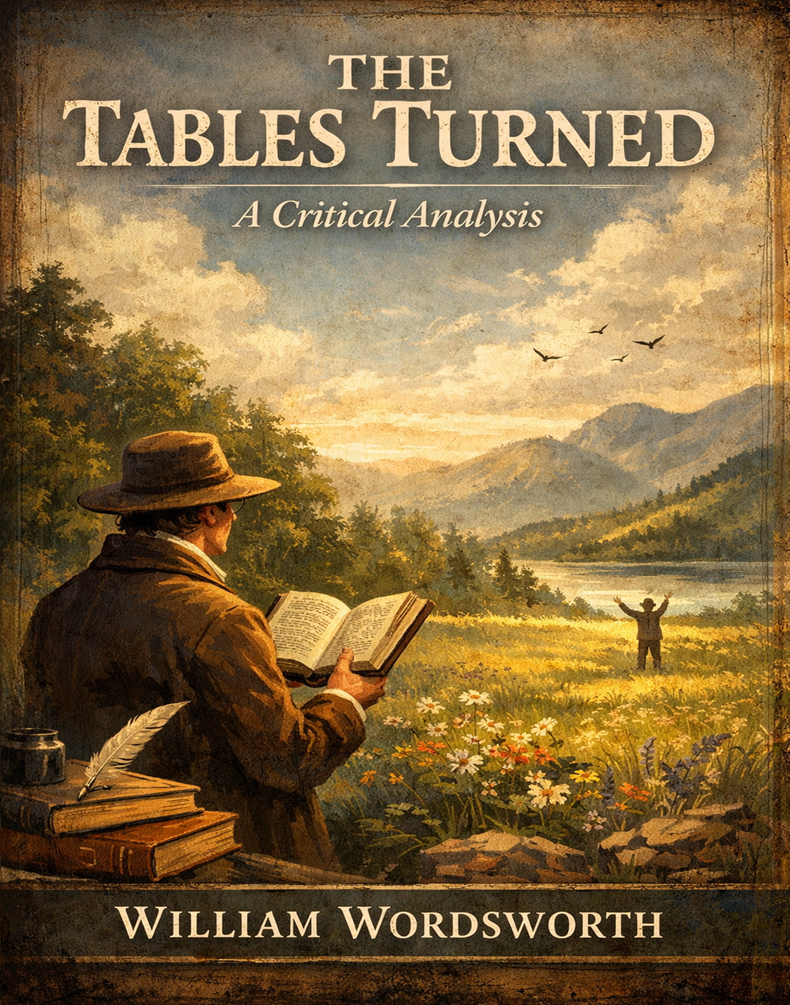
Introduction: “The Tables Turned” by William Wordsworth
“The Tables Turned” by William Wordsworth : first appeared in 1798 in Lyrical Ballads, with a Few Other Poems (Wordsworth’s landmark collaborative volume with Samuel Taylor Coleridge, first issued in October 1798). In this brief “evening scene,” Wordsworth urges a studious friend to abandon sterile bookishness—“Up! up! my Friend, and quit your books”—and recover a fuller mode of knowing through direct encounter with the living world: “Come forth into the light of things, / Let Nature be your teacher.” The poem’s central ideas crystallize a core Romantic argument: nature offers “spontaneous wisdom” and moral insight (“One impulse from a vernal wood / May teach you more of man …”), whereas the over-active analytic mind and the culture of “Science and Art” can deform what they study—“Our meddling intellect / Mis-shapes the beauteous forms of things:— / We murder to dissect.” Its enduring popularity stems from how memorably it compresses Wordsworth’s program for poetry and education—anti-mechanistic, experience-based, ethically serious—into plain diction, songlike quatrains, and quotable imperatives (“Close up those barren leaves”), making it both a defining statement of Lyrical Ballads’ Romantic ethos and an unusually teachable, widely anthologized lyric.
Text: “The Tables Turned” by William Wordsworth
Up! up! my Friend, and quit your books;
Or surely you’ll grow double:
Up! up! my Friend, and clear your looks;
Why all this toil and trouble?
The sun above the mountain’s head,
A freshening lustre mellow
Through all the long green fields has spread,
His first sweet evening yellow.
Books! ’tis a dull and endless strife:
Come, hear the woodland linnet,
How sweet his music! on my life,
There’s more of wisdom in it.
And hark! how blithe the throstle sings!
He, too, is no mean preacher:
Come forth into the light of things,
Let Nature be your teacher.
She has a world of ready wealth,
Our minds and hearts to bless—
Spontaneous wisdom breathed by health,
Truth breathed by cheerfulness.
One impulse from a vernal wood
May teach you more of man,
Of moral evil and of good,
Than all the sages can.
Sweet is the lore which Nature brings;
Our meddling intellect
Mis-shapes the beauteous forms of things:—
We murder to dissect.
Enough of Science and of Art;
Close up those barren leaves;
Come forth, and bring with you a heart
That watches and receives.
Annotations: “The Tables Turned” by William Wordsworth
| Stanza | Line | Text | Annotation (meaning/function) | Literary devices |
| 1 | 1 | Up! up! my Friend, and quit your books; | The speaker urgently calls the friend away from study and into lived experience. | 👉 Imperative | 👥 Direct address | 🔁 Repetition | 🎶 Sound pattern |
| 1 | 2 | Or surely you’ll grow double: | A humorous warning: excessive bookishness will make you “grow double” (physically/mentally stagnant). | 🧩 Hyperbole | 🎶 Sound pattern |
| 1 | 3 | Up! up! my Friend, and clear your looks; | Repeats the call—shake off gloom and mental strain. | 👉 Imperative | 👥 Direct address | 🔁 Repetition | 🎶 Sound pattern |
| 1 | 4 | Why all this toil and trouble? | Questions the value of anxious labor over books; challenges the friend’s mindset. | ❓ Rhetorical question | 🎶 Sound pattern |
| 2 | 5 | The sun above the mountain’s head, | Establishes a pastoral scene; nature is elevated and vivid. | 🖼️ Visual imagery | 🧍 Personification (mountain “head”) |
| 2 | 6 | A freshening lustre mellow | Soft, renewing light suggests calm restoration. | 🖼️ Visual imagery | 🎶 Sound pattern |
| 2 | 7 | Through all the long green fields has spread, | Broad, panoramic view; emphasizes nature’s abundance and reach. | 🖼️ Visual imagery | 🌈 Color imagery | 🎶 Sound pattern |
| 2 | 8 | His first sweet evening yellow. | The sun is personified; evening light is sensuously described as “sweet” and “yellow.” | 🧍 Personification | 🌈 Color imagery | 🖼️ Visual imagery | 🎶 Sound pattern |
| 3 | 9 | Books! ’tis a dull and endless strife: | Books are framed as exhausting conflict—study becomes sterile struggle. | 🧠 Metaphor | ⚖️ Contrast | 🔊 Exclamation (forceful opening) |
| 3 | 10 | Come, hear the woodland linnet, | Invites listening to nature as an alternative source of insight. | 👉 Imperative | 🎵 Auditory imagery | 🖼️ Pastoral imagery |
| 3 | 11 | How sweet his music! on my life, | Declares the birdsong’s beauty with emotional emphasis and personal oath. | 🎵 Auditory imagery | 🔊 Exclamation | 🧍 Personification |
| 3 | 12 | There’s more of wisdom in it. | Claims natural sound contains deeper wisdom than book-learning. | ⚖️ Contrast | 🧠 Implicit metaphor (wisdom “in” music) |
| 4 | 13 | And hark! how blithe the throstle sings! | Heightens immediacy: listen now—nature is lively and instructive. | 👉 Imperative (“hark”) | 🎵 Auditory imagery | 🔊 Exclamation |
| 4 | 14 | He, too, is no mean preacher: | Bird is cast as a “preacher”; “no mean” understates to praise strongly. | 🧠 Metaphor | 🧍 Personification | 🔎 Litotes/understatement |
| 4 | 15 | Come forth into the light of things, | Calls the friend outward into direct encounter with reality (“light” as clarity/truth). | 👉 Imperative | 🧠 Metaphor | 🖼️ Imagery |
| 4 | 16 | Let Nature be your teacher. | Central thesis: Nature instructs better than formal study. | 🧍 Personification | 🧠 Metaphor (Nature-as-teacher) | 👉 Imperative |
| 5 | 17 | She has a world of ready wealth, | Nature (as “She”) is abundant and immediately available to enrich life. | 🧍 Personification | 🧠 Metaphor (wealth = spiritual/intellectual riches) |
| 5 | 18 | Our minds and hearts to bless— | Nature’s “wealth” benefits intellect and emotion alike. | 📚 Metonymy/synecdoche (minds/hearts) | 🧍 Personification (blessing) |
| 5 | 19 | Spontaneous wisdom breathed by health, | Wisdom is pictured as natural breath arising from well-being. | 🧠 Metaphor | 🧍 Personification | 🎶 Sound pattern |
| 5 | 20 | Truth breathed by cheerfulness. | Parallel claim: truth flows from a joyful disposition, not strained analysis. | 🧠 Metaphor | 🧍 Personification | ⚖️ Contrast (cheer vs. toil) |
| 6 | 21 | One impulse from a vernal wood | Even a single springtime “impulse” from nature can educate profoundly. | 🖼️ Visual imagery | 🧠 Metaphor | 🧍 Personification |
| 6 | 22 | May teach you more of man, | Nature’s brief lesson outweighs extensive study of humanity. | 🧩 Hyperbole | ⚖️ Contrast |
| 6 | 23 | Of moral evil and of good, | Frames ethics in opposites; highlights the breadth of what nature can teach. | ⚖️ Antithesis (evil/good) |
| 6 | 24 | Than all the sages can. | Diminishes bookish authorities (“sages”) compared to nature’s instruction. | 🧩 Hyperbole | 📚 Metonymy (sages = learned tradition) |
| 7 | 25 | Sweet is the lore which Nature brings; | Praises nature’s knowledge; uses inverted syntax for emphasis. | 🌀 Inversion | 🧍 Personification | 🧠 Metaphor (“lore”) |
| 7 | 26 | Our meddling intellect | Critiques the analytical mind as intrusive and distorting. | 🧍 Personification (intellect “meddles”) |
| 7 | 27 | Mis-shapes the beauteous forms of things:— | Suggests analysis deforms beauty—turns living forms into abstractions. | 🧠 Metaphor | ⚖️ Contrast (beauty vs. distortion) | 🎶 Sound pattern |
| 7 | 28 | We murder to dissect. | Striking epigram: dissection/analysis destroys what it seeks to understand. | 🧠 Metaphor | 💥 Aphorism/epigram | ⚖️ Paradox (knowing by killing) |
| 8 | 29 | Enough of Science and of Art; | Rejects overreliance on formal disciplines in this moment. | 👉 Imperative (elliptical command) | 📚 Metonymy (Science/Art = scholastic culture) |
| 8 | 30 | Close up those barren leaves; | Tells the friend to shut the books; “leaves” also puns on nature’s leaves—books are “barren,” nature is fertile. | 👉 Imperative | 🧠 Metaphor | 🧷 Pun/wordplay | 🖼️ Imagery |
| 8 | 31 | Come forth, and bring with you a heart | Invitation to approach nature with receptivity, not mere intellect. | 👉 Imperative | 📚 Metonymy/synecdoche (heart = inner disposition) |
| 8 | 32 | That watches and receives. | Defines the proper posture: attentive observation and open acceptance. | 🎶 Sound pattern | 🧠 Implicit metaphor (heart as perceiver) | 🔁 Parallelism |
Literary And Poetic Devices: “The Tables Turned” by William Wordsworth
| Device | Example from the poem | Explanation |
| 🟣 Anaphora | “Up! up! my Friend… / Up! up! my Friend…” | Repetition at the beginning of successive lines intensifies urgency and persuasion. |
| 🟠 Apostrophe | “Up! up! my Friend” | Direct address creates a conversational, exhortative voice aimed at correcting the listener. |
| 🟢 Assonance | “His first sweet evening yellow.” | Repetition of the long “ee” vowel sound (sweet / eve-) adds euphony and softens the evening mood. |
| 🔺 Caesura | “Books! ’tis a dull and endless strife:” | A strong internal pause (punctuation) produces abrupt emphasis, mimicking impatience with bookish study. |
| 🟤 Connotation | “barren leaves” | “Barren” implies sterility and lifelessness; “leaves” suggests pages, framing books as unfruitful without lived experience. |
| 🟥 Contrast | “Books! ’tis a dull and endless strife” vs. “How sweet his music!” | Sharp opposition between dry study and enlivening nature strengthens the poem’s argument. |
| 🟦 Diction | “quit your books,” “Enough of Science and of Art” | Plain, direct word choice supports the poem’s accessible, practical instruction. |
| 🟪 Enjambment | “A freshening lustre mellow / Through all the long green fields has spread” | The thought runs over the line-break, creating flow that mirrors the spreading light. |
| 🟧 Exclamation | “Up! up!” / “Books!” | Exclamations heighten emotional force and the speaker’s insistence. |
| 🟩 Hyperbole | “One impulse from a vernal wood / May teach you more of man… / Than all the sages can.” | Deliberate exaggeration elevates nature’s insight above accumulated scholarly authority. |
| 🔶 Imagery | “The sun above the mountain’s head… / His first sweet evening yellow.” | Vivid visual detail immerses the reader in the scene and models sensory learning. |
| ⚫ Imperative (command) | “Come forth… / Let Nature be your teacher.” | Commands function as moral direction, pushing the reader from passivity to experience. |
| 🟫 Interjection | “Hark! how blithe the throstle sings!” | Sudden inserted words simulate spontaneous speech and shift attention to immediate perception. |
| 🔵 Metaphor | “Come forth into the light of things” | “Light” operates as a metaphor for clarity and reality—knowledge as illumination through experience. |
| 🟨 Metonymy | “Close up those barren leaves” | “Leaves” stands for the book/pages (a related part for the whole), critiquing secondhand learning. |
| 🟣 Metre (iambic tetrameter, largely) | “Up! up! my Friend, and quit your books;” | Predominantly four-beat lines give brisk momentum suited to advice and exhortation. |
| 🟠 Personification | “Let Nature be your teacher. / She has a world of ready wealth” | Nature is given human agency (“teacher,” “she”), reinforcing its authority as a moral guide. |
| 🟢 Rhyme scheme (ABAB) | “books / looks” and “double / trouble” | Alternating end-rhymes produce a songlike structure that aids memorability and emphasis. |
| 🔺 Symbolism | “books” vs. “vernal wood” | Books symbolize abstract/secondhand knowledge; the wood symbolizes living, experiential wisdom. |
| 🟥 Tone (didactic/admonitory) | “Enough of Science and of Art; / Close up those barren leaves” | The speaker instructs firmly, warning against over-analysis and urging receptive attention. |
Themes: “The Tables Turned” by William Wordsworth
· 🌿 Nature as Teacher and the Romantic Theory of Knowledge
“The Tables Turned” by William Wordsworth frames Nature as an epistemic authority whose lessons arrive through immediate perception rather than through mediated study, and the speaker’s repeated imperatives function as a pedagogy of attention that redirects the learner from pages to fields, birdsong, and evening light. By personifying Nature as a “teacher” endowed with “ready wealth,” the poem argues that knowledge is not merely accumulated but awakened, because wisdom is pictured as something that “breathes” through health and cheerfulness and therefore enters the mind as a living force. This Romantic stance does not deny intelligence; instead, it reorders it, proposing that the most reliable insight emerges when the self becomes receptive to the “light of things,” so that observation, feeling, and moral reflection are integrated rather than compartmentalized, and learning becomes a form of re-communion with the world. In this way, Nature replaces books as the primary curriculum.
· 📚 Critique of Bookishness and the Reductionist “Meddling Intellect”
“The Tables Turned” by William Wordsworth advances a sustained critique of bookish overinvestment and of the analytical habit that treats lived reality as an object to be mastered, because “Books” become a “dull and endless strife” and the “meddling intellect” is accused of mis-shaping what is intrinsically beautiful. The poem’s most severe judgment—“We murder to dissect”—condenses a whole philosophy of anti-reductionism: when experience is cut into concepts, its vital wholeness is lost, and the mind gains technical description at the cost of wonder, sympathy, and ethical clarity. Even “Science and…Art,” here standing metonymically for institutional knowledge, are labeled “barren leaves,” a phrase that turns pages into sterile foliage and implies that abstraction can mimic life while failing to nourish it. Thus, the poem invites disciplined humility, urging the reader to close the book not to become ignorant, but to become whole, again and again.
· 🐦 Sensory Joy, Health, and the Reanimation of Perception
“The Tables Turned” by William Wordsworth celebrates the senses as pathways to restoration, suggesting that renewal begins when the body and attention are re-synchronized with the rhythms of the natural world, and the poem’s imagery of “freshening lustre,” “long green fields,” and “sweet evening yellow” makes light itself feel medicinal. Auditory motifs deepen this therapy of perception: the linnet’s music and the throstle’s “blithe” song are not decorative background, but living signals that awaken delight and, through delight, awaken discernment. When the speaker swears “on my life” that there is “more of wisdom” in birdsong, he links knowledge to vitality, implying that a fatigued mind cannot think clearly until it learns to feel clearly. Cheerfulness and health, repeatedly associated with “breath,” become the conditions for truth, so that joy is treated not as escapism but as an epistemic and moral resource that steadies judgment in practice.
· ⚖️ Moral Education through Receptivity and Participation
“The Tables Turned” by William Wordsworth links moral formation to humility, arguing that ethical insight is not manufactured by piling up authorities but discovered when the learner adopts a receptive posture that “watches and receives,” because even “one impulse from a vernal wood” may teach more of “moral evil and of good” than “all the sages.” Nature, therefore, functions as a tutor whose scenes and sounds train discrimination and sympathy, while the speaker’s summons to “bring with you a heart” insists that intellect without feeling becomes ethically unreliable. By contrasting abstract study with embodied attention, the poem implies that conscience grows through participation in the world’s patterns—light shifting into evening, birds calling from the wood, breath moving with cheerfulness—so that moral knowledge is experienced as alignment rather than as mere instruction. The result is a disciplined ethic in which the self is refined through responsive engagement.
Literary Theories and “The Tables Turned” by William Wordsworth
| Theory | Key lens (what it prioritizes) | References from the poem (textual anchors) | What the theory helps you argue about the poem |
| 🟢 Romanticism / Nature-Centered Epistemology | Nature as a primary source of truth, moral insight, and authentic feeling; suspicion of mechanistic rationalism. | “Come forth into the light of things, / Let Nature be your teacher”; “One impulse from a vernal wood / May teach you more of man… / Than all the sages can”; “Truth breathed by cheerfulness.” | The poem becomes a manifesto of Romantic knowing: direct experience and affective receptivity are superior to abstract study, because nature “teaches” holistic wisdom and moral perception. |
| 🟣 New Criticism (Formalist Close Reading) | Meaning emerges from the text’s internal structure—imagery, paradox, rhythm, patterning—rather than author biography or history. | Refrains/commands: “Up! up! my Friend”; sonic pattern and balanced claims: “We murder to dissect”; closure as resolution: “bring with you a heart / That watches and receives.” | You can argue the poem’s persuasion is achieved formally: imperative syntax + patterned stanzaic design create momentum, while the paradox “We murder to dissect” condenses the critique of analysis into a memorable aphorism. |
| 🟠 Marxist Criticism (Ideology of Labor, Leisure, and Value) | How texts encode social relations—work discipline, productivity, institutional authority, and classed access to “culture.” | “quit your books”; “Why all this toil and trouble?”; “Books! ’tis a dull and endless strife”; “Close up those barren leaves.” | The poem can be read as resisting a culture of disciplined “toil” associated with institutional learning and productivity, proposing instead a counter-value system where “wealth” is natural and shared (“a world of ready wealth”), not credentialed or gatekept. |
| 🔵 Ecocriticism (Human–Nature Relationship and Environmental Ethics) | Representation of nature; critique of human domination; ethics of attention, humility, and non-extractive ways of knowing. | “Let Nature be your teacher”; “Our meddling intellect / Mis-shapes the beauteous forms of things:— / We murder to dissect”; “Sweet is the lore which Nature brings.” | The poem critiques extractive, objectifying knowledge (“dissect”) and promotes an ecological ethic of receptivity—learning as attentive listening (“Come, hear… / And hark!”) rather than mastery—anticipating later environmental arguments about instrumental reason. |
Critical Questions about “The Tables Turned” by William Wordsworth
🟦 1) How does the poem redefine “knowledge,” and what does it imply is lost when learning is limited to books?
“The Tables Turned” by William Wordsworth redefines knowledge as an embodied, ethically charged mode of perception rather than a purely textual accumulation of facts, because the speaker insists that wisdom is encountered in lived attentiveness—“Come forth into the light of things”—instead of being extracted from “books” through “toil and trouble.” By privileging listening (“Come, hear the woodland linnet”) and direct encounter with the “long green fields,” the poem implies that book-learning, when absolutized, dulls affect and narrows judgment, producing a mind that is technically busy yet existentially unawakened. Moreover, the claim that “There’s more of wisdom” in birdsong suggests that nature offers integrative insight, where cognition, feeling, and moral sense converge, whereas reading alone risks becoming a closed circuit of concepts. In this view, what is lost is not information but wholeness: a “heart / That watches and receives,” capable of understanding life without reducing it.
🟣 2) What is Wordsworth’s critique of analysis and “meddling intellect,” and is it anti-intellectual or anti-reductionist?
“The Tables Turned” by William Wordsworth stages a pointed critique of analytic habits that, while claiming to clarify reality, may distort it by treating living forms as inert objects, a danger condensed in the brutal aphorism, “We murder to dissect.” The phrase does not simply reject thinking; rather, it indicts a particular epistemology in which understanding becomes synonymous with breaking down, labeling, and mastering, so that beauty is converted into parts and meaning is mistaken for mechanism. When the speaker dismisses the “barren leaves” of “Science and of Art,” he targets an arid intellectualism that forgets the ethical and affective dimensions of knowing, because it seeks certainty without receptivity and explanation without wonder. The poem is therefore best read as anti-reductionist: it urges a disciplined openness in which the mind does not abandon inquiry, but restrains its impulse to dominate, allowing “spontaneous wisdom” and “truth breathed by cheerfulness” to register as legitimate forms of insight.
🟧 3) How does the poem’s rhetoric (commands, sound, and structure) function to persuade rather than merely describe?
“The Tables Turned” by William Wordsworth persuades through a rhetoric of urgency that repeatedly converts reflection into action, since the poem is built on imperatives—“Up! up!,” “Come, hear,” “Come forth,” “Close up”—that create a tempo of insistence and make the reader feel summoned, not merely addressed. Because the speaker frames reading as “dull and endless strife” while presenting nature as immediately sensuous (“first sweet evening yellow”), the argument advances by contrast, moving from the cramped posture of study to the expansive scene of fields, sun, and birdsong. The alternation of exclamation and caesural interruption (“Books!”) gives the voice an almost conversational impatience, as though the poem itself refuses to linger in abstraction. Even the recurring auditory cues—“hear,” “hark”—work as staged demonstrations: the poem does not only talk about listening to nature; it rehearses the act of listening as a persuasive method, culminating in the ethical posture of a “heart / That watches and receives.”
🟢 4) What moral and social vision emerges from the poem’s elevation of nature, and how might it challenge institutional authority?
“The Tables Turned” by William Wordsworth advances a moral vision in which genuine cultivation depends less on credentialed knowledge than on a renewed capacity for attention, because the speaker locates ethical learning in the “vernal wood,” where an “impulse” may teach “moral evil and of good” more effectively than “all the sages.” This claim quietly challenges institutional authority by implying that wisdom is not the monopoly of scholars, experts, or inherited canons, since nature’s “ready wealth” is available to anyone willing to “come forth” and observe without coercive frameworks. At the same time, the poem promotes a social ethic of humility: if “meddling intellect” mis-shapes reality, then moral seriousness requires self-limitation, a refusal to treat the world as material for control. Thus the invitation to bring “a heart / That watches and receives” becomes a civic as well as personal proposal, suggesting that healthier communities might emerge when knowledge is tempered by receptivity, joy, and a non-extractive relation to what lives beyond the page.
Literary Works Similar to “The Tables Turned” by William Wordsworth
- 🟢 “Expostulation and Reply” by William Wordsworth — Like Wordsworth’s “The Tables Turned”, it challenges bookish, secondhand learning and argues that wisdom comes through quiet receptivity to nature rather than relentless study.
- 🟣 “Lines Written in Early Spring” by William Wordsworth — It similarly uses a serene natural scene to generate moral reflection, contrasting nature’s restorative harmony with human “toil” and self-inflicted distress.
- 🟠 “The School Boy” by William Blake — It parallels Wordsworth’s critique of “barren” learning by portraying institutional schooling as stifling natural joy, growth, and the intuitive education of the outdoors.
- 🔵 “When I Heard the Learn’d Astronomer” by Walt Whitman — It echoes the poem’s anti-reductionist impulse by rejecting cold analysis in favor of direct, awed experience of the natural world as a truer mode of knowing.
Representative Quotations of “The Tables Turned” by William Wordsworth
| Quotation | Context (what is happening in the poem) | Theoretical perspective (bold) + explanation |
| 🔷 “Up! up! my Friend, and quit your books;” | The speaker opens with an urgent call for the friend to abandon excessive study and re-enter lived experience. | Romanticism — Knowledge is framed as experiential and affective, not merely textual; the line inaugurates the poem’s revolt against secondhand learning. |
| 🟣 “Why all this toil and trouble?” | The speaker questions the cost of relentless reading, presenting it as needless strain that dims the spirit. | Marxist Criticism — “Toil” encodes a work-discipline ideology; the poem resists productivity-as-virtue and revalues leisure and embodied perception. |
| 🟠 “The sun above the mountain’s head,” | The poem pivots from the indoor world of books to an outdoor scene, grounding its argument in sensory immediacy. | Phenomenology — Meaning arises from direct perception; the “sun” anchors truth in what is encountered, not what is abstracted. |
| 🟢 “Books! ’tis a dull and endless strife:” | A blunt interruption dismisses book-learning as monotonous contention, intensifying the polemical tone. | New Criticism — The interjection and caesura (“Books!”) enact the speaker’s impatience formally; the poem’s structure reinforces its argument. |
| 🔺 “Come, hear the woodland linnet,” | The speaker redirects attention to birdsong, modeling listening as a method of learning. | Ecocriticism — The line promotes non-extractive attention to nature (listening rather than mastering), positioning the more-than-human world as ethically instructive. |
| 🟤 “There’s more of wisdom in it.” | The birdsong is elevated as a superior teacher, undercutting scholarly authority and learned tradition. | Romanticism — Wisdom is “felt” and intuited through nature’s living presence, challenging the supremacy of institutional knowledge. |
| 🟥 “Let Nature be your teacher.” | The poem states its core thesis explicitly, personifying Nature as a moral guide and educator. | Ecocriticism — Nature is not a backdrop but an agent of instruction, encouraging an ethic of humility and relational learning. |
| 🟦 “One impulse from a vernal wood / May teach you more of man,” | A single springtime moment is claimed to yield deeper moral insight than extensive philosophical study. | Humanist Moral Criticism — Ethical knowledge is depicted as arising from lived encounter and reflection, not solely from “sages” or doctrinal systems. |
| 🟪 “Our meddling intellect / Mis-shapes the beauteous forms of things:” | The poem critiques analytic intrusion: the mind’s urge to control can deform what it seeks to understand. | Post-Enlightenment Critique / Anti-reductionism — The poem attacks reductive rationality that converts living wholeness into manipulable parts, thereby distorting value and beauty. |
| 🟧 “We murder to dissect.” | The argument culminates in a stark aphorism: analysis can become a kind of violence against life and meaning. | Ecocriticism — “Dissect” symbolizes extractive knowledge practices; the line warns that domination-as-understanding destroys the very vitality it claims to explain. |
Suggested Readings: “The Tables Turned” by William Wordsworth
- Books
- Bate, Jonathan. Romantic Ecology: Wordsworth and the Environmental Tradition. Routledge, 1991.
- Wordsworth, William, and Samuel Taylor Coleridge. Lyrical Ballads. Edited by Michael Mason, 2nd ed., Routledge, 2007.
- Academic articles
- Gael, Patricia. “Lyrical Ballads in British Periodicals, 1798–1800.” The Wordsworth Circle, vol. 44, no. 1, Winter 2013, pp. 61–67. https://doi.org/10.1086/TWC24045879. Accessed 9 Jan. 2026.
- Thiria-Meulemans, Aurélie. “Science of Feelings”: On the Complementarity between Science and Poetry in Wordsworth.” Études anglaises, vol. 64, no. 2, 2011, pp. 142–152. https://doi.org/10.3917/etan.642.0142. Accessed 9 Jan. 2026.
- Poem websites
- Wordsworth, William. “The Tables Turned.” Poetry Foundation, https://www.poetryfoundation.org/poems/45557/the-tables-turned. Accessed 9 Jan. 2026.
- Wordsworth, William. “The Tables Turned.” Representative Poetry Online (University of Toronto Libraries), https://rpo.library.utoronto.ca/content/tables-turned. Accessed 9 Jan. 2026.