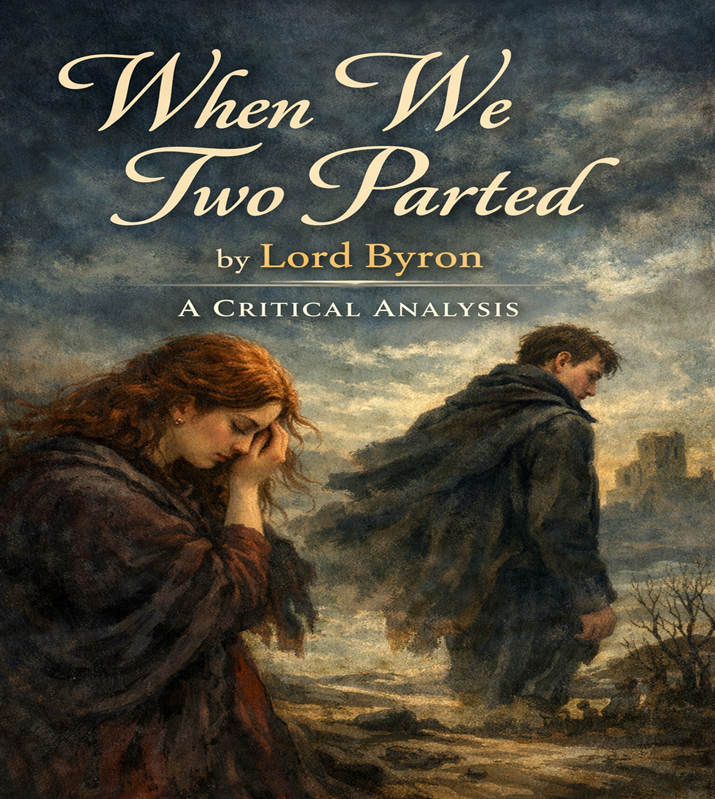
Introduction: “When We Two Parted” by Lord Byron
“When We Two Parted” by Lord Byron first appeared in 1816, though it was written earlier, around 1808, and was later included in his collection Hebrew Melodies (1815–1821). The poem articulates the anguish of a clandestine love that has ended in betrayal and social disgrace, dramatizing themes of secrecy, emotional rupture, memory, and enduring sorrow. Byron frames separation not as a single moment but as a prolonged condition of suffering—“Half broken-hearted / To sever for years”—where silence replaces intimacy and grief becomes cyclical. The beloved’s moral fall and public shame (“Thy vows are all broken, / And light is thy fame”) intensify the speaker’s private torment, especially as her name becomes “A knell to mine ear,” transforming memory into an auditory wound. The poem’s circular structure, returning in the final stanza to the opening phrase “With silence and tears,” underscores the inescapability of loss and emotional stasis. Its enduring popularity stems from this stark emotional economy, confessional intensity, and universal portrayal of love constrained by secrecy and social codes, which allows readers to recognize their own experiences of muted grief and unresolved attachment within Byron’s restrained yet devastating lyric voice.
Text: “When We Two Parted” by Lord Byron
When we two parted
In silence and tears,
Half broken-hearted
To sever for years,
Pale grew thy cheek and cold,
Colder thy kiss;
Truly that hour foretold
Sorrow to this.
The dew of the morning
Sunk chill on my brow—
It felt like the warning
Of what I feel now.
Thy vows are all broken,
And light is thy fame;
I hear thy name spoken,
And share in its shame.
They name thee before me,
A knell to mine ear;
A shudder comes o’er me—
Why wert thou so dear?
They know not I knew thee,
Who knew thee too well—
Long, long shall I rue thee,
Too deeply to tell.
In secret we met—
In silence I grieve,
That thy heart could forget,
Thy spirit deceive.
If I should meet thee
After long years,
How should I greet thee?—
With silence and tears.
Annotations: “When We Two Parted” by Lord Byron
| Stanza / Lines | Annotation (Meaning & Effect) | Literary Devices |
| Stanza 1 When we two parted… Sorrow to this. | The speaker recalls the moment of separation, marked by emotional numbness rather than dramatic outburst. The beloved’s physical coldness foreshadows long-lasting grief, suggesting emotional betrayal and irreversible loss. | ◆ (Red) Alliteration – silence / sever / sorrow ■ (Blue) Metonymy – cheek, kiss represent emotional intimacy ▲ (Green) Foreshadowing – “that hour foretold / sorrow” ★ (Gold) Imagery – visual and tactile coldness |
| Stanza 2 The dew of the morning… Of what I feel now. | Natural imagery mirrors inner suffering. The cold dew becomes a physical manifestation of emotional pain, linking past experience with present anguish. | ● (Purple) Symbolism – dew symbolizes grief ◆ (Red) Simile (implicit) – physical chill parallels emotional chill ★ (Gold) Sensory Imagery – tactile sensation of cold |
| Stanza 3 Thy vows are all broken… And share in its shame. | The speaker condemns the beloved’s broken promises and damaged reputation. Personal sorrow merges with public dishonor, intensifying humiliation and moral betrayal. | ■ (Blue) Irony – “light is thy fame” (reputation is morally dark) ▲ (Green) Moral Judgment – broken vows ◆ (Red) Alliteration – name / shame |
| Stanza 4 They name thee before me… Why wert thou so dear? | Hearing the beloved’s name triggers physical horror. The metaphor of a funeral bell suggests emotional death and unresolved attachment. | ✖ (Black) Metaphor – “knell to mine ear” ★ (Gold) Auditory Imagery – sound as pain ● (Purple) Rhetorical Question – expresses torment |
| Stanza 5 They know not I knew thee… Too deeply to tell. | The speaker contrasts public ignorance with private intimacy. Repetition emphasizes enduring regret and emotional depth that language cannot express. | ◆ (Red) Repetition – “long, long” ▲ (Green) Contrast – public vs private knowledge ■ (Blue) Understatement – pain “too deeply to tell” |
| Stanza 6 In secret we met… Thy spirit deceive. | The love affair is revealed as secretive and morally conflicted. Emotional betrayal is framed as both forgetfulness and deception. | ● (Purple) Parallelism – heart forget / spirit deceive ✖ (Black) Moral Allegory – betrayal as spiritual failure ◆ (Red) Alliteration – secret / silence |
| Stanza 7 If I should meet thee… With silence and tears. | The poem closes by echoing its opening. Silence replaces speech, confirming that grief is permanent and cyclical rather than resolved. | ◎ (Silver) Circular Structure – ending mirrors beginning ★ (Gold) Motif – silence and tears ▲ (Green) Pathos – emotional resignation |
Literary And Poetic Devices: “When We Two Parted” by Lord Byron
| Literary Device | Example from the Poem | Explanation |
| Apostrophe 🟢 | “Why wert thou so dear?” | The speaker directly addresses the absent beloved, heightening emotional intensity. |
| Assonance 🟣 | “Half broken-hearted” | Repetition of vowel sounds creates a slow, mournful musical effect. |
| Caesura 🔴 | “A shudder comes o’er me—” | A strong pause disrupts rhythm, mirroring emotional shock and pain. |
| Circular Structure 🟡 | “In silence and tears” (opening and ending) | The poem ends where it begins, suggesting grief that remains unresolved. |
| Contrast 🟠 | Public naming vs. private knowing | Juxtaposition highlights the tension between social ignorance and personal intimacy. |
| Elegiac Tone 🟤 | Entire poem | The poem adopts a mournful, reflective tone typical of elegy. |
| Enjambment ⚫ | “When we two parted / In silence and tears” | The continuation of sense across lines conveys lingering emotional flow. |
| Foreshadowing 🟦 | “That hour foretold / Sorrow to this” | The moment of parting predicts long-term suffering. |
| Imagery 🟩 | “Pale grew thy cheek and cold” | Vivid visual and tactile imagery makes emotional pain concrete. |
| Irony 🟪 | “Light is thy fame” | “Light” ironically suggests moral darkness rather than honor. |
| Metaphor 🟥 | “A knell to mine ear” | The beloved’s name is compared to a funeral bell, symbolizing emotional death. |
| Motif 🟨 | Silence, secrecy, tears | Repeated elements unify the poem around concealed grief. |
| Pathos 🟧 | “Long, long shall I rue thee” | Language is designed to evoke sympathy and emotional response. |
| Parallelism 🟫 | “Thy heart could forget, / Thy spirit deceive” | Balanced structure emphasizes the completeness of betrayal. |
| Repetition ⬛ | “Long, long” | Repetition stresses the persistence and duration of sorrow. |
| Rhetorical Question 🟦 | “How should I greet thee?” | A question posed for effect expresses emotional helplessness. |
| Symbolism 🟩 | “The dew of the morning” | Dew symbolizes coldness, grief, and emotional heaviness. |
| Understatement 🟪 | “Too deeply to tell” | Pain is minimized verbally to suggest its overwhelming depth. |
| Tone 🟥 | Quiet, restrained, mournful | Controlled tone intensifies authenticity and emotional gravity. |
Themes: “When We Two Parted” by Lord Byron
- 🔹 Theme 1: Secrecy and Forbidden Love
“When We Two Parted” by Lord Byron foregrounds secrecy as a defining condition of love, portraying an intimate relationship that must exist in concealment and therefore carries within it the conditions of its own collapse. The repeated emphasis on “silence” signifies not merely the absence of speech but the enforced suppression of identity, desire, and moral agency under restrictive social norms. Lines such as “In secret we met— / In silence I grieve” demonstrate how love deprived of public legitimacy becomes a private affliction rather than a sustaining bond. This secrecy intensifies suffering because the speaker is denied recognition, empathy, or closure, and is forced into solitary remembrance. Byron thus presents forbidden love as psychologically corrosive: it deepens emotional dependence while simultaneously ensuring isolation. The theme implicitly critiques social conventions that render authentic feeling illicit, suggesting that love, when confined to secrecy, becomes intensely real yet socially erased. - 🔸 Theme 2: Betrayal and Moral Disillusionment
“When We Two Parted” by Lord Byron develops betrayal as both an emotional catastrophe and a moral reckoning, where personal faithlessness converges with public dishonor. The speaker’s anguish arises not solely from separation but from the beloved’s ethical collapse, starkly expressed in “Thy vows are all broken, / And light is thy fame.” Betrayal here operates on several levels: the violation of romantic trust, the erosion of moral integrity, and the contamination of shared memory. Byron intensifies this disillusionment by situating it within a social context, as the beloved’s name, once intimate, becomes “A knell to mine ear,” symbolizing how public knowledge transforms private pain into renewed trauma. Love, stripped of trust, yields only shame and resentment. The theme exposes how betrayal destabilizes emotional bonds and moral certainties alike, leaving the speaker suspended between irrecoverable affection and irrevocable disillusionment. - 🔹 Theme 3: Memory, Time, and Enduring Grief
“When We Two Parted” by Lord Byron portrays memory as a relentless temporal force that preserves suffering rather than alleviating it. Time in the poem does not heal; instead, it extends grief “for years,” indicating that emotional wounds mature rather than diminish. Byron collapses past and present through sensory imagery, as in “The dew of the morning / Sunk chill on my brow,” where a remembered physical sensation becomes indistinguishable from present pain. This fusion of temporal moments suggests that memory functions as a continuous emotional present rather than a distant recollection. The poem’s circular structure—ending with the same “silence and tears” that open it—reinforces the idea of emotional stasis despite the passage of years. Grief thus becomes a permanent condition, governed by memory’s refusal to fade. The theme captures the universal persistence of loss, revealing how love, once internalized, continues to dominate consciousness long after separation. - 🔸 Theme 4: Silence, Shame, and Social Judgment
“When We Two Parted” by Lord Byron interrogates silence as both a personal response to grief and a condition imposed by social shame. Silence in the poem is neither tranquil nor redemptive; rather, it is punitive, enforced by the weight of public judgment and moral scandal. The speaker’s suffering is compounded by the disparity between public perception and private knowledge, as others “know not” the beloved as deeply as the speaker does. Hearing her name spoken publicly becomes an act of violence, converting reputation into an instrument of pain. Byron presents shame as a social mechanism that isolates the individual, forcing grief inward and denying any form of expressive release. Silence thus becomes the speaker’s only refuge, yet it also imprisons him within unresolved sorrow. Through this theme, the poem critiques moral surveillance and exposes how social judgment magnifies personal loss into enduring psychological exile.
Literary Theories and “When We Two Parted” by Lord Byron
| Literary Theory | Application to the Poem (with Textual Evidence) |
| 🔵 Romanticism | Romanticism emphasizes intense emotion, personal loss, secrecy, and memory, all of which dominate the poem. Byron foregrounds private suffering over public expression: “In silence and tears,” “In secret we met— / In silence I grieve.” Nature mirrors emotion, a key Romantic trait: “The dew of the morning / Sunk chill on my brow— / It felt like the warning / Of what I feel now.” The poem privileges subjective feeling, emotional authenticity, and the enduring power of memory. |
| 🟢 Psychoanalytic Criticism | From a psychoanalytic lens, the poem dramatizes repressed desire, trauma, and unresolved grief. The repeated return to “silence” and “tears” suggests emotional repression. The beloved’s name functions as a traumatic trigger: “They name thee before me, / A knell to mine ear; / A shudder comes o’er me.” The speaker’s inability to imagine closure—“How should I greet thee?— / With silence and tears”—reveals fixation and melancholia rather than healing. |
| 🟣 Feminist Criticism | Feminist theory highlights the poem’s critique of gendered morality and social judgment. The woman’s public reputation is condemned—“Light is thy fame”—while the male speaker retains moral authority and emotional voice. Society condemns her, not him: “I hear thy name spoken, / And share in its shame.” The poem exposes how patriarchal norms disproportionately punish female sexuality while rendering male suffering noble and articulate. |
| 🔴 New Historicism | New Historicism situates the poem within early 19th-century British social codes of honor, secrecy, and reputation. The emphasis on concealment—“In secret we met”—reflects social constraints on illicit relationships. Public naming becomes social violence: “They name thee before me.” The poem reflects Romantic-era anxieties about honor, scandal, and social surveillance, showing how private love is shaped—and destroyed—by public norms. |
Critical Questions about “When We Two Parted” by Lord Byron
🔵 1. How does silence function as a central emotional and structural element in the poem?
“When We Two Parted” by Lord Byron presents silence not merely as the absence of speech but as a dominant emotional condition that structures the entire poem. Silence accompanies the lovers’ separation, frames their secret meetings, and ultimately governs the imagined reunion, suggesting that grief has rendered language inadequate. Byron uses silence to replace melodrama with restraint, allowing suppressed emotion to speak more powerfully than overt expression. This repeated motif also reflects the social constraints surrounding the relationship, implying scandal, secrecy, and moral tension. Structurally, the poem begins and ends with “silence and tears,” creating a circular pattern that reinforces emotional stagnation rather than closure. The speaker’s inability to articulate his suffering openly reveals a psychological paralysis, where pain becomes internalized and enduring. Thus, silence functions simultaneously as a thematic marker of repression, a symbol of social secrecy, and a structural device that sustains the poem’s tragic continuity.
🔴 2. In what ways does Byron connect physical imagery with emotional suffering?
“When We Two Parted” by Lord Byron intricately links physical sensations with emotional distress, transforming inner grief into tangible experience. Images of coldness dominate the poem: the beloved’s cheek grows “pale,” her kiss becomes “cold,” and the dew of the morning sinks “chill” upon the speaker’s brow. These sensations are not incidental but symbolic, as physical cold mirrors emotional abandonment and moral detachment. Byron’s use of bodily imagery allows readers to feel sorrow rather than merely understand it intellectually. Moreover, the persistence of cold imagery across time—from the moment of parting to the speaker’s present state—suggests that emotional wounds do not heal but instead solidify into a permanent condition. By collapsing the boundary between body and mind, Byron reinforces Romantic ideals in which emotion governs perception, and suffering is experienced as a total, embodied reality rather than an abstract psychological state.
🟢 3. How does the poem explore the tension between private love and public reputation?
“When We Two Parted” by Lord Byron exposes a profound conflict between private intimacy and public judgment, revealing how love becomes corrupted under social scrutiny. The speaker insists that others “know not” the beloved as he knew her, establishing a sharp divide between public perception and private truth. While the world speaks her name casually, for the speaker it tolls like a funeral bell, underscoring how reputation transforms personal memory into collective shame. Byron intensifies this tension through irony, particularly in the phrase “light is thy fame,” where public visibility is equated with moral lightness rather than honor. The poem thus critiques a society that reduces complex emotional relationships to scandal and gossip. In doing so, Byron suggests that private love, when exposed to public discourse, loses its sanctity and becomes a source of enduring humiliation, especially for the one who loved sincerely and in silence.
🟣 4. Why does the poem end without emotional resolution, and what is the significance of this choice?
“When We Two Parted” by Lord Byron deliberately denies emotional resolution, ending instead with the same “silence and tears” that marked its beginning. This structural choice reinforces the idea that some emotional losses are irreversible and resistant to narrative closure. Unlike traditional lyric poems that move toward consolation or acceptance, Byron’s poem remains suspended in grief, reflecting a Romantic understanding of memory as persistent and haunting. The imagined future meeting does not promise reconciliation or healing; rather, it anticipates renewed silence, suggesting that time intensifies sorrow instead of diminishing it. This unresolved ending also mirrors real human experience, where betrayal and secrecy often leave emotional wounds unhealed. By refusing closure, Byron preserves the authenticity of suffering and emphasizes the permanence of emotional truth, allowing the poem to resonate as a realistic and psychologically complex meditation on loss.
Literary Works Similar to “When We Two Parted” by Lord Byron
- 🔹 “Remembrance” by Emily Brontë
This poem closely resembles “When We Two Parted” in its exploration of enduring grief after lost love, where emotional fidelity persists beyond separation and time, and remembrance becomes a solemn, almost sacred act of private mourning rather than consolation. - 🔸 “Neutral Tones” by Thomas Hardy
Like Byron’s poem, this work depicts the emotional aftermath of a failed relationship through restrained language and bleak imagery, emphasizing disillusionment, emotional detachment, and the lasting psychological chill produced by love’s betrayal. - 🔹 “A Broken Appointment” by Thomas Hardy
This poem parallels “When We Two Parted” in its focus on abandonment and silent suffering, portraying love as an expectation painfully unmet and grief as a condition endured privately, without resolution or public acknowledgment. - 🔸 “He Wishes for the Cloths of Heaven” by W. B. Yeats
Although gentler in tone, this poem shares Byron’s emotional vulnerability and reverence for love, presenting intimacy as fragile and unreciprocated, where restraint, humility, and unspoken longing intensify the speaker’s emotional exposure.
Representative Quotations of “When We Two Parted” by Lord Byron
| Quotation | Contextual Reference | Theoretical Perspective & Explanation |
| 💙 “When we two parted / In silence and tears” | Opening scene of separation marked by emotional restraint | 🔵 Romanticism – Emotional Intensity & Subjectivity: The poem begins with inward grief rather than dramatic action, privileging private emotion over public expression—core to Romantic aesthetics. |
| 🖤 “Half broken-hearted / To sever for years” | Long-term emotional rupture implied at the moment of parting | 🟢 Psychoanalytic – Trauma & Fixation: The phrase suggests unresolved mourning and anticipatory grief, indicating psychic fixation rather than closure. |
| ❄️ “Pale grew thy cheek and cold, / Colder thy kiss” | Physical description of emotional withdrawal | 🟣 Feminist – Emotional Abandonment & Gendered Blame: The woman is portrayed as emotionally cold, subtly reinforcing stereotypes of female betrayal while centering male suffering. |
| 🌫️ “Truly that hour foretold / Sorrow to this” | Retrospective reflection on the moment of separation | 🟢 Psychoanalytic – Retrospective Trauma: Memory reshapes the past as prophecy, a classic symptom of trauma where earlier moments gain fatalistic meaning. |
| 🌿 “The dew of the morning / Sunk chill on my brow” | Nature mirrors inner desolation | 🔵 Romanticism – Nature as Emotional Correspondent: Natural imagery externalizes inner suffering, aligning the speaker’s body with the landscape. |
| ⚠️ “It felt like the warning / Of what I feel now” | Emotional present linked to past sensation | 🟢 Psychoanalytic – Repression & Foreboding: Sensory experience becomes a somatic signal of suppressed emotional pain returning in consciousness. |
| 🔔 “They name thee before me, / A knell to mine ear” | Public mention of the beloved causes pain | 🔴 New Historicism – Social Surveillance & Reputation: The ‘knell’ reflects how public discourse and naming enforce moral judgment in Romantic-era society. |
| 🩸 “And share in its shame” | Speaker internalizes public disgrace associated with her | 🟣 Feminist – Gendered Morality: The woman bears social disgrace (“light is thy fame”), while the man assumes the role of tragic witness, exposing patriarchal asymmetry. |
| 🤐 “In secret we met— / In silence I grieve” | Love concealed, grief internalized | 🔴 New Historicism – Illicit Love & Secrecy: Highlights cultural constraints on relationships, where secrecy is both protection and punishment. |
| 💧 “How should I greet thee?— / With silence and tears.” | Imagined future reunion | 🔵 Romanticism + 🟢 Psychoanalytic – Eternalized Sorrow: The cyclical return to silence and tears signifies Romantic devotion fused with psychological inability to move beyond loss. |
Suggested Readings: “When We Two Parted” by Lord Byron
BOOKS
- Bone, Drummond, editor. The Cambridge Companion to Byron. 2nd ed., Cambridge University Press, 2023.
- McGann, Jerome J. Byron and Romanticism. Edited by James Soderholm, Cambridge University Press, 2002.
ACADEMIC ARTICLES
- Reva, Iryna. “Stylistic Features of G. Byron in the Poem ‘When We Two Parted’.” *Актуальні питання гуманітарних наук*, issue 75, vol. 3, 2024, pp. 155–160. https://www.aphn-journal.in.ua/archive/75_2024/part_3/24.pdf. Accessed 9 Jan. 2026.
- Yang, Pukai. “Analysis of George Gordon Byron’s ‘When We Two Parted’.” *Verse Version*, vol. 13, no. 1, 2024, pp. 73–79. https://doi.org/10.64699/EWVK9710. Accessed 9 Jan. 2026.
POEM WEBSITES
- Byron, George Gordon. “When We Two Parted.” Academy of American Poets (Poets.org), https://poets.org/poem/when-we-two-parted. Accessed 9 Jan. 2026.
- Byron, George Gordon (Lord). “When We Two Parted.” Poetry-Archive.com, https://www.poetry-archive.com/b/when_we_two_parted/. Accessed 9 Jan. 2026.