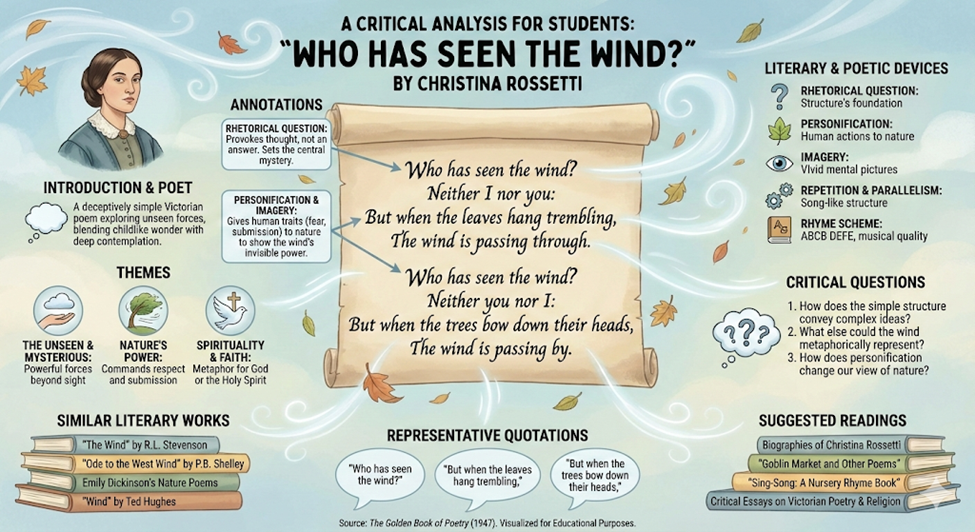
Introduction: “Who Has Seen the Wind?” by Christina Rossetti
“Who Has Seen the Wind?” by Christina Rossetti : first appeared in 1872 in Rossetti’s children’s verse collection Sing-Song: A Nursery Rhyme Book, though it is often encountered today through later anthologies such as The Golden Book of Poetry (1947). The poem’s main idea is that some realities are invisible in themselves yet known by their effects: the wind cannot be directly “seen” (“Neither I nor you: / Neither you nor I”), but its presence becomes legible in nature’s responsive signs—“when the leaves hang trembling” and “when the trees bow down their heads.” Its enduring popularity follows from this fusion of childlike plainness and philosophical clarity: the repeated question-and-answer structure (“Who has seen the wind?”) creates memorability; the concrete imagery (leaves trembling, trees bowing) makes an abstract concept graspable; and the gentle cadence and parallelism invite recitation, teaching readers to infer the unseen through observable change.
Text: “Who Has Seen the Wind?” by Christina Rossetti
Neither I nor you:
But when the leaves hang trembling,
The wind is passing through.
Who has seen the wind?
Neither you nor I:
But when the trees bow down their heads,
The wind is passing by.
Source: The Golden Book of Poetry (1947)
Annotations: “Who Has Seen the Wind?” by Christina Rossetti
| Unit | Text | Annotation | Literary devices |
| Key | — | Legend for symbols used in the “Literary devices” column | 🟥 Rhetorical Question; 🟨 Repetition / Refrain; 🟦 Imagery; 🟩 Personification; 🟪 Parallelism; 🟧 Enjambment; ⬛ Symbolism (unseen force) |
| Stanza 1 (overall) | Neither I nor you… (to) …passing through. | Establishes the central paradox: the wind is invisible, yet its presence is verified by observable effects (movement in leaves). This frames a larger idea: some realities are known indirectly. | ⬛ Symbolism; 🟦 Imagery; 🟪 Parallelism (structure anticipates stanza 2) |
| Line 1 | Neither I nor you: | A direct, inclusive denial: neither speaker nor listener can literally see the wind—setting up the poem’s method of knowing through evidence rather than sight. | ⬛ Symbolism (limits of perception); 🟪 Parallelism (with “Neither you nor I”) |
| Line 2 | But when the leaves hang trembling, | The “proof” arrives through a vivid natural sign: trembling leaves mark the wind’s passage. The line turns from denial (“Neither…”) to empirical observation (“But when…”). | 🟦 Imagery; 🟩 Personification (leaves “trembling” evokes human response); 🟧 Enjambment (drives into the next line) |
| Line 3 | The wind is passing through. | Concludes the stanza’s logic: the wind is not seen, but its movement is known through what it moves. “Passing through” suggests permeation—an unseen presence threading the visible world. | ⬛ Symbolism (unseen presence); 🟧 Enjambment/resolution (completes the prior line’s setup) |
| Stanza 2 (overall) | Who has seen the wind?… (to) …passing by. | Repeats the inquiry and proof-pattern, intensifying the theme by shifting from leaves to trees—a larger scale that strengthens the sense of force and universality. | 🟥 Rhetorical Question; 🟨 Repetition/Refrain; 🟦 Imagery; 🟩 Personification; 🟪 Parallelism; ⬛ Symbolism |
| Line 4 | Who has seen the wind? | A question asked for emphasis, not information. It dramatizes human wonder and underscores that the wind’s reality exceeds direct visual confirmation. | 🟥 Rhetorical Question; ⬛ Symbolism (the unseen) |
| Line 5 | Neither you nor I: | Restates the shared limitation and reinforces the poem’s inclusive address: the truth applies to everyone, not just the speaker. | 🟨 Repetition (echo of stanza 1’s denial); 🟪 Parallelism |
| Line 6 | But when the trees bow down their heads, | A stronger, more solemn sign than trembling leaves: trees “bow” like people. This makes nature appear responsive, even reverent, to an invisible power. | 🟩 Personification (“bow down their heads”); 🟦 Imagery; 🟧 Enjambment |
| Line 7 | The wind is passing by. | Returns to the poem’s recurring conclusion: the wind’s presence is inferred from its effects. “Passing by” suggests transience—felt, then gone—yet unmistakable. | 🟨 Repetition/Refrain (same syntactic closure as stanza 1); ⬛ Symbolism (indirect knowledge) |
Literary And Poetic Devices: “Who Has Seen the Wind?” by Christina Rossetti
| Device (A–Z) | Short definition | Example from the poem | How it works here (explanation) |
| 🔴 Alliteration | Repetition of initial consonant sounds. | “when the wind” | The repeated w sound creates a soft musical effect that suits the airy subject (wind). |
| 🟠 Anaphora | Repetition of a word/phrase at the beginning of successive lines. | “Who has seen the wind?” (opens both stanzas) | The repeated opening line makes the poem chant-like, memorable, and emphatic. |
| 🟡 Antithesis | Juxtaposition of contrasting ideas. | “seen” vs. “Neither I nor you” | Contrasts direct sight with indirect knowledge, sharpening the poem’s central idea. |
| 🟢 Assonance | Repetition of vowel sounds in nearby words. | “trees … seen” / “bow … down” | Echoed vowel sounds unify lines and add a lullaby-like flow. |
| 🔵 Caesura | A deliberate pause within a line (often via punctuation). | “Neither I nor you:**” | The colon creates a teaching-like pause—question, then a measured answer. |
| 🟣 Consonance | Repetition of consonant sounds within/at ends of words. | “wind … passind” | The repeated nd sound adds sonic cohesion across the lines. |
| 🟤 Diction | Word choice and its effect. | “leaves,” “trees,” “trembling,” “bow” | Simple, concrete words make the poem accessible while supporting a deeper point. |
| ⚫ End Rhyme (full + slant) | Rhyming at line endings (perfect or near). | “you / through” (slant), “I / by” (near/perfect) | Light rhyme reinforces the nursery-rhyme quality and makes it easy to recite. |
| ⚪ Enjambment | Meaning runs into the next line without a full stop. | “But when the leaves hang trembling, / The wind is passing through.” | The thought flows across lines, mirroring the wind’s continuous movement. |
| 🟥 Imagery | Sensory description (visual/kinesthetic). | “leaves hang trembling”; “trees bow down their heads” | The poem makes the invisible wind “visible” through movement we can observe. |
| 🟧 Meter (loose accentual/ballad-like) | Patterned rhythm of stresses (often flexible). | The short, song-like lines | The cadence is child-friendly and memorable, contributing to the poem’s popularity. |
| 🟨 Parallelism | Repetition of similar grammatical structures. | “Neither I nor you” / “Neither you nor I” | Balanced phrasing reinforces clarity and adds pleasing symmetry. |
| 🟩 Paradox | A seeming contradiction that reveals truth. | “Who has seen the wind? … Neither…” yet we know it exists | Highlights the logic: reality can be proven by effects, not direct sight. |
| 🟦 Personification | Giving human qualities to nonhuman things. | “trees bow down their heads” | Makes nature act like humans, dramatizing the wind’s power and presence. |
| 🟪 Quatrain (form) | A four-line stanza. | Each stanza has 4 lines | The tight form supports a “two examples, one lesson” structure. |
| 🟫 Refrain (with variation) | Repeated line/phrase, sometimes slightly changed. | “The wind is passing through.” / “The wind is passing by.” | Repetition anchors the theme; small variation keeps the second stanza fresh. |
| ♦️ Repetition | Reuse of words/lines for emphasis and rhythm. | “wind” + “Neither…nor…” + repeated question | Reinforces the central message and increases memorability. |
| 🔶 Rhetorical Question | A question asked to provoke thought, not to get an answer. | “Who has seen the wind?” | Pulls readers into reflection, then guides them to infer the unseen. |
| 🔷 Symbolism | A concrete thing represents broader meanings. | “wind” as an unseen force | The wind can symbolize invisible realities (influence, spirit, change) known by their effects. |
| ⭐️ Tone (gentle, wondering) | The speaker’s attitude conveyed by style and sound. | Calm certainty: “Neither… But when…” | A quiet, instructive wonder makes the poem soothing and universally appealing. |
Themes: “Who Has Seen the Wind?” by Christina Rossetti
- 🌬️ The Existence of Invisible Reality: In “Who Has Seen the Wind?” by Christina Rossetti, the central exploration revolves around the profound concept that reality is not solely defined by what is immediately visible to the human eye. Through the simple, rhetorical questioning that structures the poem, Rossetti immediately establishes the limitation of ocular perception, asserting that neither the speaker nor the auditor has visually verified the wind’s existence. However, rather than dismissing the unseen as unreal, the poem argues for a different mode of knowing, suggesting that powerful forces manifest their presence through their tangible effects upon the material world. By observing the trembling leaves and the bowing trees, we are compelled to acknowledge the existence of an invisible agent, thereby validating the idea that significant aspects of our universe operate beyond the scope of direct sight, requiring us to deduce reality through evidence rather than mere appearance.
- 🌳 The Power of Nature and Creation: The immense, often overwhelming power of the natural world is a primary theme in “Who Has Seen the Wind?” by Christina Rossetti, presented through the interaction between elusive air currents and the rooted landscape. Although the wind itself remains intangible, its strength is undeniable as it asserts dominance over the physical environment, transitioning from a gentle force that causes delicate leaves to merely “hang trembling” to a commanding presence that forces mighty trees to “bow down their heads” in a gesture of submission. This escalation of imagery serves to emphasize the sheer scale of nature’s unseen energies, illustrating a dynamic where the visible world is constantly shaped, moved, and sometimes subjugated by invisible forces that are vastly more powerful than the vegetation that surrounds them. Rossetti captures a sense of awe regarding a natural order that functions independently of human control.
- ✝️ Faith and Spiritual Perception: Given the deep religious devotion of its author, “Who Has Seen the Wind?” by Christina Rossetti is widely interpreted as an allegorical meditation on the nature of faith and spiritual perception in a material world. The wind, which is universally felt but never seen, serves as a potent metaphor for divine presence—specifically God or the Holy Spirit—whose existence cannot be empirically proven by human sight yet whose influence is undeniably evident throughout creation. Just as we deduce the wind’s passage by the bending of the trees, Rossetti suggests that the faithful perceive the divine through the mysterious workings of the universe and spiritual movements within the soul, requiring a reliance on belief rather than ocular proof. The poem thus becomes a gentle theological lesson, encouraging a mode of perception that transcends the physical senses to embrace spiritual realities known only through their consequences.
- 👁️ Human Limitation versus Divine Omnipresence: The inherent constraint of human sensory capability is sharply contrasted with a ubiquitous, almost omnipresent force in “Who Has Seen the Wind?” by Christina Rossetti. By repeatedly answering her own rhetorical question with the collective negative phrase “Neither I nor you” in both stanzas, Rossetti emphasizes a universal human limitation: we are bound by our physical senses and cannot perceive the totality of the forces surrounding us. This acknowledgment of human finiteness is juxtaposed against the wind’s ability to be “passing through” and “passing by” continuously, affecting everything from the smallest trembling leaf to the largest bowing tree without ever being captured by our gaze. This contrast subtly highlights a humbling perspective on humanity’s place in the cosmos, suggesting that while we are confined by what we can physically see, the greater forces of the universe operate entirely outside those mortal restrictions.
Literary Theories and “Who Has Seen the Wind?” by Christina Rossetti
| Theory | Core lens (what it focuses on) | References from the poem | Theory-based reading (how the poem aligns) |
| 🟦 New Criticism / Formalism | Close reading of form, structure, imagery, sound, and internal meaning (text-as-self-contained). | Refrain-like question: “Who has seen the wind?”; negations: “Neither I nor you / Neither you nor I”; parallel nature-signs: “leaves hang trembling,” “trees bow down their heads”; closure: “The wind is passing through / …passing by.” | The poem’s meaning is produced through pattern and repetition: the repeated question-answer structure and balanced syntax teach a rule—the unseen is known by observable effects. The twin stanzas operate like matched proofs, and the gentle sound-patterning enhances the lyric’s coherence and memorability. |
| 🟩 Reader-Response Theory | Meaning emerges through the reader’s participation, prior knowledge, and interpretive experience. | Direct address: “Neither I nor you”; inclusive reversal: “Neither you nor I”; observable cues: “when the leaves hang trembling,” “when the trees bow down their heads.” | The poem recruits the reader into shared discovery: by addressing “I” and “you,” it turns interpretation into an interactive inference task—the reader “finds” the wind by recognizing signs in nature. Its simplicity invites repeated rereading, allowing different readers (child/adult) to supply different “unseen” meanings (mystery, faith, change, influence). |
| 🟨 Ecocriticism | Literature’s representation of nature, environment, nonhuman agency, and human–nature relations. | Nature as evidence: “leaves hang trembling”; trees as responsive bodies: “trees bow down their heads”; wind as nonhuman force: “The wind is passing through/by.” | The poem centers nonhuman agency: wind acts, leaves tremble, trees bow—nature is not a backdrop but a system of interactions. The lyric models environmental attentiveness: instead of mastering or naming the wind, humans learn humility by reading ecological effects and respecting forces beyond direct perception. |
| 🟣 Psychoanalytic Criticism | The psyche, especially how the unseen (desire, fear, the unconscious) appears through symptoms and signs. | Unseen presence: “Who has seen the wind?”; denial of direct access: “Neither…”; symptoms of presence: “leaves…trembling,” “trees bow down.” | The wind functions like an unconscious force: not directly visible, yet powerfully real, revealed through “symptoms” (trembling, bowing). The poem suggests how internal or invisible forces shape observable behavior—just as wind moves trees, hidden pressures move minds and lives, knowable indirectly through their effects. |
Critical Questions about “Who Has Seen the Wind?” by Christina Rossetti
🟥 Critical Question 1: How does the poem distinguish between “seeing” and “knowing,” and what kind of epistemology does it propose?
“Who Has Seen the Wind?” — Christina Rossetti The poem turns a childlike query into a meditation on knowledge, because it insists that the wind cannot be verified by sight yet can be established by effects, and this distinction challenges any naïve trust in the visible. By pairing the categorical negation “Neither I nor you” with the conditional “But when,” Rossetti frames perception as inference, so that trembling leaves become evidence and the natural world reads like a text. The speaker invites the reader into a shared epistemic limit, while also offering a method for crossing it: attend to change, maintain patience, and interpret consequences. In this way, the poem suggests that truth is often indirect, emerging through patterns rather than appearances, and it values attentiveness over possession. The wind becomes a figure for realities—emotional, ethical, or spiritual—that must be known by what they do, for the reader in practice.
🟦 Critical Question 2: How do imagery and personification work together to make the invisible wind intelligible without reducing its mystery?
“Who Has Seen the Wind?” — Christina Rossetti Rossetti makes the wind legible by animating what it touches, and the poem’s personification is interpretive, because it translates an invisible force into a human grammar of gesture. Leaves “hang trembling,” as bodies do under pressure, and trees “bow down their heads,” like humbled subjects, implying power without naming an agent. This framing raises a critical question: do the images merely report physics, or do they suggest an order in which the world responds to something greater than itself? Because the poem refuses to specify what the wind “means,” it keeps the symbolism open, so readers may hear in the bowing trees fear, reverence, surrender, or simple responsiveness. Such strategic personification stabilizes tone, since wonder is balanced by restraint rather than grand proclamation. The result is a quiet phenomenology of awe, where nature becomes the medium through which the unseen announces itself.
🟩 Critical Question 3: What is the critical function of the poem’s parallel stanzas and refrain-like repetition in shaping meaning?
“Who Has Seen the Wind?” — Christina Rossetti The poem’s two stanzas operate like matched units of thought, and their near-identical architecture functions as an argument, because repetition becomes the method by which an elusive phenomenon is made stable. Each stanza moves from denial (“Neither…”) to conditional observation (“But when…”) and then to a declarative closure (“The wind is passing…”), so the reader experiences a cycle of question, test, and conclusion. This parallelism produces a refrain-like certainty, yet it foregrounds the limits of language, since the wind is repeatedly named only as something that “passes,” never as something that can be held. By shifting from “through” to “by,” Rossetti subtly varies spatial relations, and the variation keeps the pattern from becoming mechanical while hinting that the unseen can be felt both within and alongside us. In critical terms, the structure enacts epistemic humility: it claims no mastery, only repeatable attention.
🟪 Critical Question 4: What symbolic possibilities does the wind invite, and how does the poem’s ambiguity expand its interpretive reach?
“Who Has Seen the Wind?” — Christina Rossetti Because the wind is present and unseeable, the poem invites symbolic readings in which an intangible force—faith, feeling, time, or influence—becomes real only through what it sets in motion. Rossetti’s diction stays materially grounded, however, and this restraint prevents allegory from hardening into a single doctrine, since the poem never instructs the reader what to believe. Instead, it models a hermeneutic practice: one observes effects, tests impressions against shared experience, and accepts that some causes remain beyond direct representation. From a critical perspective, this is a politics of modest claims, where authority rests on common evidence rather than on private revelation, and where certainty is replaced by repeated, careful noticing. Thus the wind functions as a threshold symbol, connecting the sensory to the metaphysical while preserving ambiguity, so that the poem can speak to secular skepticism and to religious sensibility at once.
Literary Works Similar to “Who Has Seen the Wind?” by Christina Rossetti
- 🪁 “The Wind” by Robert Louis Stevenson: Like Rossetti’s work, this poem is written from a child’s perspective and uses personification to describe the wind not as something seen, but as a mysterious “beast” identified only by the sounds it makes and its physical impact on the environment.
- 🍃 “Ode to the West Wind” by Percy Bysshe Shelley: While more complex in structure, this Romantic poem shares Rossetti’s central theme of the wind as an invisible, uncontrollable spirit—a “destroyer and preserver”—that manifests its immense power by driving dead leaves and bowing the woods.
- 🚪 “The Wind – tapped like a tired Man –” by Emily Dickinson: Similar to Rossetti’s use of personification, Dickinson treats the wind as a guest entering a home, giving human qualities to an intangible force to explore how the invisible natural world interacts intimately with human experience.
- 🌼 “I Wandered Lonely as a Cloud” by William Wordsworth: This poem mirrors Rossetti’s imagery of nature responding to the breeze; just as Rossetti’s leaves tremble, Wordsworth’s daffodils are described as “fluttering and dancing in the breeze,” illustrating how the unseen wind breathes life and motion into the static landscape.
Representative Quotations of “Who Has Seen the Wind?” by Christina Rossetti
| Representative quotation | Context | Explanation (what the quotation does) |
| 🌬️ “Who has seen the wind?” | Context: Opening question that frames both stanzas. Perspective: Reader-Response | The line invites the reader into an inquiry. Meaning is produced through the reader’s participation—answering by noticing evidence rather than expecting direct sight. |
| 👥 “Neither I nor you:” | Context: Immediate answer that denies direct visual access. Perspective: New Criticism / Formalism | The crisp negation creates tension between question and answer; the punctuation (colon) controls rhythm and makes the statement sound authoritative and didactic. |
| 🍃 “But when the leaves hang trembling,” | Context: First observable sign of the wind. Perspective: Ecocriticism | The poem grounds knowledge in nonhuman response: nature becomes the “text” that records wind’s passage through movement and change. |
| ➡️ “The wind is passing through.” | Context: First stanza’s concluding inference. Perspective: Psychoanalytic Criticism | The wind’s presence is known only by symptoms (trembling leaves), paralleling how unseen inner forces are inferred from outward signs. |
| 🌬️ “Who has seen the wind?” | Context: Repetition at the start of stanza two. Perspective: New Criticism / Formalism | As a refrain, repetition binds the poem structurally, creating symmetry and reinforcing the central paradox: unseen yet undeniable. |
| 👤↔️👤 “Neither you nor I:” | Context: A mirrored reversal of the earlier negation. Perspective: Reader-Response | The reversal (“you” first) emphasizes shared limitation and shared knowing, positioning reader and speaker on equal interpretive footing. |
| 🌳 “But when the trees bow down their heads,” | Context: Second observable sign; intensified image of wind’s force. Perspective: Ecocriticism | Trees are depicted as responsive bodies; the line portrays nature as active and reactive, highlighting nonhuman agency and ecological interrelation. |
| 🙇 “bow down their heads,” | Context: A focused phrase within the second stanza’s image. Perspective: New Criticism / Formalism | Personification compresses meaning into a vivid gesture. The “bow” makes the wind’s invisible power emotionally legible through a human-like action. |
| 🚶♂️ “The wind is passing by.” | Context: Final inference; slight variation on “passing through.” Perspective: New Criticism / Formalism | The minimal variation (“by” vs. “through”) subtly shifts spatial sense while preserving closure—an elegant formal strategy that avoids monotony. |
| 🌀 “Neither I nor you… / Neither you nor I…” | Context: The poem’s paired denials across both stanzas (taken together). Perspective: Psychoanalytic Criticism | The repeated denial dramatizes epistemic limits: we cannot “see” the force directly, yet we are compelled to acknowledge it through effects—like unconscious pressures shaping visible behavior. |
Suggested Readings: “Who Has Seen the Wind?” by Christina Rossetti
Books
- Rossetti, Christina Georgina. Sing-Song: A Nursery Rhyme Book. Project Gutenberg, 2025.
- Kent, David A., editor. The Achievement of Christina Rossetti. Cornell University Press, 1987.
Academic Articles
- Garlitz, Barbara. “Christina Rossetti’s Sing-Song and Nineteenth-Century Children’s Poetry.” PMLA / Publications of the Modern Language Association of America, vol. 70, no. 3, June 1955, pp. 539–543. Cambridge Core, https://www.cambridge.org/core/journals/pmla/article/christina-rossettis-singsong-and-nineteenthcentury-childrens-poetry/BE054A45F15F053803D9DEDEF579F9CA. Accessed 15 Jan. 2026. https://doi.org/10.2307/460055.
- Pikalova, Anna. “The Representation of the ‘Emotive-I’ of Christina Rossetti’s Identity in Her Children’s Poetry.” Cognitive Studies | Études cognitives, no. 19, 2019, article no. 1925. https://doi.org/10.11649/cs.1925. Journal site, https://journals.ispan.edu.pl/index.php/cs-ec/en/article/view/cs.1925. Accessed 15 Jan. 2026.
Poem Websites
- Rossetti, Christina. “Who Has Seen the Wind?” Poetry Foundation, Poetry Foundation, https://www.poetryfoundation.org/poems/43197/who-has-seen-the-wind. Accessed 15 Jan. 2026.
- Rossetti, Christina. “Who Has Seen the Wind?” Poets.org, Academy of American Poets, https://poets.org/poem/who-has-seen-wind. Accessed 15 Jan. 2026.