“We Wear the Mask” by Paul Laurence Dunbar: A Critical Analysis

“We Wear the Mask” by Paul Laurence Dunbar first appeared in 1895 in Dunbar’s poetry collection Majors and Minors, later reprinted in The Complete Poems of Paul Laurence Dunbar

"We Wear the Mask" by Paul Laurence Dunbar: A Critical Analysis
Introduction: “We Wear the Mask” by Paul Laurence Dunbar

“We Wear the Mask” by Paul Laurence Dunbar first appeared in 1895 in Dunbar’s poetry collection Majors and Minors, later reprinted in The Complete Poems of Paul Laurence Dunbar. The poem articulates the psychological and social necessity of concealment, particularly for marginalized African Americans navigating a racially oppressive society. Through the controlling metaphor of the “mask,” Dunbar dramatizes enforced emotional dissimulation—“We wear the mask that grins and lies”—to expose the disjunction between public performance and private suffering, captured poignantly in “With torn and bleeding hearts we smile.” The poem also interrogates the ethics of visibility, rejecting voyeuristic sympathy—“Why should the world be over-wise, / In counting all our tears and sighs?”—while simultaneously invoking spiritual witness in the anguished apostrophe, “O great Christ.” Its enduring popularity stems from this layered universality: while rooted in the historical realities of racial injustice, the poem resonates broadly as a critique of social hypocrisy and emotional labor, making the mask a timeless emblem of human resilience under constraint.

Text: “We Wear the Mask” by Paul Laurence Dunbar

We wear the mask that grins and lies,

It hides our cheeks and shades our eyes,—

This debt we pay to human guile;

With torn and bleeding hearts we smile,

And mouth with myriad subtleties.

Why should the world be over-wise,

In counting all our tears and sighs?

Nay, let them only see us, while

       We wear the mask.

We smile, but, O great Christ, our cries

To thee from tortured souls arise.

We sing, but oh the clay is vile

Beneath our feet, and long the mile;

But let the world dream otherwise,

       We wear the mask!

Copyright Credit: Paul Laurence. Dunbar, ““We Wear the Mask.”” from The Complete Poems of Paul Laurence Dunbar. (New York: Dodd, Mead and Company)

Annotations: “We Wear the Mask” by Paul Laurence Dunbar
Line / StanzaCritical AnnotationLiterary Devices
1. “We wear the mask that grins and lies,”Introduces the controlling metaphor of the poem: the “mask” signifies a false public persona adopted to survive social hostility. The contrast between “grins” and “lies” exposes emotional falsification.◆ Symbolism (mask = false identity) · ◇ Metaphor · ◈ Paradox
2. “It hides our cheeks and shades our eyes,—”Concealment extends from emotion to perception; eyes, traditionally linked with truth, are deliberately obscured, suggesting enforced invisibility.◆ Symbolism · ▲ Visual Imagery · ◇ Metaphor
3. “This debt we pay to human guile;”Suffering is framed as a compulsory transaction. Society’s deception (“human guile”) extracts an emotional cost from the marginalized.◇ Metaphor (debt) · ■ Abstraction · ◈ Irony
4. “With torn and bleeding hearts we smile,”Violent emotional imagery highlights inner trauma masked by outward cheerfulness, underscoring psychological oppression.▲ Imagery · ◈ Paradox · ◆ Symbolism
5. “And mouth with myriad subtleties.”Speech becomes cautious and indirect; expression is filtered, strategic, and coded rather than authentic.◇ Metonymy (mouth = speech) · ▣ Alliteration · ◆ Symbolism
Stanza 1 (Overall)Establishes the extended metaphor of masking as a collective survival strategy under social and racial pressure.◆ Extended Metaphor · ● Theme: Oppression
Literary And Poetic Devices: “We Wear the Mask” by Paul Laurence Dunbar
DeviceDefinitionExample from the PoemExplanation
🔷 AllegoryA work conveying a deeper moral, social, or political meaningThe poem as a wholeThe poem allegorizes the African American experience of masking pain to survive racial oppression.
🟢 AlliterationRepetition of initial consonant sounds“mouth with myriad”The soft repetition suggests controlled speech and restrained expression.
🟣 ApostropheAddressing an absent or abstract being“O great Christ”The speaker appeals to divine justice, highlighting spiritual suffering ignored by society.
🔶 AssonanceRepetition of vowel sounds“grins and lies”The repeated i sound reinforces artificial cheerfulness and deceit.
🔴 ConceitAn extended or controlling metaphorThe “mask”The mask governs the entire poem, symbolizing enforced emotional disguise.
🟡 ContrastJuxtaposition of opposing ideas“We smile… / With torn and bleeding hearts”Highlights the gap between outward appearance and inner reality.
🟤 DictionPurposeful word choice“torn,” “bleeding,” “tortured”Pain-laden diction reveals psychological and emotional violence.
🔵 End RhymeRhyming words at the end of lines“lies / eyes”The fixed rhyme scheme reflects social rigidity and constraint.
🟠 EnjambmentSentence running over multiple lines“This debt we pay… / With torn and bleeding hearts we smile”Mirrors emotional overflow contained by social rules.
🟩 HyperboleDeliberate exaggeration“counting all our tears and sighs”Emphasizes society’s invasive scrutiny of suffering.
🟥 ImageryLanguage appealing to the senses“torn and bleeding hearts”Creates vivid mental images of internal pain.
🟦 IronyContrast between expectation and reality“We smile”Smiling becomes ironic because it masks agony rather than joy.
🟪 MetaphorImplicit comparison“We wear the mask”The mask stands for emotional suppression and social performance.
🟫 MotifRepeated thematic elementRepetition of “mask”Reinforces habitual concealment as a survival mechanism.
⚫ PersonificationHuman qualities given to abstractions“human guile”Deception is treated as an active social force.
⚪ RefrainRepeated line or phrase“We wear the mask”The refrain stresses inevitability and collective experience.
🔺 Religious AllusionReference to religious belief or figure“Christ”Introduces moral authority beyond an unjust society.
🔻 Rhetorical QuestionQuestion not meant to be answered“Why should the world be over-wise?”Challenges society’s right to probe private suffering.
⭐ SymbolismObjects representing abstract ideasThe “mask”Symbolizes racial survival, emotional labor, and social hypocrisy.
💠 ToneAuthor’s emotional attitudeSomber, restrainedThe controlled tone reflects dignified endurance rather than open revolt.
Themes: “We Wear the Mask” by Paul Laurence Dunbar

🎭 Theme 1: Masking as a Strategy of Survival

“We Wear the Mask” by Paul Laurence Dunbar foregrounds masking as a deliberate survival mechanism adopted by marginalized individuals in a hostile social environment, where emotional concealment functions less as personal dishonesty than as a socially enforced discipline. The poem frames the mask as necessary because the public sphere is structured by judgment, coercion, and racial surveillance, and therefore the self must be strategically edited to remain safe. By reiterating the refrain, Dunbar intensifies the sense of inevitability, implying that concealment is not episodic but habitual, almost institutional, and the collective voice suggests that this is a shared condition rather than an isolated psychological habit. Moreover, the tension between outward smiling and inward injury underscores how survival often requires performance, especially when vulnerability is punished and authenticity is exploited. In this way, masking becomes a paradoxical form of resistance-through-restraint, enabling endurance where direct exposure would invite harm.


🩸 Theme 2: Emotional Pain and Suppressed Suffering

“We Wear the Mask” by Paul Laurence Dunbar renders suppressed suffering as both intensely private and broadly communal, using visceral diction to reveal how the inner life is wounded by the demand to appear untroubled. The poem’s imagery of “torn and bleeding hearts” collapses the distance between emotion and bodily injury, suggesting that psychological pain is not metaphorically mild but materially devastating, while the insistence on smiling exposes a coercive social script that requires the afflicted to perform stability. This enforced cheerfulness does not erase anguish; rather, it intensifies it by preventing acknowledgement, articulation, and relief, thereby transforming sorrow into a chronic condition that must be managed in silence. Additionally, the poem implies that the world’s refusal to engage suffering produces a double violence: first, the original injustice, and second, the compelled suppression of its effects. Consequently, Dunbar presents emotional restraint not as composure but as the evidence of an ongoing, unrecognized trauma.


👁️ Theme 3: Social Hypocrisy and the Illusion of Harmony

“We Wear the Mask” by Paul Laurence Dunbar critiques a society that prefers the comfort of appearances to the ethical burden of truth, revealing how public harmony is often purchased through denial and selective vision. The speaker challenges the world’s intrusive “wisdom” in counting tears, because such observation is exposed as superficial: it measures symptoms without confronting causes, and it consumes suffering as spectacle while avoiding responsibility. Dunbar suggests that the mask is not merely worn by the oppressed but is tacitly demanded by the social order, since acknowledging pain would disrupt the illusion of moral legitimacy upon which that order depends. When the poem states that the world may “dream otherwise,” it implies that collective self-deception is an enabling condition of injustice, allowing inequality to persist without crisis of conscience. Thus, the poem frames social hypocrisy as an active structure, where ignorance functions less as absence of knowledge than as cultivated, convenient refusal.


✝️ Theme 4: Spiritual Appeal and Moral Witness

“We Wear the Mask” by Paul Laurence Dunbar introduces a theological register that transforms private anguish into moral testimony, as the speaker directs hidden cries to Christ when human society proves incapable of recognition or justice. This apostrophic appeal signals both faith and indictment: faith, because suffering is addressed to a divine witness presumed to see beneath appearances; indictment, because the turn toward God implicitly exposes the failure of earthly institutions and social conscience. The poem’s contrast between singing and standing on “vile” clay sharpens the tension between spiritual aspiration and degraded material conditions, suggesting that endurance is achieved not through naïve optimism but through a disciplined holding-together of hope and despair. In this framework, religion becomes less a sentimental refuge than a language of accountability, enabling the speaker to assert the reality of suffering even when the world demands silence. Consequently, the poem casts spiritual address as a form of resistant truth-telling under conditions of forced disguise.

Literary Theories and “We Wear the Mask” by Paul Laurence Dunbar
Theory (with Symbol)Core Theoretical FocusReference from the PoemTheory-Based Interpretation
🔴 Marxist CriticismPower, oppression, ideology, class and racial domination“This debt we pay to human guile”From a Marxist perspective, the “mask” represents ideological coercion imposed by a dominant social order. The oppressed are compelled to perform contentment to sustain hegemonic stability and avoid punishment within an unequal racial system.
🔵 Postcolonial TheoryOthering, marginalization, identity under domination“We wear the mask that grins and lies”The poem reflects postcolonial identity formation, where the colonized or racialized subject conceals pain to conform to dominant cultural expectations, internalizing silence as a survival strategy.
🟢 Psychoanalytic CriticismRepression, divided self, psychological trauma“With torn and bleeding hearts we smile”Psychoanalytically, the mask symbolizes repression. The smile functions as a defense mechanism, while the “torn and bleeding hearts” expose deep psychological trauma suppressed beneath social performance.
🟣 New HistoricismText in relation to its historical and cultural moment“Why should the world be over-wise, / In counting all our tears and sighs?”Read through New Historicism, the poem reflects late 19th-century African American realities under Jim Crow. The refusal to display suffering critiques a society that consumes Black pain without offering justice.
Critical Questions about “We Wear the Mask” by Paul Laurence Dunbar

🔴 Critical Question 1: How does the metaphor of the mask function as a social and psychological device in the poem?

“We Wear the Mask” by Paul Laurence Dunbar employs the mask as a sustained metaphor that operates simultaneously on social and psychological levels. Socially, the mask represents enforced performance within a hostile racial order, compelling the speaker to project contentment—“We wear the mask that grins and lies”—as a strategy of survival. Psychologically, the mask signifies repression, as authentic emotions are deliberately concealed to avoid further harm. Dunbar fuses these dimensions by presenting smiling not as joy but as labor, a “debt” paid to “human guile,” suggesting moral coercion rather than voluntary deception. The phrase “torn and bleeding hearts” exposes the psychic cost of this concealment, indicating trauma internalized through habitual silence. Thus, the mask is not merely a disguise but a mechanism of endurance shaped by systemic injustice. Its function lies in enabling outward conformity while preserving an inner self that, though wounded, resists total erasure through awareness and articulation.


🔵 Critical Question 2: Why does the speaker reject public recognition of suffering, and what critique does this imply?

“We Wear the Mask” by Paul Laurence Dunbar articulates a deliberate refusal to make private suffering publicly legible, as seen in the rhetorical question, “Why should the world be over-wise, / In counting all our tears and sighs?” This rejection critiques a society that demands emotional transparency without offering empathy, justice, or structural change. The speaker recognizes that public acknowledgment of pain often becomes voyeuristic rather than restorative, transforming suffering into spectacle. By insisting that the world “dream otherwise,” the poem exposes the asymmetry of power between observer and observed, where the marginalized are expected to display anguish for moral validation. Dunbar’s critique extends beyond racial dynamics to indict a broader human tendency to consume others’ pain as information rather than responsibility. Silence, therefore, becomes an act of agency rather than weakness. The poem suggests that withholding suffering preserves dignity and resists exploitation, challenging liberal assumptions that visibility alone produces justice.


🟢 Critical Question 3: What role does religious imagery play in intensifying the poem’s emotional depth?

“We Wear the Mask” by Paul Laurence Dunbar invokes religious imagery to intensify emotional depth and to establish a moral contrast between divine witness and social indifference. The apostrophic cry, “O great Christ,” marks a shift from public concealment to private confession, suggesting that while society is denied access to true suffering, the divine is addressed as a compassionate witness. This invocation does not function as doctrinal piety but as an ethical appeal, emphasizing that the speaker’s anguish exceeds human systems of recognition. The juxtaposition of smiling performance with “tortured souls” underscores the inadequacy of social morality and relocates justice to a transcendent domain. Furthermore, the religious address amplifies the poem’s lament without dissolving into despair, as it implies the existence of an ultimate moral reckoning. Thus, religious imagery deepens the poem’s pathos while reinforcing its critique of a world that normalizes injustice through emotional ignorance.


🟣 Critical Question 4: Why has the poem remained relevant across historical and cultural contexts?

“We Wear the Mask” by Paul Laurence Dunbar has endured because its central metaphor transcends its immediate historical context while remaining firmly rooted in it. Although the poem emerges from the lived realities of African Americans in the late nineteenth century, its exploration of emotional concealment resonates universally in societies structured by inequality, surveillance, and social performance. The act of masking—smiling while suffering—remains a recognizable human response to institutional pressure, whether shaped by race, class, gender, or professional norms. Dunbar’s restrained tone, formal structure, and disciplined rhetoric further contribute to its longevity, allowing readers across eras to recognize their own forms of masked existence. The poem’s relevance lies in its refusal to sentimentalize pain; instead, it offers a lucid articulation of resilience without romanticizing endurance. By naming concealment as both necessary and damaging, the poem continues to speak powerfully to modern audiences negotiating visibility, identity, and survival.

Literary Works Similar to “We Wear the Mask” by Paul Laurence Dunbar
  1. 🎭 Sympathy” by Paul Laurence Dunbar
    This poem parallels We Wear the Mask by expressing the psychological confinement of Black experience, using the caged bird as a metaphor for suppressed pain and enforced emotional restraint under racial oppression.
  2. 🕊️ If We Must Die” by Claude McKay
    Like We Wear the Mask, this poem confronts systemic injustice, but whereas Dunbar emphasizes concealment for survival, McKay transforms suppressed rage into a call for dignified resistance against dehumanization.
  3. 👁️ Incident” by Countee Cullen
    This poem shares Dunbar’s focus on the lasting psychological impact of racial hostility, illustrating how a single moment of cruelty can eclipse joy and force premature emotional self-awareness.
  4. 🔥 “Still I Rise” by Maya Angelou
    While Angelou’s tone is openly defiant rather than masked, the poem resonates with Dunbar’s work in its articulation of historical pain and the strategic negotiation of identity within an oppressive social order.
Representative Quotations of “We Wear the Mask” by Paul Laurence Dunbar
QuotationContextTheoretical Perspective
🎭 “We wear the mask that grins and lies,”Opening line introducing the central metaphorPostcolonial Theory — The “mask” signifies enforced performance by a marginalized subject required to appear compliant within a dominant racial culture.
🩸 “With torn and bleeding hearts we smile,”Contrast between inner pain and outer displayPsychoanalytic Criticism — Reveals repression and psychological trauma masked by socially acceptable behavior.
🎭 “This debt we pay to human guile;”Explanation of why the mask is wornMarxist Criticism — Suggests ideological coercion, where emotional conformity is the cost of survival under an oppressive system.
😶 “And mouth with myriad subtleties.”Controlled speech replacing honest expressionDiscourse Theory — Language is manipulated to maintain safety, showing how power regulates expression.
❓ “Why should the world be over-wise,”Rhetorical challenge to societyNew Historicism — Reflects historical realities where Black suffering was scrutinized but never remedied.
😢 “In counting all our tears and sighs?”Continuation of rhetorical critiqueCritical Race Theory — Critiques voyeuristic consumption of Black pain without accountability or justice.
🙏 “O great Christ, our cries”Shift from society to divine addressTheological Criticism — Spiritual appeal exposes the moral failure of social institutions.
🔥 “To thee from tortured souls arise.”Intensification of spiritual sufferingExistential Criticism — Emphasizes anguish, alienation, and the search for meaning amid injustice.
🛣️ “Beneath our feet, and long the mile;”Image of exhausting journeySymbolic Interactionism — Life is portrayed as an ongoing struggle shaped by social roles and expectations.
🎭 “But let the world dream otherwise,”Deliberate continuation of disguiseIdeology Critique — Maintaining illusion sustains dominant myths while silencing oppressed realities.
Suggested Readings: “We Wear the Mask” by Paul Laurence Dunbar

Books

  • Dunbar, Paul Laurence. The Collected Poetry of Paul Laurence Dunbar. Edited by Joanne M. Braxton, University of Virginia Press, 1993.
  • Harrell, Willie J., Jr., editor. We Wear the Mask: Paul Laurence Dunbar and the Politics of Representative Reality. Kent State University Press, 2010.

Academic Articles

  • Morgan, Thomas L. “We Wear the Mask: Paul Laurence Dunbar and the Politics of Representative Reality.” African American Review, vol. 44, no. 4, 2011, pp. 725–727. https://doi.org/10.1353/afa.2011.0059. Accessed 1 Jan. 2026.
  • Black, Daniel P. “Literary Subterfuge: Early African American Writing and the Trope of the Mask.” CLA Journal, vol. 48, no. 4, June 2005, pp. 387–403. JSTOR, https://www.jstor.org/stable/44325281. Accessed 1 Jan. 2026.

Poem Websites

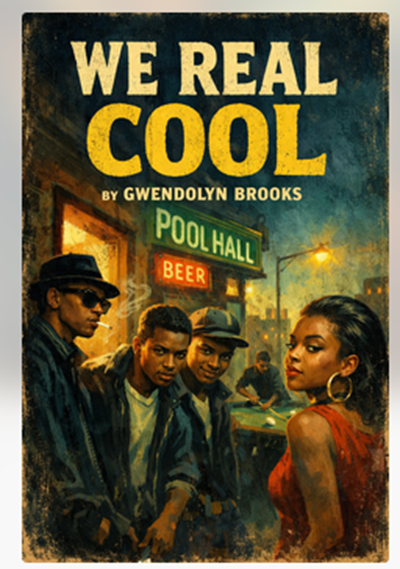
“We Real Cool” by Gwendolyn Brooks: A Critical Analysis

“We Real Cool” by Gwendolyn Brooks first appeared in 1959 in Poetry (September 1959) and was later collected in Brooks’s 1960 volume The Bean Eaters. Framed by the stark scene-setting subtitle—“The Pool Players

"We Real Cool" by Gwendolyn Brooks: A Critical Analysis
Introduction: “We Real Cool” by Gwendolyn Brooks

“We Real Cool” by Gwendolyn Brooks first appeared in 1959 in Poetry (September 1959) and was later collected in Brooks’s 1960 volume The Bean Eaters. Framed by the stark scene-setting subtitle—“The Pool Players. / Seven at the Golden Shovel.”—the poem compresses a whole social world into a collective first-person voice whose repeated “We” performs confidence while hinting at fragility. The speakers define “cool” through deliberate refusals and risks—“Left school,” “Lurk late,” “Strike straight,” “Sing sin,” and “Thin gin”—a catalogue of truancy, nocturnal drift, violence, vice, and self-numbing that reads like a set of ritual boasts and defenses. The poem’s main idea is that rebellious identity-making can feel empowering in the moment yet is structurally self-consuming, a tension sealed by the abrupt moral and temporal collapse of the last couplet: “Jazz June. We / Die soon.” Its enduring popularity follows from this exact combination of radical brevity, musical (jazz-like) cadence, and devastating closure: in just a few spare strokes Brooks makes the bravado legible, exposes its costs without sermonizing, and leaves readers with a line that is easy to remember yet difficult to forget.

Text: “We Real Cool” by Gwendolyn Brooks

 The Pool Players.
        Seven at the Golden Shovel.

            We real cool. We   

            Left school. We

            Lurk late. We

            Strike straight. We

            Sing sin. We   

            Thin gin. We

            Jazz June. We   

            Die soon.

Copyright Credit: Gwendolyn Brooks, “We Real Cool” from Selected Poems. Copyright © 1963 by Gwendolyn Brooks. Reprinted with the permission of the Estate of Gwendolyn Brooks.

Source: Poetry (September 1959)

Annotations: “We Real Cool” by Gwendolyn Brooks

TextAnnotationLiterary devices
Legend (how to read devices)Symbols below identify recurring techniques Brooks uses to create a clipped, “jazz-like” rhythm and a sharp moral turn.🔁 Repetition/Epistrophe • ↩️ Enjambment & line-break emphasis • 🎵 End rhyme • 🔤 Sound play (alliteration/assonance/internal rhyme) • 🗣️ Colloquial diction & ellipsis • 🧠 Double entendre • 🕯️ Imagery/Symbolism • 🔮 Foreshadowing • 🎭 Irony/Social critique
The Pool Players.Establishes the speakers as a collective (“players”)—not only pool players, but also risk-takers “playing” with life choices; sets up a choral, group-voice poem.🕯️ Framing/setting imagery • 🎭 Social critique (public labeling)
Seven at the Golden Shovel.A precise headcount gives documentary realism; “Golden Shovel” works as a loaded sign: glamour (“Golden”) shadowed by burial (“shovel”), quietly forecasting the end.🕯️ Symbolism (place-name) • 🔮 Foreshadowing • 🔤 Emphasis through specificity (“Seven”)
We real cool. WeThe group self-defines with bravado; the dropped verb (“are”) signals spoken voice; the line break isolates “We,” forcing a pause that turns identity into a beat.🔁 Repetition (We) • ↩️ Line-break syncopation • 🗣️ Colloquial diction/ellipsis • 🎭 Irony (boast undercut by context)
Left school. WeA blunt confession framed as a badge of honor; ending again on “We” stresses collective responsibility—no one person escapes the group’s choices.🔁 Repetition • ↩️ Line-break emphasis • 🎵 End rhyme (cool/school) • 🧩 Parallelism (same sentence pattern)
Lurk late. We“Lurk” shifts the tone from carefree to suspect: secrecy, marginal spaces, and nighttime danger; the clipped phrasing mimics quick, evasive movement.🕯️ Imagery (night/streets) • 🔮 Foreshadowing (risk escalates) • 🔤 Sound play (L- onset/harsh consonants) • ↩️ Line-break emphasis
Strike straight. WeCan be read literally (accurate pool shots) and figuratively (violence/retaliation); the ambiguity lets “coolness” slide into menace.🧠 Double entendre • 🎵 End rhyme (late/straight) • 🔁 Repetition • 🎭 Irony (skill vs harm)
Sing sin. WeA tight phrase that fuses pleasure with wrongdoing—celebration replaces conscience; the musical verb (“Sing”) anticipates the later “Jazz.”🔤 Sound play (s- repetition) • 🎭 Irony (sin as entertainment) • ↩️ Line-break emphasis • 🕯️ Moral imagery
Thin gin. WeDrinking becomes routine; “thin” suggests dilution/cheapness and also bodily/spiritual depletion—pleasure that reduces rather than enriches.🔤 Sound play (sin/gin internal echo) • 🕯️ Imagery (alcohol as habit) • 🔮 Foreshadowing (self-wasting) • 🔁 Repetition
Jazz June. We“Jazz” as a verb implies improvisation, speed, and nightlife; “June” hints at youth/summer—brief seasonality that cannot last.🔤 Sound play (J- alliteration/assonance) • 🕯️ Seasonal imagery (June = youth) • ↩️ Line-break emphasis • 🎭 Irony (celebration before collapse)
Die soon.The poem snaps shut: no trailing “We,” no lingering rhythm—finality replaces bravado. The earlier “cool” posture is exposed as fragile and short-lived.🔮 Foreshadowing fulfilled • 🎵 End rhyme (June/soon) • ⛔ Closure via omission (no final “We”) • 🎭 Irony (boast → mortality)
Literary And Poetic Devices: “We Real Cool” by Gwendolyn Brooks
DeviceShort definitionExample from the poemHow it works here
🔴 AlliterationRepetition of initial consonant sounds“Lurk late”; “Strike straight”The repeated sounds create a crisp, percussive beat—like quick cues in a pool hall.
🟠 AnaphoraRepetition at the start of successive phrases/lines“We real cool. We / Left school. We …”“We” becomes a chant of group identity, confidence, and self-assertion.
🟡 AssonanceRepetition of vowel sounds“thin gin”The tight vowel sound makes the line clipped and dry, reinforcing the sense of depletion.
🟢 CaesuraA deliberate pause within a line“We real cool. We”The pause creates a beat-drop; the extra “We” sounds like a posed signature after each claim.
🔵 ColloquialismEveryday, informal speech“We real cool.”The spoken grammar/cadence feels authentic and immediate, fitting youthful bravado.
🟣 ConsonanceRepetition of consonant sounds (often at line ends)“sin / gin”; “June / soon”The shared end-sounds bind the poem tightly and add a closing-in musicality.
🟤 DictionWord choice and its effect“Left,” “Lurk,” “Strike,” “Thin,” “Die”Mostly blunt one-syllable verbs: hard-edged action that hints at hard consequences.
⚫ Ellipsis (omission)Leaving out words that are understood“We real cool” (omits “are”)The omission speeds the line and performs “cool,” while subtly signaling instability beneath the pose.
⚪ EnjambmentMeaning runs over a line break“We real cool. We / Left school. We”The carry-over keeps momentum and restlessness, while each “We” resets the stance.
🟥 End-stopped lineA line ending with punctuation/complete thought“We real cool. We”Short, snapped statements feel like boasts delivered as finished facts.
🟧 EpigramBrief, memorable poem with a sharp point“Jazz June. We / Die soon.”The ending lands like a proverb—compact, quotable, and devastating.
🟨 ImageryConcrete detail that evokes a scene“Seven at the Golden Shovel.”A vivid place-name anchors the speakers in a specific social space and mood.
🟩 IronyContrast between surface meaning and deeper meaning“We real cool.” → “Die soon.”The swagger of “cool” is undercut by the ending; freedom flips into self-destruction.
🟦 MinimalismExtreme brevity and sparenessVery short lines; few adjectivesThe stripped style intensifies the voice and amplifies the final warning.
🟪 ParallelismRepeated grammatical structures“Lurk late. We / Strike straight. We / Sing sin. We”The repeated pattern suggests a routine—choices becoming a cycle.
♦️ RefrainRepeated line/phrase across the poemRecurring “We”Like a chorus, “We” reinforces solidarity while sounding like continual self-justification.
♣️ Rhyme (full/near)Sound correspondence at line ends“cool/school,” “sin/gin,” “June/soon”The rhyme makes the poem musical and memorable; the neatness contrasts with messy lives.
♥️ Rhythm (syncopation)Pattern of beats/stresses“We real cool. We” (beat-like phrasing)The cadence mimics jazz riffs—short, syncopated bursts that perform style and bravado.
💠 SynecdocheA part stands for a whole“Seven at the Golden Shovel.”The seven voices represent a wider youth experience, condensed into one collective “We.”
⭐ Volta (turn)A shift in tone/meaning, often near the endTurn into “Die soon.”The poem pivots from defiance to mortality, converting swagger into warning.

Themes: “We Real Cool” by Gwendolyn Brooks

  • 🔷 Performative “Cool” and Collective Identity
    “We Real Cool” by Gwendolyn Brooks presents “coolness” as a performed group identity, because the repeated “We” functions like a chant that asserts solidarity while simultaneously revealing how fragile that solidarity is. When the speakers declare, “We real cool. We / Left school. We,” the compressed grammar and abrupt pauses create a voice that sounds confident, yet the relentless return to the collective pronoun suggests they must keep re-declaring themselves to keep uncertainty at bay. The poem’s tight, slogan-like statements operate as public self-fashioning, as though the seven players at “the Golden Shovel” can become a single persona by speaking in unison. At the same time, the chorus flattens individuality and implies that belonging requires adopting the same risky script, so that identity is gained through membership but purchased at the cost of personal depth and sustained possibility. In this way, the poem shows collective swagger as both protection and self-erasure.
  • 🟥 Rebellion, Truancy, and Defiance of Institutions
    “We Real Cool” by Gwendolyn Brooks frames youthful rebellion as both an act of will and a symptom of exclusion, since the poem’s proud declarations—“Left school,” “Lurk late”—stage refusal as freedom even while implying that conventional routes to recognition may already feel blocked. By placing “Left school” so early, Brooks makes institutional rejection the foundation of the speakers’ self-definition, and by pairing it with nocturnal drifting she suggests that, once stabilizing structures are abandoned, time itself becomes unregulated and precarious. The poem’s minimal, one-syllable verbs read like a list of deliberate choices, yet their accumulation feels less like open possibility and more like narrowing options, as if defiance is the only language left to young men who have learned that compliance does not guarantee belonging. The result is a portrait of rebellion that is posture and protest at once, but also a drift into consequences the speakers refuse to name directly.
  • 🟩 Risk Culture, Violence, and Self-Destructive Pleasure
    “We Real Cool” by Gwendolyn Brooks maps a risk culture in which pleasure, danger, and status reinforce one another, because the speakers bind identity to acts that court harm: “Strike straight,” “Sing sin,” “Thin gin.” “Strike straight” can signal both skill and aggression, so the poem keeps violence hovering without specifying a target, and that ambiguity mirrors how normalized threat can become within a peer code that prizes hardness. Likewise, “Sing sin” converts wrongdoing into performance, implying that transgression is not merely committed but showcased, while “Thin gin” reduces intoxication to an image of depletion, as though the very substance meant to fortify them instead erodes them. Even “Jazz June,” with its brightness and music, reads like a brief seasonal flare—an aestheticized present that intensifies the moment but cannot extend it. The poem therefore links hedonism to erosion, suggesting that “cool” is maintained only by repeatedly courting what will undo it.
  • 🟣 Foreshortened Futures and the Shock of Mortality
    “We Real Cool” by Gwendolyn Brooks delivers its central warning through an ending that is musically inevitable yet morally startling, because “Jazz June. We / Die soon.” collapses pleasure into death with almost no transition, forcing the reader to feel how quickly a life can move from pose to silence. “Die soon” is not argued for; it is asserted, and that bluntness suggests a social reality in which early death is less an abstract risk than a known horizon for the “Seven” whose days are organized around lurking, striking, sinning, and drinking. By withholding explanation, Brooks avoids sermonizing, yet the final couplet retrospectively darkens every earlier boast, so that the poem’s rhythms begin to sound like a countdown rather than a celebration. Mortality here is not merely biological; it is structural and social, implying that certain lives are granted intensity in the present precisely because the future has been quietly foreclosed.
Literary Theories and “We Real Cool” by Gwendolyn Brooks
Literary theory (theory in same cell)Core lens (what it asks)Poem references (quoted phrases)Theory-based reading (applied to We Real Cool)
🏛️ New Criticism / FormalismHow do form, sound, and structure produce meaning?“We … We …”; “cool/school,” “late/straight,” “sin/gin,” “June/soon”; the missing final “We” after “Die soon.”The poem’s tight couplets, end rhymes, and repeated “We” create a chant-like rhythm that mimics bravado. The line breaks make “We” a percussive beat—identity performed, not explained. The formal shock is the last line: by withholding “We” at the end, Brooks converts group swagger into abrupt finality, making mortality the poem’s decisive “closure.”
🧩 Structuralism (Binary oppositions)What oppositions and social codes structure meaning?“cool” vs “school”; “lurk late” vs social respectability; “sing sin” vs moral order; “Jazz June” vs “Die soon.”The poem is built on binaries: institutional order (school) versus street code (cool); visibility versus lurking; life/season (June) versus death (soon). The “We” functions as a collective sign (a group identity produced by shared behaviors), while the Golden Shovel setting codes the speakers into a recognizable cultural script of rebellion that leads to predictable social outcomes.
💼 Marxist / Cultural MaterialismHow do class, labor, institutions, and ideology shape lives? Who benefits from the social order?“Left school”; “lurk late”; “Thin gin”; “Seven at the Golden Shovel.”The poem can be read as a snapshot of marginalized youth positioned outside the pathways of social mobility (signaled by “Left school”). Leisure (pool hall) is not “free” but shaped by material constraint: limited access to secure work and education fosters alternative status economies (“cool”). “Thin gin” hints at cheap consumption and scarcity. The fatal ending underscores how a classed social environment can convert youthful defiance into shortened life chances.
🧬 Critical Race Theory / African American StudiesHow do race and power structure representation, space, and “respectability” narratives?“The Pool Players”; “Seven at the Golden Shovel”; repeated “We”; “Die soon.”Read as a racialized urban micro-scene, the poem refuses an outsider’s moral lecture and instead offers an inside, collective voice (“We”) that performs “cool” as both style and survival. The pool hall becomes a racialized social space where identity is negotiated under surveillance and stereotype. The ending—“Die soon”—can be read as an indictment of structural conditions that render Black youth disproportionately vulnerable (social risk, institutional abandonment, and constrained futures), even as the poem preserves their voice with dignity and precision.
Critical Questions about “We Real Cool” by Gwendolyn Brooks
  • 🔍 Critical Question 1: How does the poem’s repeated “We” shape our understanding of identity and responsibility?
    “We Real Cool” by Gwendolyn Brooks uses the recurring “We” to construct a collective persona that feels confident, rhythmic, and unified, yet the same chorus also complicates responsibility by dispersing it across the group. Because each statement is immediately followed by “We,” the voice reads like a practiced performance, as though the speakers are continuously affirming that they belong and that their choices are shared rather than individual. This collective framing can be read as protective, since it offers solidarity within a marginal space (“Seven at the Golden Shovel”), but it can also be read as evasive, because the group voice allows any single speaker to hide behind the plural and to treat risky actions—“Left school,” “Thin gin”—as badges of membership rather than personal decisions with personal consequences. In this way, Brooks turns a simple pronoun into a moral instrument, showing how identity can be built through community while accountability is quietly diluted.
  • 🧩 Critical Question 2: Does the poem criticize the speakers, sympathize with them, or do both at once?
    “We Real Cool” by Gwendolyn Brooks achieves its sharpest effect by refusing a single, settled posture toward the speakers, because the poem simultaneously records their bravado with lyrical precision and exposes how that bravado collapses into vulnerability. On one level, the clipped, musical lines honor the speakers’ style—“Lurk late,” “Strike straight,” “Jazz June”—and the voice sounds self-possessed, even charismatic, which can draw the reader into a momentary admiration of their “cool.” Yet the sequence of verbs steadily accumulates into a portrait of narrowing options, and the final turn—“Die soon”—reframes the earlier swagger as a tragic performance staged against a foreshortened future. Brooks therefore critiques the culture of risk and self-harm without turning the speakers into mere objects of blame, since the poem’s restraint and lack of moralizing invite the reader to ask what social conditions make such a script feel desirable, available, or inevitable. The poem thus holds judgment and empathy in productive tension.
  • 🎷 Critical Question 3: What is the relationship between the poem’s musicality and its message about time, pleasure, and consequence?
    “We Real Cool” by Gwendolyn Brooks makes musicality do ethical work, because the poem’s syncopated brevity resembles jazz riffing—quick bursts, sharp stops, and repeated motifs—while the content narrates a lifestyle built on speed, sensation, and improvisation. Each compact phrase lands like a beat, and the repeated “We” functions as a refrain that keeps the voice moving forward, so the reader experiences momentum even as the poem offers almost no narrative explanation. That musical propulsion mirrors the speakers’ logic of the present: they “Lurk late,” “Sing sin,” and “Thin gin” as if the night is endless, while the poem’s rapid pacing suggests, ironically, how fast the consequences arrive. When Brooks writes “Jazz June,” she concentrates pleasure into a bright, seasonal instant, and by placing “Die soon” immediately after, she turns the rhythm into a kind of countdown, where style accelerates the approach of loss. The poem’s sound, therefore, is not decorative; it is the mechanism through which fleeting pleasure and shortened time are felt.
  • ⚖️ Critical Question 4: How does the poem invite a social reading of marginalization without explicitly stating social facts?
    “We Real Cool” by Gwendolyn Brooks implies a dense social context through strategic minimalism, because it offers only a location marker—“The Pool Players. / Seven at the Golden Shovel.”—and then lets the speakers’ declarations disclose the pressures and limits shaping their lives. By naming a specific gathering place, the poem situates the speakers in a public yet marginal space where leisure becomes identity, and by foregrounding “Left school,” it signals a break with institutional pathways that typically structure mobility and recognition. The poem never supplies background on poverty, race, or neighborhood conditions, yet the condensed list of actions—lurking, striking, drinking—reads like a familiar survival script associated with restricted opportunity and peer-coded prestige. Importantly, Brooks avoids overt sociological explanation, and this restraint prevents the poem from flattening the speakers into case studies; instead, it compels the reader to infer the social forces that make “cool” feel necessary and danger feel normal. The closing “Die soon” then operates as a structural indictment, suggesting that premature endings are not only personal outcomes but also social patterns.
Literary Works Similar to “We Real Cool” by Gwendolyn Brooks
  1. 🔷 Harlem” by Langston Hughes — Like Brooks, it uses compressed, musical phrasing to expose how social pressure and blocked futures can turn youthful energy into danger and loss.
  2. 🟥 Ballad of Birmingham” by Dudley Randall — Similar in its plainspoken clarity and moral punch, it confronts the vulnerability of Black youth and ends with a stark, unforgettable finality.
  3. 🟩 “We Wear the Mask” by Paul Laurence Dunbar — Like We Real Cool, it relies on a collective “we” voice to show identity as performance under social constraint, with irony beneath the surface.
  4. 🟨 “The Revolution Will Not Be Televised” by Gil Scott-Heron — Comparable for its beat-driven cadence and cultural critique, using rhythmic repetition and street-register language to indict the realities surrounding Black life.
Representative Quotations of “We Real Cool” by Gwendolyn Brooks
QuotationContextTheoretical perspective
🔹 “We real cool.”Context: The poem opens in a collective first-person voice, establishing a public pose of confidence that will govern every subsequent claim.Theoretical perspective: Performative identity (cultural studies/discourse) — “cool” functions as a social performance; the assertion sounds like self-creation through speech, yet its insistence hints that the identity must be repeatedly staged to remain credible.
🟦 “We / Left school.”Context: Early placement makes withdrawal from institutional schooling the foundation of the group’s self-definition and social stance.Theoretical perspective: Marxist / cultural materialist reading — the line can be read as a refusal of dominant mobility scripts, while also registering how classed institutions distribute opportunity unevenly, making “leaving” both choice and symptom of structural constraint.
🟩 “We / Lurk late.”Context: The speakers align themselves with nighttime, secrecy, and a rhythm of life outside regulated schedules and surveillance.Theoretical perspective: Spatial theory (urban/liminal space) — “late” marks a liminal temporal zone where marginal identities consolidate; the poem suggests how belonging is produced in edges (night, street, pool hall) rather than in sanctioned daytime spaces.
🟥 “We / Strike straight.”Context: The phrase implies precision and hardness; it can gesture to pool skill while keeping aggression and threat suggestively present.Theoretical perspective: Masculinity studies / subcultural capital — “straight” striking reads as competence coded as toughness; credibility is earned through displays of control and force, which become currencies inside the peer group.
🟨 “We / Sing sin.”Context: Transgression becomes celebratory and communal, as if wrongdoing is converted into music and identity rather than guilt.Theoretical perspective: Psychoanalytic (defense and desire) — turning “sin” into “song” aestheticizes forbidden desire, functioning as a defense mechanism that transforms moral anxiety into performance and pleasure.
🟪 “We / Thin gin.”Context: The poem compresses substance use into two clipped words, suggesting both indulgence and depletion (body, judgment, future).Theoretical perspective: Critical public-health / social realism — “thin” implies erosion; the line can be read as a minimal social document of self-medicating under pressure, where coping practices accelerate harm.
🎷 “We / Jazz June.”Context: The diction brightens; “June” evokes youth, summer, and possibility, while “jazz” implies improvisation, style, and speed.Theoretical perspective: Formalist (sound-and-structure) with modernist aesthetics — the poem’s musical economy peaks here; the line dramatizes how style becomes a way to seize the present, compressing life into a vivid, performative moment.
⚫ “We / Die soon.”Context: The closing couplet abruptly collapses bravado into mortality, turning the preceding boasts into a foreshortened life narrative.Theoretical perspective: Existential / tragic realism — the poem confronts finitude without explanation or moralizing; the bluntness makes death feel not merely personal but predictable within the speakers’ chosen (and socially conditioned) script.
🟠 “The Pool Players.”Context: The subtitle frames the speakers as a recognizable social group gathered around leisure, risk, and display, before the “We” voice even begins.Theoretical perspective: Reader-response / framing theory — the label guides interpretation by priming expectations about youth culture and social judgment; the poem then complicates that expectation by giving the group a seductive, self-authored voice.
🟤 “Seven at the Golden Shovel.”Context: A precise number and a named place create a vivid micro-scene: a small cohort in a specific social space with its own codes of belonging.Theoretical perspective: New Historicist / cultural studies (microhistory) — the detail anchors the poem in lived social geography; the localized “Golden Shovel” becomes a symbol of how everyday sites produce identity, ritual, and fate.
Suggested Readings: “We Real Cool” by Gwendolyn Brooks

Books

  1. Brooks, Gwendolyn. The Bean Eaters. Harper, 1960.
  2. Mootry, Maria, and Gary Smith, editors. A Life Distilled: Gwendolyn Brooks, Her Poetry and Fiction. University of Illinois Press, 1987.

Academic articles

  1. Lockhart, James. “We Real Cool”: Dialect in the Middle-School Classroom.” English Journal, vol. 80, no. 8, Dec. 1991, pp. 53–58. https://doi.org/10.58680/ej19918206. Accessed 29 Dec. 2025.
  2. Sih, Emmerencia Beh. “A Postcolonial Reading of D.H Lawrence ‘Snake’ and Gwendolyn Brooks ‘We Real Cool’.” The Creative Launcher, vol. 5, no. 5, 30 Dec. 2020, pp. 36–42. https://doi.org/10.53032/tcl.2020.5.5.04. Accessed 29 Dec. 2025.

Poem websites

  1. Brooks, Gwendolyn. “We Real Cool.” Poetry Foundation (Poetry magazine archive). https://www.poetryfoundation.org/poetrymagazine/poems/28112/we-real-cool. Accessed 29 Dec. 2025.
  2. Brooks, Gwendolyn. “We Real Cool.” Poets.org (Academy of American Poets). https://poets.org/poem/we-real-cool. Accessed 29 Dec. 2025.

T. S. Eliot as a Literary Theorist

T. S. Eliot as a Literary Theorist emerges as one of the most influential critical minds of the twentieth century, distinguished above all by his insistence on impersonality, tradition, and disciplined critical judgment as the foundations of serious literature.

T. S. Eliot as a Literary Theorist
Introduction: T. S. Eliot as a Literary Theorist

T. S. Eliot as a Literary Theorist emerges as one of the most influential critical minds of the twentieth century, distinguished above all by his insistence on impersonality, tradition, and disciplined critical judgment as the foundations of serious literature. Born in St. Louis, Missouri, in 1888 into a cultivated New England–rooted family, Eliot’s early intellectual formation combined moral seriousness with philosophical rigor, qualities that later shaped both his poetry and criticism (Sharpe 1–3) . Educated at Harvard University, where he studied philosophy and completed a doctoral dissertation on F. H. Bradley (though without taking the degree), and later influenced by his exposure to French Symbolism and British Idealism during his years in Europe, Eliot developed a critical outlook grounded in comparative analysis, historical consciousness, and philosophical precision (Kenner 12–14) . His major critical works—The Sacred Wood (1920), Selected Essays (1932), The Use of Poetry and the Use of Criticism (1933), and On Poetry and Poets (1957)—articulate a coherent critical doctrine centered on the subordination of the poet’s personality to the demands of form, tradition, and language. In his seminal essay “Tradition and the Individual Talent,” Eliot famously asserts that “the progress of an artist is a continual self-sacrifice, a continual extinction of personality,” redefining creativity as an impersonal process rooted in historical continuity rather than romantic self-expression (Eliot, Selected Essays). As Brian Lee persuasively argues, Eliot’s criticism should be read as “continuous with the poetry and the preoccupations of the poetry,” revealing a sustained concern with the tension between personality and impersonality rather than a simple denial of the self (Lee 2–3) . Equally significant is Eliot’s emphasis on “analysis and comparison” as the critic’s primary tools, a method that, as Hugh Kenner notes, made him “the most gifted and most influential literary critic in English in the twentieth century” by reshaping the very standards of evaluation and close reading (Kenner 14).

Major Works of T. S. Eliot as a Literary Theorist

🔷 The Sacred Wood (1920)

  • 🔹 Eliot’s first major critical volume, establishing him as a formalist and anti-Romantic critic.
  • 🔹 Introduces the core principles of impersonality, tradition, and discipline in art.
  • 🔹 Argues that poetry must be judged by standards of structure, language, and tradition, not by the poet’s emotions or biography.
  • 🔹 Famous for rejecting Romantic expressivism and promoting classical restraint.
  • 📌 Quotation:

“Poetry is not a turning loose of emotion, but an escape from emotion; it is not the expression of personality, but an escape from personality” (The Sacred Wood 58).

  • 🔹 This work laid the foundation for New Criticism by privileging textual autonomy over authorial intention.

🔷 “Tradition and the Individual Talent” (1919) (Essay)

  • 🔹 Eliot’s most influential theoretical essay; central to modern literary theory.
  • 🔹 Re-defines tradition as a dynamic, living order rather than passive inheritance.
  • 🔹 Introduces the doctrine of impersonality, radically challenging Romantic aesthetics.
  • 🔹 Asserts that the poet’s mind functions as a catalyst, not a source of self-expression.
  • 📌 Quotation:

“The progress of an artist is a continual self-sacrifice, a continual extinction of personality” (Selected Essays 17).

  • 🔹 This essay reshaped twentieth-century criticism by linking historical consciousness with artistic originality.

🔷 Selected Essays (1932; rev. 1951)

  • 🔹 A comprehensive collection consolidating Eliot’s mature critical positions.
  • 🔹 Covers poetry, drama, tradition, criticism, religion, and culture.
  • 🔹 Emphasizes analysis and comparison as the critic’s essential method.
  • 🔹 Reinforces the critic’s role as an arbiter of standards, not a moral preacher or biographer.
  • 📌 Quotation:

“The critic must have a very highly developed sense of fact” (Selected Essays 23).

  • 🔹 This work institutionalized Eliot’s authority as the intellectual legislator of modern criticism.

🔷 The Use of Poetry and the Use of Criticism (1933)

  • 🔹 Explores the historical relationship between poetry and criticism.
  • 🔹 Argues that criticism evolves in response to poetic innovation.
  • 🔹 Defends criticism as an independent intellectual discipline, not secondary commentary.
  • 🔹 Strongly opposes impressionistic and journalistic criticism.
  • 📌 Quotation:

“Criticism is as inevitable as breathing” (Use of Poetry 19).

  • 🔹 Positions criticism as essential to sustaining literary culture.

🔷 After Strange Gods: A Primer of Modern Heresy (1934)

  • 🔹 Extends literary criticism into cultural and moral criticism.
  • 🔹 Critiques modern liberalism, secularism, and cultural relativism.
  • 🔹 Advocates for cultural homogeneity and moral tradition.
  • 📌 Quotation:

“No culture can appear or develop except in relation to a religion” (After Strange Gods 31).

  • 🔹 Though controversial, it reveals Eliot’s belief in culture as an organic moral system.

🔷 On Poetry and Poets (1957)

  • 🔹 Eliot’s late reflections on poetry, poets, and criticism.
  • 🔹 Synthesizes earlier ideas on tradition, impersonality, and poetic form.
  • 🔹 Displays a more reflective and less polemical tone.
  • 📌 Quotation:

“Genuine poetry can communicate before it is understood” (On Poetry and Poets 238).

  • 🔹 Reinforces Eliot’s lifelong commitment to aesthetic discipline and historical continuity.

🔷 To Criticize the Critic (1965)

  • 🔹 Final collection addressing misunderstandings of his critical positions.
  • 🔹 Clarifies tensions between impersonality and belief, tradition and individuality.
  • 🔹 Emphasizes responsible, informed criticism grounded in knowledge.
  • 📌 Quotation:

“There are no definitive answers in criticism” (To Criticize the Critic 21).

  • 🔹 Confirms Eliot’s view of criticism as an ongoing intellectual dialogue, not dogma.
Major Literary Ideas of T. S. Eliot as a Literary Theorist

🔷 Impersonality of Art

  • 🔹 Eliot’s most influential theoretical principle; a direct challenge to Romantic subjectivism.
  • 🔹 Argues that poetry is not self-expression but a transformation of emotion into form.
  • 🔹 The poet’s personality must be subordinated to artistic discipline.
  • 🔹 The poet acts as a medium, not a confessor.
  • 📌 Quotation:

“Poetry is not a turning loose of emotion, but an escape from emotion… not the expression of personality, but an escape from personality” (Selected Essays 58).

  • 🔹 This idea laid the groundwork for formalist and New Critical approaches.

🔷 Tradition and Historical Sense

  • 🔹 Eliot redefines tradition as an active, living order, not a passive inheritance.
  • 🔹 True originality requires awareness of the entire literary past.
  • 🔹 The present work modifies the tradition just as tradition shapes the present.
  • 📌 Quotation:

“The historical sense involves a perception, not only of the pastness of the past, but of its presence” (Selected Essays 14).

  • 🔹 This idea reshaped modern literary historiography and canon formation.

🔷 Objective Correlative

  • 🔹 Eliot’s theory explaining how emotion should be expressed in art.
  • 🔹 Emotion must be conveyed through a set of objects, situations, or events, not direct statement.
  • 🔹 Condemns vague emotionalism and sentimentality.
  • 📌 Quotation:

“The only way of expressing emotion in the form of art is by finding an ‘objective correlative’” (Selected Essays 48).

  • 🔹 This concept became foundational for text-centered interpretation.

🔷 Dissociation of Sensibility

  • 🔹 A historical theory explaining the decline of unified thought and feeling in post-seventeenth-century poetry.
  • 🔹 Praises Metaphysical poets for uniting intellect and emotion.
  • 🔹 Criticizes later poetry for fragmenting sensibility.
  • 📌 Quotation:

“A dissociation of sensibility set in, from which we have never recovered” (Selected Essays 64).

  • 🔹 Influenced modern evaluations of Metaphysical poetry and modernist aesthetics.

🔷 Poet as Catalyst (Chemical Analogy)

  • 🔹 Eliot compares the poet’s mind to a catalyst in a chemical reaction.
  • 🔹 The poet enables emotional fusion without being altered by it.
  • 🔹 Reinforces the doctrine of impersonality.
  • 📌 Quotation:

“The mind of the poet is the shred of platinum” (Selected Essays 17).

  • 🔹 Strengthens Eliot’s scientific and analytical approach to creativity.

🔷 Criticism as an Autonomous Discipline

  • 🔹 Eliot insists that criticism is not inferior to poetry.
  • 🔹 Criticism requires knowledge, discipline, and comparison, not opinion.
  • 🔹 Rejects impressionistic and journalistic criticism.
  • 📌 Quotation:

“Criticism is as inevitable as breathing” (The Use of Poetry 19).

  • 🔹 This idea professionalized modern literary criticism.

🔷 Analysis and Comparison as Critical Method

  • 🔹 Eliot emphasizes methodical analysis over emotional response.
  • 🔹 Comparison situates texts within literary tradition.
  • 🔹 Demands wide reading and intellectual rigor from critics.
  • 📌 Quotation:

“Analysis and comparison… are necessary to the great critic” (The Sacred Wood 21).

  • 🔹 This principle underpins academic literary study.

🔷 Classicism vs. Romanticism

  • 🔹 Eliot identifies himself as a classicist, not a romantic.
  • 🔹 Values order, restraint, discipline, and form.
  • 🔹 Rejects spontaneity and excessive individualism.
  • 📌 Quotation:

“Classicism demands discipline, control, and tradition” (For Lancelot Andrewes 7).

  • 🔹 Reinforces his opposition to emotional excess in literature.

🔷 Unity of Culture, Religion, and Literature

  • 🔹 Eliot extends literary criticism into cultural theory.
  • 🔹 Argues that literature cannot exist independently of moral and religious frameworks.
  • 🔹 Culture is organic, hierarchical, and tradition-based.
  • 📌 Quotation:

“No culture can appear or develop except in relation to a religion” (After Strange Gods 31).

  • 🔹 This idea connects Eliot’s literary theory to his social thought.

🔷 Poetry as Communication Beyond Meaning

  • 🔹 Eliot believes poetry communicates at a level prior to rational understanding.
  • 🔹 Sound, rhythm, and structure convey meaning intuitively.
  • 📌 Quotation:

“Genuine poetry can communicate before it is understood” (On Poetry and Poets 238).

  • 🔹 Anticipates modern linguistic and reader-response theories.
Theoretical Terms/Concepts of T. S. Eliot as a Literary Theorist
Theoretical Term / ConceptCore IdeaKey QuotationReference
Impersonality of ArtPoetry should not express the poet’s personal emotions; it should transform emotion into objective form through discipline and tradition.“Poetry is not a turning loose of emotion, but an escape from emotion… not the expression of personality, but an escape from personality.”(Eliot, Selected Essays 58)
TraditionTradition is a living, dynamic order of literature; true originality emerges only through historical consciousness.“The historical sense involves a perception, not only of the pastness of the past, but of its presence.”(Eliot, Selected Essays 14)
Historical SenseThe poet must write with awareness of the entire European literary tradition as a simultaneous order.“No poet, no artist of any art, has his complete meaning alone.”(Eliot, Selected Essays 15)
Objective CorrelativeEmotion in art must be expressed through concrete objects, situations, or events, not direct statement.“The only way of expressing emotion in the form of art is by finding an ‘objective correlative.’”(Eliot, Selected Essays 48)
Dissociation of SensibilityA historical rupture after the 17th century separated thought from feeling, weakening later poetry.“A dissociation of sensibility set in, from which we have never recovered.”(Eliot, Selected Essays 64)
Poet as Catalyst (Chemical Analogy)The poet’s mind facilitates poetic creation without being altered by emotions involved.“The mind of the poet is the shred of platinum.”(Eliot, Selected Essays 17)
ClassicismEmphasizes order, restraint, tradition, and formal discipline against Romantic excess.“The poet must be difficult because he must be aware of tradition.”(Eliot, For Lancelot Andrewes 7)
Anti-RomanticismRejects spontaneity, emotional overflow, and self-centered creativity of Romantic poets.“The emotion of art is impersonal.”(Eliot, Selected Essays 40)
Criticism as an Autonomous DisciplineCriticism is an independent intellectual activity requiring rigor, knowledge, and method.“Criticism is as inevitable as breathing.”(Eliot, Use of Poetry 19)
Analysis and ComparisonThe essential method of sound criticism; impressionistic responses are inadequate.“Analysis and comparison… are necessary to the great critic.”(Eliot, The Sacred Wood 21)
Unity of Thought and FeelingGreat poetry fuses intellect and emotion into a single sensibility.“A thought to Donne was an experience.”(Eliot, Selected Essays 64)
Tradition vs. Individual TalentIndividual talent gains value only through its relation to tradition.“The existing monuments form an ideal order among themselves.”(Eliot, Selected Essays 15)
Poetry as Communication Beyond MeaningPoetry communicates at a sensory and emotional level before rational understanding.“Genuine poetry can communicate before it is understood.”(Eliot, On Poetry and Poets 238)
Culture–Religion–Literature NexusLiterature is inseparable from moral, religious, and cultural frameworks.“No culture can appear or develop except in relation to a religion.”(Eliot, After Strange Gods 31)
Application of Theoretical Ideas of T. S. Eliot as a Literary Theorist To Literary Works

🔷 “The Love Song of J. Alfred Prufrock” (1917)

Application of Impersonality, Objective Correlative, and Dissociation of Sensibility

  • 🔹 Eliot’s theory of impersonality is applied through Prufrock, whose voice is not a confessional self but a dramatic persona representing modern psychological paralysis. The poem exemplifies Eliot’s belief that poetry should escape personal emotion and instead objectify experience (Eliot, Selected Essays 58).
  • 🔹 The urban imagery—“the yellow fog,” “half-deserted streets,” and “overwhelming question”—functions as an objective correlative, embodying Prufrock’s anxiety without explicit emotional explanation (Eliot, Selected Essays 48).
  • 🔹 The poem illustrates dissociation of sensibility, as Prufrock thinks endlessly but cannot act or feel decisively, confirming Eliot’s critique of modern fragmentation of thought and emotion (Eliot, Selected Essays 64).

🔷 The Waste Land (1922)

Application of Tradition, Impersonality, and Fragmentation

  • 🔹 Eliot’s concept of tradition is fully realized through dense allusions to Dante, Shakespeare, the Bible, Eastern texts, and classical myth, demonstrating that modern poetry must be written in conscious dialogue with the past (Eliot, Selected Essays 14–15).
  • 🔹 The poem enacts impersonality by eliminating a unified speaker; instead, multiple disjointed voices reflect a collective cultural consciousness, not Eliot’s personal emotions (Eliot, Selected Essays 58).
  • 🔹 The poem’s broken structure embodies Eliot’s diagnosis of cultural decay, making form itself the objective correlative of postwar spiritual disintegration (Eliot, The Sacred Wood 21).

🔷 The Hollow Men (1925)

Application of Objective Correlative and Cultural Criticism

  • 🔹 Eliot’s theory of the objective correlative operates through recurring symbolic images—“stuffed men,” “dry voices,” “dead land”—which externalize spiritual emptiness without direct moral preaching (Eliot, Selected Essays 48).
  • 🔹 The poem reflects Eliot’s belief that modern humanity lacks moral and religious coherence, aligning with his cultural criticism that literature mirrors the health of civilization (Eliot, After Strange Gods 31).
  • 🔹 The absence of dramatic action confirms Eliot’s idea that modern poetry communicates through atmosphere and image rather than narrative resolution (Eliot, On Poetry and Poets 238).

🔷 Four Quartets (1935–1942)

Application of Tradition, Unity of Thought and Feeling, and Poetry as Communication

  • 🔹 Eliot overcomes the dissociation of sensibility by reintegrating philosophical reflection with spiritual emotion, realizing his ideal of unified sensibility praised in Metaphysical poets (Eliot, Selected Essays 64).
  • 🔹 The poem exemplifies tradition as a living order, blending Christian theology, Eastern philosophy, classical imagery, and modern history into a unified poetic structure (Eliot, Selected Essays 14).
  • 🔹 Eliot’s belief that poetry communicates before rational understanding is realized through rhythm, repetition, and musical structure rather than argument (Eliot, On Poetry and Poets 238).
  • 🔹 The work demonstrates Eliot’s mature classicism: discipline, restraint, and metaphysical depth replace modern fragmentation.
Representative Quotations of T. S. Eliot as a Literary Theorist
No.QuotationExplanation (Theoretical Significance)
1“To do the useful thing, to say the courageous thing, to contemplate the beautiful thing: that is enough for one man’s life.” (Eliot 93)This statement reflects Eliot’s belief in ethical restraint and cultural responsibility, rejecting the Romantic ideal of boundless self-expression and affirming a classical balance between action, intellect, and aesthetic contemplation.
2“To be a ‘ruined man’ is itself a vocation.” (Eliot 121)Eliot suggests that the poet’s life may be professionally or socially fractured, yet artistically meaningful. This supports his view that poetic vocation often demands sacrifice, aligning with his theory of impersonality and self-effacement.
3“Criticism is as inevitable as breathing.” (Eliot 19)This famous assertion establishes criticism as an autonomous and necessary intellectual activity, not subordinate to poetry, reinforcing Eliot’s role in professionalizing modern literary criticism.
4“The ordinary reader… obfuscates his senses by the desire to be clever.” (Eliot 107)Eliot critiques naïve rationalism in reading poetry, emphasizing sensibility over immediate comprehension, a key principle in modernist and formalist criticism.
5“The more seasoned reader… does not bother about understanding; not, at least, at first.” (Eliot 108)This supports Eliot’s theory that poetry communicates before it is understood, privileging rhythm, tone, and structure over paraphrasable meaning.
6“Some of the poetry to which I am most devoted is poetry which I did not understand at first reading.” (Eliot 108)Eliot legitimizes difficulty in poetry, arguing that obscurity is not a flaw but often a sign of depth and complexity, central to his defense of modernist aesthetics.
7“A poetry is not a substitute for religion, nor is religion a substitute for poetry.” (Eliot 144)This quotation clarifies Eliot’s distinction between aesthetic and spiritual domains, even while affirming their deep cultural interdependence.
8“The history of poetry is a history of the development of sensibility.” (Eliot 51)Eliot links poetic evolution to changes in human perception and feeling, reinforcing his concept of dissociation of sensibility as a historical phenomenon.
9“Poetry begins… in delight and ends in wisdom.” (Eliot 76)This aphorism encapsulates Eliot’s belief that poetry moves from aesthetic pleasure to intellectual and moral insight, aligning art with disciplined reflection rather than emotional excess.
10“Shakespeare gives us several levels of meaning… revealed gradually.” (Eliot 114)Eliot illustrates his belief in multi-layered textual meaning, supporting close reading and rejecting reductive or purely thematic interpretations of literature.
Criticism of the Ideas of T. S. Eliot as a Literary Theorist

🔷 Criticism of the Doctrine of Impersonality

  • Eliot’s claim that poetry requires the “extinction of personality” is seen as theoretically inconsistent, since his own poetry reflects personal crises, beliefs, and spiritual struggles.
  • Critics argue that complete impersonality is neither possible nor desirable, as all language is shaped by subjectivity.
  • The doctrine risks dehumanizing poetry, reducing lived experience to technical form.
  • M. H. Abrams contends that Eliot undervalues the expressive dimension central to poetic creation.

🔷 Elitism in the Concept of Tradition

  • Eliot’s notion of “tradition” privileges a Eurocentric, male-dominated canon, marginalizing non-Western and popular literary traditions.
  • His emphasis on “historical sense” assumes specialized education and cultural capital, making literature inaccessible to common readers.
  • Critics argue that tradition becomes static and exclusionary, despite Eliot’s claim that it is dynamic.
  • Raymond Williams criticizes Eliot for using tradition to legitimize cultural hierarchy.

🔷 Overemphasis on Formalism

  • Eliot’s focus on structure, imagery, and technique neglects social, political, and historical contexts.
  • His ideas contributed to New Criticism, which often ignored issues of class, gender, race, and power.
  • Literature is reduced to an autonomous aesthetic object, detached from material reality.
  • Marxist critics view Eliot’s formalism as ideologically conservative.

🔷 Problematic Theory of the Objective Correlative

  • The “objective correlative” is criticized as vague and circular, offering no clear criteria for identifying the “correct” set of objects.
  • Emotional response varies across cultures and readers, undermining Eliot’s claim to objective expression.
  • The theory oversimplifies the complex relationship between emotion, language, and reader interpretation.
  • Post-structuralists argue meaning cannot be fixed through symbols alone.

🔷 Historical Determinism in Dissociation of Sensibility

  • Eliot’s claim that post-seventeenth-century poetry suffered a permanent decline is seen as historically reductive.
  • The theory idealizes Metaphysical poets while unfairly dismissing Romantic and Victorian poetry.
  • Critics argue that changes in poetic style reflect evolution, not decay.
  • F. R. Leavis partially accepted but later nuanced this claim.

🔷 Anti-Romantic Bias

  • Eliot’s rejection of Romanticism is viewed as selective and polemical, ignoring its intellectual and formal complexity.
  • Romantic poets such as Wordsworth and Shelley are reduced to emotionalists, which critics consider misrepresentation.
  • Later critics argue Romanticism also involves discipline, tradition, and philosophical depth.

🔷 Conservatism in Cultural Theory

  • Eliot’s linkage of literature with religion and cultural homogeneity is criticized as reactionary and exclusionary.
  • His preference for social order and hierarchy conflicts with pluralist and democratic cultural models.
  • Cultural critics argue that his views suppress diversity and dissent.
  • Terry Eagleton criticizes Eliot for masking ideology as aesthetic judgment.

🔷 Neglect of the Reader

  • Eliot’s criticism prioritizes author, tradition, and text, while minimizing the role of the reader.
  • Reader-response theorists argue meaning emerges through reader interaction, not authorial control.
  • His model assumes an “ideal reader” with elite training, marginalizing alternative readings.

🔷 Contradictions within Eliot’s Critical Practice

  • Eliot frequently revises or contradicts his own ideas, especially regarding impersonality and belief.
  • Critics note a tension between theory and practice, as his later poetry (Four Quartets) is overtly philosophical and spiritual.
  • This inconsistency raises doubts about the coherence of his theoretical system.

🔷 Limited Applicability to Contemporary Literature

  • Eliot’s theories are less effective for analyzing postcolonial, feminist, and experimental texts.
  • Modern criticism demands attention to identity, power, and discourse, areas largely absent in Eliot’s framework.
  • As a result, Eliot is often treated as historically foundational but theoretically incomplete.
Suggested Readings on T. S. Eliot as a Literary Theorist

Books

  • Austin, Allen. T. S. Eliot: The Literary and Social Criticism. Indiana University Press, 1971.
  • Cianci, Giovanni, and Jason Harding, editors. T. S. Eliot and the Concept of Tradition. Cambridge University Press, 2007.
  • Lee, Brian. Theory and Personality: The Significance of T. S. Eliot’s Criticism. Athlone Press, 1979.
  • Margolis, John D. T. S. Eliot’s Intellectual Development, 1922–1939. University of Chicago Press, 1972.

Academic articles (peer-reviewed journal scholarship)

Websites (reliable research hubs / authoritative texts)

“WALTZING MATILDA” by A.B. “Banjo” Paterson: A Critical Analysis

“WALTZING MATILDA” by A.B. “Banjo” Paterson first appeared in 1895, when it was written during Paterson’s stay at Dagworth Station in Queensland, and it later achieved wider circulation through its publication as sheet music in 1903.

"WALTZING MATILDA" by A.B. "Banjo" Paterson: A Critical Analysis
Introduction: “WALTZING MATILDA” by A.B. “Banjo” Paterson

“WALTZING MATILDA” by A.B. “Banjo” Paterson first appeared in 1895, when it was written during Paterson’s stay at Dagworth Station in Queensland, and it later achieved wider circulation through its publication as sheet music in 1903; although not formally issued as part of a single poetic collection at the time, it became central to Paterson’s ballad tradition and to the broader corpus of Australian bush verse. The poem narrates the tragic yet defiant story of a swagman who, confronted by colonial authority—the “squatter” and the “policeman – one, two, and three”—chooses death over surrender, leaping into the “waterhole” beneath the “Coolibah tree.” Its main ideas include resistance to authority, the harsh realities of itinerant bush life, and a romanticized ethos of freedom and mateship, encapsulated in the recurring refrain “Who’ll come a-waltzing Matilda with me,” where “waltzing” signifies wandering and “Matilda” the swagman’s bedroll. The song’s enduring popularity stems from its rhythmic ballad form, memorable chorus, use of distinctly Australian vernacular (“swagman,” “jumbuck,” “billabong”), and its symbolic articulation of anti-authoritarian sentiment and national identity, with the swagman’s voice hauntingly persisting even after death—“his voice can be heard as it sings in the billabongs”—thereby transforming a local bush narrative into a lasting cultural myth.

Text: “WALTZING MATILDA” by A.B. “Banjo” Paterson

Oh there once was a swagman camped in the billabongs,

  Under the shade of a Coolibah tree;

And he sang as he looked at the old billy boiling

  “Who’ll come a-waltzing Matilda with me.”

  Who’ll come a-waltzing Matilda, my darling.

    Who’ll come a-waltzing Matilda with me.

  Waltzing Matilda and leading a water-bag.

    Who’ll come a-waltzing Matilda with me.

Up came the jumbuck to drink at the waterhole,

  Up jumped the swagman and grabbed him with glee;

And he sang as he put him away in his tucker-bag,

  “Who’ll come a-waltzing Matilda with me.”

  Who’ll come a-waltzing Matilda, my darling.

    Who’ll come a-waltzing Matilda with me.

  Waltzing Matilda and leading a water-bag.

    Who’ll come a-waltzing Matilda with me.

Up came the squatter a-riding his thoroughbred;

  Up came the policeman – one, two, and three.

“Whose is the jumbuck you’ve got in the tucker-bag?

  You’ll come a-waltzing Matilda with we.”

  Who’ll come a-waltzing Matilda, my darling.

    Who’ll come a-waltzing Matilda with me.

  Waltzing Matilda and leading a water-bag.

    Who’ll come a-waltzing Matilda with me.

Up sprang the swagman and jumped into the waterhole,

  Drowning himself by the Coolibah tree;

And his voice can be heard as it sings in the billabongs,

  “Who’ll come a-waltzing Matilda with me.”

  Who’ll come a-waltzing Matilda, my darling.

    Who’ll come a-waltzing Matilda with me.

  Waltzing Matilda and leading a water-bag.

    Who’ll come a-waltzing Matilda with me.

Written 1895, first published as sheet music 1903.

Annotations: “WALTZING MATILDA” by A.B. “Banjo” Paterson
Stanza / LinesText FocusAnnotation / MeaningLiterary Devices
Stanza 1“Oh there once was a swagman… Coolibah tree”Introduces the swagman as a wandering bush worker and situates the poem firmly in the Australian landscape. The calm, pastoral setting contrasts with the tragic end that follows.🖼️ Imagery (billabong, Coolibah tree); 🌿 Local Color (Australian bush terms); 📜 Ballad Convention (narrative opening); 🎵 Alliteration (“billy boiling”)
Stanza 1 (Refrain line)“Who’ll come a-waltzing Matilda with me”The refrain functions as an invitation to companionship but also symbolizes freedom, wandering, and resistance to settled authority.🔁 Repetition; 🎶 Refrain; 🧳 Symbolism (“Matilda” = swag); 🗣️ Colloquial Diction
Chorus (Repeated throughout)“Who’ll come a-waltzing Matilda, my darling…”Reinforces the song-like quality and communal appeal. The affectionate address (“my darling”) universalizes the swagman’s voice.🔁 Repetition; 🎼 Musicality; ❤️ Apostrophe; 🔄 Cyclical Structure
Stanza 2“Up came the jumbuck… tucker-bag”Depicts an impulsive act of survival. The swagman’s cheerful tone (“with glee”) masks the seriousness of the crime.🐑 Symbolism (jumbuck = livelihood/property); ⚡ Action Verbs; 🎭 Irony (singing while stealing); 🗺️ Realism
Stanza 3“Up came the squatter… one, two, and three”Authority enters the poem. The squatter and policemen represent colonial power, law, and class hierarchy.👮 Symbolism (law and authority); 🔢 Climax through Enumeration (“one, two, and three”); ⚔️ Conflict; 🎭 Dramatic Tension
Stanza 3 (Dialogue)“Whose is the jumbuck… with we”The collective “we” emphasizes institutional power confronting the isolated swagman.🗣️ Direct Speech; ⚖️ Power Contrast; 👥 Collective Voice; 🎭 Tone Shift
Stanza 4“Up sprang the swagman… Coolibah tree”The swagman chooses death over capture, transforming him into a tragic, defiant figure.💀 Tragic Hero Motif; 🌊 Symbolism (waterhole = escape); ⚡ Sudden Action; 🎭 Pathos
Stanza 4 (Final lines)“And his voice can be heard… billabongs”Even in death, the swagman’s voice endures, suggesting legend, memory, and cultural immortality.👻 Personification (voice after death); 🕰️ Myth-Making; 🔁 Echo/Refrain; 🧠 Romanticization
Final ChorusRepeated refrainThe repetition at the end elevates the swagman from an individual to a national symbol of freedom and resistance.🔁 Repetition; 🏳️ National Myth; 🎶 Circular Ending; 🧳 Symbolic Persistence
Literary And Poetic Devices: “WALTZING MATILDA” by A.B. “Banjo” Paterson
DeviceExample from the PoemExpanded Explanation
1 🔵 Alliteration“old billy boiling”The repetition of the initial /b/ sound creates a rhythmic, musical flow that mirrors oral storytelling and folk song tradition, enhancing memorability.
2 💜 Apostrophe“my darling”The speaker directly addresses an unnamed listener, creating intimacy and emotional warmth, which contrasts sharply with the poem’s tragic conclusion.
3 🟢 Ballad FormNarrative stanzas + recurring chorusThe poem follows the traditional ballad structure—simple language, storytelling, repetition—making it ideal for singing and oral transmission.
4 🟠 Colloquial Diction“swagman,” “jumbuck,” “tucker-bag”Use of everyday Australian bush vocabulary grounds the poem in lived experience and asserts a distinct national voice.
5 🔴 ConflictSwagman vs. squatter & policeThe central conflict pits an individual drifter against colonial authority, reflecting class struggle and resistance to institutional power.
6 🟣 Direct Speech“Whose is the jumbuck you’ve got…”Dialogue dramatizes the encounter, increases immediacy, and allows authority to speak in its own commanding voice.
7 🟤 Dramatic IronySinging cheerfully before deathThe swagman’s carefree singing contrasts with the grim outcome, heightening tragedy and emotional impact.
8 ⚫ Enumeration“one, two, and three”The counting of policemen emphasizes numerical dominance and inevitability, suggesting overwhelming institutional force.
9 🟡 Imagery“billabongs,” “Coolibah tree”Visual imagery vividly evokes the Australian bush, situating the poem in a specific physical and cultural landscape.
10 🟩 Legend / Myth-MakingVoice heard after deathThe continuation of the swagman’s voice transforms him from a mortal figure into a folkloric symbol of freedom and defiance.
11 🟦 Local ColorBush setting and lifestyleDetailed depiction of rural Australia reinforces cultural authenticity and national identity.
12 🟥 Narrative PoetryBeginning → climax → resolutionThe poem tells a complete story with rising action and tragic resolution, distinguishing it from purely lyrical verse.
13 🟪 Personification“his voice can be heard”Human attributes are given to an absent presence, suggesting memory, legend, and spiritual endurance beyond death.
14 🟧 Refrain“Who’ll come a-waltzing Matilda with me”The repeated refrain unifies the poem structurally and thematically, reinforcing freedom, wandering, and companionship.
15 🟫 RepetitionChorus repeated after every stanzaRepetition strengthens musical quality, reinforces themes, and aids oral recall, crucial for folk songs.
16 🌸 RomanticismGlorification of defiant deathThe swagman’s suicide is idealized as a noble assertion of freedom, reflecting Romantic values of individualism.
17 ⭐ SymbolismMatilda, jumbuck, waterholeObjects function symbolically: Matilda (freedom), jumbuck (survival/property), waterhole (escape/death).
18 🎭 ToneLight, lyrical yet tragicThe blend of cheerfulness and fatalism deepens emotional complexity and avoids moralizing judgment.
19 💀 Tragic HeroSwagman chooses deathLike a classical tragic hero, the swagman asserts agency through self-destruction rather than submission.
20 🎶 Verbal MusicRhyme, rhythm, chorusMusical elements ensure longevity, enabling the poem to survive as both literature and song.
Themes: “WALTZING MATILDA” by A.B. “Banjo” Paterson
  • 🌾 Bush Life and the Itinerant Ethos
    “WALTZING MATILDA” by A.B. “Banjo” Paterson foregrounds the harsh yet symbolically resonant realities of Australian bush life through the figure of the swagman, whose itinerant existence reflects both material deprivation and a fiercely guarded independence. The images of the billabong, the Coolibah tree, and the boiling billy are not decorative details but culturally saturated signs that encode a landscape shaping identity, endurance, and worldview. The swagman’s solitary camping and habitual singing suggest a rhythm of life attuned to nature rather than property or permanence, while the recurring invitation to “waltz Matilda” ritualizes movement as a way of life. Through complex narrative layering, Paterson presents bush life as a site where hardship is normalized and dignity is preserved through song, thereby transforming marginal existence into a defining cultural ethos rather than a condition of failure.
  • 🐑 Class Conflict and Colonial Authority
    “WALTZING MATILDA” by A.B. “Banjo” Paterson articulates a pointed critique of colonial class relations by staging a conflict between the dispossessed swagman and the institutional powers embodied by the squatter and the police. The act of taking the jumbuck, while framed with ironic cheer, exposes the asymmetry between survival-driven necessity and legally protected wealth. The squatter’s arrival on horseback functions as a visual marker of privilege, sharply contrasting with the swagman’s precarious existence, while the presence of multiple policemen underscores the collective force of law deployed to defend property rather than justice. Through this confrontation, the poem aligns moral authority with the marginalized figure, implicitly questioning the legitimacy of colonial legal structures. Paterson thus embeds social protest within folk narrative, allowing class antagonism to surface through story rather than overt polemic.
  • 💧 Defiance, Freedom, and Existential Choice
    “WALTZING MATILDA” by A.B. “Banjo” Paterson reaches its thematic climax in the swagman’s decision to leap into the billabong, an act that transforms personal despair into symbolic resistance. Rather than submitting to arrest and institutional control, he chooses death as an assertion of autonomy, thereby redefining freedom as the power to refuse unjust authority even at the cost of life itself. This moment complicates moral judgment, as the act is neither celebrated nor condemned outright but framed as a final, uncompromising choice. The persistence of the swagman’s voice after death reinforces the idea that resistance outlives the individual, echoing across the landscape as a form of collective memory. In this way, Paterson presents freedom not as legal entitlement but as existential resolve, exercised most starkly when all conventional options have been exhausted.
  • 🎶 Myth, Ballad Tradition, and National Consciousness
    “WALTZING MATILDA” by A.B. “Banjo” Paterson operates as a foundational cultural myth through its ballad structure, repetition, and musical cadence, all of which facilitate oral transmission and communal participation. The refrain’s cyclical return mirrors the endurance of the values it encodes, allowing the swagman’s story to transcend its immediate narrative and enter the realm of national folklore. By blending tragedy with melodic simplicity, the poem converts social critique into a shared cultural memory that is easily recalled and widely circulated. The ghostly continuation of the swagman’s song symbolizes how national identity is shaped less by official histories than by remembered acts of defiance. Consequently, the poem functions as an alternative historical archive, preserving ideals of egalitarianism, resistance, and resilience at the heart of Australian self-understanding.
Literary Theories and “WALTZING MATILDA” by A.B. “Banjo” Paterson
Literary TheoryApplication to “WALTZING MATILDA” by A.B. “Banjo” Paterson (with textual references)
🔴 Marxist Criticism“WALTZING MATILDA” by A.B. “Banjo” Paterson can be read as a critique of class inequality under colonial capitalism, where economic power is concentrated in the hands of landowners while itinerant laborers remain dispossessed. The swagman represents the proletariat, living without property and surviving on marginal means, whereas the squatter symbolizes the bourgeois class, protected by both wealth and law. The line “Up came the squatter a-riding his thoroughbred” sharply contrasts privilege with poverty, while “Whose is the jumbuck you’ve got in the tucker-bag?” exposes how property rights override human need. The arrival of the police—“one, two, and three”—illustrates the state’s role in enforcing capitalist order, thereby criminalizing survival and aligning law with class dominance rather than justice.
🟢 New Historicism“WALTZING MATILDA” by A.B. “Banjo” Paterson gains deeper significance when situated within the socio-historical context of 1890s Australia, a period marked by labor unrest, shearers’ strikes, and resistance to pastoral elites. The swagman’s theft of the jumbuck echoes real historical tensions between itinerant workers and wealthy squatters. Lines such as “You’ll come a-waltzing Matilda with we” reflect the coercive authority of colonial law, while the setting—billabongs, Coolibah trees, and waterholes—anchors the poem firmly in the lived geography of the Australian bush. The poem thus operates not merely as folklore but as a cultural document that records working-class dissent, embedding historical conflict within a seemingly simple ballad structure.
🔵 Existentialism“WALTZING MATILDA” by A.B. “Banjo” Paterson anticipates existential concerns by dramatizing individual freedom, choice, and defiance in the face of absurd authority. The swagman’s final act—“Up sprang the swagman and jumped into the waterhole”—constitutes an assertion of agency when confronted with an oppressive system that denies dignity and autonomy. Rather than submitting to arrest, he chooses death, transforming suicide into a conscious act of resistance. The haunting continuation of his voice—“And his voice can be heard as it sings in the billabongs”—suggests that meaning is created through choice rather than imposed by law or morality. Freedom here is existential, rooted in self-determination even under extreme constraint.
🟣 Postcolonial Theory“WALTZING MATILDA” by A.B. “Banjo” Paterson can be interpreted as a postcolonial text that questions the legitimacy of imported British legal and economic systems imposed upon the Australian landscape. The squatter and police represent colonial authority, enforcing ownership and order in a land portrayed as communal and natural. The swagman’s intimate connection with the bush—“camped in the billabongs / Under the shade of a Coolibah tree”—contrasts with the rigid, external structures of colonial power. His defiance and subsequent death expose the violence inherent in colonial governance, where law suppresses indigenous modes of living and mobility. The poem thus subtly resists imperial norms by valorizing marginal figures and bush ethics over colonial hierarchy.
Critical Questions about “WALTZING MATILDA” by A.B. “Banjo” Paterson

🔵 Question 1: How does “Waltzing Matilda” represent resistance to authority and class conflict?

Answer:
“WALTZING MATILDA” by A.B. “Banjo” Paterson presents resistance to authority through the figure of the swagman, whose clash with the squatter and the police symbolizes deeper class tensions within colonial Australian society. The swagman, an itinerant laborer with no property or institutional protection, embodies the marginalized working class, while the squatter and policemen represent landownership, law, and colonial power. When confronted with the question, “Whose is the jumbuck you’ve got in the tucker-bag?”, the swagman’s refusal to submit culminates in his leap into the waterhole, a deliberate act that transforms personal desperation into symbolic defiance. Rather than surrendering to a system that criminalizes survival, he asserts autonomy through self-destruction, thereby rejecting the legitimacy of imposed authority. Paterson does not moralize this act; instead, the continued singing voice suggests cultural validation of rebellion. Thus, the poem elevates resistance into a defining national ethos rooted in egalitarianism and skepticism toward power.


🟢 Question 2: In what ways does the ballad form contribute to the poem’s meaning and popularity?

Answer:
“WALTZING MATILDA” by A.B. “Banjo” Paterson derives much of its meaning and enduring popularity from its ballad form, which allows a serious social narrative to be conveyed through simple, memorable, and musical verse. The regular rhythm, repetitive refrain, and straightforward storytelling make the poem easily singable, ensuring its transmission through oral culture rather than elite literary circles alone. This accessibility enables the swagman’s story to resonate collectively, transforming an individual tragedy into shared cultural memory. Moreover, the recurring chorus—“Who’ll come a-waltzing Matilda with me”—functions both as a narrative pause and an ideological invitation, drawing listeners into the values of freedom, wandering, and mateship. The ballad form also softens the poem’s tragic ending; the musical repetition prevents despair from overwhelming the narrative, instead framing death as legendary rather than purely bleak. Consequently, the ballad structure is not merely decorative but central to the poem’s mythic and national status.


🔴 Question 3: Discuss the symbolic significance of landscape and natural elements in the poem.

Answer:
“WALTZING MATILDA” by A.B. “Banjo” Paterson employs the Australian landscape not merely as a backdrop but as an active symbolic framework that shapes the poem’s meaning. Elements such as the billabong, the Coolibah tree, and the waterhole represent both physical survival and existential choice. The billabong, a quiet and isolated body of water, signifies marginal existence on the edges of society, mirroring the swagman’s social position. The Coolibah tree offers shade and temporary refuge, emphasizing the transience of the swagman’s life, while the waterhole ultimately becomes a site of escape and death. Nature, unlike colonial authority, does not judge or interrogate; it receives the swagman without coercion. Furthermore, the final image of the voice echoing in the billabongs suggests that the land itself preserves memory and legend. Thus, Paterson transforms the Australian bush into a moral and cultural space aligned with freedom and resistance.


🟣 Question 4: Why has “Waltzing Matilda” come to be regarded as an unofficial national song of Australia?

Answer:
“WALTZING MATILDA” by A.B. “Banjo” Paterson has achieved the status of an unofficial national song because it articulates core Australian values through a compelling blend of narrative, symbolism, and music. The poem celebrates egalitarianism by centering a humble swagman rather than a heroic leader, thereby privileging ordinary experience over institutional authority. Its use of distinctly Australian language—such as “swagman,” “jumbuck,” and “billabong”—asserts linguistic and cultural independence from British tradition, while its setting in the harsh yet liberating bush reinforces a national identity forged through endurance and self-reliance. Moreover, the swagman’s defiant refusal to submit resonates with Australia’s historical skepticism toward hierarchy and power. The song’s accessibility, reinforced by its ballad form and memorable refrain, has allowed it to transcend literary boundaries and enter popular consciousness. As a result, the poem functions as a cultural myth that continues to unify collective memory and identity.

Literary Works Similar to “WALTZING MATILDA” by A.B. “Banjo” Paterson
  1. 🎵 “Song of the Ungirt Runners” by A.B. “Banjo” Paterson
    This poem closely resembles “WALTZING MATILDA” by A.B. “Banjo” Paterson in its celebration of Australian bush life and the romanticization of endurance, freedom, and egalitarian spirit, as it foregrounds ordinary men whose dignity arises from resilience, mobility, and resistance to rigid social hierarchies rather than from wealth or institutional power.
  2. 🌾 The Man from Snowy River” by A.B. “Banjo” Paterson
    Like “WALTZING MATILDA” by A.B. “Banjo” Paterson, this poem elevates a marginal figure into a national hero, using the Australian landscape as a testing ground for courage and independence, while reinforcing bush values that privilege action, self-reliance, and moral worth over class privilege or inherited authority.
  3. 🔥 Clancy of the Overflow” by A.B. “Banjo” Paterson
    This poem parallels “WALTZING MATILDA” by A.B. “Banjo” Paterson in its critique of settled, bureaucratic life and its idealization of itinerant bush existence, portraying freedom as spatial movement and emotional vitality in contrast to the confinement and spiritual emptiness associated with urban or institutional environments.
  4. 🌍 “The Vagabond” by Robert Louis Stevenson
    Similar to “WALTZING MATILDA” by A.B. “Banjo” Paterson, this poem glorifies the wandering life and frames mobility as a philosophical stance against social constraint, presenting the figure of the wanderer as morally autonomous, joyfully defiant, and deeply connected to nature rather than to property, law, or social conformity.
Representative Quotations of “WALTZING MATILDA” by A.B. “Banjo” Paterson
QuotationContextTheoretical Perspective & Explanation
1 🔵 “Oh there once was a swagman camped in the billabongs”Opening line introducing the protagonist and settingCultural Materialism / Social Realism: The line situates the swagman as a marginal labor figure embedded in material conditions of colonial Australia, foregrounding class and survival on the periphery of society.
2 🟢 “Under the shade of a Coolibah tree”Description of the swagman’s resting placeEcocriticism: Nature functions as refuge and companion, suggesting an alternative moral order outside colonial law, where the land offers shelter denied by society.
3 🟡 “And he sang as he looked at the old billy boiling”Swagman calmly singing while cookingRomanticism: The carefree singing romanticizes hardship, idealizing individual freedom and emotional resilience in the face of material scarcity.
4 🟠 “Who’ll come a-waltzing Matilda with me”Refrain repeated throughout the poemNationalism / Cultural Myth Theory: The refrain acts as an ideological invitation, transforming wandering into a collective identity and a symbol of national ethos.
5 🔴 “Up came the jumbuck to drink at the waterhole”Arrival of the sheepMarxist Perspective: The jumbuck represents property and economic value, highlighting how survival becomes criminalized under systems of ownership.
6 🟣 “Up came the squatter a-riding his thoroughbred”Entry of landownerPostcolonial Theory: The squatter embodies colonial privilege and land control, contrasting sharply with the dispossession of the swagman.
7 ⚫ “Up came the policeman—one, two, and three”Law enforcement arrivesPower and Authority Theory (Foucault): Enumeration emphasizes surveillance and coercive force, illustrating how institutional power overwhelms the individual.
8 🟤 “Whose is the jumbuck you’ve got in the tucker-bag?”Questioning the swagmanLegal Realism: Law is presented as rigid and accusatory, ignoring context, hunger, or necessity, thereby exposing moral limitations of legality.
9 💀 “Up sprang the swagman and jumped into the waterhole”Swagman’s suicideExistentialism: The act represents an ultimate assertion of agency, where death is chosen over submission, affirming freedom through self-determination.
10 🌈 “And his voice can be heard as it sings in the billabongs”Closing imageMyth-Making / Collective Memory: The persistence of the voice elevates the swagman into legend, suggesting that cultural memory outlives physical existence.
Suggested Readings: “WALTZING MATILDA” by A.B. “Banjo” Paterson

Books


Academic Articles


Poem Websites


Marcel Proust as a Literary Theorist

Marcel Proust as a Literary Theorist can be understood through the reflective, meta-aesthetic dimension of his fiction and criticism, which consistently theorize the nature of art, memory, time, and reading.

Marcel Proust as a Literary Theorist
Introduction: Marcel Proust as a Literary Theorist

Marcel Proust as a Literary Theorist can be understood through the reflective, meta-aesthetic dimension of his fiction and criticism, which consistently theorize the nature of art, memory, time, and reading. Born on 10 July 1871 in Paris and deceased on 18 November 1922, Proust was raised in a cultivated bourgeois household, the son of Adrien Proust, a prominent physician, and Jeanne Weil, whose intellectual influence and Jewish heritage deeply shaped his sensibility. He was educated at the Lycée Condorcet in the 1880s and later studied law and philosophy at the Sorbonne, though chronic asthma and ill health curtailed a conventional academic career. His early literary phase culminated in Les Plaisirs et les Jours (1896), followed by critical and translational engagement with John Ruskin between 1899 and 1906, experiences that sharpened his theoretical concerns with perception and interpretation. Proust’s central work, À la recherche du temps perdu, written primarily between 1908 and 1922 and published in seven volumes from 1913 (Du côté de chez Swann) to 1927 (Le Temps retrouvé, posthumously), articulates a sustained theory of literature as an event of consciousness, where involuntary memory generates aesthetic truth rather than empirical realism. Across the novel and his essays—particularly Contre Sainte-Beuve (written 1908–1909; published 1954)—Proust rejects biographical criticism and proposes that artistic truth emerges from the impersonal depths of the self, accessible only through form, style, and temporal structuring. His major theoretical ideas include the primacy of involuntary memory, the constructive architecture of narrative (often compared to a cathedral), the stratified nature of identity, and the autonomy of aesthetic experience from social or moral utility, positioning him as a foundational precursor to modern narratology, phenomenology, and reader-response theory.

Major Works of Marcel Proust as a Literary Theorist

À la recherche du temps perdu (In Search of Lost Time, 1913–1927)

Primary theoretical text articulated through fiction

  • Theoretical focus: Time, memory, narrative form, aesthetic truth, and the act of reading as an epistemological process.
  • Key idea: Literature is not a mirror of life but a means of discovering truth through form and involuntary memory.
  • Major contribution: Establishes the novel as a theoretical laboratory where narrative structure itself produces knowledge.
  • Central concept: Involuntary memory as the foundation of authentic artistic experience, surpassing conscious recollection.
  • Representative quotation:

“The only true voyage of discovery… would be not to visit strange lands but to possess other eyes” (Recherche).

  • Theoretical implication: Anticipates phenomenology and reader-response theory by locating meaning in perception rather than plot.
  • MLA in-text citation: (Proust Recherche †)

Contre Sainte-Beuve (Against Sainte-Beuve, written 1908–1909; pub. 1954)

Foundational manifesto of modern literary theory

  • Theoretical focus: Rejection of biographical criticism and positivist literary history.
  • Key idea: The “social self” of the author is irrelevant to artistic creation; the work emerges from a deeper, impersonal self.
  • Major contribution: Redefines authorship and inaugurates anti-intentional, text-centered criticism.
  • Representative quotation:

“A book is the product of a different self from the one we manifest in our habits, in society, in our vices” (Contre Sainte-Beuve).

  • Theoretical implication: Prefigures New Criticism, structuralism, and poststructuralist critiques of authorial intention.
  • MLA in-text citation: (Proust Contre Sainte-Beuve ‡)

Jean Santeuil (written 1895–1899; pub. 1952)

Avant-texte and theoretical precursor

  • Theoretical focus: Early experimentation with memory, selfhood, and narrative reflexivity.
  • Key idea: Fiction as a space of becoming rather than representation.
  • Major contribution: Serves as a genetic blueprint for Recherche, revealing Proust’s evolving theory of composition.
  • Critical significance: Demonstrates the shift from autobiographical realism to constructed aesthetic form.
  • Theoretical implication: Supports genetic criticism and theories of textual evolution.
  • MLA in-text citation: (Proust Jean Santeuil §)

• Essays on Style and Aesthetics (1896–1920)

Explicit theoretical reflections

  • Key texts:
    • “À propos du ‘style’ de Flaubert”
    • Critical essays in Pastiches et mélanges
  • Theoretical focus: Style as vision; metaphor as cognitive structure.
  • Representative quotation:

“Style is not a matter of technique but of vision” (Pastiches et mélanges).

  • Major contribution: Recasts style as epistemological rather than ornamental.
  • Theoretical implication: Anticipates modern stylistics and cognitive poetics.
  • MLA in-text citation: (Proust Pastiches ¶)

Correspondance (Letters, 1880s–1922)

Meta-theoretical reflections on art, construction, and readership

  • Theoretical focus: Composition, construction (construction inflexible), and readerly misrecognition.
  • Key idea: Meaning is completed by the reader, not guaranteed by the author.
  • Representative quotation:

“I want everything to appear together so that the composition may be understood” (Correspondance).

  • Major contribution: Articulates a constructivist theory of literary form.
  • Theoretical implication: Aligns Proust with early constructivist and anti-essentialist aesthetics.
  • MLA in-text citation: (Proust Correspondance ***)

• Proust’s Implicit Theory of Literature (Synthetic Contribution)

Across fiction, criticism, and letters

  • Core principles:
    • Literature as event, not representation
    • Truth accessed through form and time, not fact
    • Reading as an active interpretive act
  • Scholarly assessment: Proust functions as a theorist without system, embedding theory within narrative practice.
  • Critical consensus: His work bridges 19th-century realism and 20th-century modernist theory.
  • MLA in-text citation: (Wood ††; Houppermans ‡‡)
Major Literary Ideas of Marcel Proust as a Literary Theorist

Literature as an Epistemological Act (Art as Knowledge)

  • Proust conceives literature as a mode of knowledge, not representation or moral instruction.
  • Art reveals truths about reality that remain inaccessible to empirical observation or rational analysis.
  • Fiction functions as a cognitive act through which reality is re-experienced and reinterpreted.
  • Quotation:

“Real life, life at last laid bare and illuminated, the only life in consequence which can be said to be really lived, is literature” (Proust, Time Regained).


Involuntary Memory as the Source of Aesthetic Truth

  • Conscious memory is superficial and distorted by habit; involuntary memory restores authenticity.
  • Sensory experience collapses temporal distance, uniting past and present in a revelatory moment.
  • Artistic creation originates in such involuntary recollections.
  • Quotation:

“The past is hidden somewhere outside the realm, beyond the reach of intellect, in some material object” (Proust, Swann’s Way).


Rejection of Biographical Criticism

  • Proust challenges Sainte-Beuve’s biographical method by separating the work from the author’s social self.
  • The artist creates from a deeper, impersonal interior self inaccessible to social observation.
  • This position anticipates modern anti-intentional and text-centered criticism.
  • Quotation:

“A book is the product of a different self from the one we manifest in our habits, in society, in our vices” (Proust, Contre Sainte-Beuve).


Style as Vision, Not Ornament

  • Style is not rhetorical embellishment but a unique way of seeing the world.
  • Metaphor functions as an epistemological device, reorganizing perception.
  • Each great writer invents a new visual and cognitive system.
  • Quotation:

“Style is not a matter of technique but of vision” (Proust, Pastiches et mélanges).


The Constructed Architecture of the Literary Work

  • Proust insists that literary works are rigorously constructed, not spontaneous recollections.
  • Repetition, recurrence of characters, and narrative circularity are structural principles.
  • The novel must be apprehended as a totality to be understood.
  • Quotation:

“I want everything to appear together so that the composition may be understood” (Proust, Correspondance).


Time as Psychological and Non-Linear

  • Chronological time is subordinate to lived, psychological time.
  • Meaning emerges retrospectively through memory and narrative return.
  • This conception anticipates phenomenological and narratological theories of time.
  • Quotation:

“Time which we thought lost is time regained” (Proust, Time Regained).


Reading as an Active and Creative Act

  • The reader does not passively receive meaning but actively reconstructs it.
  • Literature awakens truths already latent within the reader’s own experience.
  • Reading becomes a collaborative act between text and consciousness.
  • Quotation:

“Every reader, as he reads, is in fact the reader of his own self” (Proust, Time Regained).


Identity as Fragmented and Temporal

  • The self is not unified but composed of successive, temporally distinct selves.
  • Literature reveals the instability and mutability of identity.
  • This insight anticipates modern and poststructural theories of subjectivity.
  • Quotation:

“Our personality is built up of successive states” (Proust, The Guermantes Way).


Art as Redemption from Time and Death

  • Art alone preserves experience from oblivion and decay.
  • Through form, transient life attains permanence and meaning.
  • Writing becomes an existential vocation and ethical necessity.
  • Quotation:

“Through art alone are we able to emerge from ourselves” (Proust, Time Regained).

Theoretical Terms/Concepts of Marcel Proust as a Literary Theorist
Theoretical Term / ConceptReference Sentence / QuotationExplanation (Theoretical Significance)
Involuntary Memory“The past is hidden somewhere outside the realm, beyond the reach of intellect, in some material object” (Proust, Swann’s Way).Central to Proust’s aesthetics: authentic truth emerges not from conscious recollection but from sudden sensory experiences that collapse past and present. Anticipates phenomenology and memory studies.
Psychological (Lived) Time“Time which we thought lost is time regained” (Proust, Time Regained).Proust rejects linear chronology in favor of subjective, experiential time, shaping modern narratology and theories of temporal consciousness.
Impersonal / Deep Self“A book is the product of a different self from the one we manifest in our habits, in society” (Proust, Contre Sainte-Beuve).Counters biographical criticism by positing a deeper artistic self; foundational for anti-intentionalism and text-centered criticism.
Style as Vision“Style is not a matter of technique but of vision” (Proust, Pastiches et mélanges).Style becomes an epistemological category—a unique way of seeing reality—rather than rhetorical ornament. Influences stylistics and cognitive poetics.
Architectural Construction of the Work“I want everything to appear together so that the composition may be understood” (Proust, Correspondance).The literary work is a rigorously constructed whole, comparable to a cathedral; meaning emerges only when the total structure is grasped.
Reader as Co-Creator“Every reader, as he reads, is in fact the reader of his own self” (Proust, Time Regained).Anticipates reader-response theory by assigning an active, creative role to the reader in producing meaning.
Repetition and Return“The reality that literature seizes is born of repeated impressions” (Proust, Time Regained).Narrative repetition and return are not redundancy but mechanisms through which meaning and identity are gradually disclosed.
Fragmented Identity“Our personality is built up of successive states” (Proust, The Guermantes Way).The self is multiple and temporally unstable, prefiguring modern and poststructural theories of subjectivity.
Literature as Experiment“Real life, life at last laid bare and illuminated… is literature” (Proust, Time Regained).Literature functions as a laboratory for knowledge, not a mirror of reality—aligning Proust with modern epistemological theories of art.
Art as Redemption from Time“Through art alone are we able to emerge from ourselves” (Proust, Time Regained).Art rescues experience from time, habit, and death, giving transient life permanence and meaning.
Application of Theoretical Ideas of Marcel Proust as a Literary Theorist  To Literary Works

1. Du côté de chez Swann (Swann’s Way, 1913)

Theory Applied: Involuntary Memory & Literature as Knowledge

  • Theoretical application:
    • The famous madeleine episode exemplifies Proust’s theory that involuntary memory reveals truths inaccessible to conscious intellect.
    • The narrative demonstrates that knowledge emerges through sensation, not rational recall.
  • Textual operation:
    • Memory collapses time, fusing past and present into a single epistemological event.
    • The novel itself becomes an experiment in phenomenological discovery.
  • Key quotation:

“The past is hidden somewhere outside the realm, beyond the reach of intellect, in some material object” (Proust, Swann’s Way).

  • Critical implication:
    • Establishes literature as a mode of cognition, not recollection or autobiography.

2. Le Côté de Guermantes (The Guermantes Way, 1920–1921)

Theory Applied: Fragmented Identity & Impersonal Self

  • Theoretical application:
    • Proust’s rejection of unified identity appears through shifting perceptions of aristocratic society.
    • Identity is shown as historical, social, and temporal, not essential.
  • Textual operation:
    • The Guermantes family loses its mythical aura once socially accessed.
    • The narrator recognizes that selves evolve through time and perception.
  • Key quotation:

“Our personality is built up of successive states” (Proust, The Guermantes Way).

  • Critical implication:
    • Anticipates poststructural views of identity as unstable and constructed.

3. Sodome et Gomorrhe (Sodom and Gomorrah, 1921–1922)

Theory Applied: Rejection of Biographical Essentialism & Reader as Interpreter

  • Theoretical application:
    • Sexual identity is depicted as fluid, performative, and socially mediated.
    • Proust resists moral, medical, or biographical explanations of desire.
  • Textual operation:
    • Characters’ identities are revealed through observation, misreading, and reinterpretation.
    • The reader must actively assemble meaning.
  • Key quotation:

“Error is the necessary condition of knowledge” (Proust, Sodom and Gomorrah).

  • Critical implication:
    • Aligns with modern theories of interpretive uncertainty and reader-response criticism.

4. Le Temps retrouvé (Time Regained, 1927)

Theory Applied: Art as Redemption from Time & Constructed Architecture

  • Theoretical application:
    • Proust’s full aesthetic theory is articulated explicitly: art rescues experience from time and death.
    • The novel retroactively reveals the architectural unity of the entire work.
  • Textual operation:
    • Recurrent memories allow the narrator to recognize his vocation as a writer.
    • Meaning emerges retrospectively, validating non-linear narrative.
  • Key quotation:

“Real life, life at last laid bare and illuminated, the only life which can be said to be really lived, is literature” (Proust, Time Regained).

  • Critical implication:
    • Confirms literature as an ontological and epistemological act, not a social document.

Synthesis: Theory into Narrative Practice
  • Across all four works, Proust does not explain theory abstractly—he performs it through narrative form.
  • His fiction functions simultaneously as novel, philosophy, and literary theory, prefiguring:
    • Phenomenology (Husserl)
    • Narratology (Genette)
    • Reader-response theory (Iser)
    • Poststructural critiques of authorship (Barthes)
Representative Quotations of Marcel Proust as a Literary Theorist
Quotation (with MLA citation)Theoretical ConceptExplanation (Literary-Theoretical Significance)
“Let us be grateful to the people who make us happy; they are the charming gardeners who make our souls blossom” (Proust, In Search of Lost Time).Relational Aesthetics of SubjectivityProust conceptualizes identity as relational and affective. Subjectivity is cultivated through encounters, anticipating later theories of intersubjectivity and affect studies.
“The real voyage of discovery consists not in seeking new landscapes, but in having new eyes” (Proust, In Search of Lost Time).Perception over ExperienceThis statement encapsulates Proust’s epistemology: meaning arises from transformed perception, not from external novelty—central to phenomenological literary theory.
“Always try to keep a patch of sky above your life” (Proust, Swann’s Way).Imaginative TranscendenceImagination operates as resistance to determinism and habit, enabling aesthetic distance from suffering—an ethical function of art.
“Remembrance of things past is not necessarily the remembrance of things as they were” (Proust, In Search of Lost Time).Constructed MemoryMemory is creative and interpretive, not archival. This challenges positivist historiography and underpins modern narrative theory.
“Every reader, as he reads, is actually the reader of himself…” (Proust, Time Regained).Reader-Response TheoryLiterature acts as an “optical instrument,” making the reader an active co-producer of meaning—anticipating Iser and Fish.
“Happiness is beneficial for the body, but it is grief that develops the powers of the mind” (Proust, In Search of Lost Time).Productive SufferingCognitive and artistic depth arise from suffering, aligning creativity with loss rather than pleasure—key to Proust’s aesthetics of knowledge.
“Love is a striking example of how little reality means to us” (Proust, In Search of Lost Time).Illusion and DesireLove exemplifies how perception overrides reality; desire constructs its own truth—anticipating psychoanalytic literary criticism.
“My destination is no longer a place, rather a new way of seeing” (Proust, In Search of Lost Time).Epistemological JourneyKnowledge is internal and perceptual, not spatial—redefining the Bildungsroman as cognitive rather than social progress.
“We don’t receive wisdom; we must discover it for ourselves…” (Proust, In Search of Lost Time).Anti-Didactic KnowledgeWisdom cannot be transmitted; it must be experienced—literature awakens insight rather than teaching doctrine.
“Reading is that fruitful miracle of a communication in the midst of solitude” (Proust, Days of Reading).Solitary CommunicationReading is paradoxically social and solitary, reinforcing literature’s role as inward dialogue rather than public instruction.
“Our personality is built up of successive states” (Proust, The Guermantes Way).Fragmented IdentityIdentity is temporal and discontinuous, prefiguring poststructural and modern psychological theories of the self.
“Thanks to art, instead of seeing one world only, our own, we see that world multiply itself…” (Proust, Time Regained).Plurality of Worlds through ArtArt generates multiple perceptual realities, rejecting realism and affirming aesthetic multiplicity.
“Through art alone are we able to emerge from ourselves” (Proust, Time Regained).Art as TranscendenceArt enables escape from solipsism and temporality, granting access to shared yet singular truths.
Criticism of the Ideas of Marcel Proust as a Literary Theorist

Over-Privileging Subjective Experience

  • Proust’s theory places excessive emphasis on individual consciousness, sensation, and memory, risking solipsism.
  • Critics argue that social, historical, and material conditions are subordinated to private perception.
  • This inward turn limits the applicability of his theory to collective or socio-political narratives.

Elitism and Restricted Accessibility

  • Proust’s belief that aesthetic truth emerges through refined perception has been criticized as culturally elitist.
  • His complex style, long sentences, and reliance on cultivated sensibility implicitly exclude non-elite readers.
  • Marxist and cultural critics argue that this aesthetic stance neglects class-based literary production and reception.

Neglect of Historical and Political Context

  • As a theorist, Proust largely sidelines history, politics, and ideology in favor of psychological depth.
  • His focus on aristocratic and bourgeois worlds has been criticized for aestheticizing decline rather than engaging power structures.
  • Historicist critics view his work as insufficiently responsive to crises such as capitalism, war, and colonial modernity.

Problematic Rejection of Biographical Criticism

  • While influential, Proust’s dismissal of biography is seen by some scholars as overcorrective.
  • Later theorists argue that authorship, identity, and lived experience cannot be fully separated from textual production.
  • Feminist and postcolonial critics, in particular, challenge the erasure of embodied and social authorial positions.

Limited Ethical and Social Engagement

  • Proust’s aestheticism prioritizes artistic truth over moral or ethical responsibility.
  • Critics argue that suffering is often aestheticized rather than ethically interrogated.
  • This stance contrasts with traditions that view literature as a vehicle for social critique or reform.

Psychological Reductionism

  • His emphasis on memory, desire, and jealousy has been read as reducing complex social relations to psychological mechanisms.
  • Some psychoanalytic critics argue that Proust universalizes subjective pathology as aesthetic norm.
  • This risks conflating individual neurosis with general epistemological insight.

Gender and Sexual Politics

  • Feminist critics have highlighted problematic representations of women, often depicted as objects of obsession or projection.
  • While progressive in depicting non-normative sexuality, Proust’s framework can still reinforce male-centered perception.
  • Women’s interiority is frequently mediated through male consciousness rather than articulated independently.

Anti-Systematic Nature of His Theory

  • Proust offers no coherent or formalized theoretical system; his ideas are dispersed across fiction and letters.
  • This makes his contribution difficult to operationalize within structured literary theory.
  • Critics argue that his influence is more inspirational than methodological.

Tension Between Universality and Particularity

  • Proust claims access to universal aesthetic truths, yet his insights arise from highly specific cultural contexts.
  • This creates a tension between claimed universality and historical specificity.
  • Poststructuralist critics question whether his truths are transferable beyond his milieu.

Reception as Novelist Rather Than Theorist

  • Some scholars argue that reading Proust primarily as a theorist risks instrumentalizing his fiction.
  • His novels may resist theoretical extraction and function better as literary experiences than conceptual frameworks.
  • This critique insists on preserving the autonomy of the literary over the theoretical.
Suggested Readings on Marcel Proust as a Literary Theorist

Books

  • Compagnon, Antoine. Proust entre deux siècles. Éditions du Seuil, 2013.
  • Deleuze, Gilles. Proust and Signs: The Complete Text. Translated by Richard Howard, U of Minnesota P, 2003.
  • Houppermans, Sjef. Marcel Proust constructiviste. Rodopi, 2007.
  • Wood, Michael. Marcel Proust. Oxford UP, 2023.

Academic Articles

  • Delacour, Jean. “Proust’s Contribution to the Psychology of Memory: The Reminiscences from the Standpoint of Cognitive Science.” Theory & Psychology, vol. 11, no. 2, 2001, pp. 255–271. https://doi.org/10.1177/0959354301112006.
  • Epstein, Russell. “Consciousness, Art, and the Brain: Lessons from Marcel Proust.” Consciousness and Cognition, vol. 13, no. 2, June 2004, pp. 213–240. https://doi.org/10.1016/S1053-8100(03)00006-0.
  • Jansen, Yolande. “The Red Shoes: Walter Benjamin’s Reading of Memory in Marcel Proust’s À la recherche du temps perdu, in the Light of the Dreyfus Affair.” Journal of Romance Studies, vol. 3, no. 1, 2003, pp. 29–43. https://doi.org/10.3828/jrs.3.1.29.

Websites

  • Ecclesiastical Proust Archive. http://proustarchive.org. Accessed 28 Dec. 2025.
  • Société des Amis de Marcel Proust et des Amis de Combray. https://www.amisdeproust.fr/en/. Accessed 28 Dec. 2025.

“Indian Boarding School: The Runaways” by Louise Erdrich: A Critical Analysis

“Indian Boarding School: The Runaways” by Louise Erdrich first appeared in her 1984 debut collection, Jacklight, and has since become a seminal work for its harrowing yet lyrical depiction of the Native American boarding school experience.

"Indian Boarding School: The Runaways" by Louise Erdrich: A Critical Analysis

Introduction: “Indian Boarding School: The Runaways” by Louise Erdrich

“Indian Boarding School: The Runaways” by Louise Erdrich first appeared in her 1984 debut collection, Jacklight, and has since become a seminal work for its harrowing yet lyrical depiction of the Native American boarding school experience. The poem’s enduring popularity lies in its ability to give a collective voice to “us kids,” transforming a historical trauma into a deeply personal narrative of resistance, displacement, and the unyielding instinct to return to one’s roots. Erdrich centers the poem on the inescapable pull of home, which haunts the children even in their unconscious moments: “Home’s the place we head for in our sleep.” The text is celebrated for its visceral imagery, particularly the metaphor of the railroad tracks as “old / lacerations that we love,” suggesting that the path home is synonymous with pain and that by “Riding scars / you can’t get lost.” The poem captures the tragic cycle of their rebellion; the children brave the “cold in / regulation clothes” only to face the inevitability of failure, aware that “the / sheriff’s waiting at midrun / to take us back” in a vehicle described as “dumb and warm.” Ultimately, the poem serves as an indictment of forced assimilation, symbolized by the “long green” dresses—”the color you would think shame was”—and the “shameful work” of scrubbing sidewalks, yet it asserts a quiet resilience as the children’s memories and identities, like “frail outlines,” persist beneath the erasure.

Text: “Indian Boarding School: The Runaways” by Louise Erdrich

Home’s the place we head for in our sleep.   

Boxcars stumbling north in dreams

don’t wait for us. We catch them on the run.   

The rails, old lacerations that we love,   

shoot parallel across the face and break   

just under Turtle Mountains. Riding scars

you can’t get lost. Home is the place they cross.

The lame guard strikes a match and makes the dark   

less tolerant. We watch through cracks in boards   

as the land starts rolling, rolling till it hurts   

to be here, cold in regulation clothes.

We know the sheriff’s waiting at midrun

to take us back. His car is dumb and warm.

The highway doesn’t rock, it only hums

like a wing of long insults. The worn-down welts   

of ancient punishments lead back and forth.

All runaways wear dresses, long green ones,

the color you would think shame was. We scrub   

the sidewalks down because it’s shameful work.   

Our brushes cut the stone in watered arcs   

and in the soak frail outlines shiver clear

a moment, things us kids pressed on the dark   

face before it hardened, pale, remembering

delicate old injuries, the spines of names and leaves.

Copyright Credit: Louise Erdrich, “Indian Boarding School: The Runaways” from Original Fire: Selected and New Poems. Copyright © 2003 by Louise Erdrich. Reprinted with the permission of HarperCollins Publishers, Inc.

Annotations: “Indian Boarding School: The Runaways” by Louise Erdrich
Stanza / Line(s)AnnotationLiterary Devices
“Home’s the place we head for in our sleep.”Home exists only in dreams, indicating exile, displacement, and psychic homelessness caused by the boarding school system.Metaphor (Red) · ▲ Irony (Blue) · ● Psychological Symbolism (Green)
“Boxcars stumbling north in dreams / don’t wait for us. We catch them on the run.”The children imagine escape through freight trains; “stumbling” personifies movement as unstable and dangerous, reflecting desperation.Personification (Red) · ◆ Imagery (Orange) · ✦ Motif of Escape (Purple)
“The rails, old lacerations that we love,”Rails are compared to wounds, symbolizing colonial violence paradoxically embraced as a route to freedom.Metaphor (Red) · ● Paradox (Green) · ✧ Historical Trauma (Brown)
“shoot parallel across the face and break / just under Turtle Mountains.”The land is given a human “face”; the break suggests borders between captivity and home, culture and erasure.Extended Metaphor (Red) · ◆ Personification (Orange)
“Riding scars / you can’t get lost. Home is the place they cross.”Scars become guides; Indigenous identity is mapped through pain rather than geography.Symbolism (Red) · ● Irony (Green) · ✦ Theme of Identity (Purple)
“The lame guard strikes a match and makes the dark / less tolerant.”Authority intrudes violently into darkness; “lame” implies moral and institutional failure.Symbolism (Red) · ▲ Connotation (Blue) · ◆ Visual Imagery (Orange)
“We watch through cracks in boards”Surveillance and imprisonment imagery; children exist in fragments, denied wholeness.Visual Imagery (Red) · ✦ Motif of Confinement (Purple)
“as the land starts rolling, rolling till it hurts”Movement becomes physically painful, echoing forced migration and cultural rupture.Repetition (Red) · ● Kinaesthetic Imagery (Green)
“cold in regulation clothes.”Uniforms erase individuality; institutional cold mirrors emotional deprivation.Symbolism (Red) · ▲ Metonymy (Blue)
“We know the sheriff’s waiting at midrun / to take us back.”Escape is foreclosed; colonial law enforces cyclical captivity.Foreshadowing (Red) · ✧ Structural Violence (Brown)
“His car is dumb and warm.”Mechanical comfort contrasts with human cruelty; irony undercuts false safety.Irony (Red) · ● Personification (Green)
“The highway doesn’t rock, it only hums / like a wing of long insults.”Modern roads symbolize assimilation—smooth, efficient, but emotionally brutal.Simile (Red) · ◆ Aural Imagery (Orange) · ✦ Modernity Critique (Purple)
“The worn-down welts / of ancient punishments lead back and forth.”Historical abuse repeats itself; trauma is cyclical and inherited.Metaphor (Red) · ✧ Intergenerational Trauma (Brown)
“All runaways wear dresses, long green ones,”Gender humiliation is imposed; green ironically evokes both nature and shame.Symbolism (Red) · ● Irony (Green)
“the color you would think shame was.”Shame is aestheticized, exposing how punishment becomes internalized.Abstract Metaphor (Red) · ▲ Emotive Connotation (Blue)
“We scrub / the sidewalks down because it’s shameful work.”Forced labor enforces submission; shame becomes disciplinary.Social Critique (Red) · ✦ Theme of Degradation (Purple)
“Our brushes cut the stone in watered arcs”Labor is violent; even cleaning becomes an act of wounding.Violent Imagery (Red) · ◆ Visual Imagery (Orange)
“frail outlines shiver clear / a moment”Brief resurfacing of memory and identity before erasure resumes.Ephemerality (Red) · ● Imagery (Green)
“things us kids pressed on the dark / face before it hardened”Children attempt to leave marks on history before colonial systems solidify.Extended Metaphor (Red) · ✧ Memory & Resistance (Brown)
“delicate old injuries, the spines of names and leaves.”Language and nature preserve identity; names resist annihilation.Symbolism (Red) · ◆ Organic Imagery (Orange) · ✦ Cultural Memory (Purple)
Literary And Poetic Devices: “Indian Boarding School: The Runaways” by Louise Erdrich
DeviceShort definitionExampleHow it works in this poem
🔴 AlliterationRepetition of initial consonant sounds in nearby words.“rolling, rolling”The repeated r/l sounds add momentum and strain, mimicking the train’s movement and the body’s weariness.
🟠 AnaphoraRepetition of a word/phrase at the beginning of successive clauses/lines.“Home is … / Home is …”The repeated opening stresses longing and obsession: “home” becomes the poem’s emotional anchor and ache.
🟡 AssonanceRepetition of vowel sounds in nearby words.“dumb and warm”Soft vowel echoes create a muted, resigned music that fits the “warm” trap of return/capture.
🟢 CaesuraA purposeful pause within a line (often via punctuation).“The rails, old lacerations …”The comma interrupts the line like a jolt—mirroring the harshness of the rails and the interrupted lives of the children.
🔵 ConnotationImplied meanings/associations beyond the literal definition.“regulation clothes”“Regulation” connotes institutional control and dehumanization, framing the children as managed bodies rather than persons.
🟣 EnjambmentA thought continues past the end of a line without a full stop.“The rails … / shoot parallel …”The sense spills forward, creating speed and inevitability—like being carried along by tracks, rules, and forced return.
🟤 HyperboleDeliberate exaggeration for emphasis.“till it hurts / to be here”The intensity magnifies the physical and psychological pain of displacement, cold, and containment.
⚫ ImageryVivid sensory description (sight, sound, touch, etc.).“through cracks in boards”The cramped visual detail places us inside confinement, watching the world from a restricted, surveilled position.
⚪ IronyA contrast between expectation and reality; bitter or wry reversal.“Home’s the place we head for in our sleep”“Home” should be reachable and safe, yet it is accessed mainly in dreams—highlighting loss and forced separation.
🟥 MetaphorA direct comparison where one thing is another.“The rails, old lacerations”The tracks become wounds: the landscape and the children’s histories are marked by injury and coercion.
🟧 MetonymySubstituting a related object/term for the thing meant.“the sheriff”The sheriff stands for the whole enforcement system—law, capture, and the machinery of return to the institution.
🟨 OnomatopoeiaWord sounds imitate the sound they describe.“it only hums”“Hums” reproduces the highway’s steady sound, contrasting with the rocking train and implying numb, mechanical certainty.
🟩 OxymoronTwo seemingly contradictory terms placed together.“dumb and warm”Warmth usually comforts, but paired with “dumb” it becomes a mindless, coercive comfort—dangerously soothing.
🟦 ParadoxA statement that seems contradictory yet reveals a truth.“Riding scars / you can’t get lost”The “scars” (trauma marks) become navigation; pain itself maps identity and direction when normal routes are denied.
🟪 PersonificationGiving human traits to nonhuman things.“makes the dark / less tolerant”Darkness is treated as a judging presence, intensifying threat and suggesting the world itself participates in discipline.
🟫 RepetitionIntentional reuse of words/phrases for emphasis or rhythm.“rolling, rolling”The doubled word creates insistence and fatigue, echoing relentless motion and recurring punishment.
⬛ SimileComparison using like or as.“hums / like a wing …”The highway’s hum becomes an insulting “wing,” turning ordinary sound into a persistent, belittling force.
⬜ SymbolismConcrete details stand for larger abstract ideas.“long green” dressesThe dresses symbolize imposed identity and “shame,” turning clothing into a visible badge of social control and humiliation.
🟣 SynecdocheA part represents the whole (or the whole represents a part).“through cracks”“Cracks” (a small part of the wall) represent the children’s entire narrowed access to freedom, knowledge, and the outside world.
🔷 ToneThe speaker’s attitude (emotional stance) toward the subject.“old lacerations that we love”The tone is conflicted—tenderness braided with hurt—capturing how trauma, memory, and longing can coexist.
Themes: “Indian Boarding School: The Runaways” by Louise Erdrich

🔴 Theme 1: Forced Displacement and the Fractured Idea of Home

Indian Boarding School: The Runaways by Louise Erdrich presents home not as a stable physical location but as a fractured, dreamlike longing shaped by colonial violence and forced removal. The children’s repeated attempts to flee the boarding school dramatize how Indigenous belonging has been severed from geography and relocated into memory, sleep, and desire, where it can exist only temporarily and without consequence. Through images of boxcars, rails, and relentless motion, Erdrich reveals that the journey toward home is perpetually incomplete, as institutional power intercepts and redirects Indigenous mobility. Home, therefore, becomes an abstract crossing point—“the place they cross”—rather than a destination, suggesting that cultural rootedness has been displaced by imposed systems of control. This theme exposes how the boarding school operates not merely as a site of education but as a mechanism for unmaking Indigenous relationships to land, ancestry, and continuity, leaving the children suspended between movement and capture, hope and inevitability.


🔵 Theme 2: Colonial Discipline, Surveillance, and Institutional Power

Indian Boarding School: The Runaways by Louise Erdrich constructs the boarding school as a rigid disciplinary apparatus in which authority manifests through constant surveillance, physical containment, and the looming presence of law enforcement. Guards, sheriffs, uniforms, and regulations function collectively to remind the children that escape is not simply discouraged but structurally impossible, since power extends beyond the school into roads, vehicles, and legal systems. Erdrich’s depiction of the sheriff’s “dumb and warm” car underscores the banality of oppression, revealing how coercion often disguises itself as order and comfort. The children’s awareness that recapture is inevitable reinforces the cyclical nature of colonial discipline, where resistance is anticipated and preemptively neutralized. This theme highlights how institutional power operates impersonally yet relentlessly, reducing Indigenous children to managed bodies whose movements, clothing, and labor are strictly regulated, thereby illustrating the broader colonial strategy of control through normalization rather than overt brutality alone.


🟢 Theme 3: Shame, Gendered Punishment, and the Politics of Humiliation

Indian Boarding School: The Runaways by Louise Erdrich exposes shame as a calculated instrument of colonial discipline, particularly through gendered forms of punishment that target bodily appearance and public labor. The enforced wearing of identical green dresses, regardless of identity or gender, transforms clothing into a mechanism of humiliation that strips individuality while visually marking the children as subjects of institutional authority. Shame is further internalized through compulsory labor, such as scrubbing sidewalks, which reinforces the idea that Indigenous presence itself is something that must be erased or cleansed. By linking shame to color, work, and exposure, Erdrich demonstrates how emotional degradation becomes normalized, teaching children to associate their bodies and identities with disgrace. This theme reveals that colonial power does not rely solely on physical force but also on psychological conditioning, where repeated humiliation ensures compliance by embedding inferiority within the self, making resistance not only dangerous but emotionally exhausting.


🟣 Theme 4: Memory, Trauma, and Subtle Forms of Cultural Resistance

Indian Boarding School: The Runaways by Louise Erdrich portrays memory as both fragile and defiant, functioning as a quiet but persistent form of resistance against cultural erasure. The fleeting impressions left by children’s hands, names, and natural images on stone symbolize attempts to inscribe identity onto an environment designed to suppress it, even if those marks remain visible only momentarily. Erdrich’s imagery of scars, welts, and “old injuries” emphasizes that trauma is cumulative and historical, passed down through generations rather than confined to individual experience. Yet within this trauma lies endurance, as memory preserves cultural presence when language, land, and autonomy are under threat. This theme underscores that resistance does not always take the form of successful escape; instead, it survives in recollection, naming, and the refusal to forget. By foregrounding memory, Erdrich affirms Indigenous resilience while acknowledging the profound cost at which it persists.

Literary Theories and “Indian Boarding School: The Runaways” by Louise Erdrich
Literary TheoryApplication to the Poem (Critical Explanation)Textual References from the Poem
🔴 Postcolonial TheoryThe poem exposes the boarding school as a colonial apparatus designed to erase Indigenous identity through displacement, surveillance, and enforced assimilation. The children’s attempts to flee are not merely physical acts but symbolic resistance against imperial structures that regulate movement, clothing, labor, and language. Colonial power extends beyond the school into law enforcement, transportation systems, and geography itself, revealing how empire embeds control within everyday institutions.“Home’s the place we head for in our sleep” · “We know the sheriff’s waiting at midrun / to take us back” · “cold in regulation clothes”
🔵 Trauma TheoryThe poem represents trauma as cyclical, embodied, and inherited rather than singular or event-based. Scars, welts, and injuries recur throughout the poem, suggesting that historical violence persists across generations. Trauma manifests through repetition, fragmented memory, and involuntary recall, particularly in dream imagery and bodily pain. The children’s experiences demonstrate how institutional abuse becomes internalized, shaping identity and perception long after the immediate violence ends.“old lacerations that we love” · “The worn-down welts / of ancient punishments” · “delicate old injuries”
🟢 Marxist / Ideological CriticismThe poem critiques institutional labor and discipline as mechanisms of ideological control rather than economic productivity. Forced cleaning work functions symbolically to erase Indigenous presence from public space while teaching submission through humiliation. The children’s labor has no transformative value; instead, it reinforces power hierarchies by conditioning obedience and shame. This reflects how institutions reproduce dominance by turning bodies into instruments of ideological compliance.“We scrub / the sidewalks down because it’s shameful work” · “Our brushes cut the stone”
🟣 Feminist / Gender StudiesGendered punishment is central to the poem’s portrayal of control, as enforced dresses feminize and humiliate all runaways regardless of gender. Clothing becomes a tool for disciplining the body and enforcing conformity, revealing how colonial systems manipulate gender norms to weaken resistance. Shame is aestheticized and imposed, linking femininity with degradation rather than agency.“All runaways wear dresses, long green ones” · “the color you would think shame was”
Critical Questions about “Indian Boarding School: The Runaways” by Louise Erdrich

🔴 Critical Question 1: How does the poem redefine “home” when return is imagined more vividly in dreams than in reality?
“Indian Boarding School: The Runaways” by Louise Erdrich Home is less a geographic destination than a psychological compass, because the speakers “head for” it in sleep while their waking bodies are governed by “regulation clothes” and the certainty of being taken back, and this disjunction makes home both sanctuary and indictment. The boxcars that “don’t wait” imply that even movement is on hostile terms: the children must seize escape “on the run,” as if belonging can only be chased, never granted. When the poem concludes that “Home is the place they cross,” home becomes an intersection rather than a dwelling, suggesting that Indigenous attachment persists yet is reduced to brief, precarious contact with land and memory. The repeated naming of home therefore does not resolve displacement; instead, it converts longing into endurance, where imagination protects what institutions try to sever, and where dream becomes the only space not fully policed.

🟠 Critical Question 2: In what ways does Erdrich use injury imagery to map institutional violence onto the landscape and its routes?
“Indian Boarding School: The Runaways” by Louise Erdrich The poem’s injury lexicon—“lacerations,” “scars,” “welts”—invites readers to treat institutional violence as infrastructure, because the routes the children travel are described as wounds shared by land and body. When “rails” become “old lacerations” that “shoot parallel across the face,” mobility loses neutrality and the landscape is figured as a battered human visage, marked by an imposed geometry that cuts and confines. The unsettling admission that these lacerations are ones “that we love” exposes how repeated coercion can be misrecognized as familiarity, especially when pain becomes the only stable map available. Later, “worn-down welts / of ancient punishments” suggest an intergenerational continuity, as though the marks have been rubbed smooth by time but never erased. Even the highway’s hum “like a wing of long insults” carries contempt forward, translating historical brutality into modern sound and route. Geography thus becomes an archive of domination.

🟡 Critical Question 3: How do the dresses, the color green, and the “shameful work” show shame as socially produced rather than naturally felt?
“Indian Boarding School: The Runaways” by Louise Erdrich By foregrounding dresses, color, and scrubbing, the poem treats shame as something produced and administered, because it is attached to visible markers and repetitive labor that teach the children to view themselves through an institutional gaze. “All runaways wear dresses” implies enforced uniformity and gendered exposure, so that escape itself carries a costume that can betray, classify, and ridicule, even before any authority speaks. The “long green” fabric is described as “the color you would think shame was,” a synesthetic turn that shows ideology colonizing perception until an emotion seems like a physical property. When the speakers “scrub / the sidewalks down because it’s shameful work,” humiliation is routinized into the body: arms repeat motions, eyes track stains, and the self learns to equate usefulness with abasement. Erdrich thereby reframes shame as a technology of control, not an inner truth for them.

🟢 Critical Question 4: What does the poem suggest about memory and resistance through the momentary “outlines” that appear as the children scrub the stone?
“Indian Boarding School: The Runaways” by Louise Erdrich The poem’s closing scene suggests that memory persists as trace and flare, because the brushes that “cut the stone in watered arcs” raise “frail outlines” that “shiver clear,” as though coerced labor becomes a medium of revelation. What the children scrub to satisfy authority also becomes what they briefly recover: impressions “pressed on the dark / face before it hardened,” which implies that identities and stories lie beneath institutional surfaces, waiting for the right pressure, angle, or water to reappear. The moment is temporary—“a moment”—and that brevity matters, since it models resistance not as a triumphant overturning of power but as intermittent visibility that interrupts the intended erasure. The “spines of names and leaves” link personal memory to the nonhuman world, implying that land remembers alongside people, even when the school tries to sever that relation. Thus, cleaning becomes an accidental archive.

Literary Works Similar to “Indian Boarding School: The Runaways” by Louise Erdrich
  1. 🔴 “I Lost My Talk” by Rita Joe — Similarity: Like Erdrich’s boarding-school poem, it records forced assimilation as a lived theft of voice, language, and selfhood enacted through institutional schooling; Text: (nac-cna.ca)
  2. 🔵 “The Powwow at the End of the World” by Sherman Alexie — Similarity: It parallels Erdrich’s theme of Indigenous resistance by framing justice and return as prerequisites for reconciliation, thereby refusing “closure” without decolonial repair; Text: (The Poetry Foundation)
  3. 🟢 “Helen Betty Osborne” by Marilyn Dumont — Similarity: Like Erdrich’s depiction of systemic harm, it indicts settler-colonial violence and the social structures that make Indigenous lives vulnerable, turning lyric into testimony.
  4. 🟣 “Dear John Wayne” by Louise Erdrich — Similarity: It complements the boarding-school critique by exposing how dominant cultural narratives (myth, cinema, masculinity) normalize Indigenous dispossession and humiliation, extending institutional violence into popular culture.
Representative Quotations of “Indian Boarding School: The Runaways” by Louise Erdrich
QuotationContext (what is happening in the poem)Theoretical perspective
🔴 “Home’s the place we head for in our sleep.”The speakers (runaways) define home as a dream-direction rather than a reachable place.Postcolonial Theory: Home becomes an imagined refuge because colonial institutions have displaced Indigenous belonging, turning “home” into a psychic territory rather than a protected geography.
🔵 “Boxcars stumbling north in dreams”Escape is envisioned through trains moving north; movement is unstable and precarious.Trauma Theory: Dream-escape signals dissociation and involuntary replay, where the mind rehearses flight because waking reality forecloses freedom.
🟢 “We catch them on the run.”The children must seize fleeting chances; escape requires urgency and risk.New Historicism: The line reflects historically specific constraints around Native mobility under policing regimes, embedding individual action within institutional power structures.
🟣 “The rails, old lacerations”Rails are described as wounds across the land, simultaneously harmful and useful for escape.Trauma Theory: The landscape is read through injury; routes of movement are literally figured as scars, suggesting trauma is mapped onto space and becomes a navigation system.
🟠 “Riding scars”The children “ride” on scar-like rails; harm becomes the very medium of motion.Postcolonial Theory: Colonial infrastructure is double-edged—built within domination, yet repurposed in acts of resistance, revealing survival inside oppressive systems.
🟡 “cold in regulation clothes”Uniforms and rules produce physical coldness and symbolic dehumanization.Foucauldian Discipline (Power/Surveillance): “Regulation” marks the body as administratively governed; clothing becomes a technology of docility that standardizes identity.
🟤 “the sheriff’s waiting”The runaways anticipate capture; state authority is positioned to intercept them.Postcolonial Theory: The sheriff stands for settler law, showing how colonial governance extends beyond the school into broader state enforcement that returns children to captivity.
🟧 “His car is dumb and warm.”The vehicle is comfortingly warm but morally vacant; it enables forced return.Ideological Critique (Marxist/State Apparatus): Apparent comfort masks coercion; the state’s “soft” surfaces normalize domination, making recapture feel routine and inevitable.
🟩 “All runaways wear dresses”Runaways are forced into dresses, implying imposed gendering and humiliation.Feminist / Gender Studies: Gender becomes a weapon; enforced dress codes discipline bodies, shame them publicly, and fracture agency through coerced performance of identity.
🟥 “it’s shameful work”The children scrub sidewalks; labor is framed as degrading rather than dignified.Marxist / Ideological Criticism: Labor here is not empowerment but degradation—work functions as social control, teaching submission and internalized inferiority rather than producing value.
Suggested Readings: “Indian Boarding School: The Runaways” by Louise Erdrich

Books

  • Child, Brenda J. Boarding School Seasons: American Indian Families, 1900–1940. University of Nebraska Press, 1998.
  • Chavkin, Allan, editor. The Chippewa Landscape of Louise Erdrich. University of Alabama Press, 1999.

Academic articles

  • Schacht, Miriam. “Games of Silence: Indian Boarding Schools in Louise Erdrich’s Novels.” Studies in American Indian Literatures, vol. 27, no. 2, 2015, pp. 62–79. DOI: https://doi.org/10.5250/studamerindilite.27.2.0062.
  • Wilkinson, Elizabeth. “Gertrude Bonnin’s Rhetorical Strategies of Silence.” Studies in American Indian Literatures, vol. 25, no. 3, 2013, pp. 33–56. DOI: https://doi.org/10.5250/studamerindilite.25.3.0033.

Poem websites