Introduction: “Accents” by Denise Frohman
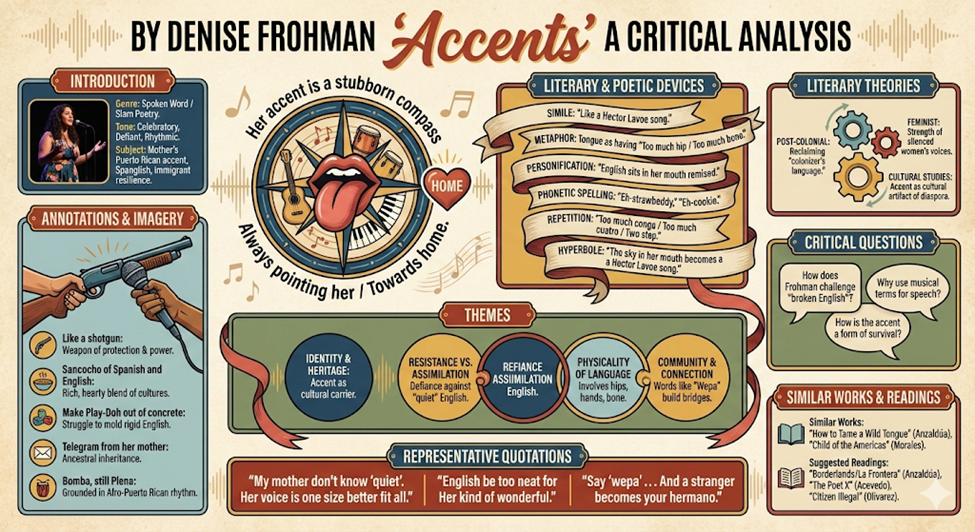
“Accents” by Denise Frohman first appeared in public circulation as a recorded spoken-word piece in Frohman’s debut album Feels Like Home (released December 10, 2013), before spreading widely in print/online reprints (one prominent posting credits the poem © 2012). It also appears in the teaching anthology Reading, Writing, and Rising Up (2nd ed., 2017), which helped embed it in classroom and social-justice literacy contexts. At its core, the poem celebrates bilingual identity and refuses linguistic shame by rendering the mother’s voice as power (“holds her accent like a shotgun”), cultural fusion (“a sanchocho of Spanish and English”), and inheritance (“a telegram from her mother”), while turning “mispronunciation” into music and embodied rhythm (“clave…hand clap,” conga/cuatro, and even the invocation of Hector Lavoe) Its popularity comes from that electrifying mix of vivid metaphor, code-switching realism (“eh-strawbeddy,” “eh-cookie”), and communal recognition (“wepa,” “dale”)—plus mass sharing through performance culture and a widely used TED-Ed animation that brought the poem to global student audiences.
Text: “Accents” by Denise Frohman
My mom holds her accent like a shotgun,
With two good hands.
Her tongue, all brass knuckle
Slipping in between her lips
Her hips, all laughter and wind clap
She speaks a sanchocho of Spanish and English,
Pushing up and against one another
In rapid fire
There is no telling my mother to be “quiet, “
My mother don’t know “quiet.”
Her voice is one size better fit all
And you best not tell her to hush
She waited too many years for her voice to arrive
To be told it needed house-keeping
So it don’t matter if I’m in the next room
Or in a park
My momma still gonna shout my name like
‘Dene, ven por aqui’
See English sits in her mouth remixed
So “strawberry” becomes “eh-strawbeddy”
And “cookie” becomes “eh-cookie”
And kitchen, key chain, and chicken all sound the same.
My mama doesn’t say “yes”
She says, “ah ha”
And suddenly the sky in her mouth becomes a Hector Lavoe song.
Her tongue can’t lay itself down fat enough
For the English language,
It got too much hip
Too much bone
Too much conga
Too much cuatro
Two step
Got too many piano keys
In-between her teeth
It got too much clave
Too much hand clap, hand clap
It got too much clave
Too much hand clap, hand clap
It got too much hip
Too much bone
Too much conga
Too much cuatro
Two step
Got too many piano keys
In-between her teeth
It got too much clave
Too much hand clap, hand clap
It got too much salsa to sit still
It’s being an anxious child wanting to
Make Play-Doh out of concrete
English be too neat for
Her kind of wonderful
Her words spill in conversation
Between women whose hands are all they got
Sometimes our hands are all we got
And our accents remind us that we are still
Bomba, still plena
Say “wepa” Wepa
And a stranger becomes your hermano,
Say “dale” Dale
And a crowd becomes a family reunion.
My mother’s tongue is a telegram from her mother
Decorated with the coqui’s of el campo
So even though her lips can barely
Stretch themselves around English,
Her accent is a stubborn compass
Always pointing her
Towards home.
Annotations: “Accents” by Denise Frohman
| Stanza / Line(s) | Text | Annotations & Literary Devices |
| 1 | “My mom holds her accent like a shotgun…” | 🔫 Simile – accent compared to a weapon (power, defense).💪 Imagery – physical strength (“two good hands”).🗣️ Metaphor – accent as force/agency, not deficiency. |
| 2 | “Her tongue, all brass knuckle…” | 🥊 Metaphor – tongue as weapon.👄 Personification – tongue given aggressive agency.🎯 Consonance – harsh sounds mimic toughness. |
| 3 | “Her hips, all laughter and wind clap” | 💃 Synesthetic Imagery – sound + movement.🌬️ Metaphor – body as rhythm/music.🎶 Musicality – bodily motion echoes sound. |
| 4 | “She speaks a sancocho of Spanish and English” | 🍲 Cultural Metaphor – language as stew (hybridity).🌍 Code-switching – bilingual identity.🧬 Postcolonial Identity – linguistic fusion. |
| 5 | “Pushing up and against one another / In rapid fire” | 🔥 Violent Imagery – language collision.⚡ Kinetic Imagery – speed and tension.🔁 Enjambment – continuous motion. |
| 6 | “There is no telling my mother to be ‘quiet’” | 🚫 Defiance – rejection of silencing.📢 Repetition – emphasis on resistance.⚖️ Political Undertone – voice vs. oppression. |
| 7 | “She waited too many years for her voice to arrive” | ⏳ Personification – voice as traveler.📜 Historical Allusion – immigrant delay/suppression.💔 Pathos – emotional injustice. |
| 8 | “To be told it needed house-keeping” | 🧹 Metaphor – accent as ‘dirty’.🧠 Internalized Linguistic Shame – critique of assimilation.🧩 Irony – policing identity. |
| 9 | “‘Dene, ven por aqui’” | 🌐 Code-switching – lived bilingualism.👩👧 Intimacy of Language – maternal bond.📍 Cultural Grounding – Spanish as home-language. |
| 10 | “English sits in her mouth remixed” | 🎧 Metaphor – language as music remix.🔄 Hybridity – reshaping dominant language.🗣️ Orality – spoken over written norms. |
| 11 | “‘eh-strawbeddy’ … ‘eh-cookie’” | 😂 Phonetic Spelling – accent realism.🎭 Mimicry – sound-based identity.📚 Linguistic Play – resistance through humor. |
| 12 | “And suddenly the sky in her mouth becomes a Hector Lavoe song” | ☁️ Extended Metaphor – mouth as sky/music space.🎵 Allusion – salsa legend (heritage).💃 Cultural Pride – Latin musical lineage. |
| 13 | “Her tongue can’t lay itself down fat enough” | 🧠 Personification – tongue with will.📏 Metaphor – English as restrictive mold.⚠️ Critique of Standard English. |
| 14 | “Too much hip… conga… cuatro… clave” | 🥁 Anaphora – rhythmic insistence.🎼 Musical Lexicon – Afro-Caribbean culture.🌺 Cultural Assertion – embodied identity. |
| 15 (Refrain) | Repetition of musical lines | 🔁 Repetition / Chorus Effect – oral tradition.💓 Rhythmic Intensification – heartbeat of culture.📣 Performance Poetry – spoken-word cadence. |
| 16 | “English be too neat for / Her kind of wonderful” | ✂️ Contrast – neat vs. messy beauty.💥 Subversion – disorder as strength.🌈 Aesthetic Reversal – reclaiming accent. |
| 17 | “Between women whose hands are all they got” | ✋ Symbolism – labor, survival.👩👩👧 Collective Feminine Experience.🤝 Solidarity Motif. |
| 18 | “Bomba, still plena… wepa… dale” | 🪘 Cultural Lexicon – Afro-Puerto Rican forms.🎉 Communal Language – speech builds kinship.🫂 Transformation Motif – stranger → family. |
| 19 | “My mother’s tongue is a telegram from her mother” | 📬 Metaphor – language as inherited message.🧬 Intergenerational Memory.📖 Oral History. |
| 20 (Closing) | “Her accent is a stubborn compass / Always pointing her / Towards home.” | 🧭 Extended Metaphor – accent as direction/home.🏠 Theme of Belonging.✨ Resolution – identity affirmed, not corrected. |
Literary And Poetic Devices: “Accents” by Denise Frohman
| Device (A–Z) | Example from the poem | Explanation (how it works here) |
| Alliteration | “brass brass knuckle” / “hand clap, hand clap” | Repetition of initial consonant sounds adds punchy rhythm and emphasis. |
| Anaphora | “Too much hip / Too much bone / Too much conga…” | Repeating a phrase at line starts creates momentum and a chant-like insistence. |
| Assonance | “hips, all laughter and wind clap” | Repeated vowel sounds make the line feel musical and fluid. |
| Cultural allusion | “the sky in her mouth becomes a Hector Lavoe song” | Refers to a salsa icon to anchor voice/identity in Puerto Rican/Latinx cultural sound. |
| Code-switching | “‘Dene, ven por aqui’” / “Spanish and English” | Switching languages shows authentic bilingual life and resists “English-only” norms. |
| Consonance | “too much clave / too much hand clap” | Repeated consonant endings create percussive sonic texture (like the music named). |
| Diction | “shotgun,” “brass knuckle,” “rapid fire” | Word choice is forceful and kinetic, framing accent as power, not deficiency. |
| Enjambment | “Slipping in between her lips / Her hips…” | Meaning runs across lines, mimicking quick speech and breathless performance energy. |
| Extended metaphor | “My mom holds her accent like a shotgun…” continuing with “rapid fire” | Sustains a central comparison: accent = weapon/strength, highlighting resistance and survival. |
| Hyperbole | “There is no telling my mother to be ‘quiet’” | Exaggeration stresses how uncontainable and unapologetic her voice is. |
| Imagery | “decorated with the coqui’s of el campo” | Vivid sensory picture ties language to landscape, memory, and homeland. |
| Metaphor | “Her tongue, all brass knuckle” | Direct comparison gives language a physical, protective force. |
| Onomatopoeia | “ah ha” / “wepa” | Speech-sounds imitate lived vocal expression—street, home, and celebration. |
| Parallelism | “It got too much hip / too much bone / too much conga…” | Repeated grammatical structure intensifies the argument and creates musical symmetry. |
| Personification | “See English sits in her mouth remixed” | Gives “English” human action, showing language as something shaped and re-made. |
| Repetition | “It got too much clave / too much hand clap, hand clap” (repeated) | Repetition becomes percussion—echoing Afro-Caribbean musical patterns and insistence. |
| Simile | “holds her accent like a shotgun” | A vivid “like” comparison establishes the poem’s defiant tone immediately. |
| Sound symbolism | “strawberry” → “eh-strawbeddy” | Spelling mimics accent; the poem performs pronunciation rather than merely describing it. |
| Symbolism | “Her accent is a stubborn compass / Always pointing her / Towards home.” | Accent symbolizes origin, identity, and belonging—directional and emotionally anchoring. |
| Tone | Defiant pride: “you best not tell her to hush” | The speaker’s attitude is celebratory and resistant—accent is dignity, not “house-keeping.” |
Themes: “Accents” by Denise Frohman
- 🔥 Voice as Resistance and Self-Assertion
“Accents” by Denise Frohman frames the mother’s voice as force rather than flaw, so the accent becomes a practiced dignity that refuses policing and refuses shame. When the speaker says her mother “holds her accent like a shotgun,” the simile converts pronunciation into power, and the follow-through—“rapid fire,” “brass knuckle,” and “you best not tell her to hush”—builds a sustained argument that silence is a social demand placed on migrant women. Because the mother “waited too many years for her voice to arrive,” any attempt at “house-keeping” is exposed as erasure; the poem insists that shouting across rooms or parks is not rudeness but survival, an earned right to occupy air. Even the playful phonetics of “eh-strawbeddy” and “eh-cookie” become resistance, since they flaunt difference rather than conceal it, and they assert that speakers, not gatekeepers, own language. Accent becomes identity in motion, and audibility becomes a kind of justice. - 🎧 Bilingual Hybridity and Linguistic Remix
“Accents” by Denise Frohman celebrates linguistic hybridity, portraying bilingual speech not as broken English but as a creative “sanchocho of Spanish and English” in which two systems push, collide, and produce new music. Because English “sits in her mouth remixed,” words are re-engineered—“strawberry” becomes “eh-strawbeddy,” “cookie” becomes “eh-cookie,” and “kitchen, key chain, and chicken” blur—so phonology becomes evidence of cultural agency rather than deficiency. The poem’s syntax accelerates with enjambment and rhythmic listing, mirroring how code-switching happens in real time, while the repeated percussion of “clave” and “hand clap” suggests that accent carries its own beat, independent of standardized pronunciation. Even the mother’s “ah ha” replaces “yes,” so affirmation arrives through a different sonic register, and that difference is treated as style, joy, and intellect combined. By refusing translation glosses, Frohman invites the reader to listen, not correct, and to accept that meaning travels through tone, rhythm, and memory too. - 🧭 Intergenerational Memory and the Pull of Home
“Accents” by Denise Frohman treats accent as inheritance, arguing that speech carries family history the way heirlooms carry fingerprints, so the mother’s mouth becomes an archive that cannot be packed away. When the poem calls her tongue “a telegram from her mother,” it compresses generations into a single transmission, and by adding the “coqui’s of el campo,” it attaches soundscape and geography to that message, as if homeland arrives inside vowels. Although the mother’s lips can “barely stretch themselves around English,” the poem refuses to read this as failure, because the strain signals diaspora’s pressure and the persistence of origin under that pressure. The closing image of a “stubborn compass” is especially decisive: accent does not merely recall home, it continually points toward it, guiding identity through dislocation, longing, and daily negotiation between languages. Thus, every utterance becomes a return route, and every misfit syllable becomes proof of belonging still. - 🪘 Community, Solidarity, and Cultural Continuity
“Accents” by Denise Frohman expands the mother’s accent from a private household trait into a communal technology, showing how shared sound can convert strangers into kin and create belonging in public space. The poem locates this social power “between women whose hands are all they got,” a line that links labor, gender, and survival, and then it turns accent into a bridge, because the right utterance—“wepa” or “dale”—reorganizes social relations so that “a stranger becomes your hermano” and “a crowd becomes a family reunion.” These transformations are not sentimental; they are practical, since in migratory life community is often assembled through small recognitions, repeated phrases, and familiar rhythms. By stacking cultural music markers like “bomba” and “plena,” Frohman suggests that language is also ceremony, and that speaking with accent is a way of keeping collective culture audible, coordinated, and un-erased. In that chorus, voice becomes shelter, and listening becomes shared responsibility.
Literary Theories and “Accents” by Denise Frohman
| Literary Theory | Application to the Poem (with Textual References & Symbols) |
| 🌍 Postcolonial Theory | 🧭 Accent as Resistance to Linguistic Imperialism – The poem challenges the dominance of Standard English and colonial language hierarchies.📌 “She speaks a sancocho of Spanish and English” → hybridity and creolization.📌 “English be too neat for / Her kind of wonderful” → rejection of colonial linguistic norms.🛑 Accent is not a flaw but a site of cultural survival and defiance. |
| 🗣️ Sociolinguistics / Linguistic Identity Theory | 🎧 Accent as Identity Marker – Language reflects class, migration, ethnicity, and belonging.📌 “So ‘strawberry’ becomes ‘eh-strawbeddy’” → phonological transfer.📌 “Kitchen, key chain, and chicken all sound the same” → L1 interference.🔑 The poem validates non-standard speech as authentic identity rather than linguistic deficiency. |
| 👩👧 Feminist Theory (Intersectional) | ✋ Women’s Voice, Labor, and Survival – The mother’s voice resists silencing imposed by patriarchy and migration.📌 “There is no telling my mother to be ‘quiet’” → defiance of gendered silence.📌 “Between women whose hands are all they got” → female labor and solidarity.⚖️ Gender, class, and ethnicity intersect in shaping whose voices are policed. |
| 🧠 Cultural Memory / Diaspora Theory | 📬 Language as Inherited Memory – Accent carries ancestral history across generations.📌 “My mother’s tongue is a telegram from her mother” → intergenerational transmission.📌 “Her accent is a stubborn compass / Always pointing her / Towards home” → diaspora identity anchored in language.🏠 Accent becomes a mnemonic device, preserving homeland and belonging. |
Critical Questions about “Accents” by Denise Frohman
🔫 Critical Question 1: How does the poem redefine accent as a source of power rather than linguistic deficiency?
“Accents” by Denise Frohman redefines accent as a form of embodied power by consistently associating it with strength, resistance, and agency rather than error or lack, a redefinition that directly challenges dominant linguistic hierarchies. The opening simile—“My mom holds her accent like a shotgun”—immediately frames accent as a weapon, suggesting protection, self-defense, and authority, while the repeated imagery of force, rhythm, and music further reinforces this idea of vocal strength. Instead of presenting accented English as something broken or incomplete, the poem insists that English itself is inadequate for the speaker’s mother, described as “too neat” for her “kind of wonderful.” Through this inversion, Frohman exposes how standards of “correct” speech are socially constructed and politically enforced, particularly against immigrant and working-class voices. As a result, accent becomes not a flaw to be corrected but a lived assertion of identity that refuses silence, correction, or erasure.
🎧 Critical Question 2: In what ways does the poem use sound, rhythm, and music to construct cultural identity?
“Accents” by Denise Frohman constructs cultural identity through a dense soundscape in which rhythm, repetition, and musical allusions replace traditional lyrical harmony with Afro-Caribbean musical energy. The poem repeatedly invokes instruments and forms such as “conga,” “cuatro,” “clave,” “bomba,” and “plena,” embedding cultural memory directly into the sonic texture of the verse. These references are reinforced by anaphora and chant-like repetition, which mimic oral performance and communal music rather than silent, written poetry. Moreover, phonetic spellings like “eh-strawbeddy” foreground pronunciation itself as a creative act, transforming accent into audible art. By aligning language with music, the poem suggests that cultural identity is not static or grammatical but rhythmic, bodily, and inherited through performance. In this way, Frohman positions sound as a carrier of history and belonging, allowing accent to function as a living archive of diasporic experience rather than a deviation from linguistic norms.
👩👧 Critical Question 3: How does the poem connect accent with gender, labor, and women’s survival?
“Accents” by Denise Frohman links accent with gender and labor by portraying the mother’s voice as inseparable from a history of work, endurance, and delayed self-expression shaped by both patriarchy and migration. The speaker emphasizes that her mother “waited too many years for her voice to arrive,” a line that gestures toward the silencing of immigrant women whose labor is valued more than their speech. This connection is deepened through references to women “whose hands are all they got,” suggesting manual labor as both survival and limitation, while language becomes the one space where authority can still be claimed. The refusal to be “quiet” or to “hush” directly challenges gendered expectations of restraint and obedience. As a result, accent functions as a feminist assertion, where speaking loudly, imperfectly, and unapologetically becomes an act of resistance against systems that seek to discipline both women’s bodies and their voices.
🧭 Critical Question 4: What role does accent play in preserving memory, ancestry, and the idea of home?
“Accents” by Denise Frohman presents accent as a vessel of cultural memory and ancestral continuity, transforming language into a medium through which home is remembered and sustained across generations. This idea is crystallized in the metaphor “My mother’s tongue is a telegram from her mother,” which frames accent as a transmitted message carrying history, landscape, and emotion. Even when English dominates public life, the mother’s accent remains a “stubborn compass,” symbolically directing her toward an origin that cannot be fully erased by assimilation. The repeated Spanish words and cultural references function as mnemonic anchors, ensuring that identity is not severed from place despite displacement. Consequently, home in the poem is not defined geographically but linguistically, residing in pronunciation, rhythm, and inherited speech patterns. Accent thus becomes a form of cultural orientation, enabling diasporic subjects to remain connected to their roots while navigating new linguistic and social terrains.
Literary Works Similar to “Accents” by Denise Frohman
- 🧬 “Mother Tongue” by Amy Tan (poetic prose)
🗣️ Similarity: Both works foreground immigrant mothers’ English to challenge the myth of “broken language,” presenting accent as intellect, memory, and emotional truth rather than deficiency. - ✋ “Those Winter Sundays” by Robert Hayden
👩👦 Similarity: While quieter in tone, Hayden’s poem parallels Frohman’s work in honoring parental sacrifice and unacknowledged labor, transforming everyday acts into sites of dignity and love. - 🪘 “Bilingual/Bilingüe” by Rhina P. Espaillat
🌐 Similarity: Like “Accents,” this poem dramatizes code-switching and linguistic tension between English and Spanish, portraying bilingualism as an inherited struggle and cultural inheritance.
Representative Quotations of “Accents” by Denise Frohman
| Quotation | Context (reference) | Theoretical perspective |
| 🔥 “My mom holds her accent like a shotgun, / With two good hands.” | The speaker opens by framing the mother’s accent as something held, controlled, and ready—an asset rather than a defect. | Critical Sociolinguistics (language ideology & linguistic stigma): The line reverses the usual deficit model of “accent,” turning it into symbolic power, and exposing how “proper speech” norms often function as social discipline. |
| ⚡ “She speaks a sanchocho of Spanish and English, / Pushing up and against one another / In rapid fire” | The mother’s bilingual speech is portrayed as a dynamic mixture that collides and creates energy rather than confusion. | Translanguaging Theory: The poem treats bilingual practice as a single, flexible repertoire (not two separate “pure” codes), where meaning is produced through mixing, speed, and pressure rather than conformity. |
| 🛡️ “There is no telling my mother to be ‘quiet,’ / My mother don’t know ‘quiet.’” | The speaker rejects attempts to regulate the mother’s volume and presence, emphasizing unapologetic audibility. | Feminist Theory (voice, agency, and gendered silencing): The refusal of “quiet” reads as resistance to the cultural expectation that certain women—especially migrant/working-class women—must minimize themselves to be acceptable. |
| 🧹 “She waited too many years for her voice to arrive / To be told it needed house-keeping” | The poem recalls delayed access to voice (through migration, struggle, or marginalization) and condemns later demands to “tidy” that voice. | Postcolonial Critique (assimilation & respectability): “House-keeping” becomes a metaphor for assimilationist policing, revealing how dominant cultures demand linguistic cleaning as the price of belonging. |
| 🎛️ “See English sits in her mouth remixed” | English is not mastered by imitation; it is reshaped inside the mother’s body and cultural rhythm. | Performance/Remix Aesthetics: The poem frames speech as creative production—English is sampled, re-cut, and re-timed—so accent becomes artistry and authorship rather than error. |
| 🍓 “So ‘strawberry’ becomes ‘eh-strawbeddy’” | The speaker performs the sound of the mother’s accent on the page, foregrounding phonetics as lived identity. | Indexicality in Sociolinguistics: The altered pronunciation “indexes” origin, class, and community; the poem insists that these audible markers carry meaning and dignity, not deficiency. |
| 🎶 “And suddenly the sky in her mouth becomes a Hector Lavoe song.” | The mother’s speech is likened to music, transforming everyday talk into cultural sound and celebration. | Diaspora & Cultural Memory Studies: By invoking Hector Lavoe, the poem ties accent to collective memory, suggesting that voice preserves homeland affect through rhythm, reference, and sonic lineage. |
| 🧼 “English be too neat for / Her kind of wonderful” | Standard English is depicted as overly tidy and restrictive, unable to contain the mother’s expressive range. | Bourdieu (linguistic capital & standard language ideology): “Neat” signals the prestige norm; the poem critiques how “correctness” becomes a gatekeeping currency that undervalues vibrant, nonstandard forms of speech. |
| 🤝 “Say ‘wepa’… And a stranger becomes your hermano,” | Shared expressions act like social passwords that generate instant recognition and belonging across unfamiliar spaces. | Speech Community / Ethnolinguistic Identity: The poem shows how language practices produce community in real time, converting public space into relational space through culturally loaded words. |
| 🧭 “Her accent is a stubborn compass / Always pointing her / Towards home.” | The poem ends by presenting accent as direction—an internal guide that continually orients the mother toward origin and belonging. | Diaspora Studies (home, displacement, affective geography): Accent functions as portable “home,” a map carried in the body, implying that migration changes location but does not erase the coordinates of identity. |
Suggested Readings: “Accents” by Denise Frohman
📚 Books
- Baker-Bell, April. Linguistic Justice: Black Language, Literacy, Identity, and Pedagogy. Routledge, 2020.
- Edwards, John. Language and Identity. Cambridge University Press, 2012.
📄 Academic Articles
- McCrocklin, Shannon. “Understanding Accent and Identity on the Border: Exploring Bilinguals’ Perceptions of Intelligibility, Accentedness, and Language-Learning Goals.” SciELO – Identities & Language Studies, vol. 18, 2025. https://www.scielo.br/j/ides/a/dwjvNvJsQjCXqJVcJ8RPBvR/
- Sung, Chit Cheung Matthew. “Does Accent Matter? Investigating the Relationship between Accent and Identity in English as a Lingua Franca Communication.” System, vol. 60, 2016, pp. 55-65. https://doi.org/10.1016/j.system.2016.06.002
🌐 Poem & Poetry Websites
- “Accents by Denice Frohman.” Narrative Northeast, 11 Mar. 2025, https://narrativenortheast.com/?p=1952.
- “Accents by Denice Frohman.” Tealight Taylor Poets’ Corner, https://tealighttaylor.wordpress.com/poets-corner/accents-by-denice-frohman/.