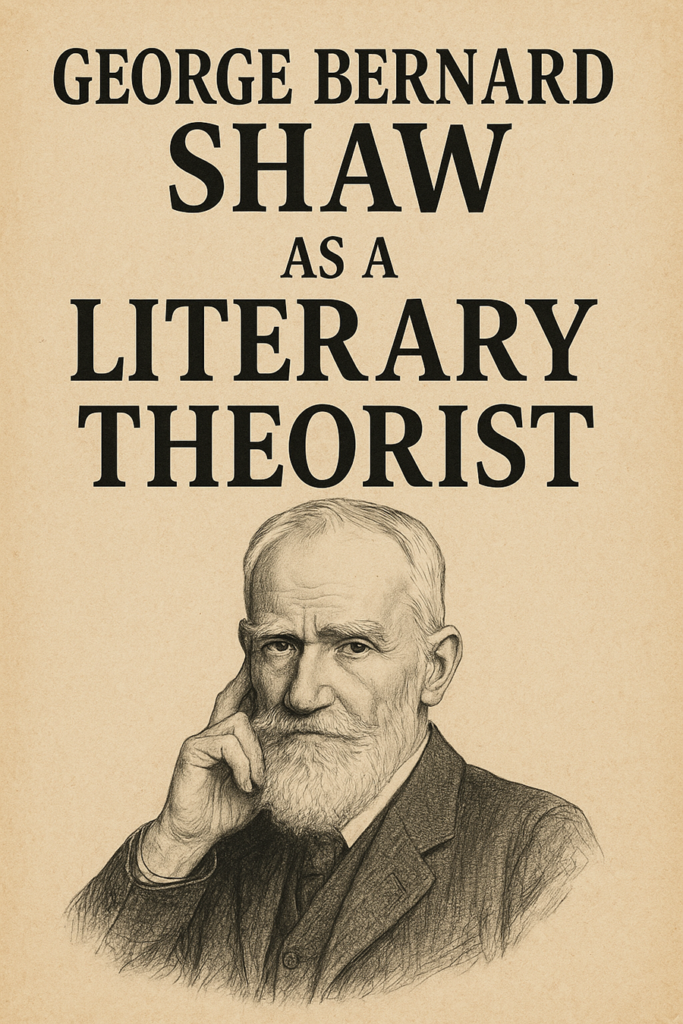
Introduction: George Bernard Shaw as a Literary Theorist
George Bernard Shaw as a Literary Theorist is best understood as a social critic who treats criticism as an instrument of intellectual and public reform—a stance summed up in his refusal to write on merely aesthetic grounds: “For art’s sake alone I would not face the toil of writing a single sentence” (Shaw, qtd. in Weintraub ix). Born 26 July 1856 in Dublin, Ireland, and deceased 2 November 1950 in Ayot St. Lawrence, Hertfordshire, England (Britannica), Shaw grew up in “genteel poverty,” and his early education was uneven: he was first tutored by a clerical uncle, then attended schools he largely rejected; by age 16 he was already employed in a land agent’s office (Britannica). His full education, however, was largely self-directed: after moving to London (1876), he formed himself through intensive reading and debate—spending “his afternoons in the British Museum reading room… and his evenings… in the lectures and debates” of London’s intellectual culture (Britannica). As a theorist of literature and culture, Shaw’s central method is to turn texts into platforms for argument, since (as Weintraub notes) he often used books as “platform for saying something cogent” about society and art (Weintraub ix). Even his geography becomes theoretical: he explains his choice of metropolitan English letters in explicitly instrumental terms—“the English language was my weapon… [so] there was nothing for it but London” (Shaw, qtd. in Kent 342).
This combination of polemic, realism, and ethical-social judgment informs both his critical prose (e.g., The Quintessence of Ibsenism, The Perfect Wagnerite, The Sanity of Art) and his major dramatic works—Man and Superman, Major Barbara, Pygmalion, Heartbreak House, Back to Methuselah, and Saint Joan—whose famously expansive prefaces and “discussion” structures extend criticism into drama as a vehicle for ideas rather than mere entertainment.
Major Works of George Bernard Shaw as a Literary Theorist
The Quintessence of Ibsenism (1891)
- Shaw’s earliest major theoretical book, born from his Fabian Society lecture series on “Socialism in Contemporary Literature,” and designed to explain why Ibsen’s drama mattered aesthetically and socially.
- Core claim: modern drama should move from plot-mechanics to argument—what later critics call Shaw’s “discussion play.”
- Signature maxim: “the discussion is the test of the playwright” (Shaw qtd. in Kent 347).
- A related principle is that discussion can become structurally dominant: it may “assimilate” the action, making “play and discussion practically identical” (Shaw qtd. in Kent 347).
The Perfect Wagnerite (1898)
- Shaw’s landmark model of “reading” a major artwork as ideology, ethics, and social structure—treating opera/music drama as a serious site of modern cultural theory (not mere entertainment).
- It belongs to his wider canon-making project: Shaw frames modern European art as a living authority for modern consciousness.
- The cosmopolitan “world-literature” claim often used to situate this stance: modern European “literature and music now form a Bible …” (Shaw qtd. in Kent 345).
“Better Than Shakespear?” (critical essay; collected)
- A key theoretical statement of Shaw’s historicism: art changes because ideas and moral horizons change, not because craft suddenly becomes “better.”
- Compressed thesis: “It is the philosophy, the outlook on life, that changes, not the craft of the playwright” (Shaw 231).
- He links theatrical renewal to intellectual renewal: “there can be no new drama without a new philosophy” (Shaw 231).
Preface to Man and Superman (1903) — Shaw’s aesthetic manifesto in preface-form
- Shaw turns the preface into theory: an explicit declaration that writing is justified by intellectual and public purpose, not “art-for-art’s-sake” piety.
- His blunt anti-aestheticism (in the narrow sense): “For art’s sake alone I would not face the toil of writing a single sentence” (Shaw 226).
- Style becomes epistemic and argumentative (not decorative): style, he says, is “the power to put a fact with the most absolute conviction” (Shaw 226).
“Fiction and Truth” (lecture; prepared 1887)
- One of Shaw’s clearest theoretical positions on narrative ethics: fiction is not morally neutral; it should be written with intention and consequence in view.
- Programmatic claims: “a work of fiction should have a purpose” and “Art was not outside the sphere of morals” (Shaw qtd. in Weintraub xxv).
- He also rejects formulaic plotting as a substitute for organic form: “The proper framework for a book is its own natural skeleton” (Shaw qtd. in Weintraub xxv).
The Sanity of Art (art theory; grounded in his 1890s criticism)
- Shaw argues that the social function of art is educational of perception and character—not mere pleasure.
- Representative principle: art must “cultivate and refine our senses and faculties” (Shaw qtd. in Weintraub xxvi).
- And its ethical horizon is explicit: it should make us “intolerant of baseness, cruelty, injustice” (Shaw qtd. in Weintraub xxvi).
“Caliban upon Setebos” (1884; early major criticism)
- A formative critical stance: Shaw ranks genres by what they demand from the artist—defending drama as a discipline of total design and intellectual pressure.
- Memorable comparative claim: dramatic invention requires being “at once actor, poet, stage manager, and scene painter” (Shaw qtd. in Weintraub xxiii).
“What Is a World Classic?” (late critical reflection; “Postscript”)
- Shaw’s mature synthesis: modern ideas can be socially dangerous unless they achieve aesthetic force; hence, style and art become vehicles for intellectual change.
- One-line theory of cultural survival for dissent: “heretical teaching must be made irresistibly attractive by fine art” (Shaw 241).
Shaw’s “anti–well-made play” poetics (theory across criticism and practice)
- Shaw rejects carpentered plot as lifeless mechanism: “constructed plays are all dead wood” (Shaw qtd. in Kent 347).
- He explicitly ties formal innovation to philosophy/politics: he tells Ellen Terry he must be “more than a common dramatist” (Shaw qtd. in Kent 348).
Major Literary Ideas of George Bernard Shaw as a Literary Theorist
| Major literary idea (Shaw the theorist) | Explanation | Key formulation / evidence | Where it appears |
| Art is not morally neutral; literature must have purpose | Shaw treats art as ethically consequential: reading/theatre shapes character, so serious writing should pursue an intelligible social-moral end rather than pure ornament. | “Art was not ‘outside the sphere of morals’ … ‘a work of fiction should have a purpose’” (Shaw qtd. in Weintraub xiv). | Weintraub’s introductory synthesis of Shaw’s critical stance (from Shaw’s early lecture “Fiction and Truth”). |
| Rejection of “art for art’s sake” | Shaw explicitly opposes aestheticism detached from meaning; for him, art’s value depends on what it asserts and changes in life. | “For art’s sake alone I would not face the toil of writing a single sentence” (Shaw 226). | “Preface to Man and Superman” excerpted in Nondramatic Literary Criticism. |
| Style = force of conviction (“assertion”), not decorative flourish | Shaw defines style pragmatically: persuasive energy is the core of language; rhetoric is justified by intellectual commitment (“conviction”). | “Effectiveness of assertion is the Alpha and Omega of style” (Shaw 226). | “Preface to Man and Superman” (critical portion). |
| Anti-plot carpentry: organic form over mechanical plotting | He attacks formulaic plotting as a “machine-made” scaffold that cripples art; form must grow from the work’s own internal logic and necessity. | “The proper framework for a book is its own natural skeleton” (Shaw qtd. in Weintraub xiv). | Weintraub’s introduction summarizing Shaw’s 1880s–1890s review principles. |
| Anti–well-made play: “constructed” drama is dead | Shaw rejects the French “well-made play” formula; drama should feel alive and intellectually driven, not mechanically engineered for suspense. | “constructed plays are all dead wood” (Shaw qtd. in Kent 347). | Kent’s study of Shaw’s relation to European dramaturgy and the “well-made play.” |
| The “discussion play” as modern dramatic form | Shaw elevates argument as the structural core of drama: stage conflict becomes discursive, turning theatre into public reasoning (Shaw’s “play of ideas”). | “the discussion is the test of the playwright” (Shaw qtd. in Kent 347). | Kent’s analysis of Shaw’s Ibsenism and the modernization of dramatic structure. |
| New drama requires new philosophy (idea-change > craft-change) | Shaw historicizes art: technical skill repeats across time, but major artistic revolutions require a transformed worldview; hence aesthetics follows ideas. | “there can be no new drama without a new philosophy” (Shaw 232). | “Better than Shakespear?” excerpted in Nondramatic Literary Criticism. |
| World classic = high purpose + high art (heresy must be aestheticized) | Shaw theorizes canon/“world classic” status as the fusion of intellectual audacity with artistic attractiveness: radical thought survives when carried by compelling form. | “Heretical teaching must be made irresistibly attractive by fine art” (Shaw qtd. in Weintraub xv). | Weintraub’s introduction quoting Shaw’s 1944 “Postscript: What Is a World Classic?” |
| Criticism as ethical-cultural work (critic as “missionary” and “elucidator”) | Shaw treats criticism as a civic practice: the critic clarifies purpose, values, and consequences rather than merely judging and “executing” artworks. | “a critic … was a missionary and elucidator, not a judge and executioner” (Weintraub xiv). | Weintraub’s framing of Shaw’s critical vocation in the volume’s introduction. |
Theoretical Terms/Concepts of George Bernard Shaw as a Literary Theorist
| Terms / Concepts | Explanation |
| Discussion Play | Shaw’s modern drama is grounded in the “discussion play”: theatre organized around sustained argument (ethical, social, political), a form associated with Ibsen and taken up by Shaw as a blueprint for “a new dramatic structure.” |
| Critic as “missionary and elucidator” | For Shaw, criticism should explain and guide rather than condemn: “a critic…was a missionary and elucidator, not a judge and executioner.” |
| Purpose in fiction / drama | Shaw rejects aesthetic neutrality: he argues that art is not “outside the sphere of morals” and insists that “a work of fiction should have a purpose.” |
| Art’s civilizing (sensory + moral) function | He defines high art as cultivating refined perception and moral sensibility, making audiences “intolerant of baseness, cruelty, [and] injustice,” not merely entertained. |
| Anti–“art for art’s sake” | Shaw denies that art’s sole end is aesthetic display: “But ‘for art’s sake’ alone I would not face the toil of writing a single sentence.” |
| “Effectiveness of assertion” (style as conviction) | Style, for Shaw, is inseparable from intellectual force: “Effectiveness of assertion is the Alpha and Omega of style…He who has nothing to assert has no style.” |
| “The writer has opinions” (ideational energy as artistic value) | Artistic quality depends less on what a book “propagates” than on the author’s possession of real convictions: “the main thing…is not the opinions…it propagates, but the fact that the writer has opinions.” |
| Natural form vs. plot-mechanics (“natural skeleton”) | Shaw attacks plot-as-machine: the proper framework is “its own natural skeleton”; if a work is born without one, “let it perish as a shapeless abortion.” |
| Anti–Well-Made Play (“Scribe formula” / “Sardoodledom”) | He opposes rigid, formulaic plotting, claiming his own drama avoids “dead wood”: “My plays are miracles…because I have never constructed them…every bit of them is alive for somebody.” |
| World Classic (literature as metaphysical inquiry) | In later self-definition, Shaw calls a “world classic” a work that “try[ies] to solve, or at least to formulate, the riddles of creation.” |
| Heresy + aesthetic strategy (art as vehicle for dangerous truth) | Because new ideas provoke hostility, Shaw argues that “Heretical teaching must be made irresistibly attractive by fine art” to survive. |
| Creative Evolution (anti-pessimism metaphysic) | When creeds collapse, Shaw frames a stark choice: one must “embrace Creative Evolution or fall into…utterly discouraging pessimism.” |
| “Improved types of humanity” (the “highly evolved” protagonist) | Shaw theorizes the hero/heroine as the “most highly evolved person,” whose intelligent, foreseeing actions may look like “crimes” to “average” readers—yet superiority remains evident. |
| Paradox as critical/theoretical method | Shaw values a Nietzschean mode of critique: “pungency…rousing, startling paradoxes,” and the tactic of getting “underneath moral precepts…[and] upsetting them.” |
| Anti-Determinism (“what must be must be”) | He rejects reducing his work to determinism, contrasting passive fatalism (“what will be will be”) with necessity/agency (“what must be must be”). |
Application of Theoretical Ideas of George Bernard Shaw as a Literary Theorist To Literary Works
- Henrik Ibsen, A Doll’s House (1879)
Shaw’s core theoretical claim is that modern drama proves itself through argument, not carpentered intrigue: “the discussion is the test of the playwright” (Shaw qtd. in Kent 347). - Read through this Shavian lens, A Doll’s House culminates not in sensational “stage tricks,” but in a sustained ethical debate (Nora/Torvald) where the “discussion” expands until it “assimilates” the action, making “play and discussion practically identical” (Shaw qtd. in Kent 347).
- The famous final confrontation thus becomes (in Shaw’s terms) the play’s true dramatic engine: a forensic stripping-away of idealized marriage, culminating in Nora’s decision as a rational answer to the argument the play has been building all along.
- George Bernard Shaw, Pygmalion (1913)
Shaw applies his anti-formula aesthetics to his own practice by rejecting the “well-made” pattern as lifeless mechanism: “My plays are miracles of dramatic organization because I have never constructed them: there is not an ounce of dead wood in them: every bit of them is alive for somebody… ‘To me constructed plays are all dead wood’” (Shaw qtd. in Kent 347). - In Pygmalion, this principle shows up as a drama driven by ideas in collision—language as social power, class as performance, “education” as domination—so that the plot’s real movement occurs through talk (argument, cross-examination, verbal redefinition) rather than melodramatic suspense. The work becomes a demonstration of Shaw’s “discussion play” doctrine: the audience is compelled to judge institutions and ideologies (accent prejudice, gendered authority, social mobility) because the play’s most decisive “actions” are the contested meanings produced in dialogue.
- William Shakespeare, Hamlet (c. 1600–1601)
Shaw’s criticism often treats Shakespeare as a cautionary example of how “plot necessity” can deform dramatic life. He argues against “Procrustean scaffolds,” insisting: “The proper framework for a book is its own natural skeleton” (Shaw 23). - Shaw claims Shakespeare “suffered himself…to be persuaded…that plots were necessary,” so that “The stolen plots forced him to deform his plays” with “inconsistencies” and other encumbrances (Shaw 23). From this angle, Hamlet becomes a vivid instance of the tension Shaw diagnoses between the audience’s appetite for immediate dramatic intensity and the burdens of exposition—Shaw even points to Hamlet’s complaint that clowns made the pit laugh while the serious actors were wearying it with “some necessary question of the play” (Shaw 23).
- Shaw’s theoretical takeaway is formal and ideological: modern drama should resist inherited plot-machinery and build structure from the “natural skeleton” of living conflict and intelligible argument.
- George Eliot, Middlemarch (1871–72)
Shaw’s late theoretical position turns on the question of human agency (volition) versus pessimistic determinism. In his “World Classic” reflections, he admits he “almost venerated” Middlemarch as a teen, yet condemns its fatalistic horizon: “there is not a ray of hope: the characters have no more volition than billiard balls: they are moved only by circumstances and heredity” (Shaw 241). - The Shavian application is clear: where Middlemarch embodies a world of constraint that drains willpower into causality, Shaw argues modern writers must craft forms of thought that keep agency alive—since “heretical teaching must be made irresistibly attractive by fine art” if new thinking is to survive public hostility (Shaw 241). Within this framework, Eliot’s greatness is acknowledged, but her determinist atmosphere becomes, for Shaw, precisely what the modern “world classic” must overcome by joining intellectual risk to aesthetic power and a philosophy that can sustain hope, struggle, and volition.
Representative Quotations of George Bernard Shaw as a Literary Theorist
| Representative quotation | What it illustrates in Shaw’s literary theory |
| “Effectiveness of assertion is the Alpha and Omega of style.” (Shaw, Man and Superman) | Style, for Shaw, is not ornament but forceful intellectual pressure—the writer’s conviction made rhetorically effective. |
| “I would not face the toil of writing a single sentence.” (Shaw, Man and Superman) | A rejection of “art-for-art’s-sake” aesthetics: writing must be justified by purpose, argument, and social meaning, not mere virtuosity. |
| “It is the philosophy, the outlook on life, that changes.” (Shaw, Three Plays for Puritans) | Drama evolves because the ideas governing a society evolve; artistic renewal follows conceptual (philosophic) renewal. |
| “there can be no new drama without a new philosophy.” (Shaw, Three Plays for Puritans) | Shaw’s historicist claim that modern drama requires a new worldview—new ethical and intellectual premises, not just new technique. |
| “The manufacture of well made plays is not an art: it is an industry.” (Shaw, “How to Write a Popular Play”) | His critique of formula theatre: “well-made” plotting becomes mechanical production, not interpretive art. |
| “Now great art is never produced for its own sake.” (Shaw, “How to Write a Popular Play”) | Shaw frames great art as mission-driven (ethically/collectively oriented), not self-enclosed aesthetic play. |
| “The Ring … is a drama of today.” (Shaw, The Perfect Wagnerite) | A model of Shaw’s critical method: works should be read for their contemporary social and political meaning, even when mythic in form. |
| “not … a remote and fabulous antiquity.” (Shaw, The Perfect Wagnerite) | Myth and tradition are valuable insofar as they function as allegories of living structures (power, economy, ideology). |
| “Every step in morals is made by challenging the validity of the existing conception.” (Shaw, “The Sanity of Art”) | A core Shaw principle: moral/intellectual progress is critical and revisionary—art participates by disputing inherited “truths.” |
| “Heretical teaching must be … made irresistibly attractive by fine art.” (Shaw qtd. in Weintraub) | Shaw’s theory of persuasive art: if art is to reform thought, it must combine intellectual dissent with aesthetic compulsion (pleasure as a vehicle for truth). |
Criticism of the Ideas of George Bernard Shaw as a Literary Theorist
“Talk” over action: the ‘discussion play’ as an aesthetic liability
- Shaw openly elevates debate as dramatic substance—“the discussion is the test of the playwright” (Kent 347).
- But a durable line of reception argues that this principle swells plays beyond theatrical economy: in Saint Joan criticism, “two consistent features of Shaw criticism” are “that his plays are too long, and that they are dominated by discussion rather than action” (Ormond 70).
· Resistance to “well-made” plotting: innovation or structural weakness
- Shaw attacks constructed plotting as “dead wood” (Kent 347), aligning his theory with anti-formula dramaturgy.
- Yet hostile reviewers converted that anti-formal stance into an accusation of craft-deficit: he faced “savaging by English theatre critics, who bemoaned his inability to write a well-made play” (Kent 355).
Didactic rhetoric and “forensic” theatre: art becoming sermon
- Shaw’s own model is unapologetically rhetorical—he praises a “forensic technique” and “a free use of all the rhetorical and lyrical arts of the orator, the preacher, the pleader, and the rhapsodist” (Kent 347).
- Critics often read that as polemic displacing dramatic ambiguity: e.g., an early review labels Saint Joan “tedious and loquacious” and “a mere historical scaffolding” for Shavian wit (Ormond 69).
· The epilogue/preface habit: interpretive over-determination
- Reception repeatedly objects when Shaw “underlines” what the play already implies; reviewers felt Saint Joan’s Epilogue “repetitive and redundant” (Ormond 70).
- The larger theoretical criticism is that Shaw’s explanatory apparatus can narrow interpretive freedom by instructing audiences how to read.
· Paradox as method: brilliance vs. “cheap effects”
- Shaw’s critical persona thrives on overturning “moral precepts” with “startling paradoxes” (Kent 346).
- But later evaluators sometimes treat this as performative contrarianism: one commentator contrasts another critic’s sobriety with “the pamphleteering Shaw without the irresponsibility (which produced the paradoxes and the cheap effects)” (George Orwell: The Critical Heritage 226).
· Creative Evolution / “Life Force”: philosophical ambition, scientific vulnerability
- Shaw’s teleological “creative evolution” has been challenged as incompatible with modern biological science; one scholarly assessment calls it “completely and essentially opposed to the findings of modern microbiology” (Mills).
- The theoretical criticism here is epistemic: Shaw’s metaphysics can look like a literary-moral myth mistaken for scientific explanation.
· Ethical-political controversy: eugenics and authoritarian sympathies
- Biographical and institutional summaries note that Shaw advocated eugenics and held other contentious political positions; the Nobel Prize site explicitly flags his “contradictory and controversial views,” including advocacy of eugenics and sympathies with Hitler, Stalin, and Mussolini (“George Bernard Shaw – Facts”).
- This fuels a core critique of his “improvement” discourse: that social “progress” talk can slide into coercive or anti-democratic imaginaries when mapped onto real governance.
Suggested Readings on George Bernard Shaw as a Literary Theorist
Books
- Shaw, George Bernard. The Quintessence of Ibsenism: Now Completed to the Death of Ibsen. Constable, 1913.
- Shaw, George Bernard. Our Theatres in the Nineties: Criticisms Contributed Week by Week to the Saturday Review from January 1895 to May 1898. 3 vols., Constable, 1932. (
- Shaw, George Bernard. Bernard Shaw’s Nondramatic Literary Criticism. Edited by Stanley Weintraub, University of Nebraska Press, 1972.
- Innes, Christopher, editor. The Cambridge Companion to George Bernard Shaw. Cambridge UP, 1998.
Academic Articles
- Crawford, F. D. “Bernard Shaw’s Theory of Literary Art.” The Journal of General Education, vol. 34, no. 1, 1982, pp. 20–34. JSTOR, www.jstor.org/stable/27796888.
- James, Eugene Nelson. “The Critic as Dramatist: Bernard Shaw, 1895–1898.” The Shaw Review, vol. 5, no. 3, Sept. 1962, pp. 97–108. JSTOR, www.jstor.org/stable/40682474.
- Ortiz, Javier. “Bernard Shaw’s Ibsenisms.” Alicante Journal of English Studies / Revista Alicantina de Estudios Ingleses, no. 7, 1994, pp. 151–58. https://doi.org/10.14198/raei.1994.7.13.
- Kalmar, Jack. “Shaw on Art.” Modern Drama, vol. 2, no. 2, 1959, pp. 147–159. https://doi.org/10.3138/md.2.2.147.
Websites
- International Shaw Society. International Shaw Society, n.d., https://shawsociety.org/. Accessed 4 Dec. 2025.
- “SHAW: The Journal of Bernard Shaw Studies.” Pennsylvania State University Press, n.d., https://www.psupress.org/journals/jnls_Shaw.html. Accessed 4 Dec. 2025.