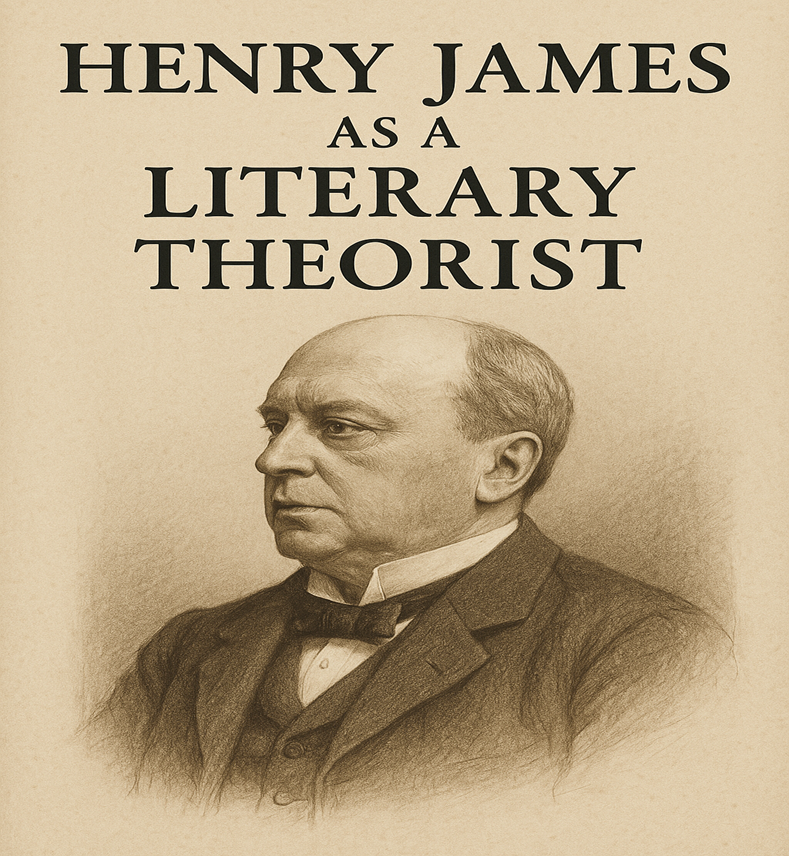
Introduction: Henry James as a Literary Theorist
Henry James as a literary theorist emerges from the unique convergence of his cosmopolitan upbringing, rigorous intellectual training, and lifelong engagement with European and American cultural forms. Born into an intellectually vibrant New York family and educated through transatlantic travel and private study, James early developed what he later termed a capacity for the “free play of mind,” a disposition rooted in “ironic detachment” that he recalled as his “great initiation” into criticism (James, The Art of Criticism, Introduction, p. 2). His theoretical sensibility matured through encounters with figures like Sainte-Beuve and Matthew Arnold, whose emphasis on disinterestedness shaped his conviction that criticism must examine “not the abstract principle of truth but…the execution” of a work (p. 2). This foundational belief—later articulated in “The Art of Fiction”—asserted that the novelist must be granted freedom of subject because “our criticism is applied only to what he makes of it,” thereby grounding his organicist principle that a novel should “grow naturally, from within,” with the writer’s task being the disciplined realization of a chosen subject’s inherent possibilities (Rawlings, Critical Essays on Henry James, Introduction, pp. 11–13). Across major works such as The Portrait of a Lady, The Ambassadors, and the celebrated New York Edition Prefaces, James refined these principles into a coherent aesthetic that privileged form, consciousness, and the subtle interplay between observer and world. Ford Madox Ford noted that James’s greatness lay in this “conscious craftsmanship,” a meticulous process in which “he mellows his vintages” through revision, revealing the method behind his art (Ford, Henry James: A Critical Study, pp. 4–7). His theoretical legacy thus rests on the fusion of experience, analysis, and imaginative sympathy—an “intellectual fusion and synthesis” that made him, as Veeder and Griffin observe, not merely a novelist of genius but “the premier critic of fiction in the nineteenth century” (p. 1).
Major Works of Henry James as a Literary Theorist
• The Art of Fiction (1884)
- James’s most influential theoretical statement, articulating his philosophy of the novel as an art grounded in freedom, experience, and execution.
- He insists that the critic must judge a work “only by what the artist makes of his subject,” emphasizing disinterestedness and artistic autonomy (James, The Art of Criticism, p. 2).
- Rejects prescriptive rules, arguing instead that “the only obligation is that it be interesting,” thereby broadening the scope of permissible fictional subjects.
- Establishes his famous principle of the “organic” novel, which should “grow naturally, from within,” a formulation elucidated by Rawlings in describing James’s organicist aesthetic (Critical Essays on Henry James, pp. 11–13).
- Frequently cited as the foundation of modern Anglo-American narrative theory.
• Prefaces to the New York Edition (1907–1909)
- A monumental series of critical reflections accompanying the revised edition of his novels.
- James uses the prefaces to review and reinterpret his earlier works, merging theory and autobiographical craft.
- Veeder notes that the Prefaces create “a body of theory unprecedented in the criticism of fiction,” where James “applies his critical skills to himself” (pp. 4–5).
- Introduces key concepts such as:
- The “center of consciousness” (or “point of view”) as the structural anchor of narrative.
- The novelist as orchestrator of perception and experience.
- Revision as re-seeing, not merely rewriting.
- Together, these prefaces constitute James’s most sustained theoretical project, shaping modern narrative theory.
• “Criticism” (1891, 1893)
- A programmatic essay on the role and responsibilities of the critic in shaping cultural life.
- James attacks superficial reviewing, lamenting the “deluge of reviews” amounting to “Philistine twaddle” (Critical Essays on Henry James, p. 12).
- Argues that intelligent criticism has the “prime function” of making “our absorption and enjoyment…as aware of itself as possible,” elevating public taste (p. 12).
- Advocates for disinterestedness, inherited from Arnold and Sainte-Beuve, positioning the critic between philosopher and historian.
- Establishes criticism as a moral and cultural duty, not a commercial performance.
• Hawthorne (1879)
- A full-length monograph exploring Nathaniel Hawthorne’s aesthetic and cultural significance.
- One of the few books James devoted entirely to another author.
- In The Art of Criticism, James’s admiration for Hawthorne as an American talent intersects with broader reflections on national identity and artistic creation (pp. 101–132).
- Provides early formulations of ideas later refined in The Art of Fiction: the relation between subject matter, execution, and psychological nuance.
- Demonstrates James’s developing view of fiction as a moral and psychological art, shaped by environment and temperament.
• Essays on French Novelists—Balzac, Maupassant, Turgenev (1870s–1880s)
Balzac
- In essays from 1875 and 1878, James examines Balzac’s vast imaginative power and structural mastery.
- Veeder notes how James used such essays to articulate “larger questions of method and principle” (p. 5).
- Balzac becomes a foundational figure for James’s defense of fiction as a serious art.
Guy de Maupassant (1888)
- A theoretical discussion framed through close analysis.
- James uses Maupassant to elaborate on narrative economy, selection, and the ethics of representation.
Ivan Turgenev (1884, 1888)
- James celebrates Turgenev’s finesse and artistic restraint.
- Ford Madox Ford reports that James esteemed Turgenev as “the beautiful genius,” a model of purity and balance in narrative art (Henry James: A Critical Study, pp. 5–6).
- These essays show James shaping his own narrative ideals through comparative criticism.
• “The Future of the Novel” (1899)
- A forward-looking essay assessing the evolving possibilities of fiction.
- James argues that the novel must continue expanding its focus on consciousness and complexity of experience.
- Emphasizes the need for cultural maturity in readers capable of appreciating psychological fiction.
- Complements his earlier theoretical work by mapping the trajectory rather than the principles of the modern novel.
• “The New Novel” (1914)
- A late-career essay examining emerging narrative forms.
- Though less polished than earlier essays, it shows James’s continued engagement with evolving aesthetics.
- Veeder describes it as containing “moments of power” even if overly expansive (p. 13).
- Reveals James’s vigilance regarding literary innovation and his refusal to become outdated.
Major Literary Ideas of Henry James as a Literary Theorist
| Major Literary Idea | Detailed Explanation | Quotations |
| 1. The Organic Growth of the Novel | James believed a novel should not follow rules imposed from outside but should grow “naturally, from within,” shaped entirely by the subject and the author’s imaginative treatment. This concept rejects mechanical plot formulas and elevates fiction to the level of a living artistic organism. It positions the novelist as a gardener of experience who allows the seed of an idea to develop according to its own inner logic. | James insists that the novel must be judged by “the test of execution,” since “the subject should determine the treatment,” leading him to compare good fiction to an organism whose parts mutually sustain a coherent whole (Rawlings, Critical Essays on Henry James, Introduction, pp. 11–13). |
| 2. Art as Freedom of Representation | James revolutionized Victorian literary thought by arguing that fiction has no predetermined boundaries—anything may become a legitimate subject if the author renders it compelling. This idea dismantles moralistic restrictions and asserts artistic autonomy as the foundation of the modern novel. | In The Art of Fiction, James argues that “we must grant the artist his subject,” because “our criticism is applied only to what he makes of it,” thereby asserting an unlimited domain for fiction (Veeder & Griffin, The Art of Criticism, p. 2). |
| 3. Disinterested and “Free Play of Mind” in Criticism | James held that genuine criticism must be free of personal bias, dogma, or moralizing. Influenced by Matthew Arnold and Sainte-Beuve, he advocated for a critical stance that is simultaneously philosophical and historical, yet never partisan. This “free play of mind” allows the critic to judge a work according to its own aims, not external expectations. | James recalls his youthful discovery of “ironic detachment” as the birth of “free play of mind,” a condition he identifies as the basis of mature criticism (Veeder & Griffin, The Art of Criticism, Introduction, p. 2). He praises Sainte-Beuve for comparing a work “with its own concrete standard of truth,” free from dogma (pp. 2–3). |
| 4. Point of View (Center of Consciousness) | One of James’s most influential contributions is his theory of point of view, which argues that a novel gains artistic unity by filtering events through a controlled consciousness. Instead of omniscient narration, James foregrounds perception, interiority, and psychological realism, making the novel a study of how characters see the world. | The Prefaces to the New York Edition show James developing the “center of consciousness,” where narrative coherence emerges through a single refined intelligence, forming what Veeder calls an “unprecedented body of theory” (p. 4). |
| 5. Revision as Re-seeing | For James, revision was never mechanical editing; it was an imaginative act of rediscovery. He believed a writer must “re-see” his material, uncover deeper patterns, and refine perceptions. This idea linked craft to consciousness and revealed the hidden architecture of narrative art. | Veeder notes that James’s Prefaces show revision as “re-reading and re-seeing,” an act meant to create a “community of fellow readers” who appreciate the art of fiction (pp. 4–5). |
| 6. Fiction as a Vehicle for Human Consciousness | James argued that fiction should explore the complexity of human experience, emotion, and perception rather than rely on sensational events. This interiority allows fiction to function as a moral and psychological investigation rather than mere entertainment. | James’s critique of superficial fiction notes the need for literature to explore “the finer reasons of things,” making consciousness the central material of the novel (Veeder & Griffin, p. 8). |
| 7. The Moral Function of Criticism | James saw criticism not as fault-finding but as a social and intellectual duty. Moral judgment, he argued, belongs not to the subject but to the execution of the work. Thus, a critic elevates cultural taste by encouraging awareness, subtlety, and intellectual engagement. | He condemns the “Philistine twaddle” of superficial reviews and insists that the function of criticism is to make “our absorption and our enjoyment…as aware of itself as possible” (Rawlings, Critical Essays, pp. 12–13). |
| 8. The Novel as a Serious Artistic Form (Anti-Mrs. Grundy Position) | James opposed Victorian moral policing of fiction (symbolized by “Mrs. Grundy”), insisting that fiction must confront reality, complexity, and adult experience without censorship. The novel, in his view, is an art form equal to painting or drama. | In “The Art of Fiction,” he asserts that the novel’s only requirement is that “it be interesting”—a direct refusal of moralistic boundaries (Veeder & Griffin, p. 2). |
| 9. The Cosmopolitan Perspective | Drawing on his American upbringing and European immersion, James viewed literature through an international lens. He believed national identity enriches but does not limit artistic vision—writers must “pick and choose and assimilate” from global cultures. | In an 1867 letter, James declares that Americans can “deal freely with forms of civilization not our own,” allowing for a “vast intellectual fusion and synthesis” (Veeder & Griffin, p. 1). |
| 10. The Novel as a Structured Experience (Unity of Design) | For James, a novel must possess structural harmony—everything contributes to the total effect. No scene, description, or character should exist without purpose. This idea anticipates modernist concerns with narrative economy. | Ford Madox Ford praises James’s “conscious craftsmanship,” noting how he “changed the words…mellowed his vintages,” revealing intense attention to form (Ford, Henry James: A Critical Study, pp. 4–7). |
Theoretical Terms/Concepts of Henry James as a Literary Theorist
| Theoretical Term / Concept | Explanation | Quotations |
| 1. “The Test of Execution” | James argues that a novel should be judged not by its subject but by how the novelist executes it. Execution—form, structure, style—is the central criterion of artistic value. | James insists that “abstract rules…he abhorred,” and that criticism must examine “whether or not the manner of its handling is appropriate to the subject”—a principle he names “the test of execution” (Rawlings, Critical Essays on Henry James, pp. 11–13). |
| 2. “Organic Form” / The Novel as an Organism | James believed fiction must grow “naturally, from within.” The story’s seed determines its necessary structure, like a living organism whose parts mutually support the whole. | Rawlings explains James’s view that novels “should grow naturally, from within,” mirroring an organism, with unity greater than the sum of its parts (Critical Essays, pp. 11–12). |
| 3. “Free Play of Mind” | A condition of critical disinterestedness—freedom from prejudice and dogma—allowing the critic to engage with a work on its own terms. This is foundational for James’s critical method. | James recalls the early “glimpse of that possibility of a ‘free play of mind’” which later drew him into the critical tradition of Arnold and Sainte-Beuve (Veeder & Griffin, The Art of Criticism, p. 2). |
| 4. “Disinterestedness” | Borrowed from Arnold and Sainte-Beuve, disinterestedness is the critic’s ability to evaluate a work without moralizing or imposing personal or social agendas. The critic compares the work only with its own aims. | James praises Sainte-Beuve for judging works by “their own concrete standard of truth,” a model for his principle of disinterested criticism (Art of Criticism, pp. 2–3). |
| 5. “Point of View” / “Center of Consciousness” | James’s foundational narrative concept. Instead of omniscient narration, events should be filtered through a chosen consciousness, creating psychological unity and formal precision. | Veeder notes that in the Prefaces James develops the “center of consciousness” as the basis of structural coherence and modern narrative form (Art of Criticism, p. 4). |
| 6. “The House of Fiction” | A metaphor James uses to describe fiction as a many-windowed house, where each “window” (or perspective) offers a partial but meaningful view of reality. This reinforces his emphasis on limited point of view. | Though the metaphor appears mainly in the Prefaces, Veeder confirms that James’s Prefaces create “a body of theory unprecedented” in their handling of perspective and readerly vision (Art of Criticism, pp. 4–5). |
| 7. “Dramatic Method” | James insists that the novelist must dramatize rather than tell—showing consciousness, not explaining it. Scenes must unfold with dramatic vividness rather than authorial intrusion. | Ford Madox Ford describes James’s craftsmanship and his meticulous attention to dramatizing consciousness, calling him “the greatest of living writers” for his precise technique (Henry James: A Critical Study, pp. 4–7). |
| 8. “The Artist’s Freedom” | Central to James’s theory: the novelist must choose any subject without restriction. Fiction has no prescribed themes; its sole obligation is to be interesting and intelligently executed. | In The Art of Fiction, James states: “we must grant the artist his subject,” and criticism must judge only “what he makes of it” (Veeder & Griffin, p. 2). |
| 9. “Revision as Re-seeing” | For James, revision is not mechanical correction but an imaginative rediscovery. The writer must revisit the material to uncover deeper forms and meanings. | Veeder notes that James regarded revision as “re-reading and re-seeing,” creating a reflective community of readers (Art of Criticism, pp. 4–5). |
| 10. “The Novel as a Serious Art Form” | James rejects Victorian moralism, arguing that the novel is a high art form equal to painting or drama. Its purpose is not moral instruction but the exploration of experience. | He critiques the “Philistine twaddle” of limiting fiction to moral themes and asserts the critic’s role in elevating cultural taste (Rawlings, Critical Essays, pp. 12–13). |
| 11. “Experience as the Source of Fiction” | James famously asserts that the novelist must draw deeply from personal experience, observation, and impression, transforming them through imagination rather than reproducing them literally. | In his theoretical essays, James argues that the novelist’s material comes from “forms of civilization not our own,” which must be assimilated through imaginative intelligence (Veeder & Griffin, p. 1). |
| 12. “The Reader as Collaborator” | James conceives fiction as a cooperative venture between writer and reader. The novelist must trust the reader to infer, imagine, and interpret. The Prefaces show James designing fiction to reward active reading. | Veeder observes that James wrote the Prefaces to build “a community of fellow readers,” inviting them into the process of interpretation (Art of Criticism, p. 5). |
Application of Theoretical Ideas of Henry James as a Literary Theorist To Literary Works
🟦 The Portrait of a Lady — Application of Jamesian Theory
- Point of View / Center of Consciousness
- The entire novel reflects James’s belief in a unified “center of consciousness,” with Isabel Archer’s perceptions structuring the narrative world.
- The plot unfolds through Isabel’s moral and psychological impressions rather than external events, enacting James’s method of dramatized consciousness.
- Organic Form
- The novel “grows” from Isabel’s initial innocence to her disillusionment, embodying James’s principle that a novel must develop “naturally, from within.”
- No scene is accidental; each contributes to the gradual revelation of character.
- Execution Over Subject
- The themes (marriage, freedom, betrayal) are familiar, but James’s execution—subtle dialogue, psychological depth—fulfills his idea that artistry lies not in subject but in treatment.
- The Novel as a Serious Art
- The work avoids melodrama and moral didacticism, demonstrating James’s insistence that fiction should be a vehicle for complex human consciousness, not moral preaching.
🟩 The Turn of the Screw — Application of Jamesian Theory
- Ambiguity & Free Play of Mind
- James’s theory of “free play of mind” is enacted through deliberate ambiguity: Are the ghosts real or psychological projections?
- The reader must interpret, collaborate, and fill gaps—reflecting his belief in the reader as an active participant.
- Point of View as Dramatic Method
- The governess’s limited point of view dramatizes perception and unreliability, showing James’s idea that point of view shapes reality itself.
- Execution Determines Meaning
- The supernatural plot is secondary; James’s execution through controlled narrative framing (manuscript, storyteller, governess) creates psychological depth.
- Revision as Re-seeing
- The layered narrative structure resembles James’s Preface discussion of “re-seeing,” where each retelling adds interpretive complexity.
🟥 The Ambassadors — Application of Jamesian Theory
- Center of Consciousness (Lambert Strether)
- Strether functions as James’s perfect example of a narrative filtered through a single refined consciousness.
- Everything the reader learns about Paris, Chad, and morality comes through Strether’s evolving judgment.
- The House of Fiction (Many Windows)
- Different characters provide “windows”—Maria Gostrey, Waymarsh, Madame de Vionnet—demonstrating James’s metaphor that each viewpoint offers partial insight.
- Mature Organic Design
- The novel’s structure mirrors Strether’s psychological journey, fulfilling James’s idea of organic form: the narrative unfolds in harmony with consciousness, not external plot machinery.
- Artistic Freedom
- James’s insistence that the novelist may choose any subject is evident in the episodic, reflective, slow-moving plot—groundbreaking in its time.
🟨 Daisy Miller — Application of Jamesian Theory
- Cultural Perception and Point of View
- The novella deploys third-person limited narration from Winterbourne’s perspective, making Daisy’s character a study in perception—a distinctly Jamesian concept.
- Execution Over Moral Judgment
- Instead of condemning Daisy, James’s subtle execution forces the reader to question Winterbourne’s assumptions, reflecting his critique of superficial moralism (“Philistine twaddle”).
- The Cosmopolitan Lens
- The contrast between American spontaneity and European decorum illustrates James’s belief that fiction thrives on international “fusion and synthesis.”
- Dramatic Method
- Daisy’s character is revealed not through description but through social encounters—meeting the Giovanelli, walking in Rome—applying James’s rule: show, do not tell.
Representative Quotations of Henry James as a Literary Theorist
| Quotation (Henry James) | Explanation (Theoretical Significance) | Reference |
| 1. “Try to be one of those on whom nothing is lost.” | A foundational Jamesian doctrine: the novelist must observe everything—gestures, tones, motives—because fiction grows from experience carefully perceived. This defines his epistemology of fiction: acute consciousness is the writer’s primary tool. | James, The Art of Fiction, in The Art of Criticism, argues for maximal receptivity as the basis of artistic creation (p. 2). |
| 2. “We must grant the artist his subject… our criticism is applied only to what he makes of it.” | This quotation defines James’s central aesthetic law: execution matters more than subject. No topic is unfit for fiction; only bad handling disqualifies it. This liberated modern fiction from Victorian moral censorship. | The Art of Fiction, in The Art of Criticism, states this fundamental principle of disinterested criticism (p. 2). |
| 3. “The theory too is interesting.” | James insists that fiction must be understood not only as practice but as a discipline with principles. He elevates literary theory as a legitimate intellectual pursuit rather than mere commentary. | Quoted in Rawlings’s introduction to Critical Essays on Henry James (p. 11). |
| 4. “The subject should determine the treatment.” | This formulation establishes James’s organic theory of art: the artwork’s form emerges naturally from its material. No external rules should dictate style, tone, or structure. | Rawlings identifies this principle as central to James’s critical aesthetic in Critical Essays on Henry James (pp. 11–12). |
| 5. “Novels, like plants, should grow naturally, from within.” | A metaphor explaining James’s belief in organic unity—fiction is not assembled mechanically but grows through internal necessity. This anticipates modernist structural thinking. | Rawlings, Critical Essays, explains James’s analogy between fiction and living organisms (pp. 12–13). |
| 6. “One got the first glimpse of that possibility of a ‘free play of mind.’” | James describes the intellectual freedom required for criticism—detached, flexible, sensitive to nuance. This “free play of mind” is the condition for both artistic creation and critical insight. | James, The Art of Criticism, Introduction, describing his early critical awakening (p. 2). |
| 7. “The critic compares a work with itself, with its own concrete standard of truth.” | James rejects dogmatic criticism. He argues that each work establishes its own artistic laws; the critic must judge a work relative to its intentions, not external norms. | James’s analysis of Sainte-Beuve in The Art of Criticism (pp. 2–3). |
| 8. “The great condition of criticism is disinterestedness.” | This restates James’s Arnoldian belief that criticism must resist bias, moralism, and personal preference. It must judge impartially, focusing on artistic execution. | Discussed in The Art of Criticism where James aligns with Arnold and Sainte-Beuve (pp. 2–4). |
| 9. “Revision is re-seeing.” | In the Prefaces, James repeatedly explains that revising is not editing but re-vision—discovering new depths and possibilities. This concept reveals his commitment to the novel as a crafted, reflective art. | Veeder notes this in the introduction to The Art of Criticism (pp. 4–5). |
| 10. “Fiction is… the most independent, the most elastic, the most prodigious of literary forms.” | James here affirms the autonomy of fiction. Its “elasticity” allows psychological depth, multiple viewpoints, and expanded consciousness—foundational to his modern narrative theory. | Discussed across James’s theoretical essays, summarized by Veeder in The Art of Criticism (pp. 1–4). |
Criticism of the Ideas of Henry James as a Literary Theorist
🟥 1. Excessive Emphasis on Point of View
- Critics argue that James’s obsession with the “center of consciousness” turns fiction into a narrow psychological tunnel, limiting narrative variety.
- His strict commitment to controlled perspective is seen as inhibiting plot dynamism and social breadth.
- Realist and social-novelist critics claim that life cannot always be filtered through a single, refined intelligence without distorting social reality.
🟦 2. Obscurity and Over-Refinement in Style
- James’s late style—dense, elliptical, and abstract—is often criticized as inaccessible and elitist.
- Some view his syntax as excessively convoluted, making his fiction and criticism difficult for general readers.
- Critics argue that his theoretical insistence on “fineness of perception” becomes, in practice, stylistic overindulgence.
🟩 3. Neglect of Plot and External Action
- James’s idea that fiction should focus on consciousness rather than events is criticized for diminishing narrative momentum.
- Traditional storytellers see his theory as undervaluing action, suspense, and social causality.
- Critics claim that novels shaped solely by interior life risk becoming static or introspective to a fault.
🟨 4. Over-Idealization of the Artist’s Freedom
- James insists the novelist can choose any subject so long as execution is sound, but critics argue this ignores ethical, cultural, and political responsibilities.
- Some claim that absolute artistic freedom risks excusing harmful representations or ideological blindness.
- Feminist and postcolonial readers ask: Whose freedom? Under what social conditions?
🟪 5. Limited Social Vision
- James is faulted for focusing on the privileged classes, which critics say distorts the representational scope of fiction.
- His theoretical writings rarely discuss class, labor, race, or public institutions.
- Marxist critics argue that his emphasis on psychology over material conditions limits his relevance to broader human experience.
🟫 6. Understatement of Moral Criticism
- James’s insistence on disinterestedness and his refusal to moralize are criticized for lacking ethical engagement.
- Victorian critics claimed he avoided clear moral positions; contemporary ethicists argue that literature cannot be morally neutral.
- Some see his “non-judgmental” stance as a retreat from social responsibility.
🟧 7. Intellectual Elitism
- James’s belief in the refined, sensitive, perceptive reader is seen as excluding ordinary audiences.
- His criticism assumes a high level of cultural capital, especially familiarity with European art and history.
- His novels and theories appear designed for an upper-class readership with leisure and education—not for the democratic public.
🟫 8. Minimal Engagement with Political Context
- Critics argue that James’s theories treat literature as a private, aesthetic exercise rather than a political form.
- Unlike Zola or Tolstoy, James does not foreground social movements, political institutions, or collective life.
- His “international theme” focuses on manners and psychology rather than structural inequalities.
🟦 9. Over-Reliance on Psychological Realism
- James’s belief that fiction should explore “finer shades of consciousness” is criticized for narrowing the novel to mental life.
- Experimental, comedic, or fantastical genres fall outside his theoretical preference.
- Some argue that psychological realism becomes formulaic under his model, limiting formal innovation.
🟥 10. Ambiguity as a Method Taken Too Far
- While ambiguity is one of James’s strengths, detractors argue it becomes obstructive rather than illuminating.
- The Turn of the Screw exemplifies this: critics debate whether ambiguity enhances or frustrates meaning.
- Some see his embrace of “free play of mind” as license for interpretive obscurity rather than artistic clarity.
Suggested Readings on Henry James as a Literary Theorist
Four Books
- James, Henry. The Art of Criticism: Henry James on the Theory and the Practice of Fiction. Edited by William Veeder and Susan M. Griffin, University of Chicago Press, 1986. https://press.uchicago.edu/ucp/books/book/chicago/A/bo5976862.html. Accessed 7 Dec. 2025.
- James, Henry. The Art of the Novel: Critical Prefaces. Introduction by R. P. Blackmur, University of Chicago Press, 2011.
- James, Henry. Literary Criticism: Essays on Literature, American Writers, English Writers. Edited by Leon Edel and Mark Wilson, Library of America, 1984. https://www.loa.org/books/59-literary-criticism-essays-on-literature-american-writers-english-writers/. Accessed 7 Dec. 2025.
- Rawlings, Peter, editor. Critical Essays on Henry James. Routledge, 2018. https://www.routledge.com/Critical-Essays-on-Henry-James/Rawlings/p/book/9781138611504. Accessed 7 Dec. 2025.
Two Websites
- The Henry James Society. “The Henry James Society.” The Henry James Society, https://www.henryjames.org/the-henry-james-society.html. Accessed 7 Dec. 2025.
- Johns Hopkins University Press. “The Henry James Review.” Hopkins Press, https://www.press.jhu.edu/journals/henry-james-review. Accessed 7 Dec. 2025.
Two Academic Article
- Wellek, René. “Henry James’s Literary Theory and Criticism.” American Literature, vol. 30, no. 3, 1958, pp. 293–321. JSTOR, https://www.jstor.org/stable/2922186. Accessed 7 Dec. 2025.
- Spilka, Mark. “Henry James and Walter Besant: ‘The Art of Fiction’ Controversy.” NOVEL: A Forum on Fiction, vol. 6, no. 2, Winter 1973, pp. 101–119. JSTOR, https://www.jstor.org/stable/1345427. Accessed 7 Dec. 2025.