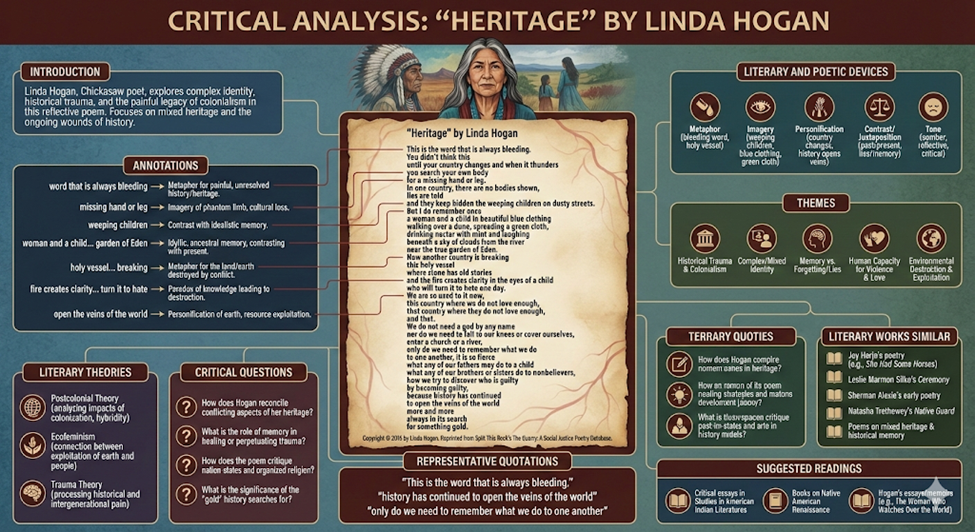
Introduction: “Heritage” by Linda Hogan
“Heritage” by Linda Hogan first appeared in 2016 and was circulated through Split This Rock’s social-justice poetry platform The Quarry; it was later included in her collection A History of Kindness (2018). The poem interrogates inheritance not as pride or lineage but as a legacy of violence, displacement, and moral complicity, opening with the searing claim that “This is the word that is always bleeding,” and extending that wound across nations where bodies are hidden, children weep, and “history has continued / to open the veins of the world.” Hogan juxtaposes intimate memory—“a woman and a child in beautiful blue clothing” laughing beneath a sky “near the true garden of Eden”—with the relentless machinery of war that “breaks this holy vessel,” transforming innocence into future hatred. Its popularity rests on this ethical clarity and global reach: the poem refuses sectarian remedies (“We do not need a god by any name”) and insists instead on human accountability—remembering “what we do to one another,” and how the pursuit of “something gold” perpetuates collective guilt—thereby resonating with readers as a concise, unsparing meditation on colonialism, war, and shared responsibility, articulated through images and lines drawn directly from the poem itself.
Text: “Heritage” by Linda Hogan
This is the word that is always bleeding.
You didn’t think this
until your country changes and when it thunders
you search your own body
for a missing hand or leg.
In one country, there are no bodies shown,
lies are told
and they keep hidden the weeping children on dusty streets.
But I do remember once
a woman and a child in beautiful blue clothing
walking over a dune, spreading a green cloth,
drinking nectar with mint and laughing
beneath a sky of clouds from the river
near the true garden of Eden.
Now another country is breaking
this holy vessel
where stone has old stories
and the fire creates clarity in the eyes of a child
who will turn it to hate one day.
We are so used to it now,
this country where we do not love enough,
that country where they do not love enough,
and that.
We do not need a god by any name
nor do we need to fall to our knees or cover ourselves,
enter a church or a river,
only do we need to remember what we do
to one another, it is so fierce
what any of our fathers may do to a child
what any of our brothers or sisters do to nonbelievers,
how we try to discover who is guilty
by becoming guilty,
because history has continued
to open the veins of the world
more and more
always in its search
for something gold.
Copyright © 2016 by Linda Hogan. Reprinted from Split This Rock’s The Quarry: A Social Justice Poetry Database.
Annotations: “Heritage” by Linda Hogan
| Text (Line / Stanza) | Annotation with Literary Devices |
| “This is the word that is always bleeding.” | 🩸 Metaphor: “Word” represents history / heritage, portrayed as perpetually wounded. 🗣 Tone: Lamenting, accusatory—language itself carries violence. |
| “You didn’t think this / until your country changes…” | 🧠 Symbolism: “Country” signifies political upheaval. ⚡ Imagery: Bodily fear mirrors national collapse. 🌍 Universalization: Applies to any nation. |
| “…you search your own body / for a missing hand or leg.” | 🩸 Metaphor: Amputation symbolizes loss of humanity and identity. ⚡ Imagery: Trauma internalized physically. |
| “In one country, there are no bodies shown…” | 🎭 Irony: Absence of bodies does not mean absence of death. ⛓ Juxtaposition: Visibility vs. denial. 🕰 Historical Consciousness: Media erasure of violence. |
| “lies are told / and they keep hidden the weeping children…” | ⚡ Imagery: Children embody innocent suffering. 🗣 Tone: Condemnatory. 🧠 Symbolism: Dust = neglect and abandonment. |
| “But I do remember once / a woman and a child in beautiful blue clothing…” | ⛓ Juxtaposition: Past peace vs. present violence. ⚡ Imagery: Blue evokes serenity and dignity. 🧠 Symbolism: Memory as resistance. |
| “drinking nectar with mint and laughing…” | 🕊 Allusion: Edenic imagery of harmony. ⚡ Sensory Imagery: Taste, sound, and sight create an idealized past. |
| “beneath a sky of clouds from the river / near the true garden of Eden.” | 🕊 Biblical Allusion: Eden symbolizes lost innocence. 🧠 Symbolism: Nature as moral order before corruption. |
| “Now another country is breaking / this holy vessel” | 🩸 Metaphor: “Holy vessel” = civilization / humanity. 🗣 Tone: Mourning, prophetic. |
| “where stone has old stories” | 🕰 Historical Consciousness: Land remembers what humans forget. 🧠 Symbolism: Stone as ancestral memory. |
| “and the fire creates clarity in the eyes of a child / who will turn it to hate one day.” | 🔥 Foreshadowing: Trauma breeding future violence. ⚡ Imagery: Fire = destruction and awakening. 🧠 Symbolism: Cycle of inherited hatred. |
| “We are so used to it now…” | 🔁 Repetition: Normalization of violence. 🗣 Tone: Moral fatigue, resignation. |
| “this country… that country… and that.” | 🌍 Universalization: Violence transcends borders. 🔁 Repetition: Emphasizes global complicity. |
| “We do not need a god by any name…” | 🎭 Irony: Religion fails to prevent cruelty. 🗣 Diction: Plain, declarative—ethical clarity over dogma. |
| “only do we need to remember what we do / to one another” | 🧠 Symbolism: Memory as moral responsibility. 🗣 Tone: Ethical exhortation. |
| “what any of our fathers may do to a child…” | 🌍 Universalization: Violence is not confined to enemies. 🩸 Metaphor: Family as microcosm of society. |
| “how we try to discover who is guilty / by becoming guilty,” | 🎭 Irony: Justice corrupted into imitation of violence. 🧠 Paradox: Moral self-destruction. |
| “because history has continued / to open the veins of the world…” | 🩸 Extended Metaphor: History as a bleeding body. 🕰 Historical Consciousness: Cyclical violence. |
| “always in its search / for something gold.” | 🧠 Symbolism: Gold = power, empire, greed. 🎭 Irony: Wealth pursued through bloodshed. |
Literary And Poetic Devices: “Heritage” by Linda Hogan
| Device | Example from the Poem | Explanation |
| 1 🔮 Allusion | “near the true garden of Eden” | Biblical reference to Eden symbolizing lost innocence and humanity’s moral fall. |
| 2 🔁 Anaphora | “what any of our fathers may do… / what any of our brothers or sisters do…” | Repetition at the beginning of clauses intensifies moral responsibility and accusation. |
| 3 🎵 Assonance | “bleeding… weeping… keeping” | Repetition of vowel sounds produces a sorrowful, lyrical effect. |
| 4 ✂️ Caesura | “We are so used to it now,” | A strong pause conveys exhaustion and emotional heaviness. |
| 5 ⚖️ Contrast | “laughing” vs. “breaking / this holy vessel” | Highlights the gulf between innocence and destruction. |
| 6 ➰ Enjambment | “history has continued / to open the veins of the world” | Line continuation reflects the ongoing nature of violence. |
| 7 🌍 Global Imagery | “one country… another country” | Expands suffering beyond borders to global humanity. |
| 8 💥 Hyperbole | “open the veins of the world” | Exaggeration emphasizes the scale of historical violence. |
| 9 🖼️ Imagery | “weeping children on dusty streets” | Creates vivid visual and emotional impact. |
| 10 🎭 Irony | “discover who is guilty / by becoming guilty” | Reveals the contradiction of violence in the name of justice. |
| 11 🩸 Metaphor | “history… open the veins of the world” | History is compared to a violent force draining humanity. |
| 12 🔗 Motif | Repeated use of “country” | Reinforces themes of nationalism, war, and shared guilt. |
| 13 📜 Moral Didacticism | “only do we need to remember what we do / to one another” | The poem directly teaches an ethical lesson. |
| 14 🔄 Paradox | “by becoming guilty” | Expresses a self-contradictory truth about moral failure. |
| 15 🧠 Personification | “history has continued” | History is given human agency and intent. |
| 16 🔂 Repetition | “this country… that country” | Emphasizes the universality of violence. |
| 17 ⛪ Religious Symbolism | “holy vessel” | Suggests sacred human life violated by war. |
| 18 🏺 Symbolism | “something gold” | Represents greed, colonial desire, and exploitation. |
| 19 🌑 Tone (Lamenting) | “bleeding, breaking, hate” | Establishes sorrow, condemnation, and moral urgency. |
| 20 🌈 Universalism | “We do not need a god by any name” | Advocates human ethics over sectarian divisions. |
Themes: “Heritage” by Linda Hogan
🩸 Theme 1: Violence as Inherited History
“Heritage” by Linda Hogan presents violence not as a momentary political accident but as an inherited historical condition that continues to reproduce itself across generations and geographies. The poem conceptualizes history as a living, bleeding organism whose wounds never close, suggesting that violence is passed down much like cultural memory or national identity. Hogan’s use of bodily imagery—missing limbs, open veins, wounded children—collapses the distinction between past and present, implying that contemporary atrocities are not aberrations but repetitions of earlier historical crimes. The notion of “heritage” is thus radically redefined: instead of pride, lineage, or tradition, it becomes a legacy of bloodshed, conquest, and moral failure. By portraying history as actively “searching for something gold,” Hogan critiques imperial greed and material ambition as recurring motivations behind violence, showing how the same destructive impulses resurface under different national, religious, or ideological disguises, thereby binding humanity to a continuous cycle of inherited harm.
🔥 Theme 2: The Cycle of Trauma and the Making of Future Hatred
“Heritage” by Linda Hogan powerfully explores how trauma inflicted upon children becomes the seedbed for future violence, thereby sustaining an unbroken cycle of hatred. The poem’s haunting image of fire creating “clarity in the eyes of a child / who will turn it to hate one day” foregrounds the psychological transformation of innocence into rage, revealing how suffering is internalized and later externalized as aggression. Hogan suggests that violence is not only physical but pedagogical: children learn cruelty by witnessing it, absorbing it as a distorted moral education. This intergenerational transmission of trauma ensures that wars never truly end; they merely pause long enough to shape the next generation of participants. By emphasizing the vulnerability of children rather than the heroism of combatants, the poem shifts attention from political narratives to ethical consequences, underscoring how societies manufacture their own future enemies through neglect, brutality, and moral blindness.
🌍 Theme 3: Global Complicity and the Normalization of Suffering
“Heritage” by Linda Hogan advances a deeply unsettling theme of global complicity, arguing that repeated exposure to violence has rendered humanity dangerously accustomed to suffering. Through the refrain-like movement across “this country,” “that country,” and “another,” the poem dissolves national boundaries, portraying violence as a shared global condition rather than an isolated regional crisis. Hogan indicts not only perpetrators but also observers—those who consume sanitized narratives where “no bodies are shown” and lies replace truth. The normalization of suffering becomes a moral failure in itself, as repeated exposure dulls empathy and transforms outrage into resignation. By emphasizing how people grow “used to it,” Hogan critiques modern spectatorship, media censorship, and political detachment, suggesting that indifference is as destructive as active violence. The poem thus positions ethical responsibility not within borders or ideologies but within human awareness itself, insisting that silence and inaction perpetuate harm.
🕊 Theme 4: Moral Responsibility Beyond Religion and National Identity
“Heritage” by Linda Hogan articulates a profound ethical vision that rejects religious, national, and ideological justifications for violence, insisting instead on a universal moral accountability grounded in human relationships. Hogan explicitly dismantles the idea that divine authority, ritual practice, or institutional belief systems can absolve cruelty, asserting that ethical failure occurs not in the absence of faith but in the presence of inhumanity. By declaring that humanity does not need “a god by any name,” the poem does not deny spirituality; rather, it condemns the misuse of belief as a weapon against others. Hogan extends moral culpability inward, emphasizing familial violence—what fathers, brothers, and sisters do—as evidence that cruelty begins at home before expanding outward into national or religious conflict. This theme ultimately reframes morality as relational and immediate, urging remembrance, accountability, and compassion as the only means of breaking history’s bloodstained inheritance.
Literary Theories and “Heritage” by Linda Hogan
| Literary Theory | Application to the Poem (with Textual References) |
| 🩸 Postcolonial Theory | “Heritage” by Linda Hogan can be read as a postcolonial indictment of imperial violence and historical exploitation. The poem’s recurring movement across unnamed “countries” highlights how colonial power structures erase bodies, suppress truth, and normalize domination. Lines such as “there are no bodies shown, / lies are told” expose the manufactured narratives of empire, while “history has continued / to open the veins of the world” frames colonial history as a system that extracts wealth and resources through bloodshed. 🩸 Metaphor of bleeding veins aligns with postcolonial critiques of extraction economies, and 🌍 Universalization shows that colonial violence is not confined to one geography but persists globally under different political guises. |
| 🔥 Trauma Theory | From a trauma-theoretical perspective, “Heritage” by Linda Hogan foregrounds the psychological transmission of violence across generations. The poem emphasizes how unprocessed trauma shapes future identities, most powerfully in the image of “the eyes of a child / who will turn it to hate one day.” 🔥 Foreshadowing reveals trauma as cyclical rather than episodic, while ⚡ Imagery of fire and bodily injury represents the internal scars left by conflict. Trauma here is not individual but collective, embedded within families, nations, and history itself, suggesting that unresolved suffering inevitably reproduces aggression unless consciously addressed through remembrance and ethical responsibility. |
| 🌱 Eco-critical Theory | “Heritage” by Linda Hogan aligns strongly with eco-critical thought by portraying land and nature as living archives of human violence. References such as “where stone has old stories” and “beneath a sky of clouds from the river” present the natural world as a witness to history rather than a passive backdrop. 🌱 Symbolism positions land as morally conscious, while 🕰 Historical Consciousness suggests that environmental destruction parallels human cruelty. The poem critiques modern civilization’s rupture from ecological harmony, contrasting Edenic imagery with present devastation to show how exploitation of nature and exploitation of people stem from the same colonial and capitalist impulses. |
| 🎭 Ethical Humanism | Through an ethical humanist lens, “Heritage” by Linda Hogan rejects religious absolutism and nationalist morality in favor of universal human accountability. The speaker’s assertion that “We do not need a god by any name” foregrounds ethics grounded in action rather than belief. 🎭 Irony exposes how religion and ideology often legitimize violence, while 🗣 Plain diction reinforces moral clarity. The poem insists that responsibility lies in how humans treat one another—“what any of our fathers may do to a child”—thus locating ethical failure within everyday relationships rather than abstract doctrines, making compassion and remembrance the poem’s central moral imperatives. |
Critical Questions about “Heritage” by Linda Hogan
🔍 Question 1: How does the poem redefine the concept of “heritage” beyond cultural pride or ancestry?
“Heritage” by Linda Hogan redefines inheritance not as cultural continuity or ancestral honor but as a painful legacy of violence, moral failure, and historical repetition. Rather than celebrating traditions, Hogan presents heritage as “the word that is always bleeding,” suggesting that what is passed down is suffering, memory, and complicity in injustice. Through references to hidden bodies, weeping children, and nations at war, the poem frames heritage as the transmission of collective trauma across generations and borders. Hogan implies that modern humanity inherits not only land or belief systems but also patterns of cruelty, silence, and exploitation. This redefinition challenges nationalist and romantic notions of heritage by exposing how history perpetuates harm in the pursuit of power and “something gold.” Ultimately, the poem insists that true inheritance lies in ethical responsibility: what we choose to remember, acknowledge, and refuse to repeat determines whether heritage remains a wound or becomes a site of moral awakening.
🌍 Question 2: In what ways does the poem establish violence as a global and shared human condition?
“Heritage” by Linda Hogan constructs violence as a universal condition by deliberately dissolving geographic, religious, and cultural boundaries. The repeated references to “one country,” “another country,” “this country,” and “that country” prevent the reader from isolating blame, suggesting instead that violence is systemic and globally reproduced. Hogan’s imagery of concealed corpses, war-torn streets, and endangered children appears deliberately non-specific, allowing these scenes to stand in for conflicts worldwide. Even moments of beauty—such as the woman and child laughing near “the true garden of Eden”—are transient, overshadowed by the inevitability of destruction. By asserting that “we do not love enough” everywhere, Hogan implicates all societies, including the reader’s own. Violence is thus portrayed not as an anomaly but as a shared human failure, sustained by denial, greed, and historical amnesia, making global responsibility unavoidable.
⚖️ Question 3: How does the poem critique moral judgment and the idea of guilt in times of conflict?
“Heritage” by Linda Hogan offers a profound critique of moral judgment by exposing how the search for justice often reproduces the very violence it seeks to condemn. The paradoxical assertion that humans attempt to “discover who is guilty / by becoming guilty” reveals the cyclical nature of blame, retaliation, and self-righteous violence. Hogan suggests that in war and ideological conflict, moral clarity becomes corrupted when individuals or nations justify cruelty in the name of righteousness, belief, or defense. By emphasizing familial metaphors—fathers harming children, siblings attacking nonbelievers—the poem shows how violence infiltrates intimate human relationships, not just political systems. This critique dismantles binary distinctions between innocence and guilt, arguing that participation in cycles of hatred implicates all actors. Hogan’s moral vision is not relativistic but ethical: it demands self-recognition, restraint, and accountability rather than punishment masked as justice.
🕊️ Question 4: What ethical solution does the poem ultimately propose in place of religion or ideology?
“Heritage” by Linda Hogan rejects religious, ritualistic, and ideological solutions to human violence, proposing instead an ethics grounded in memory, compassion, and responsibility. The poem explicitly states that humanity does not need “a god by any name,” nor rituals such as kneeling, covering oneself, or entering sacred spaces. This rejection does not deny spirituality but critiques its institutional failure to prevent cruelty. Hogan argues that ethical action begins with remembering “what we do to one another,” emphasizing conscious awareness over doctrine. The solution she offers is deceptively simple yet profoundly demanding: love, remembrance, and refusal to dehumanize others. By framing violence as a result of forgetting shared humanity, the poem positions ethical memory as the only viable resistance to historical repetition. In this way, Hogan replaces theology with humanism, asserting that moral responsibility—not belief systems—must become humanity’s true heritage.
Literary Works Similar to “Heritage” by Linda Hogan
- 🩸 “The Colonel” by Carolyn Forché
Like “Heritage,” this poem exposes state violence and historical atrocity through visceral imagery, emphasizing how political power normalizes brutality while silencing victims. - 🔥 “Home” by Warsan Shire
This poem parallels “Heritage” in portraying displacement, inherited trauma, and the psychological cost of national collapse, particularly through the suffering of civilians and children. - 🕊 “A Song on the End of the World” by Czesław Miłosz
Like Hogan’s poem, this work critiques human indifference to suffering, illustrating how ordinary life continues alongside catastrophe, thereby indicting moral complacency.
Representative Quotations of “Heritage” by Linda Hogan
| 🌈 Quotation | 📖 Reference to Context | 🧠 Theoretical Perspective & Explanation |
| 🩸 “This is the word that is always bleeding.” | Opening line; the speaker defines the abstract concept of “heritage” immediately as an active, painful wound rather than a static legacy. | Trauma Theory / Somatic Memory: The poem initiates a corporeal engagement with history, suggesting that heritage is not merely a record of the past but a living, visceral injury. The “bleeding” implies a trauma that refuses to clot or heal, representing the ongoing pain of indigenous displacement and cultural loss. |
| ✋ “you search your own body / for a missing hand or leg.” | Stanza 1; describes the physical sensation of loss triggered by national upheaval and “thunder” (war/conflict). | Postcolonial Theory / Phantom Limb Syndrome: Hogan employs the metaphor of the phantom limb to illustrate cultural dismemberment. The colonial experience strips away parts of identity (land, language, kin), leaving the colonized subject searching their own physical being for a part of themselves that has been violently severed yet still aches. |
| 🙈 “lies are told / and they keep hidden the weeping children on dusty streets.” | Stanza 2; contrasts the official, sanitized version of a country with the hidden reality of suffering. | Marxist Criticism / Ideological State Apparatus: This highlights the manipulation of media and narrative by state powers to maintain control. The “lies” serve as an ideological veil that obscures the human cost of political decisions, specifically the suffering of the most vulnerable (children), to protect the image of the nation-state. |
| 🌿 “drinking nectar with mint… near the true garden of Eden.” | Stanza 3; a flashback or ancestral memory of a woman and child in a peaceful, idyllic setting before the conflict. | Ecocriticism / Indigenous Epistemology: This represents a counter-narrative of harmony, positioning the indigenous connection to land (the “true garden”) against the artificial boundaries of the nation. It invokes a pre-colonial or spiritual reality where humanity exists in symbiotic pleasure with the earth, contrasting sharply with the current violence. |
| ⚱️ “Now another country is breaking / this holy vessel” | Stanza 4; the shift from the memory of the garden back to the destruction of the present moment. | Spiritual Ecofeminism: The earth/body is conceptualized as a sacred container (“holy vessel”). The “breaking” signifies a violation that is simultaneously physical (war), spiritual (desecration), and gendered, linking the destruction of the land to the destruction of the feminine/maternal archetype established in the previous stanza. |
| 🔥 “fire creates clarity in the eyes of a child / who will turn it to hate one day.” | Stanza 4; observing a child witnessing destruction, predicting the future emotional toll of this trauma. | Psychoanalytic Criticism / The Cycle of Violence: Hogan identifies the genesis of intergenerational hate. The “clarity” is a traumatic realization of the world’s cruelty, which calcifies into hatred. It suggests that terrorists or soldiers are often created in the crucible of childhood trauma, framing violence as a learned, inevitable response to earlier victimization. |
| 💔 “this country where we do not love enough, / that country where they do not love enough” | Stanza 5; a lament on the universal failure of empathy across different warring nations. | Humanism / Universalism: The poet moves beyond a binary of “us vs. them” to a universal critique of the human condition. By equating “this country” and “that country” through their shared lack of love, Hogan deconstructs nationalistic fervor, suggesting that the root cause of war is a collective spiritual deficit rather than political difference. |
| ⛪ “We do not need a god by any name… only do we need to remember what we do / to one another” | Stanza 6; a rejection of organized religion in favor of moral accountability and memory. | Secular Ethics / Moral Philosophy: Hogan advocates for an ethics of remembrance over dogma. She critiques religious institutions (“god by any name,” “enter a church”) as unnecessary distractions from the true moral imperative: facing the brutal reality of human actions (“what we do to one another”) and accepting responsibility without divine mediation. |
| ⚖️ “how we try to discover who is guilty / by becoming guilty” | Stanza 6; discussing the futility of retributive justice and the pursuit of enemies. | Mimetic Theory (René Girard): This illustrates the trap of mimetic violence, where the attempt to punish the aggressor leads the victim to imitate the aggressor’s violence. In seeking “who is guilty,” the seeker commits new atrocities, thereby entering the same moral category they sought to condemn, perpetuating an endless loop of conflict. |
| ⛏️ “history has continued / to open the veins of the world… in its search / for something gold.” | Final lines; connecting the history of human violence to the extraction of resources from the earth. | Material Ecocriticism / Anti-Capitalism: The poem concludes by linking colonial violence to resource extraction. History is personified as a vampire or miner, “opening the veins” (rivers, mines, bloodlines) not for survival, but for greed (“something gold”). It frames the destruction of indigenous heritage and the environment as collateral damage in the capitalist pursuit of wealth. |
Suggested Readings: “Heritage” by Linda Hogan
Books
- Hogan, Linda. A History of Kindness: Poems. Torrey House Press, 2020.
- Hogan, Linda. Dark. Sweet.: New & Selected Poems. Coffee House Press, 2014.
Academic Articles
- Magrane, Eric. “‘Healing, Belonging, Resistance, and Mutual Care’: Reading Indigenous Ecopoetics and Climate Narratives.” Literary Geographies, vol. 4, no. 2, 2018, pp. 156–170. https://www.literarygeographies.net/index.php/LitGeogs/article/view/92/pdf. Accessed 20 Jan. 2026.
- Hogan, Linda. “The Eyes of the Animals.” Ecozon@: European Journal of Literature, Culture and Environment, vol. 1, no. 1, 2010. https://doi.org/10.37536/ECOZONA.2010.1.1.345. Accessed 20 Jan. 2026.
Poem Websites
- Hogan, Linda. “History.” The Quarry: A Social Justice Poetry Database, Split This Rock, 25 Mar. 2016, https://www.splitthisrock.org/poetry-database/poem/history1. Accessed 20 Jan. 2026.
- Hogan, Linda. “History.” Academy of American Poets (Poets.org), 2016, https://poets.org/poem/history-1. Accessed 20 Jan. 2026.