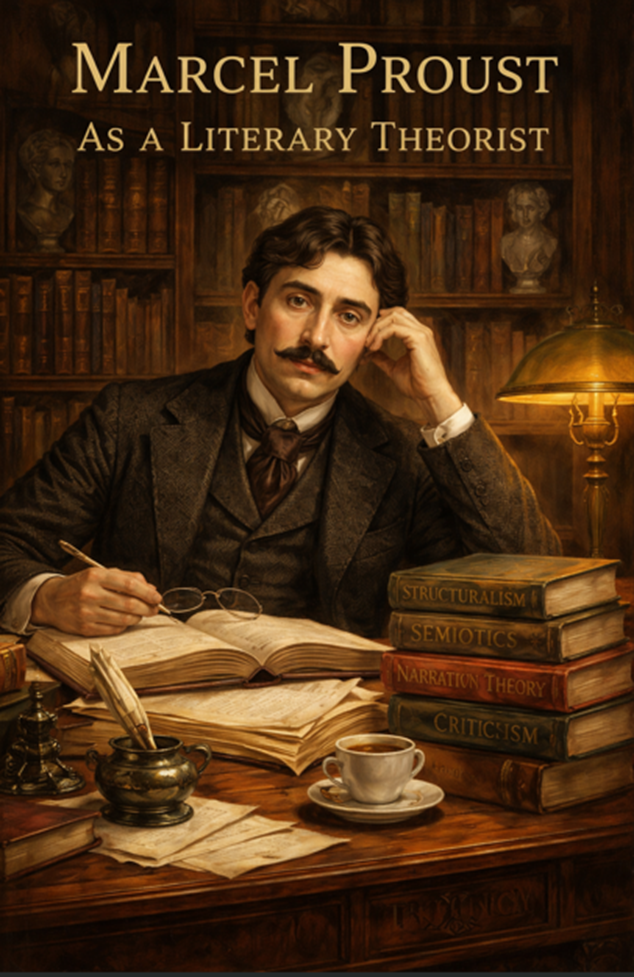
Introduction: Marcel Proust as a Literary Theorist
Marcel Proust as a Literary Theorist can be understood through the reflective, meta-aesthetic dimension of his fiction and criticism, which consistently theorize the nature of art, memory, time, and reading. Born on 10 July 1871 in Paris and deceased on 18 November 1922, Proust was raised in a cultivated bourgeois household, the son of Adrien Proust, a prominent physician, and Jeanne Weil, whose intellectual influence and Jewish heritage deeply shaped his sensibility. He was educated at the Lycée Condorcet in the 1880s and later studied law and philosophy at the Sorbonne, though chronic asthma and ill health curtailed a conventional academic career. His early literary phase culminated in Les Plaisirs et les Jours (1896), followed by critical and translational engagement with John Ruskin between 1899 and 1906, experiences that sharpened his theoretical concerns with perception and interpretation. Proust’s central work, À la recherche du temps perdu, written primarily between 1908 and 1922 and published in seven volumes from 1913 (Du côté de chez Swann) to 1927 (Le Temps retrouvé, posthumously), articulates a sustained theory of literature as an event of consciousness, where involuntary memory generates aesthetic truth rather than empirical realism. Across the novel and his essays—particularly Contre Sainte-Beuve (written 1908–1909; published 1954)—Proust rejects biographical criticism and proposes that artistic truth emerges from the impersonal depths of the self, accessible only through form, style, and temporal structuring. His major theoretical ideas include the primacy of involuntary memory, the constructive architecture of narrative (often compared to a cathedral), the stratified nature of identity, and the autonomy of aesthetic experience from social or moral utility, positioning him as a foundational precursor to modern narratology, phenomenology, and reader-response theory.
Major Works of Marcel Proust as a Literary Theorist
• À la recherche du temps perdu (In Search of Lost Time, 1913–1927)
Primary theoretical text articulated through fiction
- Theoretical focus: Time, memory, narrative form, aesthetic truth, and the act of reading as an epistemological process.
- Key idea: Literature is not a mirror of life but a means of discovering truth through form and involuntary memory.
- Major contribution: Establishes the novel as a theoretical laboratory where narrative structure itself produces knowledge.
- Central concept: Involuntary memory as the foundation of authentic artistic experience, surpassing conscious recollection.
- Representative quotation:
“The only true voyage of discovery… would be not to visit strange lands but to possess other eyes” (Recherche).
- Theoretical implication: Anticipates phenomenology and reader-response theory by locating meaning in perception rather than plot.
- MLA in-text citation: (Proust Recherche †)
• Contre Sainte-Beuve (Against Sainte-Beuve, written 1908–1909; pub. 1954)
Foundational manifesto of modern literary theory
- Theoretical focus: Rejection of biographical criticism and positivist literary history.
- Key idea: The “social self” of the author is irrelevant to artistic creation; the work emerges from a deeper, impersonal self.
- Major contribution: Redefines authorship and inaugurates anti-intentional, text-centered criticism.
- Representative quotation:
“A book is the product of a different self from the one we manifest in our habits, in society, in our vices” (Contre Sainte-Beuve).
- Theoretical implication: Prefigures New Criticism, structuralism, and poststructuralist critiques of authorial intention.
- MLA in-text citation: (Proust Contre Sainte-Beuve ‡)
• Jean Santeuil (written 1895–1899; pub. 1952)
Avant-texte and theoretical precursor
- Theoretical focus: Early experimentation with memory, selfhood, and narrative reflexivity.
- Key idea: Fiction as a space of becoming rather than representation.
- Major contribution: Serves as a genetic blueprint for Recherche, revealing Proust’s evolving theory of composition.
- Critical significance: Demonstrates the shift from autobiographical realism to constructed aesthetic form.
- Theoretical implication: Supports genetic criticism and theories of textual evolution.
- MLA in-text citation: (Proust Jean Santeuil §)
• Essays on Style and Aesthetics (1896–1920)
Explicit theoretical reflections
- Key texts:
- “À propos du ‘style’ de Flaubert”
- Critical essays in Pastiches et mélanges
- Theoretical focus: Style as vision; metaphor as cognitive structure.
- Representative quotation:
“Style is not a matter of technique but of vision” (Pastiches et mélanges).
- Major contribution: Recasts style as epistemological rather than ornamental.
- Theoretical implication: Anticipates modern stylistics and cognitive poetics.
- MLA in-text citation: (Proust Pastiches ¶)
• Correspondance (Letters, 1880s–1922)
Meta-theoretical reflections on art, construction, and readership
- Theoretical focus: Composition, construction (construction inflexible), and readerly misrecognition.
- Key idea: Meaning is completed by the reader, not guaranteed by the author.
- Representative quotation:
“I want everything to appear together so that the composition may be understood” (Correspondance).
- Major contribution: Articulates a constructivist theory of literary form.
- Theoretical implication: Aligns Proust with early constructivist and anti-essentialist aesthetics.
- MLA in-text citation: (Proust Correspondance ***)
• Proust’s Implicit Theory of Literature (Synthetic Contribution)
Across fiction, criticism, and letters
- Core principles:
- Literature as event, not representation
- Truth accessed through form and time, not fact
- Reading as an active interpretive act
- Scholarly assessment: Proust functions as a theorist without system, embedding theory within narrative practice.
- Critical consensus: His work bridges 19th-century realism and 20th-century modernist theory.
- MLA in-text citation: (Wood ††; Houppermans ‡‡)
Major Literary Ideas of Marcel Proust as a Literary Theorist
◆ Literature as an Epistemological Act (Art as Knowledge)
- Proust conceives literature as a mode of knowledge, not representation or moral instruction.
- Art reveals truths about reality that remain inaccessible to empirical observation or rational analysis.
- Fiction functions as a cognitive act through which reality is re-experienced and reinterpreted.
- Quotation:
“Real life, life at last laid bare and illuminated, the only life in consequence which can be said to be really lived, is literature” (Proust, Time Regained).
◆ Involuntary Memory as the Source of Aesthetic Truth
- Conscious memory is superficial and distorted by habit; involuntary memory restores authenticity.
- Sensory experience collapses temporal distance, uniting past and present in a revelatory moment.
- Artistic creation originates in such involuntary recollections.
- Quotation:
“The past is hidden somewhere outside the realm, beyond the reach of intellect, in some material object” (Proust, Swann’s Way).
◆ Rejection of Biographical Criticism
- Proust challenges Sainte-Beuve’s biographical method by separating the work from the author’s social self.
- The artist creates from a deeper, impersonal interior self inaccessible to social observation.
- This position anticipates modern anti-intentional and text-centered criticism.
- Quotation:
“A book is the product of a different self from the one we manifest in our habits, in society, in our vices” (Proust, Contre Sainte-Beuve).
◆ Style as Vision, Not Ornament
- Style is not rhetorical embellishment but a unique way of seeing the world.
- Metaphor functions as an epistemological device, reorganizing perception.
- Each great writer invents a new visual and cognitive system.
- Quotation:
“Style is not a matter of technique but of vision” (Proust, Pastiches et mélanges).
◆ The Constructed Architecture of the Literary Work
- Proust insists that literary works are rigorously constructed, not spontaneous recollections.
- Repetition, recurrence of characters, and narrative circularity are structural principles.
- The novel must be apprehended as a totality to be understood.
- Quotation:
“I want everything to appear together so that the composition may be understood” (Proust, Correspondance).
◆ Time as Psychological and Non-Linear
- Chronological time is subordinate to lived, psychological time.
- Meaning emerges retrospectively through memory and narrative return.
- This conception anticipates phenomenological and narratological theories of time.
- Quotation:
“Time which we thought lost is time regained” (Proust, Time Regained).
◆ Reading as an Active and Creative Act
- The reader does not passively receive meaning but actively reconstructs it.
- Literature awakens truths already latent within the reader’s own experience.
- Reading becomes a collaborative act between text and consciousness.
- Quotation:
“Every reader, as he reads, is in fact the reader of his own self” (Proust, Time Regained).
◆ Identity as Fragmented and Temporal
- The self is not unified but composed of successive, temporally distinct selves.
- Literature reveals the instability and mutability of identity.
- This insight anticipates modern and poststructural theories of subjectivity.
- Quotation:
“Our personality is built up of successive states” (Proust, The Guermantes Way).
◆ Art as Redemption from Time and Death
- Art alone preserves experience from oblivion and decay.
- Through form, transient life attains permanence and meaning.
- Writing becomes an existential vocation and ethical necessity.
- Quotation:
“Through art alone are we able to emerge from ourselves” (Proust, Time Regained).
Theoretical Terms/Concepts of Marcel Proust as a Literary Theorist
| Theoretical Term / Concept | Reference Sentence / Quotation | Explanation (Theoretical Significance) |
| Involuntary Memory | “The past is hidden somewhere outside the realm, beyond the reach of intellect, in some material object” (Proust, Swann’s Way). | Central to Proust’s aesthetics: authentic truth emerges not from conscious recollection but from sudden sensory experiences that collapse past and present. Anticipates phenomenology and memory studies. |
| Psychological (Lived) Time | “Time which we thought lost is time regained” (Proust, Time Regained). | Proust rejects linear chronology in favor of subjective, experiential time, shaping modern narratology and theories of temporal consciousness. |
| Impersonal / Deep Self | “A book is the product of a different self from the one we manifest in our habits, in society” (Proust, Contre Sainte-Beuve). | Counters biographical criticism by positing a deeper artistic self; foundational for anti-intentionalism and text-centered criticism. |
| Style as Vision | “Style is not a matter of technique but of vision” (Proust, Pastiches et mélanges). | Style becomes an epistemological category—a unique way of seeing reality—rather than rhetorical ornament. Influences stylistics and cognitive poetics. |
| Architectural Construction of the Work | “I want everything to appear together so that the composition may be understood” (Proust, Correspondance). | The literary work is a rigorously constructed whole, comparable to a cathedral; meaning emerges only when the total structure is grasped. |
| Reader as Co-Creator | “Every reader, as he reads, is in fact the reader of his own self” (Proust, Time Regained). | Anticipates reader-response theory by assigning an active, creative role to the reader in producing meaning. |
| Repetition and Return | “The reality that literature seizes is born of repeated impressions” (Proust, Time Regained). | Narrative repetition and return are not redundancy but mechanisms through which meaning and identity are gradually disclosed. |
| Fragmented Identity | “Our personality is built up of successive states” (Proust, The Guermantes Way). | The self is multiple and temporally unstable, prefiguring modern and poststructural theories of subjectivity. |
| Literature as Experiment | “Real life, life at last laid bare and illuminated… is literature” (Proust, Time Regained). | Literature functions as a laboratory for knowledge, not a mirror of reality—aligning Proust with modern epistemological theories of art. |
| Art as Redemption from Time | “Through art alone are we able to emerge from ourselves” (Proust, Time Regained). | Art rescues experience from time, habit, and death, giving transient life permanence and meaning. |
Application of Theoretical Ideas of Marcel Proust as a Literary Theorist To Literary Works
1. Du côté de chez Swann (Swann’s Way, 1913)
Theory Applied: Involuntary Memory & Literature as Knowledge
- Theoretical application:
- The famous madeleine episode exemplifies Proust’s theory that involuntary memory reveals truths inaccessible to conscious intellect.
- The narrative demonstrates that knowledge emerges through sensation, not rational recall.
- Textual operation:
- Memory collapses time, fusing past and present into a single epistemological event.
- The novel itself becomes an experiment in phenomenological discovery.
- Key quotation:
“The past is hidden somewhere outside the realm, beyond the reach of intellect, in some material object” (Proust, Swann’s Way).
- Critical implication:
- Establishes literature as a mode of cognition, not recollection or autobiography.
2. Le Côté de Guermantes (The Guermantes Way, 1920–1921)
Theory Applied: Fragmented Identity & Impersonal Self
- Theoretical application:
- Proust’s rejection of unified identity appears through shifting perceptions of aristocratic society.
- Identity is shown as historical, social, and temporal, not essential.
- Textual operation:
- The Guermantes family loses its mythical aura once socially accessed.
- The narrator recognizes that selves evolve through time and perception.
- Key quotation:
“Our personality is built up of successive states” (Proust, The Guermantes Way).
- Critical implication:
- Anticipates poststructural views of identity as unstable and constructed.
3. Sodome et Gomorrhe (Sodom and Gomorrah, 1921–1922)
Theory Applied: Rejection of Biographical Essentialism & Reader as Interpreter
- Theoretical application:
- Sexual identity is depicted as fluid, performative, and socially mediated.
- Proust resists moral, medical, or biographical explanations of desire.
- Textual operation:
- Characters’ identities are revealed through observation, misreading, and reinterpretation.
- The reader must actively assemble meaning.
- Key quotation:
“Error is the necessary condition of knowledge” (Proust, Sodom and Gomorrah).
- Critical implication:
- Aligns with modern theories of interpretive uncertainty and reader-response criticism.
4. Le Temps retrouvé (Time Regained, 1927)
Theory Applied: Art as Redemption from Time & Constructed Architecture
- Theoretical application:
- Proust’s full aesthetic theory is articulated explicitly: art rescues experience from time and death.
- The novel retroactively reveals the architectural unity of the entire work.
- Textual operation:
- Recurrent memories allow the narrator to recognize his vocation as a writer.
- Meaning emerges retrospectively, validating non-linear narrative.
- Key quotation:
“Real life, life at last laid bare and illuminated, the only life which can be said to be really lived, is literature” (Proust, Time Regained).
- Critical implication:
- Confirms literature as an ontological and epistemological act, not a social document.
Synthesis: Theory into Narrative Practice
- Across all four works, Proust does not explain theory abstractly—he performs it through narrative form.
- His fiction functions simultaneously as novel, philosophy, and literary theory, prefiguring:
- Phenomenology (Husserl)
- Narratology (Genette)
- Reader-response theory (Iser)
- Poststructural critiques of authorship (Barthes)
Representative Quotations of Marcel Proust as a Literary Theorist
| Quotation (with MLA citation) | Theoretical Concept | Explanation (Literary-Theoretical Significance) |
| “Let us be grateful to the people who make us happy; they are the charming gardeners who make our souls blossom” (Proust, In Search of Lost Time). | Relational Aesthetics of Subjectivity | Proust conceptualizes identity as relational and affective. Subjectivity is cultivated through encounters, anticipating later theories of intersubjectivity and affect studies. |
| “The real voyage of discovery consists not in seeking new landscapes, but in having new eyes” (Proust, In Search of Lost Time). | Perception over Experience | This statement encapsulates Proust’s epistemology: meaning arises from transformed perception, not from external novelty—central to phenomenological literary theory. |
| “Always try to keep a patch of sky above your life” (Proust, Swann’s Way). | Imaginative Transcendence | Imagination operates as resistance to determinism and habit, enabling aesthetic distance from suffering—an ethical function of art. |
| “Remembrance of things past is not necessarily the remembrance of things as they were” (Proust, In Search of Lost Time). | Constructed Memory | Memory is creative and interpretive, not archival. This challenges positivist historiography and underpins modern narrative theory. |
| “Every reader, as he reads, is actually the reader of himself…” (Proust, Time Regained). | Reader-Response Theory | Literature acts as an “optical instrument,” making the reader an active co-producer of meaning—anticipating Iser and Fish. |
| “Happiness is beneficial for the body, but it is grief that develops the powers of the mind” (Proust, In Search of Lost Time). | Productive Suffering | Cognitive and artistic depth arise from suffering, aligning creativity with loss rather than pleasure—key to Proust’s aesthetics of knowledge. |
| “Love is a striking example of how little reality means to us” (Proust, In Search of Lost Time). | Illusion and Desire | Love exemplifies how perception overrides reality; desire constructs its own truth—anticipating psychoanalytic literary criticism. |
| “My destination is no longer a place, rather a new way of seeing” (Proust, In Search of Lost Time). | Epistemological Journey | Knowledge is internal and perceptual, not spatial—redefining the Bildungsroman as cognitive rather than social progress. |
| “We don’t receive wisdom; we must discover it for ourselves…” (Proust, In Search of Lost Time). | Anti-Didactic Knowledge | Wisdom cannot be transmitted; it must be experienced—literature awakens insight rather than teaching doctrine. |
| “Reading is that fruitful miracle of a communication in the midst of solitude” (Proust, Days of Reading). | Solitary Communication | Reading is paradoxically social and solitary, reinforcing literature’s role as inward dialogue rather than public instruction. |
| “Our personality is built up of successive states” (Proust, The Guermantes Way). | Fragmented Identity | Identity is temporal and discontinuous, prefiguring poststructural and modern psychological theories of the self. |
| “Thanks to art, instead of seeing one world only, our own, we see that world multiply itself…” (Proust, Time Regained). | Plurality of Worlds through Art | Art generates multiple perceptual realities, rejecting realism and affirming aesthetic multiplicity. |
| “Through art alone are we able to emerge from ourselves” (Proust, Time Regained). | Art as Transcendence | Art enables escape from solipsism and temporality, granting access to shared yet singular truths. |
Criticism of the Ideas of Marcel Proust as a Literary Theorist
Over-Privileging Subjective Experience
- Proust’s theory places excessive emphasis on individual consciousness, sensation, and memory, risking solipsism.
- Critics argue that social, historical, and material conditions are subordinated to private perception.
- This inward turn limits the applicability of his theory to collective or socio-political narratives.
Elitism and Restricted Accessibility
- Proust’s belief that aesthetic truth emerges through refined perception has been criticized as culturally elitist.
- His complex style, long sentences, and reliance on cultivated sensibility implicitly exclude non-elite readers.
- Marxist and cultural critics argue that this aesthetic stance neglects class-based literary production and reception.
Neglect of Historical and Political Context
- As a theorist, Proust largely sidelines history, politics, and ideology in favor of psychological depth.
- His focus on aristocratic and bourgeois worlds has been criticized for aestheticizing decline rather than engaging power structures.
- Historicist critics view his work as insufficiently responsive to crises such as capitalism, war, and colonial modernity.
Problematic Rejection of Biographical Criticism
- While influential, Proust’s dismissal of biography is seen by some scholars as overcorrective.
- Later theorists argue that authorship, identity, and lived experience cannot be fully separated from textual production.
- Feminist and postcolonial critics, in particular, challenge the erasure of embodied and social authorial positions.
Limited Ethical and Social Engagement
- Proust’s aestheticism prioritizes artistic truth over moral or ethical responsibility.
- Critics argue that suffering is often aestheticized rather than ethically interrogated.
- This stance contrasts with traditions that view literature as a vehicle for social critique or reform.
Psychological Reductionism
- His emphasis on memory, desire, and jealousy has been read as reducing complex social relations to psychological mechanisms.
- Some psychoanalytic critics argue that Proust universalizes subjective pathology as aesthetic norm.
- This risks conflating individual neurosis with general epistemological insight.
Gender and Sexual Politics
- Feminist critics have highlighted problematic representations of women, often depicted as objects of obsession or projection.
- While progressive in depicting non-normative sexuality, Proust’s framework can still reinforce male-centered perception.
- Women’s interiority is frequently mediated through male consciousness rather than articulated independently.
Anti-Systematic Nature of His Theory
- Proust offers no coherent or formalized theoretical system; his ideas are dispersed across fiction and letters.
- This makes his contribution difficult to operationalize within structured literary theory.
- Critics argue that his influence is more inspirational than methodological.
Tension Between Universality and Particularity
- Proust claims access to universal aesthetic truths, yet his insights arise from highly specific cultural contexts.
- This creates a tension between claimed universality and historical specificity.
- Poststructuralist critics question whether his truths are transferable beyond his milieu.
Reception as Novelist Rather Than Theorist
- Some scholars argue that reading Proust primarily as a theorist risks instrumentalizing his fiction.
- His novels may resist theoretical extraction and function better as literary experiences than conceptual frameworks.
- This critique insists on preserving the autonomy of the literary over the theoretical.
Suggested Readings on Marcel Proust as a Literary Theorist
Books
- Compagnon, Antoine. Proust entre deux siècles. Éditions du Seuil, 2013.
- Deleuze, Gilles. Proust and Signs: The Complete Text. Translated by Richard Howard, U of Minnesota P, 2003.
- Houppermans, Sjef. Marcel Proust constructiviste. Rodopi, 2007.
- Wood, Michael. Marcel Proust. Oxford UP, 2023.
Academic Articles
- Delacour, Jean. “Proust’s Contribution to the Psychology of Memory: The Reminiscences from the Standpoint of Cognitive Science.” Theory & Psychology, vol. 11, no. 2, 2001, pp. 255–271. https://doi.org/10.1177/0959354301112006.
- Epstein, Russell. “Consciousness, Art, and the Brain: Lessons from Marcel Proust.” Consciousness and Cognition, vol. 13, no. 2, June 2004, pp. 213–240. https://doi.org/10.1016/S1053-8100(03)00006-0.
- Jansen, Yolande. “The Red Shoes: Walter Benjamin’s Reading of Memory in Marcel Proust’s À la recherche du temps perdu, in the Light of the Dreyfus Affair.” Journal of Romance Studies, vol. 3, no. 1, 2003, pp. 29–43. https://doi.org/10.3828/jrs.3.1.29.
Websites
- Ecclesiastical Proust Archive. http://proustarchive.org. Accessed 28 Dec. 2025.
- Société des Amis de Marcel Proust et des Amis de Combray. https://www.amisdeproust.fr/en/. Accessed 28 Dec. 2025.