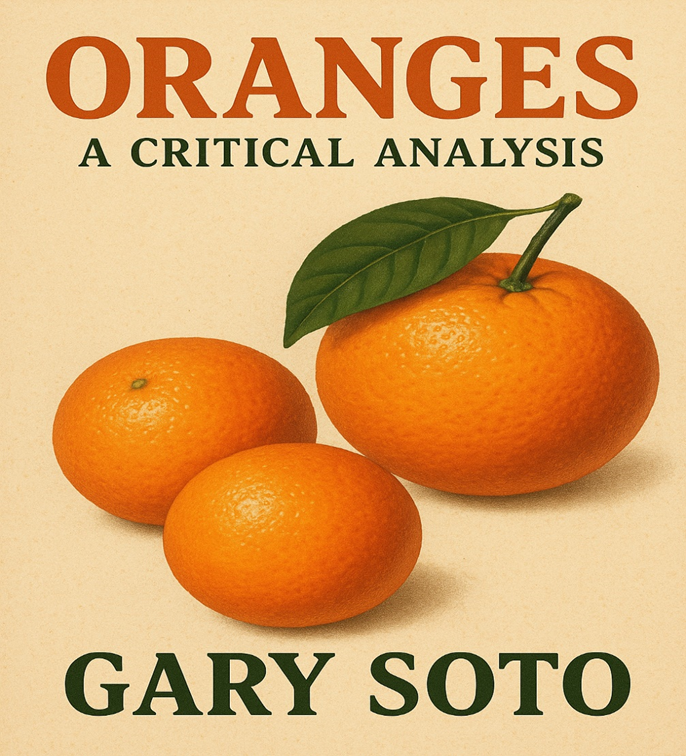
Introduction: “Oranges” by Gary Soto
“Oranges” by Gary Soto first appeared in 1983 (in Poetry magazine) and was subsequently collected in Soto’s poetry book Black Hair (1985), later circulating widely through classroom-friendly reprintings such as A Fire in My Hands: A Book of Poems (Scholastic, 1990). The poem’s main ideas center on adolescent first love, social class and embarrassment, and quiet moral courage: the speaker—“twelve, / Cold, and weighted down / With two oranges”—stages a small act of dignity when his “nickle” cannot cover the girl’s “chocolate / That cost a dime,” so he adds “an orange” and lets the “saleslady” understand “Very well what it was all / About,” turning poverty into tenderness rather than shame. Its popularity endures because it renders a universally recognizable rite of passage with exceptionally teachable clarity—vivid winter imagery (“December. Frost cracking”), cinematic detail (the “tiny bell,” “a narrow aisle of goods”), and a memorable symbolic close in which the orange’s brightness against the “gray of December” becomes the emotional ignition of first affection, “like…a fire in my hands.”
Text: “Oranges” by Gary Soto
Oranges
Gary Soto
The first time I walked
With a girl, I was twelve,
Cold, and weighted down
With two oranges in my jacket.
December. Frost cracking
Beneath my steps, my breath
Before me, then gone,
As I walked toward
Her house, the one whose
Porch light burned yellow
Night and day, in any weather.
A dog barked at me, until
She came out pulling
At her gloves, face bright
With rouge. I smiled,
Touched her shoulder, and led
Her down the street, across
A used car lot and a line
Of newly planted trees,
Until we were breathing
Before a drugstore. We
Entered, the tiny bell
Bringing a saleslady
Down a narrow aisle of goods.
I turned to the candies
Tiered like bleachers,
And asked what she wanted –
Light in her eyes, a smile
Starting at the corners
Of her mouth. I fingered
A nickle in my pocket,
And when she lifted a chocolate
That cost a dime,
I didn’t say anything.
I took the nickle from
My pocket, then an orange,
And set them quietly on
The counter. When I looked up,
The lady’s eyes met mine,
And held them, knowing
Very well what it was all
About.
Outside,
A few cars hissing past,
Fog hanging like old
Coats between the trees.
I took my girl’s hand
In mine for two blocks,
Then released it to let
Her unwrap the chocolate.
I peeled my orange
That was so bright against
The gray of December
That, from some distance,
Someone might have thought
I was making a fire in my hands.
Annotations: “Oranges” by Gary Soto
| Section | Annotation | Devices |
| Opening setup (first movement) | The speaker frames a first “date” as both exciting and burdensome: he’s young, cold, and carrying two oranges—a concrete detail that also preloads the poem’s central symbol (warmth, value, tenderness). | 🔵 Imagery; 🟠 Symbolism; ⚫ Theme (coming-of-age); 🟤 Enjambment |
| December walk / sensory cold | Winter details (frost, breath appearing and vanishing) externalize adolescent nerves: the environment mirrors uncertainty and vulnerability. | 🔵 Imagery; 🟦 Atmosphere; 🟢 Sound (crisp consonants); 🟤 Enjambment |
| Her house / “porch light” constancy | The girl’s home is marked by a steady, welcoming light—suggesting safety, warmth, and a kind of emotional “target” the boy is walking toward. | 🟠 Symbolism; 🔵 Imagery; 🟩 Characterization (her world as inviting); ⚫ Theme (desire for warmth/belonging) |
| Dog barking / threshold moment | A minor obstacle heightens tension, then relief arrives when she appears; the poem shows how small social moments feel amplified at twelve. | 🟦 Atmosphere; ⚫ Theme (social anxiety); 🟩 Characterization; 🟤 Enjambment |
| Girl’s appearance (gloves, rouge) | Specific details build realism and gentle glamour; the speaker’s attention to her face and gestures conveys awe, tenderness, and youthful self-consciousness. | 🔵 Imagery; 🟩 Characterization; ⚫ Tone (tender/nostalgic); 🟤 Enjambment |
| Walking together / crossing spaces (street, car lot, trees) | The route functions like a rite-of-passage corridor: ordinary public spaces become “charged” because this is the speaker’s first romantic walk with a girl. | 🟠 Symbolism (journey motif); 🟦 Setting; 🔵 Imagery; ⚫ Theme (initiation) |
| Drugstore entry / “tiny bell” | The store is staged like a small theater: sounds and narrow aisles intensify the sense of scrutiny and stakes (he is being “watched” by the adult world). | 🔵 Imagery; 🟦 Atmosphere; 🟢 Sound; ⚫ Theme (public pressure) |
| Candy choice / economic tension begins | The girl’s choice triggers the poem’s central conflict: affection meets money. The speaker’s silence signals embarrassment and quick calculation. | 🟧 Social critique (class/money); ⚫ Theme (dignity vs. lack); 🟩 Characterization (restraint) |
| Nickel vs. dime (problem crystallizes) | A tiny price gap becomes huge emotionally. The poem shows how adolescence magnifies small material limits into moral tests. | 🟧 Social critique; ⚫ Theme; 🟤 Enjambment (pressure through pacing) |
| The “payment” (nickel + orange) | The boy improvises an exchange that lets him preserve dignity and give the girl what she wants. The orange shifts from fruit to value token and love token. | 🟠 Symbolism (orange as warmth/value); 🟧 Irony (improper payment treated as understood); 🟩 Characterization (resourcefulness); ⚫ Theme (moral courage) |
| Saleslady’s knowing look (silent complicity) | The adult’s gaze is crucial: she recognizes the situation and chooses empathy over enforcement. This is the poem’s ethical hinge—quiet kindness without humiliation. | 🟩 Characterization (saleslady); ⚫ Theme (compassion); 🟧 Social critique; 🔵 Imagery (eye contact as drama) |
| “Outside” shift / world resumes | The poem resets the scene: cars, fog, and cold return. The public world keeps moving, but the boy’s private victory lingers. | 🟦 Atmosphere; 🔵 Imagery; ⚫ Tone (calm after tension) |
| Handholding / release | Brief intimacy is carefully paced: holding hands, then releasing so she can unwrap the chocolate—showing respect, nervousness, and sweet restraint. | 🟩 Characterization; ⚫ Theme (gentle love); 🟤 Enjambment (soft continuation) |
| Final orange image (“fire in my hands”) | The closing image converts the orange into a vivid emblem of warmth and feeling against winter gray: love and dignity become visible light in his hands. | 🟣 Metaphor (orange as “fire”); 🟡 Simile-like comparison (appearance from distance); 🟠 Symbolism; 🔵 Imagery; ⚫ Theme (love as warmth) |
Literary And Poetic Devices: “Oranges” by Gary Soto
| Device (A–Z) | Definition | Example from “Oranges” | Detailed explanation (how it works here) |
| Alliteration 🔶 | Repetition of initial consonant sounds | “Frost cracking” | The repeated hard consonants create a brittle, snapping sound-pattern that acoustically imitates ice breaking underfoot. This sonic texture makes the cold feel physical and immediate, reinforcing the speaker’s discomfort and the winter setting that frames the tenderness of the walk. |
| Ambiguity 🟠 | A phrase/image with layered meaning | “knowing / Very well what it was all / About” | The line does not specify exactly what the saleslady understands, allowing several meanings to coexist: the boy’s shortage of money, his attempt to “make up” the difference, and the vulnerability of a first date. This ambiguity enlarges the scene from a simple transaction into an ethical and emotional recognition shared between strangers. |
| Anaphora 🍊 | Repetition at the start of clauses/lines | “I took…” / “I peeled…” | The repeated “I” gives the poem a confessional, memoir-like cadence, emphasizing personal responsibility and initiative. Each “I” marks a step in the boy’s decision-making, showing his movement from nervousness to action—especially in the drugstore where he must choose dignity over explanation. |
| Assonance 🟧 | Repetition of vowel sounds | “cold… two oranges” | The recurring rounded “o” sound slows the rhythm and creates a subdued, hushed musicality. That softness contrasts with the harsh environment, mirroring how the boy tries to keep his feelings controlled while carrying a quiet hope (symbolized by the oranges) through the cold. |
| Caesura 🟨 | A strong pause within a line | “December. Frost cracking” | The full stop produces a sudden halt—like a breath taken before continuing. It functions as a memory-cut or cinematic jump: first the month (a mood), then the sound of winter. This pause heightens the sense that the speaker is recalling vivid, isolated sensory details that define the moment. |
| Connotation 🟫 | Emotional/cultural associations of a word | “Porch light burned yellow” | “Yellow” connotes warmth, welcome, and safety, so the girl’s home appears as a stable, glowing point in a harsh neighborhood winter. “Burned” also suggests intensity—how brightly this ordinary detail registers in a twelve-year-old’s mind. The connotative warmth anticipates the emotional warmth the boy seeks. |
| Enjambment 🟩 | Meaning carries over line breaks | “my breath / Before me, then gone,” | The breath “travels” across the line break the way vapor drifts forward in cold air. Enjambment keeps the motion continuous, conveying walking, anticipation, and the fleeting nature of confidence—visible for a moment, then disappearing, much like the boy’s courage as he approaches the girl’s house and later the counter. |
| Extended Metaphor 🟦 | A metaphor developed over multiple lines | Orange brightness → “making a fire in my hands” | The orange begins as literal fruit but gathers metaphorical power as the poem advances: carried “weighted down,” used as tender currency, then finally glowing against December gray. By the end, the orange becomes “fire,” an extended figure for warmth, desire, and the ability to create light in a cold world—an image that elevates a small adolescent gesture into something emblematic. |
| Hyperbole 🟪 | Exaggeration for emphasis | “Porch light… / Night and day, in any weather.” | The claim is likely not literal; it expresses the boy’s perception. Hyperbole conveys fixation: he notices, remembers, and mythologizes details connected to the girl. It also signals how first love enlarges ordinary objects (a porch light) into constants—like a beacon—within the speaker’s emotional landscape. |
| Imagery 🟥 | Language that appeals to the senses | “Frost cracking,” “face bright / With rouge,” “Fog hanging…” | Soto layers tactile (cold, gloves), visual (yellow light, rouge, gray December, bright orange), and auditory images (barking dog, bell, hissing cars). This sensory density makes the memory credible and embodied. It also dramatizes contrast: dull winter palette versus the vivid orange and the girl’s brightened face, underscoring tenderness inside bleakness. |
| Internal Rhyme 🟣 | Sound echo within a line/adjacent words | “breath / Before me” | The partial echo creates a small music that feels intimate rather than showy, matching the poem’s understated style. It links “breath” and “before” conceptually too: his breath literally appears before him, and metaphorically his nervous anticipation runs ahead of him. |
| Juxtaposition 🔷 | Placing contrasting elements together | “bright… orange” vs. “gray of December” | The poem repeatedly sets warmth against cold, brightness against dullness, abundance (orange) against lack (nickel). This structural contrast intensifies the emotional stakes: the boy’s small resources and big feelings. The orange’s color becomes more radiant precisely because the surrounding world is wintry and muted. |
| Metaphor 🔺 | Direct comparison (no like/as) | “making a fire in my hands” | The orange becomes “fire,” converting fruit into a symbol of heat, courage, and desire. The metaphor also suggests creation: he is making warmth, not merely holding it. This frames the boy’s improvisation at the counter and his tenderness outside as acts of imaginative transformation—turning scarcity into meaning. |
| Mood (Atmosphere) 🔻 | Overall emotional environment | “Cold… Frost cracking… Fog…” | The atmosphere is quiet, cold, and slightly tense—streets, fog, hissing cars, a narrow aisle. That restrained mood makes the affectionate moments (touching her shoulder, holding hands) feel more fragile and precious. The wintery mood also supports the central theme: warmth is rare, therefore valuable. |
| Onomatopoeia 🔔 | Sound-imitative or sound-evoking word | “the tiny bell” | Even without spelling a “ding,” the bell is a sound-cue that signals entry into a public, adult space where rules and money matter. The bell “brings” the saleslady, triggering the poem’s key tension: private feelings meet public economy. It marks the moment the boy’s innocence is tested. |
| Personification 🌿 | Human/animal qualities given to objects | “cars hissing past” | “Hissing” gives cars a snake-like, judgmental presence, as if the world is alive around them. This heightens the boy’s self-consciousness and the sense that the environment witnesses the awkwardness of adolescence. It also thickens the soundscape, keeping the mood cold and urban. |
| Simile 🧥 | Comparison using like/as | “Fog hanging like old / Coats” | The simile makes fog feel heavy, used, and draped—suggesting weariness and an almost human shabbiness in the landscape. “Old coats” also resonate with the boy’s own jacket and the theme of being “weighted down,” connecting setting to character: winter clothing, poverty/ordinariness, and emotional burden. |
| Symbolism 🔥 | Concrete object stands for an idea | “two oranges” | The oranges symbolize more than food: they are portable warmth (color), small wealth (trade value), and proof of forethought (he brings them). When one orange becomes part of the “payment,” it symbolizes sacrifice and creative problem-solving. At the end, the remaining orange symbolizes lingering warmth—love held in the hands, briefly luminous against a gray world. |
| Tone 🎭 | Speaker’s attitude (felt in diction/style) | “set them quietly on / the counter” | The diction is restrained, plain, and honest—no melodrama—creating a tender, reflective tone. “Quietly” conveys humility and a desire not to cause a scene, while also signaling moral seriousness: he wants to resolve the moment with dignity. The tone invites empathy for the boy rather than ridicule. |
| Understatement 🕯️ | Deliberate restraint that intensifies feeling | “I didn’t say anything.” | The poem refuses to explain, plead, or justify; instead it relies on silence and shared understanding. This understatement makes the moment more charged: we feel the boy’s embarrassment and courage precisely because he will not articulate it. The quiet becomes ethical and emotional—his action speaks for him, and the saleslady’s gaze completes the meaning. |
Themes: “Oranges” by Gary Soto
🔴 Theme 1: First Love as a Coming-of-Age Rite
“Oranges” by Gary Soto presents first love as an initiation into adult feeling, where emotion arrives before the language to manage it, and the speaker must therefore communicate through action. At “twelve,” he is “cold” and “weighted down,” and that physical heaviness doubles as the psychological pressure of wanting to impress, to belong, and to do the “right” thing under scrutiny. The walk through “December” is not merely a route to a house or a store; it is a passage from private longing into public exposure, where a small choice can become a defining moment. He touches her shoulder, leads her across ordinary spaces, and then confronts the social drama of desire in a shop aisle, discovering that affection is not only a feeling but also a practice. Even the brief handholding, then release, signals restraint, respect, and youthful self-consciousness.
🟠 Theme 2: Dignity Under Economic Constraint (Class and Shame)
“Oranges” by Gary Soto frames poverty not as spectacle but as a quiet, formative pressure that shapes conduct, choices, and self-worth. The boy’s “nickle” is not simply money; it is a limit that threatens to expose him, and the girl’s “chocolate / That cost a dime” becomes a test of whether he will admit failure, withdraw, or improvise with dignity. His silence—“I didn’t say anything”—is loaded with social awareness, because the store is a public stage where embarrassment can become humiliation if the moment collapses. Instead, he converts what he has into what he needs: he places the coin “then an orange” on the counter, a gesture that is materially inadequate yet morally deliberate, since it protects the girl from awkwardness and protects himself from retreat. The poem’s power lies in how a tiny economic gap becomes an ethical crossroads, resolved through courage that is understated, not heroic.
🟢 Theme 3: Compassion and Unspoken Solidarity (The Saleslady’s Ethics)
“Oranges” by Gary Soto suggests that kindness often functions through restraint, especially when one person has institutional power and the other is vulnerable. The saleslady’s response is conveyed through a single charged exchange of looks—“The lady’s eyes met mine, / And held them”—which implies recognition without interrogation, and judgment without punishment. Crucially, she “knowing / Very well what it was all / About,” chooses not to embarrass the boy, and her silence becomes a form of ethical speech: she allows the transaction to proceed as if dignity, not currency, were the governing rule. In doing so, the poem models a humane social contract, where adults can protect children’s pride without turning generosity into performance. This quiet solidarity also deepens the love story, because it permits the boy’s affection to remain intact rather than being derailed by exposure. The scene therefore reframes “authority” as care, and social order as mercy when it matters most.
🔵 Theme 4: Warmth and Light Against Winter Gray (Symbolism of the Orange)
“Oranges” by Gary Soto builds a sustained opposition between winter’s cold austerity and the sudden radiance of youthful intimacy, using setting as emotional grammar and the orange as its signature symbol. The poem opens in “December,” with “frost cracking” and breath that appears “then gone,” establishing a world of scarcity, disappearance, and muted color; against that backdrop, the girl’s porch light “burned yellow / Night and day,” hinting at warmth as a desired refuge. The final image intensifies this symbolic architecture: the speaker peels an orange “so bright against / The gray of December” that someone might think he is “making a fire in my hands.” The orange thus becomes more than fruit—simultaneously payment, offering, and emblem—because it carries color, heat, and possibility into a season defined by cold restraint. By ending on that luminous contrast, the poem suggests that first love, however small, can briefly re-color the world and make private feeling visibly real.
Literary Theories and “Oranges” by Gary Soto
| Literary Theory | Core lens (what it asks) | References from the poem | What the lens reveals in “Oranges” |
| New Criticism / Formalism 🔷 | How do form, imagery, tone, and pattern produce meaning within the text itself? | “December. Frost cracking”; “Tiered like bleachers”; “set them quietly on / the counter”; “bright against / the gray of December… making a fire” | The poem’s meaning is engineered through tight contrasts (cold/heat, gray/bright, nickel/dime) and a controlled, understated tone. The culminating metaphor of “fire” resolves the poem’s internal pattern: emotional warmth is made through small acts, and the orange becomes the objective correlative for love, courage, and dignity. |
| Marxist Criticism 💼 | How do class, money, labor, and economic power shape relationships and selfhood? | “I fingered / A nickel”; “a chocolate / That cost a dime”; “I took… then an orange, / And set them… on / the counter”; “the lady’s eyes… knowing” | The central tension is economic: the boy’s desire is constrained by scarcity, and the market price (a dime) becomes a social test. The orange functions as improvised value—an alternative “currency”—exposing how affection and dignity are negotiated under class pressure. The saleslady’s knowing look highlights the power imbalance and the ethics of exchange in everyday capitalism. |
| Psychoanalytic Criticism 🧠 | How do desire, anxiety, shame, and the formation of identity appear through gesture and symbolism? | “The first time I walked / With a girl, I was twelve”; “weighted down / With two oranges”; “I didn’t say anything”; “her smile / Starting at the corners”; “held them, knowing” | The poem dramatizes adolescent desire alongside fear of exposure. “Weighted down” signals emotional burden as much as physical; silence (“I didn’t say anything”) becomes a defense against shame. The saleslady’s gaze externalizes the boy’s superego-like awareness of social rules, while the orange-as-“fire” expresses a wish to transform anxiety into warmth and competence. |
| Reader-Response Criticism 👁️ | How does meaning emerge through the reader’s participation, inference, and emotional alignment? | “knowing / Very well what it was all / About”; the unspoken transaction; the final image “Someone might have thought / I was making a fire” | Soto strategically withholds explanation, prompting readers to supply motives and feelings (embarrassment, generosity, complicity, kindness). The poem’s “gaps” (what the saleslady thinks, what the girl notices, what the boy feels) recruit the reader into the scene, making the ethical-emotional weight of the moment feel personal rather than merely narrated. The final image invites readers to reinterpret the entire episode as a remembered |
Critical Questions about “Oranges” by Gary Soto
- 🔴 Critical Question 1: How does the poem turn a minor purchase into a serious test of dignity and social class?
“Oranges” by Gary Soto converts the seemingly trivial gap between a “nickle” and a “dime” into a moral and social trial, because the boy is not only buying candy but also negotiating how he will be seen—by the girl, by the adult clerk, and by himself. Although he “didn’t say anything,” that silence functions as compressed social knowledge: he understands that admitting shortage could dissolve the fragile romance into embarrassment, and he also senses that retreat would mark him as incapable of care. When he places “an orange” beside the coin, he invents an alternative economy in which generosity, not adequacy, measures worth; yet the gesture is risky, since it could invite ridicule if interpreted as childish or dishonest. The poem’s critique is therefore subtle but sharp: it exposes how quickly affection becomes entangled with money, while insisting that dignity can still be practiced through quiet improvisation. - 🟠 Critical Question 2: What is the ethical role of the saleslady, and why is her “knowing” gaze so central to the poem’s meaning?
“Oranges” by Gary Soto places the saleslady at the poem’s ethical pivot, because her response determines whether the boy’s vulnerability becomes humiliation or becomes a preserved secret. The line in which her eyes “met mine, / And held them” creates a charged stillness, and the subsequent claim that she knows “Very well what it was all / About” establishes that the situation is legible to adult authority even when the child cannot name it. Importantly, she does not expose him through questions, nor does she dramatize charity through overt kindness; instead, she collaborates through silence, allowing the transaction to proceed as though his offered “orange” carries acceptable value. That restraint matters because it respects the boy’s pride and protects the girl from awkwardness, while also suggesting a humane social order in which rules can be tempered by empathy. Her “knowing” becomes solidarity, and solidarity becomes the condition that lets young love remain intact. - 🔵 Critical Question 3: How does the orange function as a shifting symbol—gift, currency, and emotional “heat”—across the poem’s narrative arc?
“Oranges” by Gary Soto uses the orange as a dynamic symbol that gathers meanings as the scene intensifies, moving from a simple object in his jacket to a charged emblem of love under constraint. At first, the fruit is part of the boy’s “weighted down” readiness, as though he carries brightness into winter in anticipation of an encounter he cannot yet control; later, at the counter, it becomes a substitute currency, a material that cannot truly pay but can nonetheless signify intention. This symbolic shift matters because it reframes “value” as relational rather than financial: the orange stands for the boy’s willingness to sacrifice his own small comfort to keep the moment honorable. Finally, when he peels it “so bright against / The gray of December,” and it resembles “a fire in my hands,” the orange becomes emotional heat made visible, a radiance that counters cold weather and social coldness alike. The poem thus argues—without preaching—that tenderness can be materially modest yet imaginatively immense. - 🟢 Critical Question 4: How do form, pacing, and winter imagery shape the poem’s tone of memory, and what does that suggest about how the speaker understands his past?
“Oranges” by Gary Soto achieves its nostalgic authority through controlled pacing and cinematic detail, since the long, flowing lines and frequent enjambment mimic the forward motion of walking while also reproducing the breathy momentum of recollection. The winter setting—“December,” “frost cracking,” breath appearing “then gone,” and “fog hanging like old / Coats”—does more than decorate the scene; it establishes a visual grammar of scarcity and grayness against which small warmth becomes disproportionately meaningful. Because the speaker narrates from a later vantage point, the remembered moment is shaped into a coherent moral episode, where tension rises in the drugstore and resolves in the quiet complicity of the clerk; this shaping does not make the memory “false,” but it does reveal interpretation at work, as though the adult speaker now recognizes what the child only felt. The poem’s tone therefore suggests that growing up involves rereading one’s smallest acts—silence, offering, restraint—as the early evidence of character, and that memory becomes a lens that intensifies ordinary light into lasting significance.
Literary Works Similar to “Oranges” by Gary Soto
- 🔴 “First Love” by John Clare — Like Soto’s “Oranges,” this poem captures the bodily shock and innocence of first romantic feeling, focusing on how sudden desire can overwhelm a young speaker’s composure and self-control.
- 🔵 “Those Winter Sundays” by Robert Hayden — Similar to “Oranges,” it frames love as quiet sacrifice against a cold backdrop, where warmth (literal and emotional) is communicated through understated actions rather than declarations.
- 🟣 “Blackberry-Picking” by Seamus Heaney — Like “Oranges,” it is a vivid, sensory recollection of youth in which a simple fruit-centered memory becomes a vehicle for coming-of-age insight and the bittersweet education of desire and loss.
- 🟢 “The Gift” by Li-Young Lee — Similar to “Oranges,” it uses a small, intimate act in a remembered scene to represent love as tenderness and moral care, showing how affection is transmitted through gestures more than words.
Representative Quotations of “Oranges” by Gary Soto
| Quotation | Context (what is happening in the poem) | Theoretical perspective |
| 🔵🟠⚫ “I was twelve, / Cold, and weighted down” | The speaker introduces the memory as both physical discomfort and emotional pressure, establishing adolescence as a moment of heightened self-awareness. | Coming-of-age / Bildungsroman lens: the “weight” signals more than winter clothing; it marks the burden of self-presentation, desire, and uncertainty that accompanies first intimacy. |
| 🔵🟠 “two oranges in my jacket” | The oranges are literal items carried through the date, but they also anticipate their later use in the drugstore. | Symbolic / semiotic reading: the orange functions as portable warmth and “value,” allowing feeling to be expressed materially when words and money are insufficient. |
| 🟦🔵 “December. Frost cracking” | The cold setting frames the encounter in a harsh atmosphere, where breath and warmth are temporary. | Ecocritical / atmosphere-as-affect: winter is not mere backdrop; it externalizes constraint, making any warmth (human or symbolic) appear more vivid and necessary. |
| 🟠🟦 “Porch light burned yellow / Night and day” | The girl’s home is associated with steady light, suggesting safety and an almost idealized destination. | Phenomenological (perception) approach: the speaker’s sensory fixation on light shows how memory selects details that carry emotional meaning, turning ordinary illumination into an affective anchor. |
| 🟢🟦 “the tiny bell / Bringing a saleslady” | The store’s sound cues the arrival of adult oversight; the private date becomes publicly visible. | Goffman-style social performance (micro-sociology): the bell marks entry into a “front stage” where class, competence, and embarrassment can be evaluated by others. |
| 🟧⚫ “a nickle in my pocket” | The boy’s limited money quietly introduces class pressure without explicit complaint or self-pity. | Marxist / material conditions: the nickel represents how economic limits shape romantic possibility, producing anxiety and forcing improvisation within a market setting. |
| 🟧⚫ “a chocolate / That cost a dime” | The price gap is small yet socially enormous; it threatens to puncture the moment’s dignity. | Cultural studies (class and shame): the dime is a social threshold; the poem shows how consumer space can convert minor scarcity into a crisis of identity and masculinity. |
| 🟠🔵⚫ “set them quietly on / the counter” | He places the nickel and an orange as a combined “payment,” choosing action over confession or withdrawal. | Ethics of care / virtue ethics: the quiet gesture prioritizes the girl’s comfort and the shared moment’s integrity, displaying courage, tact, and responsibility rather than rule-following. |
| 🟢⚫ “The lady’s eyes met mine” | The clerk understands the situation and silently cooperates, preventing humiliation. | Recognition ethics (intersubjectivity): the gaze becomes moral acknowledgment; by not exposing him, she validates his dignity and converts authority into compassionate discretion. |
| 🟣🟠🔵 “making a fire in my hands” | The final image transforms the peeled orange into visible warmth against winter gray, sealing the memory’s meaning. | Metaphoric / affect theory: “fire” crystallizes the emotional payoff—love, pride, and warmth—showing how a small act can radiate lasting significance in recollection. |
Suggested Readings: “Oranges” by Gary Soto
Books
- Soto, Gary. Black Hair. University of Pittsburgh Press, 1985. Google Books, https://books.google.com/books/about/Black_Hair.html?id=K1NbAAAAMAAJ. Accessed 10 Dec. 2025.
- Soto, Gary. A Fire in My Hands: Poems. Rev. ed., Houghton Mifflin Harcourt, 2013. Google Books, https://books.google.com/books/about/A_Fire_in_My_Hands.html?id=jSoWngEACAAJ. Accessed 10 Dec. 2025.
Academic articles
- Lee, Don. “About Gary Soto.” Ploughshares, vol. 21, no. 1, 1995, pp. 188–192. JSTOR, https://www.jstor.org/stable/40351942. Accessed 10 Dec. 2025.
- Olivares, Julián. “The Streets of Gary Soto.” Latin American Literary Review, vol. 18, no. 35, Jan.–Jun. 1990, pp. 32–49. JSTOR, https://www.jstor.org/stable/20119538. Accessed 10 Dec. 2025.
Poem websites
- Soto, Gary. “Oranges.” Poetry, June 1983. Poetry Foundation, https://www.poetryfoundation.org/poetrymagazine/poems/35513/oranges. Accessed 10 Dec. 2025.
- Soto, Gary. “Oranges.” Achieve the Core, 13 Sept. 2014, https://achievethecore.org/page/1754/oranges. Accessed 10 Dec. 2025.