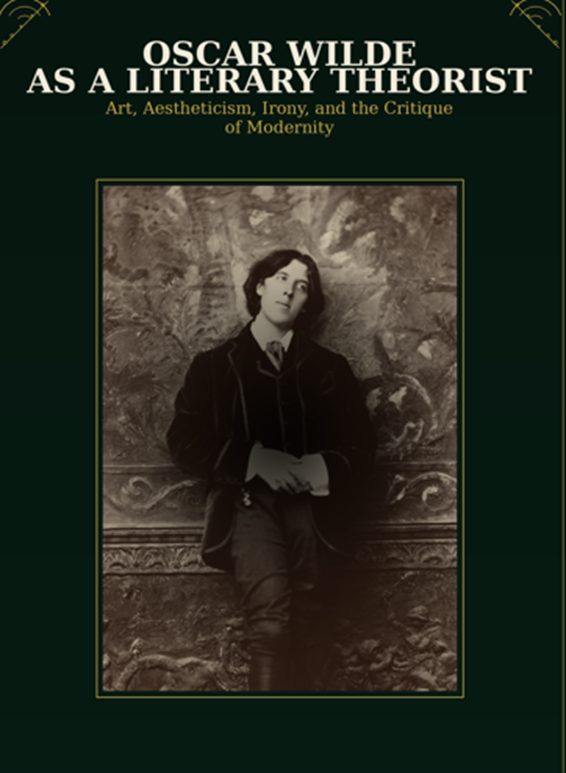
Introduction: Oscar Wilde as a Literary Theorist
Oscar Wilde as a Literary Theorist emerges above all as a paradoxical aesthete who treats criticism not as secondary commentary but as an independent, creative act—so much so that he insists “the highest criticism…is…the record of one’s own soul” (Wilde, The Critic as Artist 395). Born in Dublin (1854) into an intellectually charged Irish milieu shaped by his mother’s nationalist-literary presence (Lady Wilde, “Speranza”), Wilde’s early formation combined cultural politics with an intense commitment to style and imagination (Bristow 123). His educational background sharpened this orientation: he read classics at Trinity College Dublin (1871–1874) and then pursued literae humaniores (“Greats”) at Oxford (1874–1878), working through extensive notebooks that reveal serious scholarly method beneath the pose of effortless brilliance (Bristow 162). From this training, Wilde develops a set of core theoretical ideas: (1) criticism is a distinct art requiring superior refinement—“criticism demands infinitely more cultivation than creation does” (Wilde, qtd. in Weintraub x); (2) art is not a mirror of reality but a generative force that shapes perception and conduct, captured in Vivian’s dictum “Life imitates Art far more than Art imitates Life” (Wilde, The Decay of Lying 220); and (3) history and “fact” are themselves aesthetic constructions, hence “the one duty we owe to history is to re-write it” (Wilde, qtd. in Weintraub xxix). These principles crystalize in his major critical works—especially “The Critic as Artist” and “The Decay of Lying” (collected in Intentions)—while his literary practice in The Picture of Dorian Gray, The Importance of Being Earnest, and Salomé dramatizes the same claims: that style produces truth-effects, that social “reality” is theatrical, and that interpretation is itself a form of creation rather than mere judgment (Wilde, The Critic as Artist 395).
Major Works of Oscar Wilde as a Literary Theorist
Preface to The Picture of Dorian Gray (1890): Aesthetic Autonomy, Symbol, and Anti-Moralizing Criticism
Wilde’s preface functions as a compact manifesto for aesthetic criticism: it asserts the autonomy of art, defines criticism as creative translation, and rejects the reduction of literature to moral adjudication—an explicitly “theoretical” posture that later schools (formalism, aestheticism, aspects of reader-response) echo.
- 🌸 “The artist is the creator of beautiful things.” (Wilde, Literary Criticism 229)
🌼 “The highest, as the lowest, form of criticism is a mode of autobiography.” (Wilde, Literary Criticism 229)
🌺 “There is no such thing as a moral or an immoral book. Books are well written, or badly written.” (Wilde, Literary Criticism 229)
🌷 “All art is quite useless.” (Wilde, Literary Criticism 230)
“The Critic as Artist” (1890; in Intentions): Criticism as Cultural Leadership and Creative Reproduction
Here Wilde elevates criticism from “secondary” commentary to an engine of cultural consciousness: criticism does not merely follow art; it “leads” by imposing form, articulating value, and making meaning transmissible through imaginative re-creation—turning interpretation into a quasi-creative act.
- 🌸 “There was never a time when Criticism was more needed than it is now. It is only by its means that Humanity can become conscious of the point at which it has arrived.” (Wilde, Literary Criticism 228)
🌼 “Creation is always behind the age. It is Criticism that leads us.” (Wilde, Literary Criticism 228)
🌺 The critic, Wilde insists, reproduces art “in a mode that is never imitative,” making the critic’s work a transformation rather than a copy. (Wilde, Literary Criticism 228)
“The Decay of Lying” (1889; in Intentions): Anti-Mimesis and the Priority of Artistic Fabrication
In this dialogue, Wilde theorizes art as invention rather than mirror: the “lie” becomes a disciplined aesthetic principle—style, selection, and imaginative distortion that (paradoxically) best reveals what mere factuality cannot.
- 🌸 “Lying, the telling of beautiful untrue things, is the proper aim of Art.” (Wilde, Literary Criticism 169)
🌼 “Life imitates Art far more than Art imitates Life.” (Wilde, Literary Criticism 182)
🌺 Wilde’s “lying” is not fraud but form: art achieves intensity by refusing the dull coercions of “the actual,” thereby shaping how reality is later perceived and even lived. (Wilde, Literary Criticism 182)
“The Truth of Masks” (1885/1891): Semiotics of Costume, Performance, and the Theatrical Production of Meaning
Wilde’s essay treats costume as an interpretive system: clothing operates as sign, dramaturgical device, and “technology” of illusion—anticipating later theoretical emphases on performance, signification, and the constructedness of identity on stage (and by implication, in social life).
- 🌸 Costume can function as “a mode of intensifying dramatic situation.” (Wilde, Literary Criticism 135)
🌼 Shakespeare “saw that costume could be made… expressive of certain types of character.” (Wilde, Literary Criticism 139)
🌺 Wilde frames historical accuracy as valuable only when aesthetically transfigured—archaeology must be “transfused into some form of art,” rather than becoming pedantic “lecture.” (Wilde, Bristow et al. 262)
“The Soul of Man under Socialism” (1891): Individualism as the Condition of Art and the Politics of Aesthetic Freedom
Wilde’s social theory is inseparable from his aesthetics: he argues that art requires the freedom of the unique temperament, and that coercive publics and states deform art into mere craft. This makes his “literary theory” simultaneously ethical-political: an argument about the material conditions that allow creativity to exist.
- 🌸 “A work of art is the unique result of a unique temperament.” (Wilde, Artist as Critic 300)
🌼 “Art is the most intense mode of individualism that the world has known.” (Wilde, Artist as Critic 300)
🌺 “The true perfection of man lies, not in what man has, but in what man is.” (Wilde, Artist as Critic 291)
Major Literary Ideas of Oscar Wilde as a Literary Theorist
| Major Wildean Literary Idea | Explanation / Commentary | Key quotation |
| 🌸 Criticism is a creative art (not “secondary” talk) | Wilde elevates criticism into an imaginative reproduction of art: the critic transforms a work into “another manner,” making interpretation itself a mode of artistic making. This is foundational to Wilde’s theory of criticism as cultural authority and meaning-production. | “I would call criticism a creation within a creation.” (Wilde 221) |
| 🌼 Criticism leads culture; creation tends to repeat | Wilde argues that criticism supplies innovation by inventing “fresh forms,” whereas creation often reiterates inherited patterns. Criticism becomes the intellectual mechanism by which an age becomes self-conscious. | “Creation is always behind the age. It is Criticism that leads us.” (Wilde 228) |
| 🌺 The critic “translates” impressions into new form/material | Wilde defines the critic not as a moral judge but as a translator of aesthetic experience—someone who re-expresses beauty through a new medium (language, style, genre). This implies interpretation is materially productive, not merely evaluative. | “The critic is he who can translate into another manner or a new material his impression of beautiful things.” (Wilde 229) |
| 🌷 Aesthetic autonomy: art is not to be judged morally | Wilde separates ethics from aesthetics: the literary work is to be assessed as writing (style, form, execution), not as moral instruction. This is a direct rejection of Victorian moralized reviewing culture. | “There is no such thing as a moral or an immoral book. Books are well written, or badly written.” (Wilde 229) |
| 🌻 Art is “surface and symbol”; interpretation is risky and powerful | Wilde theorizes aesthetic meaning as double-layered: art offers both surface pleasure and symbolic depth, but reading “beneath” or “as symbol” carries interpretive danger—suggesting that meaning is not stable, and that the reader’s approach partly creates what is found. | “All art is at once surface and symbol.” (Wilde 230) |
| 🌹 Art mirrors the spectator, not “life” | Wilde relocates “truth” from external reality to reception: the artwork reflects the viewer/reader—taste, desire, corruption, cultivation—thereby aligning criticism with self-revelation and positioning interpretation as autobiographical. | “It is the spectator, and not life, that art really mirrors.” (Wilde 230) |
| 🌸 Anti-mimesis: “life imitates art” and the aesthetics of “lying” | Wilde’s most disruptive claim is that art shapes how reality is perceived and even enacted; “lying” becomes a disciplined aesthetic principle (fabrication, selection, stylization) rather than a moral fault. Bristow’s analysis summarizes Wilde’s dialogue-argument and its cultural implications. | “Life imitates art far more than Art imitates Life.” (Bristow 233) |
Theoretical Terms/Concepts of Oscar Wilde as a Literary Theorist
- 🌸 Criticism-as-Creation (Creative Criticism)
Explanation: Wilde rejects the hierarchy that treats criticism as “secondary.” For him, the critic reshapes already “purified” artistic material into a new aesthetic object; interpretation is itself a productive art. - Example (quotation): “I would call criticism a creation within a creation.” (Wilde, Literary Criticism 221)
- 🌼 Autobiographical Criticism (Impressionism in Reading)
Explanation: Wilde defines high criticism as the critic’s refined self-record—less about “events” and more about moods, sensibility, and intellectual passion. This is a key Wildean premise for later reader-centered approaches. - Example (quotation): “That is what the highest criticism really is, the record of one’s own soul.” (Wilde, Literary Criticism 222)
- 🌺 Cultural Leadership of Criticism (Criticism Leads the Age)
Explanation: Wilde claims that criticism is how an era becomes self-conscious; it “imposes form upon chaos” and therefore leads cultural development more than “creation,” which tends to repeat. - Example (quotation): “Creation is always behind the age. It is Criticism that leads us.” (Wilde, Literary Criticism 228)
- 🌷 The Critical Faculty Invents Forms (Form-Making Theory of History)
Explanation: Wilde’s theory is not only about reviewing art but about how art evolves: new schools and genres arise from critical intelligence (classification, refinement, formal invention). - Example (quotation): “For it is the critical faculty that invents fresh forms.” (Wilde, Literary Criticism 214)
- 🌻 Anti-Mimesis (Life Imitates Art)
Explanation: Wilde reverses the commonsense model of representation: art does not simply copy reality; it helps produce what later looks like reality. Bristow’s discussion clarifies that the relationship is causal—art exerts an “imaginative hold” over its audience and conduct. - Example (quotation): “Life imitates art far more than Art imitates Life.” (Bristow 231)
- 🌹 “Lying in Art” (Beautiful Untruths / Romance over Realism)
Explanation: “Lying” becomes a technical aesthetic principle: disciplined invention that resists crude “Realism” and restores “Romance.” Bristow explains Wilde’s distinction between debased lying (journalism) and the pure form—“Lying in Art.” - Example (quotation): “The supreme type of lying…is ‘Lying in Art.’” (Bristow 233)
- 🌸 Aesthetic Autonomy (Art vs. Ethics)
Explanation: Wilde separates aesthetic judgment from moral policing: books are to be evaluated by writing and form, not by alleged virtue/vice. This is central to his theory of art’s independence from social moralism. - Example (quotation): “There is no such thing as a moral or an immoral book. Books are well written, or badly written.” (Wilde, Artist as Critic 264)
- 🌼 Surface / Symbol and the Risk of Interpretation (Hermeneutic Peril)
Explanation: Wilde insists that art is simultaneously surface pleasure and symbolic depth—but warns that aggressive “beneath-the-surface” reading can corrupt the reader’s relationship to beauty. - Example (quotation): “All art is at once surface and symbol…Those who read the symbol do so at their peril.” (Wilde, Literary Criticism 230)
- 🌺 The Spectator-Mirror Principle (Reception as Meaning-Maker)
Explanation: Wilde relocates the “mirror” function of art from the external world to the viewer/reader; interpretation reveals the spectator’s sensibility—one reason criticism becomes “autobiography.” - Example (quotation): “It is the spectator, and not life, that art really mirrors.” (Wilde, Literary Criticism 230)
- 🌷 Individualism / Unique Temperament (Artist’s Autonomy from Demand)
Explanation: Wilde theorizes art as the outcome of a singular temperament; once the artist caters to demand, art collapses into craft. This is his aesthetic theory of artistic freedom (with clear social implications). - Example (quotation): “A work of art is the unique result of a unique temperament…Art is the most intense mode of individualism that the world has known.” (Wilde, Artist as Critic 300)
Application of Theoretical Ideas of Oscar Wilde as a Literary Theorist to Literary Works
| Literary Work | Application of Oscar Wilde’s Theoretical Ideas |
| The Picture of Dorian Gray (1890) | This novel is the most sustained fictional enactment of Wilde’s aesthetic theory. It applies aesthetic autonomy and the surface/symbol doctrine articulated in the Preface, where Wilde insists that “There is no such thing as a moral or an immoral book” (Wilde, Literary Criticism 229). The portrait dramatizes the danger of interpretive moralism: readers who search obsessively for ethical meanings repeat the very error Wilde warns against—reading “the symbol” at their peril (230). The novel also illustrates anti-mimesis: Dorian’s life imitates the aesthetic script offered by art (the “yellow book”), confirming Wilde’s claim that “Life imitates Art far more than Art imitates Life” (The Decay of Lying 182). |
| The Importance of Being Earnest (1895) | The play exemplifies Wilde’s rejection of Realism in favor of artifice, performance, and mask-play. Social identity becomes theatrical rather than “natural,” aligning with Wilde’s theory that art does not mirror life but reshapes how life is perceived. The deliberate artificiality of dialogue and plot supports Wilde’s idea that comedy thrives on style rather than verisimilitude. Moreover, the play enacts the spectator-mirror principle: audiences recognize their own social hypocrisies not because the play imitates life, but because “it is the spectator, and not life, that art really mirrors” (Wilde, Literary Criticism 230). |
| Salomé (1891) | Salomé applies Wilde’s theory of symbolist surface and aesthetic autonomy most radically. Its repetitive imagery and ritualized language force readers toward symbolic interpretation while simultaneously demonstrating the risk of over-interpretation that Wilde theorizes in the Preface. Moral outrage directed at the play exemplifies Wilde’s claim that ethical judgment is an illegitimate critical category for art. As Wilde argues elsewhere, art and ethics are “absolutely distinct and separate spheres” (Wilde, Artist as Critic 265), and Salomé becomes a practical test-case for this separation. |
| “The Happy Prince” (1888) | This tale illustrates Wilde’s belief in cultivated reading and impressionistic criticism. While the story appears morally transparent, Wilde’s theory insists that its value lies not in didactic instruction but in the reader’s refined emotional response. The text rewards those who “find beautiful meanings in beautiful things” (Wilde, Literary Criticism 229), aligning with Wilde’s view that criticism is autobiographical—“the record of one’s own soul” (222). The story thus applies Wilde’s theory that art generates ethical feeling indirectly through beauty, not through moral preaching. |
Representative Quotations of Oscar Wilde as a Literary Theorist
| Quotation | Explanation (how the quotation functions theoretically) |
| 🌸 “To reveal art and conceal the artist is art’s aim.” (Wilde, Literary Criticism 229) | Establishes Wilde’s doctrine of impersonality: criticism should not reduce artworks to biography; art is a formal construction whose “truth” is aesthetic, not confessional. |
| 🌼 “The critic is he who can translate into another manner or a new material his impression of beautiful things.” (Wilde, Literary Criticism 229) | Defines criticism as creative translation (not mere evaluation): the critic produces a new work (a new “manner”/“material”) out of aesthetic experience. |
| 🌺 “The highest, as the lowest, form of criticism is a mode of autobiography.” (Wilde, Literary Criticism 229) | Core Wildean premise for impressionistic/reader-centered criticism: interpretation reveals the critic’s sensibility; the critic’s “self” is the medium of value. |
| 🌷 “There is no such thing as a moral or an immoral book. Books are well written, or badly written. That is all.” (Wilde, Literary Criticism 229) | Articulates aesthetic autonomy: ethical judgment is an illegitimate critical category for literature; evaluation belongs to form, style, and artistic execution. |
| 🌻 “All art is at once surface and symbol.” (Wilde, Literary Criticism 230) | Wilde’s compact semiotic theory of art: art operates simultaneously as sensuous surface and symbolic depth, resisting single-level interpretation. |
| 🌹 “It is the spectator, and not life, that art really mirrors.” (Wilde, Literary Criticism 230) | A major reception principle: meaning is co-produced by the audience; art reflects the interpreter’s desires, fears, and cultivation more than external reality. |
| 🌸 “All art is quite useless.” (Wilde, Literary Criticism 230) | Wilde’s most famous statement of anti-utilitarian aesthetics: art’s “use” is not instrumental (moral, political, practical) but aesthetic—valued for its own form and intensity. |
| 🌼 “Life imitates Art far more than Art imitates Life.” (Wilde, Literary Criticism 196) | The center of Wilde’s anti-mimetic theory: art shapes perception and behavior; “reality” often follows aesthetic scripts generated by literature, painting, and style. |
| 🌺 “Lying, the telling of beautiful untrue things, is the proper aim of Art.” (Wilde, Literary Criticism 196) | Reframes “lying” as an aesthetic virtue: deliberate invention and stylization are the condition of artistic beauty, opposing crude “Realism” and factual worship. |
| 🌷 “Man is least himself when he talks in his own person. Give him a mask, and he will tell you the truth.” (Wilde, Artist as Critic 420) | A theory of mask, performance, and truth-effects: identity and sincerity are often produced through artifice; representation can disclose truths unavailable to direct self-report. |
Criticism of the Ideas of Oscar Wilde as a Literary Theorist
- Aestheticism and the Charge of Moral Evasion
Critics from the Victorian period onward have argued that Wilde’s insistence on aesthetic autonomy—especially his claim that “there is no such thing as a moral or an immoral book”—amounts to an evasion of ethical responsibility. From this perspective, Wilde’s theory is seen as insufficient for addressing literature’s social and moral consequences, particularly in texts like The Picture of Dorian Gray, where ethical effects appear inseparable from aesthetic form. - Excessive Subjectivism in Impressionistic Criticism
Wilde’s definition of criticism as “the record of one’s own soul” has been criticized for collapsing evaluation into personal taste. Later formalists and structuralists object that such subjectivism undermines the possibility of shared standards of interpretation and turns criticism into refined autobiography rather than disciplined analysis. - Paradox over Systematic Theory
Wilde’s theoretical writings privilege wit, paradox, and dialogue over conceptual rigor. While rhetorically powerful, this method has been criticized for lacking a coherent, systematic framework, making his ideas difficult to operationalize as a stable critical methodology. - Anti-Mimesis as Overstatement
The claim that “life imitates art more than art imitates life” has been challenged as an overcorrection rather than a balanced theory of representation. Marxist and historicist critics argue that material conditions, social structures, and historical forces shape art more decisively than Wilde allows. - Elitism and the Cult of the ‘Cultivated’ Reader
Wilde’s frequent distinction between the “cultivated” and the “uncultivated” reader has been read as elitist. Critics argue that this aesthetic hierarchy marginalizes popular or mass readerships and privileges a narrow, class-inflected notion of taste and refinement. - Neglect of Socio-Political Context
Despite The Soul of Man under Socialism, Wilde’s literary theory is often seen as insufficiently attentive to power, class, and ideology. Marxist, feminist, and postcolonial critics contend that Wilde underestimates how literature participates in social struggle rather than existing in a purely aesthetic realm. - Contradiction between Theory and Practice
Some critics note a tension between Wilde’s theory of impersonality (“to reveal art and conceal the artist”) and the biographical intensity of works like De Profundis. This contradiction raises questions about whether Wilde’s own life and suffering destabilize his aesthetic detachment. - Romanticization of ‘Lying’ and Artifice
Wilde’s valorization of “lying in art” has been criticized as potentially encouraging disengagement from truth, particularly in modern contexts where misinformation and spectacle blur ethical boundaries between art, journalism, and propaganda. - Limited Engagement with Gender and Power
Feminist critics have argued that Wilde’s theoretical writings largely ignore gendered power relations, even though his creative works often dramatize them. His theory, they argue, remains silent on how aesthetic “freedom” may operate differently across gendered bodies. - Historical Containment of Wildean Aestheticism
Later theorists have suggested that Wilde’s aestheticism is historically specific to late Victorian culture and fin-de-siècle decadence. While influential, it may not easily transfer to periods where literature is inseparable from urgent political, ethical, or national concerns.
Suggested Readings on Oscar Wilde as a Literary Theorist
Books
- Wilde, Oscar. Literary Criticism of Oscar Wilde. Edited by Stanley Weintraub, University of Nebraska Press, 1968.
- Wilde, Oscar. The Artist as Critic: Critical Writings of Oscar Wilde. Edited by Richard Ellmann, University of Chicago Press, 1982. University of Chicago Press.
- Bristow, Joseph, and Rebecca N. Mitchell. Oscar Wilde’s Chatterton: Literary History, Romanticism, and the Art of Forgery. Yale University Press, 2015. Yale University Press.
- Finzi, John Charles. Oscar Wilde and His Literary Circle: A Catalog of Manuscripts and Letters in the William Andrews Clark Memorial Library. HathiTrust Digital Library.
Academic articles
- Lamarque, Peter. “The Uselessness of Art.” The Journal of Aesthetics and Art Criticism, vol. 68, no. 3, 2010, pp. 205–214. Oxford Academic, https://academic.oup.com/jaac/article-abstract/68/3/205/5979855. Accessed 12 Dec. 2025.
- Bristow, Joseph, and Rebecca N. Mitchell. “Oscar Wilde’s ‘Cultivated Blindness’: Reassessing the Textual and Intellectual History of ‘The Decay of Lying’.” The Review of English Studies, vol. 69, no. 288, 2018, pp. 94–156. Oxford Academic, https://academic.oup.com/res/article-abstract/69/288/94/4093510. Accessed 12 Dec. 2025.
- Delhorme, Carole. “Embracing and Rejecting the Ruskinian Heritage in Wilde’s Aesthetic Theories.” Cahiers victoriens et édouardiens, no. 91, 2020. OpenEdition Journals, https://journals.openedition.org/cve/7197?lang=en. Accessed 12 Dec. 2025.
Websites
- Wilde, Oscar. Intentions. Project Gutenberg, https://www.gutenberg.org/files/887/887-h/887-h.htm. Accessed 12 Dec. 2025.
- Diniejko, Andrzej. “Oscar Wilde’s Vision of Aesthetic Socialism.” The Victorian Web, 16 Nov. 2017, https://victorianweb.org/authors/wilde/diniejko.html. Accessed 12 Dec. 2025.