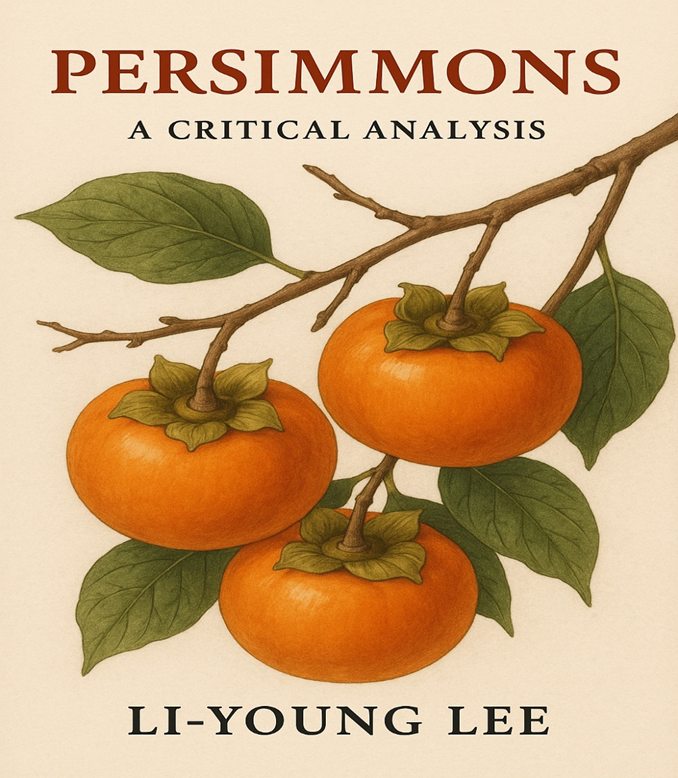
Introduction: “Persimmons” by Li-Young Lee
“Persimmons” by Li-Young Lee first appeared in 1986 in his debut collection Rose (BOA Editions), a book that frames memory as something tasted, touched, and mispronounced. The poem’s main ideas braid immigrant-language shame with sensual knowledge and familial love: the childhood classroom humiliation over “persimmon and precision” becomes a lifelong lesson that “This is precision” can mean not just correct English but the exactness of the body—how to recognize ripeness, how to “know” by smell, touch, and sweetness rather than rules. That embodied precision widens into intimacy and forgetting (the speaker teaches words, then admits “I’ve forgotten”), and then deepens into inheritance: the mother’s faith that each fruit holds “a sun inside,” the father’s “going blind,” and the final reversal where sight yields to touch as he asks “Which is this?” and the son answers, “This is persimmons,” while the father’s wrist retains “precision” even when his eyes do not. Its popularity endures because it’s both teachable and devastatingly human: a clear narrative (school → desire → parents → homecoming) carries luminous sensory detail and a universal ache—how language can wound, how memory repairs through the senses—making it, as critics note, “much loved and anthologized,” precisely because it fuses meaning with mouthfeel, word with world.
Text: “Persimmons” by Li-Young Lee
In sixth grade Mrs. Walker
slapped the back of my head
and made me stand in the corner
for not knowing the difference
between persimmon and precision.
How to choose
persimmons. This is precision.
Ripe ones are soft and brown-spotted.
Sniff the bottoms. The sweet one
will be fragrant. How to eat:
put the knife away, lay down newspaper.
Peel the skin tenderly, not to tear the meat.
Chew the skin, suck it,
and swallow. Now, eat
the meat of the fruit,
so sweet,
all of it, to the heart.
Donna undresses, her stomach is white.
In the yard, dewy and shivering
with crickets, we lie naked,
face-up, face-down.
I teach her Chinese.
Crickets: chiu chiu. Dew: I’ve forgotten.
Naked: I’ve forgotten.
Ni, wo: you and me.
I part her legs,
remember to tell her
she is beautiful as the moon.
Other words
that got me into trouble were
fight and fright, wren and yarn.
Fight was what I did when I was frightened,
Fright was what I felt when I was fighting.
Wrens are small, plain birds,
yarn is what one knits with.
Wrens are soft as yarn.
My mother made birds out of yarn.
I loved to watch her tie the stuff;
a bird, a rabbit, a wee man.
Mrs. Walker brought a persimmon to class
and cut it up
so everyone could taste
a Chinese apple. Knowing
it wasn’t ripe or sweet, I didn’t eat
but watched the other faces.
My mother said every persimmon has a sun
inside, something golden, glowing,
warm as my face.
Once, in the cellar, I found two wrapped in newspaper,
forgotten and not yet ripe.
I took them and set both on my bedroom windowsill,
where each morning a cardinal
sang, The sun, the sun.
Finally understanding
he was going blind,
my father sat up all one night
waiting for a song, a ghost.
I gave him the persimmons,
swelled, heavy as sadness,
and sweet as love.
This year, in the muddy lighting
of my parents’ cellar, I rummage, looking
for something I lost.
My father sits on the tired, wooden stairs,
black cane between his knees,
hand over hand, gripping the handle.
He’s so happy that I’ve come home.
I ask how his eyes are, a stupid question.
All gone, he answers.
Under some blankets, I find a box.
Inside the box I find three scrolls.
I sit beside him and untie
three paintings by my father:
Hibiscus leaf and a white flower.
Two cats preening.
Two persimmons, so full they want to drop from the cloth.
He raises both hands to touch the cloth,
asks, Which is this?
This is persimmons, Father.
Oh, the feel of the wolftail on the silk,
the strength, the tense
precision in the wrist.
I painted them hundreds of times
eyes closed. These I painted blind.
Some things never leave a person:
scent of the hair of one you love,
the texture of persimmons,
in your palm, the ripe weight.
Copyright Credit: Li-Young Lee, “Persimmons” from Rose. Copyright © 1986 by Li-Young Lee. Reprinted with the permission of BOA Editions Ltd., www.boaeditions.org.
Annotations: “Famous” by Naomi Shihab Nye
| Stanza | Text cue | Annotation (what it’s doing / meaning) | Literary devices |
| 1 | “sixth grade… persimmon / precision” | School becomes a site of linguistic policing: the speaker is shamed for not mastering an English distinction, turning pronunciation into a measure of “intelligence” and belonging. | 🧩 Wordplay (sound-nearness) • 🎭 Juxtaposition (fruit vs “precision”) • ⚡ Power/violence (slap) • 🪞 Irony (punishment for language) • 🧭 Symbolism (fruit = culture/identity) |
| 2 | “How to choose… This is precision… How to eat” | A counter-lesson: “precision” is redefined as intimate knowledge of the persimmon—sensory, careful, embodied—suggesting cultural knowledge can be deeper than institutional correctness. | 🧠 Extended metaphor (“precision” = embodied knowing) • 👁️ Sensory imagery (smell, softness, sweetness) • 🔁 Repetition (“How to…”) • 🗣️ Imperatives (instructional voice) • 🧭 Motif (persimmon as memory/language) |
| 3 | “Donna… I teach her Chinese… ‘I’ve forgotten’… moon” | Desire and language intertwine: intimacy becomes a space where words are taught, lost, and half-remembered—showing how memory, eros, and bilingual identity overlap. | 👂 Onomatopoeia (“chiu chiu”) • 🔁 Repetition (“I’ve forgotten”) • 🎭 Juxtaposition (lesson + nakedness) • 💬 Code-switching (Ni, wo) • 🌙 Simile (beauty “as the moon”) • 👁️ Sensory imagery (dew, crickets) |
| 4 | “fight / fright… wren / yarn… birds of yarn” | Misheard words become identity traps. The poem highlights minimal differences that create major consequences; mother’s yarn birds suggest creative, nurturing knowledge outside school’s rules. | 🧩 Wordplay/minimal pairs • 🔁 Parallelism (fight/fright explanation) • 🔄 Antimetabole-like reversal (fighting/fear) • 🌙 Simile (“soft as yarn”) • 🧭 Symbolism (mother’s craft = culture/making-self) • 👁️ Visual imagery (knotted figures) |
| 5 | “Mrs. Walker… ‘Chinese apple’… I didn’t eat” | Cultural simplification in the classroom: the fruit is renamed for comfort, but it’s unripe—and the speaker watches others consume a false version, signaling alienation and quiet resistance. | 🪞 Irony (the “lesson” is wrong/unripe) • 🎭 Contrast (speaker vs class) • 👁️ Facial/visual imagery (watching faces) • 🧭 Symbolism (unripe fruit = distorted culture) |
| 6 | “every persimmon has a sun inside” | The mother’s wisdom turns fruit into an inner radiance: identity contains warmth and value that outsiders can’t measure by pronunciation. | 🧠 Metaphor (“sun inside”) • 🧭 Symbolism (inner gold = heritage/self-worth) • 👁️ Imagery (golden, glowing, warm) |
| 7 | “cellar… wrapped… windowsill… cardinal: ‘The sun’” | The speaker stages ripening as a ritual: time, light, and song transform what was “not yet” into sweetness—suggesting patience with self, language, and belonging. | ⏳ Time motif (ripening) • 🧭 Motif (sun) • 🔁 Repetition (“The sun, the sun”) • 🎶 Auditory imagery (cardinal’s song) • 🧠 Symbolic transformation (unripe → ripe) |
| 8 | “father… going blind… song/ghost… sweet as love” | A turning-point of care: persimmons become a gift of memory and comfort to the father, blending sweetness with grief—love expressed through texture and taste when sight fades. | 🌙 Similes (“heavy as sadness,” “sweet as love”) • 👁️ Tactile imagery (swelled, heavy) • 👻 Metaphoric yearning (“song, a ghost”) • 🎭 Juxtaposition (sadness + sweetness) • 🧭 Symbolism (fruit = love carried home) |
| 9 | “This year… cellar… cane… ‘All gone’” | Present-time return: the poem shifts to an adult homecoming. The casual “stupid question” and blunt answer show how loss becomes ordinary—and still devastating. | 📜 Time shift (past → present) • 💬 Dialogue • 🪞 Understatement/irony (“stupid question”) • 👁️ Visual/tactile imagery (cane, stairs, grip) • 🎭 Contrast (happiness + blindness) |
| 10 | “box… scrolls… paintings: hibiscus, cats, persimmons” | Discovery of the father’s art reframes “precision”: it lives in craft and attention. The described paintings function like a museum scene—memory made visible. | 🎨 Ekphrasis (art description) • 🧭 Symbolism (scrolls = legacy) • 👁️ Visual imagery (leaf, flower, cats, fruit) • 🔢 Triadic structure (three scrolls) |
| 11 | “Which is this? / This is persimmons, Father.” | A deeply intimate reversal: the father cannot see, so the son supplies the naming—language becomes care, and identification becomes touch-based truth. | 💬 Dialogue • 👁️/✋ Tactile imagery (touching cloth) • 🧭 Symbolism (naming = love/recognition) • 🎭 Role reversal (child guides parent) |
| 12 | “wolftail on silk… painted blind… Some things never leave…” | The ending argues that true precision persists beyond eyesight: muscle-memory, scent, texture. The final list makes memory physical—what remains is not abstract meaning but felt presence. | 🧠 Paradox (precision while blind) • 👁️ Multi-sensory imagery (feel, scent, weight) • 📜 Reflective turn (aphoristic close) • 🧾 Enumeration/listing • 🧭 Motif (persimmon texture/weight as lasting memory) |
Literary And Poetic Devices: “Famous” by Naomi Shihab Nye
| Device | Short definition | Example from the poem | Detailed explanation |
| 🔴 Imagery (Taste / Gustatory) | Language that appeals to taste | “so sweet, / all of it, to the heart.” | The sweetness is physical and emotional: the fruit’s taste becomes a way to describe love, belonging, and the “right” kind of knowing—one that reaches “to the heart,” not just the mouth. |
| 🟠 Imagery (Smell / Olfactory) | Language that appeals to smell | “Sniff the bottoms… will be fragrant.” | Smell becomes a tool of “precision” that cannot be taught by punishment. It suggests cultural knowledge learned through daily practice and the senses, not through English-only rules. |
| 🟡 Imagery (Touch / Tactile) | Language that appeals to touch/texture | “the texture of persimmons, / in your palm, the ripe weight.” | Touch replaces sight and becomes a language of intimacy. With the father’s blindness, the poem insists that meaning can live in the hand—weight, texture, and warmth carry memory when words and eyes fail. |
| 🟢 Imagery (Visual) | Picture-making detail | “Ripe ones are soft and brown-spotted.” | The careful visual description models the poem’s larger argument: true “precision” is attentive observation. The speaker’s gaze is trained not by classroom shame but by love and careful noticing. |
| 🔵 Symbolism (Persimmon / Sun) | An object represents layered meanings | “every persimmon has a sun / inside” | The persimmon symbolizes inner radiance: cultural inheritance, warmth, and value that exists regardless of accent or error. “Sun inside” reframes what was mocked in school as something golden and sustaining. |
| 🟣 Extended Metaphor (Precision) | One idea is developed across the poem | “How to choose / persimmons. This is precision.” | “Precision” starts as a vocabulary test but expands into a philosophy: precision is the exactness of care (peeling “tenderly”), the accuracy of intimacy, and finally the disciplined artistry of the father’s wrist—a deeper correctness than pronunciation. |
| 🟤 Juxtaposition (School vs Home) | Placing contrasts side by side | “slapped… corner” vs “sweet as love.” | The poem stages two worlds: institutional authority that humiliates versus family knowledge that heals. By contrasting these spaces, Lee shows how immigrant children may be graded for errors in public but nurtured by meaning in private. |
| ⚫ Alliteration | Repeated initial consonant sounds | “brown-spotted… bottoms” | The soft, repeated “b” sounds slow the line and mimic the gentle handling of ripe fruit. Sound supports sense: the poem’s music performs the tenderness it advocates. |
| ⚪ Assonance | Repeated vowel sounds | “sweet… meat… to the heart” | Repeated long vowel sounds stretch the mouth and linger, echoing the poem’s insistence that some truths are meant to be savored, not snapped into “right/wrong” categories. |
| 🟥 Consonance | Repeated consonants within/at ends | “swelled, heavy as sadness” | The dense consonants weigh down the line, matching the “heavy” feeling. Sound becomes emotional pressure—grief is not only stated, it is felt in the line’s drag. |
| 🟧 Repetition | Repeating a word/phrase for emphasis | “The sun, the sun.” | The repeated phrase acts like a chant or insistence: warmth persists even in cellar-dimness. It reinforces the motif of inner light—memory returning again and again, refusing erasure. |
| 🟨 Anaphora | Repeating beginnings of phrases/lines | “Wrens are… / Wrens are…” | The repeated structure mimics a child’s lesson-book definitions, but the tone is affectionate. It shows the speaker learning language through wonder and association, not fear. |
| 🟩 Enjambment | Meaning runs over line breaks | “Finally understanding / he was going blind,” | The line break delays the revelation, reproducing the emotional shock of “finally understanding.” Form imitates experience: realization arrives a beat late, like grief often does. |
| 🟦 Caesura (strong internal pause) | A deliberate pause inside a line | “Naked: I’ve forgotten.” | The colon and spacing create a visible and audible gap—memory stutters. The pause dramatizes how language can fail at the edge of intimacy; some words vanish, leaving silence where fluency should be. |
| 🟪 Irony (situational) | Outcome contradicts expectation | “it wasn’t ripe or sweet… I didn’t eat” | The teacher’s cultural “gift” (a persimmon) becomes another miseducation: the fruit is unripe, so the lesson tastes wrong. The speaker’s refusal is quiet resistance—he knows more than the classroom can measure. |
| 🟫 Personification | Nonhuman given human desire/action | “so full they want to drop” | The persimmons appear almost willful, brimming with life. This personification intensifies abundance and ripeness, suggesting memory itself is so full it presses to spill out. |
| ❤️ Simile | Comparison using “like/as” | “beautiful as the moon.” | The simile lifts a private moment into mythic brightness. The moon image links desire to tenderness and awe, showing that language-learning here is not mechanical but charged with affection. |
| 💛 Synesthesia (cross-sensory blending) | One sense described through another | “something golden, glowing, / warm as my face.” | “Golden/glowing” (sight) merges with “warm” (touch). This fusion turns the persimmon into a multi-sensory emblem of comfort, suggesting that memory is stored across senses at once. |
| 💚 Motif (Forgetting / Remembering) | A recurring idea/image thread | “I’ve forgotten… I’ve forgotten.” | Forgetting recurs as a human limit—language slips, desire confuses, time erases. Yet the poem counterbalances loss with sensory anchors (scent, texture, weight), implying we remember not only with words but with the body. |
| 💙 Tone shift (Shame → Tenderness) | Movement in emotional register | from “slapped… corner” to “sweet as love.” | The poem’s power comes from its emotional arc: it begins with humiliation and ends with intimate, reverent care for a blind father and an artist’s “precision.” The tonal journey converts trauma into meaning, making the poem widely relatable: many readers recognize how the self is rebuilt through memory, family, and reclaimed language. |
Themes: “Famous” by Naomi Shihab Nye
🟠 Theme 1: Language, Identity, and Linguistic Shame
Persimmons by Li-Young Lee begins with a childhood scene where “persimmon” is confused with “precision,” and the teacher’s slap exposes how language can police belonging, because a minor phonetic slip becomes proof of failure and cultural otherness. Yet the poem refuses that verdict, since the speaker reclaims authority by redefining “precision” as lived knowledge—how to choose ripe fruit, how to peel it “tenderly,” how to teach words (“Ni, wo”), and how to keep meaning even when a translation disappears. By pairing schoolroom humiliation with the sensuous certainty of taste, touch, and naming, Lee shows that identity is not secured by perfect diction but by the ability to carry two vocabularies at once, one public and punitive, the other intimate and sustaining, and to insist that the so-called mistake contains its own truth. In that reversal, the poem makes mispronunciation a doorway into memory, tenderness, and cultural survival, rather than shame.
🟡 Theme 2: Sensory Memory and Embodied “Precision”
Persimmons by Li-Young Lee builds a poetics of the senses, arguing that the body is an archive whose evidence is more trustworthy than abstract correctness, and this claim unfolds through the step-by-step “how to” of choosing, sniffing, peeling, chewing, and swallowing. The fruit’s softness, fragrance, and “ripe weight” become a grammar of remembrance, so that what the speaker learns is not merely vocabulary but a method: attend closely, handle gently, and let sweetness arrive in its own time. When the mother says each persimmon has a “sun inside,” she names an inner radiance that can be felt as warmth even in a dark cellar, and the cardinal’s refrain, “The sun, the sun,” turns ordinary mornings into ritual confirmation. By the end, touch replaces sight for the blind father, and texture becomes meaning itself, suggesting that memory survives as sensation long after words blur or vanish and love is stored there.
🟣 Theme 3: Desire, Translation, and the Limits of Words
Persimmons by Li-Young Lee links language to intimacy, showing how words are learned, forgotten, and reinvented in the charged space between two bodies, where desire complicates the neat binaries of “right” and “wrong.” In the yard, amid dew and crickets, the speaker teaches Donna Chinese, but the lesson keeps slipping into silence—“Dew: I’ve forgotten. / Naked: I’ve forgotten”—so that forgetting becomes part of the erotic truth rather than a defect to be punished. The fragment “Ni, wo” condenses an ethics of relation, “you and me,” and when he tells her she is “beautiful as the moon,” the poem uses translation as a form of tenderness, not domination. This section also echoes the classroom’s confusion of near-sounding words (“fight” and “fright”), yet it recasts confusion as human vulnerability: the self trembles, desires, errs, and still reaches toward connection, speaking across gaps with care. What matters is the attempt to name love.
🔵 Theme 4: Family, Aging, Blindness, and Artistic Legacy
Persimmons by Li-Young Lee culminates in a family elegy where homecoming becomes reckoning, because the speaker returns to the “muddy lighting” of the cellar to search for what was lost, only to find that loss has also taken a human form in the father’s blindness. The father’s happiness at his son’s visit, and the son’s “stupid question” about his eyes, stage a tender awkwardness in which love must speak even when it cannot repair time. The gift of persimmons—“heavy as sadness, / and sweet as love”—turns the fruit into a sacrament of care, and the discovery of the father’s scrolls extends that care into art: hibiscus, cats, and two persimmons painted with “precision in the wrist.” When the father asks, “Which is this?” and the son answers, “This is persimmons,” the poem resolves language into touch, affirming that artistry, memory, and affection persist when sight, certainty, and youth are gone.
Literary Theories and “Famous” by Naomi Shihab Nye
| Theory | Core lens (what it looks for) | References from the poem (brief, quoted cues) | What this theory helps you argue in “Persimmons” |
| 🟣 Postcolonial / Diaspora Criticism | Language as power; assimilation, cultural “othering,” naming, and the policing of speech/identity. | “slapped the back of my head” (St. 1) • “difference / between persimmon and precision” (St. 1–2) • “a Chinese apple” (St. 5) • “I teach her Chinese” (St. 3) | The poem dramatizes linguistic imperialism: school enforces “correct” English as authority, while the speaker’s sensory, cultural knowledge of persimmons becomes a counter-epistemology (another way of knowing) that resists reduction and stereotyping. |
| 🟢 Psychoanalytic Criticism (Memory/Trauma & Desire) | Shame, repression, return of memory; how desire and loss shape identity; symbolic objects that carry unconscious meaning. | “made me stand in the corner” (St. 1) • “I’ve forgotten” (St. 3) • “swelled, heavy as sadness, / and sweet as love” (St. 8) • “looking / for something I lost” (St. 9) | The persimmon functions like a trigger-object: it carries childhood humiliation, erotic awakening, and later grief. The poem shows memory as bodily (taste/texture) and recurring—what was repressed (shame, longing, loss) returns through sensory detail. |
| 🟠 Feminist / Gender & Body Criticism | The body as a site of knowledge and power; intimacy, gaze, consent, and how women/maternal labor shape meaning and memory. | “Donna undresses” / “we lie naked” (St. 3) • “I part her legs” (St. 3) • “My mother made birds out of yarn” (St. 4) • “Peel the skin tenderly” (St. 2) | The poem ties language-learning to embodied intimacy and reveals gendered modes of care: Donna’s body becomes part of a learning scene, while the mother’s craftwork frames feminized labor as creative, sustaining, and meaning-making—another kind of “precision” outside patriarchal/institutional authority. |
| 🔵 Disability Studies (Blindness, Access, Alternative Knowing) | Challenges “normal” sensory hierarchies; values touch, sound, memory; examines dependency, care, dignity, and access. | “Finally understanding / he was going blind” (St. 8) • “All gone, he answers.” (St. 9) • “He raises both hands to touch the cloth” (St. 11) • “These I painted blind” (St. 12) | The poem reframes precision away from visual mastery: when sight fails, touch, texture, scent, and craft become authoritative. It becomes a meditation on access (how knowledge is made available) and on love as a practical practice of translation—naming, guiding, and sharing perception. |
Critical Questions about “Famous” by Naomi Shihab Nye
🟥 Q1. How does the poem expose “correct English” as a system of power rather than a neutral standard of learning?
“Persimmons” by Li-Young Lee shows how language becomes a tool of authority, so how does the poem critique “correctness” as social discipline? The sixth-grade episode turns a tiny phonetic distinction—“persimmon” versus “precision”—into a verdict on intelligence and belonging, and the slap makes clear that pronunciation is treated as obedience rather than learning. Lee then refuses to let institutional English own “precision,” because he redefines it as careful, sensory knowledge: smelling the fruit, peeling it tenderly, and tasting “to the heart.” When Mrs. Walker offers a “Chinese apple,” the label flattens difference into a classroom stereotype, yet the speaker’s refusal to eat quietly exposes the lesson’s falseness. Across the poem, naming becomes care—translation, not punishment—so “precision” finally means ethical attention to people, memory, and culture. In this way, the poem suggests that accents and mistakes carry migration’s history, and authority always confuses clarity with control, too.
🟧 Q2. Why does the poem insist on taste, touch, and smell, and how do the senses redefine “precision”?
“Persimmons” by Li-Young Lee asks what it means to know something truly, so how do taste, touch, and smell reshape the poem’s idea of “precision”? The instructional passages about choosing ripe fruit, laying down newspaper, and peeling “tenderly” insist that knowledge begins in the body, where attention is slow, intimate, and ethically careful. Because this precision is learned at home and through lived experience, it counters the classroom’s abstract standard that punishes error while ignoring understanding. The mother’s claim that each persimmon has “a sun / inside” turns sweetness into inner radiance, and the later “ripe weight” in the palm becomes a portable archive of identity. Even the repeated “sun” song on the windowsill stages ripening as a lesson in time: meaning cannot be forced by rules; it must be waited for, handled, and remembered. By privileging the senses, Lee suggests interpretation is not intellectual but also visceral, relational, and durable.
🟩 Q3. What is the critical purpose of the Donna episode, where intimacy and language-learning happen together?
“Persimmons” by Li-Young Lee entwines desire with language-learning, so how does the Donna episode complicate the poem’s themes of memory, shame, and belonging? In the yard, bodies lie “face-up, face-down,” and the speaker teaches Chinese words while admitting, twice, “I’ve forgotten,” which makes forgetting feel less like failure than like the ordinary cost of living between languages. The scene is intimate, yet its intimacy is also pedagogical: saying “Ni, wo” (“you and me”) turns grammar into a relationship, as if pronouns could repair the isolation produced by the classroom corner. At the same time, erotic confidence is fragile, because it depends on naming—crickets, dew, nakedness—so the gaps in vocabulary expose vulnerability even at the moment of closeness. When she is called “beautiful as the moon,” the simile offers tenderness, but it also shows how metaphor becomes a bridge when exact words slip away and the poem refuses divisions.
🟦 Q4. How does the father’s blindness transform the poem’s meanings of art, memory, and inheritance?
“Persimmons” by Li-Young Lee turns toward the father’s blindness, so how does the ending redefine art, legacy, and “precision” through disability and care? When the father answers “All gone,” vision is stripped to a fact, yet the poem refuses to treat loss as merely tragic, because it discovers another sensorium in touch, sound, and muscle-memory. The scrolls in the box—hibiscus, cats, and “two persimmons”—become proof that seeing can survive as craft, and the father’s question, “Which is this?” invites the son to become a translator of the world. The climactic claim, “These I painted blind,” is not a paradox meant to astonish; it is an argument that precision lives in the “tense / precision in the wrist,” where repetition trains the body to remember. The final list—hair’s scent, fruit’s texture, ripe weight—insists that love is stored as sensation, and transmitted as attention from one generation to another.
Literary Works Similar to “Famous” by Naomi Shihab Nye
- 🎁 “The Gift” — Li-Young Lee: Like “Persimmons,” it turns a remembered moment with the father into a meditation on tenderness, memory, and what family “gives” us beyond words.
- ❄️ “Those Winter Sundays” — Robert Hayden: It echoes “Persimmons” in its retrospective voice and its late-realized understanding of a father’s quiet love and sacrifice.
- ✍️ “Digging” — Seamus Heaney: Like Lee’s poem, it links family legacy to “craft,” showing how an inherited past is honored through a different kind of precision (art instead of labor).
- 🌳 “To the Fig Tree on 9th and Christian” — Ross Gay: It resembles “Persimmons” through fruit-centered, sensory attention that opens into gratitude, connection, and the sudden sweetness of everyday encounters.
Representative Quotations of “Famous” by Naomi Shihab Nye
| Quotation | Context in the poem | Theoretical perspective |
| 🟥 “In sixth grade Mrs. Walker / slapped the back of my head / and made me stand in the corner” | The opening memory of classroom punishment establishes the poem’s originating wound: public correction becomes bodily humiliation. | Trauma Studies / Foucauldian Discipline: The scene shows how institutions “train” bodies through shame and surveillance, turning language error into social control and producing a lasting traumatic imprint. |
| 🟠 “for not knowing the difference / between persimmon and precision.” | The central “mistake” (near-sounding words) becomes the emblem of cultural misunderstanding and linguistic policing. | Postcolonial Linguistics: English “correctness” functions as gatekeeping; the child’s accent/error is treated as deficiency, revealing power relations embedded in language standards. |
| 🟣 “How to choose / persimmons. This is precision.” | The speaker redefines “precision” away from classroom vocabulary and toward sensory knowledge and cultural practice. | Phenomenology (Embodiment): Meaning is grounded in lived experience—smell, touch, ripeness—so “precision” becomes attentiveness to the world rather than abstract correctness. |
| 🟡 “Peel the skin tenderly, not to tear the meat.” | A tactile, careful instruction that reads like a ritual of handling the fruit (and, implicitly, the self/others). | Ethics of Care: The poem converts “learning” into gentleness; tenderness becomes an epistemology, implying that true knowledge is relational and non-violent. |
| 🟦 “Crickets: chiu chiu. Dew: I’ve forgotten.” | During intimacy, language slips; the speaker can name some things, while other words vanish at the moment they’re needed. | Translation Studies / Bilingual Memory: The line dramatizes linguistic attrition and the untranslatability of lived moments—what is felt intensely may resist stable naming across languages. |
| 🟩 “Fight was what I did when I was frightened, / Fright was what I felt when I was fighting.” | The poem expands from “persimmon/precision” to other confusions, linking sound-alike words to emotional experience. | Psychoanalytic / Affective Reading: The near-echo of “fight/fright” mirrors how fear and aggression loop together; language becomes a map of inner conflict rather than a mere external label. |
| 💛 “My mother said every persimmon has a sun / inside” | The mother reframes the fruit as a source of warmth and inner radiance, countering the teacher’s cold correction. | Archetypal / Myth Criticism: The “sun inside” elevates the persimmon into a life-symbol—gold, warmth, renewal—suggesting cultural inheritance as an inner light that survives public shaming. |
| ⚫ “Finally understanding / he was going blind,” | The speaker’s delayed realization marks a shift from youthful scenes to aging, loss, and responsibility toward the father. | Disability Studies / Aging Studies: Blindness is not only loss but a reorganization of perception; the poem respects non-visual knowledge and shows care as an adaptive, relational practice. |
| ❤️ “I gave him the persimmons, / swelled, heavy as sadness, / and sweet as love.” | The fruit becomes a gift at the threshold of grief, carrying both sorrow and tenderness at once. | Affect Theory: The poem holds mixed emotions simultaneously—grief and love are not opposites but co-present weights, and sweetness becomes the vehicle for emotional complexity. |
| 🟢 “Some things never leave a person: / … the texture of persimmons, / in your palm, the ripe weight.” | The ending gathers what endures—sensory memory, intimacy, and the body’s record of love and loss. | Memory Studies (Embodied Memory): The poem argues that remembrance is stored materially (texture, scent, weight); even when words fail or eyes dim, the body preserves meaning. |
Suggested Readings: “Famous” by Naomi Shihab Nye
- Lee, Li-Young. Rose. BOA Editions, 1986. https://www.boaeditions.org/products/roseAccessed 9 Dec. 2025.
- Xu, Wenying. Eating Identities: Reading Food in Asian American Literature. University of Hawai‘i Press, 2008. https://uhpress.hawaii.edu/title/eating-identities-reading-food-in-asian-american-literature/ Accessed 9 Dec. 2025.
- Yao, Steven G. “The Precision of Persimmons: Hybridity, Grafting and the Case of Li-Young Lee.” Lit: Literature Interpretation Theory, vol. 12, no. 1, 2001, pp. 1–23. https://doi.org/10.1080/10436920108580279 Accessed 9 Dec. 2025.
- Cheung, King-Kok, and Qinghua Huang. “Transpacific Poetics: Ideographic and Prosodic Transpositions in Li-Young Lee’s ‘Persimmons’ and Marilyn Chin’s ‘Summer Sleep’.” University of Toronto Quarterly, vol. 88, no. 2, 2019. https://doi.org/10.3138/utq.88.2.11 Accessed 9 Dec. 2025.
- Lee, Li-Young. “Persimmons.” Poetry Foundation, https://www.poetryfoundation.org/poems/43011/persimmons Accessed 9 Dec. 2025.
- Lee, Li-Young. “Persimmons.” Poets.org (Academy of American Poets), https://poets.org/poem/persimmons Accessed 9 Dec. 2025.