T. S. Eliot as a Literary Theorist

T. S. Eliot as a Literary Theorist emerges as one of the most influential critical minds of the twentieth century, distinguished above all by his insistence on impersonality, tradition, and disciplined critical judgment as the foundations of serious literature.

T. S. Eliot as a Literary Theorist
Introduction: T. S. Eliot as a Literary Theorist

T. S. Eliot as a Literary Theorist emerges as one of the most influential critical minds of the twentieth century, distinguished above all by his insistence on impersonality, tradition, and disciplined critical judgment as the foundations of serious literature. Born in St. Louis, Missouri, in 1888 into a cultivated New England–rooted family, Eliot’s early intellectual formation combined moral seriousness with philosophical rigor, qualities that later shaped both his poetry and criticism (Sharpe 1–3) . Educated at Harvard University, where he studied philosophy and completed a doctoral dissertation on F. H. Bradley (though without taking the degree), and later influenced by his exposure to French Symbolism and British Idealism during his years in Europe, Eliot developed a critical outlook grounded in comparative analysis, historical consciousness, and philosophical precision (Kenner 12–14) . His major critical works—The Sacred Wood (1920), Selected Essays (1932), The Use of Poetry and the Use of Criticism (1933), and On Poetry and Poets (1957)—articulate a coherent critical doctrine centered on the subordination of the poet’s personality to the demands of form, tradition, and language. In his seminal essay “Tradition and the Individual Talent,” Eliot famously asserts that “the progress of an artist is a continual self-sacrifice, a continual extinction of personality,” redefining creativity as an impersonal process rooted in historical continuity rather than romantic self-expression (Eliot, Selected Essays). As Brian Lee persuasively argues, Eliot’s criticism should be read as “continuous with the poetry and the preoccupations of the poetry,” revealing a sustained concern with the tension between personality and impersonality rather than a simple denial of the self (Lee 2–3) . Equally significant is Eliot’s emphasis on “analysis and comparison” as the critic’s primary tools, a method that, as Hugh Kenner notes, made him “the most gifted and most influential literary critic in English in the twentieth century” by reshaping the very standards of evaluation and close reading (Kenner 14).

Major Works of T. S. Eliot as a Literary Theorist

🔷 The Sacred Wood (1920)

  • 🔹 Eliot’s first major critical volume, establishing him as a formalist and anti-Romantic critic.
  • 🔹 Introduces the core principles of impersonality, tradition, and discipline in art.
  • 🔹 Argues that poetry must be judged by standards of structure, language, and tradition, not by the poet’s emotions or biography.
  • 🔹 Famous for rejecting Romantic expressivism and promoting classical restraint.
  • 📌 Quotation:

“Poetry is not a turning loose of emotion, but an escape from emotion; it is not the expression of personality, but an escape from personality” (The Sacred Wood 58).

  • 🔹 This work laid the foundation for New Criticism by privileging textual autonomy over authorial intention.

🔷 “Tradition and the Individual Talent” (1919) (Essay)

  • 🔹 Eliot’s most influential theoretical essay; central to modern literary theory.
  • 🔹 Re-defines tradition as a dynamic, living order rather than passive inheritance.
  • 🔹 Introduces the doctrine of impersonality, radically challenging Romantic aesthetics.
  • 🔹 Asserts that the poet’s mind functions as a catalyst, not a source of self-expression.
  • 📌 Quotation:

“The progress of an artist is a continual self-sacrifice, a continual extinction of personality” (Selected Essays 17).

  • 🔹 This essay reshaped twentieth-century criticism by linking historical consciousness with artistic originality.

🔷 Selected Essays (1932; rev. 1951)

  • 🔹 A comprehensive collection consolidating Eliot’s mature critical positions.
  • 🔹 Covers poetry, drama, tradition, criticism, religion, and culture.
  • 🔹 Emphasizes analysis and comparison as the critic’s essential method.
  • 🔹 Reinforces the critic’s role as an arbiter of standards, not a moral preacher or biographer.
  • 📌 Quotation:

“The critic must have a very highly developed sense of fact” (Selected Essays 23).

  • 🔹 This work institutionalized Eliot’s authority as the intellectual legislator of modern criticism.

🔷 The Use of Poetry and the Use of Criticism (1933)

  • 🔹 Explores the historical relationship between poetry and criticism.
  • 🔹 Argues that criticism evolves in response to poetic innovation.
  • 🔹 Defends criticism as an independent intellectual discipline, not secondary commentary.
  • 🔹 Strongly opposes impressionistic and journalistic criticism.
  • 📌 Quotation:

“Criticism is as inevitable as breathing” (Use of Poetry 19).

  • 🔹 Positions criticism as essential to sustaining literary culture.

🔷 After Strange Gods: A Primer of Modern Heresy (1934)

  • 🔹 Extends literary criticism into cultural and moral criticism.
  • 🔹 Critiques modern liberalism, secularism, and cultural relativism.
  • 🔹 Advocates for cultural homogeneity and moral tradition.
  • 📌 Quotation:

“No culture can appear or develop except in relation to a religion” (After Strange Gods 31).

  • 🔹 Though controversial, it reveals Eliot’s belief in culture as an organic moral system.

🔷 On Poetry and Poets (1957)

  • 🔹 Eliot’s late reflections on poetry, poets, and criticism.
  • 🔹 Synthesizes earlier ideas on tradition, impersonality, and poetic form.
  • 🔹 Displays a more reflective and less polemical tone.
  • 📌 Quotation:

“Genuine poetry can communicate before it is understood” (On Poetry and Poets 238).

  • 🔹 Reinforces Eliot’s lifelong commitment to aesthetic discipline and historical continuity.

🔷 To Criticize the Critic (1965)

  • 🔹 Final collection addressing misunderstandings of his critical positions.
  • 🔹 Clarifies tensions between impersonality and belief, tradition and individuality.
  • 🔹 Emphasizes responsible, informed criticism grounded in knowledge.
  • 📌 Quotation:

“There are no definitive answers in criticism” (To Criticize the Critic 21).

  • 🔹 Confirms Eliot’s view of criticism as an ongoing intellectual dialogue, not dogma.
Major Literary Ideas of T. S. Eliot as a Literary Theorist

🔷 Impersonality of Art

  • 🔹 Eliot’s most influential theoretical principle; a direct challenge to Romantic subjectivism.
  • 🔹 Argues that poetry is not self-expression but a transformation of emotion into form.
  • 🔹 The poet’s personality must be subordinated to artistic discipline.
  • 🔹 The poet acts as a medium, not a confessor.
  • 📌 Quotation:

“Poetry is not a turning loose of emotion, but an escape from emotion… not the expression of personality, but an escape from personality” (Selected Essays 58).

  • 🔹 This idea laid the groundwork for formalist and New Critical approaches.

🔷 Tradition and Historical Sense

  • 🔹 Eliot redefines tradition as an active, living order, not a passive inheritance.
  • 🔹 True originality requires awareness of the entire literary past.
  • 🔹 The present work modifies the tradition just as tradition shapes the present.
  • 📌 Quotation:

“The historical sense involves a perception, not only of the pastness of the past, but of its presence” (Selected Essays 14).

  • 🔹 This idea reshaped modern literary historiography and canon formation.

🔷 Objective Correlative

  • 🔹 Eliot’s theory explaining how emotion should be expressed in art.
  • 🔹 Emotion must be conveyed through a set of objects, situations, or events, not direct statement.
  • 🔹 Condemns vague emotionalism and sentimentality.
  • 📌 Quotation:

“The only way of expressing emotion in the form of art is by finding an ‘objective correlative’” (Selected Essays 48).

  • 🔹 This concept became foundational for text-centered interpretation.

🔷 Dissociation of Sensibility

  • 🔹 A historical theory explaining the decline of unified thought and feeling in post-seventeenth-century poetry.
  • 🔹 Praises Metaphysical poets for uniting intellect and emotion.
  • 🔹 Criticizes later poetry for fragmenting sensibility.
  • 📌 Quotation:

“A dissociation of sensibility set in, from which we have never recovered” (Selected Essays 64).

  • 🔹 Influenced modern evaluations of Metaphysical poetry and modernist aesthetics.

🔷 Poet as Catalyst (Chemical Analogy)

  • 🔹 Eliot compares the poet’s mind to a catalyst in a chemical reaction.
  • 🔹 The poet enables emotional fusion without being altered by it.
  • 🔹 Reinforces the doctrine of impersonality.
  • 📌 Quotation:

“The mind of the poet is the shred of platinum” (Selected Essays 17).

  • 🔹 Strengthens Eliot’s scientific and analytical approach to creativity.

🔷 Criticism as an Autonomous Discipline

  • 🔹 Eliot insists that criticism is not inferior to poetry.
  • 🔹 Criticism requires knowledge, discipline, and comparison, not opinion.
  • 🔹 Rejects impressionistic and journalistic criticism.
  • 📌 Quotation:

“Criticism is as inevitable as breathing” (The Use of Poetry 19).

  • 🔹 This idea professionalized modern literary criticism.

🔷 Analysis and Comparison as Critical Method

  • 🔹 Eliot emphasizes methodical analysis over emotional response.
  • 🔹 Comparison situates texts within literary tradition.
  • 🔹 Demands wide reading and intellectual rigor from critics.
  • 📌 Quotation:

“Analysis and comparison… are necessary to the great critic” (The Sacred Wood 21).

  • 🔹 This principle underpins academic literary study.

🔷 Classicism vs. Romanticism

  • 🔹 Eliot identifies himself as a classicist, not a romantic.
  • 🔹 Values order, restraint, discipline, and form.
  • 🔹 Rejects spontaneity and excessive individualism.
  • 📌 Quotation:

“Classicism demands discipline, control, and tradition” (For Lancelot Andrewes 7).

  • 🔹 Reinforces his opposition to emotional excess in literature.

🔷 Unity of Culture, Religion, and Literature

  • 🔹 Eliot extends literary criticism into cultural theory.
  • 🔹 Argues that literature cannot exist independently of moral and religious frameworks.
  • 🔹 Culture is organic, hierarchical, and tradition-based.
  • 📌 Quotation:

“No culture can appear or develop except in relation to a religion” (After Strange Gods 31).

  • 🔹 This idea connects Eliot’s literary theory to his social thought.

🔷 Poetry as Communication Beyond Meaning

  • 🔹 Eliot believes poetry communicates at a level prior to rational understanding.
  • 🔹 Sound, rhythm, and structure convey meaning intuitively.
  • 📌 Quotation:

“Genuine poetry can communicate before it is understood” (On Poetry and Poets 238).

  • 🔹 Anticipates modern linguistic and reader-response theories.
Theoretical Terms/Concepts of T. S. Eliot as a Literary Theorist
Theoretical Term / ConceptCore IdeaKey QuotationReference
Impersonality of ArtPoetry should not express the poet’s personal emotions; it should transform emotion into objective form through discipline and tradition.“Poetry is not a turning loose of emotion, but an escape from emotion… not the expression of personality, but an escape from personality.”(Eliot, Selected Essays 58)
TraditionTradition is a living, dynamic order of literature; true originality emerges only through historical consciousness.“The historical sense involves a perception, not only of the pastness of the past, but of its presence.”(Eliot, Selected Essays 14)
Historical SenseThe poet must write with awareness of the entire European literary tradition as a simultaneous order.“No poet, no artist of any art, has his complete meaning alone.”(Eliot, Selected Essays 15)
Objective CorrelativeEmotion in art must be expressed through concrete objects, situations, or events, not direct statement.“The only way of expressing emotion in the form of art is by finding an ‘objective correlative.’”(Eliot, Selected Essays 48)
Dissociation of SensibilityA historical rupture after the 17th century separated thought from feeling, weakening later poetry.“A dissociation of sensibility set in, from which we have never recovered.”(Eliot, Selected Essays 64)
Poet as Catalyst (Chemical Analogy)The poet’s mind facilitates poetic creation without being altered by emotions involved.“The mind of the poet is the shred of platinum.”(Eliot, Selected Essays 17)
ClassicismEmphasizes order, restraint, tradition, and formal discipline against Romantic excess.“The poet must be difficult because he must be aware of tradition.”(Eliot, For Lancelot Andrewes 7)
Anti-RomanticismRejects spontaneity, emotional overflow, and self-centered creativity of Romantic poets.“The emotion of art is impersonal.”(Eliot, Selected Essays 40)
Criticism as an Autonomous DisciplineCriticism is an independent intellectual activity requiring rigor, knowledge, and method.“Criticism is as inevitable as breathing.”(Eliot, Use of Poetry 19)
Analysis and ComparisonThe essential method of sound criticism; impressionistic responses are inadequate.“Analysis and comparison… are necessary to the great critic.”(Eliot, The Sacred Wood 21)
Unity of Thought and FeelingGreat poetry fuses intellect and emotion into a single sensibility.“A thought to Donne was an experience.”(Eliot, Selected Essays 64)
Tradition vs. Individual TalentIndividual talent gains value only through its relation to tradition.“The existing monuments form an ideal order among themselves.”(Eliot, Selected Essays 15)
Poetry as Communication Beyond MeaningPoetry communicates at a sensory and emotional level before rational understanding.“Genuine poetry can communicate before it is understood.”(Eliot, On Poetry and Poets 238)
Culture–Religion–Literature NexusLiterature is inseparable from moral, religious, and cultural frameworks.“No culture can appear or develop except in relation to a religion.”(Eliot, After Strange Gods 31)
Application of Theoretical Ideas of T. S. Eliot as a Literary Theorist To Literary Works

🔷 “The Love Song of J. Alfred Prufrock” (1917)

Application of Impersonality, Objective Correlative, and Dissociation of Sensibility

  • 🔹 Eliot’s theory of impersonality is applied through Prufrock, whose voice is not a confessional self but a dramatic persona representing modern psychological paralysis. The poem exemplifies Eliot’s belief that poetry should escape personal emotion and instead objectify experience (Eliot, Selected Essays 58).
  • 🔹 The urban imagery—“the yellow fog,” “half-deserted streets,” and “overwhelming question”—functions as an objective correlative, embodying Prufrock’s anxiety without explicit emotional explanation (Eliot, Selected Essays 48).
  • 🔹 The poem illustrates dissociation of sensibility, as Prufrock thinks endlessly but cannot act or feel decisively, confirming Eliot’s critique of modern fragmentation of thought and emotion (Eliot, Selected Essays 64).

🔷 The Waste Land (1922)

Application of Tradition, Impersonality, and Fragmentation

  • 🔹 Eliot’s concept of tradition is fully realized through dense allusions to Dante, Shakespeare, the Bible, Eastern texts, and classical myth, demonstrating that modern poetry must be written in conscious dialogue with the past (Eliot, Selected Essays 14–15).
  • 🔹 The poem enacts impersonality by eliminating a unified speaker; instead, multiple disjointed voices reflect a collective cultural consciousness, not Eliot’s personal emotions (Eliot, Selected Essays 58).
  • 🔹 The poem’s broken structure embodies Eliot’s diagnosis of cultural decay, making form itself the objective correlative of postwar spiritual disintegration (Eliot, The Sacred Wood 21).

🔷 The Hollow Men (1925)

Application of Objective Correlative and Cultural Criticism

  • 🔹 Eliot’s theory of the objective correlative operates through recurring symbolic images—“stuffed men,” “dry voices,” “dead land”—which externalize spiritual emptiness without direct moral preaching (Eliot, Selected Essays 48).
  • 🔹 The poem reflects Eliot’s belief that modern humanity lacks moral and religious coherence, aligning with his cultural criticism that literature mirrors the health of civilization (Eliot, After Strange Gods 31).
  • 🔹 The absence of dramatic action confirms Eliot’s idea that modern poetry communicates through atmosphere and image rather than narrative resolution (Eliot, On Poetry and Poets 238).

🔷 Four Quartets (1935–1942)

Application of Tradition, Unity of Thought and Feeling, and Poetry as Communication

  • 🔹 Eliot overcomes the dissociation of sensibility by reintegrating philosophical reflection with spiritual emotion, realizing his ideal of unified sensibility praised in Metaphysical poets (Eliot, Selected Essays 64).
  • 🔹 The poem exemplifies tradition as a living order, blending Christian theology, Eastern philosophy, classical imagery, and modern history into a unified poetic structure (Eliot, Selected Essays 14).
  • 🔹 Eliot’s belief that poetry communicates before rational understanding is realized through rhythm, repetition, and musical structure rather than argument (Eliot, On Poetry and Poets 238).
  • 🔹 The work demonstrates Eliot’s mature classicism: discipline, restraint, and metaphysical depth replace modern fragmentation.
Representative Quotations of T. S. Eliot as a Literary Theorist
No.QuotationExplanation (Theoretical Significance)
1“To do the useful thing, to say the courageous thing, to contemplate the beautiful thing: that is enough for one man’s life.” (Eliot 93)This statement reflects Eliot’s belief in ethical restraint and cultural responsibility, rejecting the Romantic ideal of boundless self-expression and affirming a classical balance between action, intellect, and aesthetic contemplation.
2“To be a ‘ruined man’ is itself a vocation.” (Eliot 121)Eliot suggests that the poet’s life may be professionally or socially fractured, yet artistically meaningful. This supports his view that poetic vocation often demands sacrifice, aligning with his theory of impersonality and self-effacement.
3“Criticism is as inevitable as breathing.” (Eliot 19)This famous assertion establishes criticism as an autonomous and necessary intellectual activity, not subordinate to poetry, reinforcing Eliot’s role in professionalizing modern literary criticism.
4“The ordinary reader… obfuscates his senses by the desire to be clever.” (Eliot 107)Eliot critiques naïve rationalism in reading poetry, emphasizing sensibility over immediate comprehension, a key principle in modernist and formalist criticism.
5“The more seasoned reader… does not bother about understanding; not, at least, at first.” (Eliot 108)This supports Eliot’s theory that poetry communicates before it is understood, privileging rhythm, tone, and structure over paraphrasable meaning.
6“Some of the poetry to which I am most devoted is poetry which I did not understand at first reading.” (Eliot 108)Eliot legitimizes difficulty in poetry, arguing that obscurity is not a flaw but often a sign of depth and complexity, central to his defense of modernist aesthetics.
7“A poetry is not a substitute for religion, nor is religion a substitute for poetry.” (Eliot 144)This quotation clarifies Eliot’s distinction between aesthetic and spiritual domains, even while affirming their deep cultural interdependence.
8“The history of poetry is a history of the development of sensibility.” (Eliot 51)Eliot links poetic evolution to changes in human perception and feeling, reinforcing his concept of dissociation of sensibility as a historical phenomenon.
9“Poetry begins… in delight and ends in wisdom.” (Eliot 76)This aphorism encapsulates Eliot’s belief that poetry moves from aesthetic pleasure to intellectual and moral insight, aligning art with disciplined reflection rather than emotional excess.
10“Shakespeare gives us several levels of meaning… revealed gradually.” (Eliot 114)Eliot illustrates his belief in multi-layered textual meaning, supporting close reading and rejecting reductive or purely thematic interpretations of literature.
Criticism of the Ideas of T. S. Eliot as a Literary Theorist

🔷 Criticism of the Doctrine of Impersonality

  • Eliot’s claim that poetry requires the “extinction of personality” is seen as theoretically inconsistent, since his own poetry reflects personal crises, beliefs, and spiritual struggles.
  • Critics argue that complete impersonality is neither possible nor desirable, as all language is shaped by subjectivity.
  • The doctrine risks dehumanizing poetry, reducing lived experience to technical form.
  • M. H. Abrams contends that Eliot undervalues the expressive dimension central to poetic creation.

🔷 Elitism in the Concept of Tradition

  • Eliot’s notion of “tradition” privileges a Eurocentric, male-dominated canon, marginalizing non-Western and popular literary traditions.
  • His emphasis on “historical sense” assumes specialized education and cultural capital, making literature inaccessible to common readers.
  • Critics argue that tradition becomes static and exclusionary, despite Eliot’s claim that it is dynamic.
  • Raymond Williams criticizes Eliot for using tradition to legitimize cultural hierarchy.

🔷 Overemphasis on Formalism

  • Eliot’s focus on structure, imagery, and technique neglects social, political, and historical contexts.
  • His ideas contributed to New Criticism, which often ignored issues of class, gender, race, and power.
  • Literature is reduced to an autonomous aesthetic object, detached from material reality.
  • Marxist critics view Eliot’s formalism as ideologically conservative.

🔷 Problematic Theory of the Objective Correlative

  • The “objective correlative” is criticized as vague and circular, offering no clear criteria for identifying the “correct” set of objects.
  • Emotional response varies across cultures and readers, undermining Eliot’s claim to objective expression.
  • The theory oversimplifies the complex relationship between emotion, language, and reader interpretation.
  • Post-structuralists argue meaning cannot be fixed through symbols alone.

🔷 Historical Determinism in Dissociation of Sensibility

  • Eliot’s claim that post-seventeenth-century poetry suffered a permanent decline is seen as historically reductive.
  • The theory idealizes Metaphysical poets while unfairly dismissing Romantic and Victorian poetry.
  • Critics argue that changes in poetic style reflect evolution, not decay.
  • F. R. Leavis partially accepted but later nuanced this claim.

🔷 Anti-Romantic Bias

  • Eliot’s rejection of Romanticism is viewed as selective and polemical, ignoring its intellectual and formal complexity.
  • Romantic poets such as Wordsworth and Shelley are reduced to emotionalists, which critics consider misrepresentation.
  • Later critics argue Romanticism also involves discipline, tradition, and philosophical depth.

🔷 Conservatism in Cultural Theory

  • Eliot’s linkage of literature with religion and cultural homogeneity is criticized as reactionary and exclusionary.
  • His preference for social order and hierarchy conflicts with pluralist and democratic cultural models.
  • Cultural critics argue that his views suppress diversity and dissent.
  • Terry Eagleton criticizes Eliot for masking ideology as aesthetic judgment.

🔷 Neglect of the Reader

  • Eliot’s criticism prioritizes author, tradition, and text, while minimizing the role of the reader.
  • Reader-response theorists argue meaning emerges through reader interaction, not authorial control.
  • His model assumes an “ideal reader” with elite training, marginalizing alternative readings.

🔷 Contradictions within Eliot’s Critical Practice

  • Eliot frequently revises or contradicts his own ideas, especially regarding impersonality and belief.
  • Critics note a tension between theory and practice, as his later poetry (Four Quartets) is overtly philosophical and spiritual.
  • This inconsistency raises doubts about the coherence of his theoretical system.

🔷 Limited Applicability to Contemporary Literature

  • Eliot’s theories are less effective for analyzing postcolonial, feminist, and experimental texts.
  • Modern criticism demands attention to identity, power, and discourse, areas largely absent in Eliot’s framework.
  • As a result, Eliot is often treated as historically foundational but theoretically incomplete.
Suggested Readings on T. S. Eliot as a Literary Theorist

Books

  • Austin, Allen. T. S. Eliot: The Literary and Social Criticism. Indiana University Press, 1971.
  • Cianci, Giovanni, and Jason Harding, editors. T. S. Eliot and the Concept of Tradition. Cambridge University Press, 2007.
  • Lee, Brian. Theory and Personality: The Significance of T. S. Eliot’s Criticism. Athlone Press, 1979.
  • Margolis, John D. T. S. Eliot’s Intellectual Development, 1922–1939. University of Chicago Press, 1972.

Academic articles (peer-reviewed journal scholarship)

Websites (reliable research hubs / authoritative texts)

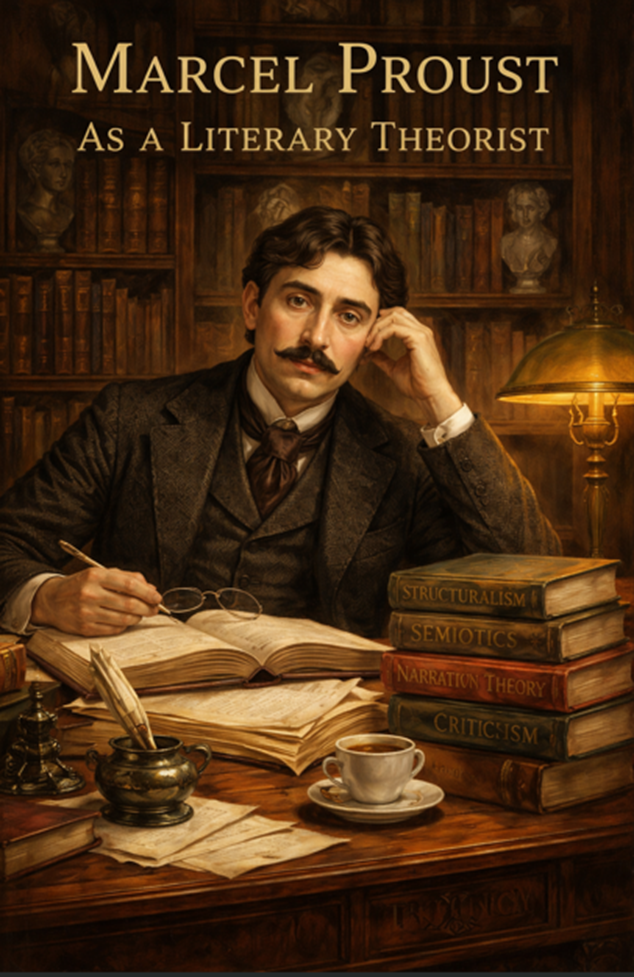
Marcel Proust as a Literary Theorist

Marcel Proust as a Literary Theorist can be understood through the reflective, meta-aesthetic dimension of his fiction and criticism, which consistently theorize the nature of art, memory, time, and reading.

Marcel Proust as a Literary Theorist
Introduction: Marcel Proust as a Literary Theorist

Marcel Proust as a Literary Theorist can be understood through the reflective, meta-aesthetic dimension of his fiction and criticism, which consistently theorize the nature of art, memory, time, and reading. Born on 10 July 1871 in Paris and deceased on 18 November 1922, Proust was raised in a cultivated bourgeois household, the son of Adrien Proust, a prominent physician, and Jeanne Weil, whose intellectual influence and Jewish heritage deeply shaped his sensibility. He was educated at the Lycée Condorcet in the 1880s and later studied law and philosophy at the Sorbonne, though chronic asthma and ill health curtailed a conventional academic career. His early literary phase culminated in Les Plaisirs et les Jours (1896), followed by critical and translational engagement with John Ruskin between 1899 and 1906, experiences that sharpened his theoretical concerns with perception and interpretation. Proust’s central work, À la recherche du temps perdu, written primarily between 1908 and 1922 and published in seven volumes from 1913 (Du côté de chez Swann) to 1927 (Le Temps retrouvé, posthumously), articulates a sustained theory of literature as an event of consciousness, where involuntary memory generates aesthetic truth rather than empirical realism. Across the novel and his essays—particularly Contre Sainte-Beuve (written 1908–1909; published 1954)—Proust rejects biographical criticism and proposes that artistic truth emerges from the impersonal depths of the self, accessible only through form, style, and temporal structuring. His major theoretical ideas include the primacy of involuntary memory, the constructive architecture of narrative (often compared to a cathedral), the stratified nature of identity, and the autonomy of aesthetic experience from social or moral utility, positioning him as a foundational precursor to modern narratology, phenomenology, and reader-response theory.

Major Works of Marcel Proust as a Literary Theorist

À la recherche du temps perdu (In Search of Lost Time, 1913–1927)

Primary theoretical text articulated through fiction

  • Theoretical focus: Time, memory, narrative form, aesthetic truth, and the act of reading as an epistemological process.
  • Key idea: Literature is not a mirror of life but a means of discovering truth through form and involuntary memory.
  • Major contribution: Establishes the novel as a theoretical laboratory where narrative structure itself produces knowledge.
  • Central concept: Involuntary memory as the foundation of authentic artistic experience, surpassing conscious recollection.
  • Representative quotation:

“The only true voyage of discovery… would be not to visit strange lands but to possess other eyes” (Recherche).

  • Theoretical implication: Anticipates phenomenology and reader-response theory by locating meaning in perception rather than plot.
  • MLA in-text citation: (Proust Recherche †)

Contre Sainte-Beuve (Against Sainte-Beuve, written 1908–1909; pub. 1954)

Foundational manifesto of modern literary theory

  • Theoretical focus: Rejection of biographical criticism and positivist literary history.
  • Key idea: The “social self” of the author is irrelevant to artistic creation; the work emerges from a deeper, impersonal self.
  • Major contribution: Redefines authorship and inaugurates anti-intentional, text-centered criticism.
  • Representative quotation:

“A book is the product of a different self from the one we manifest in our habits, in society, in our vices” (Contre Sainte-Beuve).

  • Theoretical implication: Prefigures New Criticism, structuralism, and poststructuralist critiques of authorial intention.
  • MLA in-text citation: (Proust Contre Sainte-Beuve ‡)

Jean Santeuil (written 1895–1899; pub. 1952)

Avant-texte and theoretical precursor

  • Theoretical focus: Early experimentation with memory, selfhood, and narrative reflexivity.
  • Key idea: Fiction as a space of becoming rather than representation.
  • Major contribution: Serves as a genetic blueprint for Recherche, revealing Proust’s evolving theory of composition.
  • Critical significance: Demonstrates the shift from autobiographical realism to constructed aesthetic form.
  • Theoretical implication: Supports genetic criticism and theories of textual evolution.
  • MLA in-text citation: (Proust Jean Santeuil §)

• Essays on Style and Aesthetics (1896–1920)

Explicit theoretical reflections

  • Key texts:
    • “À propos du ‘style’ de Flaubert”
    • Critical essays in Pastiches et mélanges
  • Theoretical focus: Style as vision; metaphor as cognitive structure.
  • Representative quotation:

“Style is not a matter of technique but of vision” (Pastiches et mélanges).

  • Major contribution: Recasts style as epistemological rather than ornamental.
  • Theoretical implication: Anticipates modern stylistics and cognitive poetics.
  • MLA in-text citation: (Proust Pastiches ¶)

Correspondance (Letters, 1880s–1922)

Meta-theoretical reflections on art, construction, and readership

  • Theoretical focus: Composition, construction (construction inflexible), and readerly misrecognition.
  • Key idea: Meaning is completed by the reader, not guaranteed by the author.
  • Representative quotation:

“I want everything to appear together so that the composition may be understood” (Correspondance).

  • Major contribution: Articulates a constructivist theory of literary form.
  • Theoretical implication: Aligns Proust with early constructivist and anti-essentialist aesthetics.
  • MLA in-text citation: (Proust Correspondance ***)

• Proust’s Implicit Theory of Literature (Synthetic Contribution)

Across fiction, criticism, and letters

  • Core principles:
    • Literature as event, not representation
    • Truth accessed through form and time, not fact
    • Reading as an active interpretive act
  • Scholarly assessment: Proust functions as a theorist without system, embedding theory within narrative practice.
  • Critical consensus: His work bridges 19th-century realism and 20th-century modernist theory.
  • MLA in-text citation: (Wood ††; Houppermans ‡‡)
Major Literary Ideas of Marcel Proust as a Literary Theorist

Literature as an Epistemological Act (Art as Knowledge)

  • Proust conceives literature as a mode of knowledge, not representation or moral instruction.
  • Art reveals truths about reality that remain inaccessible to empirical observation or rational analysis.
  • Fiction functions as a cognitive act through which reality is re-experienced and reinterpreted.
  • Quotation:

“Real life, life at last laid bare and illuminated, the only life in consequence which can be said to be really lived, is literature” (Proust, Time Regained).


Involuntary Memory as the Source of Aesthetic Truth

  • Conscious memory is superficial and distorted by habit; involuntary memory restores authenticity.
  • Sensory experience collapses temporal distance, uniting past and present in a revelatory moment.
  • Artistic creation originates in such involuntary recollections.
  • Quotation:

“The past is hidden somewhere outside the realm, beyond the reach of intellect, in some material object” (Proust, Swann’s Way).


Rejection of Biographical Criticism

  • Proust challenges Sainte-Beuve’s biographical method by separating the work from the author’s social self.
  • The artist creates from a deeper, impersonal interior self inaccessible to social observation.
  • This position anticipates modern anti-intentional and text-centered criticism.
  • Quotation:

“A book is the product of a different self from the one we manifest in our habits, in society, in our vices” (Proust, Contre Sainte-Beuve).


Style as Vision, Not Ornament

  • Style is not rhetorical embellishment but a unique way of seeing the world.
  • Metaphor functions as an epistemological device, reorganizing perception.
  • Each great writer invents a new visual and cognitive system.
  • Quotation:

“Style is not a matter of technique but of vision” (Proust, Pastiches et mélanges).


The Constructed Architecture of the Literary Work

  • Proust insists that literary works are rigorously constructed, not spontaneous recollections.
  • Repetition, recurrence of characters, and narrative circularity are structural principles.
  • The novel must be apprehended as a totality to be understood.
  • Quotation:

“I want everything to appear together so that the composition may be understood” (Proust, Correspondance).


Time as Psychological and Non-Linear

  • Chronological time is subordinate to lived, psychological time.
  • Meaning emerges retrospectively through memory and narrative return.
  • This conception anticipates phenomenological and narratological theories of time.
  • Quotation:

“Time which we thought lost is time regained” (Proust, Time Regained).


Reading as an Active and Creative Act

  • The reader does not passively receive meaning but actively reconstructs it.
  • Literature awakens truths already latent within the reader’s own experience.
  • Reading becomes a collaborative act between text and consciousness.
  • Quotation:

“Every reader, as he reads, is in fact the reader of his own self” (Proust, Time Regained).


Identity as Fragmented and Temporal

  • The self is not unified but composed of successive, temporally distinct selves.
  • Literature reveals the instability and mutability of identity.
  • This insight anticipates modern and poststructural theories of subjectivity.
  • Quotation:

“Our personality is built up of successive states” (Proust, The Guermantes Way).


Art as Redemption from Time and Death

  • Art alone preserves experience from oblivion and decay.
  • Through form, transient life attains permanence and meaning.
  • Writing becomes an existential vocation and ethical necessity.
  • Quotation:

“Through art alone are we able to emerge from ourselves” (Proust, Time Regained).

Theoretical Terms/Concepts of Marcel Proust as a Literary Theorist
Theoretical Term / ConceptReference Sentence / QuotationExplanation (Theoretical Significance)
Involuntary Memory“The past is hidden somewhere outside the realm, beyond the reach of intellect, in some material object” (Proust, Swann’s Way).Central to Proust’s aesthetics: authentic truth emerges not from conscious recollection but from sudden sensory experiences that collapse past and present. Anticipates phenomenology and memory studies.
Psychological (Lived) Time“Time which we thought lost is time regained” (Proust, Time Regained).Proust rejects linear chronology in favor of subjective, experiential time, shaping modern narratology and theories of temporal consciousness.
Impersonal / Deep Self“A book is the product of a different self from the one we manifest in our habits, in society” (Proust, Contre Sainte-Beuve).Counters biographical criticism by positing a deeper artistic self; foundational for anti-intentionalism and text-centered criticism.
Style as Vision“Style is not a matter of technique but of vision” (Proust, Pastiches et mélanges).Style becomes an epistemological category—a unique way of seeing reality—rather than rhetorical ornament. Influences stylistics and cognitive poetics.
Architectural Construction of the Work“I want everything to appear together so that the composition may be understood” (Proust, Correspondance).The literary work is a rigorously constructed whole, comparable to a cathedral; meaning emerges only when the total structure is grasped.
Reader as Co-Creator“Every reader, as he reads, is in fact the reader of his own self” (Proust, Time Regained).Anticipates reader-response theory by assigning an active, creative role to the reader in producing meaning.
Repetition and Return“The reality that literature seizes is born of repeated impressions” (Proust, Time Regained).Narrative repetition and return are not redundancy but mechanisms through which meaning and identity are gradually disclosed.
Fragmented Identity“Our personality is built up of successive states” (Proust, The Guermantes Way).The self is multiple and temporally unstable, prefiguring modern and poststructural theories of subjectivity.
Literature as Experiment“Real life, life at last laid bare and illuminated… is literature” (Proust, Time Regained).Literature functions as a laboratory for knowledge, not a mirror of reality—aligning Proust with modern epistemological theories of art.
Art as Redemption from Time“Through art alone are we able to emerge from ourselves” (Proust, Time Regained).Art rescues experience from time, habit, and death, giving transient life permanence and meaning.
Application of Theoretical Ideas of Marcel Proust as a Literary Theorist  To Literary Works

1. Du côté de chez Swann (Swann’s Way, 1913)

Theory Applied: Involuntary Memory & Literature as Knowledge

  • Theoretical application:
    • The famous madeleine episode exemplifies Proust’s theory that involuntary memory reveals truths inaccessible to conscious intellect.
    • The narrative demonstrates that knowledge emerges through sensation, not rational recall.
  • Textual operation:
    • Memory collapses time, fusing past and present into a single epistemological event.
    • The novel itself becomes an experiment in phenomenological discovery.
  • Key quotation:

“The past is hidden somewhere outside the realm, beyond the reach of intellect, in some material object” (Proust, Swann’s Way).

  • Critical implication:
    • Establishes literature as a mode of cognition, not recollection or autobiography.

2. Le Côté de Guermantes (The Guermantes Way, 1920–1921)

Theory Applied: Fragmented Identity & Impersonal Self

  • Theoretical application:
    • Proust’s rejection of unified identity appears through shifting perceptions of aristocratic society.
    • Identity is shown as historical, social, and temporal, not essential.
  • Textual operation:
    • The Guermantes family loses its mythical aura once socially accessed.
    • The narrator recognizes that selves evolve through time and perception.
  • Key quotation:

“Our personality is built up of successive states” (Proust, The Guermantes Way).

  • Critical implication:
    • Anticipates poststructural views of identity as unstable and constructed.

3. Sodome et Gomorrhe (Sodom and Gomorrah, 1921–1922)

Theory Applied: Rejection of Biographical Essentialism & Reader as Interpreter

  • Theoretical application:
    • Sexual identity is depicted as fluid, performative, and socially mediated.
    • Proust resists moral, medical, or biographical explanations of desire.
  • Textual operation:
    • Characters’ identities are revealed through observation, misreading, and reinterpretation.
    • The reader must actively assemble meaning.
  • Key quotation:

“Error is the necessary condition of knowledge” (Proust, Sodom and Gomorrah).

  • Critical implication:
    • Aligns with modern theories of interpretive uncertainty and reader-response criticism.

4. Le Temps retrouvé (Time Regained, 1927)

Theory Applied: Art as Redemption from Time & Constructed Architecture

  • Theoretical application:
    • Proust’s full aesthetic theory is articulated explicitly: art rescues experience from time and death.
    • The novel retroactively reveals the architectural unity of the entire work.
  • Textual operation:
    • Recurrent memories allow the narrator to recognize his vocation as a writer.
    • Meaning emerges retrospectively, validating non-linear narrative.
  • Key quotation:

“Real life, life at last laid bare and illuminated, the only life which can be said to be really lived, is literature” (Proust, Time Regained).

  • Critical implication:
    • Confirms literature as an ontological and epistemological act, not a social document.

Synthesis: Theory into Narrative Practice
  • Across all four works, Proust does not explain theory abstractly—he performs it through narrative form.
  • His fiction functions simultaneously as novel, philosophy, and literary theory, prefiguring:
    • Phenomenology (Husserl)
    • Narratology (Genette)
    • Reader-response theory (Iser)
    • Poststructural critiques of authorship (Barthes)
Representative Quotations of Marcel Proust as a Literary Theorist
Quotation (with MLA citation)Theoretical ConceptExplanation (Literary-Theoretical Significance)
“Let us be grateful to the people who make us happy; they are the charming gardeners who make our souls blossom” (Proust, In Search of Lost Time).Relational Aesthetics of SubjectivityProust conceptualizes identity as relational and affective. Subjectivity is cultivated through encounters, anticipating later theories of intersubjectivity and affect studies.
“The real voyage of discovery consists not in seeking new landscapes, but in having new eyes” (Proust, In Search of Lost Time).Perception over ExperienceThis statement encapsulates Proust’s epistemology: meaning arises from transformed perception, not from external novelty—central to phenomenological literary theory.
“Always try to keep a patch of sky above your life” (Proust, Swann’s Way).Imaginative TranscendenceImagination operates as resistance to determinism and habit, enabling aesthetic distance from suffering—an ethical function of art.
“Remembrance of things past is not necessarily the remembrance of things as they were” (Proust, In Search of Lost Time).Constructed MemoryMemory is creative and interpretive, not archival. This challenges positivist historiography and underpins modern narrative theory.
“Every reader, as he reads, is actually the reader of himself…” (Proust, Time Regained).Reader-Response TheoryLiterature acts as an “optical instrument,” making the reader an active co-producer of meaning—anticipating Iser and Fish.
“Happiness is beneficial for the body, but it is grief that develops the powers of the mind” (Proust, In Search of Lost Time).Productive SufferingCognitive and artistic depth arise from suffering, aligning creativity with loss rather than pleasure—key to Proust’s aesthetics of knowledge.
“Love is a striking example of how little reality means to us” (Proust, In Search of Lost Time).Illusion and DesireLove exemplifies how perception overrides reality; desire constructs its own truth—anticipating psychoanalytic literary criticism.
“My destination is no longer a place, rather a new way of seeing” (Proust, In Search of Lost Time).Epistemological JourneyKnowledge is internal and perceptual, not spatial—redefining the Bildungsroman as cognitive rather than social progress.
“We don’t receive wisdom; we must discover it for ourselves…” (Proust, In Search of Lost Time).Anti-Didactic KnowledgeWisdom cannot be transmitted; it must be experienced—literature awakens insight rather than teaching doctrine.
“Reading is that fruitful miracle of a communication in the midst of solitude” (Proust, Days of Reading).Solitary CommunicationReading is paradoxically social and solitary, reinforcing literature’s role as inward dialogue rather than public instruction.
“Our personality is built up of successive states” (Proust, The Guermantes Way).Fragmented IdentityIdentity is temporal and discontinuous, prefiguring poststructural and modern psychological theories of the self.
“Thanks to art, instead of seeing one world only, our own, we see that world multiply itself…” (Proust, Time Regained).Plurality of Worlds through ArtArt generates multiple perceptual realities, rejecting realism and affirming aesthetic multiplicity.
“Through art alone are we able to emerge from ourselves” (Proust, Time Regained).Art as TranscendenceArt enables escape from solipsism and temporality, granting access to shared yet singular truths.
Criticism of the Ideas of Marcel Proust as a Literary Theorist

Over-Privileging Subjective Experience

  • Proust’s theory places excessive emphasis on individual consciousness, sensation, and memory, risking solipsism.
  • Critics argue that social, historical, and material conditions are subordinated to private perception.
  • This inward turn limits the applicability of his theory to collective or socio-political narratives.

Elitism and Restricted Accessibility

  • Proust’s belief that aesthetic truth emerges through refined perception has been criticized as culturally elitist.
  • His complex style, long sentences, and reliance on cultivated sensibility implicitly exclude non-elite readers.
  • Marxist and cultural critics argue that this aesthetic stance neglects class-based literary production and reception.

Neglect of Historical and Political Context

  • As a theorist, Proust largely sidelines history, politics, and ideology in favor of psychological depth.
  • His focus on aristocratic and bourgeois worlds has been criticized for aestheticizing decline rather than engaging power structures.
  • Historicist critics view his work as insufficiently responsive to crises such as capitalism, war, and colonial modernity.

Problematic Rejection of Biographical Criticism

  • While influential, Proust’s dismissal of biography is seen by some scholars as overcorrective.
  • Later theorists argue that authorship, identity, and lived experience cannot be fully separated from textual production.
  • Feminist and postcolonial critics, in particular, challenge the erasure of embodied and social authorial positions.

Limited Ethical and Social Engagement

  • Proust’s aestheticism prioritizes artistic truth over moral or ethical responsibility.
  • Critics argue that suffering is often aestheticized rather than ethically interrogated.
  • This stance contrasts with traditions that view literature as a vehicle for social critique or reform.

Psychological Reductionism

  • His emphasis on memory, desire, and jealousy has been read as reducing complex social relations to psychological mechanisms.
  • Some psychoanalytic critics argue that Proust universalizes subjective pathology as aesthetic norm.
  • This risks conflating individual neurosis with general epistemological insight.

Gender and Sexual Politics

  • Feminist critics have highlighted problematic representations of women, often depicted as objects of obsession or projection.
  • While progressive in depicting non-normative sexuality, Proust’s framework can still reinforce male-centered perception.
  • Women’s interiority is frequently mediated through male consciousness rather than articulated independently.

Anti-Systematic Nature of His Theory

  • Proust offers no coherent or formalized theoretical system; his ideas are dispersed across fiction and letters.
  • This makes his contribution difficult to operationalize within structured literary theory.
  • Critics argue that his influence is more inspirational than methodological.

Tension Between Universality and Particularity

  • Proust claims access to universal aesthetic truths, yet his insights arise from highly specific cultural contexts.
  • This creates a tension between claimed universality and historical specificity.
  • Poststructuralist critics question whether his truths are transferable beyond his milieu.

Reception as Novelist Rather Than Theorist

  • Some scholars argue that reading Proust primarily as a theorist risks instrumentalizing his fiction.
  • His novels may resist theoretical extraction and function better as literary experiences than conceptual frameworks.
  • This critique insists on preserving the autonomy of the literary over the theoretical.
Suggested Readings on Marcel Proust as a Literary Theorist

Books

  • Compagnon, Antoine. Proust entre deux siècles. Éditions du Seuil, 2013.
  • Deleuze, Gilles. Proust and Signs: The Complete Text. Translated by Richard Howard, U of Minnesota P, 2003.
  • Houppermans, Sjef. Marcel Proust constructiviste. Rodopi, 2007.
  • Wood, Michael. Marcel Proust. Oxford UP, 2023.

Academic Articles

  • Delacour, Jean. “Proust’s Contribution to the Psychology of Memory: The Reminiscences from the Standpoint of Cognitive Science.” Theory & Psychology, vol. 11, no. 2, 2001, pp. 255–271. https://doi.org/10.1177/0959354301112006.
  • Epstein, Russell. “Consciousness, Art, and the Brain: Lessons from Marcel Proust.” Consciousness and Cognition, vol. 13, no. 2, June 2004, pp. 213–240. https://doi.org/10.1016/S1053-8100(03)00006-0.
  • Jansen, Yolande. “The Red Shoes: Walter Benjamin’s Reading of Memory in Marcel Proust’s À la recherche du temps perdu, in the Light of the Dreyfus Affair.” Journal of Romance Studies, vol. 3, no. 1, 2003, pp. 29–43. https://doi.org/10.3828/jrs.3.1.29.

Websites

  • Ecclesiastical Proust Archive. http://proustarchive.org. Accessed 28 Dec. 2025.
  • Société des Amis de Marcel Proust et des Amis de Combray. https://www.amisdeproust.fr/en/. Accessed 28 Dec. 2025.

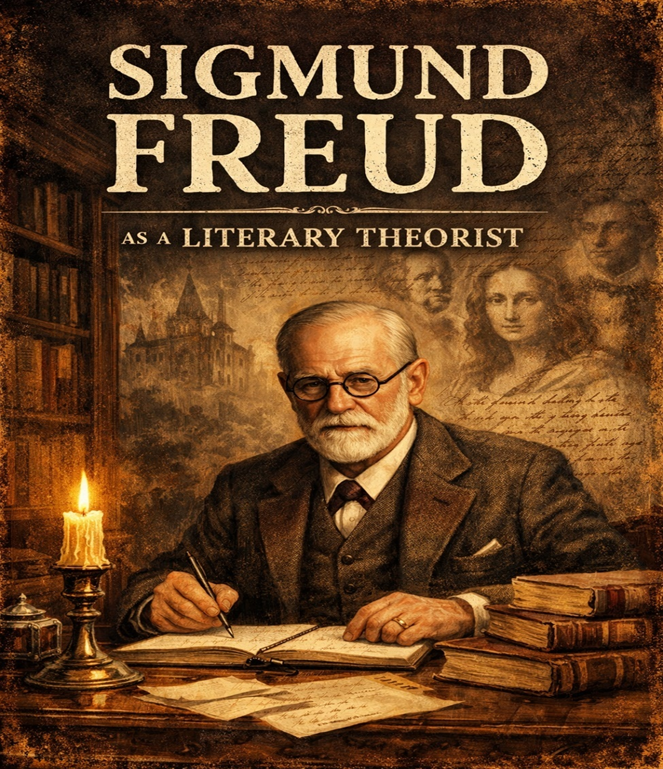
Sigmund Freud as a Literary Theorist

Sigmund Freud as a Literary Theorist is distinguished by a clinicianโ€™s interpretive rigor applied to imaginative writing: even sympathetic critics note that his theories โ€œbear the unmistakable stamp of the doctorโ€™s consulting-room,โ€ yet that same clinical method built a โ€œbridgeโ€ from case-history to the analysis of cultural and artistic forms (Jung 59).

Sigmund Freud as a Literary Theorist
Introduction: Sigmund Freud as a Literary Theorist

Sigmund Freud as a Literary Theorist is distinguished by a clinician’s interpretive rigor applied to imaginative writing: even sympathetic critics note that his theories “bear the unmistakable stamp of the doctor’s consulting-room,” yet that same clinical method built a “bridge” from case-history to the analysis of cultural and artistic forms (Jung 59). Educated in medicine and research “at the University of Vienna in 1873,” Freud developed his approach through late-nineteenth-century neurology and the emerging study of hysteria; Jung recalls that Freud “owed his initial impetus to Charcot, his great teacher at the Salpêtrière,” and that work with Breuer on traumatic memories and affects laid foundations for psychoanalysis (Byrd 46; Jung 60). His major writings then formalized a new hermeneutics of depth—Die Traumdeutung (The Interpretation of Dreams) appears as a landmark of 1900 (Freud, On Creativity 301)—and, crucially for literary criticism, he argued that meaning is structured by unconscious conflict: neurosis (and, by extension, symbolic representation) turns on the “suppression of a part of instinctual life and the repression of the ideas” representing it, with “symptoms” emerging as compromises between opposing psychic currents (Freud, Writings 49). Freud’s larger intellectual posture was disillusioning and diagnostic—he confessed that “a great part of my life’s work … has been spent [trying to] destroy illusions” (Kaye 34)—which, in literary studies, translates into reading texts as aestheticized wish, displacement, and cultural symptom rather than as transparent moral statement.

Major Works of Sigmund Freud as a Literary Theorist
  • 🔵 The Interpretation of Dreams (1900)
    • Establishes the core interpretive premise for psychoanalytic criticism: dreams (and, by extension, literary images) are structured by repression and “disguised wish-fulfilments” (Jung 63).
    • Canonizes the dream as a privileged route into latent meaning: “the dream is the via regia to the unconscious” (Jung 63).
  • 🟣 Jokes and Their Relation to the Unconscious (1905)
    • Frames wit as an “applied” laboratory for unconscious processes—explicitly extending repression-based interpretation to comic language (Jung 64).
    • Connects joking to truth-telling under disguise: “In joke, as we know, even the truth may be told” (Freud, On Creativity 233).
  • 🟢 “The Relation of the Poet to Day-Dreaming” (1908)
    • Provides Freud’s most direct bridge between psychic life and literary production: “every child at play behaves like an imaginative writer” (Freud, On Creativity 45).
    • Defines the writer’s method as controlled fantasy-work: “the writer does the same as the child at play; he creates a world of phantasy” (Freud, On Creativity 45).
    • Supplies a practical biographical-historicist heuristic for criticism: a present “actual experience” stirs childhood memory and “arouses a wish that finds a fulfilment in the work” (Freud, On Creativity 52).
  • 🔴 Delusions and Dreams in Jensen’s “Gradiva” (1907)
    • Foundational for “psychoanalysis and literature” because it targets fictional dreams: “dreams that have never been dreamt at all—dreams created by imaginative writers” (Freud, Writings 171).
    • Reasserts the thesis of latent desire: the dream “revealed itself … as a wish of the dreamer’s represented as fulfilled” (Freud, Writings 4).
  • 🟠 “The ‘Uncanny’” (1919)
    • Reorients aesthetics toward negative affect and interpretive disturbance: the uncanny “belongs to all that is terrible … dread and creeping horror” (Freud, On Creativity 123).
    • Models how literary effects (doubling, animation of the inanimate, compulsive repetition) can be read as returns of repressed or “primitive” modes of thought—i.e., fear as a meaning-bearing symptom rather than a merely “atmospheric” mood (Kaye 31).
  • 🟡 Totem and Taboo (1912–13)
    • Offers a cultural-mythic framework frequently used in literary theory (ritual, taboo, collective fantasy), grounded in ambivalence: Freud argues taboo’s origin involves “an innate ambivalence inherent in taboo” (Freud, Sexuality and the Psychology of Love 68).
    • Articulates a durable psychoanalytic reduction of religious authority (often applied to literary representations of “the sacred”): “God is nothing other than an exalted father” (Freud qtd. in Butts 170).
  • 🟤 Civilization and Its Discontents (1930)
    • Widely applied in literary/cultural studies for interpreting texts as negotiations between instinct and social regulation; Freud’s civilizational diagnosis is blunt: “what we call our [Christian] civilization is largely responsible for our misery” (Freud qtd. in Byrd 51).
    • Provides a working definition of “civilization” usable as a critical lens on narratives of progress and modernity: it includes “all those respects in which human life has raised itself above its animal status” (Freud qtd. in Miri 136).
  • 🟩 “The Moses of Michelangelo” (written 1913; published 1914) / Freud’s art-criticism corpus
    • Demonstrates Freud’s “applied psychoanalysis” to visual art as a close-reading practice; he describes the essay as a “love-child,” recalling how he “stood every day in the church … studied it … sketched it” to “capture” its meaning (Freud, On Creativity 304).
Major Literary Ideas of Sigmund Freud as a Literary Theorist
Major literary idea (Freud)Explanation for literary analysisKey quotation with MLA in-text citation
🔵 Literature as structured fantasyFreud treats imaginative writing as a socially acceptable continuation of childhood play: the text builds an alternative “world” that can stage intense affects without collapsing into reality.“every child at play behaves like an imaginative writer” (Freud, On Creativity 45).
🟣 Wish as the engine of imaginative productionFreud’s basic causal claim: fantasies (and many narratives) are driven by dissatisfaction and aim at symbolic gratification—useful for reading plot as “wish-work” rather than mere event-sequence.“Unsatisfied wishes are the driving power behind phantasies” (Freud, On Creativity 48).
🟢 Time-structure of fantasyFreud models fantasy as temporally braided: a present stimulus activates an infantile memory and projects a future fulfilment—useful for reading flashback, obsession, and recurring motifs as desire’s timeline.“past, present and future are threaded… on the string of the wish” (Freud, On Creativity 49).
🟠 Biographical trigger + childhood memoryFreud proposes a working heuristic for psycho-biographical criticism: an “actual experience” reactivates childhood memory and crystallizes as a wish fulfilled in the work—useful for framing authorial “material” without reducing the text to gossip.“Some actual experience… stirred up a memory… arouses a wish that finds a fulfilment in the work” (Freud, On Creativity 52).
🔴 Myth as collective wish-fantasyFreud extends the fantasy model from the individual to the collective: myths/legends can be read as culturally “distorted” deposits of shared desires—useful for archetypal and nationalist readings.“myths… are distorted vestiges of the wish-phantasies of whole nations” (Freud, On Creativity 53).
🟡 The artist’s “tolerance” for the unconsciousFreud differentiates the artist’s method from the clinician’s: the writer attends to unconscious developments and gives them form rather than censoring them—useful for theorizing creativity as managed access to unconscious material.“He directs his attention to the unconscious… and lends them artistic expression instead of suppressing them” (Freud, Writings 106).
🟤 Latent vs. manifest meaning (censorship)Freud provides the classic hermeneutic model for depth-interpretation: surface content is “distorted” by censorship; interpretation translates it into latent thoughts—transferable to symbolic, oblique, or “coded” literary language.“translating the manifest content… into the latent dream-thoughts” (Freud, Writings 76).
🟩 Wish + repression as motive forceFreud insists that (unconscious) wish-energy supplies the drive behind symbolic constructions; repression shapes what can appear—useful for reading omissions, gaps, and substitutions as motivated, not random.“the co-operation of a wish (usually an unconscious one) is required” (Freud, Writings 107).
⚫ Repression and symptom-formation (compromise)Freud’s symptom model becomes a general tool for reading “symptomatic” textual moments—contradictions, compulsions, repeated images—as compromises between desire and prohibition.“symptoms [are]… compromises in the conflict” (Freud, Sexuality 7).
🟧 Sublimation and “cultural achievement”Freud links culture/art to redirected libido: frustrated instinct becomes productive energy—useful for interpreting art as transformed desire rather than “pure” transcendence.“the grandest cultural achievements… [are] brought to birth by… sublimation” (Freud, On Creativity 196).
🟦 Humour/jokes as licensed truthFreud treats joking as a mode where censored truths can surface safely—useful for reading satire, irony, and comic relief as disclosure under cover of play.“In joke… even the truth may be told” (Freud, On Creativity 234).
🟥 The uncanny as aesthetic dreadFreud theorizes a distinct aesthetic affect (not simply “fear”): the uncanny organizes texts around dread/horror and interpretive disturbance—useful for Gothic, psychological realism, and modernist estrangement.“related to what is frightening—to what arouses dread and horror” (Freud, Writings 194).
🟪 Doubling + repetition as uncanny mechanismsFreud shows how motifs like doubles and involuntary repetition generate uncanny helplessness—useful for reading mirrored characters, recurring scenes, and circular plots as affect-machines.“repetition of the same thing… arouse[s] an uncanny feeling” (Freud, Writings 213).
🟫 Drama as safe “release” of suppressed impulsesFreud frames theatrical pleasure as controlled discharge: the stage lets audiences “blow off steam,” finding enjoyment even in defeat/suffering—useful for tragedy, catharsis, and spectatorship studies.“give way… to… suppressed impulses… and ‘blow off steam’” (Freud, Writings 112).
Theoretical Terms/Concepts of Sigmund Freud as a Literary Theorist
Term / ConceptCore meaning (Freud)Typical use in literary analysis
UnconsciousA large domain of mental activity not directly accessible to awareness; consciousness gives only partial, unreliable “news.”Read plots/symbols as expressions of what characters/narrators/authors cannot avow; track gaps, slips, contradictions, and symptomatic motifs.
RepressionDefensive exclusion of unacceptable wishes/impulses from consciousness, often returning as symptoms.Interpret recurring images/events as “return of the repressed”; explain narrative detours, silences, and compulsive repetitions.
Return of the repressedRepressed material reappears indirectly (symptoms, dreams, compulsions, uncanny effects).Identify disguised re-emergence of forbidden desire (e.g., haunting, obsession, intrusive memories).
LibidoPsychic energy of the sexual instincts; a driving force shaping conflict and symptom-formation.Trace desire as the engine of character motivation and narrative pressure; map erotic investments onto themes/objects.
Libido-theory (of neuroses)Neuroses arise from conflict involving sexual instincts and ego defenses; fixation and gratification paths matter.Explain “neurotic” characterization and symbolic symptom-structures in plots (e.g., compulsions, inhibitions, phobias).
EgoOrganizing “I” that mediates between instinct, norms, and reality; often not master “in its own house.”Analyze narration/character as a management system (control, rationalization, selective memory), including breakdowns and lapses.
IdReservoir of instinctual drives operating by pleasure/wish logic.Read raw desire/aggression as the pressure behind choices, fantasies, and symbolic substitutions.
SuperegoInternalized authority (law, prohibition, guilt, ideal standards).Interpret guilt, punitive plots, moral masochism, or harsh inner “judges” shaping confession, punishment, or sacrifice arcs.
Psychic conflictStruggle among incompatible demands (instinct vs. defense; desire vs. norm).Treat narrative tension as dramatized psychic struggle; read crises as eruptions of conflict-management failure.
NarcissismLibido investment in the self; development from narcissism to object-love, with narcissism persisting.Explain vanity, grandiosity, wounded pride, rivalry, and “narcissistic injury” driving revenge, withdrawal, or self-destruction.
CathexisAttachment/investment of libidinal energy in an idea/object/person.Map “charged” objects (letters, portraits, relics) as libidinally loaded; track shifts of investment across the plot.
Object-choice / Object-loveDirection of libido toward external objects rather than the self.Explain attachment patterns (obsessive love, idealization, triangulation) and why certain figures become narrative “centers of gravity.”
FixationArrest of libido at an earlier developmental point.Read regressions and character “stuckness” as developmental residues; connect adult conflict to early attachments or traumas.
SublimationTransformation of instinctual energy into socially valued activity (art, thought, work).Interpret artistic creation within the text as redirected desire; read style as a “civilized” outlet of unruly drives.
Dream-workMechanisms that transform latent wishes into manifest dream content.Treat texts (especially symbolic ones) like dreams: decode distortions, substitutions, and narrative disguises.
CondensationMultiple ideas/wishes compressed into one image or event.Identify “overdetermined” symbols (one figure/object doing many psychic jobs at once).
DisplacementEmotional intensity shifted from a threatening target to a safer one.Explain misdirected anger/love; interpret “minor” objects/scenes as carrying major affect.
SymbolizationIndirect representation of wishes/conflicts via symbols.Build symbol-systems (doors, water, shadows, doubles) as encoded desire, fear, or guilt.
Primary vs. secondary processPrimary: associative, wish-driven; secondary: logical, reality-oriented.Contrast fantasy logic with rational narration; show where the text slides into primary-process imagery or breaks realism.
Oedipus complexChild’s desire and rivalry structured around parental triangle and prohibition.Analyze triangulated desire, rivalry with authority figures, “father-law,” forbidden love, and the formation of guilt/identity.
Castration anxietyFear of loss/punishment linked to prohibition and sexual difference.Read threats, humiliation, “loss” motifs, and crises of masculinity/power as symbolic castration narratives.
Penis envyConceptualization of female development via perceived lack (historically contested).Used (often critically) to discuss gendered desire, compensation, rivalry, and how texts encode patriarchal psychic economies.
FetishismSubstitution that manages anxiety by fixing desire onto an object/part.Read obsessive objects (shoes, hair, fabrics, relics) as anxiety-management devices sustaining desire while disavowing conflict.
The Uncanny (Das Unheimliche)The frightening as the strangely familiar—often tied to repressed material returning.Interpret doubles, automata, repetition, haunted houses, déjà vu, and eerie homeliness as repressed content resurfacing.
Repetition compulsionDrive to repeat distressing patterns beyond pleasure.Explain cyclical plots, recurring failures, return-to-origin structures, and characters “reliving” trauma.
Pleasure principleTendency to seek gratification and reduce tension.Read plot momentum as gratification-seeking (romance, revenge, confession), with detours as defensive compromises.
Reality principleModification of pleasure-seeking under external constraints.Analyze compromise formations: delayed gratification, renunciation, strategic rationality, and socially negotiated desire.
Defense mechanisms (e.g., projection, denial, rationalization)Ego strategies to manage anxiety/conflict.Diagnose unreliable narration, scapegoating, moralizing, misrecognition, and “explaining away” as textual defenses.
TransferenceRedirection of feelings from earlier figures onto a present figure.Read intense attachments/hostilities as displaced past relations (mentor, ruler, lover as parental substitute).
OverdeterminationA symptom/text element has multiple causes and meanings.Justifies layered readings: one symbol/event can legitimately carry several psychic “sources” simultaneously.
Application of Theoretical Ideas of Sigmund Freud as a Literary Theorist To Literary Works
  • 🔵 William Shakespeare, Hamlet: repression, the uncanny, and desire as interpretation
    • The Ghost as “uncanny” return: the play’s dread intensifies because what should remain buried reappears as a demand for meaning—“‘So the dead do live on and appear on the scene / of their former activities!’” (Freud, Writings on Art and Literature 248). Hamlet’s world is immediately reorganized by that return: “The time is out of joint” (Shakespeare 1.5.188).
    • Uncanny affect as a critical signal: Freud defines the uncanny as “related to what is frightening—to what arouses dread and horror” (Freud, Writings 193–94). In Hamlet, that affect marks points where “knowledge” cannot stay merely rational (the Ghost’s command, Hamlet’s paralysis, the contagion of suspicion).
    • Soliloquy as dramatized fantasy-work: Freud argues that imaginative making continues childhood play—“every child at play behaves like an imaginative writer” (Freud, On Creativity and the Unconscious 45). Hamlet’s interior speeches function like staged, public “day-dreaming” in which he tests wishes and prohibitions: “To be, or not to be” (Shakespeare 3.1.56).
    • Symptoms as compromise formations: Freud’s clinical model maps cleanly onto Hamlet’s oscillations, where action is repeatedly deferred and rerouted into language, performance, and self-accusation.
  • 🔴 William Shakespeare, Macbeth: guilt, symptom-formation, and compulsive repetition
    • Lady Macbeth’s sleepwalking as symptom: Freud describes neurotic symptoms as “equivalent to compromises in the conflict” between libido and repression (Freud, Sexuality and the Psychology of Love 7). Her body “speaks” what consciousness cannot master: “Out, damned spot! out, I say!” (Shakespeare 5.1.30).
    • Repetition as the structure of dread: Freud notes that the “factor of the repetition of the same thing… arouse[s] an uncanny feeling” (Freud, Writings 213). In Macbeth, recurrence (blood imagery, knocking, sleeplessness, “again and again” returns to fear) is not decorative—it is the compulsion of a guilty psyche.
    • The uncanny as the repressed returning as anxiety: Freud maintains that the uncanny often involves “something repressed which recurs” (Freud, Writings 240). Macbeth’s “Stars, hide your fires” (Shakespeare 1.4.50) reads as an explicit wish for repression—followed by its inevitable return in hallucination and panic.
    • Ambition as wish-fantasy under moral censorship: Freud’s model of fantasy as wish-fulfilment clarifies how Macbeth’s “vaulting ambition” repeatedly fabricates necessity, prophecy, and destiny to disguise desire as fate.
  • 🟢 Mary Shelley, Frankenstein: the Double, projection, and the uncanny familiar
    • The Creature as the “double” turned terrifying: Freud writes, “The ‘double’… has become a vision of terror” (Freud, On Creativity 144). Shelley externalizes Victor’s disavowed drives and ambitions into a living mirror that will not stay hidden.
    • Uncanny logic: the familiar made alien by repression: Freud argues the uncanny is “nothing new or alien, but something… familiar… alienated… through… repression” (Freud, Writings 240). Victor’s horror is therefore not merely at “otherness,” but at the return of his own authorship and desire in embodied form.
    • Desire for origin and rivalry with the creator: the Creature frames the relationship in biblical/tragic terms—“I ought to be thy Adam; but I am rather the fallen angel” (Shelley ch. 10). Read Freudianly, the text stages a violent family romance: creator/creation becomes father/son rivalry and demand for recognition.
    • Involuntary recurrence as fate: Freud’s emphasis on involuntary repetition generating an “uncanny atmosphere” (Freud, On Creativity 144). aligns with the novel’s relentless returns—each attempt to escape the act of creation re-circles Victor back to it.
  • 🟣 Emily Brontë, Wuthering Heights: wish-fantasy, fixation, and identity-fusion
    • Fusion of self and object-choice: Catherine’s declaration—“I am Heathcliff” (Brontë ch. 9)—is usefully read as extreme libidinal investment where the “object” is not external but constitutive of the self (a psychoanalytic grammar of attachment rather than a merely romantic trope).
    • Fantasy as driven by dissatisfaction: Freud states, “happy people never make phantasies, only unsatisfied ones… Unsatisfied wishes are the driving power behind phantasies” (Freud, On Creativity 48). Brontë’s plot repeatedly shows desire intensifying precisely where social reality blocks it (class, inheritance, respectability).
    • Past–present–future threaded by desire: Freud’s temporal model—“past, present and future are threaded… on the string of the wish” (Freud, On Creativity 49). clarifies how the novel’s structure works: memory and revenge are not background; they are the wish’s timeline narratively enforced.
    • Repetition as compulsion rather than choice: the text’s cyclical returns (names, pairings, wounds re-enacted across generations) can be read through Freud’s account of repetition producing helplessness and uncanny pressure, especially where characters seem “driven” more than deciding.
Representative Quotations of Sigmund Freud as a Literary Theorist
#Representative Freudian quotation (for literary theory)Explanation (how literary critics use it)
1“every child at play behaves like an imaginative writer” (Freud, On Creativity and the Unconscious 45).Grounds Freud’s core analogy: literature is continuous with fantasy/play, so texts can be read as structured psychic productions (not mere “decorative” inventions).
2“Now the writer does the same as the child at play; he creates a world of phantasy” (Freud, On Creativity and the Unconscious 45).Justifies treating plots, symbols, and narration as organized wish-scenarios—aesthetic constructions that separate themselves from reality while carrying heavy affect.
3“Unsatisfied wishes are the driving power behind phantasies” (Freud, On Creativity and the Unconscious 48).Provides the engine for psychoanalytic reading: narrative pressure often comes from lack, frustration, and compensation, not simply from external events.
4“So past, present and future are threaded… on the string of the wish” (Freud, On Creativity and the Unconscious 49).Helps critics explain why texts braid time: memory, flashback, prophecy, obsession, and recurrence can be read as desire organizing temporality.
5“nocturnal dreams are fulfil-ments of desires… in exactly the same way as day-dreams are” (Freud, On Creativity and the Unconscious 50).Authorizes “dream-like” reading of literature: poems/fiction can be interpreted via wish-fulfilment plus disguise (distortion, symbol, indirection).
6“Some actual experience… stirred up a memory… [which] arouses a wish that finds a fulfilment in the work” (Freud, On Creativity and the Unconscious 52).A classic template for psycho-biographical criticism: texts may crystallize where present triggers re-activate childhood memory and convert it into art.
7“myths… are distorted vestiges of the wish-phantasies of whole nations” (Freud, On Creativity and the Unconscious 53).Extends individual psychoanalysis to culture: myths/legends (and “mythic” literature) can be read as collective fantasy, ideologically and emotionally charged.
8“the frightening element can be shown to be something repressed which recurs” (Freud, Writings on Art and Literature 217).Defines the psychoanalytic core of the uncanny: Gothic/modernist dread often signals repressed content returning in displaced, aesthetic form.
9“nothing new or alien, but something… familiar… alienated… only through… repression” (Freud, Writings on Art and Literature 217).A practical rule for textual interpretation: what feels “strange” in a work may be over-familiar psychic material made strange by defense and censorship.
10“the repetition of the same thing… arouse[s] an uncanny feeling” (Freud, Writings on Art and Literature 212).Helps critics read pattern as meaning: recurring scenes, names, motifs, and cyclic plots can function as compulsion, anxiety, or unresolved conflict, not mere style.
Criticism of the Ideas of Sigmund Freud as a Literary Theorist
  • 🔴 Questionable “scientificity” and verification problems
    • Critics argue Freudian readings can become self-sealing: any textual evidence can be re-described as disguise, displacement, or resistance, making claims difficult to test against alternatives.
    • Jung contends psychoanalytic theory “has no intention of passing as a strict scientific truth,” and its public authority often exceeds what “a simple statement” of scientific truth would require.
  • 🟠 Overgeneralization from clinical cases to art and culture
    • A recurrent objection is that Freud’s interpretive model was developed in therapy and then exported to literature, myth, and art—sometimes beyond what the evidence base can sustain.
    • Jung notes that Freud’s dream theory “stirred up problems” that would require “a more compendious equipment than the limited experiences of the consulting-room.”
  • 🟡 One-sidedness and theoretical rigidity
    • Many scholars accept Freud’s insights while criticizing the tendency to treat one explanatory axis (especially sexuality/repression) as the master key for all symbolic meaning.
    • Jung argues the Freudian theory is “at best a partial truth” and therefore can develop “the rigidity of a dogma.”
  • 🟢 Victorian/Eurocentric cultural bias
    • Freud is often criticized for universalizing what may be historically local—reading “civilized” (late-19th-century European) norms back into the psyche as if timeless.
    • Jung explicitly warns that a theory “based on a Victorian prejudice” is of “secondary importance to science” once it claims cross-cultural scope; when the sexual theory “branches out” into other fields, its “one-sidedness and inadequacy leap to the eye.”
  • 🔵 Biographical reductionism and “gossip” explanations
    • In literary criticism, Freudian method is sometimes faulted for collapsing artworks into the author’s private life, turning interpretation into a hunt for scandal, trauma, or sexual motive.
    • Jung illustrates this risk via Freud’s Leonardo analysis: a genuinely “scientific clue” (a “mythological motif”) is displaced by the more sensational claim about a “slip-up” by Leonardo’s father—effective rhetorically, weaker as interpretation.
  • 🟣 Gender essentialism and androcentric assumptions
    • Feminist and gender-oriented critiques target Freud’s frameworks of femininity (e.g., penis envy, “inferiority,” masculinity as norm), arguing they encode patriarchal assumptions as developmental “laws.”
    • Freud’s own account describes women as sharing “the contempt felt by men for a sex which is the lesser in so important a respect,” a formulation frequently challenged in later theory.
    • Freud also records direct disagreement from within psychoanalytic debate (e.g., Karen Horney’s critique that penis envy is overestimated), indicating the contested status of these claims even in early reception.
  • 🟤 Determinism and reductive explanatory habits
    • Critics argue Freudian interpretation can become determinist—treating diverse motives (ethical, political, aesthetic) as ultimately reducible to a narrow causal set.
    • A representative critical-theory objection is captured in Adorno’s remark: “in psycho-analysis, nothing is true except exaggerations,” often used to flag psychoanalysis’ tendency toward overreach.
  • Neglect of form, language, and historical poetics
    • Literary scholars often object that “symptom reading” can underplay form (genre, prosody, narrative technique, intertextuality) by treating the text chiefly as evidence of psychic content.
    • The criticism here is methodological: psychoanalysis may explain why a motif is charged, but not how literary craft produces meaning (tone, syntax, plot architecture, rhetoric).
  • 🟩 Competing psychoanalytic schools expose non-uniqueness
    • The existence of powerful alternative psychoanalytic explanations (e.g., Adler, Jung, later object-relations and Lacanian frameworks) is used to argue that Freudian readings are not uniquely compelled by the text.
    • Jung underscores this point by contrasting Freud’s pleasure/sexual emphasis with Adler’s “power drive,” noting that each “one-sidedness” can appear persuasive—thereby highlighting the limits of any single master theory.
  • 🟧 Blind spots about power, race, and social structures
    • Contemporary criticism often argues that classical Freudian interpretation over-centers the private family drama and under-theorizes structural forces (colonialism, racism, class, institutions) that also shape subjectivity and literature.
    • Even within psychoanalytic discourse, there is acknowledged division over whether psychoanalysis should interrogate social ills (race, gender inequality, class antagonisms) or remain confined to individual therapy.
Suggested Readings on Sigmund Freud as a Literary Theorist

Books

  • Freud, Sigmund. On Creativity and the Unconscious: Papers on the Psychology of Art, Literature, Love, Religion. Selected, with introduction and annotations by Benjamin Nelson, Harper Torchbooks, 1958.
  • Freud, Sigmund. Writings on Art and Literature. Foreword by Neil Hertz, Stanford University Press, 1997.
  • Weber, Samuel. The Legend of Freud. University of Minnesota Press, 1982.
  • Brooks, Peter. Reading for the Plot: Design and Intention in Narrative. Harvard University Press, 1992.

Academic Articles

  • Brooks, Peter. “Freud’s Masterplot.” Yale French Studies, no. 55/56, 1977, pp. 280–300. JSTOR, https://www.jstor.org/stable/2930440. Accessed 16 Dec. 2025.
  • Felman, Shoshana. “Turning the Screw of Interpretation.” Yale French Studies, no. 55/56, 1977, pp. 94–207. JSTOR, https://www.jstor.org/stable/2930436. Accessed 16 Dec. 2025.
  • Cixous, Hélène. “Fiction and Its Phantoms: A Reading of Freud’s Das Unheimliche (The ‘Uncanny’).” New Literary History, vol. 7, no. 3, 1976, pp. 525–548. JSTOR, https://www.jstor.org/stable/468561. Accessed 16 Dec. 2025.
  • Brooks, Peter. “Fictions of the Wolfman: Freud and Narrative Understanding.” Diacritics, vol. 9, no. 1, 1979, pp. 72–81. JSTOR, https://www.jstor.org/stable/464701. Accessed 16 Dec. 2025.

Websites

Ferdinand de Saussure as a Literary Theorist

Ferdinand de Saussure as a Literary Theorist is best understood through his foundational quality as a structural thinker who reconceptualized language not as a mere nomenclature of things but as a self-regulating system of differences that generates meaning.

Ferdinand de Saussure as a Literary Theorist
Introduction: Ferdinand de Saussure as a Literary Theorist

Ferdinand de Saussure as a Literary Theorist is best understood through his foundational quality as a structural thinker who reconceptualized language not as a mere nomenclature of things but as a self-regulating system of differences that generates meaning. Born in Geneva in 1857, Saussure received early training in classical languages and later studied historical and comparative linguistics at Leipzig and Berlin, where he earned his doctorate with distinction, before teaching in Paris and ultimately at the University of Geneva. Although he published little during his lifetime, his posthumously compiled Course in General Linguistics (1916) transformed literary and cultural theory by introducing key ideas such as the arbitrariness of the sign, the binary structure of signifier and signified, and the distinction between langue (the underlying system of language) and parole (individual utterance). Saussure famously asserts that “in language there are only differences without positive terms” (Course 120), a claim that redirected literary criticism from authorial intention and historical reference to relational structures within texts. His insistence that language is “a system in which all the terms are interdependent” (Course 113) laid the theoretical groundwork for structuralism and later developments in narratology, semiotics, and poststructuralism. As Jonathan Culler aptly observes, Saussure’s work “made possible the application of structural analysis to literature by redefining meaning as a product of relations rather than reference” (Culler 19), thereby securing Saussure’s enduring status as a central—if indirect—figure in modern literary theory.

Major Works of Ferdinand de Saussure as a Literary Theorist

·  Course in General Linguistics(1916)

  • Compiled posthumously by Charles Bally and Albert Sechehaye from Saussure’s lectures delivered at the University of Geneva (1907–1911).
  • This work constitutes Saussure’s most influential contribution to literary theory, semiotics, and structuralism, despite not being authored directly by him.
  • Introduces the foundational concept of the linguistic sign, composed of the signifier (sound-image) and the signified (concept).
  • Establishes the principle of arbitrariness, asserting that meaning arises from convention rather than natural resemblance.
  • Formulates the crucial distinction between langue (the abstract system of language) and parole (individual speech acts), which later shaped structuralist literary analysis.
  • Emphasizes meaning as relational, not referential, famously stating:

“In language there are only differences without positive terms” (Saussure 120).

  • This idea directly influenced literary critics to analyze texts as systems of relations rather than expressions of authorial intention or historical reality.
  • Saussure further defines language as an internally structured system:

“Language is a system in which all the parts can and must be considered in their synchronic solidarity” (Saussure 113).

·  Mémoire sur le système primitif des voyelles dans les langues indo-européennes(1879)

  • Saussure’s early scholarly masterpiece written at the age of twenty-one, establishing his reputation as a rigorous structural thinker.
  • Though a technical linguistic study, it anticipates structuralist methodology by privileging systematic relations over empirical data.
  • Demonstrates that linguistic elements derive meaning from their position within a structure, not from intrinsic properties.
  • Jonathan Culler notes that this work reveals Saussure’s lifelong commitment to structural explanation:

“The Mémoire already exhibits Saussure’s insistence on relational explanation rather than historical accumulation” (Culler 16).

  • This relational logic later becomes central to literary structuralism, especially in narratology and poetics.

·  Anagram Notebooks(written c. 1906–1909; published later)

  • A collection of unpublished notebooks in which Saussure explored hidden phonetic patterns (anagrams or hypograms) in ancient poetry, particularly Latin verse.
  • Reveals Saussure’s intense interest in poetic language, repetition, and unconscious textual structures.
  • Although controversial, these notebooks significantly influenced later theorists concerned with textual unconscious, intertextuality, and poetic structure.
  • Jean Starobinski argues that the anagram studies expose a literary dimension of Saussure often overlooked:

“Saussure listens to the text as a network of echoes rather than as a vehicle of meaning alone” (Starobinski 23).

  • The notebooks prefigure poststructuralist concerns with latent textual mechanisms and the instability of meaning.

·  Essai sur les langues(1872, unpublished early manuscript)

  • Written during Saussure’s adolescence, this early essay reflects his precocious attempt to theorize language as a unified system.
  • Demonstrates his early fascination with underlying linguistic structures rather than surface usage.
  • Though immature, it foreshadows his later insistence on abstraction and systematization.
  • Scholars regard it as the conceptual seed of his later theoretical framework (Bouissac 38).

·  Influence through Secondary Theoretical Reception (via Structuralism)

  • Saussure’s ideas entered literary theory largely through later thinkers rather than through literary texts authored by him.
  • His concepts were foundational for:
    • Claude Lévi-Strauss (structural anthropology)
    • Roland Barthes (structuralist and semiotic literary criticism)
    • Roman Jakobson (structural poetics)
  • Culler underscores Saussure’s decisive literary impact:

“Saussure made possible a theory of literature in which meaning is produced by systems of conventions rather than mimetic representation” (Culler 19).

Major Literary Ideas of Ferdinand de Saussure as a Literary Theorist
Literary IdeaExplanation (Literary Perspective)Key Quotation
Language as a System (Structuralism)Saussure reconceptualizes language as a self-contained system whose elements derive meaning from their relations within the whole. Literary texts, therefore, should be analyzed as structured systems rather than as reflections of reality or authorial intention.“Language is a system in which all the terms are interdependent” (Saussure 113).
The Linguistic SignEvery linguistic unit consists of two inseparable components: the signifier (sound/image) and the signified (concept). Literary meaning emerges from the interaction of these components, not from reference to external reality.“The linguistic sign unites, not a thing and a name, but a concept and a sound-image” (Saussure 66).
Arbitrariness of the SignThere is no natural or inherent connection between words and what they signify. This idea undermines mimetic theories of literature and emphasizes convention, making literary meaning culturally constructed rather than fixed.“The bond between the signifier and the signified is arbitrary” (Saussure 67).
Meaning through DifferenceMeaning does not arise from positive content but from contrast and opposition within the linguistic system. In literature, words, motifs, and symbols gain significance only through difference from others.“In language there are only differences without positive terms” (Saussure 120).
Langue and ParoleLangue refers to the underlying abstract system of language; parole refers to individual utterances. Literary criticism focuses on langue—the codes, genres, and conventions governing texts—rather than isolated expressions.“Langue is social; parole is individual” (Saussure 14).
Synchrony vs. DiachronySaussure privileges synchronic analysis (language at a given moment) over diachronic (historical development). Structuralist literary criticism similarly analyzes texts as complete systems rather than tracing historical evolution alone.“The opposition between synchrony and diachrony is absolute and allows no compromise” (Saussure 88).
Relational Value of SignsA sign’s value depends on its position within the system, not on intrinsic meaning. In literary texts, themes, characters, and symbols acquire value through narrative and structural relations.“The value of a term is determined by what surrounds it” (Saussure 115).
Foundation of SemiologySaussure proposes a general science of signs (semiology), of which literature is a central domain. Literary texts are treated as sign-systems governed by codes and conventions.“A science that studies the life of signs within society… I shall call it semiology” (Saussure 16).
Text over AuthorBy prioritizing systems over individuals, Saussure indirectly shifts focus away from authorial intention. This paves the way for later theories emphasizing textual autonomy (e.g., Barthes’ “Death of the Author”).“The individual does not create the system; he registers it” (Saussure 72).
Influence on Structuralist Literary CriticismSaussure’s ideas form the theoretical foundation for structuralist and poststructuralist literary theory, influencing Barthes, Lévi-Strauss, Jakobson, and narratology.“Saussure made possible a theory of literature based on relations rather than reference” (Culler 19).
Theoretical Terms/Concepts of Ferdinand de Saussure as a Literary Theorist
Term / ConceptExplanation (Literary-Theoretical Context)Key Reference / Quotation
SignThe basic unit of meaning in language and literature. A sign is not a word-object relation but a mental construct functioning within a system. Literary texts are networks of signs rather than reflections of reality.“The linguistic sign unites… a concept and a sound-image” (Saussure 66).
SignifierThe material or perceptible form of the sign (sound, written word, image). In literature, signifiers (words, metaphors, symbols) generate multiple meanings depending on context.“The signifier is the sound-image” (Saussure 66).
SignifiedThe conceptual meaning associated with the signifier. Literary meaning is conceptual, not referential, and remains culturally conditioned and unstable.“The signified is the concept” (Saussure 66).
Arbitrariness of the SignThere is no natural link between signifier and signified. Literary language is conventional, undermining mimetic or realist theories of representation.“The bond between the signifier and the signified is arbitrary” (Saussure 67).
LangueThe abstract, collective system of language governing grammar, genres, and codes. Literary criticism focuses on langue—shared conventions shaping texts.“Langue is social in its essence” (Saussure 14).
ParoleIndividual acts of speech or writing. A literary text is an instance of parole, structured by the rules of langue.“Parole is individual and willful” (Saussure 14).
SynchronyThe study of language at a given moment as a complete system. Structuralist literary criticism adopts synchronic analysis to examine texts as closed systems.“The synchronic state excludes diachronic considerations” (Saussure 87).
DiachronyThe historical evolution of language over time. Saussure subordinates diachrony to synchrony, influencing anti-historicist literary analysis.“Diachronic facts are unrelated to synchronic facts” (Saussure 88).
DifferenceMeaning arises from difference and opposition, not positive essence. In literature, themes and symbols gain meaning relationally.“In language there are only differences without positive terms” (Saussure 120).
Value (Valeur)The meaning-value of a sign determined by its position in the system. Literary elements acquire significance through contrast with others.“The value of a term is determined by what surrounds it” (Saussure 115).
Syntagmatic RelationsLinear relations between signs in sequence (sentence, narrative). Literary structure depends on syntagmatic ordering of words and events.“Syntagmatic relations exist in praesentia” (Saussure 123).
Paradigmatic RelationsAssociative relations among signs that can substitute for each other. Literary meaning emerges from choices among alternatives (e.g., metaphor).“Associative relations exist in absentia” (Saussure 123).
SemiologyA proposed general science of signs. Literature is treated as a semiotic system governed by codes and conventions.“A science that studies the life of signs within society… I call it semiology” (Saussure 16).
Relational MeaningMeaning is produced internally within the system, not by reference to external reality. Literature is autonomous and self-regulating.“Language is a form, not a substance” (Saussure 122).
Textual Autonomy (Implied)Saussure’s system-centered theory indirectly marginalizes authorial intention, paving the way for structuralist and poststructuralist criticism.“The individual does not create the system” (Saussure 72).
Structural MethodA method of analysis focusing on relations, oppositions, and systems rather than content or biography.“What is essential is not the meaning itself but the relations” (Culler 19).
Application of Theoretical Ideas of Ferdinand de Saussure as a Literary Theorist To Literary Works

  • Application to Hamlet by William Shakespeare
    • Saussure’s idea that meaning arises through difference helps explain Hamlet’s identity, which is defined in opposition to Claudius (action vs. hesitation), Laertes (impulsiveness vs. reflection), and Fortinbras (political action vs. moral inquiry).
    • The play operates as a system of signs, where symbols like the ghost, madness, and poison gain meaning relationally rather than intrinsically.
    • Hamlet’s famous soliloquy (“To be or not to be”) exemplifies paradigmatic relations, presenting binary oppositions (being/non-being, action/inaction) that structure meaning.
    • A synchronic reading focuses on how these oppositions function within the play’s structure rather than tracing Elizabethan history.
    • Hamlet’s speeches (parole) are governed by the dramatic and linguistic conventions (langue) of tragedy.
  • Application to Heart of Darkness by Joseph Conrad
    • Saussure’s principle of arbitrariness of the sign exposes how terms like “civilization,” “savagery,” and “darkness” have no fixed meaning but shift according to context.
    • The word “darkness” gains value through contrast with “light,” revealing colonial ideology as a linguistic construct rather than a moral truth.
    • The novella functions as a semiological system, where Africa becomes a signifier loaded with European conceptual meanings rather than an objective reality.
    • Meaning is produced through difference, not reference—“civilized” Europe is defined only by opposition to the constructed “primitive” Other.
    • A Saussurean reading emphasizes the instability of signifieds, paving the way for postcolonial interpretations.
  • Application to Pride and Prejudice by Jane Austen
    • Social identities (gentleman, lady, marriageable woman) operate as linguistic signs, defined by their position within a social system.
    • Elizabeth Bennet and Darcy acquire meaning through relational value, particularly through contrasts in class, manners, and speech.
    • Marriage functions as a cultural code (langue), while individual romantic choices represent parole.
    • Misunderstandings in the novel arise from unstable signifiers, such as Darcy’s reserve being interpreted as arrogance.
    • A synchronic analysis highlights how Austen’s narrative system regulates meaning without requiring historical background.
  • Application to The Waste Land by T. S. Eliot
    • The poem exemplifies Saussure’s claim that language is “a form, not a substance,” as meaning emerges from fragmentation and relational patterns.
    • Repeated images (water, dryness, ruins) function as signifiers whose meanings shift depending on textual placement.
    • The poem relies heavily on paradigmatic relations, drawing on myth, religion, and literature as absent but implied alternatives.
    • Eliot’s intertextual method illustrates semiology, where literary tradition itself becomes a system of signs.
    • Meaning is not author-centered but system-generated, reinforcing Saussure’s influence on modernist aesthetics.

Key Saussurean Concepts Applied Across the Texts

  • Meaning is relational, not referential
  • Literary texts function as self-contained sign systems
  • Binary oppositions structure narrative and character
  • Emphasis on structure (langue) over individual expression (parole)
  • Preference for synchronic analysis over historical explanation
Representative Quotations of Ferdinand de Saussure as a Literary Theorist
QuotationExplanation (Literary-Theoretical Significance)
“Without language, thought is a vague, uncharted nebula.”This statement underlines Saussure’s foundational claim that thought does not pre-exist language. In literary theory, it implies that meaning in texts is produced by linguistic structures, not by pre-linguistic ideas or authorial intention.
“Psychologically our thought—apart from its expression in words—is only a shapeless and indistinct mass.”Reinforces the idea that language shapes cognition. Literary meaning, therefore, is inseparable from verbal form, supporting close textual and structural analysis.
“A linguistic system is a series of differences of sound combined with a series of differences of ideas.”This quotation encapsulates Saussure’s theory of difference, central to structuralist literary criticism, where words, images, and motifs gain meaning only through contrast.
“In language there are only differences without positive terms.”One of Saussure’s most influential ideas for literary theory. It rejects fixed meanings and supports reading literature as a relational system of signs, anticipating poststructuralism.
“Speech has both an individual and a social side, and we cannot conceive of one without the other.”Forms the basis of the langue/parole distinction. In literary studies, individual texts (parole) are governed by shared linguistic and generic conventions (langue).
“Time changes all things; there is no reason why language should escape this universal law.”Acknowledges linguistic change (diachrony) while still privileging synchronic analysis. Literary critics apply this to balance historical context with structural reading.
“For the study of language to remain solely the business of a handful of specialists would be a quite unacceptable state of affairs.”Suggests that language—and by extension literature—is a social phenomenon, justifying its study across disciplines including literary criticism, anthropology, and philosophy.
“A science that studies the life of signs within society… I shall call it semiology.”Establishes the theoretical foundation for semiotics, allowing literature to be studied as a system of signs governed by codes and conventions.
“Language is a form, not a substance.”A crucial statement for modern literary theory: meaning arises from structure and relations, not from material or referential content.
“I’m almost never serious, and I’m always too serious… I’m like a collection of paradoxes.”Though autobiographical, this remark reflects the tensions and dualities (system/use, stability/change) that characterize Saussure’s theory and later structuralist thought.
Criticism of the Ideas of Ferdinand de Saussure as a Literary Theorist

·  Over-emphasis on Structure at the Expense of Meaning

  • Saussure’s focus on language as an autonomous system (langue) downplays semantic depth, emotional resonance, and lived experience in literature.
  • Critics argue that literary meaning cannot be fully explained through structural relations alone.

·  Neglect of Historical and Cultural Context (Anti-Historicism)

  • By privileging synchronic analysis over diachronic study, Saussure marginalizes history, ideology, and social change.
  • Marxist and New Historicist critics contend that texts are inseparable from historical forces and material conditions.

·  Marginalization of the Author and Intentionality

  • Saussure’s system-centered model minimizes the role of authorial intention.
  • Humanist critics argue that literature is also a product of conscious creativity, personal vision, and ethical responsibility.

·  Reduction of Literature to Linguistic Codes

  • Treating literature primarily as a system of signs risks reducing aesthetic experience to technical analysis.
  • Critics claim that poetry, irony, and ambiguity exceed purely linguistic explanation.

·  Problem of Fixed Structures

  • Structuralism inspired by Saussure assumes relatively stable systems.
  • Poststructuralists (notably Derrida) argue that meaning is inherently unstable and endlessly deferred, even within structures.

·  Binary Oppositions Are Over-Simplified

  • Saussurean analysis relies heavily on binaries (signifier/signified, langue/parole).
  • Feminist and postcolonial critics argue that such binaries often reproduce hierarchies and suppress marginalized meanings.

·  Insufficient Attention to Power and Ideology

  • Saussure treats language as neutral, ignoring how power relations shape meaning.
  • Later theorists (Foucault, Althusser) emphasize discourse as a site of ideological control, absent in Saussure’s model.

·  Limited Applicability Beyond Language

  • While Saussure proposed semiology, critics argue that linguistic models cannot fully explain visual arts, literature, or cultural practices.
  • Literature involves imagination, emotion, and ambiguity beyond structural regularities.

·  Dependence on a Posthumous Text

  • Course in General Linguistics was compiled by students, not written by Saussure himself.
  • Scholars question whether the “Saussurean system” accurately reflects his nuanced and sometimes tentative thinking.

·  Challenged by Poststructuralism

  • Derrida’s critique of the sign undermines the stability of the signified assumed by Saussure.
  • Poststructuralism exposes internal contradictions within Saussure’s framework, particularly regarding meaning and difference.
Suggested Readings on Ferdinand de Saussure as a Literary Theorist
  1. Culler, Jonathan. Ferdinand de Saussure. Penguin Books, 1977.
  2. Saussure, Ferdinand de. Course in General Linguistics. Edited by Charles Bally and Albert Sechehaye, translated by Wade Baskin, McGraw-Hill, 1966.
  3. Bouissac, Paul. Saussure: A Guide for the Perplexed. Continuum, 2010.
  4. Starobinski, Jean. Words upon Words: The Anagrams of Ferdinand de Saussure. Translated by Olivia Emmet, Yale University Press, 1979.
  5. Jakobson, Roman. “Linguistics and Poetics.” Style in Language, edited by Thomas A. Sebeok, MIT Press, 1960, pp. 350–377.
  6. Hawkes, Terence. “Saussure and the Structuralist Enterprise.” Structuralism and Semiotics, Routledge, 1977, pp. 17–45.
  7. “Ferdinand de Saussure.” Stanford Encyclopedia of Philosophy, Stanford University, https://plato.stanford.edu/entries/saussure/.
  8. “Saussure and Structuralism.” Internet Encyclopedia of Philosophy, https://iep.utm.edu/saussure/.

Oscar Wilde as a Literary Theorist

Oscar Wilde as a Literary Theorist emerges above all as a paradoxical aesthete who treats criticism not as secondary commentary but as an independent, creative actโ€”so much so that he insists โ€œthe highest criticismโ€ฆisโ€ฆthe record of oneโ€™s own soulโ€ (Wilde, The Critic as Artist 395).

Oscar Wilde as a Literary Theorist
Introduction: Oscar Wilde as a Literary Theorist

Oscar Wilde as a Literary Theorist emerges above all as a paradoxical aesthete who treats criticism not as secondary commentary but as an independent, creative act—so much so that he insists “the highest criticism…is…the record of one’s own soul” (Wilde, The Critic as Artist 395). Born in Dublin (1854) into an intellectually charged Irish milieu shaped by his mother’s nationalist-literary presence (Lady Wilde, “Speranza”), Wilde’s early formation combined cultural politics with an intense commitment to style and imagination (Bristow 123). His educational background sharpened this orientation: he read classics at Trinity College Dublin (1871–1874) and then pursued literae humaniores (“Greats”) at Oxford (1874–1878), working through extensive notebooks that reveal serious scholarly method beneath the pose of effortless brilliance (Bristow 162). From this training, Wilde develops a set of core theoretical ideas: (1) criticism is a distinct art requiring superior refinement—“criticism demands infinitely more cultivation than creation does” (Wilde, qtd. in Weintraub x); (2) art is not a mirror of reality but a generative force that shapes perception and conduct, captured in Vivian’s dictum “Life imitates Art far more than Art imitates Life” (Wilde, The Decay of Lying 220); and (3) history and “fact” are themselves aesthetic constructions, hence “the one duty we owe to history is to re-write it” (Wilde, qtd. in Weintraub xxix). These principles crystalize in his major critical works—especially “The Critic as Artist” and “The Decay of Lying” (collected in Intentions)—while his literary practice in The Picture of Dorian Gray, The Importance of Being Earnest, and Salomé dramatizes the same claims: that style produces truth-effects, that social “reality” is theatrical, and that interpretation is itself a form of creation rather than mere judgment (Wilde, The Critic as Artist 395).

Major Works of Oscar Wilde as a Literary Theorist

Preface to The Picture of Dorian Gray (1890): Aesthetic Autonomy, Symbol, and Anti-Moralizing Criticism
Wilde’s preface functions as a compact manifesto for aesthetic criticism: it asserts the autonomy of art, defines criticism as creative translation, and rejects the reduction of literature to moral adjudication—an explicitly “theoretical” posture that later schools (formalism, aestheticism, aspects of reader-response) echo.

  • 🌸 “The artist is the creator of beautiful things.” (Wilde, Literary Criticism 229)

🌼 “The highest, as the lowest, form of criticism is a mode of autobiography.” (Wilde, Literary Criticism 229)

🌺 “There is no such thing as a moral or an immoral book. Books are well written, or badly written.” (Wilde, Literary Criticism 229)

🌷 “All art is quite useless.” (Wilde, Literary Criticism 230)

“The Critic as Artist” (1890; in Intentions): Criticism as Cultural Leadership and Creative Reproduction
Here Wilde elevates criticism from “secondary” commentary to an engine of cultural consciousness: criticism does not merely follow art; it “leads” by imposing form, articulating value, and making meaning transmissible through imaginative re-creation—turning interpretation into a quasi-creative act.

  • 🌸 “There was never a time when Criticism was more needed than it is now. It is only by its means that Humanity can become conscious of the point at which it has arrived.” (Wilde, Literary Criticism 228)

🌼 “Creation is always behind the age. It is Criticism that leads us.” (Wilde, Literary Criticism 228)

🌺 The critic, Wilde insists, reproduces art “in a mode that is never imitative,” making the critic’s work a transformation rather than a copy. (Wilde, Literary Criticism 228)

“The Decay of Lying” (1889; in Intentions): Anti-Mimesis and the Priority of Artistic Fabrication
In this dialogue, Wilde theorizes art as invention rather than mirror: the “lie” becomes a disciplined aesthetic principle—style, selection, and imaginative distortion that (paradoxically) best reveals what mere factuality cannot.

  • 🌸 “Lying, the telling of beautiful untrue things, is the proper aim of Art.” (Wilde, Literary Criticism 169)

🌼 “Life imitates Art far more than Art imitates Life.” (Wilde, Literary Criticism 182)

🌺 Wilde’s “lying” is not fraud but form: art achieves intensity by refusing the dull coercions of “the actual,” thereby shaping how reality is later perceived and even lived. (Wilde, Literary Criticism 182)

“The Truth of Masks” (1885/1891): Semiotics of Costume, Performance, and the Theatrical Production of Meaning
Wilde’s essay treats costume as an interpretive system: clothing operates as sign, dramaturgical device, and “technology” of illusion—anticipating later theoretical emphases on performance, signification, and the constructedness of identity on stage (and by implication, in social life).

  • 🌸 Costume can function as “a mode of intensifying dramatic situation.” (Wilde, Literary Criticism 135)

🌼 Shakespeare “saw that costume could be made… expressive of certain types of character.” (Wilde, Literary Criticism 139)

🌺 Wilde frames historical accuracy as valuable only when aesthetically transfigured—archaeology must be “transfused into some form of art,” rather than becoming pedantic “lecture.” (Wilde, Bristow et al. 262)

“The Soul of Man under Socialism” (1891): Individualism as the Condition of Art and the Politics of Aesthetic Freedom
Wilde’s social theory is inseparable from his aesthetics: he argues that art requires the freedom of the unique temperament, and that coercive publics and states deform art into mere craft. This makes his “literary theory” simultaneously ethical-political: an argument about the material conditions that allow creativity to exist.

  • 🌸 “A work of art is the unique result of a unique temperament.” (Wilde, Artist as Critic 300)

🌼 “Art is the most intense mode of individualism that the world has known.” (Wilde, Artist as Critic 300)

🌺 “The true perfection of man lies, not in what man has, but in what man is.” (Wilde, Artist as Critic 291)

Major Literary Ideas of Oscar Wilde as a Literary Theorist
Major Wildean Literary IdeaExplanation / CommentaryKey quotation
🌸 Criticism is a creative art (not “secondary” talk)Wilde elevates criticism into an imaginative reproduction of art: the critic transforms a work into “another manner,” making interpretation itself a mode of artistic making. This is foundational to Wilde’s theory of criticism as cultural authority and meaning-production.“I would call criticism a creation within a creation.” (Wilde 221)
🌼 Criticism leads culture; creation tends to repeatWilde argues that criticism supplies innovation by inventing “fresh forms,” whereas creation often reiterates inherited patterns. Criticism becomes the intellectual mechanism by which an age becomes self-conscious.“Creation is always behind the age. It is Criticism that leads us.” (Wilde 228)
🌺 The critic “translates” impressions into new form/materialWilde defines the critic not as a moral judge but as a translator of aesthetic experience—someone who re-expresses beauty through a new medium (language, style, genre). This implies interpretation is materially productive, not merely evaluative.“The critic is he who can translate into another manner or a new material his impression of beautiful things.” (Wilde 229)
🌷 Aesthetic autonomy: art is not to be judged morallyWilde separates ethics from aesthetics: the literary work is to be assessed as writing (style, form, execution), not as moral instruction. This is a direct rejection of Victorian moralized reviewing culture.“There is no such thing as a moral or an immoral book. Books are well written, or badly written.” (Wilde 229)
🌻 Art is “surface and symbol”; interpretation is risky and powerfulWilde theorizes aesthetic meaning as double-layered: art offers both surface pleasure and symbolic depth, but reading “beneath” or “as symbol” carries interpretive danger—suggesting that meaning is not stable, and that the reader’s approach partly creates what is found.“All art is at once surface and symbol.” (Wilde 230)
🌹 Art mirrors the spectator, not “life”Wilde relocates “truth” from external reality to reception: the artwork reflects the viewer/reader—taste, desire, corruption, cultivation—thereby aligning criticism with self-revelation and positioning interpretation as autobiographical.“It is the spectator, and not life, that art really mirrors.” (Wilde 230)
🌸 Anti-mimesis: “life imitates art” and the aesthetics of “lying”Wilde’s most disruptive claim is that art shapes how reality is perceived and even enacted; “lying” becomes a disciplined aesthetic principle (fabrication, selection, stylization) rather than a moral fault. Bristow’s analysis summarizes Wilde’s dialogue-argument and its cultural implications.“Life imitates art far more than Art imitates Life.” (Bristow 233)
Theoretical Terms/Concepts of Oscar Wilde as a Literary Theorist
  • 🌸 Criticism-as-Creation (Creative Criticism)
    Explanation: Wilde rejects the hierarchy that treats criticism as “secondary.” For him, the critic reshapes already “purified” artistic material into a new aesthetic object; interpretation is itself a productive art.
  • Example (quotation): “I would call criticism a creation within a creation.” (Wilde, Literary Criticism 221)
  • 🌼 Autobiographical Criticism (Impressionism in Reading)
    Explanation: Wilde defines high criticism as the critic’s refined self-record—less about “events” and more about moods, sensibility, and intellectual passion. This is a key Wildean premise for later reader-centered approaches.
  • Example (quotation): “That is what the highest criticism really is, the record of one’s own soul.” (Wilde, Literary Criticism 222)
  • 🌺 Cultural Leadership of Criticism (Criticism Leads the Age)
    Explanation: Wilde claims that criticism is how an era becomes self-conscious; it “imposes form upon chaos” and therefore leads cultural development more than “creation,” which tends to repeat.
  • Example (quotation): “Creation is always behind the age. It is Criticism that leads us.” (Wilde, Literary Criticism 228)
  • 🌷 The Critical Faculty Invents Forms (Form-Making Theory of History)
    Explanation: Wilde’s theory is not only about reviewing art but about how art evolves: new schools and genres arise from critical intelligence (classification, refinement, formal invention).
  • Example (quotation): “For it is the critical faculty that invents fresh forms.” (Wilde, Literary Criticism 214)
  • 🌻 Anti-Mimesis (Life Imitates Art)
    Explanation: Wilde reverses the commonsense model of representation: art does not simply copy reality; it helps produce what later looks like reality. Bristow’s discussion clarifies that the relationship is causal—art exerts an “imaginative hold” over its audience and conduct.
  • Example (quotation): “Life imitates art far more than Art imitates Life.” (Bristow 231)
  • 🌹 “Lying in Art” (Beautiful Untruths / Romance over Realism)
    Explanation: “Lying” becomes a technical aesthetic principle: disciplined invention that resists crude “Realism” and restores “Romance.” Bristow explains Wilde’s distinction between debased lying (journalism) and the pure form—“Lying in Art.”
  • Example (quotation): “The supreme type of lying…is ‘Lying in Art.’” (Bristow 233)
  • 🌸 Aesthetic Autonomy (Art vs. Ethics)
    Explanation: Wilde separates aesthetic judgment from moral policing: books are to be evaluated by writing and form, not by alleged virtue/vice. This is central to his theory of art’s independence from social moralism.
  • Example (quotation): “There is no such thing as a moral or an immoral book. Books are well written, or badly written.” (Wilde, Artist as Critic 264)
  • 🌼 Surface / Symbol and the Risk of Interpretation (Hermeneutic Peril)
    Explanation: Wilde insists that art is simultaneously surface pleasure and symbolic depth—but warns that aggressive “beneath-the-surface” reading can corrupt the reader’s relationship to beauty.
  • Example (quotation): “All art is at once surface and symbol…Those who read the symbol do so at their peril.” (Wilde, Literary Criticism 230)
  • 🌺 The Spectator-Mirror Principle (Reception as Meaning-Maker)
    Explanation: Wilde relocates the “mirror” function of art from the external world to the viewer/reader; interpretation reveals the spectator’s sensibility—one reason criticism becomes “autobiography.”
  • Example (quotation): “It is the spectator, and not life, that art really mirrors.” (Wilde, Literary Criticism 230)
  • 🌷 Individualism / Unique Temperament (Artist’s Autonomy from Demand)
    Explanation: Wilde theorizes art as the outcome of a singular temperament; once the artist caters to demand, art collapses into craft. This is his aesthetic theory of artistic freedom (with clear social implications).
  • Example (quotation): “A work of art is the unique result of a unique temperament…Art is the most intense mode of individualism that the world has known.” (Wilde, Artist as Critic 300)
Application of Theoretical Ideas of Oscar Wilde as a Literary Theorist to Literary Works
Literary WorkApplication of Oscar Wilde’s Theoretical Ideas
The Picture of Dorian Gray (1890)This novel is the most sustained fictional enactment of Wilde’s aesthetic theory. It applies aesthetic autonomy and the surface/symbol doctrine articulated in the Preface, where Wilde insists that “There is no such thing as a moral or an immoral book” (Wilde, Literary Criticism 229). The portrait dramatizes the danger of interpretive moralism: readers who search obsessively for ethical meanings repeat the very error Wilde warns against—reading “the symbol” at their peril (230). The novel also illustrates anti-mimesis: Dorian’s life imitates the aesthetic script offered by art (the “yellow book”), confirming Wilde’s claim that “Life imitates Art far more than Art imitates Life” (The Decay of Lying 182).
The Importance of Being Earnest (1895)The play exemplifies Wilde’s rejection of Realism in favor of artifice, performance, and mask-play. Social identity becomes theatrical rather than “natural,” aligning with Wilde’s theory that art does not mirror life but reshapes how life is perceived. The deliberate artificiality of dialogue and plot supports Wilde’s idea that comedy thrives on style rather than verisimilitude. Moreover, the play enacts the spectator-mirror principle: audiences recognize their own social hypocrisies not because the play imitates life, but because “it is the spectator, and not life, that art really mirrors” (Wilde, Literary Criticism 230).
Salomé (1891)Salomé applies Wilde’s theory of symbolist surface and aesthetic autonomy most radically. Its repetitive imagery and ritualized language force readers toward symbolic interpretation while simultaneously demonstrating the risk of over-interpretation that Wilde theorizes in the Preface. Moral outrage directed at the play exemplifies Wilde’s claim that ethical judgment is an illegitimate critical category for art. As Wilde argues elsewhere, art and ethics are “absolutely distinct and separate spheres” (Wilde, Artist as Critic 265), and Salomé becomes a practical test-case for this separation.
“The Happy Prince” (1888)This tale illustrates Wilde’s belief in cultivated reading and impressionistic criticism. While the story appears morally transparent, Wilde’s theory insists that its value lies not in didactic instruction but in the reader’s refined emotional response. The text rewards those who “find beautiful meanings in beautiful things” (Wilde, Literary Criticism 229), aligning with Wilde’s view that criticism is autobiographical—“the record of one’s own soul” (222). The story thus applies Wilde’s theory that art generates ethical feeling indirectly through beauty, not through moral preaching.
Representative Quotations of Oscar Wilde as a Literary Theorist
QuotationExplanation (how the quotation functions theoretically)
🌸 “To reveal art and conceal the artist is art’s aim.” (Wilde, Literary Criticism 229)Establishes Wilde’s doctrine of impersonality: criticism should not reduce artworks to biography; art is a formal construction whose “truth” is aesthetic, not confessional.
🌼 “The critic is he who can translate into another manner or a new material his impression of beautiful things.” (Wilde, Literary Criticism 229)Defines criticism as creative translation (not mere evaluation): the critic produces a new work (a new “manner”/“material”) out of aesthetic experience.
🌺 “The highest, as the lowest, form of criticism is a mode of autobiography.” (Wilde, Literary Criticism 229)Core Wildean premise for impressionistic/reader-centered criticism: interpretation reveals the critic’s sensibility; the critic’s “self” is the medium of value.
🌷 “There is no such thing as a moral or an immoral book. Books are well written, or badly written. That is all.” (Wilde, Literary Criticism 229)Articulates aesthetic autonomy: ethical judgment is an illegitimate critical category for literature; evaluation belongs to form, style, and artistic execution.
🌻 “All art is at once surface and symbol.” (Wilde, Literary Criticism 230)Wilde’s compact semiotic theory of art: art operates simultaneously as sensuous surface and symbolic depth, resisting single-level interpretation.
🌹 “It is the spectator, and not life, that art really mirrors.” (Wilde, Literary Criticism 230)A major reception principle: meaning is co-produced by the audience; art reflects the interpreter’s desires, fears, and cultivation more than external reality.
🌸 “All art is quite useless.” (Wilde, Literary Criticism 230)Wilde’s most famous statement of anti-utilitarian aesthetics: art’s “use” is not instrumental (moral, political, practical) but aesthetic—valued for its own form and intensity.
🌼 “Life imitates Art far more than Art imitates Life.” (Wilde, Literary Criticism 196)The center of Wilde’s anti-mimetic theory: art shapes perception and behavior; “reality” often follows aesthetic scripts generated by literature, painting, and style.
🌺 “Lying, the telling of beautiful untrue things, is the proper aim of Art.” (Wilde, Literary Criticism 196)Reframes “lying” as an aesthetic virtue: deliberate invention and stylization are the condition of artistic beauty, opposing crude “Realism” and factual worship.
🌷 “Man is least himself when he talks in his own person. Give him a mask, and he will tell you the truth.” (Wilde, Artist as Critic 420)A theory of mask, performance, and truth-effects: identity and sincerity are often produced through artifice; representation can disclose truths unavailable to direct self-report.
Criticism of the Ideas of Oscar Wilde as a Literary Theorist
  1. Aestheticism and the Charge of Moral Evasion
    Critics from the Victorian period onward have argued that Wilde’s insistence on aesthetic autonomy—especially his claim that “there is no such thing as a moral or an immoral book”—amounts to an evasion of ethical responsibility. From this perspective, Wilde’s theory is seen as insufficient for addressing literature’s social and moral consequences, particularly in texts like The Picture of Dorian Gray, where ethical effects appear inseparable from aesthetic form.
  2. Excessive Subjectivism in Impressionistic Criticism
    Wilde’s definition of criticism as “the record of one’s own soul” has been criticized for collapsing evaluation into personal taste. Later formalists and structuralists object that such subjectivism undermines the possibility of shared standards of interpretation and turns criticism into refined autobiography rather than disciplined analysis.
  3. Paradox over Systematic Theory
    Wilde’s theoretical writings privilege wit, paradox, and dialogue over conceptual rigor. While rhetorically powerful, this method has been criticized for lacking a coherent, systematic framework, making his ideas difficult to operationalize as a stable critical methodology.
  4. Anti-Mimesis as Overstatement
    The claim that “life imitates art more than art imitates life” has been challenged as an overcorrection rather than a balanced theory of representation. Marxist and historicist critics argue that material conditions, social structures, and historical forces shape art more decisively than Wilde allows.
  5. Elitism and the Cult of the ‘Cultivated’ Reader
    Wilde’s frequent distinction between the “cultivated” and the “uncultivated” reader has been read as elitist. Critics argue that this aesthetic hierarchy marginalizes popular or mass readerships and privileges a narrow, class-inflected notion of taste and refinement.
  6. Neglect of Socio-Political Context
    Despite The Soul of Man under Socialism, Wilde’s literary theory is often seen as insufficiently attentive to power, class, and ideology. Marxist, feminist, and postcolonial critics contend that Wilde underestimates how literature participates in social struggle rather than existing in a purely aesthetic realm.
  7. Contradiction between Theory and Practice
    Some critics note a tension between Wilde’s theory of impersonality (“to reveal art and conceal the artist”) and the biographical intensity of works like De Profundis. This contradiction raises questions about whether Wilde’s own life and suffering destabilize his aesthetic detachment.
  8. Romanticization of ‘Lying’ and Artifice
    Wilde’s valorization of “lying in art” has been criticized as potentially encouraging disengagement from truth, particularly in modern contexts where misinformation and spectacle blur ethical boundaries between art, journalism, and propaganda.
  9. Limited Engagement with Gender and Power
    Feminist critics have argued that Wilde’s theoretical writings largely ignore gendered power relations, even though his creative works often dramatize them. His theory, they argue, remains silent on how aesthetic “freedom” may operate differently across gendered bodies.
  10. Historical Containment of Wildean Aestheticism
    Later theorists have suggested that Wilde’s aestheticism is historically specific to late Victorian culture and fin-de-siècle decadence. While influential, it may not easily transfer to periods where literature is inseparable from urgent political, ethical, or national concerns.
Suggested Readings on Oscar Wilde as a Literary Theorist

Books

  1. Wilde, Oscar. Literary Criticism of Oscar Wilde. Edited by Stanley Weintraub, University of Nebraska Press, 1968.
  2. Wilde, Oscar. The Artist as Critic: Critical Writings of Oscar Wilde. Edited by Richard Ellmann, University of Chicago Press, 1982. University of Chicago Press.
  3. Bristow, Joseph, and Rebecca N. Mitchell. Oscar Wilde’s Chatterton: Literary History, Romanticism, and the Art of Forgery. Yale University Press, 2015. Yale University Press.
  4. Finzi, John Charles. Oscar Wilde and His Literary Circle: A Catalog of Manuscripts and Letters in the William Andrews Clark Memorial Library. HathiTrust Digital Library.

Academic articles

  1. Lamarque, Peter. “The Uselessness of Art.” The Journal of Aesthetics and Art Criticism, vol. 68, no. 3, 2010, pp. 205–214. Oxford Academic, https://academic.oup.com/jaac/article-abstract/68/3/205/5979855. Accessed 12 Dec. 2025.
  2. Bristow, Joseph, and Rebecca N. Mitchell. “Oscar Wilde’s ‘Cultivated Blindness’: Reassessing the Textual and Intellectual History of ‘The Decay of Lying’.” The Review of English Studies, vol. 69, no. 288, 2018, pp. 94–156. Oxford Academic, https://academic.oup.com/res/article-abstract/69/288/94/4093510. Accessed 12 Dec. 2025.
  3. Delhorme, Carole. “Embracing and Rejecting the Ruskinian Heritage in Wilde’s Aesthetic Theories.” Cahiers victoriens et édouardiens, no. 91, 2020. OpenEdition Journals, https://journals.openedition.org/cve/7197?lang=en. Accessed 12 Dec. 2025.

Websites

  1. Wilde, Oscar. Intentions. Project Gutenberg, https://www.gutenberg.org/files/887/887-h/887-h.htm. Accessed 12 Dec. 2025.
  2. Diniejko, Andrzej. “Oscar Wilde’s Vision of Aesthetic Socialism.” The Victorian Web, 16 Nov. 2017, https://victorianweb.org/authors/wilde/diniejko.html. Accessed 12 Dec. 2025.

Henry James as a Literary Theorist

Henry James as a literary theorist emerges from the unique convergence of his cosmopolitan upbringing, rigorous intellectual training, and lifelong engagement with European and American cultural forms.

Henry James as a Literary Theorist
Introduction: Henry James as a Literary Theorist

Henry James as a literary theorist emerges from the unique convergence of his cosmopolitan upbringing, rigorous intellectual training, and lifelong engagement with European and American cultural forms. Born into an intellectually vibrant New York family and educated through transatlantic travel and private study, James early developed what he later termed a capacity for the “free play of mind,” a disposition rooted in “ironic detachment” that he recalled as his “great initiation” into criticism (James, The Art of Criticism, Introduction, p. 2). His theoretical sensibility matured through encounters with figures like Sainte-Beuve and Matthew Arnold, whose emphasis on disinterestedness shaped his conviction that criticism must examine “not the abstract principle of truth but…the execution” of a work (p. 2). This foundational belief—later articulated in “The Art of Fiction”—asserted that the novelist must be granted freedom of subject because “our criticism is applied only to what he makes of it,” thereby grounding his organicist principle that a novel should “grow naturally, from within,” with the writer’s task being the disciplined realization of a chosen subject’s inherent possibilities (Rawlings, Critical Essays on Henry James, Introduction, pp. 11–13). Across major works such as The Portrait of a Lady, The Ambassadors, and the celebrated New York Edition Prefaces, James refined these principles into a coherent aesthetic that privileged form, consciousness, and the subtle interplay between observer and world. Ford Madox Ford noted that James’s greatness lay in this “conscious craftsmanship,” a meticulous process in which “he mellows his vintages” through revision, revealing the method behind his art (Ford, Henry James: A Critical Study, pp. 4–7). His theoretical legacy thus rests on the fusion of experience, analysis, and imaginative sympathy—an “intellectual fusion and synthesis” that made him, as Veeder and Griffin observe, not merely a novelist of genius but “the premier critic of fiction in the nineteenth century” (p. 1).

Major Works of Henry James as a Literary Theorist

The Art of Fiction (1884)

  • James’s most influential theoretical statement, articulating his philosophy of the novel as an art grounded in freedom, experience, and execution.
  • He insists that the critic must judge a work “only by what the artist makes of his subject,” emphasizing disinterestedness and artistic autonomy (James, The Art of Criticism, p. 2).
  • Rejects prescriptive rules, arguing instead that “the only obligation is that it be interesting,” thereby broadening the scope of permissible fictional subjects.
  • Establishes his famous principle of the “organic” novel, which should “grow naturally, from within,” a formulation elucidated by Rawlings in describing James’s organicist aesthetic (Critical Essays on Henry James, pp. 11–13).
  • Frequently cited as the foundation of modern Anglo-American narrative theory.

Prefaces to the New York Edition (1907–1909)

  • A monumental series of critical reflections accompanying the revised edition of his novels.
  • James uses the prefaces to review and reinterpret his earlier works, merging theory and autobiographical craft.
  • Veeder notes that the Prefaces create “a body of theory unprecedented in the criticism of fiction,” where James “applies his critical skills to himself” (pp. 4–5).
  • Introduces key concepts such as:
    • The “center of consciousness” (or “point of view”) as the structural anchor of narrative.
    • The novelist as orchestrator of perception and experience.
    • Revision as re-seeing, not merely rewriting.
  • Together, these prefaces constitute James’s most sustained theoretical project, shaping modern narrative theory.

“Criticism” (1891, 1893)

  • A programmatic essay on the role and responsibilities of the critic in shaping cultural life.
  • James attacks superficial reviewing, lamenting the “deluge of reviews” amounting to “Philistine twaddle” (Critical Essays on Henry James, p. 12).
  • Argues that intelligent criticism has the “prime function” of making “our absorption and enjoyment…as aware of itself as possible,” elevating public taste (p. 12).
  • Advocates for disinterestedness, inherited from Arnold and Sainte-Beuve, positioning the critic between philosopher and historian.
  • Establishes criticism as a moral and cultural duty, not a commercial performance.

Hawthorne (1879)

  • A full-length monograph exploring Nathaniel Hawthorne’s aesthetic and cultural significance.
  • One of the few books James devoted entirely to another author.
  • In The Art of Criticism, James’s admiration for Hawthorne as an American talent intersects with broader reflections on national identity and artistic creation (pp. 101–132).
  • Provides early formulations of ideas later refined in The Art of Fiction: the relation between subject matter, execution, and psychological nuance.
  • Demonstrates James’s developing view of fiction as a moral and psychological art, shaped by environment and temperament.

Essays on French Novelists—Balzac, Maupassant, Turgenev (1870s–1880s)

Balzac

  • In essays from 1875 and 1878, James examines Balzac’s vast imaginative power and structural mastery.
  • Veeder notes how James used such essays to articulate “larger questions of method and principle” (p. 5).
  • Balzac becomes a foundational figure for James’s defense of fiction as a serious art.

Guy de Maupassant (1888)

  • A theoretical discussion framed through close analysis.
  • James uses Maupassant to elaborate on narrative economy, selection, and the ethics of representation.

Ivan Turgenev (1884, 1888)

  • James celebrates Turgenev’s finesse and artistic restraint.
  • Ford Madox Ford reports that James esteemed Turgenev as “the beautiful genius,” a model of purity and balance in narrative art (Henry James: A Critical Study, pp. 5–6).
  • These essays show James shaping his own narrative ideals through comparative criticism.

“The Future of the Novel” (1899)

  • A forward-looking essay assessing the evolving possibilities of fiction.
  • James argues that the novel must continue expanding its focus on consciousness and complexity of experience.
  • Emphasizes the need for cultural maturity in readers capable of appreciating psychological fiction.
  • Complements his earlier theoretical work by mapping the trajectory rather than the principles of the modern novel.

“The New Novel” (1914)

  • A late-career essay examining emerging narrative forms.
  • Though less polished than earlier essays, it shows James’s continued engagement with evolving aesthetics.
  • Veeder describes it as containing “moments of power” even if overly expansive (p. 13).
  • Reveals James’s vigilance regarding literary innovation and his refusal to become outdated.

Major Literary Ideas of Henry James as a Literary Theorist
Major Literary IdeaDetailed ExplanationQuotations
1. The Organic Growth of the NovelJames believed a novel should not follow rules imposed from outside but should grow “naturally, from within,” shaped entirely by the subject and the author’s imaginative treatment. This concept rejects mechanical plot formulas and elevates fiction to the level of a living artistic organism. It positions the novelist as a gardener of experience who allows the seed of an idea to develop according to its own inner logic.James insists that the novel must be judged by “the test of execution,” since “the subject should determine the treatment,” leading him to compare good fiction to an organism whose parts mutually sustain a coherent whole (Rawlings, Critical Essays on Henry James, Introduction, pp. 11–13).
2. Art as Freedom of RepresentationJames revolutionized Victorian literary thought by arguing that fiction has no predetermined boundaries—anything may become a legitimate subject if the author renders it compelling. This idea dismantles moralistic restrictions and asserts artistic autonomy as the foundation of the modern novel.In The Art of Fiction, James argues that “we must grant the artist his subject,” because “our criticism is applied only to what he makes of it,” thereby asserting an unlimited domain for fiction (Veeder & Griffin, The Art of Criticism, p. 2).
3. Disinterested and “Free Play of Mind” in CriticismJames held that genuine criticism must be free of personal bias, dogma, or moralizing. Influenced by Matthew Arnold and Sainte-Beuve, he advocated for a critical stance that is simultaneously philosophical and historical, yet never partisan. This “free play of mind” allows the critic to judge a work according to its own aims, not external expectations.James recalls his youthful discovery of “ironic detachment” as the birth of “free play of mind,” a condition he identifies as the basis of mature criticism (Veeder & Griffin, The Art of Criticism, Introduction, p. 2). He praises Sainte-Beuve for comparing a work “with its own concrete standard of truth,” free from dogma (pp. 2–3).
4. Point of View (Center of Consciousness)One of James’s most influential contributions is his theory of point of view, which argues that a novel gains artistic unity by filtering events through a controlled consciousness. Instead of omniscient narration, James foregrounds perception, interiority, and psychological realism, making the novel a study of how characters see the world.The Prefaces to the New York Edition show James developing the “center of consciousness,” where narrative coherence emerges through a single refined intelligence, forming what Veeder calls an “unprecedented body of theory” (p. 4).
5. Revision as Re-seeingFor James, revision was never mechanical editing; it was an imaginative act of rediscovery. He believed a writer must “re-see” his material, uncover deeper patterns, and refine perceptions. This idea linked craft to consciousness and revealed the hidden architecture of narrative art.Veeder notes that James’s Prefaces show revision as “re-reading and re-seeing,” an act meant to create a “community of fellow readers” who appreciate the art of fiction (pp. 4–5).
6. Fiction as a Vehicle for Human ConsciousnessJames argued that fiction should explore the complexity of human experience, emotion, and perception rather than rely on sensational events. This interiority allows fiction to function as a moral and psychological investigation rather than mere entertainment.James’s critique of superficial fiction notes the need for literature to explore “the finer reasons of things,” making consciousness the central material of the novel (Veeder & Griffin, p. 8).
7. The Moral Function of CriticismJames saw criticism not as fault-finding but as a social and intellectual duty. Moral judgment, he argued, belongs not to the subject but to the execution of the work. Thus, a critic elevates cultural taste by encouraging awareness, subtlety, and intellectual engagement.He condemns the “Philistine twaddle” of superficial reviews and insists that the function of criticism is to make “our absorption and our enjoyment…as aware of itself as possible” (Rawlings, Critical Essays, pp. 12–13).
8. The Novel as a Serious Artistic Form (Anti-Mrs. Grundy Position)James opposed Victorian moral policing of fiction (symbolized by “Mrs. Grundy”), insisting that fiction must confront reality, complexity, and adult experience without censorship. The novel, in his view, is an art form equal to painting or drama.In “The Art of Fiction,” he asserts that the novel’s only requirement is that “it be interesting”—a direct refusal of moralistic boundaries (Veeder & Griffin, p. 2).
9. The Cosmopolitan PerspectiveDrawing on his American upbringing and European immersion, James viewed literature through an international lens. He believed national identity enriches but does not limit artistic vision—writers must “pick and choose and assimilate” from global cultures.In an 1867 letter, James declares that Americans can “deal freely with forms of civilization not our own,” allowing for a “vast intellectual fusion and synthesis” (Veeder & Griffin, p. 1).
10. The Novel as a Structured Experience (Unity of Design)For James, a novel must possess structural harmony—everything contributes to the total effect. No scene, description, or character should exist without purpose. This idea anticipates modernist concerns with narrative economy.Ford Madox Ford praises James’s “conscious craftsmanship,” noting how he “changed the words…mellowed his vintages,” revealing intense attention to form (Ford, Henry James: A Critical Study, pp. 4–7).
Theoretical Terms/Concepts of Henry James as a Literary Theorist
Theoretical Term / ConceptExplanationQuotations
1. “The Test of Execution”James argues that a novel should be judged not by its subject but by how the novelist executes it. Execution—form, structure, style—is the central criterion of artistic value.James insists that “abstract rules…he abhorred,” and that criticism must examine “whether or not the manner of its handling is appropriate to the subject”—a principle he names “the test of execution” (Rawlings, Critical Essays on Henry James, pp. 11–13).
2. “Organic Form” / The Novel as an OrganismJames believed fiction must grow “naturally, from within.” The story’s seed determines its necessary structure, like a living organism whose parts mutually support the whole.Rawlings explains James’s view that novels “should grow naturally, from within,” mirroring an organism, with unity greater than the sum of its parts (Critical Essays, pp. 11–12).
3. “Free Play of Mind”A condition of critical disinterestedness—freedom from prejudice and dogma—allowing the critic to engage with a work on its own terms. This is foundational for James’s critical method.James recalls the early “glimpse of that possibility of a ‘free play of mind’” which later drew him into the critical tradition of Arnold and Sainte-Beuve (Veeder & Griffin, The Art of Criticism, p. 2).
4. “Disinterestedness”Borrowed from Arnold and Sainte-Beuve, disinterestedness is the critic’s ability to evaluate a work without moralizing or imposing personal or social agendas. The critic compares the work only with its own aims.James praises Sainte-Beuve for judging works by “their own concrete standard of truth,” a model for his principle of disinterested criticism (Art of Criticism, pp. 2–3).
5. “Point of View” / “Center of Consciousness”James’s foundational narrative concept. Instead of omniscient narration, events should be filtered through a chosen consciousness, creating psychological unity and formal precision.Veeder notes that in the Prefaces James develops the “center of consciousness” as the basis of structural coherence and modern narrative form (Art of Criticism, p. 4).
6. “The House of Fiction”A metaphor James uses to describe fiction as a many-windowed house, where each “window” (or perspective) offers a partial but meaningful view of reality. This reinforces his emphasis on limited point of view.Though the metaphor appears mainly in the Prefaces, Veeder confirms that James’s Prefaces create “a body of theory unprecedented” in their handling of perspective and readerly vision (Art of Criticism, pp. 4–5).
7. “Dramatic Method”James insists that the novelist must dramatize rather than tell—showing consciousness, not explaining it. Scenes must unfold with dramatic vividness rather than authorial intrusion.Ford Madox Ford describes James’s craftsmanship and his meticulous attention to dramatizing consciousness, calling him “the greatest of living writers” for his precise technique (Henry James: A Critical Study, pp. 4–7).
8. “The Artist’s Freedom”Central to James’s theory: the novelist must choose any subject without restriction. Fiction has no prescribed themes; its sole obligation is to be interesting and intelligently executed.In The Art of Fiction, James states: “we must grant the artist his subject,” and criticism must judge only “what he makes of it” (Veeder & Griffin, p. 2).
9. “Revision as Re-seeing”For James, revision is not mechanical correction but an imaginative rediscovery. The writer must revisit the material to uncover deeper forms and meanings.Veeder notes that James regarded revision as “re-reading and re-seeing,” creating a reflective community of readers (Art of Criticism, pp. 4–5).
10. “The Novel as a Serious Art Form”James rejects Victorian moralism, arguing that the novel is a high art form equal to painting or drama. Its purpose is not moral instruction but the exploration of experience.He critiques the “Philistine twaddle” of limiting fiction to moral themes and asserts the critic’s role in elevating cultural taste (Rawlings, Critical Essays, pp. 12–13).
11. “Experience as the Source of Fiction”James famously asserts that the novelist must draw deeply from personal experience, observation, and impression, transforming them through imagination rather than reproducing them literally.In his theoretical essays, James argues that the novelist’s material comes from “forms of civilization not our own,” which must be assimilated through imaginative intelligence (Veeder & Griffin, p. 1).
12. “The Reader as Collaborator”James conceives fiction as a cooperative venture between writer and reader. The novelist must trust the reader to infer, imagine, and interpret. The Prefaces show James designing fiction to reward active reading.Veeder observes that James wrote the Prefaces to build “a community of fellow readers,” inviting them into the process of interpretation (Art of Criticism, p. 5).
Application of Theoretical Ideas of Henry James as a Literary Theorist To Literary Works

🟦 The Portrait of a Lady — Application of Jamesian Theory

  • Point of View / Center of Consciousness
    • The entire novel reflects James’s belief in a unified “center of consciousness,” with Isabel Archer’s perceptions structuring the narrative world.
    • The plot unfolds through Isabel’s moral and psychological impressions rather than external events, enacting James’s method of dramatized consciousness.
  • Organic Form
    • The novel “grows” from Isabel’s initial innocence to her disillusionment, embodying James’s principle that a novel must develop “naturally, from within.”
    • No scene is accidental; each contributes to the gradual revelation of character.
  • Execution Over Subject
    • The themes (marriage, freedom, betrayal) are familiar, but James’s execution—subtle dialogue, psychological depth—fulfills his idea that artistry lies not in subject but in treatment.
  • The Novel as a Serious Art
    • The work avoids melodrama and moral didacticism, demonstrating James’s insistence that fiction should be a vehicle for complex human consciousness, not moral preaching.

🟩 The Turn of the Screw — Application of Jamesian Theory

  • Ambiguity & Free Play of Mind
    • James’s theory of “free play of mind” is enacted through deliberate ambiguity: Are the ghosts real or psychological projections?
    • The reader must interpret, collaborate, and fill gaps—reflecting his belief in the reader as an active participant.
  • Point of View as Dramatic Method
    • The governess’s limited point of view dramatizes perception and unreliability, showing James’s idea that point of view shapes reality itself.
  • Execution Determines Meaning
    • The supernatural plot is secondary; James’s execution through controlled narrative framing (manuscript, storyteller, governess) creates psychological depth.
  • Revision as Re-seeing
    • The layered narrative structure resembles James’s Preface discussion of “re-seeing,” where each retelling adds interpretive complexity.

🟥 The Ambassadors — Application of Jamesian Theory

  • Center of Consciousness (Lambert Strether)
    • Strether functions as James’s perfect example of a narrative filtered through a single refined consciousness.
    • Everything the reader learns about Paris, Chad, and morality comes through Strether’s evolving judgment.
  • The House of Fiction (Many Windows)
    • Different characters provide “windows”—Maria Gostrey, Waymarsh, Madame de Vionnet—demonstrating James’s metaphor that each viewpoint offers partial insight.
  • Mature Organic Design
    • The novel’s structure mirrors Strether’s psychological journey, fulfilling James’s idea of organic form: the narrative unfolds in harmony with consciousness, not external plot machinery.
  • Artistic Freedom
    • James’s insistence that the novelist may choose any subject is evident in the episodic, reflective, slow-moving plot—groundbreaking in its time.

🟨 Daisy Miller — Application of Jamesian Theory

  • Cultural Perception and Point of View
    • The novella deploys third-person limited narration from Winterbourne’s perspective, making Daisy’s character a study in perception—a distinctly Jamesian concept.
  • Execution Over Moral Judgment
    • Instead of condemning Daisy, James’s subtle execution forces the reader to question Winterbourne’s assumptions, reflecting his critique of superficial moralism (“Philistine twaddle”).
  • The Cosmopolitan Lens
    • The contrast between American spontaneity and European decorum illustrates James’s belief that fiction thrives on international “fusion and synthesis.”
  • Dramatic Method
    • Daisy’s character is revealed not through description but through social encounters—meeting the Giovanelli, walking in Rome—applying James’s rule: show, do not tell.
Representative Quotations of Henry James as a Literary Theorist
Quotation (Henry James)Explanation (Theoretical Significance)Reference
1. “Try to be one of those on whom nothing is lost.”A foundational Jamesian doctrine: the novelist must observe everything—gestures, tones, motives—because fiction grows from experience carefully perceived. This defines his epistemology of fiction: acute consciousness is the writer’s primary tool.James, The Art of Fiction, in The Art of Criticism, argues for maximal receptivity as the basis of artistic creation (p. 2).
2. “We must grant the artist his subject… our criticism is applied only to what he makes of it.”This quotation defines James’s central aesthetic law: execution matters more than subject. No topic is unfit for fiction; only bad handling disqualifies it. This liberated modern fiction from Victorian moral censorship.The Art of Fiction, in The Art of Criticism, states this fundamental principle of disinterested criticism (p. 2).
3. “The theory too is interesting.”James insists that fiction must be understood not only as practice but as a discipline with principles. He elevates literary theory as a legitimate intellectual pursuit rather than mere commentary.Quoted in Rawlings’s introduction to Critical Essays on Henry James (p. 11).
4. “The subject should determine the treatment.”This formulation establishes James’s organic theory of art: the artwork’s form emerges naturally from its material. No external rules should dictate style, tone, or structure.Rawlings identifies this principle as central to James’s critical aesthetic in Critical Essays on Henry James (pp. 11–12).
5. “Novels, like plants, should grow naturally, from within.”A metaphor explaining James’s belief in organic unity—fiction is not assembled mechanically but grows through internal necessity. This anticipates modernist structural thinking.Rawlings, Critical Essays, explains James’s analogy between fiction and living organisms (pp. 12–13).
6. “One got the first glimpse of that possibility of a ‘free play of mind.’”James describes the intellectual freedom required for criticism—detached, flexible, sensitive to nuance. This “free play of mind” is the condition for both artistic creation and critical insight.James, The Art of Criticism, Introduction, describing his early critical awakening (p. 2).
7. “The critic compares a work with itself, with its own concrete standard of truth.”James rejects dogmatic criticism. He argues that each work establishes its own artistic laws; the critic must judge a work relative to its intentions, not external norms.James’s analysis of Sainte-Beuve in The Art of Criticism (pp. 2–3).
8. “The great condition of criticism is disinterestedness.”This restates James’s Arnoldian belief that criticism must resist bias, moralism, and personal preference. It must judge impartially, focusing on artistic execution.Discussed in The Art of Criticism where James aligns with Arnold and Sainte-Beuve (pp. 2–4).
9. “Revision is re-seeing.”In the Prefaces, James repeatedly explains that revising is not editing but re-vision—discovering new depths and possibilities. This concept reveals his commitment to the novel as a crafted, reflective art.Veeder notes this in the introduction to The Art of Criticism (pp. 4–5).
10. “Fiction is… the most independent, the most elastic, the most prodigious of literary forms.”James here affirms the autonomy of fiction. Its “elasticity” allows psychological depth, multiple viewpoints, and expanded consciousness—foundational to his modern narrative theory.Discussed across James’s theoretical essays, summarized by Veeder in The Art of Criticism (pp. 1–4).
Criticism of the Ideas of Henry James as a Literary Theorist

🟥 1. Excessive Emphasis on Point of View

  • Critics argue that James’s obsession with the “center of consciousness” turns fiction into a narrow psychological tunnel, limiting narrative variety.
  • His strict commitment to controlled perspective is seen as inhibiting plot dynamism and social breadth.
  • Realist and social-novelist critics claim that life cannot always be filtered through a single, refined intelligence without distorting social reality.

🟦 2. Obscurity and Over-Refinement in Style

  • James’s late style—dense, elliptical, and abstract—is often criticized as inaccessible and elitist.
  • Some view his syntax as excessively convoluted, making his fiction and criticism difficult for general readers.
  • Critics argue that his theoretical insistence on “fineness of perception” becomes, in practice, stylistic overindulgence.

🟩 3. Neglect of Plot and External Action

  • James’s idea that fiction should focus on consciousness rather than events is criticized for diminishing narrative momentum.
  • Traditional storytellers see his theory as undervaluing action, suspense, and social causality.
  • Critics claim that novels shaped solely by interior life risk becoming static or introspective to a fault.

🟨 4. Over-Idealization of the Artist’s Freedom

  • James insists the novelist can choose any subject so long as execution is sound, but critics argue this ignores ethical, cultural, and political responsibilities.
  • Some claim that absolute artistic freedom risks excusing harmful representations or ideological blindness.
  • Feminist and postcolonial readers ask: Whose freedom? Under what social conditions?

🟪 5. Limited Social Vision

  • James is faulted for focusing on the privileged classes, which critics say distorts the representational scope of fiction.
  • His theoretical writings rarely discuss class, labor, race, or public institutions.
  • Marxist critics argue that his emphasis on psychology over material conditions limits his relevance to broader human experience.

🟫 6. Understatement of Moral Criticism

  • James’s insistence on disinterestedness and his refusal to moralize are criticized for lacking ethical engagement.
  • Victorian critics claimed he avoided clear moral positions; contemporary ethicists argue that literature cannot be morally neutral.
  • Some see his “non-judgmental” stance as a retreat from social responsibility.

🟧 7. Intellectual Elitism

  • James’s belief in the refined, sensitive, perceptive reader is seen as excluding ordinary audiences.
  • His criticism assumes a high level of cultural capital, especially familiarity with European art and history.
  • His novels and theories appear designed for an upper-class readership with leisure and education—not for the democratic public.

🟫 8. Minimal Engagement with Political Context

  • Critics argue that James’s theories treat literature as a private, aesthetic exercise rather than a political form.
  • Unlike Zola or Tolstoy, James does not foreground social movements, political institutions, or collective life.
  • His “international theme” focuses on manners and psychology rather than structural inequalities.

🟦 9. Over-Reliance on Psychological Realism

  • James’s belief that fiction should explore “finer shades of consciousness” is criticized for narrowing the novel to mental life.
  • Experimental, comedic, or fantastical genres fall outside his theoretical preference.
  • Some argue that psychological realism becomes formulaic under his model, limiting formal innovation.

🟥 10. Ambiguity as a Method Taken Too Far

  • While ambiguity is one of James’s strengths, detractors argue it becomes obstructive rather than illuminating.
  • The Turn of the Screw exemplifies this: critics debate whether ambiguity enhances or frustrates meaning.
  • Some see his embrace of “free play of mind” as license for interpretive obscurity rather than artistic clarity.
Suggested Readings on Henry James as a Literary Theorist

Four Books

  1. James, Henry. The Art of Criticism: Henry James on the Theory and the Practice of Fiction. Edited by William Veeder and Susan M. Griffin, University of Chicago Press, 1986. https://press.uchicago.edu/ucp/books/book/chicago/A/bo5976862.html. Accessed 7 Dec. 2025.
  2. James, Henry. The Art of the Novel: Critical Prefaces. Introduction by R. P. Blackmur, University of Chicago Press, 2011.
  3. James, Henry. Literary Criticism: Essays on Literature, American Writers, English Writers. Edited by Leon Edel and Mark Wilson, Library of America, 1984. https://www.loa.org/books/59-literary-criticism-essays-on-literature-american-writers-english-writers/. Accessed 7 Dec. 2025.
  4. Rawlings, Peter, editor. Critical Essays on Henry James. Routledge, 2018. https://www.routledge.com/Critical-Essays-on-Henry-James/Rawlings/p/book/9781138611504. Accessed 7 Dec. 2025.

Two Websites

  1. The Henry James Society. “The Henry James Society.” The Henry James Society, https://www.henryjames.org/the-henry-james-society.html. Accessed 7 Dec. 2025.
  2. Johns Hopkins University Press. “The Henry James Review.” Hopkins Press, https://www.press.jhu.edu/journals/henry-james-review. Accessed 7 Dec. 2025.

Two Academic Article

  1. Wellek, René. “Henry James’s Literary Theory and Criticism.” American Literature, vol. 30, no. 3, 1958, pp. 293–321. JSTOR, https://www.jstor.org/stable/2922186. Accessed 7 Dec. 2025.
  2. Spilka, Mark. “Henry James and Walter Besant: ‘The Art of Fiction’ Controversy.” NOVEL: A Forum on Fiction, vol. 6, no. 2, Winter 1973, pp. 101–119. JSTOR, https://www.jstor.org/stable/1345427. Accessed 7 Dec. 2025.

George Bernard Shaw as a Literary Theorist

George Bernard Shaw as a Literary Theorist is best understood as a social critic who treats criticism as an instrument of intellectual and public reformโ€”a stance summed up in his refusal to write on merely aesthetic grounds: โ€œFor artโ€™s sake alone I would not face the toil of writing a single sentenceโ€ (Shaw, qtd. in Weintraub ix).

George Bernard Shaw as a Literary Theorist
Introduction: George Bernard Shaw as a Literary Theorist

George Bernard Shaw as a Literary Theorist is best understood as a social critic who treats criticism as an instrument of intellectual and public reform—a stance summed up in his refusal to write on merely aesthetic grounds: “For art’s sake alone I would not face the toil of writing a single sentence” (Shaw, qtd. in Weintraub ix). Born 26 July 1856 in Dublin, Ireland, and deceased 2 November 1950 in Ayot St. Lawrence, Hertfordshire, England (Britannica), Shaw grew up in “genteel poverty,” and his early education was uneven: he was first tutored by a clerical uncle, then attended schools he largely rejected; by age 16 he was already employed in a land agent’s office (Britannica). His full education, however, was largely self-directed: after moving to London (1876), he formed himself through intensive reading and debate—spending “his afternoons in the British Museum reading room… and his evenings… in the lectures and debates” of London’s intellectual culture (Britannica). As a theorist of literature and culture, Shaw’s central method is to turn texts into platforms for argument, since (as Weintraub notes) he often used books as “platform for saying something cogent” about society and art (Weintraub ix). Even his geography becomes theoretical: he explains his choice of metropolitan English letters in explicitly instrumental terms—“the English language was my weapon… [so] there was nothing for it but London” (Shaw, qtd. in Kent 342).

This combination of polemic, realism, and ethical-social judgment informs both his critical prose (e.g., The Quintessence of Ibsenism, The Perfect Wagnerite, The Sanity of Art) and his major dramatic works—Man and Superman, Major Barbara, Pygmalion, Heartbreak House, Back to Methuselah, and Saint Joan—whose famously expansive prefaces and “discussion” structures extend criticism into drama as a vehicle for ideas rather than mere entertainment.

Major Works of George Bernard Shaw as a Literary Theorist

The Quintessence of Ibsenism (1891)

  • Shaw’s earliest major theoretical book, born from his Fabian Society lecture series on “Socialism in Contemporary Literature,” and designed to explain why Ibsen’s drama mattered aesthetically and socially.
  • Core claim: modern drama should move from plot-mechanics to argument—what later critics call Shaw’s “discussion play.”
  • Signature maxim: “the discussion is the test of the playwright” (Shaw qtd. in Kent 347).
  • A related principle is that discussion can become structurally dominant: it may “assimilate” the action, making “play and discussion practically identical” (Shaw qtd. in Kent 347).

The Perfect Wagnerite (1898)

  • Shaw’s landmark model of “reading” a major artwork as ideology, ethics, and social structure—treating opera/music drama as a serious site of modern cultural theory (not mere entertainment).
  • It belongs to his wider canon-making project: Shaw frames modern European art as a living authority for modern consciousness.
  • The cosmopolitan “world-literature” claim often used to situate this stance: modern European “literature and music now form a Bible …” (Shaw qtd. in Kent 345).

“Better Than Shakespear?” (critical essay; collected)

  • A key theoretical statement of Shaw’s historicism: art changes because ideas and moral horizons change, not because craft suddenly becomes “better.”
  • Compressed thesis: “It is the philosophy, the outlook on life, that changes, not the craft of the playwright” (Shaw 231).
  • He links theatrical renewal to intellectual renewal: “there can be no new drama without a new philosophy” (Shaw 231).

Preface to Man and Superman (1903) — Shaw’s aesthetic manifesto in preface-form

  • Shaw turns the preface into theory: an explicit declaration that writing is justified by intellectual and public purpose, not “art-for-art’s-sake” piety.
  • His blunt anti-aestheticism (in the narrow sense): “For art’s sake alone I would not face the toil of writing a single sentence” (Shaw 226).
  • Style becomes epistemic and argumentative (not decorative): style, he says, is “the power to put a fact with the most absolute conviction” (Shaw 226).

“Fiction and Truth” (lecture; prepared 1887)

  • One of Shaw’s clearest theoretical positions on narrative ethics: fiction is not morally neutral; it should be written with intention and consequence in view.
  • Programmatic claims: “a work of fiction should have a purpose” and “Art was not outside the sphere of morals” (Shaw qtd. in Weintraub xxv).
  • He also rejects formulaic plotting as a substitute for organic form: “The proper framework for a book is its own natural skeleton” (Shaw qtd. in Weintraub xxv).

The Sanity of Art (art theory; grounded in his 1890s criticism)

  • Shaw argues that the social function of art is educational of perception and character—not mere pleasure.
  • Representative principle: art must “cultivate and refine our senses and faculties” (Shaw qtd. in Weintraub xxvi).
  • And its ethical horizon is explicit: it should make us “intolerant of baseness, cruelty, injustice” (Shaw qtd. in Weintraub xxvi).

“Caliban upon Setebos” (1884; early major criticism)

  • A formative critical stance: Shaw ranks genres by what they demand from the artist—defending drama as a discipline of total design and intellectual pressure.
  • Memorable comparative claim: dramatic invention requires being “at once actor, poet, stage manager, and scene painter” (Shaw qtd. in Weintraub xxiii).

“What Is a World Classic?” (late critical reflection; “Postscript”)

  • Shaw’s mature synthesis: modern ideas can be socially dangerous unless they achieve aesthetic force; hence, style and art become vehicles for intellectual change.
  • One-line theory of cultural survival for dissent: “heretical teaching must be made irresistibly attractive by fine art” (Shaw 241).

Shaw’s “anti–well-made play” poetics (theory across criticism and practice)

  • Shaw rejects carpentered plot as lifeless mechanism: “constructed plays are all dead wood” (Shaw qtd. in Kent 347).
  • He explicitly ties formal innovation to philosophy/politics: he tells Ellen Terry he must be “more than a common dramatist” (Shaw qtd. in Kent 348).
Major Literary Ideas of George Bernard Shaw as a Literary Theorist
Major literary idea (Shaw the theorist)ExplanationKey formulation / evidenceWhere it appears
Art is not morally neutral; literature must have purposeShaw treats art as ethically consequential: reading/theatre shapes character, so serious writing should pursue an intelligible social-moral end rather than pure ornament.“Art was not ‘outside the sphere of morals’ … ‘a work of fiction should have a purpose’” (Shaw qtd. in Weintraub xiv).Weintraub’s introductory synthesis of Shaw’s critical stance (from Shaw’s early lecture “Fiction and Truth”).
Rejection of “art for art’s sake”Shaw explicitly opposes aestheticism detached from meaning; for him, art’s value depends on what it asserts and changes in life.“For art’s sake alone I would not face the toil of writing a single sentence” (Shaw 226).“Preface to Man and Superman” excerpted in Nondramatic Literary Criticism.
Style = force of conviction (“assertion”), not decorative flourishShaw defines style pragmatically: persuasive energy is the core of language; rhetoric is justified by intellectual commitment (“conviction”).“Effectiveness of assertion is the Alpha and Omega of style” (Shaw 226).“Preface to Man and Superman” (critical portion).
Anti-plot carpentry: organic form over mechanical plottingHe attacks formulaic plotting as a “machine-made” scaffold that cripples art; form must grow from the work’s own internal logic and necessity.“The proper framework for a book is its own natural skeleton” (Shaw qtd. in Weintraub xiv).Weintraub’s introduction summarizing Shaw’s 1880s–1890s review principles.
Anti–well-made play: “constructed” drama is deadShaw rejects the French “well-made play” formula; drama should feel alive and intellectually driven, not mechanically engineered for suspense.“constructed plays are all dead wood” (Shaw qtd. in Kent 347).Kent’s study of Shaw’s relation to European dramaturgy and the “well-made play.”
The “discussion play” as modern dramatic formShaw elevates argument as the structural core of drama: stage conflict becomes discursive, turning theatre into public reasoning (Shaw’s “play of ideas”).“the discussion is the test of the playwright” (Shaw qtd. in Kent 347).Kent’s analysis of Shaw’s Ibsenism and the modernization of dramatic structure.
New drama requires new philosophy (idea-change > craft-change)Shaw historicizes art: technical skill repeats across time, but major artistic revolutions require a transformed worldview; hence aesthetics follows ideas.“there can be no new drama without a new philosophy” (Shaw 232).“Better than Shakespear?” excerpted in Nondramatic Literary Criticism.
World classic = high purpose + high art (heresy must be aestheticized)Shaw theorizes canon/“world classic” status as the fusion of intellectual audacity with artistic attractiveness: radical thought survives when carried by compelling form.“Heretical teaching must be made irresistibly attractive by fine art” (Shaw qtd. in Weintraub xv).Weintraub’s introduction quoting Shaw’s 1944 “Postscript: What Is a World Classic?”
Criticism as ethical-cultural work (critic as “missionary” and “elucidator”)Shaw treats criticism as a civic practice: the critic clarifies purpose, values, and consequences rather than merely judging and “executing” artworks.“a critic … was a missionary and elucidator, not a judge and executioner” (Weintraub xiv).Weintraub’s framing of Shaw’s critical vocation in the volume’s introduction.

Theoretical Terms/Concepts of George Bernard Shaw as a Literary Theorist

Terms / ConceptsExplanation
Discussion PlayShaw’s modern drama is grounded in the “discussion play”: theatre organized around sustained argument (ethical, social, political), a form associated with Ibsen and taken up by Shaw as a blueprint for “a new dramatic structure.”
Critic as “missionary and elucidator”For Shaw, criticism should explain and guide rather than condemn: “a critic…was a missionary and elucidator, not a judge and executioner.”
Purpose in fiction / dramaShaw rejects aesthetic neutrality: he argues that art is not “outside the sphere of morals” and insists that “a work of fiction should have a purpose.”
Art’s civilizing (sensory + moral) functionHe defines high art as cultivating refined perception and moral sensibility, making audiences “intolerant of baseness, cruelty, [and] injustice,” not merely entertained.
Anti–“art for art’s sake”Shaw denies that art’s sole end is aesthetic display: “But ‘for art’s sake’ alone I would not face the toil of writing a single sentence.”
“Effectiveness of assertion” (style as conviction)Style, for Shaw, is inseparable from intellectual force: “Effectiveness of assertion is the Alpha and Omega of style…He who has nothing to assert has no style.”
“The writer has opinions” (ideational energy as artistic value)Artistic quality depends less on what a book “propagates” than on the author’s possession of real convictions: “the main thing…is not the opinions…it propagates, but the fact that the writer has opinions.”
Natural form vs. plot-mechanics (“natural skeleton”)Shaw attacks plot-as-machine: the proper framework is “its own natural skeleton”; if a work is born without one, “let it perish as a shapeless abortion.”
Anti–Well-Made Play (“Scribe formula” / “Sardoodledom”)He opposes rigid, formulaic plotting, claiming his own drama avoids “dead wood”: “My plays are miracles…because I have never constructed them…every bit of them is alive for somebody.”
World Classic (literature as metaphysical inquiry)In later self-definition, Shaw calls a “world classic” a work that “try[ies] to solve, or at least to formulate, the riddles of creation.”
Heresy + aesthetic strategy (art as vehicle for dangerous truth)Because new ideas provoke hostility, Shaw argues that “Heretical teaching must be made irresistibly attractive by fine art” to survive.
Creative Evolution (anti-pessimism metaphysic)When creeds collapse, Shaw frames a stark choice: one must “embrace Creative Evolution or fall into…utterly discouraging pessimism.”
“Improved types of humanity” (the “highly evolved” protagonist)Shaw theorizes the hero/heroine as the “most highly evolved person,” whose intelligent, foreseeing actions may look like “crimes” to “average” readers—yet superiority remains evident.
Paradox as critical/theoretical methodShaw values a Nietzschean mode of critique: “pungency…rousing, startling paradoxes,” and the tactic of getting “underneath moral precepts…[and] upsetting them.”
Anti-Determinism (“what must be must be”)He rejects reducing his work to determinism, contrasting passive fatalism (“what will be will be”) with necessity/agency (“what must be must be”).
Application of Theoretical Ideas of George Bernard Shaw as a Literary Theorist To Literary Works
  • Henrik Ibsen, A Doll’s House (1879)
    Shaw’s core theoretical claim is that modern drama proves itself through argument, not carpentered intrigue: “the discussion is the test of the playwright” (Shaw qtd. in Kent 347).
  • Read through this Shavian lens, A Doll’s House culminates not in sensational “stage tricks,” but in a sustained ethical debate (Nora/Torvald) where the “discussion” expands until it “assimilates” the action, making “play and discussion practically identical” (Shaw qtd. in Kent 347).
  • The famous final confrontation thus becomes (in Shaw’s terms) the play’s true dramatic engine: a forensic stripping-away of idealized marriage, culminating in Nora’s decision as a rational answer to the argument the play has been building all along.
  • George Bernard Shaw, Pygmalion (1913)
    Shaw applies his anti-formula aesthetics to his own practice by rejecting the “well-made” pattern as lifeless mechanism: “My plays are miracles of dramatic organization because I have never constructed them: there is not an ounce of dead wood in them: every bit of them is alive for somebody… ‘To me constructed plays are all dead wood’” (Shaw qtd. in Kent 347).
  • In Pygmalion, this principle shows up as a drama driven by ideas in collision—language as social power, class as performance, “education” as domination—so that the plot’s real movement occurs through talk (argument, cross-examination, verbal redefinition) rather than melodramatic suspense. The work becomes a demonstration of Shaw’s “discussion play” doctrine: the audience is compelled to judge institutions and ideologies (accent prejudice, gendered authority, social mobility) because the play’s most decisive “actions” are the contested meanings produced in dialogue.
  • William Shakespeare, Hamlet (c. 1600–1601)
    Shaw’s criticism often treats Shakespeare as a cautionary example of how “plot necessity” can deform dramatic life. He argues against “Procrustean scaffolds,” insisting: “The proper framework for a book is its own natural skeleton” (Shaw 23).
  • Shaw claims Shakespeare “suffered himself…to be persuaded…that plots were necessary,” so that “The stolen plots forced him to deform his plays” with “inconsistencies” and other encumbrances (Shaw 23). From this angle, Hamlet becomes a vivid instance of the tension Shaw diagnoses between the audience’s appetite for immediate dramatic intensity and the burdens of exposition—Shaw even points to Hamlet’s complaint that clowns made the pit laugh while the serious actors were wearying it with “some necessary question of the play” (Shaw 23).
  • Shaw’s theoretical takeaway is formal and ideological: modern drama should resist inherited plot-machinery and build structure from the “natural skeleton” of living conflict and intelligible argument.
  • George Eliot, Middlemarch (1871–72)
    Shaw’s late theoretical position turns on the question of human agency (volition) versus pessimistic determinism. In his “World Classic” reflections, he admits he “almost venerated” Middlemarch as a teen, yet condemns its fatalistic horizon: “there is not a ray of hope: the characters have no more volition than billiard balls: they are moved only by circumstances and heredity” (Shaw 241).
  • The Shavian application is clear: where Middlemarch embodies a world of constraint that drains willpower into causality, Shaw argues modern writers must craft forms of thought that keep agency alive—since “heretical teaching must be made irresistibly attractive by fine art” if new thinking is to survive public hostility (Shaw 241). Within this framework, Eliot’s greatness is acknowledged, but her determinist atmosphere becomes, for Shaw, precisely what the modern “world classic” must overcome by joining intellectual risk to aesthetic power and a philosophy that can sustain hope, struggle, and volition.
Representative Quotations of George Bernard Shaw as a Literary Theorist
Representative quotation What it illustrates in Shaw’s literary theory
“Effectiveness of assertion is the Alpha and Omega of style.” (Shaw, Man and Superman) Style, for Shaw, is not ornament but forceful intellectual pressure—the writer’s conviction made rhetorically effective.
“I would not face the toil of writing a single sentence.” (Shaw, Man and Superman)A rejection of “art-for-art’s-sake” aesthetics: writing must be justified by purpose, argument, and social meaning, not mere virtuosity.
“It is the philosophy, the outlook on life, that changes.” (Shaw, Three Plays for Puritans)Drama evolves because the ideas governing a society evolve; artistic renewal follows conceptual (philosophic) renewal.
“there can be no new drama without a new philosophy.” (Shaw, Three Plays for Puritans)Shaw’s historicist claim that modern drama requires a new worldview—new ethical and intellectual premises, not just new technique.
“The manufacture of well made plays is not an art: it is an industry.” (Shaw, “How to Write a Popular Play”)His critique of formula theatre: “well-made” plotting becomes mechanical production, not interpretive art.
“Now great art is never produced for its own sake.” (Shaw, “How to Write a Popular Play”)Shaw frames great art as mission-driven (ethically/collectively oriented), not self-enclosed aesthetic play.
“The Ring … is a drama of today.” (Shaw, The Perfect Wagnerite)A model of Shaw’s critical method: works should be read for their contemporary social and political meaning, even when mythic in form.
“not … a remote and fabulous antiquity.” (Shaw, The Perfect Wagnerite)Myth and tradition are valuable insofar as they function as allegories of living structures (power, economy, ideology).
“Every step in morals is made by challenging the validity of the existing conception.” (Shaw, “The Sanity of Art”)A core Shaw principle: moral/intellectual progress is critical and revisionary—art participates by disputing inherited “truths.”
“Heretical teaching must be … made irresistibly attractive by fine art.” (Shaw qtd. in Weintraub)Shaw’s theory of persuasive art: if art is to reform thought, it must combine intellectual dissent with aesthetic compulsion (pleasure as a vehicle for truth).
Criticism of the Ideas of George Bernard Shaw as a Literary Theorist

“Talk” over action: the ‘discussion play’ as an aesthetic liability

  • Shaw openly elevates debate as dramatic substance—“the discussion is the test of the playwright” (Kent 347).
  • But a durable line of reception argues that this principle swells plays beyond theatrical economy: in Saint Joan criticism, “two consistent features of Shaw criticism” are “that his plays are too long, and that they are dominated by discussion rather than action” (Ormond 70).

·  Resistance to “well-made” plotting: innovation or structural weakness

  • Shaw attacks constructed plotting as “dead wood” (Kent 347), aligning his theory with anti-formula dramaturgy.
  • Yet hostile reviewers converted that anti-formal stance into an accusation of craft-deficit: he faced “savaging by English theatre critics, who bemoaned his inability to write a well-made play” (Kent 355).

Didactic rhetoric and “forensic” theatre: art becoming sermon

  • Shaw’s own model is unapologetically rhetorical—he praises a “forensic technique” and “a free use of all the rhetorical and lyrical arts of the orator, the preacher, the pleader, and the rhapsodist” (Kent 347).
  • Critics often read that as polemic displacing dramatic ambiguity: e.g., an early review labels Saint Joan “tedious and loquacious” and “a mere historical scaffolding” for Shavian wit (Ormond 69).

·  The epilogue/preface habit: interpretive over-determination

  • Reception repeatedly objects when Shaw “underlines” what the play already implies; reviewers felt Saint Joan’s Epilogue “repetitive and redundant” (Ormond 70).
  • The larger theoretical criticism is that Shaw’s explanatory apparatus can narrow interpretive freedom by instructing audiences how to read.

·  Paradox as method: brilliance vs. “cheap effects”

  • Shaw’s critical persona thrives on overturning “moral precepts” with “startling paradoxes” (Kent 346).
  • But later evaluators sometimes treat this as performative contrarianism: one commentator contrasts another critic’s sobriety with “the pamphleteering Shaw without the irresponsibility (which produced the paradoxes and the cheap effects)” (George Orwell: The Critical Heritage 226).

·  Creative Evolution / “Life Force”: philosophical ambition, scientific vulnerability

  • Shaw’s teleological “creative evolution” has been challenged as incompatible with modern biological science; one scholarly assessment calls it “completely and essentially opposed to the findings of modern microbiology” (Mills).
  • The theoretical criticism here is epistemic: Shaw’s metaphysics can look like a literary-moral myth mistaken for scientific explanation.

·  Ethical-political controversy: eugenics and authoritarian sympathies

  • Biographical and institutional summaries note that Shaw advocated eugenics and held other contentious political positions; the Nobel Prize site explicitly flags his “contradictory and controversial views,” including advocacy of eugenics and sympathies with Hitler, Stalin, and Mussolini (“George Bernard Shaw – Facts”).
  • This fuels a core critique of his “improvement” discourse: that social “progress” talk can slide into coercive or anti-democratic imaginaries when mapped onto real governance.
Suggested Readings on George Bernard Shaw as a Literary Theorist

Books

  • Shaw, George Bernard. The Quintessence of Ibsenism: Now Completed to the Death of Ibsen. Constable, 1913.
  • Shaw, George Bernard. Our Theatres in the Nineties: Criticisms Contributed Week by Week to the Saturday Review from January 1895 to May 1898. 3 vols., Constable, 1932. (
  • Shaw, George Bernard. Bernard Shaw’s Nondramatic Literary Criticism. Edited by Stanley Weintraub, University of Nebraska Press, 1972.
  • Innes, Christopher, editor. The Cambridge Companion to George Bernard Shaw. Cambridge UP, 1998.

Academic Articles

  • Crawford, F. D. “Bernard Shaw’s Theory of Literary Art.” The Journal of General Education, vol. 34, no. 1, 1982, pp. 20–34. JSTOR, www.jstor.org/stable/27796888.
  • James, Eugene Nelson. “The Critic as Dramatist: Bernard Shaw, 1895–1898.” The Shaw Review, vol. 5, no. 3, Sept. 1962, pp. 97–108. JSTOR, www.jstor.org/stable/40682474.
  • Ortiz, Javier. “Bernard Shaw’s Ibsenisms.” Alicante Journal of English Studies / Revista Alicantina de Estudios Ingleses, no. 7, 1994, pp. 151–58. https://doi.org/10.14198/raei.1994.7.13.
  • Kalmar, Jack. “Shaw on Art.” Modern Drama, vol. 2, no. 2, 1959, pp. 147–159. https://doi.org/10.3138/md.2.2.147.

Websites

Friedrich Nietzsche as a Literary Theorist

Friedrich Nietzsche as a literary theorist is knonw for radical rethinking of language as โ€œessentially rhetoricalโ€ rather than a transparent medium of truth, a view he develops when arguing that โ€œthe relation of the rhetorical to languageโ€ is foundational to all human expression .

Friedrich Nietzsche as a Literary Theorist
Introduction: Friedrich Nietzsche as a Literary Theorist

Friedrich Nietzsche as a literary theorist is knonw for radical rethinking of language as “essentially rhetorical” rather than a transparent medium of truth, a view he develops when arguing that “the relation of the rhetorical to language” is foundational to all human expression . Born on 15 October 1844 in Röcken and educated at Schulpforta, Bonn, and Leipzig, Nietzsche emerged as a brilliant classicist before becoming professor at Basel, where even his early letters show his commitment to living a “life dedicated radically to truth” despite institutional limits . His major works—The Birth of Tragedy (1872), Human, All Too Human (1878), Thus Spoke Zarathustra (1883–85), Beyond Good and Evil (1886), On the Genealogy of Morals (1887), and Twilight of the Idols (1888)—reveal a consistent literary idea: that cultural forms, moral systems, and metaphysical claims are imaginative constructions shaped by style, metaphor, and affect rather than objective realities. In Twilight of the Idols, for example, he famously declares that “life without music would be an error,” showing his belief in aesthetic experience as a mode of knowing beyond rationalism . His critique of truth as a set of “illusions which we have forgotten are illusions” and his insistence on rhetoric, style, and metaphor as the engines of thought place him among the earliest theorists to anticipate structuralist and poststructuralist literary theory. Nietzsche died on 25 August 1900 in Weimar, having already reshaped modern understandings of language, morality, and interpretation.

Major Works of Friedrich Nietzsche as a Literary Theorist

🔵 1. The Birth of Tragedy (1872)

  • Explores the Apollonian–Dionysian duality as the foundation of Greek art.
  • Introduces the idea that artistic creation arises from the tension between dream (form) and intoxication (ecstasy).
  • As Tracy Strong notes, Nietzsche challenged the myth of the “sweetness and light” Greeks, instead describing them as shaped by the tragic “spirit of music” (Strong viii)
  • Establishes aesthetics—not metaphysics—as the key to understanding culture.

🟣 2. Untimely Meditations (1873–1876)

  • A critique of historicism, mass culture, and academic complacency.
  • Advocates for a life-affirming, creativity-oriented approach to history.
  • In Nietzsche’s own words, nothing “truly revolutionary” can originate within rigid institutions of learning (Nietzsche to Rohde, 15 Dec. 1870)
  • Frames the figure of the free spirit, a key literary-critical persona.

🔶 3. Human, All Too Human (1878)

  • Breaks with Wagner and romantic metaphysics; moves toward literary psychology and genealogical critique.
  • Rethinks morality, art, and culture through aphoristic reasoning.
  • Pivots toward an analysis of how language constructs values.

🔴 4. The Gay Science (1882/1887)

  • Introduces the idea that truth is a human construct, shaped by poetic and metaphorical language.
  • Anticipates modern narratology and deconstruction.
  • Describes life as inseparable from artistic invention: existence becomes “a question of style.”
  • Helps form Nietzsche’s later idea that art is “the great stimulus to life” (GS §§1–5).

🟢 5. Thus Spoke Zarathustra (1883–85)

  • A literary-philosophical text written as scripture, poetry, allegory, and prophecy.
  • Presents major concepts: Übermensch, eternal recurrence, will to power.
  • Its lyrical metaphors illustrate Nietzsche’s belief that literature can express truths unavailable to rational discourse.
  • Strong notes that Nietzsche’s prose here is “exalted” and intentionally literary (Strong vii)

🟡 6. Beyond Good and Evil (1886)

  • A foundational text for philosophical and literary genealogy.
  • Exposes the rhetorical and linguistic roots of philosophical systems.
  • Argues that every philosophy is “the confession of its author,” revealing Nietzsche’s theory of interpretive suspicion.

🟤 7. On the Genealogy of Morals (1887)

  • A structural analysis of moral concepts—resentment, guilt, asceticism—using literary strategies (narrative, etymology, metaphor).
  • Shows how values evolve through rhetorical, cultural, and psychological forces.
  • Demonstrates that meaning is a product of interpretation, not origin.

🔷 8. Twilight of the Idols (1888)

  • Written to summarize Nietzsche’s essential critical teachings.
  • In the introduction, we learn he intended it as a “digest” of his main philosophical heterodoxies (Nietzsche, letter to Köselitz, 1888)
  • Contains literary-critical sections such as “Reason in Philosophy,” “How the ‘True World’ Finally Became a Fiction,” and “The Problem of Socrates.”
  • Declares, in a famous line: “Life without music would be an error” (Strong vii)

🔺 9. The Anti-Christ (1888)

  • A deconstruction of Christian morality through rhetorical exposure of power, narrative, and ressentiment.
  • Uses aggressive literary style to “philosophize with a hammer.”
  • The introduction notes its purpose as a critique of Western moral storytelling (Essential Works 5–6)

🟩 10. Ecce Homo (1888)

  • Nietzsche’s autobiographical “text of self-interpretation.”
  • Shows his mastery of irony, parody, and self-authorship.
  • Described by him as so emotional that each page left him “in tears” (Letter to Hillebrand, 24 May 1883)

🟪 11. On Rhetoric and Language (Lectures & Early Essays)

  • Central to understanding Nietzsche as a literary theorist.
  • In these lectures, he argues that “rhetoric is the essence of language”—that all linguistic expression is metaphorical and inventive (Introduction ix–xii)
  • His analysis of metaphor, tropes, rhythm, and style anticipates poststructuralism and linguistic turn theory.
  • Shows that meaning and truth are “human, all too human” constructions.
Major Literary Ideas of Friedrich Nietzsche as a Literary Theorist

🔵 1. Language Is Fundamentally Rhetorical, Not Logical

  • Nietzsche argues that all language is born from tropes, not from objective truth; rhetoric is not an ornament but the foundation of linguistic expression.
  • In his rhetoric lectures, he states that understanding language requires examining “the relation of the rhetorical to language,” making rhetoric a universal human activity (Nietzsche, Rhetoric Lectures 21) .
  • This idea anticipates modern structuralism and post-structuralism, especially the notion that language is a system of signs, not truths.

🟣 2. Truth Is a Human Construction Made of Metaphors

  • Nietzsche maintains that truths are merely “illusions which we have forgotten are illusions,” created through habitual metaphors.
  • His early lectures frame linguistic expression as fundamentally figurative, meaning that “typical speech” always contains embellishment and trope (Nietzsche, Rhetoric Lectures 37–38) .
  • This becomes the philosophical groundwork for later literary theories of fictionality, interpretation, and discourse.

🔶 3. Art Reveals a Deeper Reality than Rational Thought

  • Nietzsche’s literary philosophy centers on the power of art—especially tragedy and music—to reveal dimensions of existence inaccessible to logic.
  • As Tracy Strong notes, Nietzsche believed that “life without music would be an error,” expressing his conviction that artistic experience is essential to human understanding (Strong vii) .
  • This aesthetic worldview shapes his interpretation of Greek culture and his later critique of metaphysics.

🔴 4. The Apollonian and Dionysian as Literary Principles

  • Introduced in The Birth of Tragedy, these dual forces drive artistic creation:
    • Apollonian = form, clarity, individuation
    • Dionysian = ecstasy, chaos, dissolution of boundaries
  • Nietzsche rejects the Enlightenment’s notion of rational Greek serenity, arguing that tragedy arises “from the spirit of music” rather than pure reason (Strong vii–viii) .
  • This becomes a foundational idea in literary criticism and comparative aesthetics.

🟢 5. Genealogy as a Literary Method

  • Nietzsche develops a style of critique that traces concepts back to their origins in power, instinct, and rhetoric rather than universal truths.
  • In On the Genealogy of Morals, morality and meaning are shown to be products of narrative, metaphor, and historical force.
  • This genealogical approach exposes the constructedness of cultural and literary values.

🟡 6. Style as Interpretation and World-Making

  • Nietzsche views style not as ornament but as an expression of one’s philosophical position.
  • His own works—including Zarathustra—blend poetry, allegory, aphorism, and parody to show that “philosophy is the confession of its author.”
  • His rhetorical and aesthetic innovations demonstrate that meaning is inseparable from literary form.

🟤 7. Critique of Metaphysics: The True World as Fiction

  • In Twilight of the Idols, Nietzsche dismantles the Western notion of a metaphysical “true world.”
  • He explains how the “true world finally became a fiction,” revealing that metaphysical distinctions arise from linguistic and moral habits rather than reality (TI 23) .
  • This idea prefigures deconstruction’s critique of binary oppositions.

🔷 8. The Will to Power as a Principle of Interpretation

  • Nietzsche suggests that texts, values, and interpretations are driven by forces of will to power, not neutral logic.
  • Interpretation itself becomes an act of creation—an imposition of form on chaos.
  • Literary theorists later build on this to describe texts as sites of competing perspectives and desires.

🟥 9. Critique of Christian and Moral Narratives as Literary Constructions

  • In The Anti-Christ, Nietzsche exposes Christian morality as a narrative built on ressentiment and rhetorical inversion.
  • The introduction to The Essential Works explains that Nietzsche saw Christianity as a “system of practical ethics” shaped by storytelling and cultural power (Essential Works 5–6) .
  • This reveals how dominant cultural narratives shape human psychology and values.

🟪 10. Self-Authorship and Irony in Ecce Homo

  • Nietzsche treats autobiography as a literary performance, using irony, exaggeration, and parody.
  • He describes reading his own book as an emotional experience that left him “in tears” at every page (Letter to Hillebrand, 24 May 1883) .
  • This work highlights how identity is shaped through narrative and rhetorical self-interpretation.

Theoretical Terms/Concepts of Friedrich Nietzsche as a Literary Theorist
Theoretical Term / ConceptExplanationReference
Rhetoric as the Essence of LanguageNietzsche argues that language is fundamentally rhetorical—composed of tropes, figures, and creative impulses rather than transparent truths. All linguistic expression is inherently metaphorical.Nietzsche defines rhetoric as inseparable from language, emphasizing “the relation of the rhetorical to language” (Rhetoric Lectures 21) .
Truth as Metaphor / IllusionTruths are not objective facts but human-made metaphors that become naturalized through repetition. Nietzsche claims that concepts arise from imaginative transformations of experience.He explains that typical speech always includes “embellishment of speech,” showing truth’s metaphorical origin (Rhetoric Lectures 37–38) .
Apollonian and DionysianTwo aesthetic forces at the root of Greek tragedy: Apollonian (order, form, individuation) and Dionysian (ecstasy, chaos, unity with nature). Their interplay generates artistic creation.Nietzsche saw Greek tragedy emerging “from the spirit of music,” rejecting the myth of serene rational Greeks (Strong vii–viii) .
Will to Power (as Interpretation)Interpretation is an expression of the will to power—texts, values, and meanings are shaped by creative, psychological, and cultural forces, not objective logic.This principle underlies his genealogical method in works like Genealogy of Morals (discussed in Essential Works 5–6) .
GenealogyA method of tracing cultural and literary concepts back to their rhetorical, psychological, and historical origins rather than metaphysical truths.Nietzsche uses genealogy to expose the power-dynamics behind morality and meaning (Essential Works 5–7) .
Style as InterpretationFor Nietzsche, style is not decoration but a worldview. Thought is inseparable from its stylistic form—aphorism, parable, and metaphor each carry distinct philosophical meaning.His autobiographical reflections in Ecce Homo reveal how deeply he viewed his style as philosophical expression (Letter to Hillebrand, 24 May 1883) .
Death of the “True World”Nietzsche dismantles metaphysical binaries (true world vs. apparent world), showing that such distinctions are literary fictions created by philosophical rhetoric.In Twilight of the Idols, he explains how the “true world finally became a fiction” (TI 23) .
PerspectivismKnowledge is always shaped by one’s perspective; there is no view from nowhere. Multiple interpretations coexist, shaped by culture, emotion, and power.His rhetoric lectures suggest that objectivity is impossible because all language is already metaphorical and perspectival (Introduction ix–xii) .
Art as the Highest Form of KnowledgeNietzsche sees art—especially music and tragedy—as offering deeper truths than rational philosophy. Art reveals life’s intensity and contradictions.He famously states that “life without music would be an error,” emphasizing art’s existential necessity (Strong vii) .
Critique of Moral Narratives (Ressentiment)Moral systems (especially Christian morality) are literary constructions rooted in resentment, inversion, and narrative control.The Anti-Christ frames Christian morality as a constructed system of values developed through rhetorical storytelling (Essential Works 5–6) .
Application of Theoretical Ideas of Friedrich Nietzsche as a Literary Theorist To Literary Works
Nietzschean Theoretical IdeaExplanation of IdeaApplication to Literary WorkNovel (with Year)
1. PerspectivismTruth is not singular; reality is shaped by multiple perspectives and interpretive positions.The novel’s multiple narrators show how nature, activism, and human grief are understood differently by each consciousness—reflecting Nietzsche’s belief that “there are no facts, only interpretations.”Richard Powers, The Overstory (2018)
2. Will to Power (Interpretation as Creation)Interpretation is an act of power: characters impose meaning on the world to survive psychologically.Artificial intelligence develops not neutrality but desire, agency, and interpretive will—mirroring Nietzsche’s idea that cognition is never passive but an exertion of power.Kazuo Ishiguro, Klara and the Sun (2021)
3. Art as the Highest Mode of KnowledgeArt reveals deeper truths than rational discourse; creativity is a life-affirming force.The protagonists’ entire emotional and philosophical development is mediated through the creative process of designing video games, showing art as a source of identity, affirmation, and truth.Gabrielle Zevin, Tomorrow, and Tomorrow, and Tomorrow (2022)
4. Genealogy / Critique of MoralityMoral systems develop through history, power, and resentment—not objective truth.The novel deconstructs the literary world’s power structures and cultural gatekeeping, exposing the moral hierarchies, ego conflicts, and ressentiment that drive artistic institutions.Małgorzata Szejnert, The Extinction of Irena Rey (2024)
Representative Quotations of Friedrich Nietzsche as a Literary Theorist
QuotationNietzschean Theoretical Term / ConceptExplanation
1. “Without music, life would be a mistake.” — Twilight of the IdolsArt as the Highest Mode of KnowledgeArt reveals aspects of existence inaccessible to rational thought. Music symbolizes the Dionysian truth Nietzsche believed underlies life—showing why aesthetics, not logic, grounds human meaning.
2. “There are no facts, only interpretations.”PerspectivismDenies objective truth; all knowledge is constructed. This is the foundation of Nietzschean literary theory: reading = interpreting, not uncovering fixed meaning.
3. “You must have chaos within you to give birth to a dancing star.”Dionysian Creativity / Artistic BecomingSuggests that artistic creation arises from inner conflict and disorder. Reflects his view in The Birth of Tragedy that the Dionysian is the engine of creativity.
4. “Whoever fights monsters should see to it that in the process he does not become a monster.”Self-Reflexive Critique / Genealogical SuspicionAnticipates ideological criticism. Shows Nietzsche’s insistence on critiquing one’s own assumptions—core to genealogy’s examination of how values and identities are formed.
5. “Those who were seen dancing were thought to be insane by those who could not hear the music.”Perspectivism & Epistemic RelativityMeaning depends on one’s interpretive framework. What one person perceives as madness, another sees as beauty. Demonstrates that perspective shapes reality.
6. “It is hard enough to remember my opinions, without also remembering my reasons for them!”Critique of Rationalism / Instinct as Foundation of ThoughtNietzsche rejects the Enlightenment idea that reason guides belief. Shows how instinct, rhetoric, and affect lie beneath philosophical positions—aligning philosophy with literature.
7. “In heaven, all the interesting people are missing.”Critique of Morality & Cultural NarrativesA satirical inversion of Christian moral ideals. Reveals how moral “truths” are narrative constructions—tools of herd morality and ressentiment.
8. “There is always some madness in love. But there is also always some reason in madness.”Apollonian–Dionysian DualityShows the interplay of order (Apollonian) and chaos (Dionysian) in human experience. A key aesthetic principle used to interpret tragedy, literature, and narrative contradictions.
9. “Sometimes people don’t want to hear the truth because they don’t want their illusions destroyed.”Truth as Illusion / Rhetoric as ConstructionEchoes Nietzsche’s view that humans cling to comforting fictions. Literature and religion both rely on illusion-creation through metaphor and narrative.
10. “He who has a why to live for can bear almost any how.”Narrative Meaning & Will to PowerHumans endure suffering by constructing meaningful narratives (“why”). Shows Nietzsche’s belief that narrative is a survival mechanism, not a metaphysical truth.
Criticism of the Ideas of Friedrich Nietzsche as a Literary Theorist

🔴 1. Excessive Perspectivism Leads to Relativism

  • Critics argue that Nietzsche’s claim that “there are no facts, only interpretations” dissolves the possibility of stable meaning.
  • If all truth is interpretive, then literary criticism risks collapsing into pure subjectivity with no evaluative standards.

🔵 2. Overemphasis on the Dionysian Undermines Rational Analysis

  • Scholars claim Nietzsche romanticizes chaos, instinct, and ecstasy.
  • His privileging of the Dionysian sometimes devalues reasoned, structured interpretation—making his theory imbalanced.

🟣 3. Genealogy Sometimes Becomes Reductionist

  • Critics note that genealogical critique often reduces cultural and literary values to power, resentment, or psychological drives.
  • This can oversimplify complex literary texts by viewing them primarily as expressions of will to power.

🟡 4. Ambiguity and Aphoristic Style Create Interpretive Problems

  • Nietzsche’s fragmentary, poetic, and aphoristic style makes his theories hard to systematize.
  • Some argue his literary insights are brilliant but unstable, encouraging contradictory readings.

🟢 5. Anti-Metaphysical Stance Undermines Its Own Claims

  • Nietzsche rejects absolute truth yet often writes with prophetic certainty.
  • Critics question how he can dismiss metaphysical claims while asserting his own interpretive worldview with such force—leading to self-referential paradox.

🟤 6. Neglect of Social, Historical, and Material Contexts

  • Nietzsche’s focus on instinct, art, and individual creativity often ignores social structures, class dynamics, gender, and history.
  • Later theorists (e.g., Marxists, feminists, postcolonial critics) argue his ideas lack socio-political grounding.

🔶 7. Problematic Political Implications

  • Nietzsche’s critique of “herd morality” and celebration of the “higher individual” can be misread or misused in elitist or anti-democratic ways.
  • Though Nietzsche rejected nationalism, critics argue his ideas can be weaponized by extremist ideologies.

🟩 8. Limited Space for Ethical Reading Practices

  • By reducing morality to power and rhetoric, Nietzsche leaves little room for ethical responsibility in interpretation.
  • Critics argue that literature also demands ethical, communal, and empathetic engagement, not just critique.

🟦 9. Underestimates the Communal and Social Function of Literature

  • Nietzsche foregrounds the solitary creator and reader, minimizing literature’s role in shared meaning-making, moral dialogue, or cultural identity.
  • Communitarian and hermeneutic critics see this as a serious limitation.

🟥 10. Aestheticism Risks Escapism

  • His belief that art is the highest mode of knowledge may detach literature from real-world suffering, politics, and social struggle.
  • Critics argue that a purely aesthetic understanding of life may become elitist, apolitical, or disengaged.
Suggested Readings on Friedrich Nietzsche as a Literary Theorist

📘 Four Books

  1. Ansell-Pearson, Keith. An Introduction to Nietzsche as Political Thinker: The Perfect Nihilist. Cambridge University Press, 1994.
  2. De Man, Paul. “Nietzsche’s Theory of Language.” Allegories of Reading: Figural Language in Rousseau, Nietzsche, Rilke, and Proust. Yale University Press, 1979, pp. 103–130.
  3. Kofman, Sarah. Nietzsche and Metaphor. Translated by Duncan Large, Stanford University Press, 1993.
  4. Young, Julian. Nietzsche’s Philosophy of Art. Cambridge University Press, 1992.

📄 Two Academic Articles

  1. DEL CARO, ADRIAN. “Facing Zarathustra, Or the Critics Speak Back.” Colloquia Germanica, vol. 35, no. 3/4, 2002, pp. 263–85. JSTOR, http://www.jstor.org/stable/23981978. Accessed 28 Nov. 2025.
  2. Frazer, Michael L. “The Compassion of Zarathustra: Nietzsche on Sympathy and Strength.” The Review of Politics, vol. 68, no. 1, 2006, pp. 49–78. JSTOR, http://www.jstor.org/stable/20452755. Accessed 28 Nov. 2025.
  3. Caro, Jason S. “Of Our Favorite Nietzschean Question.” Political Theory, vol. 27, no. 6, 1999, pp. 750–68. JSTOR, http://www.jstor.org/stable/192245. Accessed 28 Nov. 2025.

🌐 Two Websites

  1. Katsafanas, Paul. “Friedrich Nietzsche.” Stanford Encyclopedia of Philosophy, Stanford University, 2023.
    https://plato.stanford.edu/entries/nietzsche/
  2. Welshon, Rex. “Nietzsche.” Internet Encyclopedia of Philosophy.
    https://iep.utm.edu/nietzsche/

Emile Zola as a Literary Theorist

ร‰mile Zola as a literary theorist is distinguished above all by his commitment to naturalism, a method he defined as the rigorous, quasi-scientific study of human behavior shaped by heredity and environmentโ€”what Harold Bloom calls Zolaโ€™s attempt โ€œto study temperaments and not characters,โ€ treating his figures as โ€œhuman animalsโ€ governed by physiological and social determinisms (Bloom 17โ€“18).

Emile Zola as a Literary Theorist
Introduction: Emile Zola as a Literary Theorist

Émile Zola as a literary theorist is distinguished above all by his commitment to naturalism, a method he defined as the rigorous, quasi-scientific study of human behavior shaped by heredity and environment—what Harold Bloom calls Zola’s attempt “to study temperaments and not characters,” treating his figures as “human animals” governed by physiological and social determinisms (Bloom 17–18). Born in Paris on 2 April 1840 and deceased on 29 September 1902, Zola spent his early childhood in Aix-en-Provence after the death of his father, an engineer, and received his early education at the Collège Bourbon before financial hardship forced him to leave formal schooling. His major writings include Thérèse Raquin (1867), the twenty-novel cycle Les Rougon-Macquart (1871–93), and his famous Dreyfusard intervention “J’Accuse…!”; together these works articulate his central theoretical ideas: determinism, the “experimental novel,” and the novel as a laboratory of social forces. David Baguley notes that Zola sought to create “powerful masses” of narrative shaped by the “logic… of chapters succeeding each other like superimposed blocks” (Baguley 6), while William J. Berg identifies Zola’s “poetics of vision,” through which observation becomes the basis of literary method (Berg 37). These qualities—his naturalist doctrine, his belief in the writer as a social scientist, and his panoramic mapping of French society—secure Zola’s place as one of the foundational theorists of modern realism.

Major Works of Emile Zola as a Literary Theorist

🔵 1. Le Roman expérimental (The Experimental Novel, 1880)

(Zola’s foundational theoretical manifesto)

  • Main Ideas
    • Literature must follow the methods of scientific experimentation, inspired by Claude Bernard.
    • The novelist is a physiologist of society, studying heredity and environment.
    • Characters are not free agents but products of determinism.
    • Fiction becomes a laboratory where hypotheses about behavior can be tested.
  • Key Quotations
    • “The novelist is equally an observer and experimenter” (Zola, Le Roman expérimental 12).
    • “We are determined by our blood and our surroundings” (Zola 18).
    • “The experimental novel is simply the literary application of the scientific method” (Zola 7).
  • Support from your uploaded file
    • Eduardo Febles notes that Zola’s naturalism is grounded in deterministic method: Zola observes humans as “human animals governed by forces beyond their control” (Febles, Explosive Narratives 28).

🟣 2. Documents littéraires (1881–1883)

(A collection articulating Zola’s principles of naturalism)

  • Main Ideas
    • Rejects romantic idealization; insists on exact documentation.
    • Argues for impersonal narration: the author must efface himself.
    • Defends the Naturalist school against moral and aesthetic criticism.
  • Key Quotations
    • “The truth is in the document, in the observed fact” (Zola, Documents littéraires 44).
    • “The writer must be a transparent medium, letting reality speak” (Zola 52).
  • Support from your uploaded file
    • Scott Thompson’s edition of Braddon’s essay highlights Zola’s emphasis on “truth and faithfulness” rooted in factual observation (Thompson 97).

🟢 3. Les Romanciers naturalistes (1881)

(Zola’s historical-theoretical survey of naturalistic writers)

  • Main Ideas
    • Traces the lineage of naturalism from Balzac and Flaubert.
    • Defends Naturalism as the logical evolution of literary history.
    • Sets out criteria for evaluating modern authors.
  • Key Quotations
    • “Balzac is the father of us all” (Zola, Les Romanciers naturalistes 63).
    • “Naturalism is not a school but the modern spirit applied to literature” (Zola 71).
  • Support from your uploaded file
    • Braddon’s manuscript notes Zola’s centrality in the Naturalist movement and his debt to Balzac (Thompson 95–96).

🔶 4. Le Roman naturaliste (1881)

(Defines the aims and techniques of naturalist fiction)

  • Main Ideas
    • Asserts the value of social investigation in literature.
    • Explains how plot emerges from the pressure of environment and heredity.
    • Expands on the use of real locations, professional jargon, and documentary detail.
  • Key Quotations
    • “The novel must be a corner of life, seen through a temperament” (Zola, Le Roman naturaliste 54).
    • “The writer studies causes, not effects; conditions, not accidents” (Zola 61).
  • Support from your uploaded file
    • Febles notes that naturalism “functions through causal logic and scientific determinism,” echoing Zola’s method (Febles 28).

🔻 5. Mes Haines (My Hatreds, 1866)

(Early essays setting out his rebellion against Romanticism)

  • Main Ideas
    • Attacks Romantic conventions as artificial and outdated.
    • Advocates for sincerity, truth, and modern subjects.
    • Clears ground for Zola’s later naturalist doctrine.
  • Key Quotations
    • “I have only hatred for lies, for the frauds of style and imagination” (Zola, Mes Haines 21).
    • “We must return to life as it is, not as dreamers imagine it” (Zola 26).
  • Support from your uploaded file
    • Braddon’s notes emphasize Zola’s “frank criticism” and rejection of the romantic school (Thompson 96).

🔺 6. Prefaces to Les Rougon-Macquart (1871–1893)

(Zola’s evolving theoretical reflections across 20 novels)

  • Main Ideas
    • The cycle is a scientific study of a family, tracing hereditary degeneration.
    • Each novel explores a social institution: markets, mines, the press, politics.
    • The prefaces act as mini-manifestos of method and theory.
  • Key Quotations
    • “I want to show how a family… is disorganized by the slow succession of nervous lesions” (Preface to La Fortune des Rougon 3).
    • “This is the natural and social history of a family under the Second Empire” (Zola 1).
  • Support from your uploaded file
    • Febles highlights that Zola’s works create “narratives shaped by ideological forces,” revealing naturalist theory in practice (Febles 10–11).
Major Literary Ideas of Emile Zola as a Literary Theorist

🔵 1. Literature as Scientific Experimentation (Naturalism as Science)

  • Zola argues that the novelist must act like a scientist, observing and experimenting on human behavior.
  • He bases his theory on the scientific determinism of Claude Bernard.
  • He insists that human actions arise from heredity and environment, not metaphysical free will.
  • “Humans appear as ‘human animals governed by forces beyond their control’” (Febles 28).

“Naturalism functions through causal logic and scientific determinism” (Febles 28).


🟢 2. Determinism: Heredity + Environment Shape Human Fate

  • Zola’s characters are not romantic heroes but biological organisms shaped by inherited traits.
  • Heredity causes “lesions,” degeneration, and impulses across generations.
  • Environment (poverty, mines, markets, Paris) applies physical and moral pressures.
  • Zola studies “temperaments and not characters,” treating fiction as a physiological study (Bloom 17–18).

🟣 3. The Novel as a “Laboratory of Society”

  • Fiction becomes a place to test hypotheses about human behavior.
  • The writer manipulates conditions just as a scientist manipulates variables.
  • Social institutions (e.g., markets, press, mines, the Church) become test environments.
  • Febles describes how Zola’s narratives are shaped by “ideological forces” that reveal the operation of naturalistic method (Febles 10–11).

🔶 4. The Primacy of Observation and Documentation (“Documents humains”)

  • Zola insists on rigorous documentation, collecting facts, site visits, technical vocabularies, and reports.
  • He rejects invention without foundation in observable reality.
  • Braddon notes Zola’s commitment to “truth and faithfulness” rooted in factual observation (Thompson 97).

🔻 5. Opposition to Romanticism (Anti-Idealism)

  • Romantic “dreaming,” ideal heroes, and poetic embellishments distort reality.
  • Zola critiques romanticism for moralizing, sentimentalizing, and escaping the real.
  • Braddon highlights Zola’s “frank criticism” and attack on the romantic school (Thompson 96).

🔺 6. Impersonal Narration (Authorial Effacement)

  • The author must not intrude emotionally or morally; instead, he becomes a transparent medium.
  • Zola argues that the writer should show, not preach.
  • The narrative must present facts without rhetorical manipulation.
  • Zola demands that the novelist be a “transparent medium, letting reality speak” (Thompson 97).

🟡 7. Literature as Social Physiology (Mapping Society)

  • Zola treats society as an organism with interrelated systems.
  • Each novel in Les Rougon-Macquart examines a “nervous, economic, or moral system” in crisis.
  • Febles shows how Zola links violence, anarchy, and social entropy to reveal deeper social structures.
  • “Narratives shaped by ideological forces reveal the system beneath the social body” (Febles 11).

🔘 8. Crisis, Conflict, and Social Forces as Engines of Narrative

  • Zola’s fiction emphasizes conflict between social classes, biological impulses, and economic forces.
  • His scenes use pressure, tension, and upheaval to expose underlying truths.
  • Zola depicts explosions of violence as moments when meaning becomes “inexpressible, incomprehensible, unthinkable”—a naturalist revelation of the social void (Febles 10–11).

🟥 9. Fusion of Art and Science (“Experimental Aesthetics”)

  • Zola believes naturalism is the modern art form that aligns with scientific modernity.
  • Aesthetic value arises from accuracy, not embellishment.
  • Naturalism is an artistic response to the industrial and scientific age.
  • “A convergence between new violence and the crisis of realism… ushers in modern aesthetics” (Febles 12).
Theoretical Terms/Concepts of Emile Zola as a Literary Theorist
Theoretical TermExplanationReference
🔵 Experimental Novel (Roman expérimental)Zola’s central theory: the novel should follow the scientific method, where the writer conducts experiments on characters by altering conditions (environment, heredity). Fiction becomes a laboratory for testing social hypotheses.Zola studies humans as “human animals governed by forces beyond their control,” linking narrative to scientific determinism (Febles 28).
🟢 Determinism (Heredity + Environment)Human behavior is shaped by hereditary traits and external forces, not free will. Characters inherit moral, physiological, and psychological tendencies that evolve across a family line.Bloom describes Zola’s method as studying “temperaments and not characters,” reflecting biological determinism (Bloom 17–18).
🟣 Documentation / Observation (Documents humains)Literature must be grounded in factual observation, collected documents, site visits, and real social data. Zola insists on documentation rather than imagination or romantic embellishment.Braddon notes Zola’s commitment to “truth and faithfulness” through precise observation (Thompson 97).
🔶 Impersonal Narration (Authorial Effacement)The author must remain invisible, letting reality, characters, and documented facts speak for themselves. No moralizing or sentimental commentary.Zola argues the novelist must be a “transparent medium, letting reality speak” (Thompson 97).
🔻 Anti-Romanticism (Critique of Romantic Idealism)Zola rejects romanticism for distorting reality through idealized figures, lyrical excess, and escapist fantasy. Naturalism replaces dream with biological and social truth.Braddon highlights Zola’s “frank criticism” of the romantic school (Thompson 96).
🔺 Naturalism (Scientific Realism)A literary movement defined by fidelity to material reality, social systems, and scientific causation. Naturalism exposes social mechanisms—poverty, capitalism, institutions—through detailed documentation.Febles notes naturalism’s “causal logic” rooted in science and determinism (Febles 28).
🟡 Social Physiology (Society as an Organism)Zola treats society as an interconnected organism with systems (economic, political, familial) that can malfunction. Novels diagnose social “diseases.”Febles shows how Zola’s narratives reveal “ideological forces” shaping the social body (10–11).
🔘 Crisis & Social Pressure as Narrative ForcesZola uses crises—strikes, disasters, violence, urban crowding—to expose hidden social truths. Pressure reveals underlying structures of class, power, and ideology.Violent scenes create effects that are “inexpressible, incomprehensible, unthinkable,” revealing deep social voids (Febles 10–11).
🟥 Modern Aesthetic (Fusion of Art and Science)Zola argues that modern literature must reflect scientific modernity, urban life, and industrial transformation. Naturalism is the aesthetic of the modern world, rejecting old poetic ideals.Febles identifies a “convergence” between new scientific/violent realities and the crisis of realism, producing modern aesthetics (Febles 12).
🟦 Narrative as Social Experiment (Emplotment of Forces)Plot results from the interaction of social forces—economics, politics, biology. Characters are placed in conditions that trigger predictable outcomes.Febles states Zola’s narratives function through the “emplotment of ideological forces” (Febles 11).
Application of Theoretical Ideas of Emile Zola as a Literary Theorist To Literary Works

Thérèse Raquin (1867)

  • Demonstrates Zola’s theory of biological determinism: Thérèse and Laurent are driven by hereditary impulses and physiological passions.
  • Embodies Zola’s idea of the experimental novel—characters placed in morally charged conditions to observe their degeneration.
  • Uses documentation and observation: Zola describes the shop, the passageway, and the oppressive urban environment with clinical accuracy.
  • Reflects impersonal narration—Zola does not moralize; he exposes consequences as natural effects of psychological pressure.
  • Illustrates environmental determinism: the suffocating Parisian arcade shapes the characters’ emotional decay and guilt.

Germinal (1885)

  • Applies the concept of social physiology—the mine is portrayed as an organism with lungs, veins, and a pulsating life.
  • Shows determinism through class and environment: the miners’ poverty predetermines their rebellion.
  • Demonstrates documentation, as Zola conducted extensive research on mining conditions, tools, workers’ diets, and labor struggles.
  • Uses crisis as revelation: the strike reveals deeper ideological forces shaping the social body.
  • Embodies Zola’s belief in naturalism as social science—the novel explains how labor exploitation emerges from structural economic forces.

Nana (1880)

  • Applies Zola’s theory of hereditary degeneration—Nana, a product of the Rougon-Macquart bloodline, inherits moral and physiological weaknesses.
  • Showcases the female body as a site of social determinism, revealing how Parisian high society is corrupted by its own desires.
  • Uses observation/documentation of theaters, fashion, aristocratic salons, and sexual commerce.
  • Demonstrates naturalism’s linkage between environment and corruption—luxury fuels Nana’s destructive power.
  • Reflects Zola’s anti-romanticism: Nana is not idealized; she is presented biologically, socially, and materially.

La Bête humaine (1890)

  • A clear literary application of scientific determinism, rooted in criminal psychology and inherited impulses toward violence.
  • The railway system becomes a metaphor for mechanical determinism—humans driven like machines by inner forces.
  • Embeds documentation through technical descriptions of trains, routes, signals, and railway culture.
  • Demonstrates Zola’s experimental method: Jacques Lantier is placed under conditions meant to trigger inherited homicidal tendencies.
  • Crisis (murder, derailment, political corruption) is used as a naturalistic device exposing social, mechanical, and biological breakdowns.

Representative Quotations of Emile Zola as a Literary Theorist
QuotationExplanation of Theoretical Significance
🔵 “If you ask me what I came to do in this world, I, an artist, will answer you: I am here to live out loud.”Captures Zola’s belief that the writer must expose truth publicly, rejecting romantic restraint. It embodies his anti-idealism, insistence on social engagement, and his call for literature to confront reality boldly.
🟣 “I am little concerned with beauty or perfection… All I care about is life, struggle, intensity.”Reveals Zola’s anti-romanticism and prioritization of raw life over stylized “beauty.” He values material existence, conflict, and social forces—core principles of naturalist aesthetics.
🟢 “The artist is nothing without the gift, but the gift is nothing without work.”Reflects Zola’s argument that literature is a scientific labor, not inspiration alone. Naturalism requires discipline, documentation, and method—just like experimental science.
🔴 “Art is a corner of creation seen through a temperament.”A foundational theoretical statement: even though naturalism demands documentation, the artist’s temperament filters reality. This balances objectivity (science) with subjectivity (vision).
🟡 “If you shut up truth and bury it underground, it will… gather such explosive power… it will blow up everything in its way.”Expresses Zola’s faith in truth as a force—a principle behind naturalism’s mission to expose hidden social realities (poverty, injustice, heredity, corruption).
🔶 “There are two men inside the artist, the poet and the craftsman. One is born a poet. One becomes a craftsman.”Reflects Zola’s dual model of creation: instinct + method. Naturalism requires scientific craftsmanship—research, structure, accuracy—not just poetic imagination.
🟤 “Blow the candle out, I don’t need to see what my thoughts look like.” (Germinal)Highlights Zola’s psychological naturalism: characters confront their internal forces—often dark, instinctual, inherited. Shows Zola’s interest in the unseen determinisms shaping consciousness.
🔺 “It is not I who am strong, it is reason, it is truth.”Summarizes Zola’s positivist faith in rational inquiry, aligning literature with science. This belief drives his “experimental novel” model.
🔘 “Respectable people… What bastards!” (The Belly of Paris)Reflects Zola’s critique of bourgeois morality, a recurring theme in naturalism. He exposes hypocrisy by documenting social environments without idealization.
🟦 “When there is no hope in the future, the present appears atrociously bitter.” (Thérèse Raquin)Illustrates his theory of psychological and environmental determinism: characters’ emotional states arise from oppressive settings and inherited conditions—not free choice.
Criticism of the Ideas of Emile Zola as a Literary Theorist

• Excessive Determinism Reduces Human Complexity

  • Critics argue that Zola’s belief in heredity and environment leaves no room for free will, moral choice, or psychological depth.
  • Human characters become biological machines, governed by instincts rather than consciousness.

• Overreliance on Scientific Models Weakens Art

  • Many critics contend that Zola misapplies scientific method to literature.
  • The “experimental novel” is seen as too rigid to capture the ambiguity and creativity essential to fiction.
  • Literature becomes “laboratory sociology,” losing aesthetic richness.

• Misreading of Science and Pseudo-Scientific Claims

  • Zola often relied on discredited 19th-century science, especially regarding heredity and degeneration.
  • His scientific analogies are viewed as simplistic, metaphorical, or methodologically flawed.

• Naturalism’s Obsession with the Ugly, Vulgar, and Grotesque

  • Critics accuse Zola of overemphasizing filth, vice, crime, and bodily functions.
  • His fixation on the sordid is criticized as voyeuristic and morally questionable.
  • Some contemporary reviewers called his work “putrid literature.”

• Reduction of Characters to Social and Biological Functions

  • Zola’s characters often lack the interiority found in psychological novels.
  • They function as case studies, not as individual personalities.
  • Critics argue that Zola confuses human beings with scientific specimens.

• Impersonal Narration is Impossible and Illusory

  • Zola claims the novelist should be a “transparent medium,” but critics argue that total objectivity in fiction is a myth.
  • His own ideological and moral judgments often surface despite this claim.

• Aesthetic Flatness and Lack of Imagination

  • Naturalism is accused of producing dry, documentary-style writing.
  • Critics argue that Zola undervalues imagination, symbolism, and emotional depth.

• Oversimplification of Social Forces

  • Zola’s claim that social behavior can be “experimented upon” is criticized as naïve.
  • Literature cannot replicate controlled scientific conditions.
  • His experimental method relies on deterministic assumptions rather than genuine experimentation.

• Tendency Toward Narrative Excess and Sensationalism

  • Some argue that Zola contradicts his own theory by relying on melodrama, exaggeration, and shock value.
  • His scenes of violence, sexuality, and decay appear sensational rather than scientific.

• Failure to Account for the Role of Culture, Symbolism, and Ideology

  • Later theorists claim Zola’s social model is too materialistic and ignores:
    • ideology
    • culture
    • symbolic structures
    • psychological complexity
  • Naturalism is seen as reductionist, not holistic.
Suggested Readings on Emile Zola as a Literary Theorist

📘 Four Books

1. Baguley, David. Émile Zola: Experimentalism and Realism. Cambridge University Press, 1990.

2. Bloom, Harold, editor. Émile Zola. Chelsea House Publishers, 2004.

3. Nelson, Brian. Émile Zola: A Very Short Introduction. Oxford University Press, 2020.

4. Schor, Naomi. Zola’s Crowds. Johns Hopkins University Press, 1978.


📄 Two Academic Articles

5. Kimball, M. Douglas. “Emile Zola and French Impressionism.” The Bulletin of the Rocky Mountain Modern Language Association, vol. 23, no. 2, 1969, pp. 51–57. JSTOR, https://doi.org/10.2307/1346694. Accessed 28 Nov. 2025.

6. Kimball, M. Douglas. “Emile Zola and French Impressionism.” The Bulletin of the Rocky Mountain Modern Language Association, vol. 23, no. 2, 1969, pp. 51–57. JSTOR, https://doi.org/10.2307/1346694. Accessed 28 Nov. 2025.


🌐 Two Websites

7. “Émile Zola.” https://www.ucl.ac.uk/institute-of-advanced-studies/events/2025/oct/ias-book-launch-emile-zola-life-and-dream

8. “Émile Zola” https://www.marxists.org/archive/zola/1893/experimental-novel.htm


Charles Baudelaire as a Literary Theorist

Charles Baudelaire as a literary theorist is distinguished by his capacity to join voluptรฉ (aesthetic shock) with connaissance (critical knowledge), making him, in Walter Benjaminโ€™s words, โ€œthe writer of modern lifeโ€ whose analysis of modernity emerges from within poetic creation itself (Benjamin 1).

Charles Baudelaire as a Literary Theorist
Introduction: Charles Baudelaire as a Literary Theorist

Charles Baudelaire as a literary theorist is distinguished by his capacity to join volupté (aesthetic shock) with connaissance (critical knowledge), making him, in Walter Benjamin’s words, “the writer of modern life” whose analysis of modernity emerges from within poetic creation itself (Benjamin 1). Born on 9 April 1821 and dying on 31 August 1867, Baudelaire entered the world in Paris, shaped first by an elderly father steeped in pre-Revolutionary culture and later by a mother whose remarriage he experienced as a profound emotional rupture. Rosemary Lloyd notes that Baudelaire’s childhood in the rue Hautefeuille, among “old furniture from the period of Louis XVI” and eighteenth-century pastels, forged his early visual sensitivity and his “permanent taste, since childhood, for all images” (Lloyd 9; 11). Educated at the Collège Louis-le-Grand, Baudelaire developed an early passion for art, language, sensuality, and rebellion, later transforming these experiences into the theoretical vocabulary that underpins his criticism: modernité, spleen, the ideal, the primacy of the imagination, and “the heroism of modern life,” articulated in his Salon essays (Baudelaire, Mirror of Art 220). His critical method—rejecting “cold, mathematical, heartless” criticism in favour of a “partial, passionate, and political” approach (Baudelaire, Mirror of Art ix)—established him as the first modern critic of urban life and the founder of an aesthetic theory grounded in modern experience.

Major Works of Charles Baudelaire as a Literary Theorist

The Salon of 1845

Pages: 1–37

  • Baudelaire’s first major theoretical intervention, establishing his method of criticism as rooted in sensation, intuition, and “the shock of pleasure.”
  • Rejects “cold, mathematical, heartless criticism,” arguing instead for criticism that is “partial, passionate, and political” (p. ix).
  • Lays the foundation for his belief that the critic must be a poet-observer, capable of transforming emotion into judgment.
  • Introduces early defenses of Eugène Delacroix, whom he later calls “the most original painter of the age.”

The Salon of 1846

Pages: 38–130

  • Considered the first fully mature statement of Baudelaire’s aesthetic theory.
  • Defines Romanticism as “modern art—that is, intimacy, spirituality, colour, and aspiration toward the infinite” (p. 88).
  • Argues that art must be “modern yet eternal,” combining immediacy with ideality.
  • Introduces several of his most important theoretical concepts:
    • Individualism
    • The Ideal vs. the Real
    • Naïveté as artistic mastery
  • Declares: “The critic who is poet will be the greatest critic” (p. ix).
  • Contains early formulations of his idea of modernité—the fleeting beauty of contemporary life.

On the Essence of Laughter (1855)

Pages: 131–153

  • A philosophical investigation into comedy, cruelty, and the grotesque.
  • Argues that laughter arises from “the superiority of man over nature” and is rooted in Satanic pride (p. 131).
  • Establishes Baudelaire’s theory of the comic as metaphysical, not merely social or psychological.
  • Influential for later thinkers including Bergson and Bataille.

Some French Caricaturists (1857)

Pages: 154–178

  • Discusses the role of caricature in modern visual culture.
  • Claims that caricature reveals truth through distortion—a concept aligned with his poetic method in Les Fleurs du mal.
  • Praises Honoré Daumier for embodying “the drama of contemporary life in a single gesture” (p. 154).
  • Explains how caricature participates in Baudelaire’s broader theory of modern perception.

Some Foreign Caricaturists

Pages: 179–191

  • Extends his theory of the grotesque and modern satire to international artists.
  • Argues that the comic is universally human, yet shaped by national temperament.
  • Expands his view that the artist of modern life must observe crowds, public spaces, and fleeting expressions.

The Exposition Universelle of 1855

Pages: 192–219

  • A wide historical-aesthetic reflection on art at mid-century.
  • Provides one of his most profound theoretical statements:
    • To criticize is to see, to choose, to judge in the name of an ideal” (p. ix).
  • Includes major essays on Delacroix and Ingres, demonstrating his view that imagination, not technique, determines the greatness of art.
  • Establishes the role of the critic as a philosopher of modern culture.

The Salon of 1859

Pages: 220–305

  • The most complete expression of his theory of modernity.
  • Introduces his famous definition of the modern artist:
    • The painter of modern life must capture the ephemeral, the fugitive, the contingent.”
  • Contains his critique of photography as a threat to imaginative art:
    • Photography appeals to “the queen of the faculties—the imagination—only by negation” (p. 220).
  • Argues for an aesthetic of beauty in the everyday, influenced by urban crowds and industrial rhythm.

The Life and Work of Eugène Delacroix (Obituary Essay)

Pages: 306–338

  • A landmark theoretical essay in which Baudelaire elevates Delacroix as the archetype of the modern artist.
  • Describes Delacroix’s imagination as “a flame that devours the real in order to remake it” (p. 306).
  • Synthesizes Baudelaire’s lifelong principles:
    • primacy of imagination
    • modern heroism
    • expressive colour
    • symbolic truth
  • Serves as a culminating statement of his aesthetic philosophy.
Major Literary Ideas of Charles Baudelaire as a Literary Theorist

• The Idea of Modernity (Modernité)

  • Baudelaire defines the modern artist as one who captures “the ephemeral, the fugitive, the contingent” in contemporary life (Salon of 1859, p. 220).
  • Modernity is not merely the present moment but a dual movement: the transient + the eternal.
  • He insists that the artist must “extract the eternal from the transitory,” making modernity a philosophical category rather than a time period (p. 220).
  • This becomes the foundation for later modernist theory (Benjamin, Writer of Modern Life, pp. 46–47).

• The Role of the Critic: Partial, Passionate, and Political

  • Baudelaire rejects “cold, mathematical, and heartless criticism,” insisting instead on critique that is “partial, passionate, and political” (Editor’s Introduction, p. ix).
  • Criticism must involve emotion transformed into knowledge (“volupté into connaissance”).
  • He argues: “The poet is the best of all critics,” because creation and criticism spring from the same imaginative faculty (p. xi).
  • This position collapses the binary between artist and critic, making criticism a creative act.

• Romanticism Re-defined

  • Rejects simplistic definitions of Romanticism.
  • Defines Romanticism as “modern art—that is, intimacy, spirituality, colour, aspiration towards the infinite” (Salon of 1846, p. 88).
  • Romanticism becomes a method of seeing, not a historical label.
  • It depends not on subject matter but on the intensity of expression.

• The Doctrine of the Ideal and the Real (Spleen vs. Ideal)

  • Baudelaire sees art as a struggle between spleen (boredom, decay, despair) and ideal (aspiration, beauty, transcendence).
  • He argues that “images of melancholy kindle the spirit most brightly” (Benjamin, p. 3).
  • His theory holds that the Ideal emerges from the Real’s negativity, making tension productive rather than destructive.

• Imagination as the Queen of the Faculties

  • In the Salon of 1859, he insists: “The imagination is the queen of the faculties” (p. 220).
  • Imagination transforms rather than copies reality.
  • It is the root of all artistic and critical creation, for “to imagine is to choose, to judge, and to create in the name of an Ideal” (Exposition Universelle, p. 192).
  • This idea underlies his critique of realism and photography.

• Critique of Photography and Positivism

  • Warns against the rising dominance of photography, claiming it appeals to imagination “only by negation” (Salon of 1859, p. 220).
  • Photography becomes a symbol of materialism and mechanical objectivity, which he opposes to the soul and spiritual insight of art.
  • For Baudelaire, art should “elevate the mind,” not merely replicate things.

• The Heroism of Modern Life

  • In Salon of 1846, he argues that modern life contains “heroism” equal to classical antiquity (p. 88).
  • The modern hero is found in crowds, working-class lives, prostitutes, dandies, soldiers, and ordinary city dwellers.
  • This idea shapes his praise for Delacroix as embodying “the drama of contemporary life” (Salon of 1845, p. 1).

• The Grotesque, Laughter, and the Comic

  • In On the Essence of Laughter, he argues:
    • Laughter is rooted in the superiority of man over nature” (p. 131).
    • It has a “Satanic” origin, tied to pride and metaphysical rebellion (p. 132).
  • Distinguishes between:
    • The Comic Absolute — metaphysical, universal, grotesque.
    • The Signifying Comic — social, satirical, caricatural.
  • Builds a theory of modern grotesque art that influenced Bergson and later theorists.

Art as a Spiritual and Moral Force

  • Art must uplift, not simply reproduce external appearances.
  • He writes: “To criticize is to see, to choose, to feel, and to judge in the name of an Ideal” (Exposition Universelle, p. 192).
  • Beauty has a spiritual core: “Beauty consists of an eternal element and a relative element” (implied throughout the Salons, especially 1846 and 1859).
  • He repeatedly argues that art restores man’s sense of the infinite.

• Individualism and Artistic Originality

  • Baudelaire insists on the individual genius, arguing that true originality is “the naiveté of complete mastery” (Salon of 1846, p. 88).
  • He attacks imitation, eclecticism, and schools of art.
  • For him, originality arises through inner necessity, not novelty for its own sake.

• Theory of the Flâneur (via later commentators)

(Concept developed through Baudelaire’s writings and interpreted by Benjamin.)

  • The flâneur is the modern observer, “a man who goes to the marketplace to find a buyer” (Benjamin, p. 4).
  • Baudelaire’s poetic persona becomes a theoretic figure of urban perception, collecting “the debris of modern life” (Benjamin, p. 4).
  • Modern literature begins with this new urban consciousness.
Theoretical Terms/Concepts of Charles Baudelaire as a Literary Theorist
Theoretical Term / ConceptReferenceDetailed Explanation
Modernité (Modernity)“The modern artist must capture ‘the ephemeral, the fugitive, the contingent’” (Baudelaire, Salon of 1859, p. 220).Baudelaire defines modernity as a dual phenomenon: the fleeting rhythms of urban life combined with an eternal, symbolic dimension. Modernity is the task of transforming daily experience—crowds, fashion, speed, commodities—into lasting artistic vision. This principle becomes the foundation of modernism and influences Walter Benjamin’s reinterpretation of Baudelaire as “the writer of modern life.”
The Ideal and the Real (Spleen vs. Ideal)“It is the images of melancholy that kindle the spirit most brightly” (Benjamin, On Some Motifs in Baudelaire, p. 3).Baudelaire theorizes a perpetual struggle between spleen (decay, monotony, despair) and ideal (beauty, transcendence). Rather than opposites, they produce a dialectic from which poetry and art emerge. The Ideal requires the Real’s negativity; thus the artist descends into modern suffering to extract spiritual intensity.
Imagination as the Queen of the Faculties“The imagination is ‘the queen of the faculties’” (Baudelaire, Salon of 1859, p. 220).Imagination is the supreme creative power. For Baudelaire, art must not imitate but transform reality. Imagination chooses, judges, exaggerates, and creates symbolic beauty. This idea structures his critique of photography, which he believes enslaves art to superficial accuracy.
Criticism as Partial, Passionate, and Political“Criticism must be ‘partial, passionate, and political’” (Editor’s Introduction summarizing Baudelaire’s theory, p. ix).Baudelaire rejects objective, scientific criticism. A true critic must take a position, expressing temperament, taste, and conviction. Criticism is a creative act powered by emotion (“volupté”) that transforms into judgment (“connaissance”), dissolving boundaries between poet and critic.
Romanticism Re-Defined“Romanticism is ‘modern art—that is, intimacy, spirituality, colour, aspiration toward the infinite’” (Baudelaire, Salon of 1846, p. 88).Baudelaire overturns traditional definitions of Romanticism. It is not about subject matter, the Middle Ages, or exotic landscapes; rather it is an artistic disposition that aspires toward inwardness and symbolic intensity. Romanticism becomes a method of seeing modern life spiritually.
Heroism of Modern Life“Find the ‘heroism of modern life’” (Salon of 1846, p. 88).Baudelaire argues that modernity contains forms of heroism equal to antiquity. Prostitutes, soldiers, dandies, workers, and Parisian crowds embody the drama of modern life. Modern beauty emerges not by escaping the present but by elevating it.
Theory of the Grotesque and Laughter“Laughter is rooted in ‘the superiority of man over nature’” (Baudelaire, On the Essence of Laughter, p. 131).Baudelaire distinguishes between the comic absolute (metaphysical, grotesque, universal) and the signifying comic (social, satirical). Laughter expresses human pride and fallen nature, making the grotesque a privileged mode of modern art.
The Flâneur (Modern Observer)“Baudelaire knew how it stood with the poet: as a flâneur he went to the market…to find a buyer” (Benjamin, Writer of Modern Life, p. 4).The flâneur is the wandering city observer who collects impressions, commodities, and human gestures. He becomes the symbol of modern perception—mobile, critical, fragmented. Baudelaire’s poet walks through urban crowds decoding modern life as text.
Caricature and the Truth of Distortion“Caricature reveals the drama of contemporary life ‘in a single gesture’” (Baudelaire, Some French Caricaturists, p. 154).For Baudelaire, caricature and exaggeration reveal deeper truths than realism. Distortion expresses symbolic essence. Modern art must use signs, not copies, to critique society and reveal psychological depth.
Art as a Spiritual-Moral Force“To criticize is ‘to see, to choose, to judge in the name of an ideal’” (Exposition Universelle, p. 192).Art elevates the mind toward the infinite. Beauty consists of two elements: 1) the eternal (soul, imagination), and 2) the relative (fashion, epoch). The artist must unify them. Art allows humanity to rise above materialism, boredom, and mechanized modern life.
Application of Theoretical Ideas of Charles Baudelaire as a Literary Theorist to Literary Works

1. The Picture of Dorian Gray — Oscar Wilde

• Application of “Modernité: the ephemeral + eternal”

  • Wilde merges the fleeting beauty of youth with the eternal corruption of the soul, directly mirroring Baudelaire’s command to extract “the ephemeral, the fugitive, the contingent” into symbolic form (Baudelaire, Salon of 1859, p. 220).
  • Dorian becomes a modern figure whose physical perfection (ephemeral) contrasts with the monstrous portrait (eternal).

• Application of “Imagination as the Queen of the Faculties”

  • Wilde’s magical portrait reflects Baudelaire’s belief that imagination “transforms rather than copies reality” (Salon of 1859, p. 220).
  • The portrait is an imaginative exaggeration — a symbolic embodiment of vice.

• Application of “The Ideal and the Real (Spleen vs. Ideal)”

  • Dorian exemplifies the dialectic between Ideal beauty and the Real corruption.
  • Like Baudelaire’s “images of melancholy” that “kindle the spirit” (Benjamin, p. 3), the novel uses aesthetic melancholy to expose moral decay.

2. Heart of Darkness — Joseph Conrad

• Application of “The Flâneur / The Observer of Modern Life”

  • Marlow resembles Baudelaire’s flâneur—an observer moving through symbolic spaces and recording impressions, as Benjamin describes: “Baudelaire…as a flâneur went to the market…to find a buyer” (p. 4).
  • He reads the Congo the way the flâneur reads the modern city.

• Application of “Heroism of Modern Life”

  • Baudelaire insisted modern life contains “heroism” equal to antiquity (Salon of 1846, p. 88).
  • Conrad redefines heroism through psychological endurance rather than classical bravery; Marlow’s confrontation with the darkness of civilization becomes a modern epic.

• Application of “The Grotesque and the Comic Absolute”

  • Kurtz embodies the grotesque element that Baudelaire links to metaphysical truth (“laughter is rooted in…superiority of man over nature,” p. 131).
  • The horror Kurtz represents exposes the grotesque underside of imperial “civilization.”

3. Mrs. Dalloway — Virginia Woolf

• Application of “Modernité: capturing the moment”

  • Woolf’s novel mirrors Baudelaire’s theory that modern art must seize “the ephemeral, the fugitive” (Salon of 1859, p. 220).
  • The entire narrative is structured around moment-to-moment impressions of a single day in London.

• Application of “Spirituality in Modern Life (Romanticism Re-Defined)”

  • Woolf’s “moments of being” reflect Baudelaire’s Romanticism defined as “intimacy, spirituality, colour, aspiration toward the infinite” (Salon of 1846, p. 88).
  • Everyday consciousness becomes transcendent through aesthetic perception.

• Application of “Art as a Moral-Spiritual Force”

  • Clarissa’s reflections elevate ordinary experiences into a form of spiritual communion, supporting Baudelaire’s statement:
    • To criticize is to judge in the name of an ideal” (Exposition Universelle, p. 192).
  • Woolf uses interiority to restore meaning to fragmented modern life.

4. The Love Song of J. Alfred Prufrock — T. S. Eliot

• Application of “Spleen vs. Ideal”

  • Prufrock’s paralysis reflects Baudelaire’s dialectic between the Real (spleen) and the Ideal (aspiration).
  • Benjamin observes that for Baudelaire, melancholy “kindles the spirit” (p. 3); Eliot’s poem uses melancholy to reveal modern alienation.

• Application of “The Flâneur in the Modern City”

  • Prufrock wanders through “half-deserted streets” like Baudelaire’s flâneur.
  • He observes modern urban life with weary detachment, mirroring the poet who “goes to the market…to look it over” (Benjamin, p. 4).

• Application of “Caricature and the Truth of Distortion”

  • The poem’s grotesque images (“the women come and go…”) function like caricature, capturing spiritual truths through distortion — a method Baudelaire champions when he praises caricaturists for showing drama “in a single gesture” (p. 154).

Representative Quotations of Charles Baudelaire as a Literary Theorist
QuotationTheoretical IdeaDetailed Explanation
“Always be a poet, even in prose.”Poetic Consciousness / Imaginative VisionBaudelaire insists that poetic perception is not limited to verse but is a mode of seeing the world. This anticipates his critical idea that imagination is “the queen of the faculties”—capable of transforming even ordinary prose into a heightened aesthetic experience.
“One should always be drunk… with wine, with poetry, or with virtue, as you choose.”Escape from Time / Aesthetic IntoxicationThrough “drunkenness,” Baudelaire expresses his theory of aesthetic transcendence: art, virtue, or sensation can liberate the mind from the oppressive weight of time (“le poids du Temps”). This reflects his modernist belief that art must resist the crushing monotony of modern life.
“Genius is nothing more nor less than childhood recaptured at will.”Genius as Vision / Memory as RebirthBaudelaire defines genius as the ability to recover the freshness, wonder, and immediacy of childhood perception. This parallels his essay The Painter of Modern Life, where artistic vision depends on recapturing naïveté “in full consciousness.”
“The beautiful is always bizarre.”Aesthetics of Strangeness / Modern BeautyBaudelaire challenges classical ideals by arguing that beauty arises from tension, distortion, and strangeness. True beauty contains an element of the unexpected or uncanny—anticipating Symbolist aesthetics.
“Extract the eternal from the ephemeral.”Definition of Modernity (Modernité)This is Baudelaire’s most famous theoretical formula: the modern artist must capture the fleeting (“ephemeral”) and reveal within it an unchanging spiritual truth (“eternal”). This becomes the foundation of his theory of modern poetry and visual art.
“What strange phenomena we find in a great city… Life swarms with innocent monsters.”Urban Modernity / The FlâneurBaudelaire’s urban vision emphasizes the grotesque, the unexpected, and the multiplicity of city life. The poet-flâneur wanders through the metropolis observing “innocent monsters”—a metaphor for modern alienation and fascination.
“Strangeness is a necessary ingredient in beauty.”Aesthetic Innovation / Symbolist SensibilityBeauty cannot be reduced to symmetry or harmony. For Baudelaire, true beauty disrupts expectations and introduces surprise—a principle central to modernist and Symbolist poetics.
“Remembering is only a new form of suffering.”Memory, Melancholy, and SpleenBaudelaire’s concept of spleen ties memory to psychological suffering. The past returns as pain, reinforcing his idea that modern consciousness is divided between aspiration (Ideal) and despair (Spleen).
“If the word doesn’t exist, invent it.”Language as Creation / Poet’s AuthorityBaudelaire affirms the poet’s creative power to reshape language itself. Words are not fixed but must bend to expressive need—aligning with his critique of realism and his advocacy for imaginative re-creation.
“He who looks through an open window sees fewer things than he who looks through a closed window.”Perception / Imaginative ProjectionA closed window forces the imagination to work, transforming limitation into a generative space for vision. This exemplifies Baudelaire’s belief that imagination—not empirical observation—produces artistic truth.
Criticism of the Ideas of Charles Baudelaire as a Literary Theorist

Over-Reliance on Subjectivity in Criticism

  • Baudelaire insists criticism must be “partial, passionate, and political,” which many scholars argue collapses critical distance.
  • His method privileges temperament over analysis, risking emotional bias rather than objective evaluation.
  • Opponents argue that this weakens the universality and rigor of criticism.

Ambiguity and Vagueness in Key Concepts (e.g., Modernité, Spleen, the Ideal)

  • Baudelaire’s central concepts remain elusive, metaphorical, and not systematically defined.
  • “Modernity” as “the ephemeral and eternal” is memorable but abstract, leaving room for contradictory interpretations.
  • Critics suggest that his theoretical vocabulary functions more poetically than analytically.

Romanticization of Suffering and Melancholy

  • His valorization of spleen, ennui, and psychological torment is seen as glamorizing suffering.
  • Later critics accuse him of aestheticizing despair instead of diagnosing or resisting it.
  • This tendency influenced Symbolists toward a cult of morbidity and decadence.

Problematic Moral Philosophy Underlying His Aesthetics

  • His notion that “goodness is an art” and “evil is effortless” has been criticized as fatalistic.
  • Critics argue that this aligns too closely with theological pessimism and undermines moral agency.
  • His fascination with the devil, evil, and corruption is seen as self-indulgent.

Limited Social Awareness / Elitism

  • Baudelaire’s focus on the flâneur positions the observer as a detached, upper-class male gazing upon crowds.
  • This perspective ignores class struggle, labor exploitation, and structural oppression in urban modernity.
  • Feminist critics argue that his portrayal of women as muses, seductresses, or monsters reflects a male-centric aesthetic ideology.

Aestheticism at the Expense of Ethics

  • Baudelaire’s belief that beauty may arise from the grotesque or bizarre has been criticized for its moral neutrality.
  • The idea that the beautiful is “always bizarre” risks severing aesthetics from ethical responsibility.
  • Critics argue that his aesthetics enables decadence and detachment from moral realities.

Hostility Toward Realism and Photography

  • Baudelaire’s strong critique of photography (“it appeals to imagination only by negation”) is often viewed as reactionary.
  • He fails to anticipate how photography and realism become innovative artistic forms.
  • His dismissal of realism has been called narrow and elitist.

• Self-Contradiction Between Theory and Practice

  • He advocates imaginative freedom but also imposes rigid aesthetic preferences (e.g., Delacroix as the ideal artist).
  • His own poetry sometimes contradicts his theory: for example, his obsession with the grotesque complicates his doctrine of beauty.
  • This inconsistency leads some theorists to call his criticism “brilliant but unsystematic.”

• Dependence on Metaphysical and Theological Categories

  • Ideas such as the “fallen nature of man,” “Satanic laughter,” and the moral duality of good/evil root his theory in theology.
  • Critics argue that this makes his theory incompatible with secular or materialist aesthetics.
  • His theological metaphors can obscure aesthetic analysis.

Elitist and Male-Centric Urban Vision

  • His flâneur is a solitary male wanderer with leisure—unrepresentative of ordinary urban experience.
  • Women appear mostly as objects of desire, fear, or symbolic functions, not as independent subjects.
  • Postcolonial and feminist critics question the universality of his urban modernity.
Suggested Readings on Charles Baudelaire as a Literary Theorist

Books

  • Baudelaire, Charles. Baudelaire as a Literary Critic: Selected Essays. Translated and edited by Lois Boe Hyslop and Francis E. Hyslop Jr., Pennsylvania State University Press, 1964.
  • (You may use one of the uploaded files) Baudelaire, Charles. The Mirror of Art: Critical Studies. Anchor Books Edition.
    Academic Articles
  • Newmark, Kenneth. “Now You See It, Now You Don’t: Baudelaire’s ‘Modernité’.” Journal of European Studies, vol. 45, no. 3, 2015, pp. 220-240. JSTOR, https://www.jstor.org/stable/44122735.
  • Lubecker, N. “21st Century Baudelaire? The Affective Ecology of Le Crépuscule du soir.” Oxford Literary Review, vol. 42, 2020, pp. 1-22. Oxford University Research Archive, https://ora.ox.ac.uk/objects/uuid%3A93006aac-e59f-403d-8970-0235281110a1/files/m50de8faf51b4d727d0ccb5e5fe9474ab.pdf.

Websites

  1. “Charles Baudelaire.” Poetry Foundation, Poetry Foundation, https://www.poetryfoundation.org/poets/charles-baudelaire.
  2. “Symbolism, Aestheticism and Charles Baudelaire.” Literariness, 13 Nov. 2017, https://literariness.org/2017/11/13/symbolism-aestheticism-and-charles-baudelaire/.