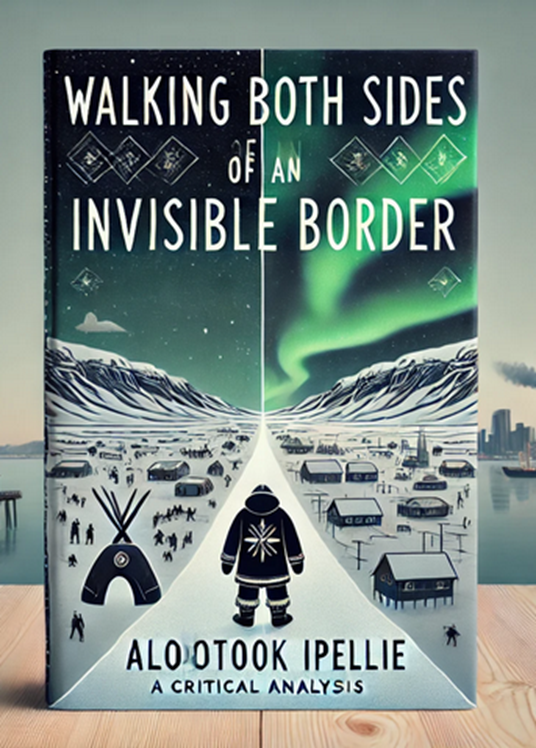
Introduction: “Walking Both Sides of an Invisible Border” by Alootook Ipellie
“Walking Both Sides of an Invisible Border” by Alootook Ipellie first appeared in 1991 in Gatherings: The En’owkin Journal of First North American Peoples (Theytus Books) and was later reprinted in the journal’s retrospective volume. The poem’s main idea is the lived, bodily split of an Inuk subject caught between cultures—an “invisible border / Separating my left and right foot”—experienced as abandonment (“I feel like an illegitimate child / Forsaken”), unjust punishment (“Sentenced to a torture chamber / Without having committed a crime”), and colonial coercion (“forced / To learn an alien culture / With an alien language”). Its popularity comes from the clarity and memorability of its central metaphor and its sharp survival-ironies: the speaker “resort[s] to fancy dancing” and calls himself “the world’s premier choreographer,” repeatedly inventing “a brand new dance step” to keep living in “two different worlds” where “two opposing cultures…are unable to integrate,” ending with an open question—“When will the invisible border / Cease to be”—that makes the struggle feel ongoing and widely relatable.
Text: “Walking Both Sides of an Invisible Border” by Alootook Ipellie
It is never easy
Walking with an invisible border
Separating my left and right foot
I feel like an illegitimate child
Forsaken by my parents
At least I can claim innocence
Since I did not ask to come
Into this world
Walking on both sides of this
Invisible border
Each and every day
And for the rest of my life
Is like having been
Sentenced to a torture chamber
Without having committed a crime
Understanding the history of humanity
I am not the least surprised
This is happening to me
A non-entity
During this population explosion
In a minuscule world
I did not ask to be born an Inuk
Nor did I ask to be forced
To learn an alien culture
With an alien language
But I lucked out on fate
Which I am unable to do
I have resorted to fancy dancing
In order to survive each day
No wonder I have earned
The dubious reputation of being
The world’s premier choreographer
Of distinctive dance steps
That allow me to avoid
Potential personal paranoia
On both sides of this invisible border
Sometimes this border becomes so wide
That I am unable to take another step
My feet being too far apart
When my crotch begins to tear apart
I am forced to invent
A brand new dance step
The premier choreographer
Saving the day once more
Destiny acted itself out
Deciding for me where I would come from
And what I would become
So I am left to fend for myself
Walking in two different worlds
Trying my best to make sense
Of two opposing cultures
Which are unable to integrate
Lest they swallow one another whole
Each and every day
Is a fighting day
A war of raw nerves
And to show for my efforts
I have a fair share of wins and losses
When will all this end
This senseless battle
Between my left and right foot
When will the invisible border
Cease to be
Annotations: “Walking Both Sides of an Invisible Border” by Alootook Ipellie
| Stanza / Key Lines | Concise Annotation (Meaning & Function) | Literary Devices |
| “It is never easy… Into this world” | Introduces lifelong psychological division; the speaker frames identity conflict as imposed and involuntary, evoking emotional abandonment and innocence. | 🔹 Extended Metaphor (invisible border) 🔹 Simile (“like an illegitimate child”) 🔹 Symbolism (border = identity split) 🔹 Pathos 🔹 Confessional Tone |
| “Walking on both sides… Without having committed a crime” | Daily existence is equated with unjust punishment, emphasizing systemic oppression and inherited suffering. | 🔹 Simile (torture chamber) 🔹 Hyperbole 🔹 Victimization Imagery 🔹 Irony (punishment without guilt) |
| “Understanding the history of humanity… In a minuscule world” | Personal marginalization is contextualized within global human history, suggesting dehumanization amid modern overpopulation. | 🔹 Allusion (human history) 🔹 Understatement (“not the least surprised”) 🔹 Metaphor (“non-entity”) 🔹 Diction (bureaucratic/impersonal) |
| “I did not ask to be born an Inuk… Which I am unable to do” | Asserts cultural coercion and linguistic alienation while underscoring lack of agency in identity formation. | 🔹 Repetition (“I did not ask”) 🔹 Cultural Conflict 🔹 Juxtaposition (native vs alien) 🔹 Irony (fate as false fortune) |
| “I have resorted to fancy dancing… On both sides of this invisible border” | Survival requires performative adaptability; identity becomes a strategic performance to avoid psychological harm. | 🔹 Extended Metaphor (dance = coping) 🔹 Satire 🔹 Irony 🔹 Motif (performance) 🔹 Symbolism |
| “Sometimes this border becomes so wide… Saving the day once more” | Identity strain reaches physical extremity; creativity becomes an emergency response to existential rupture. | 🔹 Grotesque Imagery 🔹 Personification (border widening) 🔹 Dark Humor 🔹 Hyperbole 🔹 Metaphor |
| “Destiny acted itself out… And what I would become” | Fate is portrayed as an external force, negating personal choice and reinforcing determinism. | 🔹 Personification (destiny acting) 🔹 Determinism 🔹 Fatalistic Tone |
| “So I am left to fend for myself… Lest they swallow one another whole” | Cultural duality is irreconcilable; integration threatens annihilation rather than harmony. | 🔹 Metaphor (cultures swallowing) 🔹 Binary Opposition 🔹 Imagery 🔹 Postcolonial Theme |
| “Each and every day… Between my left and right foot” | Daily life is militarized; internal identity conflict is framed as perpetual warfare. | 🔹 Extended Metaphor (war) 🔹 Anaphora 🔹 Internal Conflict 🔹 Symbolism (left/right foot) |
| “When will the invisible border / Cease to be” | Ends with unresolved yearning, emphasizing the permanence of division and absence of closure. | 🔹 Rhetorical Question 🔹 Ellipsis (implied silence) 🔹 Symbolism 🔹 Open Ending |
Literary And Poetic Devices: “Walking Both Sides of an Invisible Border” by Alootook Ipellie
| Device | Example from the Poem | Specific Explanation |
| Alienation 🟣 | “I did not ask to be born an Inuk” | The speaker articulates social and cultural estrangement caused by being Indigenous in a dominant colonial culture, emphasizing enforced otherness rather than chosen difference. |
| Allusion 🔵 | “Understanding the history of humanity” | A broad historical reference that situates the speaker’s personal suffering within a long global history of marginalization and domination. |
| Anaphora 🟢 | “Each and every day” | Repetition at the start of lines reinforces the relentlessness and inescapability of identity conflict in daily life. |
| Binary Opposition 🟠 | “left and right foot” | The body is split into opposing halves to dramatize irreconcilable cultural identities existing within one individual. |
| Determinism 🔴 | “Destiny acted itself out” | Suggests the speaker’s origin and identity were pre-decided by historical and colonial forces, leaving no room for personal agency. |
| Extended Metaphor 🟤 | “Invisible border” (throughout the poem) | The border consistently represents cultural, linguistic, and psychological division, shaping every aspect of the speaker’s existence. |
| Grotesque Imagery ⚫ | “When my crotch begins to tear apart” | A disturbing bodily image externalizes psychological strain, showing how identity conflict causes figurative self-destruction. |
| Hyperbole 🟡 | “Sentenced to a torture chamber” | Exaggerates suffering to emphasize the cruelty of living between cultures without belonging fully to either. |
| Imagery 🟩 | “My feet being too far apart” | Physical imagery makes abstract identity tension concrete, allowing readers to visualize cultural dislocation. |
| Irony 🟦 | “I lucked out on fate” | Verbal irony exposes the false promise of fate; what is described as “luck” is actually cultural loss and suffering. |
| Metaphor 🟧 | “A war of raw nerves” | Identity struggle is likened to warfare, highlighting emotional exhaustion and constant psychological combat. |
| Motif 🟨 | “dance / dancing” | Recurrent dance imagery symbolizes adaptive performance—altering behavior to survive conflicting cultural expectations. |
| Paradox 🟥 | “Walking in two different worlds” | The speaker exists simultaneously in opposing cultural realities, a logically impossible yet lived condition. |
| Pathos 🟪 | “Forsaken by my parents” | Emotional appeal underscores abandonment—not literal parents, but cultural and historical guardianship. |
| Personification 🟫 | “Destiny acted itself out” | Fate is given human agency, reinforcing the sense that impersonal forces actively shape Indigenous lives. |
| Postcolonial Theme 🟠 | “alien culture / alien language” | Highlights cultural imperialism where Indigenous identity is subordinated to colonial norms. |
| Repetition 🔁 | “I did not ask” | Reiterates lack of consent in birth, culture, and language, stressing imposed identity formation. |
| Rhetorical Question ❓ | “When will the invisible border / Cease to be” | Expresses despair and unresolved identity conflict rather than expecting an answer. |
| Simile 💠 | “like an illegitimate child” | Compares the speaker’s identity to social rejection, intensifying themes of exclusion and shame. |
| Symbolism ⭐ | “Invisible border” | Symbolizes unseen yet powerful barriers—cultural, racial, linguistic—that structure Indigenous existence. |
Themes: “Walking Both Sides of an Invisible Border” by Alootook Ipellie
- 🌍 Cultural Bifurcation and Identity Split
“Walking Both Sides of an Invisible Border” by Alootook Ipellie dramatizes cultural bifurcation by turning identity conflict into an embodied condition, where the speaker’s motion is governed by an “invisible border” separating the left and right foot, so that walking itself becomes a daily negotiation between incompatible cultural demands. Because he “did not ask to be born an Inuk,” and because he is “forced / To learn an alien culture / With an alien language,” the poem frames hybridity not as enrichment but as coerced doubleness, produced by history rather than desire. The border functions as a persistent inner frontier, one that structures perception, language, and belonging, while also generating a sense of illegitimacy and abandonment, as the speaker feels “like an illegitimate child / Forsaken by my parents.” Through this sustained metaphor, Ipellie shows how colonial modernity fractures identity into opposing registers that cannot be harmonized without loss, and yet must be inhabited, “each and every day,” as a lifelong condition. - ⚖️ Colonial Injustice and Historical Determinism
“Walking Both Sides of an Invisible Border” by Alootook Ipellie foregrounds colonial injustice by translating structural domination into the idiom of punishment, sentencing, and dispossession, so that Indigenous existence appears as a penalty imposed without guilt. When the speaker says it is “like having been / Sentenced to a torture chamber / Without having committed a crime,” he exposes how colonial power operates through systemic coercion rather than ethical accountability, converting life into ordeal while refusing to name itself as violence. The poem also expands personal suffering into historical critique, since the speaker’s awareness of “the history of humanity” makes him “not the least surprised” that he has been reduced to “a non-entity” in a “minuscule world,” thereby linking Inuit marginalization to global patterns of conquest and demographic domination. Destiny “decid[es]” what he will become, and this determinism functions as an indictment of the political order that normalizes Indigenous disempowerment as fate. - 💃 Survival, Adaptation, and Creative Resistance
“Walking Both Sides of an Invisible Border” by Alootook Ipellie presents survival as a form of creative resistance, in which the speaker’s adaptability becomes both coping mechanism and critique of the conditions that demand constant reinvention. By “resort[ing] to fancy dancing” to live through each day, he converts cultural improvisation into an art of endurance, while the irony of calling himself “the world’s premier choreographer” reveals how resilience is won at a cost, because it is required to manage “distinctive dance steps” that ward off “personal paranoia.” When the border widens so drastically that he cannot “take another step,” and when the body threatens to “tear apart,” invention returns as necessity: he must create “a brand new dance step,” a gesture that suggests agency within constraint, and self-making within oppression. The theme thus emphasizes that resistance is not always overt confrontation; it can also be the disciplined, imaginative labor of staying whole while living in fracture. - ⚔️ Psychological Conflict and Perpetual Struggle
“Walking Both Sides of an Invisible Border” by Alootook Ipellie culminates in a sustained depiction of psychological conflict, portraying the self as a site of continuous warfare produced by irreconcilable cultural pressures. The speaker insists that “each and every day / Is a fighting day,” a phrase intensified by “a war of raw nerves,” because the psyche must repeatedly absorb the shocks of living in “two different worlds” whose “opposing cultures” cannot integrate “lest they swallow one another whole.” The physical image of feet pulled apart becomes a psychological diagram of divided loyalty and chronic strain, generating exhaustion, anxiety, and instability, even as the speaker registers “wins and losses” that suggest a struggle measured in small survivals rather than triumphs. Crucially, the poem refuses neat closure, ending in a question—“When will the invisible border / Cease to be”—so that readers remain inside the ongoingness of the conflict, confronted with the persistence of colonial aftermath rather than the comfort of resolution.
Literary Theories and “Walking Both Sides of an Invisible Border” by Alootook Ipellie
| Literary Theory | How it applies to “Walking Both Sides of an Invisible Border” by Alootook Ipellie |
| 🧭 Postcolonial Theory | The poem foregrounds colonization as a lived structure that fractures Indigenous subjectivity and produces coerced hybridity; the speaker rejects voluntarism—“I did not ask to be born an Inuk / Nor did I ask to be forced / To learn an alien culture / With an alien language”—and depicts daily life as an imposed condition of division—“Walking on both sides of this / Invisible border / Each and every day / And for the rest of my life.” The “border” becomes a metaphor for colonial partitioning of self and culture, while the image of being “Sentenced to a torture chamber / Without having committed a crime” frames colonial rule as systemic injustice rather than individual failing. |
| ⚙️ New Historicism | The poem can be read as a cultural text embedded in histories of assimilation, schooling, and linguistic displacement, where personal voice is inseparable from institutional power; Ipellie situates the speaker’s pain within “the history of humanity,” and connects marginalization to modern global conditions—“a non-entity / During this population explosion / In a minuscule world.” “Destiny acted itself out / Deciding for me where I would come from / And what I would become” reads like a critique of historical forces and governance systems that assign identities and life-chances, showing how the subject is produced by sociohistorical scripts rather than purely private psychology. |
| 🧠 Psychoanalytic Criticism | The poem dramatizes psychic splitting and chronic anxiety through the embodied metaphor of feet divided by an “invisible border,” suggesting a fragmented self forced to manage incompatible internal demands; the speaker feels abandoned—“I feel like an illegitimate child / Forsaken by my parents”—and describes life as punitive—“Sentenced to a torture chamber”—which frames trauma as internalized and persistent. His “fancy dancing” operates as a coping mechanism to avoid “personal paranoia,” and the moment when the border widens so far that “my crotch begins to tear apart” externalizes psychic rupture as bodily threat, implying that identity conflict can escalate into breakdown unless continuously managed. |
| 🎭 Existentialism | The speaker confronts absurdity, thrownness, and meaning-making under constraint: he insists, “I did not ask to come / Into this world,” and later, “Destiny…Deciding for me where I would come from / And what I would become,” emphasizing existence as unchosen and conditions as imposed. Yet he still must act—“So I am left to fend for myself / Walking in two different worlds / Trying my best to make sense”—which aligns with existential responsibility amid coercive structures. The recurring questions—“When will all this end… / When will the invisible border / Cease to be”—intensify the existential tension between the desire for resolution and the reality of ongoing struggle. |
Critical Questions about “Walking Both Sides of an Invisible Border” by Alootook Ipellie
❓ Question 1: How does the metaphor of the “invisible border” structure the poem’s exploration of identity?
“Walking Both Sides of an Invisible Border” by Alootook Ipellie constructs identity through the sustained metaphor of an “invisible border,” which functions as the poem’s central organizing principle and conceptual framework. This border is not geographical but psychological, cultural, and linguistic, dividing the speaker internally rather than spatially. By locating the border between the speaker’s “left and right foot,” Ipellie internalizes colonial and cultural conflict, transforming identity into a site of perpetual imbalance. The metaphor structures the poem episodically, as each stanza revisits the border in new forms—punishment, performance, warfare—thereby reinforcing its permanence. Moreover, the invisibility of the border underscores its insidious power: although unseen, it dictates movement, behavior, and self-perception. The metaphor thus allows Ipellie to dramatize Indigenous hybridity as an embodied experience, revealing how colonial histories produce fractured selves who must constantly negotiate incompatible cultural demands without the possibility of resolution or stable belonging.
🟣 Question 2: In what ways does the poem critique colonial assimilation and cultural coercion?
“Walking Both Sides of an Invisible Border” by Alootook Ipellie offers a pointed critique of colonial assimilation by foregrounding the absence of consent in the speaker’s cultural formation. The repeated assertion “I did not ask” emphasizes that neither birth, language, nor cultural displacement was chosen, thereby exposing assimilation as an imposed and violent process rather than a benign exchange. The description of learning an “alien culture” and “alien language” frames colonial education as estrangement from one’s original identity, producing a subject who must survive by adaptation rather than integration. Importantly, Ipellie avoids overt political rhetoric and instead embeds critique within lived experience, showing how assimilation penetrates the body, psyche, and daily routine. The speaker’s resort to “fancy dancing” functions as a metaphor for performative compliance, suggesting that Indigenous survival often depends on strategic mimicry. Through this lens, the poem exposes colonialism as an ongoing condition that fractures identity while disguising coercion as cultural progress.
🟠 Question 3: How does bodily imagery intensify the poem’s psychological conflict?
“Walking Both Sides of an Invisible Border” by Alootook Ipellie employs bodily imagery to translate abstract identity conflict into visceral, tangible experience, thereby intensifying its psychological impact. The division of the body—particularly the feet pulled “too far apart”—renders cultural duality as physical strain, making inner conflict legible through pain and imbalance. The most striking image, in which the speaker’s body threatens to tear apart, uses grotesque exaggeration to convey the violence of living between incompatible worlds. This strategy collapses the distinction between mental and physical suffering, suggesting that colonial trauma is not merely ideological but somatic. Furthermore, the body becomes a site of resistance and creativity, as the speaker invents new “dance steps” to avoid collapse. Such imagery underscores resilience while refusing romanticization, showing survival as a continuous act of improvisation. By grounding psychological fragmentation in corporeal terms, Ipellie ensures that identity conflict is experienced not as theory but as lived, painful reality.
🔴 Question 4: Why does the poem end without resolution, and what is the significance of this open ending?
“Walking Both Sides of an Invisible Border” by Alootook Ipellie deliberately concludes without resolution to reflect the enduring nature of Indigenous identity conflict under colonial modernity. The final rhetorical question—asking when the invisible border will cease—remains unanswered, signaling that the struggle is ongoing rather than episodic. This open ending resists the conventional narrative of reconciliation or integration, which often simplifies or neutralizes colonial trauma. Instead, Ipellie presents identity as a permanent condition of negotiation, shaped by historical forces that cannot be undone by individual will alone. The absence of closure also places ethical responsibility on the reader, compelling recognition rather than comfort. By refusing resolution, the poem mirrors the lived reality of many Indigenous subjects whose cultural divisions persist across generations. The ending thus transforms uncertainty into a political statement, asserting that true resolution requires structural and historical change, not merely personal adaptation or symbolic inclusion.
Literary Works Similar to “Walking Both Sides of an Invisible Border” by Alootook Ipellie
- 🟦 “I Lost My Talk” by Rita Joe — Like Ipellie, Joe frames colonial assimilation as a theft of language and selfhood, depicting Indigenous identity as forced to negotiate an “alien” tongue and culture while enduring the lasting psychic aftershock of that rupture.
- 🟥 “Indian Boarding School: The Runaways” by Louise Erdrich — Similar to Ipellie’s “invisible border,” Erdrich renders the body and daily life as sites of institutional violence, where Indigenous children are disciplined into cultural division and survival becomes a tense, continual escape from imposed identity.
- 🟩 “An American Sunrise” by Joy Harjo — Harjo, like Ipellie, writes from the aftermath of dispossession, linking personal voice to collective history and showing how Indigenous presence persists in a world structured by colonial borders, removal, and enforced re-mapping of belonging.
- 🟨 “In My Country” by Jackie Kay — Echoing Ipellie’s “two different worlds,” Kay explores a split sense of belonging and the pressure of competing cultural claims, portraying identity as lived between registers that do not easily integrate without producing tension and self-interrogation.
Representative Quotations of “Walking Both Sides of an Invisible Border” by Alootook Ipellie
| Quotation | Context & Theoretical Perspective | Explanation |
| ⭐ “Walking with an invisible border / Separating my left and right foot” | Context: Opening image of divided self | Theory: Postcolonial Identity / Hybridity | The body is split to symbolize internalized colonial division, presenting identity as a site of permanent imbalance rather than harmony. |
| 🟣 “I feel like an illegitimate child / Forsaken by my parents” | Context: Emotional self-definition | Theory: Psychological Alienation | The simile frames Indigenous identity as socially rejected, evoking abandonment by both native and dominant cultures. |
| 🔴 “Sentenced to a torture chamber / Without having committed a crime” | Context: Daily lived experience | Theory: Structural Violence | The speaker equates existence with unjust punishment, highlighting oppression without guilt or agency. |
| 🔵 “Understanding the history of humanity / I am not the least surprised” | Context: Reflective historical awareness | Theory: Historical Materialism / Postcolonial History | Personal suffering is linked to long histories of domination, normalizing injustice as systemic rather than accidental. |
| 🟠 “A non-entity / During this population explosion” | Context: Self-erasure | Theory: Dehumanization under Modernity | The speaker presents himself as invisible within mass society, critiquing modern systems that erase Indigenous presence. |
| 🟨 “I did not ask to be born an Inuk” | Context: Assertion of non-consent | Theory: Anti-Essentialism / Identity Politics | Rejects romanticized notions of identity by stressing birth and culture as imposed, not chosen. |
| 🟦 “To learn an alien culture / With an alien language” | Context: Cultural displacement | Theory: Linguistic Imperialism | Language becomes a tool of domination, alienating the speaker from Indigenous epistemology. |
| 🟢 “I have resorted to fancy dancing / In order to survive each day” | Context: Survival strategy | Theory: Performance Theory (Goffman) | Identity is performed strategically, suggesting survival depends on adaptive self-presentation. |
| ⚫ “When my crotch begins to tear apart” | Context: Extreme bodily strain | Theory: Embodied Trauma | Grotesque bodily imagery externalizes psychological rupture caused by irreconcilable identities. |
| ❓ “When will the invisible border / Cease to be” | Context: Poem’s unresolved ending | Theory: Postcolonial Pessimism / Open Text | The unanswered question denies closure, emphasizing the permanence of colonial identity conflict. |
Suggested Readings: “Walking Both Sides of an Invisible Border” by Alootook Ipellie
Books
- Ipellie, Alootook. Arctic Dreams and Nightmares. Theytus Books, 1993. Inhabit Media (publisher page), https://inhabitbooks.com/products/arctic-dreams-and-nightmares. Accessed 28 Dec. 2025.
- Moses, Daniel David, Terry Goldie, and Armand Garnet Ruffo, editors. An Anthology of Canadian Native Literature in English. 4th ed., Oxford UP, 2013. Oxford University Press Canada (companion page), https://www.oupcanada.com/higher_education/companion/literature/9780195443530.html. Accessed 28 Dec. 2025.
Academic articles
- Desrochers-Turgeon, Émélie. “Between Lines and Beyond Boundaries: Alootook Ipellie’s Entanglements of Space.” Études/Inuit/Studies, vol. 44, no. 1–2, 2020, pp. 53–84. JSTOR, https://www.jstor.org/stable/27078825. Accessed 28 Dec. 2025.
- McMahon-Coleman, Kimberley L. “Dreaming an Identity Between Two Cultures: The Works of Alootook Ipellie.” Kunapipi: Journal of Postcolonial Writing, vol. 28, no. 1, 2006, pp. 108–125. University of Wollongong Research Online, https://ro.uow.edu.au/ndownloader/files/50395965. Accessed 28 Dec. 2025.
Poem websites
- Ipellie, Alootook. “Walking Both Sides of an Invisible Border.” Poetry In Voice, https://poetryinvoice.ca/read/poems/walking-both-sides-invisible-border. Accessed 28 Dec. 2025. (poetryinvoice.ca)
- Ipellie, Alootook. “Walking Both Sides of an Invisible Border.” IsumaTV, https://www.isuma.tv/journals-knud-rasmussen-sense-memory-and-high-definition-inuit-storytelling/journals-knud-rasmussen. Accessed 28 Dec. 2025.