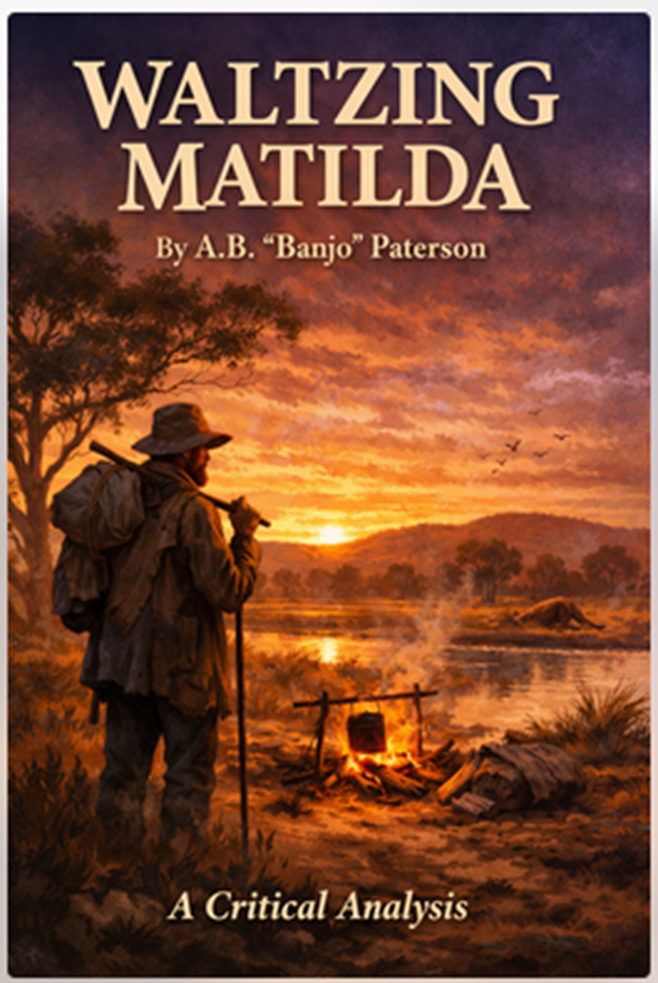
Introduction: “WALTZING MATILDA” by A.B. “Banjo” Paterson
“WALTZING MATILDA” by A.B. “Banjo” Paterson first appeared in 1895, when it was written during Paterson’s stay at Dagworth Station in Queensland, and it later achieved wider circulation through its publication as sheet music in 1903; although not formally issued as part of a single poetic collection at the time, it became central to Paterson’s ballad tradition and to the broader corpus of Australian bush verse. The poem narrates the tragic yet defiant story of a swagman who, confronted by colonial authority—the “squatter” and the “policeman – one, two, and three”—chooses death over surrender, leaping into the “waterhole” beneath the “Coolibah tree.” Its main ideas include resistance to authority, the harsh realities of itinerant bush life, and a romanticized ethos of freedom and mateship, encapsulated in the recurring refrain “Who’ll come a-waltzing Matilda with me,” where “waltzing” signifies wandering and “Matilda” the swagman’s bedroll. The song’s enduring popularity stems from its rhythmic ballad form, memorable chorus, use of distinctly Australian vernacular (“swagman,” “jumbuck,” “billabong”), and its symbolic articulation of anti-authoritarian sentiment and national identity, with the swagman’s voice hauntingly persisting even after death—“his voice can be heard as it sings in the billabongs”—thereby transforming a local bush narrative into a lasting cultural myth.
Text: “WALTZING MATILDA” by A.B. “Banjo” Paterson
Oh there once was a swagman camped in the billabongs,
Under the shade of a Coolibah tree;
And he sang as he looked at the old billy boiling
“Who’ll come a-waltzing Matilda with me.”
Who’ll come a-waltzing Matilda, my darling.
Who’ll come a-waltzing Matilda with me.
Waltzing Matilda and leading a water-bag.
Who’ll come a-waltzing Matilda with me.
Up came the jumbuck to drink at the waterhole,
Up jumped the swagman and grabbed him with glee;
And he sang as he put him away in his tucker-bag,
“Who’ll come a-waltzing Matilda with me.”
Who’ll come a-waltzing Matilda, my darling.
Who’ll come a-waltzing Matilda with me.
Waltzing Matilda and leading a water-bag.
Who’ll come a-waltzing Matilda with me.
Up came the squatter a-riding his thoroughbred;
Up came the policeman – one, two, and three.
“Whose is the jumbuck you’ve got in the tucker-bag?
You’ll come a-waltzing Matilda with we.”
Who’ll come a-waltzing Matilda, my darling.
Who’ll come a-waltzing Matilda with me.
Waltzing Matilda and leading a water-bag.
Who’ll come a-waltzing Matilda with me.
Up sprang the swagman and jumped into the waterhole,
Drowning himself by the Coolibah tree;
And his voice can be heard as it sings in the billabongs,
“Who’ll come a-waltzing Matilda with me.”
Who’ll come a-waltzing Matilda, my darling.
Who’ll come a-waltzing Matilda with me.
Waltzing Matilda and leading a water-bag.
Who’ll come a-waltzing Matilda with me.
Written 1895, first published as sheet music 1903.
Annotations: “WALTZING MATILDA” by A.B. “Banjo” Paterson
| Stanza / Lines | Text Focus | Annotation / Meaning | Literary Devices |
| Stanza 1 | “Oh there once was a swagman… Coolibah tree” | Introduces the swagman as a wandering bush worker and situates the poem firmly in the Australian landscape. The calm, pastoral setting contrasts with the tragic end that follows. | 🖼️ Imagery (billabong, Coolibah tree); 🌿 Local Color (Australian bush terms); 📜 Ballad Convention (narrative opening); 🎵 Alliteration (“billy boiling”) |
| Stanza 1 (Refrain line) | “Who’ll come a-waltzing Matilda with me” | The refrain functions as an invitation to companionship but also symbolizes freedom, wandering, and resistance to settled authority. | 🔁 Repetition; 🎶 Refrain; 🧳 Symbolism (“Matilda” = swag); 🗣️ Colloquial Diction |
| Chorus (Repeated throughout) | “Who’ll come a-waltzing Matilda, my darling…” | Reinforces the song-like quality and communal appeal. The affectionate address (“my darling”) universalizes the swagman’s voice. | 🔁 Repetition; 🎼 Musicality; ❤️ Apostrophe; 🔄 Cyclical Structure |
| Stanza 2 | “Up came the jumbuck… tucker-bag” | Depicts an impulsive act of survival. The swagman’s cheerful tone (“with glee”) masks the seriousness of the crime. | 🐑 Symbolism (jumbuck = livelihood/property); ⚡ Action Verbs; 🎭 Irony (singing while stealing); 🗺️ Realism |
| Stanza 3 | “Up came the squatter… one, two, and three” | Authority enters the poem. The squatter and policemen represent colonial power, law, and class hierarchy. | 👮 Symbolism (law and authority); 🔢 Climax through Enumeration (“one, two, and three”); ⚔️ Conflict; 🎭 Dramatic Tension |
| Stanza 3 (Dialogue) | “Whose is the jumbuck… with we” | The collective “we” emphasizes institutional power confronting the isolated swagman. | 🗣️ Direct Speech; ⚖️ Power Contrast; 👥 Collective Voice; 🎭 Tone Shift |
| Stanza 4 | “Up sprang the swagman… Coolibah tree” | The swagman chooses death over capture, transforming him into a tragic, defiant figure. | 💀 Tragic Hero Motif; 🌊 Symbolism (waterhole = escape); ⚡ Sudden Action; 🎭 Pathos |
| Stanza 4 (Final lines) | “And his voice can be heard… billabongs” | Even in death, the swagman’s voice endures, suggesting legend, memory, and cultural immortality. | 👻 Personification (voice after death); 🕰️ Myth-Making; 🔁 Echo/Refrain; 🧠 Romanticization |
| Final Chorus | Repeated refrain | The repetition at the end elevates the swagman from an individual to a national symbol of freedom and resistance. | 🔁 Repetition; 🏳️ National Myth; 🎶 Circular Ending; 🧳 Symbolic Persistence |
Literary And Poetic Devices: “WALTZING MATILDA” by A.B. “Banjo” Paterson
| Device | Example from the Poem | Expanded Explanation |
| 1 🔵 Alliteration | “old billy boiling” | The repetition of the initial /b/ sound creates a rhythmic, musical flow that mirrors oral storytelling and folk song tradition, enhancing memorability. |
| 2 💜 Apostrophe | “my darling” | The speaker directly addresses an unnamed listener, creating intimacy and emotional warmth, which contrasts sharply with the poem’s tragic conclusion. |
| 3 🟢 Ballad Form | Narrative stanzas + recurring chorus | The poem follows the traditional ballad structure—simple language, storytelling, repetition—making it ideal for singing and oral transmission. |
| 4 🟠 Colloquial Diction | “swagman,” “jumbuck,” “tucker-bag” | Use of everyday Australian bush vocabulary grounds the poem in lived experience and asserts a distinct national voice. |
| 5 🔴 Conflict | Swagman vs. squatter & police | The central conflict pits an individual drifter against colonial authority, reflecting class struggle and resistance to institutional power. |
| 6 🟣 Direct Speech | “Whose is the jumbuck you’ve got…” | Dialogue dramatizes the encounter, increases immediacy, and allows authority to speak in its own commanding voice. |
| 7 🟤 Dramatic Irony | Singing cheerfully before death | The swagman’s carefree singing contrasts with the grim outcome, heightening tragedy and emotional impact. |
| 8 ⚫ Enumeration | “one, two, and three” | The counting of policemen emphasizes numerical dominance and inevitability, suggesting overwhelming institutional force. |
| 9 🟡 Imagery | “billabongs,” “Coolibah tree” | Visual imagery vividly evokes the Australian bush, situating the poem in a specific physical and cultural landscape. |
| 10 🟩 Legend / Myth-Making | Voice heard after death | The continuation of the swagman’s voice transforms him from a mortal figure into a folkloric symbol of freedom and defiance. |
| 11 🟦 Local Color | Bush setting and lifestyle | Detailed depiction of rural Australia reinforces cultural authenticity and national identity. |
| 12 🟥 Narrative Poetry | Beginning → climax → resolution | The poem tells a complete story with rising action and tragic resolution, distinguishing it from purely lyrical verse. |
| 13 🟪 Personification | “his voice can be heard” | Human attributes are given to an absent presence, suggesting memory, legend, and spiritual endurance beyond death. |
| 14 🟧 Refrain | “Who’ll come a-waltzing Matilda with me” | The repeated refrain unifies the poem structurally and thematically, reinforcing freedom, wandering, and companionship. |
| 15 🟫 Repetition | Chorus repeated after every stanza | Repetition strengthens musical quality, reinforces themes, and aids oral recall, crucial for folk songs. |
| 16 🌸 Romanticism | Glorification of defiant death | The swagman’s suicide is idealized as a noble assertion of freedom, reflecting Romantic values of individualism. |
| 17 ⭐ Symbolism | Matilda, jumbuck, waterhole | Objects function symbolically: Matilda (freedom), jumbuck (survival/property), waterhole (escape/death). |
| 18 🎭 Tone | Light, lyrical yet tragic | The blend of cheerfulness and fatalism deepens emotional complexity and avoids moralizing judgment. |
| 19 💀 Tragic Hero | Swagman chooses death | Like a classical tragic hero, the swagman asserts agency through self-destruction rather than submission. |
| 20 🎶 Verbal Music | Rhyme, rhythm, chorus | Musical elements ensure longevity, enabling the poem to survive as both literature and song. |
Themes: “WALTZING MATILDA” by A.B. “Banjo” Paterson
- 🌾 Bush Life and the Itinerant Ethos
“WALTZING MATILDA” by A.B. “Banjo” Paterson foregrounds the harsh yet symbolically resonant realities of Australian bush life through the figure of the swagman, whose itinerant existence reflects both material deprivation and a fiercely guarded independence. The images of the billabong, the Coolibah tree, and the boiling billy are not decorative details but culturally saturated signs that encode a landscape shaping identity, endurance, and worldview. The swagman’s solitary camping and habitual singing suggest a rhythm of life attuned to nature rather than property or permanence, while the recurring invitation to “waltz Matilda” ritualizes movement as a way of life. Through complex narrative layering, Paterson presents bush life as a site where hardship is normalized and dignity is preserved through song, thereby transforming marginal existence into a defining cultural ethos rather than a condition of failure. - 🐑 Class Conflict and Colonial Authority
“WALTZING MATILDA” by A.B. “Banjo” Paterson articulates a pointed critique of colonial class relations by staging a conflict between the dispossessed swagman and the institutional powers embodied by the squatter and the police. The act of taking the jumbuck, while framed with ironic cheer, exposes the asymmetry between survival-driven necessity and legally protected wealth. The squatter’s arrival on horseback functions as a visual marker of privilege, sharply contrasting with the swagman’s precarious existence, while the presence of multiple policemen underscores the collective force of law deployed to defend property rather than justice. Through this confrontation, the poem aligns moral authority with the marginalized figure, implicitly questioning the legitimacy of colonial legal structures. Paterson thus embeds social protest within folk narrative, allowing class antagonism to surface through story rather than overt polemic. - 💧 Defiance, Freedom, and Existential Choice
“WALTZING MATILDA” by A.B. “Banjo” Paterson reaches its thematic climax in the swagman’s decision to leap into the billabong, an act that transforms personal despair into symbolic resistance. Rather than submitting to arrest and institutional control, he chooses death as an assertion of autonomy, thereby redefining freedom as the power to refuse unjust authority even at the cost of life itself. This moment complicates moral judgment, as the act is neither celebrated nor condemned outright but framed as a final, uncompromising choice. The persistence of the swagman’s voice after death reinforces the idea that resistance outlives the individual, echoing across the landscape as a form of collective memory. In this way, Paterson presents freedom not as legal entitlement but as existential resolve, exercised most starkly when all conventional options have been exhausted. - 🎶 Myth, Ballad Tradition, and National Consciousness
“WALTZING MATILDA” by A.B. “Banjo” Paterson operates as a foundational cultural myth through its ballad structure, repetition, and musical cadence, all of which facilitate oral transmission and communal participation. The refrain’s cyclical return mirrors the endurance of the values it encodes, allowing the swagman’s story to transcend its immediate narrative and enter the realm of national folklore. By blending tragedy with melodic simplicity, the poem converts social critique into a shared cultural memory that is easily recalled and widely circulated. The ghostly continuation of the swagman’s song symbolizes how national identity is shaped less by official histories than by remembered acts of defiance. Consequently, the poem functions as an alternative historical archive, preserving ideals of egalitarianism, resistance, and resilience at the heart of Australian self-understanding.
Literary Theories and “WALTZING MATILDA” by A.B. “Banjo” Paterson
| Literary Theory | Application to “WALTZING MATILDA” by A.B. “Banjo” Paterson (with textual references) |
| 🔴 Marxist Criticism | “WALTZING MATILDA” by A.B. “Banjo” Paterson can be read as a critique of class inequality under colonial capitalism, where economic power is concentrated in the hands of landowners while itinerant laborers remain dispossessed. The swagman represents the proletariat, living without property and surviving on marginal means, whereas the squatter symbolizes the bourgeois class, protected by both wealth and law. The line “Up came the squatter a-riding his thoroughbred” sharply contrasts privilege with poverty, while “Whose is the jumbuck you’ve got in the tucker-bag?” exposes how property rights override human need. The arrival of the police—“one, two, and three”—illustrates the state’s role in enforcing capitalist order, thereby criminalizing survival and aligning law with class dominance rather than justice. |
| 🟢 New Historicism | “WALTZING MATILDA” by A.B. “Banjo” Paterson gains deeper significance when situated within the socio-historical context of 1890s Australia, a period marked by labor unrest, shearers’ strikes, and resistance to pastoral elites. The swagman’s theft of the jumbuck echoes real historical tensions between itinerant workers and wealthy squatters. Lines such as “You’ll come a-waltzing Matilda with we” reflect the coercive authority of colonial law, while the setting—billabongs, Coolibah trees, and waterholes—anchors the poem firmly in the lived geography of the Australian bush. The poem thus operates not merely as folklore but as a cultural document that records working-class dissent, embedding historical conflict within a seemingly simple ballad structure. |
| 🔵 Existentialism | “WALTZING MATILDA” by A.B. “Banjo” Paterson anticipates existential concerns by dramatizing individual freedom, choice, and defiance in the face of absurd authority. The swagman’s final act—“Up sprang the swagman and jumped into the waterhole”—constitutes an assertion of agency when confronted with an oppressive system that denies dignity and autonomy. Rather than submitting to arrest, he chooses death, transforming suicide into a conscious act of resistance. The haunting continuation of his voice—“And his voice can be heard as it sings in the billabongs”—suggests that meaning is created through choice rather than imposed by law or morality. Freedom here is existential, rooted in self-determination even under extreme constraint. |
| 🟣 Postcolonial Theory | “WALTZING MATILDA” by A.B. “Banjo” Paterson can be interpreted as a postcolonial text that questions the legitimacy of imported British legal and economic systems imposed upon the Australian landscape. The squatter and police represent colonial authority, enforcing ownership and order in a land portrayed as communal and natural. The swagman’s intimate connection with the bush—“camped in the billabongs / Under the shade of a Coolibah tree”—contrasts with the rigid, external structures of colonial power. His defiance and subsequent death expose the violence inherent in colonial governance, where law suppresses indigenous modes of living and mobility. The poem thus subtly resists imperial norms by valorizing marginal figures and bush ethics over colonial hierarchy. |
Critical Questions about “WALTZING MATILDA” by A.B. “Banjo” Paterson
🔵 Question 1: How does “Waltzing Matilda” represent resistance to authority and class conflict?
Answer:
“WALTZING MATILDA” by A.B. “Banjo” Paterson presents resistance to authority through the figure of the swagman, whose clash with the squatter and the police symbolizes deeper class tensions within colonial Australian society. The swagman, an itinerant laborer with no property or institutional protection, embodies the marginalized working class, while the squatter and policemen represent landownership, law, and colonial power. When confronted with the question, “Whose is the jumbuck you’ve got in the tucker-bag?”, the swagman’s refusal to submit culminates in his leap into the waterhole, a deliberate act that transforms personal desperation into symbolic defiance. Rather than surrendering to a system that criminalizes survival, he asserts autonomy through self-destruction, thereby rejecting the legitimacy of imposed authority. Paterson does not moralize this act; instead, the continued singing voice suggests cultural validation of rebellion. Thus, the poem elevates resistance into a defining national ethos rooted in egalitarianism and skepticism toward power.
🟢 Question 2: In what ways does the ballad form contribute to the poem’s meaning and popularity?
Answer:
“WALTZING MATILDA” by A.B. “Banjo” Paterson derives much of its meaning and enduring popularity from its ballad form, which allows a serious social narrative to be conveyed through simple, memorable, and musical verse. The regular rhythm, repetitive refrain, and straightforward storytelling make the poem easily singable, ensuring its transmission through oral culture rather than elite literary circles alone. This accessibility enables the swagman’s story to resonate collectively, transforming an individual tragedy into shared cultural memory. Moreover, the recurring chorus—“Who’ll come a-waltzing Matilda with me”—functions both as a narrative pause and an ideological invitation, drawing listeners into the values of freedom, wandering, and mateship. The ballad form also softens the poem’s tragic ending; the musical repetition prevents despair from overwhelming the narrative, instead framing death as legendary rather than purely bleak. Consequently, the ballad structure is not merely decorative but central to the poem’s mythic and national status.
🔴 Question 3: Discuss the symbolic significance of landscape and natural elements in the poem.
Answer:
“WALTZING MATILDA” by A.B. “Banjo” Paterson employs the Australian landscape not merely as a backdrop but as an active symbolic framework that shapes the poem’s meaning. Elements such as the billabong, the Coolibah tree, and the waterhole represent both physical survival and existential choice. The billabong, a quiet and isolated body of water, signifies marginal existence on the edges of society, mirroring the swagman’s social position. The Coolibah tree offers shade and temporary refuge, emphasizing the transience of the swagman’s life, while the waterhole ultimately becomes a site of escape and death. Nature, unlike colonial authority, does not judge or interrogate; it receives the swagman without coercion. Furthermore, the final image of the voice echoing in the billabongs suggests that the land itself preserves memory and legend. Thus, Paterson transforms the Australian bush into a moral and cultural space aligned with freedom and resistance.
🟣 Question 4: Why has “Waltzing Matilda” come to be regarded as an unofficial national song of Australia?
Answer:
“WALTZING MATILDA” by A.B. “Banjo” Paterson has achieved the status of an unofficial national song because it articulates core Australian values through a compelling blend of narrative, symbolism, and music. The poem celebrates egalitarianism by centering a humble swagman rather than a heroic leader, thereby privileging ordinary experience over institutional authority. Its use of distinctly Australian language—such as “swagman,” “jumbuck,” and “billabong”—asserts linguistic and cultural independence from British tradition, while its setting in the harsh yet liberating bush reinforces a national identity forged through endurance and self-reliance. Moreover, the swagman’s defiant refusal to submit resonates with Australia’s historical skepticism toward hierarchy and power. The song’s accessibility, reinforced by its ballad form and memorable refrain, has allowed it to transcend literary boundaries and enter popular consciousness. As a result, the poem functions as a cultural myth that continues to unify collective memory and identity.
Literary Works Similar to “WALTZING MATILDA” by A.B. “Banjo” Paterson
- 🎵 “Song of the Ungirt Runners” by A.B. “Banjo” Paterson
This poem closely resembles “WALTZING MATILDA” by A.B. “Banjo” Paterson in its celebration of Australian bush life and the romanticization of endurance, freedom, and egalitarian spirit, as it foregrounds ordinary men whose dignity arises from resilience, mobility, and resistance to rigid social hierarchies rather than from wealth or institutional power. - 🌾 “The Man from Snowy River” by A.B. “Banjo” Paterson
Like “WALTZING MATILDA” by A.B. “Banjo” Paterson, this poem elevates a marginal figure into a national hero, using the Australian landscape as a testing ground for courage and independence, while reinforcing bush values that privilege action, self-reliance, and moral worth over class privilege or inherited authority. - 🔥 “Clancy of the Overflow” by A.B. “Banjo” Paterson
This poem parallels “WALTZING MATILDA” by A.B. “Banjo” Paterson in its critique of settled, bureaucratic life and its idealization of itinerant bush existence, portraying freedom as spatial movement and emotional vitality in contrast to the confinement and spiritual emptiness associated with urban or institutional environments. - 🌍 “The Vagabond” by Robert Louis Stevenson
Similar to “WALTZING MATILDA” by A.B. “Banjo” Paterson, this poem glorifies the wandering life and frames mobility as a philosophical stance against social constraint, presenting the figure of the wanderer as morally autonomous, joyfully defiant, and deeply connected to nature rather than to property, law, or social conformity.
Representative Quotations of “WALTZING MATILDA” by A.B. “Banjo” Paterson
| Quotation | Context | Theoretical Perspective & Explanation |
| 1 🔵 “Oh there once was a swagman camped in the billabongs” | Opening line introducing the protagonist and setting | Cultural Materialism / Social Realism: The line situates the swagman as a marginal labor figure embedded in material conditions of colonial Australia, foregrounding class and survival on the periphery of society. |
| 2 🟢 “Under the shade of a Coolibah tree” | Description of the swagman’s resting place | Ecocriticism: Nature functions as refuge and companion, suggesting an alternative moral order outside colonial law, where the land offers shelter denied by society. |
| 3 🟡 “And he sang as he looked at the old billy boiling” | Swagman calmly singing while cooking | Romanticism: The carefree singing romanticizes hardship, idealizing individual freedom and emotional resilience in the face of material scarcity. |
| 4 🟠 “Who’ll come a-waltzing Matilda with me” | Refrain repeated throughout the poem | Nationalism / Cultural Myth Theory: The refrain acts as an ideological invitation, transforming wandering into a collective identity and a symbol of national ethos. |
| 5 🔴 “Up came the jumbuck to drink at the waterhole” | Arrival of the sheep | Marxist Perspective: The jumbuck represents property and economic value, highlighting how survival becomes criminalized under systems of ownership. |
| 6 🟣 “Up came the squatter a-riding his thoroughbred” | Entry of landowner | Postcolonial Theory: The squatter embodies colonial privilege and land control, contrasting sharply with the dispossession of the swagman. |
| 7 ⚫ “Up came the policeman—one, two, and three” | Law enforcement arrives | Power and Authority Theory (Foucault): Enumeration emphasizes surveillance and coercive force, illustrating how institutional power overwhelms the individual. |
| 8 🟤 “Whose is the jumbuck you’ve got in the tucker-bag?” | Questioning the swagman | Legal Realism: Law is presented as rigid and accusatory, ignoring context, hunger, or necessity, thereby exposing moral limitations of legality. |
| 9 💀 “Up sprang the swagman and jumped into the waterhole” | Swagman’s suicide | Existentialism: The act represents an ultimate assertion of agency, where death is chosen over submission, affirming freedom through self-determination. |
| 10 🌈 “And his voice can be heard as it sings in the billabongs” | Closing image | Myth-Making / Collective Memory: The persistence of the voice elevates the swagman into legend, suggesting that cultural memory outlives physical existence. |
Suggested Readings: “WALTZING MATILDA” by A.B. “Banjo” Paterson
Books
- Paterson, A. B. Saltbush Bill, J.P., and Other Verses. Angus & Robertson, 1917.
https://archive.org/details/saltbushbilljp00pate - Paterson, A. B. The Collected Poems of Banjo Paterson. Angus & Robertson, 1921.
https://archive.org/details/collectedpoemsof00pate
Academic Articles
- Nathan, S. Jerald Sagaya. “Social and Cultural Realism in Banjo Paterson’s ‘Waltzing Matilda.’” ResearchGate, 26 Sept. 2025,
https://www.researchgate.net/publication/395808636_Social_and_Cultural_Realism_in_Banjo_Paterson%27s_Waltzing_Matilda - Hermann, Aaron. “‘Waltzing Matilda’: Early Evidence of Racism in Australian Society?” Primerjalna književnost / Comparative Literature, vol. 39, no. 3, 2016,
https://ojs-gr.zrc-sazu.si/primerjalna_knjizevnost/article/view/6375
Poem Websites
- “Waltzing Matilda.” Poetry Foundation,
https://www.poetryfoundation.org/poems/47301/waltzing-matilda - “Waltzing Matilda.” Australian Government – National Library of Australia,
https://www.nla.gov.au/stories/australias-favourite-song-waltzing-matilda