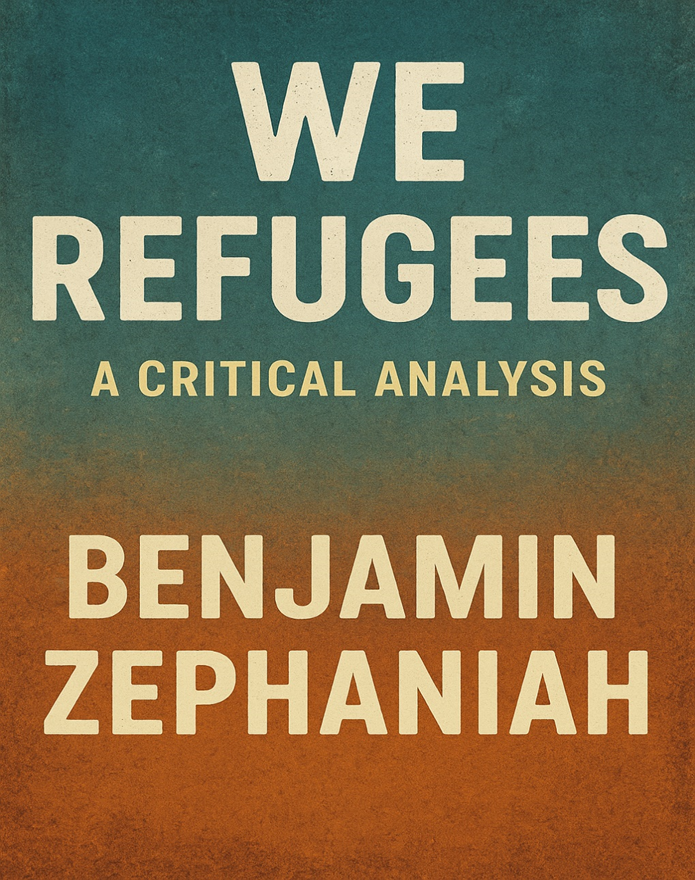
Introduction: “We Refugees” by Benjamin Zephaniah
“We Refugees” by Benjamin Zephaniah first appeared in 2003 in his poetry collection Too Black, Too Strong, a volume that confronts racism, displacement, and political violence with Zephaniah’s characteristic spoken-word urgency. The poem’s power lies in its universalization of the refugee experience: the speaker repeatedly affirms “I come from…” to reveal a wide spectrum of suffering—political persecution (“they shoot me for my song”), religious intolerance (“They don’t like the way I pray”), gender oppression (“girls cannot go to school”), ecological devastation (“the valley floods each year”), and cultural erasure (“I am told I have no country now”). Zephaniah’s refrain—“We can all be refugees”—transforms the poem from a personal lament into a global moral claim, arguing that displacement is not an exception but a shared human vulnerability. The poem’s popularity stems from this ethical universality, its rhythmic clarity, and its powerful reminder that “We all came from refugees,” a line that dissolves boundaries between “us” and “them” by grounding human identity in shared histories of migration and struggle. Through accessible language and vivid imagery, Zephaniah offers a compelling critique of nationalism and xenophobia, which has made “We Refugees” a frequently taught and widely discussed poem in contemporary literature.
Text: “We Refugees” by Benjamin Zephaniah
I come from a musical place
Where they shoot me for my song
And my brother has been tortured
By my brother in my land.
I come from a beautiful place
Where they hate my shade of skin
They don’t like the way I pray
And they ban free poetry.
I come from a beautiful place
Where girls cannot go to school
There you are told what to believe
And even young boys must grow beards.
I come from a great old forest
I think it is now a field
And the people I once knew
Are not there now.
We can all be refugees
Nobody is safe,
All it takes is a mad leader
Or no rain to bring forth food,
We can all be refugees
We can all be told to go,
We can be hated by someone
For being someone.
I come from a beautiful place
Where the valley floods each year
And each year the hurricane tells us
That we must keep moving on.
I come from an ancient place
All my family were born there
And I would like to go there
But I really want to live.
I come from a sunny, sandy place
Where tourists go to darken skin
And dealers like to sell guns there
I just can’t tell you what’s the price.
I am told I have no country now
I am told I am a lie
I am told that modern history books
May forget my name.
We can all be refugees
Sometimes it only takes a day,
Sometimes it only takes a handshake
Or a paper that is signed.
We all came from refugees
Nobody simply just appeared,
Nobody’s here without a struggle,
And why should we live in fear
Of the weather or the troubles?
We all came here from somewhere.
Annotations: “We Refugees” by Benjamin Zephaniah
| Text (Stanza/Line) | Annotation / Meaning | Devices |
| I come from a musical place / Where they shoot me for my song / And my brother has been tortured / By my brother in my land. | Refugee identity emerges from a land where creativity (music) is criminalized; internal conflict (“brother hurting brother”) signals civil war. | 🔵 Metaphor (music = identity) 🔴 Imagery (violence) ⚫ Contrast (beauty vs brutality) 🟩 Political Critique 🟤 Tone: tragic |
| I come from a beautiful place / Where they hate my shade of skin / They don’t like the way I pray / And they ban free poetry. | A “beautiful” homeland made ugly by racism, religious discrimination, censorship. | 🟡 Symbolism (beauty corrupted) ⚫ Contrast 🟣 Irony (beauty vs hate) 🔴 Imagery (skin, prayer) 🟩 Political Critique |
| I come from a beautiful place / Where girls cannot go to school / There you are told what to believe / And even young boys must grow beards. | Oppression of education, forced ideology, and enforced religious identity. | 🟡 Symbolism (beard as forced identity) 🔴 Imagery 🟢 Repetition (I come from) 🟤 Tone: oppressive |
| I come from a great old forest / I think it is now a field / And the people I once knew / Are not there now. | Environmental destruction mirrors cultural erasure; displacement has depopulated the speaker’s land. | 🔵 Metaphor (forest = heritage) ⚫ Contrast (forest → field) 🔴 Imagery 🟡 Symbolism |
| We can all be refugees / Nobody is safe, / All it takes is a mad leader / Or no rain to bring forth food, | Refugeehood is universal; war or climate change can displace anyone. | 🟢 Repetition (we) 🟧 Universal theme 🔵 Metaphor (mad leader = tyranny) 🟩 Political critique |
| We can all be refugees / We can all be told to go, / We can be hated by someone / For being someone. | Identity itself can become a reason for persecution. | 🟢 Repetition 🔵 Metaphor (“being someone”) 🟣 Irony 🟧 Universal theme |
| I come from a beautiful place / Where the valley floods each year / And each year the hurricane tells us / That we must keep moving on. | Natural disasters also cause displacement; nature “commands” migration. | 🔵 Personification (hurricane tells) 🔴 Imagery (floods) 🟡 Symbolism (valley) |
| I come from an ancient place / All my family were born there / And I would like to go there / But I really want to live. | Homeland ties vs survival; longing vs necessity. | ⚫ Contrast (heritage vs safety) 🟤 Tone: mournful 🔵 Metaphor (“ancient place”) |
| I come from a sunny, sandy place / Where tourists go to darken skin / And dealers like to sell guns there / I just can’t tell you what’s the price. | Tourism and violence coexist; exploitation and conflict shape the land. | ⚫ Contrast (tourists vs guns) 🔴 Imagery 🟩 Political critique |
| Page 1. / I am told I have no country now / I am told I am a lie / I am told that modern history books / May forget my name. | Erasure of identity; loss of legal and historical belonging. | 🟢 Repetition (“I am told”) 🟤 Tone: despair 🟡 Symbolism (name = identity) 🔵 Metaphor (lie) |
| We can all be refugees / Sometimes it only takes a day, / Sometimes it only takes a handshake / Or a paper that is signed. | Bureaucracy (documents) and political decisions instantly turn people into refugees. | 🟧 Universal theme 🟩 Political critique 🔵 Metaphor (handshake = political deal) |
| We all came from refugees / Nobody simply just appeared, / Nobody’s here without a struggle, | Historical migration of humanity; refugeehood is part of human story. | 🟢 Repetition 🔵 Metaphor (struggle = history) 🟧 Universal theme |
| And why should we live in fear / Of the weather or the troubles? / We all came here from somewhere. | Rejects fear-based politics; emphasizes shared human origin. | 🟧 Universal theme 🟤 Tone: hopeful 🔴 Imagery (“weather,” “troubles”) |
Literary And Poetic Devices: “We Refugees” by Benjamin Zephaniah
| Device | Definition | Detailed Explanation |
| 🔵 Metaphor | A direct comparison: “They shoot me for my song.” | “Song” metaphorically represents the speaker’s identity, culture, creative freedom, and human dignity. The metaphor shows how authoritarian regimes criminalize self-expression. It suggests that being oneself becomes life-threatening. |
| 🔴 Imagery | Sensory description: “Sunny, sandy place… valley floods each year.” | Zephaniah uses vivid visual and natural imagery to contrast beauty and danger. It grounds the reader in real landscapes marked by violence, poverty, and climate disasters. Imagery makes refugee experiences emotionally immediate. |
| 🟢 Repetition | Deliberate recurrence of phrases: “I come from…” / “We can all be refugees.” | Repetition emphasizes identity, universality, and urgency. It showcases the speaker’s fragmented sense of belonging and highlights how displacement is not limited to one group—it can happen to anyone. |
| 🟡 Symbolism | An object representing deeper meaning: “Forest… now a field.” | The “forest” symbolizes culture, memory, and ancestral roots, while the “field” symbolizes loss, destruction, and erasure. Symbolism conveys how war and displacement wipe out entire histories and communities. |
| 🟣 Irony | A contrast between appearance and truth: “A beautiful place… where they hate my shade of skin.” | The irony exposes how places praised for their natural beauty hide deep social injustices. It criticizes societies that celebrate landscapes yet brutalize the people living there. |
| 🟠 Alliteration | Repetition of initial sounds: “Sunny, sandy place.” | Creates natural flow, musical rhythm, and memorability. Alliteration softens the tone momentarily before contrasting with darker themes (violence, racism, war). |
| ⚫ Contrast | Opposing ideas placed side by side: “Tourists… dealers sell guns there.” | Contrast exposes hypocrisy: outsiders visit for pleasure while locals suffer violence. This highlights unequal experiences of the same land. |
| 🟤 Tone | Emotional colouring: “I am told I am a lie.” | The tone shifts from sorrowful and resigned to universal and empowering. The line expresses deep emotional trauma, humiliation, and the dehumanizing effects of displacement. |
| 🟣 Personification | Giving human traits to non-human forces: “The hurricane tells us / That we must keep moving on.” | Nature becomes an agent of forced migration. Personification emphasizes powerlessness—refugees are pushed by both political and natural forces. |
| 🟧 Universal Theme | Idea applying to all humans: “We all came from refugees.” | Expands the poem’s message beyond one group, arguing that migration is humanity’s origin story. It challenges xenophobia by stressing shared ancestry. |
| 🟩 Political Critique | Implicit criticism of power structures: “All it takes is a mad leader.” | Zephaniah critiques dictatorships, civil-war politics, and state brutality. The line exposes how one leader’s decisions can destroy millions of lives. |
| 💜 Paradox | A statement that contradicts yet reveals truth: “Hated by someone / For being someone.” | The paradox shows the absurdity of identity-based hatred. It exposes the irrationality of racism, nationalism, and religious intolerance. |
| 💠 Anaphora | Repetition at the start of lines: “I am told… I am told…” | Emphasizes how trauma is imposed repeatedly. It mimics indoctrination, reflecting how refugees are defined by others’ narratives instead of their own. |
| 🔶 Hyperbole | Exaggeration for emphasis: “Nobody is safe.” | Not literally true but emotionally and politically accurate. Hyperbole highlights how violence and instability spread unpredictably, making displacement a looming possibility. |
| 🧡 Juxtaposition | Placing two images/ideas side by side: “Beautiful place… hate my shade of skin.” | Juxtaposition exposes contradictions and magnifies injustice. It shows how natural beauty coexists with social cruelty and prejudice. |
| 💛 Colloquial Diction | Everyday conversational language: “I just can’t tell you what’s the price.” | Creates authenticity and immediacy. The informal voice reflects oral storytelling, making the speaker sound like a real refugee recounting their story. |
| 💙 Moral Appeal | Ethical persuasion toward empathy: “Why should we live in fear?” | The poet appeals to human conscience, urging readers to question the fairness of borders, persecution, and discrimination. It calls for global responsibility. |
| 💚 Historical Reference | Allusion to forgotten or erased histories: “Modern history books / May forget my name.” | Highlights how displaced groups are erased from national narratives. Reveals the violence of historical silence and collective amnesia. |
| 🟥 Parallelism | Similar grammatical structure: “Sometimes it only takes a day… Sometimes it only takes a handshake…” | Enhances rhythm while showing how quickly refugeehood can be imposed. Political decisions and signatures can uproot entire families overnight. |
| 🟪 Free Verse | Poetry without rhyme or fixed meter: Entire poem. | Mirrors natural speech and mimics testimonial or oral history. Free verse gives Zephaniah freedom to blend storytelling, protest, and philosophy without structural restrictions—appropriate for a poem about freedom and displacement. |
Themes: “We Refugees” by Benjamin Zephaniah
🔥 Theme 1: Persecution and Violence
“We Refugees” by Benjamin Zephaniah exposes the brutal reality of persecution and political violence that forces individuals to flee their homelands, using the repeated declaration “I come from…” to reveal a world where people are shot “for my song” and tortured “by my brother in my land,” thereby suggesting that violence is not only external but internal, emerging from fractured societies. Zephaniah constructs a lyrical catalogue of suffering—racial hatred, religious intolerance, state repression—through lines such as “They hate my shade of skin” and “They ban free poetry,” which illustrate how basic freedoms collapse under authoritarianism. These images create an atmosphere of fear and instability that underscores the poem’s critique of oppressive systems. By emphasizing that persecution may arise from political madness (“a mad leader”) or even environmental scarcity, Zephaniah broadens the concept of violence beyond war, insisting that persecution remains a global and multifaceted threat, not confined to any single geography.
🌧️ Theme 2: Displacement, Statelessness, and Loss of Home
“We Refugees” by Benjamin Zephaniah foregrounds the psychological weight of displacement and statelessness, articulating how forced migration fractures one’s connection to land, memory, and identity. The speaker’s lament—“I am told I have no country now”—captures a profound erasure, suggesting that exile extends beyond physical dislocation into the realm of belonging, where even history books “may forget my name.” Zephaniah intertwines personal grief with environmental destruction, as the transformation of a homeland—“a great old forest… now a field”—symbolizes the disappearance of cultural and ecological anchors. Through these images, the poem portrays displacement as a continuous cycle rather than a single event, reinforced by natural calamities (“the valley floods each year”) and political upheavals (“a paper that is signed”), both capable of uprooting communities overnight. By presenting home as something fragile and constantly slipping away, the poem emphasizes that displacement is not merely a refugee’s burden but a universal human vulnerability.
🕊️ Theme 3: Universal Human Vulnerability and Shared Origins
“We Refugees” by Benjamin Zephaniah emphasizes the universality of human vulnerability by insisting that the refugee experience is not confined to particular nations, races, or religions but is a condition all humanity may face under the wrong historical circumstances. The refrain “We can all be refugees” functions as a moral warning, suggesting that privilege and security are temporary states that can be undone by a “handshake,” a signed document, a change in leadership, or even the absence of rain. By concluding that “We all came from refugees,” Zephaniah collapses the imagined boundaries between citizen and outsider, reminding readers that migration, struggle, and displacement lie at the roots of human civilization. This theme reframes the refugee not as an alien figure but as a mirror reflecting our shared pasts. Through this universalist perspective, the poem critiques xenophobia and nationalist exclusivity, urging empathy by showing that no society is immune to the precarity that generates refugees.
🌍 Theme 4: Critique of Racism, Xenophobia, and Global Inequality
“We Refugees” by Benjamin Zephaniah offers a powerful critique of the racial prejudice, cultural intolerance, and economic inequalities that shape global attitudes toward refugees, revealing how societies often fear or reject “someone / For being someone.” Zephaniah highlights the hypocrisy of nations that celebrate multiculturalism yet demean refugees, as seen when the poem contrasts violent homelands with tourist-friendly landscapes where outsiders “go to darken skin” while locals struggle under gun violence and exploitation. By juxtaposing these contradictory images, the poem exposes the double standards of a world that commodifies some cultures while criminalizing others. The line “They hate my shade of skin” shows how racism becomes a catalyst for displacement, while the ban on “free poetry” reveals deeper cultural suppression. Through these examples, Zephaniah portrays xenophobia not as an isolated bias but as a global system that shapes who is welcomed, who is excluded, and whose suffering is acknowledged.
Literary Theories and “We Refugees” by Benjamin Zephaniah
| Theory | Application to the Poem |
| 🌍 Postcolonial Theory | Postcolonial reading of “We Refugees” by Benjamin Zephaniah highlights the lingering effects of colonial power structures, racial hierarchies, and cultural displacement. Lines such as “They hate my shade of skin” reveal how racialized identities remain sites of oppression in postcolonial societies, while the banning of “free poetry” shows the silencing of marginalized voices. The poem’s repeated refrain “We can all be refugees” questions the colonial logic of borders and belonging, suggesting that displacement is a global legacy of imperial domination. |
| ⚖️ Marxist Theory | A Marxist reading of “We Refugees” by Benjamin Zephaniah uncovers class struggle, economic inequality, and exploitation that intersect with the refugee experience. When the speaker mentions a place where “tourists go to darken skin” but local people face gun violence from “dealers,” Zephaniah exposes the capitalist commodification of some lives and the disposability of others. The transformation of “a great old forest… now a field” also gestures toward capitalist extraction and environmental degradation that force the poor to migrate. |
| 🧠 Psychological Theory | A psychological lens applied to “We Refugees” by Benjamin Zephaniah foregrounds trauma, identity fragmentation, and the emotional weight of exile. The line “I am told I have no country now” reflects the crisis of selfhood that emerges when one’s history and belonging are erased. The poem’s accumulation of suffering—torture, racial hatred, natural disasters—reveals chronic trauma shaping the refugee psyche, while the yearning in “I would like to go there / But I really want to live” captures the psychological conflict between nostalgia for home and the instinct for survival. |
| 🤝 Humanist Theory | A humanist interpretation of “We Refugees” by Benjamin Zephaniah underscores universal dignity, empathy, and shared humanity. Zephaniah’s declaration “We all came from refugees” reframes the refugee not as an ‘other’ but as an extension of our collective origins. The poet appeals to moral responsibility by showing that persecution (“they shoot me for my song”), intolerance (“They don’t like the way I pray”), and disaster (“the hurricane tells us / That we must keep moving on”) threaten any human life. The poem’s universalizing refrain “We can all be refugees” reinforces a moral worldview grounded in compassion and equality. |
Critical Questions about “We Refugees” by Benjamin Zephaniah
🔵 1. How does “We Refugees” by Benjamin Zephaniah challenge traditional notions of national identity and belonging?
In “We Refugees” by Benjamin Zephaniah, the poet dismantles rigid and exclusionary conceptions of national identity by presenting belonging as inherently fragile, historically constructed, and susceptible to sudden loss. Through repeated declarations of “I come from…,” Zephaniah demonstrates that identity is shaped less by borders and more by lived experiences, memories, and cultural trauma. Traditional notions of belonging—often rooted in race, religion, or territorial continuity—collapse in the face of the poem’s assertion that displacement can occur “in a day” or through “a paper that is signed.” Complex sentences and layered images reveal that the markers states use to define citizenship are arbitrary and reversible, dependent upon power rather than justice. Ultimately, Zephaniah argues that national identity is neither permanent nor secure; it is a fragile construct that can be taken away by political violence, environmental disaster, or social prejudice. Belonging, therefore, becomes an ethical and human question rather than a bureaucratic one.
🔴 2. In what ways does “We Refugees” by Benjamin Zephaniah highlight the universality of suffering and displacement?
In “We Refugees” by Benjamin Zephaniah, universality emerges through the poet’s deliberate use of repetition, parallelism, and collective pronouns, which frame displacement not as an isolated event affecting specific communities but as an essential part of the human condition. When Zephaniah writes, “We can all be refugees,” he dismantles the binary between “citizen” and “outsider,” suggesting that suffering is not limited by geography, privilege, or historical moment. His references to “mad leaders,” environmental disasters, and bureaucratic decisions illustrate how forces beyond individual control can uproot anyone. The poem’s cumulative imagery—floods, hurricanes, torture, censorship—creates a global tapestry of instability, revealing that vulnerability is universal even if suffering manifests differently across contexts. Through complex, interwoven sentences, Zephaniah insists that migration is both a historical constant and a contemporary inevitability, urging readers to recognize shared humanity rather than rely on divisive national categories that obscure the universal nature of fear, loss, and resilience.
🟣 3. How does “We Refugees” by Benjamin Zephaniah criticize political power and the role of leadership in causing displacement?
In “We Refugees” by Benjamin Zephaniah, the poet mounts a subtle yet scathing critique of political power by illustrating how arbitrary, impulsive, or oppressive leadership can destabilize entire populations. The line “All it takes is a mad leader” encapsulates the poet’s condemnation of unaccountable authority figures who, driven by ideological extremism or personal ambition, weaponize governance against their own people. Zephaniah’s complex syntactic structures reveal that displacement is rarely accidental; it is often the product of deliberate political acts—wars, discriminatory laws, cultural suppression, and violent policing—which reduce individuals to fugitives from their own homes. The poet further critiques the bureaucratization of oppression through the haunting observation that refugeehood can result from “a handshake” or “a paper that is signed,” highlighting how formal agreements, treaties, or decrees can erase centuries of belonging. The poem thus exposes political leadership as a primary driver of global suffering, forcing readers to confront systemic failures rather than individualize blame.
🟢 4. How does “We Refugees” by Benjamin Zephaniah reshape readers’ moral responsibility toward displaced people?
*In “We Refugees”/by Benjamin Zephaniah, the poem transforms moral responsibility from a distant humanitarian obligation into an immediate ethical demand by revealing the shared foundations of human migration. Through evocative imagery and complex, interconnected sentences, Zephaniah urges readers to recognize that displacement is not an anomaly affecting a marginal group but a condition to which all humans are historically and existentially connected. When he asserts, “We all came from refugees,” he reframes refugeehood as a universal origin rather than a stigma, compelling readers to reconsider attitudes shaped by privilege or national narratives. By exposing the emotional, political, and environmental forces that uproot lives, the poem awakens empathy rooted in identification rather than pity. Ultimately, Zephaniah positions moral responsibility as a collective duty: to resist xenophobia, challenge exclusionary policies, and cultivate a humanitarian vision that acknowledges the dignity, history, and shared humanity of all displaced individuals.
Literary Works Similar to “We Refugees” by Benjamin Zephaniah
- “Refugee Blues” by W.H. Auden: Like Zephaniah’s poem, this work uses a repetitive, driving rhythm to expose the cruelty of bureaucracy and the dehumanizing feeling of being unwanted in a wealthy country.
- “Home” by Warsan Shire: This piece mirrors Zephaniah’s urgent tone to argue that displacement is a desperate act of survival, famously stating that “no one puts their children in a boat unless the water is safer than the land.”
- “Refugees” by Brian Bilston: Sharing Zephaniah’s clever playfulness to challenge perspective, this poem is a palindrome that reads as hateful top-to-bottom, but becomes a message of compassion when read bottom-to-top.
- “The Emigrée” by Carol Rumens: Similar to the sense of loss in Zephaniah’s work, this poem depicts a speaker clinging to the bright, sun-filled memory of their war-torn homeland despite the hostility they face in their new city.
- “Checking Out Me History” by John Agard: This poem closely matches Zephaniah’s oral performance style and use of Caribbean dialect to defy Eurocentric systems and reclaim a silenced cultural identity.
Representative Quotations of “We Refugees” by Benjamin Zephaniah
| Quotation | Context | Theoretical Perspective |
| 🌍 “They hate my shade of skin” | The speaker describes racist persecution in his homeland. | Postcolonial Theory: Shows racial hierarchy, colonial legacy, and colour-based oppression shaping refugee identities. |
| 🔥 “They shoot me for my song” | Refers to political repression where artistic expression becomes dangerous. | Political Criticism: Highlights authoritarian violence and the criminalization of cultural expression. |
| 🌧️ “The valley floods each year” | A homeland repeatedly devastated by natural disasters. | Ecocritical Perspective: Environmental insecurity and climate-driven displacement force communities into migration. |
| 🕊️ “We can all be refugees” | A universalizing refrain stating that anyone can be uprooted. | Humanism: Emphasizes shared vulnerability and common human dignity across nations and identities. |
| 🌍 “I am told I have no country now” | The speaker confronts erasure of national belonging and statelessness. | Postcolonial Theory: Reveals the fragility of citizenship and the arbitrary nature of political borders. |
| 🔥 “Sometimes it only takes a day” | Suggests sudden displacement through conflict, disaster, or political change. | Disaster Studies: Shows how crises can rapidly transform lives and create refugees overnight. |
| 🧠 “I am told I am a lie” | Expresses psychological trauma and identity dissolution. | Psychological Theory: Highlights the emotional harm caused by dispossession and erasure of identity. |
| 🌍 “We all came from refugees” | The poem’s concluding reminder of shared migratory origins. | Humanist Perspective: Argues that refugee experience is foundational to human history and collective memory. |
| ⚖️ “Dealers like to sell guns there” | Describes violence and exploitation shaping the homeland. | Marxist Theory: Exposes capitalist violence, black-market economies, and inequality intensifying displacement. |
| 🌧️ “The hurricane tells us / That we must keep moving on” | Natural forces compel repeated migration. | Ecocritical + Climate Migration Theory: Demonstrates how environmental change creates climate refugees. |
Suggested Readings: “We Refugees” by Benjamin Zephaniah
📚 Books
- Zephaniah, Benjamin. Refugee Boy. Bloomsbury, 2001.
- Berry, James, editor. News for Babylon: The Chatto Book of West-Indian and Black British Poetry. Chatto & Windus, 1984.
📄 Academic Articles
- Shihab, M. N. P. “A Study of Selected Poems of Benjamin Zephaniah.” International Journal of Creative Research Thoughts, 2025.
https://ijcrt.org/papers/IJCRT2501755.pdf - Indrák, Břetislav. “Racial and Ethnic Aspects in the Work of Benjamin Zephaniah.” Master’s Thesis, 2019.
https://theses.cz/id/dvi21g/Indrak_Bretislav_s_thesis-Zephaniah.pdf
🌐 Poem Websites
- “We Refugees by Benjamin Zephaniah.” PoemAnalysis.com, 2019.
https://poemanalysis.com/benjamin-zephaniah/we-refugees/ - “We Refugees (Benjamin Zephaniah).” Revision World.
https://revisionworld.com/level-revision/english-literature-gcse-level/poetry/post-1914-poems/benjamin-zephaniah/we-refugees