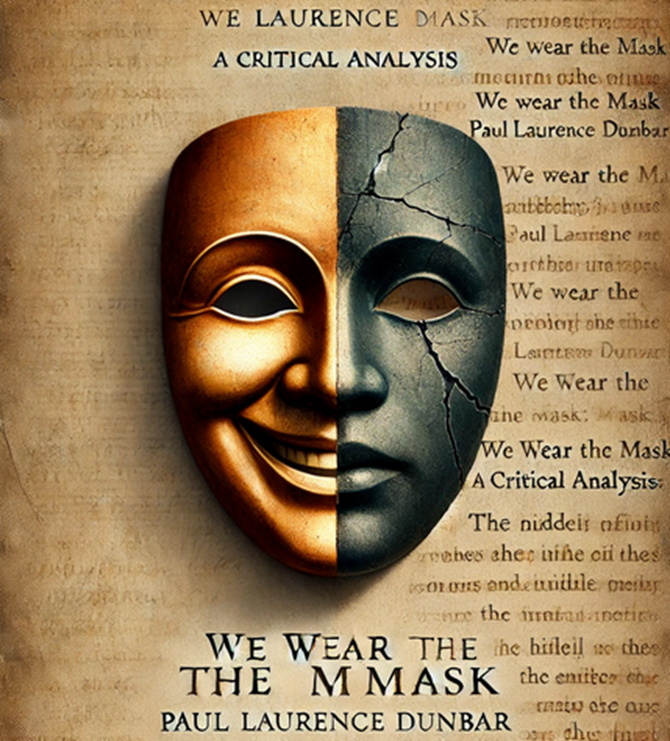
Introduction: “We Wear the Mask” by Paul Laurence Dunbar
“We Wear the Mask” by Paul Laurence Dunbar first appeared in 1895 in Dunbar’s poetry collection Majors and Minors, later reprinted in The Complete Poems of Paul Laurence Dunbar. The poem articulates the psychological and social necessity of concealment, particularly for marginalized African Americans navigating a racially oppressive society. Through the controlling metaphor of the “mask,” Dunbar dramatizes enforced emotional dissimulation—“We wear the mask that grins and lies”—to expose the disjunction between public performance and private suffering, captured poignantly in “With torn and bleeding hearts we smile.” The poem also interrogates the ethics of visibility, rejecting voyeuristic sympathy—“Why should the world be over-wise, / In counting all our tears and sighs?”—while simultaneously invoking spiritual witness in the anguished apostrophe, “O great Christ.” Its enduring popularity stems from this layered universality: while rooted in the historical realities of racial injustice, the poem resonates broadly as a critique of social hypocrisy and emotional labor, making the mask a timeless emblem of human resilience under constraint.
Text: “We Wear the Mask” by Paul Laurence Dunbar
We wear the mask that grins and lies,
It hides our cheeks and shades our eyes,—
This debt we pay to human guile;
With torn and bleeding hearts we smile,
And mouth with myriad subtleties.
Why should the world be over-wise,
In counting all our tears and sighs?
Nay, let them only see us, while
We wear the mask.
We smile, but, O great Christ, our cries
To thee from tortured souls arise.
We sing, but oh the clay is vile
Beneath our feet, and long the mile;
But let the world dream otherwise,
We wear the mask!
Copyright Credit: Paul Laurence. Dunbar, ““We Wear the Mask.”” from The Complete Poems of Paul Laurence Dunbar. (New York: Dodd, Mead and Company)
Annotations: “We Wear the Mask” by Paul Laurence Dunbar
| Line / Stanza | Critical Annotation | Literary Devices |
| 1. “We wear the mask that grins and lies,” | Introduces the controlling metaphor of the poem: the “mask” signifies a false public persona adopted to survive social hostility. The contrast between “grins” and “lies” exposes emotional falsification. | ◆ Symbolism (mask = false identity) · ◇ Metaphor · ◈ Paradox |
| 2. “It hides our cheeks and shades our eyes,—” | Concealment extends from emotion to perception; eyes, traditionally linked with truth, are deliberately obscured, suggesting enforced invisibility. | ◆ Symbolism · ▲ Visual Imagery · ◇ Metaphor |
| 3. “This debt we pay to human guile;” | Suffering is framed as a compulsory transaction. Society’s deception (“human guile”) extracts an emotional cost from the marginalized. | ◇ Metaphor (debt) · ■ Abstraction · ◈ Irony |
| 4. “With torn and bleeding hearts we smile,” | Violent emotional imagery highlights inner trauma masked by outward cheerfulness, underscoring psychological oppression. | ▲ Imagery · ◈ Paradox · ◆ Symbolism |
| 5. “And mouth with myriad subtleties.” | Speech becomes cautious and indirect; expression is filtered, strategic, and coded rather than authentic. | ◇ Metonymy (mouth = speech) · ▣ Alliteration · ◆ Symbolism |
| Stanza 1 (Overall) | Establishes the extended metaphor of masking as a collective survival strategy under social and racial pressure. | ◆ Extended Metaphor · ● Theme: Oppression |
Literary And Poetic Devices: “We Wear the Mask” by Paul Laurence Dunbar
| Device | Definition | Example from the Poem | Explanation |
| 🔷 Allegory | A work conveying a deeper moral, social, or political meaning | The poem as a whole | The poem allegorizes the African American experience of masking pain to survive racial oppression. |
| 🟢 Alliteration | Repetition of initial consonant sounds | “mouth with myriad” | The soft repetition suggests controlled speech and restrained expression. |
| 🟣 Apostrophe | Addressing an absent or abstract being | “O great Christ” | The speaker appeals to divine justice, highlighting spiritual suffering ignored by society. |
| 🔶 Assonance | Repetition of vowel sounds | “grins and lies” | The repeated i sound reinforces artificial cheerfulness and deceit. |
| 🔴 Conceit | An extended or controlling metaphor | The “mask” | The mask governs the entire poem, symbolizing enforced emotional disguise. |
| 🟡 Contrast | Juxtaposition of opposing ideas | “We smile… / With torn and bleeding hearts” | Highlights the gap between outward appearance and inner reality. |
| 🟤 Diction | Purposeful word choice | “torn,” “bleeding,” “tortured” | Pain-laden diction reveals psychological and emotional violence. |
| 🔵 End Rhyme | Rhyming words at the end of lines | “lies / eyes” | The fixed rhyme scheme reflects social rigidity and constraint. |
| 🟠 Enjambment | Sentence running over multiple lines | “This debt we pay… / With torn and bleeding hearts we smile” | Mirrors emotional overflow contained by social rules. |
| 🟩 Hyperbole | Deliberate exaggeration | “counting all our tears and sighs” | Emphasizes society’s invasive scrutiny of suffering. |
| 🟥 Imagery | Language appealing to the senses | “torn and bleeding hearts” | Creates vivid mental images of internal pain. |
| 🟦 Irony | Contrast between expectation and reality | “We smile” | Smiling becomes ironic because it masks agony rather than joy. |
| 🟪 Metaphor | Implicit comparison | “We wear the mask” | The mask stands for emotional suppression and social performance. |
| 🟫 Motif | Repeated thematic element | Repetition of “mask” | Reinforces habitual concealment as a survival mechanism. |
| ⚫ Personification | Human qualities given to abstractions | “human guile” | Deception is treated as an active social force. |
| ⚪ Refrain | Repeated line or phrase | “We wear the mask” | The refrain stresses inevitability and collective experience. |
| 🔺 Religious Allusion | Reference to religious belief or figure | “Christ” | Introduces moral authority beyond an unjust society. |
| 🔻 Rhetorical Question | Question not meant to be answered | “Why should the world be over-wise?” | Challenges society’s right to probe private suffering. |
| ⭐ Symbolism | Objects representing abstract ideas | The “mask” | Symbolizes racial survival, emotional labor, and social hypocrisy. |
| 💠 Tone | Author’s emotional attitude | Somber, restrained | The controlled tone reflects dignified endurance rather than open revolt. |
Themes: “We Wear the Mask” by Paul Laurence Dunbar
🎭 Theme 1: Masking as a Strategy of Survival
“We Wear the Mask” by Paul Laurence Dunbar foregrounds masking as a deliberate survival mechanism adopted by marginalized individuals in a hostile social environment, where emotional concealment functions less as personal dishonesty than as a socially enforced discipline. The poem frames the mask as necessary because the public sphere is structured by judgment, coercion, and racial surveillance, and therefore the self must be strategically edited to remain safe. By reiterating the refrain, Dunbar intensifies the sense of inevitability, implying that concealment is not episodic but habitual, almost institutional, and the collective voice suggests that this is a shared condition rather than an isolated psychological habit. Moreover, the tension between outward smiling and inward injury underscores how survival often requires performance, especially when vulnerability is punished and authenticity is exploited. In this way, masking becomes a paradoxical form of resistance-through-restraint, enabling endurance where direct exposure would invite harm.
🩸 Theme 2: Emotional Pain and Suppressed Suffering
“We Wear the Mask” by Paul Laurence Dunbar renders suppressed suffering as both intensely private and broadly communal, using visceral diction to reveal how the inner life is wounded by the demand to appear untroubled. The poem’s imagery of “torn and bleeding hearts” collapses the distance between emotion and bodily injury, suggesting that psychological pain is not metaphorically mild but materially devastating, while the insistence on smiling exposes a coercive social script that requires the afflicted to perform stability. This enforced cheerfulness does not erase anguish; rather, it intensifies it by preventing acknowledgement, articulation, and relief, thereby transforming sorrow into a chronic condition that must be managed in silence. Additionally, the poem implies that the world’s refusal to engage suffering produces a double violence: first, the original injustice, and second, the compelled suppression of its effects. Consequently, Dunbar presents emotional restraint not as composure but as the evidence of an ongoing, unrecognized trauma.
👁️ Theme 3: Social Hypocrisy and the Illusion of Harmony
“We Wear the Mask” by Paul Laurence Dunbar critiques a society that prefers the comfort of appearances to the ethical burden of truth, revealing how public harmony is often purchased through denial and selective vision. The speaker challenges the world’s intrusive “wisdom” in counting tears, because such observation is exposed as superficial: it measures symptoms without confronting causes, and it consumes suffering as spectacle while avoiding responsibility. Dunbar suggests that the mask is not merely worn by the oppressed but is tacitly demanded by the social order, since acknowledging pain would disrupt the illusion of moral legitimacy upon which that order depends. When the poem states that the world may “dream otherwise,” it implies that collective self-deception is an enabling condition of injustice, allowing inequality to persist without crisis of conscience. Thus, the poem frames social hypocrisy as an active structure, where ignorance functions less as absence of knowledge than as cultivated, convenient refusal.
✝️ Theme 4: Spiritual Appeal and Moral Witness
“We Wear the Mask” by Paul Laurence Dunbar introduces a theological register that transforms private anguish into moral testimony, as the speaker directs hidden cries to Christ when human society proves incapable of recognition or justice. This apostrophic appeal signals both faith and indictment: faith, because suffering is addressed to a divine witness presumed to see beneath appearances; indictment, because the turn toward God implicitly exposes the failure of earthly institutions and social conscience. The poem’s contrast between singing and standing on “vile” clay sharpens the tension between spiritual aspiration and degraded material conditions, suggesting that endurance is achieved not through naïve optimism but through a disciplined holding-together of hope and despair. In this framework, religion becomes less a sentimental refuge than a language of accountability, enabling the speaker to assert the reality of suffering even when the world demands silence. Consequently, the poem casts spiritual address as a form of resistant truth-telling under conditions of forced disguise.
Literary Theories and “We Wear the Mask” by Paul Laurence Dunbar
| Theory (with Symbol) | Core Theoretical Focus | Reference from the Poem | Theory-Based Interpretation |
| 🔴 Marxist Criticism | Power, oppression, ideology, class and racial domination | “This debt we pay to human guile” | From a Marxist perspective, the “mask” represents ideological coercion imposed by a dominant social order. The oppressed are compelled to perform contentment to sustain hegemonic stability and avoid punishment within an unequal racial system. |
| 🔵 Postcolonial Theory | Othering, marginalization, identity under domination | “We wear the mask that grins and lies” | The poem reflects postcolonial identity formation, where the colonized or racialized subject conceals pain to conform to dominant cultural expectations, internalizing silence as a survival strategy. |
| 🟢 Psychoanalytic Criticism | Repression, divided self, psychological trauma | “With torn and bleeding hearts we smile” | Psychoanalytically, the mask symbolizes repression. The smile functions as a defense mechanism, while the “torn and bleeding hearts” expose deep psychological trauma suppressed beneath social performance. |
| 🟣 New Historicism | Text in relation to its historical and cultural moment | “Why should the world be over-wise, / In counting all our tears and sighs?” | Read through New Historicism, the poem reflects late 19th-century African American realities under Jim Crow. The refusal to display suffering critiques a society that consumes Black pain without offering justice. |
Critical Questions about “We Wear the Mask” by Paul Laurence Dunbar
🔴 Critical Question 1: How does the metaphor of the mask function as a social and psychological device in the poem?
“We Wear the Mask” by Paul Laurence Dunbar employs the mask as a sustained metaphor that operates simultaneously on social and psychological levels. Socially, the mask represents enforced performance within a hostile racial order, compelling the speaker to project contentment—“We wear the mask that grins and lies”—as a strategy of survival. Psychologically, the mask signifies repression, as authentic emotions are deliberately concealed to avoid further harm. Dunbar fuses these dimensions by presenting smiling not as joy but as labor, a “debt” paid to “human guile,” suggesting moral coercion rather than voluntary deception. The phrase “torn and bleeding hearts” exposes the psychic cost of this concealment, indicating trauma internalized through habitual silence. Thus, the mask is not merely a disguise but a mechanism of endurance shaped by systemic injustice. Its function lies in enabling outward conformity while preserving an inner self that, though wounded, resists total erasure through awareness and articulation.
🔵 Critical Question 2: Why does the speaker reject public recognition of suffering, and what critique does this imply?
“We Wear the Mask” by Paul Laurence Dunbar articulates a deliberate refusal to make private suffering publicly legible, as seen in the rhetorical question, “Why should the world be over-wise, / In counting all our tears and sighs?” This rejection critiques a society that demands emotional transparency without offering empathy, justice, or structural change. The speaker recognizes that public acknowledgment of pain often becomes voyeuristic rather than restorative, transforming suffering into spectacle. By insisting that the world “dream otherwise,” the poem exposes the asymmetry of power between observer and observed, where the marginalized are expected to display anguish for moral validation. Dunbar’s critique extends beyond racial dynamics to indict a broader human tendency to consume others’ pain as information rather than responsibility. Silence, therefore, becomes an act of agency rather than weakness. The poem suggests that withholding suffering preserves dignity and resists exploitation, challenging liberal assumptions that visibility alone produces justice.
🟢 Critical Question 3: What role does religious imagery play in intensifying the poem’s emotional depth?
“We Wear the Mask” by Paul Laurence Dunbar invokes religious imagery to intensify emotional depth and to establish a moral contrast between divine witness and social indifference. The apostrophic cry, “O great Christ,” marks a shift from public concealment to private confession, suggesting that while society is denied access to true suffering, the divine is addressed as a compassionate witness. This invocation does not function as doctrinal piety but as an ethical appeal, emphasizing that the speaker’s anguish exceeds human systems of recognition. The juxtaposition of smiling performance with “tortured souls” underscores the inadequacy of social morality and relocates justice to a transcendent domain. Furthermore, the religious address amplifies the poem’s lament without dissolving into despair, as it implies the existence of an ultimate moral reckoning. Thus, religious imagery deepens the poem’s pathos while reinforcing its critique of a world that normalizes injustice through emotional ignorance.
🟣 Critical Question 4: Why has the poem remained relevant across historical and cultural contexts?
“We Wear the Mask” by Paul Laurence Dunbar has endured because its central metaphor transcends its immediate historical context while remaining firmly rooted in it. Although the poem emerges from the lived realities of African Americans in the late nineteenth century, its exploration of emotional concealment resonates universally in societies structured by inequality, surveillance, and social performance. The act of masking—smiling while suffering—remains a recognizable human response to institutional pressure, whether shaped by race, class, gender, or professional norms. Dunbar’s restrained tone, formal structure, and disciplined rhetoric further contribute to its longevity, allowing readers across eras to recognize their own forms of masked existence. The poem’s relevance lies in its refusal to sentimentalize pain; instead, it offers a lucid articulation of resilience without romanticizing endurance. By naming concealment as both necessary and damaging, the poem continues to speak powerfully to modern audiences negotiating visibility, identity, and survival.
Literary Works Similar to “We Wear the Mask” by Paul Laurence Dunbar
- 🎭 “Sympathy” by Paul Laurence Dunbar
This poem parallels We Wear the Mask by expressing the psychological confinement of Black experience, using the caged bird as a metaphor for suppressed pain and enforced emotional restraint under racial oppression. - 🕊️ “If We Must Die” by Claude McKay
Like We Wear the Mask, this poem confronts systemic injustice, but whereas Dunbar emphasizes concealment for survival, McKay transforms suppressed rage into a call for dignified resistance against dehumanization. - 👁️ “Incident” by Countee Cullen
This poem shares Dunbar’s focus on the lasting psychological impact of racial hostility, illustrating how a single moment of cruelty can eclipse joy and force premature emotional self-awareness. - 🔥 “Still I Rise” by Maya Angelou
While Angelou’s tone is openly defiant rather than masked, the poem resonates with Dunbar’s work in its articulation of historical pain and the strategic negotiation of identity within an oppressive social order.
Representative Quotations of “We Wear the Mask” by Paul Laurence Dunbar
| Quotation | Context | Theoretical Perspective |
| 🎭 “We wear the mask that grins and lies,” | Opening line introducing the central metaphor | Postcolonial Theory — The “mask” signifies enforced performance by a marginalized subject required to appear compliant within a dominant racial culture. |
| 🩸 “With torn and bleeding hearts we smile,” | Contrast between inner pain and outer display | Psychoanalytic Criticism — Reveals repression and psychological trauma masked by socially acceptable behavior. |
| 🎭 “This debt we pay to human guile;” | Explanation of why the mask is worn | Marxist Criticism — Suggests ideological coercion, where emotional conformity is the cost of survival under an oppressive system. |
| 😶 “And mouth with myriad subtleties.” | Controlled speech replacing honest expression | Discourse Theory — Language is manipulated to maintain safety, showing how power regulates expression. |
| ❓ “Why should the world be over-wise,” | Rhetorical challenge to society | New Historicism — Reflects historical realities where Black suffering was scrutinized but never remedied. |
| 😢 “In counting all our tears and sighs?” | Continuation of rhetorical critique | Critical Race Theory — Critiques voyeuristic consumption of Black pain without accountability or justice. |
| 🙏 “O great Christ, our cries” | Shift from society to divine address | Theological Criticism — Spiritual appeal exposes the moral failure of social institutions. |
| 🔥 “To thee from tortured souls arise.” | Intensification of spiritual suffering | Existential Criticism — Emphasizes anguish, alienation, and the search for meaning amid injustice. |
| 🛣️ “Beneath our feet, and long the mile;” | Image of exhausting journey | Symbolic Interactionism — Life is portrayed as an ongoing struggle shaped by social roles and expectations. |
| 🎭 “But let the world dream otherwise,” | Deliberate continuation of disguise | Ideology Critique — Maintaining illusion sustains dominant myths while silencing oppressed realities. |
Suggested Readings: “We Wear the Mask” by Paul Laurence Dunbar
Books
- Dunbar, Paul Laurence. The Collected Poetry of Paul Laurence Dunbar. Edited by Joanne M. Braxton, University of Virginia Press, 1993.
- Harrell, Willie J., Jr., editor. We Wear the Mask: Paul Laurence Dunbar and the Politics of Representative Reality. Kent State University Press, 2010.
Academic Articles
- Morgan, Thomas L. “We Wear the Mask: Paul Laurence Dunbar and the Politics of Representative Reality.” African American Review, vol. 44, no. 4, 2011, pp. 725–727. https://doi.org/10.1353/afa.2011.0059. Accessed 1 Jan. 2026.
- Black, Daniel P. “Literary Subterfuge: Early African American Writing and the Trope of the Mask.” CLA Journal, vol. 48, no. 4, June 2005, pp. 387–403. JSTOR, https://www.jstor.org/stable/44325281. Accessed 1 Jan. 2026.
Poem Websites
- Dunbar, Paul Laurence. “We Wear the Mask.” Poetry Foundation, Poetry Foundation, https://www.poetryfoundation.org/poems/44203/we-wear-the-mask. Accessed 1 Jan. 2026.
- Dunbar, Paul Laurence. “We Wear the Mask.” Poets.org, Academy of American Poets, https://poets.org/poem/we-wear-mask. Accessed 1 Jan. 2026.