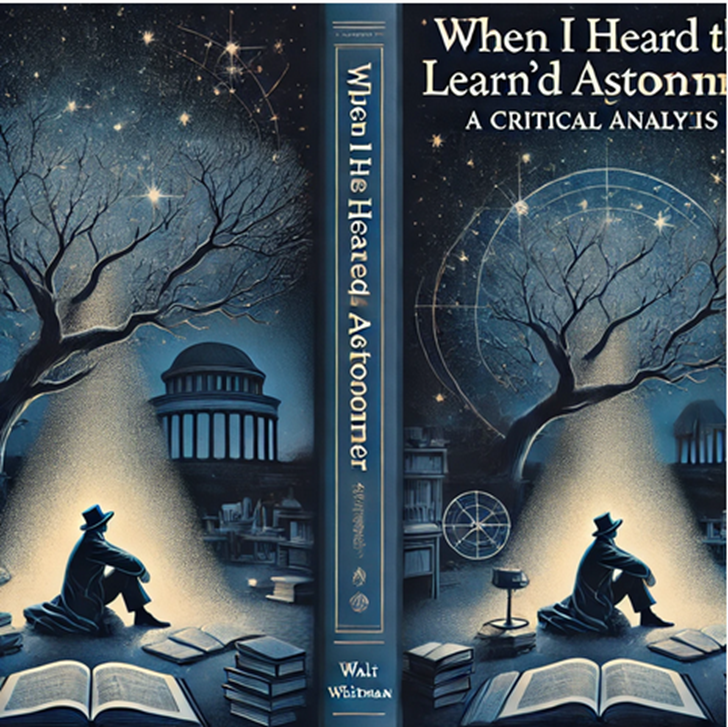
Introduction: “When I Heard the Learn’d Astronomer” by Walt Whitman
“When I Heard the Learn’d Astronomer” by Walt Whitman: first appeared in 1865 in Whitman’s Civil War–era poetry collection Drum-Taps, and it was subsequently incorporated into Leaves of Grass beginning with the 1867 edition (after Drum-Taps was appended), later shifting between clusters in subsequent printings. The poem’s central idea is that analytic knowledge can deaden wonder when it becomes purely mechanical—“the proofs, the figures…ranged in columns,” “charts and diagrams, to add, divide, and measure”—so the speaker, “tired and sick” in the applauding “lecture-room,” chooses direct, solitary encounter, “gliding out” into the “mystical moist night-air” to look up “in perfect silence at the stars.” Its enduring popularity stems from this sharply dramatized, universally recognizable tension between quantified explanation and lived experience (a contrast conveyed with memorable anaphora—repeated “When I…”—and an elegant pivot from public spectacle to private awe), making the poem both immediately accessible and perennially relevant to modern debates about what science can explain versus what human beings still need to feel in order to understand.
Text: “When I Heard the Learn’d Astronomer” by Walt Whitman
When I heard the learn’d astronomer,
When the proofs, the figures, were ranged in columns before me,
When I was shown the charts and diagrams, to add, divide, and measure them,
When I sitting heard the astronomer where he lectured with much applause in the lecture-room,
How soon unaccountable I became tired and sick,
Till rising and gliding out I wander’d off by myself,
In the mystical moist night-air, and from time to time,
Look’d up in perfect silence at the stars.
Annotations: “When I Heard the Learn’d Astronomer” by Walt Whitman
| Line | Text | Annotation (what Whitman is doing) | Literary devices |
| 1 | When I heard the learn’d astronomer, | Establishes the scene: the speaker is an audience member confronted with “learned” authority—science presented through expertise rather than wonder. | ◆ Anaphora; ⬣ Contrast (implicit: learning vs feeling); ✦ Symbolism (astronomer as scientific rationalism) |
| 2 | When the proofs, the figures, were ranged in columns before me, | Emphasizes method, order, and quantification—knowledge arranged as data, not lived experience. | ◆ Anaphora; ■ Listing/parallel structure; ● Imagery (columns/arrangement); ⬣ Contrast |
| 3 | When I was shown the charts and diagrams, to add, divide, and measure them, | Intensifies the mathematical frame: the cosmos is reduced to operations; the speaker is guided into calculation rather than contemplation. | ◆ Anaphora; ■ Listing (charts/diagrams; add/divide/measure); ● Imagery; ⬣ Contrast |
| 4 | When I sitting heard the astronomer where he lectured with much applause in the lecture-room, | Critiques institutional validation: applause signals social approval, yet the speaker feels increasingly disconnected inside this formal space. | ◆ Anaphora; ✦ Symbolism (lecture-room as institutional knowledge); ⬣ Contrast (public acclaim vs private unease) |
| 5 | How soon unaccountable I became tired and sick, | The internal reaction arrives abruptly: the speaker’s body rejects the experience—an embodied critique of “accountable” (measurable) discourse. | ⊙ Tone shift (to discomfort); ⬣ Contrast; ✦ Symbolism (sickness as spiritual/intellectual suffocation); ■ Inversion/hyperbaton (unusual word order adds strain) |
| 6 | Till rising and gliding out I wander’d off by myself, | Movement replaces analysis: the speaker exits quietly, choosing solitude and autonomy over sanctioned learning. | ⊙ Tone shift (toward release); ● Imagery (motion); ▲ Sound device (soft consonance in “gliding”); ✦ Symbolism (departure as reclaiming wonder) |
| 7 | In the mystical moist night-air, and from time to time, | Sensory, almost sacred atmosphere: “mystical” reframes knowledge as felt presence; the pacing suggests calm, intermittent looking. | ● Imagery (tactile/atmospheric); ▲ Alliteration/assonance (“mystical moist”); ✦ Symbolism (night-air as intuitive experience); ⬣ Contrast |
| 8 | Look’d up in perfect silence at the stars. | Climactic return to direct encounter: silence replaces lecture; the stars become immediate, awe-inspiring realities beyond measurement. | ● Imagery (visual stillness); ✦ Symbolism (stars as transcendent wonder); ⊙ Tone shift (peace/awe); ⬣ Contrast (silence vs lecture/applause) |
Literary And Poetic Devices: “When I Heard the Learn’d Astronomer” by Walt Whitman
| Device (A–Z) | Example from the poem | Explanation |
| 🔷 Alliteration | “mystical moist” | Repetition of initial consonant sounds creates gentle musicality, matching the calm night setting. |
| 🟥 Anaphora | “When I heard…” / “When the proofs…” / “When I was shown…” | Repeated openings build a cumulative, lecture-like rhythm that heightens the impact of the later turn (“tired and sick”). |
| ⚫⚪ Antithesis | “lecture-room” vs. “mystical moist night-air”; “figures” vs. “stars” | Strong oppositions foreground the poem’s argument: calculation can drain wonder, while direct experience restores it. |
| 🟣 Assonance | “tired and sick” | Repeated vowel sounds sharpen the line’s emotional intensity, reinforcing discomfort and fatigue. |
| ⏸️ Caesura | “How soon…tired and sick, / Till rising…” | A decisive pause and turn marks the shift from passive listening to active escape into solitude. |
| 🌙 Connotation | “mystical,” “moist,” “perfect silence” | Words carry spiritual and sensory associations, framing the night as cleansing and transcendent. |
| 🌓 Contrast | “with much applause” vs. “by myself” | Public noise and approval are set against solitude and quiet to show where true meaning occurs for the speaker. |
| ✒️ Diction | “gliding,” “wander’d,” “mystical” | Elevated, gentle word choice suggests fluid movement and reflective contemplation rather than analysis. |
| ➿ Enjambment | “…wander’d off by myself, / In the mystical moist night-air…” | Run-on lines mirror the speaker’s continuous motion out of the room and into open space. |
| 🎴 Imagery | “charts and diagrams”; “mystical moist night-air”; “stars” | Sensory pictures shift from technical visuals to natural atmosphere, guiding the reader from measurement to wonder. |
| 🎭 Irony | The lecture causes “tired and sick,” but stargazing brings “perfect silence” | The expected place of learning feels stifling, while the informal encounter with nature becomes the deeper “lesson.” |
| 🧩 Juxtaposition | “proofs…figures” placed near “perfect silence…stars” | Side-by-side placement of two worlds (data vs. awe) lets the poem persuade through structure more than argument. |
| 🔥 Metaphor (implicit) | “proofs…figures…columns” as a stand-in for reductionist knowing | The mathematical apparatus implicitly represents a mindset that reduces mystery to calculation. |
| 🌫️ Mood | “mystical moist night-air…perfect silence” | Establishes a meditative, reverent atmosphere that contrasts with the crowded lecture-room. |
| ⭐ Motif | Repeated pattern: lecture → fatigue → exit → night → stars | A recurring movement from abstraction to experience reinforces the poem’s central theme. |
| 🟦 Parallelism | “add, divide, and measure” | Balanced phrasing emphasizes mechanical routine, making the learning feel procedural and exhausting. |
| 👁️ Point of View (First-person) | “When I heard…” / “I wander’d off” | Personal narration makes the response intimate and relatable, encouraging reader identification. |
| 🔁 Repetition | Repeated “When…” and “astronomer” | Intensifies monotony and pressure, increasing the relief of the speaker’s departure into quiet. |
| 🪐 Symbolism | “lecture-room” = abstract/institutional knowledge; “stars” = direct sublime reality | Places and objects carry larger meanings about two modes of understanding: mediated vs. immediate. |
| 🎚️ Tone | Shift from attentive observation to reverent silence (“Look’d up in perfect silence…”) | The speaker’s attitude evolves from outward engagement to inward awe, concluding in quiet wonder rather than debate. |
Themes: “When I Heard the Learn’d Astronomer” by Walt Whitman
- 🔵 Theme 1: Science vs. Lived Wonder (Whitman’s critique of reductionism)
When I Heard the Learn’d Astronomer — Walt Whitman frames a tension between scientific explanation and immediate experience, suggesting not that science is false, but that it can become spiritually sterile when reduced to “proofs” and “figures” “ranged in columns” and converted into procedures to “add, divide, and measure.” In the lecture-room, knowledge arrives mediated through charts, applause, and institutional authority, yet the speaker’s body registers a counter-truth—he becomes “tired and sick”—as if the lived sense of the cosmos is being replaced by a clerical handling of it. By contrast, the poem presents wonder as an epistemology grounded in presence: the speaker “glid[es] out,” enters the “mystical moist night-air,” and looks up “in perfect silence at the stars,” implying that awe, solitude, and sensory immediacy can restore a more integrated understanding than calculation alone. - 🟢 Theme 2: Alienation in Institutions and the Desire for Solitude
When I Heard the Learn’d Astronomer — Walt Whitman dramatizes how institutional settings can estrange an individual from authentic feeling, because the “lecture-room,” while socially validated “with much applause,” demands a posture of passive reception that flattens personal response into conformity. The speaker sits and listens, surrounded by the public machinery of approval, and yet his internal experience moves in the opposite direction, producing an “unaccountable” fatigue that signals misfit rather than ignorance. When he “rising” and “gliding out” wanders “by myself,” the poem does not merely describe a physical exit; it depicts a psychological reclamation of agency, as solitude becomes the condition for a more truthful encounter with the world. In this sense, Whitman casts aloneness not as loneliness but as a necessary clearing of noise—social, intellectual, and emotional—so that perception can become undistracted, reverent, and self-possessed. - 🟣 Theme 3: Silence as a Higher Mode of Knowing
When I Heard the Learn’d Astronomer — Walt Whitman treats silence not as absence but as a disciplined, meaningful medium through which reality can be apprehended, especially when language and numbers have begun to feel oppressive. The lecture is full of talk, demonstration, and approval, yet it yields diminishing returns for the speaker, because the cosmos is being translated into forms that, while accurate, are experientially impoverished; consequently, the speaker seeks the “perfect silence” in which the stars can be encountered without mediation. Silence, here, functions as an ethical and cognitive choice: by withholding commentary, the speaker refuses to dominate the object of contemplation and instead allows the sublime to disclose itself on its own terms. Moreover, the poem’s movement into the “mystical moist night-air” suggests that knowledge can be bodily and atmospheric, so that the quiet surrounding the speaker becomes part of the understanding, aligning mind, sense, and spirit into a single, coherent response. - 🟠 Theme 4: The Limits of Quantification and the Hunger for the Sublime
When I Heard the Learn’d Astronomer — Walt Whitman asserts that quantification, while powerful, has limits when confronted with the sublime, because the immeasurable dimensions of existence—vastness, beauty, mystery—cannot be fully possessed by calculation without losing their qualitative force. The poem’s catalog of intellectual tools—“proofs,” “figures,” “charts,” “diagrams”—implies mastery through representation, yet the speaker’s nausea indicates that mastery can become a kind of spiritual overreach, in which the universe is treated as a problem to be processed rather than a presence to be met. By stepping outside, the speaker does not reject knowledge; rather, he resituates it, choosing a mode of encounter that preserves scale and astonishment, since looking up “from time to time” in “perfect silence” allows the stars to remain other, immense, and unowned. Whitman thus suggests that human wholeness requires both comprehension and reverence, with the sublime restoring what measurement cannot supply.
Literary Theories and “When I Heard the Learn’d Astronomer” by Walt Whitman
| Theory | Core lens (what it looks for) | References from the poem (quoted phrases) | Reading of the poem through the lens (application) |
| 🔴 Formalist / New Criticism | How meaning emerges from structure, repetition, contrast, tone shift, and the poem’s internal “logic.” | Repetition: “When…” (lines 1–4); institutional diction: “proofs, the figures,” “charts and diagrams”; volta: “How soon… tired and sick”; resolution: “perfect silence,” “the stars.” | The poem’s artistry lies in a controlled binary tension: measured discourse (proofs/figures/columns) versus unmediated perception (silence/stars). The repeated “When” builds accumulative pressure until the abrupt bodily reaction (“tired and sick”) functions as a turn; the final image (“perfect silence… stars”) provides a formal closure that privileges awe over analysis without needing external context. |
| 🔵 Reader-Response | How the text guides the reader’s feelings, identification, and interpretive choices; meaning as experience rather than fixed message. | “before me,” “I was shown,” “I became,” “by myself”; pacing markers: “How soon,” “from time to time.” | The poem choreographs the reader into the speaker’s position: first passive reception (“shown,” “before me”), then visceral alienation (“tired and sick”), then relief and attentiveness (“wander’d off,” “from time to time”). The “right” meaning is not a thesis but an affective journey—many readers feel the claustrophobia of the lecture-room and the release of the night-air, so the poem’s argument is realized as felt transformation. |
| 🟢 Marxist / Cultural Materialist | Knowledge as power; critique of institutions, prestige, and ideological “common sense”; how authority is socially produced. | “learn’d astronomer”; “lecture-room”; “lectured with much applause”; “proofs… figures… columns” (bureaucratic ordering). | The astronomer embodies credentialed authority; the lecture-room and applause stage a public ritual that legitimizes a particular regime of knowledge. “Proofs/figures/columns” suggest the bureaucratization of understanding—an ideological form that can alienate the subject. The speaker’s exit becomes a refusal of institutional mediation: he rejects knowledge as spectacle and status, reclaiming a more direct relation to the world outside sanctioned spaces. |
| 🟣 Eco-criticism | Human–nature relation; resistance to treating nature as an object to quantify; emphasis on embodied, sensory encounter and ecological humility. | “add, divide, and measure”; “mystical moist night-air”; “Look’d up in perfect silence at the stars.” | The poem opposes instrumental reason (“measure”) with an ecologically attuned mode of being—breathing night-air, lingering “from time to time,” and meeting the stars in “perfect silence.” Nature here is not data but presence; the speaker’s movement outdoors is an ethical/aesthetic shift toward non-dominating attention, implying that true understanding may require receptivity rather than extraction and calculation. |
Critical Questions about “When I Heard the Learn’d Astronomer” by Walt Whitman
- 🔷 Critical Question 1: Does the poem reject science, or does it critique how science is presented and received?
“When I Heard the Learn’d Astronomer” by Walt Whitman does not reject science as a valid way of knowing; rather, it critiques a mode of presentation that converts discovery into sterile procedure, so that “proofs” and “figures” “ranged in columns” become an end in themselves and the listener is positioned as a passive consumer of authority in a lecture-room “with much applause.” The speaker’s sudden fatigue—“How soon unaccountable I became tired and sick”—signals not anti-intellectualism but an experiential mismatch, because the cosmic subject is mediated through charts, diagrams, and arithmetic verbs (“add, divide, and measure”) that foreground method over meaning. When the speaker “glid[es] out” into the “mystical moist night-air,” the poem implies that scientific knowledge needs complementing by direct encounter, since wonder and presence restore what abstraction can diminish, making the poem a plea for epistemic balance rather than an attack on science. - 🟢 Critical Question 2: What is the function of the poem’s structure—especially the repeated “When”—in shaping its argument?
“When I Heard the Learn’d Astronomer” by Walt Whitman uses anaphora—repeating “When” at the opening of successive lines—to imitate accumulation, as if the lecture’s content is being stacked in the speaker’s mind the same way “figures” are stacked in “columns,” and this structural pressure is essential to the poem’s critique. Each “When” adds another layer of mediation—proofs, figures, charts, diagrams, applause—until the experience becomes claustrophobic, and the reader feels the weight of procedure before the speaker explicitly names his discomfort. Because the turn occurs after this buildup, the line “How soon unaccountable I became tired and sick” lands as a bodily verdict on an overprocessed experience, and the subsequent “Till” functions almost like release, allowing the syntax to flow outward into open air. Structurally, then, the poem persuades by enacting the shift from accumulation to liberation, making form mirror theme. - 🟣 Critical Question 3: Why does Whitman emphasize solitude and silence, and what kind of knowledge do they enable?
“When I Heard the Learn’d Astronomer” by Walt Whitman foregrounds solitude and silence because, in the poem’s logic, they enable a non-instrumental relation to reality, one in which the observer does not treat the universe as data to be managed but as presence to be contemplated. The lecture-room is crowded, performative, and validated by “much applause,” yet it produces fatigue, suggesting that social noise and institutional authority can distract from genuine perception, especially when the mind is pushed to receive information rather than to encounter meaning. By “rising and gliding out” to wander “by myself,” the speaker reclaims agency, and by looking up “in perfect silence at the stars,” he enters a mode of knowing grounded in attention, humility, and wonder, where comprehension is not forced through explanation but allowed to emerge through stillness. Silence, therefore, becomes epistemic as well as emotional: it is the condition under which the sublime can be felt without being reduced. - 🟠 Critical Question 4: How does the poem’s contrast between the “lecture-room” and the “mystical moist night-air” speak to modern debates about education and learning?
“When I Heard the Learn’d Astronomer” by Walt Whitman anticipates a contemporary critique of education that overvalues measurable outcomes and procedural competence while undervaluing curiosity, embodiment, and affect, because the poem stages learning as a conflict between quantified instruction and experiential understanding. In the lecture-room, knowledge is delivered through “charts and diagrams” and through operations that sound like assessment—“add, divide, and measure”—so that the student’s role becomes to process and reproduce rather than to dwell in mystery, and the applause suggests a system that rewards performance and authority. Yet the speaker’s sickness implies that such learning can be psychologically alienating, especially when it displaces wonder, which is often the very motive that first draws people to the stars. The exit into the “mystical moist night-air” offers an alternative pedagogy: learning that includes direct contact, reflective solitude, and reverent attention, implying that education is incomplete when it neglects the experiential dimension of understanding.
Literary Works Similar to “When I Heard the Learn’d Astronomer” by Walt Whitman
- 🟩 “The Tables Turned” by William Wordsworth — Like Whitman, it urges turning away from bookish/analytic learning toward direct encounter with nature as a truer teacher.
- 🟥 “Sonnet—To Science” by Edgar Allan Poe — Like Whitman’s fatigue with “proofs” and “figures,” Poe frames science as draining wonder and imagination from the poet’s lived experience of the heavens.
- 🟦 “Dover Beach” by Matthew Arnold — Like Whitman’s move from lecture-room to night-air, it pivots from public explanation to private, sensory attention at night, using the natural scene to critique modern certainty.
- 🟪 “The World Is Too Much With Us” by William Wordsworth — Like Whitman, it laments how modern habits and priorities make people “out of tune” with nature, implying recovery through renewed, immediate perception.
Representative Quotations of “When I Heard the Learn’d Astronomer” by Walt Whitman
| Quotation | Context (what is happening in the poem) | Theoretical perspective |
| 🔵 “When I heard the learn’d astronomer,” | The speaker opens by placing himself in a formal learning situation, listening to an expert whose authority is socially recognized. | Sociology of knowledge: The phrase foregrounds expertise as a social role (“learn’d”), inviting a critique of how authority shapes what counts as “legitimate” knowledge and how audiences are positioned as receivers rather than co-experiencers. |
| 🟢 “When the proofs, the figures, were ranged in columns before me,” | The lecture becomes visibly numerical and evidentiary, with information arranged as if in a ledger or report. | Positivism / empiricism critique: “Proofs” and “figures” signal a worldview that privileges quantification, implying that truth is secured through numerical display, even if such display can distance the learner from wonder. |
| 🟣 “When I was shown the charts and diagrams,” | Visual aids mediate the cosmos through representation rather than direct encounter. | Semiotics / representation theory: Charts and diagrams are sign-systems that stand in for reality, raising the poem’s key concern that signs can displace the thing itself, especially when the learner confuses representation with experience. |
| 🟠 “to add, divide, and measure them,” | The stars are treated as objects for operations, stressing procedure and calculation. | Instrumental rationality (Weber/Frankfurt School): The line exemplifies a means-end logic in which nature becomes a manipulable object, and learning risks turning into technique rather than a relationship with the sublime. |
| 🔴 “When I sitting heard the astronomer where he lectured with much applause in the lecture-room,” | The speaker is seated amid public approval; the setting is social, performative, and institutional. | Institutional critique / cultural capital: “Applause” marks the lecture as a prestige event; the poem hints that social validation can reinforce a single mode of knowing, rewarding performance and status as much as insight. |
| 🟡 “How soon unaccountable I became tired and sick,” | A sudden bodily reaction disrupts the expectation that learning is purely uplifting or rational. | Affect theory / embodied cognition: The speaker’s body “knows” something the lecture does not address—fatigue and nausea become evidence that cognition is inseparable from feeling and physiological response. |
| 🟩 “Till rising and gliding out” | The speaker shifts from passive listening to active refusal, quietly exiting the sanctioned space. | Existential agency: The movement signals a choice to reclaim authenticity; the self asserts freedom by leaving a situation that feels inauthentic, even if that departure defies social expectations. |
| 🟦 “I wander’d off by myself,” | The speaker embraces solitude as the condition for a different kind of attention. | Transcendentalist individualism: The line aligns truth-seeking with inward freedom and |
Suggested Readings: “When I Heard the Learn’d Astronomer” by Walt Whitman
Books
- Greenspan, Ezra, editor. The Cambridge Companion to Walt Whitman. Cambridge University Press, 1995.
- Killingsworth, M. Jimmie. The Cambridge Introduction to Walt Whitman. Cambridge University Press, 2007.
Academic Articles
- Lahey, Trace. “Star Gazing: Interpretive Approaches to Whitman’s ‘When I Heard the Learn’d Astronomer.’” English in Education, vol. 57, no. 1, 2023, pp. 45–58. https://doi.org/10.1080/04250494.2022.2149394.
- Dugdale, Clarence. “Whitman’s Knowledge of Astronomy.” University of Texas Studies in English, no. 16, 1936, pp. 124–137. JSTOR, https://www.jstor.org/stable/20779478.
Poem Websites
- Whitman, Walt. “When I Heard the Learn’d Astronomer.” Poetry Foundation, Poetry Foundation, https://www.poetryfoundation.org/poems/45479/when-i-heard-the-learnd-astronomer. Accessed 8 Jan. 2026.
- Whitman, Walt. “When I Heard the Learn’d Astronomer.” Academy of American Poets, poets.org, https://poets.org/poem/when-i-heard-learnd-astronomer. Accessed 8 Jan. 2026.