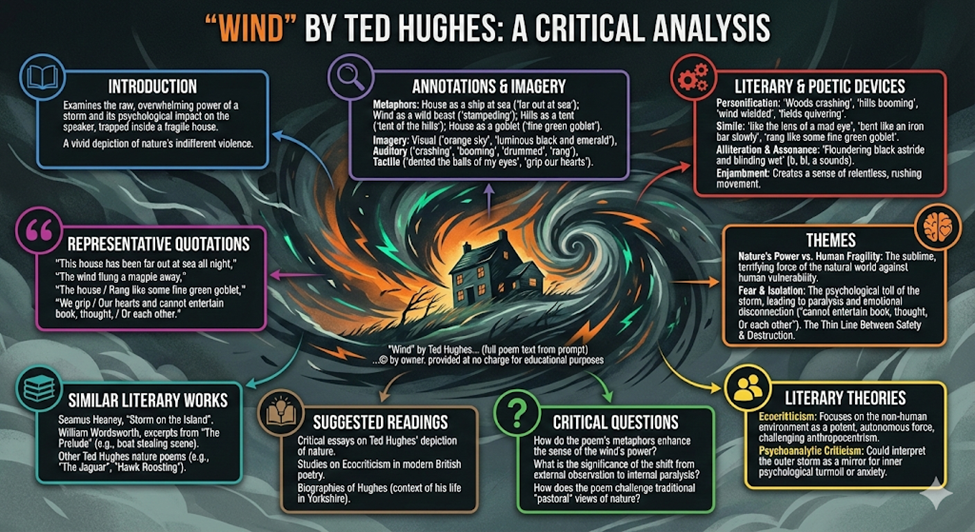
Introduction: “Wind” by Ted Hughes
“Wind” by Ted Hughes first appeared in 1957 and was later included in his debut poetry collection The Hawk in the Rain, a volume that established Hughes as a major post-war poetic voice. The poem presents nature as a violently animate and overpowering force, depicting a storm that threatens not only the physical structure of the house but also the psychological stability of its inhabitants. Hughes’s central idea is the insignificance and vulnerability of human life when confronted with elemental power, a theme reinforced through aggressive, kinetic imagery such as “Winds stampeding the fields,” “wind wielded / Blade-light,” and the house that “Rang like some fine green goblet,” suggesting imminent destruction. Nature is personified as a relentless, almost predatory presence, while humans are reduced to passive endurance, “we grip / Our hearts and cannot entertain book, thought.” The poem’s popularity stems from its visceral language, muscular rhythms, and striking metaphors, which embody Hughes’s distinctive poetic style—one that rejects pastoral calm in favour of raw, elemental energy. By dramatizing the struggle between human fragility and natural force with such sensory intensity, Wind remains a powerful and frequently anthologized example of Hughes’s vision of nature as both magnificent and terrifying.
Text: “Wind” by Ted Hughes
his house has been far out at sea all night,
The woods crashing through darkness, the booming hills,
Winds stampeding the fields under the window
Floundering black astride and blinding wet
Till day rose; then under an orange sky
The hills had new places, and wind wielded
Blade-light, luminous black and emerald,
Flexing like the lens of a mad eye.
At noon I scaled along the house-side as far as
The coal-house door. Once I looked up –
Through the brunt wind that dented the balls of my eyes
The tent of the hills drummed and strained its guyrope,
The fields quivering, the skyline a grimace,
At any second to bang and vanish with a flap;
The wind flung a magpie away and a black-
Back gull bent like an iron bar slowly. The house
Rang like some fine green goblet in the note
That any second would shatter it. Now deep
In chairs, in front of the great fire, we grip
Our hearts and cannot entertain book, thought,
Or each other. We watch the fire blazing,
And feel the roots of the house move, but sit on,
Seeing the window tremble to come in,
Hearing the stones cry out under the horizons.
© by owner. provided at no charge for educational purposes
Annotations: “Wind” by Ted Hughes
| Stanza / Line(s) | Text (Excerpt) | Annotation & Literary Devices (symbols embedded) |
| Stanza 1, Line 1 | “his house has been far out at sea all night,” | The simile establishes immediate instability and isolation, portraying the house as a vulnerable vessel. 🌊 Metaphor (house as ship), 🌌 Atmospheric imagery, 🧍 Personification (house experiencing peril). |
| Stanza 1, Line 2 | “The woods crashing through darkness, the booming hills,” | Nature is violent and aggressive; sound imagery dominates. 💥 Auditory imagery, 🧱 Personification, 🔊 Onomatopoeia (“crashing,” “booming”). |
| Stanza 1, Line 3 | “Winds stampeding the fields under the window” | Wind is animalistic and uncontrollable, reinforcing chaos. 🐎 Zoomorphism, 🌪️ Personification, 🎥 Kinetic imagery. |
| Stanza 1, Line 4 | “Floundering black astride and blinding wet” | Darkness and storm merge into a sensory assault. 🌑 Visual imagery, 💦 Tactile imagery, 🌀 Fragmentation (syntax mirrors confusion). |
| Stanza 2, Line 5 | “Till day rose; then under an orange sky” | Dawn does not bring relief; the color is ominous. 🌅 Symbolism (orange as menace), 🎨 Color imagery, ⚠️ Irony. |
| Stanza 2, Line 6 | “The hills had new places, and wind wielded” | Landscape reshaped by force; wind acts as a weapon-bearer. 🗺️ Hyperbole, ⚔️ Personification, 🌍 Pathetic fallacy. |
| Stanza 2, Line 7 | “Blade-light, luminous black and emerald,” | Contrasting colors suggest beauty fused with danger. 🖌️ Oxymoron, ✨ Visual imagery, ⚖️ Juxtaposition. |
| Stanza 2, Line 8 | “Flexing like the lens of a mad eye.” | Nature is insane and watchful, intensifying threat. 👁️ Simile, 🤪 Grotesque imagery, 🧠 Psychological symbolism. |
| Stanza 3, Line 9 | “At noon I scaled along the house-side…” | Human movement is cautious and animal-like. 🧗 Metaphor, 🕰️ Temporal marker, 🧍 Human vulnerability. |
| Stanza 3, Line 11 | “Through the brunt wind that dented the balls of my eyes” | Extreme physical assault by wind. 👀 Hyperbole, 🤕 Tactile imagery, 🌪️ Violent personification. |
| Stanza 3, Line 12 | “The tent of the hills drummed and strained its guyrope,” | Hills become a fragile tent, close to collapse. 🏕️ Extended metaphor, 🥁 Auditory imagery, 🧵 Structural symbolism. |
| Stanza 4, Line 13 | “The fields quivering, the skyline a grimace,” | The land reacts like a terrified face. 😬 Personification, 🎭 Facial imagery, ⚡ Emotive landscape. |
| Stanza 4, Line 15 | “The wind flung a magpie away…” | Casual violence against life underscores power imbalance. 🐦 Symbolism (fragility), 💨 Kinetic imagery, 🧨 Force diction. |
| Stanza 4, Line 16 | “Back gull bent like an iron bar slowly.” | Strength overwhelmed by stronger force. 🔩 Simile, 🐦 Natural imagery, ⏳ Slow-motion effect. |
| Stanza 5, Line 17 | “The house / Rang like some fine green goblet” | Beauty and fragility combined; sound becomes crystalline. 🍷 Simile, 🎶 Auditory imagery, 💎 Symbolism (fragile civilization). |
| Stanza 5, Line 18 | “That any second would shatter it.” | Constant anticipation of destruction. ⏱️ Suspense, 💥 Foreshadowing, ⚠️ Threat imagery. |
| Stanza 6, Line 19–20 | “We grip / Our hearts…” | Fear becomes collective and visceral. ❤️ Metonymy, 🤝 Collective pronoun, 😨 Emotional imagery. |
| Stanza 6, Line 21 | “cannot entertain book, thought,” | Culture and intellect are rendered powerless. 📚 Symbolism, 🧠 Negation, 🚫 Mental paralysis. |
| Stanza 7, Line 22 | “We watch the fire blazing,” | Fire contrasts with wind—controlled vs. wild energy. 🔥 Elemental contrast, 👀 Stillness imagery, ⚖️ Binary opposition. |
| Stanza 7, Line 23 | “And feel the roots of the house move” | Even foundations are unstable. 🌱 Metaphor, 🏠 Symbolism, 😰 Existential threat. |
| Stanza 7, Line 24 | “Seeing the window tremble to come in,” | Boundary between inside and outside collapses. 🪟 Personification, 🚪 Threshold symbolism, 🌪️ Invasion motif. |
| Stanza 7, Line 25 | “Hearing the stones cry out under the horizons.” | The earth itself protests; apocalyptic close. 🗿 Personification, 📣 Auditory imagery, 🌍 Cosmic scale. |
Literary And Poetic Devices: “Wind” by Ted Hughes
| Device | Example | Explanation |
| Alliteration | “bang and vanish… black- / Back gull bent” | The repetition of the hard ‘b’ sound emphasizes the force and violence of the wind. |
| Allusion | “The house / Rang like some fine green goblet” | A subtle reference, possibly to the musical glasses (glass harp) or just the fragility of fine glass, contrasting with the storm’s power. |
| Anthropomorphism | “Hearing the stones cry out” | Attributing human behaviors (crying out) to inanimate objects (stones), giving the landscape a sense of suffering. |
| Assonance | “black / Back” | The repetition of the short ‘a’ vowel sound links the words and creates a harsh, jarring rhythm. |
| Consonance | “crashing… hills… house” | The repetition of consonant sounds (often at the end or middle of words, but here broadly creating texture) mimics the hissing or crashing noise of the storm. |
| Diction (Violent) | “crashing,” “booming,” “stampeding” | The specific choice of forceful, aggressive words establishes the poem’s threatening tone. |
| Enjambment | “black- / Back” | The line break splits the phrase across two lines, creating a jagged, disjointed reading speed that mirrors the wind’s chaos. |
| Hyperbole | “dented the balls of my eyes” | An exaggeration expressing the physical pressure of the wind; the wind cannot literally dent eyeballs, but it feels that intense. |
| Imagery (Visual) | “orange sky,” “emerald” | Vivid color descriptions that create a surreal, almost bruised appearance of the landscape after the storm. |
| Irony | “The house… at sea all night” | The house is inland (implied by “hills” and “woods”), yet it is described as being at sea, creating a conceptual contrast. |
| Metaphor | “The tent of the hills” | Comparing the hills to a tent suggests they are temporary, fragile, and stretched to their limit by the wind. |
| Onomatopoeia | “booming,” “crashing,” “bang” | Words that sound like the noise they describe, immersing the reader in the auditory experience of the storm. |
| Personification | “The skyline a grimace” | Giving the horizon a human facial expression (grimace) suggests pain, tension, or a threatening demeanor. |
| Plosives | “Blinding,” “Black,” “Blade,” “Back” | The repeated use of ‘b’ and ‘p’ sounds creates an explosive, percussive effect when reading aloud. |
| Repetition | “house” (appearing in stanzas 1, 3, 4, 6) | Repeating the word anchors the poem in the speaker’s fragile shelter, highlighting its vulnerability. |
| Simile | “Flexing like the lens of a mad eye” | Comparing the wind’s visual distortion to a “mad eye” suggests the storm changes the reality of what is seen, making it terrifying. |
| Structure (Quatrains) | (The entire poem) | The poem is built of six four-line stanzas (quatrains), providing a rigid container that barely holds back the chaotic content. |
| Symbolism | “The fire” | The fire represents the fragile warmth and civilization of humans, contrasting with the cold, wild nature outside. |
| Tone | (Throughout the poem) | The attitude is fearful, awestruck, and tense, conveying the speaker’s vulnerability against nature. |
| Zoomorphism | “Winds stampeding,” “Floundering” | Describing the wind with animalistic traits (like a herd of horses or a clumsy beast) to emphasize its uncontrollable, living power. |
Themes: “Wind” by Ted Hughes
🌪️ Theme 1: The Overwhelming Power of Nature
“Wind” by Ted Hughes foregrounds the idea that nature is an autonomous, violent force that dwarfs human presence and agency, presenting the wind not as a background element but as the poem’s dominant, almost tyrannical protagonist. Throughout the poem, the wind actively reshapes landscapes, bends hills, flings birds, and threatens to shatter the house, thereby establishing a vision of nature that is dynamic, destructive, and uncontrollable rather than harmonious or benign. Hughes employs sustained personification and aggressive kinetic imagery to show that the natural world operates according to its own brutal logic, indifferent to human comfort or survival. The repeated emphasis on sound—booming hills, drumming horizons, crying stones—intensifies the sense of relentless assault and reinforces the idea that nature communicates through force rather than reason. Consequently, the poem challenges romanticized notions of pastoral calm and instead asserts a modern, Darwinian worldview in which humanity exists precariously within a vastly superior elemental order.
🏠 Theme 2: Human Vulnerability and Fragility
“Wind” by Ted Hughes powerfully explores human vulnerability by situating the speaker and the domestic space in a position of extreme exposure, where even the most basic structures of shelter and security appear temporary and unreliable. The house, repeatedly described as trembling, ringing, and close to shattering, becomes a symbol of fragile human civilization attempting to withstand forces far beyond its control. Hughes deliberately minimizes human action—reducing it to gripping hearts, sitting still, and watching—so that human agency appears passive and defensive rather than assertive. The speaker’s physical struggle to move against the wind and the inability to read, think, or interact meaningfully underscore how quickly intellectual and cultural pursuits collapse under existential threat. Through this depiction, the poem suggests that human confidence is an illusion sustained only in moments of calm, and that when nature asserts itself fully, humanity is reduced to a state of primal fear and instinctive endurance.
🔥 Theme 3: Civilization versus Elemental Forces
“Wind” by Ted Hughes dramatizes a stark confrontation between human civilization and raw elemental power, presenting this conflict through carefully chosen symbols such as the house, books, fire, and furniture, all of which stand for order, culture, and stability. These human constructs are contrasted with the wind’s chaotic energy, which ignores boundaries, invades domestic space, and threatens structural collapse. The fire, though blazing, offers psychological comfort rather than genuine protection, suggesting that civilization provides only symbolic resistance against nature’s dominance. Hughes emphasizes that intellectual life—represented by books and thought—becomes impossible under elemental pressure, implying that culture flourishes only when nature temporarily withdraws. This opposition highlights the fragility of human achievements and questions the permanence of progress, proposing instead that civilization is a thin, vulnerable layer imposed upon a fundamentally hostile world. The poem thus articulates a bleak but compelling vision of humanity’s tenuous foothold within an indifferent universe.
🌌 Theme 4: Existential Fear and Cosmic Insignificance
“Wind” by Ted Hughes conveys a profound sense of existential anxiety by expanding the storm beyond a localized event into a cosmic disturbance that seems to unsettle the very structure of reality. The horizons strain, stones cry out, and landscapes grimace, creating an impression that the natural order itself is under immense pressure, thereby diminishing human presence to near insignificance. Hughes’s imagery repeatedly blurs the boundary between the physical and the psychological, so that the external violence of the storm mirrors an internal state of fear, helplessness, and awe. The collective pronoun “we” universalizes this experience, transforming private terror into a shared human condition and suggesting that such moments expose fundamental truths about existence. Ultimately, the poem implies that beneath human confidence lies an awareness of cosmic vulnerability, where survival depends not on mastery but on endurance, and where humanity’s place in the universe is marginal, contingent, and perpetually at risk.
Literary Theories and “Wind” by Ted Hughes
| Literary Theory | Application to “Wind” by Ted Hughes (with Textual References) |
| 🌿 Ecocriticism | Ecocritical reading foregrounds the poem’s portrayal of nature as an autonomous, overwhelming force that resists human control or harmony. The wind is not a backdrop but an active agent: “Winds stampeding the fields” and “The wind flung a magpie away” depict nature’s raw energy as indifferent to human presence. The house itself becomes precarious—“the roots of the house move”—suggesting the fragility of human constructions when confronted with elemental power. Hughes rejects pastoral idealization and instead presents nature as violent, dynamic, and sublime, aligning the poem with ecocritical concerns about humanity’s illusory dominance over the natural world. |
| 🧠 Psychoanalytic Criticism | From a psychoanalytic perspective, the storm externalizes inner anxiety and unconscious fear. The relentless wind mirrors psychological assault, as seen in “the brunt wind that dented the balls of my eyes,” where perception itself is distorted. The speakers’ paralysis—“we grip / Our hearts and cannot entertain book, thought”—suggests regression to a primal survival state, dominated by fear and helplessness. The house, a symbol of psychic security, is threatened with collapse, reflecting the instability of the human psyche under extreme pressure. Nature thus becomes a projection of repressed dread and existential vulnerability. |
| 🏛️ Existentialism | Existentialist readings emphasize human insignificance in an indifferent universe. The wind operates without motive or moral meaning, relentlessly battering landscape and people alike: “The tent of the hills drummed and strained its guyrope.” Human agency is reduced to endurance rather than action; the speakers can only “sit on” while anticipating annihilation. The absence of comfort, order, or transcendence reflects existential absurdity, where meaning is not offered by nature. The poem dramatizes the existential condition of being thrown into a hostile world, compelled to confront fear without consolation. |
| ⚙️ Structuralism / Formalism | A formalist or structuralist approach highlights how meaning is generated through linguistic pattern, sound, and metaphor rather than authorial intention. Hughes relies on violent verbs (“crashing,” “stampeding,” “flung”) and dense alliteration to construct a semantic field of aggression. Recurrent images of tension—“strained its guyrope,” “window tremble”—create a cohesive structure of instability. The house functions as a central signifier, repeatedly redefined through metaphor (“green goblet”), unifying the poem’s system of meaning. The poem’s impact arises from its tightly controlled verbal architecture. |
Critical Questions about “Wind” by Ted Hughes
🌪️ Critical Question 1: How does the poem represent the relationship between human beings and nature?
“Wind” by Ted Hughes presents a relationship defined not by harmony but by confrontation, in which human beings are rendered fragile and marginal before the overwhelming power of nature. The storm is not merely an external event but an invasive force that penetrates domestic space, as the house “has been far out at sea all night,” metaphorically transforming human shelter into a vulnerable vessel. Hughes repeatedly emphasizes nature’s dominance through violent kinetic imagery—“winds stampeding the fields” and “the wind flung a magpie away”—which underscores humanity’s lack of control. The inhabitants’ response is not resistance but endurance; they “grip / Our hearts,” reduced to passive witnesses of elemental fury. This imbalance reflects Hughes’s broader vision of nature as autonomous and indifferent, dismantling anthropocentric assumptions and revealing a world where human security is provisional and perpetually threatened.
🧠 Critical Question 2: In what ways does the storm function as a psychological metaphor in the poem?
“Wind” by Ted Hughes can be read as an externalization of psychological terror, where the storm mirrors inner states of anxiety, fear, and cognitive paralysis. The speaker’s perception is physically assaulted—“the brunt wind that dented the balls of my eyes”—suggesting that even vision and thought are destabilized. As the storm intensifies, intellectual activity collapses, and the speakers “cannot entertain book, thought, / Or each other,” indicating a regression to primal survival consciousness. The house, often symbolic of mental and emotional stability, becomes precarious, its “roots” moving under pressure, reflecting the fragility of psychic defenses. Through this sustained metaphor, Hughes presents fear not as abstract emotion but as a bodily and spatial experience, showing how extreme natural force dismantles rationality and exposes the vulnerability underlying human composure.
🏛️ Critical Question 3: How does the poem express existential ideas about human existence and meaning?
“Wind” by Ted Hughes resonates strongly with existentialist concerns by depicting a universe that is powerful, indifferent, and devoid of moral reassurance. The wind operates without intention or symbolism of redemption; it simply acts, relentlessly battering hills, birds, and human dwellings alike. Human beings possess no agency beyond endurance, as they “sit on” in fearful anticipation, unable to alter their condition. This enforced passivity foregrounds existential helplessness, where individuals confront a hostile reality without guidance or transcendence. The anticipated shattering of the house—“any second would shatter it”—reinforces the fragility of human existence and the constant proximity of annihilation. Meaning, therefore, is not bestowed by nature but must be confronted—or endured—by humans themselves. Hughes’s poem thus stages an existential encounter in which survival replaces certainty and courage lies in persistence rather than mastery.
⚙️ Critical Question 4: How do language and poetic technique contribute to the poem’s impact?
“Wind” by Ted Hughes derives much of its force from linguistic aggression and structural precision, which together enact the violence they describe. Hughes employs dense alliteration and plosive sounds—“woods crashing,” “booming hills,” “black back gull bent”—to create an auditory experience that mimics the storm’s pressure. Verbs such as “stampeding,” “flung,” and “strained” sustain a semantic field of tension and motion, ensuring that the poem never settles into stillness. Extended metaphors, particularly the house as a “fine green goblet,” fuse beauty with fragility, heightening the sense of imminent destruction. The accumulation of clauses and enjambment mirrors the wind’s relentless force, pushing syntax forward without pause. Through this tightly controlled verbal architecture, Hughes transforms language itself into an embodiment of elemental power.
Literary Works Similar to “Wind” by Ted Hughes
- 🏠⛈️ “Storm on the Island” by Seamus Heaney: This poem mirrors Hughes’s setting of a house under siege by the elements, portraying nature not as a friend, but as a violent, invisible attacker that leaves humans fearful and isolated.
- ❄️⛓️ “Spellbound” by Emily Brontë: Sharing the intense atmospheric tension of “Wind,” this poem captures a speaker paralyzed by a storm, describing “wild winds” and a darkening sky that trap the observer in a moment of elemental awe and helplessness.
- 🌬️🍂 “Ode to the West Wind” by Percy Bysshe Shelley: While more Romantic in tone, this poem parallels Hughes’s work by personifying the wind as an unstoppable, god-like force that violently alters the sea, sky, and land (“destroyer and preserver”).
- ⚔️❄️ “Exposure” by Wilfred Owen: Although a war poem, it uses similar personification and violent imagery (“merciless iced east winds that knive us”) to depict the weather as a hostile, sentient enemy that is just as deadly as human conflict.
Representative Quotations of “Wind” by Ted Hughes
| Quotation | Context | Theoretical Perspective & Explanation |
| 🌊 “his house has been far out at sea all night,” | Context: The opening line immediately destabilizes domestic security by metaphorically relocating the house into a hostile marine environment. | Ecocriticism / Existentialism: The metaphor dissolves the boundary between land and sea, emphasizing human precarity within nature and suggesting that civilization floats temporarily within an indifferent ecological order. |
| 💥 “The woods crashing through darkness, the booming hills,” | Context: Nature is introduced through violent sound imagery, dominating the sensory field. | Ecocriticism: The landscape acts with autonomous force, rejecting pastoral harmony and presenting nature as an active, destructive agent rather than a passive backdrop. |
| 🐎 “Winds stampeding the fields under the window” | Context: The wind is animalized, charging across cultivated land near human shelter. | Post-Romantic Naturalism: The zoomorphic imagery strips nature of sentimentality and frames it as instinct-driven energy overwhelming human order. |
| 🎨 “Blade-light, luminous black and emerald,” | Context: Dawn reveals a strangely beautiful yet threatening transformation of the landscape. | Aesthetic Sublime (Burkean): The fusion of beauty and danger produces awe rather than comfort, aligning with the sublime where terror and attraction coexist. |
| 👁️ “Flexing like the lens of a mad eye.” | Context: Nature is perceived as distorted, watchful, and unhinged. | Psychological / Existential Reading: The simile projects human anxiety onto nature, suggesting a destabilized consciousness confronting chaos beyond rational control. |
| 👀 “Through the brunt wind that dented the balls of my eyes” | Context: The speaker experiences physical assault while attempting to look outward. | Phenomenology: Perception itself becomes painful, indicating how extreme natural forces disrupt embodied human experience and sensory reliability. |
| 🏕️ “The tent of the hills drummed and strained its guyrope,” | Context: Even massive landforms appear fragile and temporary. | Deconstruction of Stability: The metaphor undermines assumptions of permanence, suggesting that all structures—natural or human—are contingent and unstable. |
| 🐦 “The wind flung a magpie away” | Context: A small living creature is casually destroyed by the storm. | Ecocritical Ethics: The line exposes nature’s moral indifference, challenging anthropocentric expectations of balance or justice in the natural world. |
| 🍷 “The house / Rang like some fine green goblet” | Context: The house vibrates musically under pressure, moments before collapse. | Symbolic Humanism: Civilization is rendered as fragile art—beautiful but easily shattered—highlighting the aesthetic yet vulnerable nature of human achievement. |
| 🌍 “Hearing the stones cry out under the horizons.” | Context: The poem ends with the earth itself vocalizing strain. | Cosmic Existentialism: The personification elevates the storm to a universal scale, suggesting that human fear mirrors a deeper, cosmic instability beyond human relevance. |
Suggested Readings: “Wind” by Ted Hughes
Books
- Hughes, Ted. The Hawk in the Rain. Faber and Faber, 1957. Faber.
- Gifford, Terry, editor. The Cambridge Companion to Ted Hughes. Cambridge University Press, 2011.
Academic Articles
- Ali, Hazim Mohamed, Aswan Jalal Abbas, and Sarab Kadir Mugair. “Stylistic Analysis of Cohesion in Ted Hughes ‘The Wind’.” Utopía y Praxis Latinoamericana, vol. 25, no. Extra 1, 2020, pp. 32–39. Dialnet,
https://dialnet.unirioja.es/descarga/articulo/7406148.pdfAccessed 19 Jan. 2026. DOI: http://doi.org/10.5281/zenodo.3766108. - Çakar, Emre. “In-between the Uncertainties: Ted Hughes and the Art of Negative Capability.” Çankaya University Journal of Humanities and Social Sciences, vol. 18, no. 2, 2024, pp. 399–409. DergiPark,
https://dergipark.org.tr/en/download/article-file/3928262Accessed 19 Jan. 2026. DOI: https://doi.org/10.47777/cankujhss.1483594
Poem / Study-Guide
- “Wind.” PoemAnalysis,
https://poemanalysis.com/ted-hughes/wind/Accessed 19 Jan. 2026. - “Wind.” LitCharts,
https://www.litcharts.com/poetry/ted-hughes/windAccessed 19 Jan. 2026.